WRITING SKILLS
Business Communication
PRESENTED BY:-
ROHLUPUII RALTE (B03)
CHARU SANCHETI (B04)
APEE SINGH (B09)
HIMANSHI DUA (B10)
ZISHAN ALI (B27)
FACULTY’S NAME:-
DR. SHWETA AWASTHI
Introduction
2
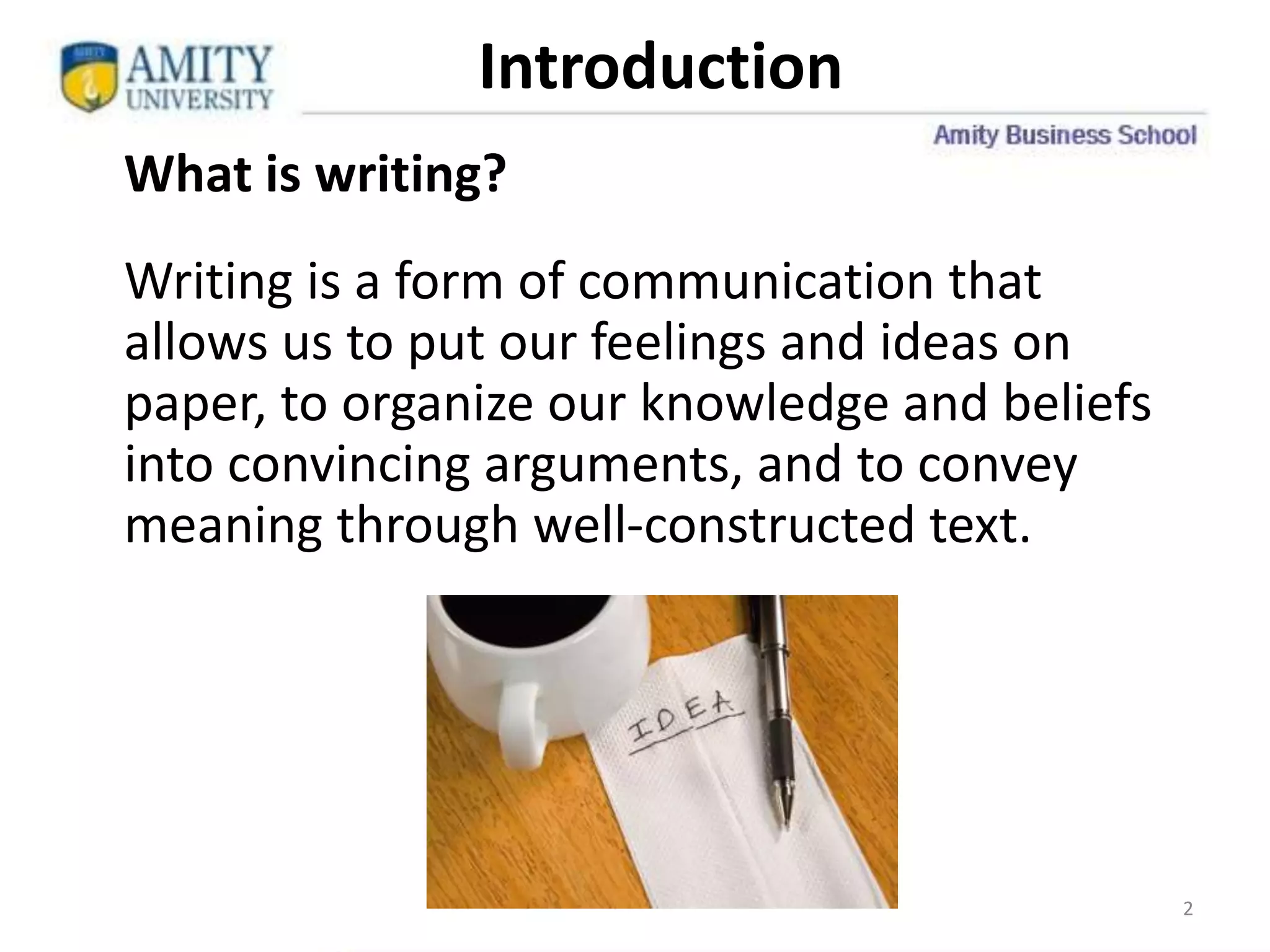
What is writing?
Writing is a form of communication that
allows us to put our feelings and ideas on
paper, to organize our knowledge and beliefs
into convincing arguments, and to convey
meaning through well-constructed text.
3
• Writing skills are an important part of
communication.
• Good writing skills allow you to communicate
your message with clarity and ease.
• The communication takes place to a far larger
audience than through face-to-face or
telephone conversations.
Why Writing?
• Creates a permanent record.
• Allows you to store information for future
reference.
• Easily distributed.
• All recipients receive the same information.
• Necessary for legal and binding
documentation.
4
Questions a Writer Asks
• How do I begin?
• What is my purpose?
• How do I make my point clear?
• How do I create a logical flow?
• How do I avoid grammatical errors?
• How can I make my message brief?
• How can I create a visual effect?
5
Types of Writing
A writer’s style is a reflection of his/her
personality, unique voice, and way of
approaching the audience and readers.
There are four general purposes that lead
someone to write a piece, and these are
known as the four styles, or types, of writing.
6
1. Informative
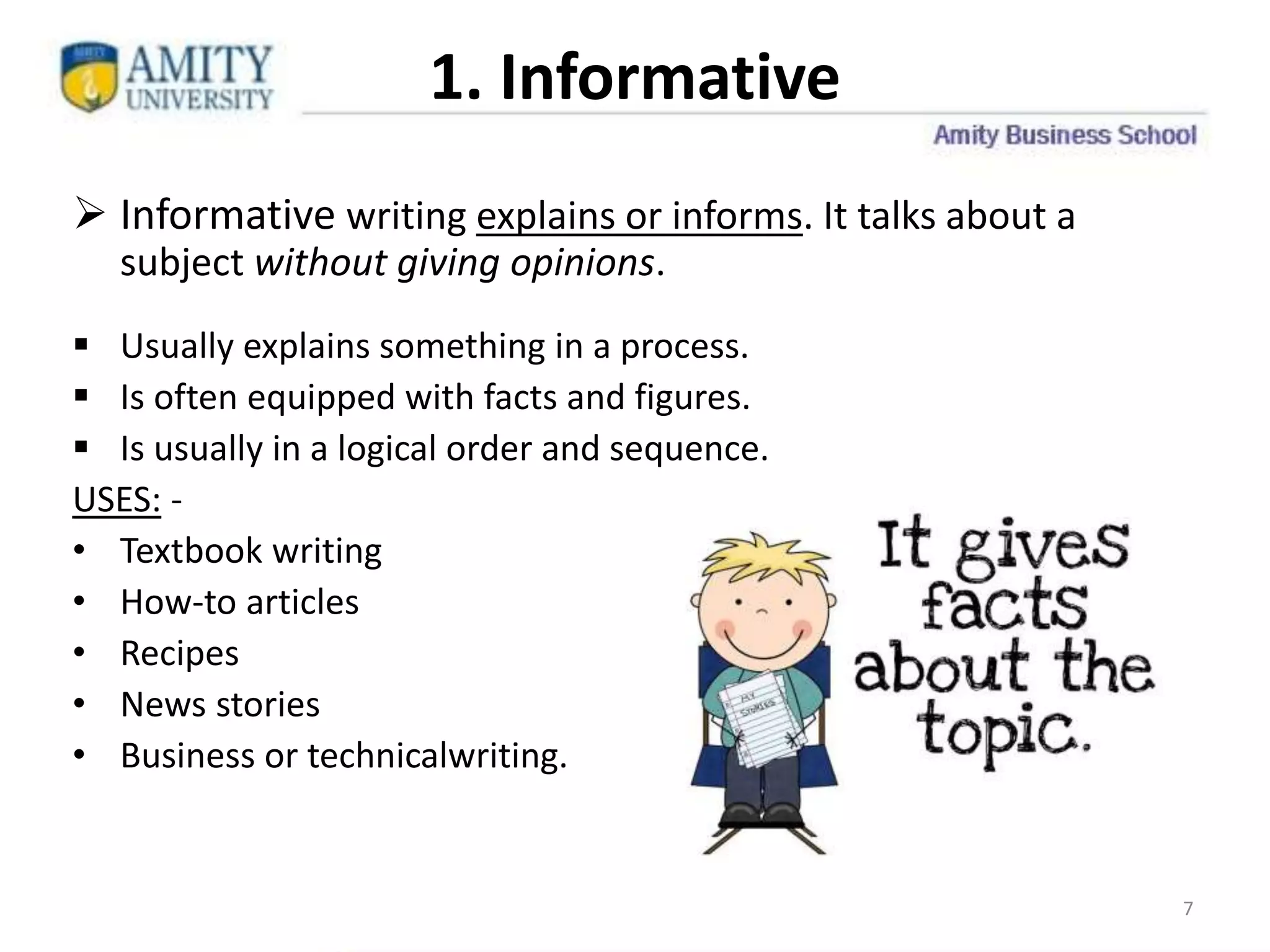
 Informative writing explains or informs. It talks about a
subject without giving opinions.
 Usually explains something in a process.
 Is often equipped with facts and figures.
 Is usually in a logical order and sequence.
USES: -
• Textbook writing
• How-to articles
• Recipes
• News stories
• Business or technicalwriting.
7
2. Descriptive
 Descriptive writing focuses on communicating the details of a
character, event, or place.
 It is often poetic in nature
 It describes places, people, events, situations, or locations in a
highly-detailed manner.
 The author visualizes what he/she sees, hears, tastes, smells, and
feels.
USES:-
• Poetry
• Journal or diary writing
• Nature writing
• Descriptive passages in fiction
8
3. Persuasive
 Persuasive writing tries to bring other people around to your
point of view.
 Equipped with reasons, arguments, and justifications.
 Author takes a stand and asks you to agree with his point of view.
 Asks for readers to do something about the situation (this is called a
call-to-action).
USES:-
• Opinion and editorial newspaper pieces.
• Advertisements.
• Reviews (of books, music, movie etc.)
• Letter of recommendation.
• Letter of complaint.
• Cover letters
9
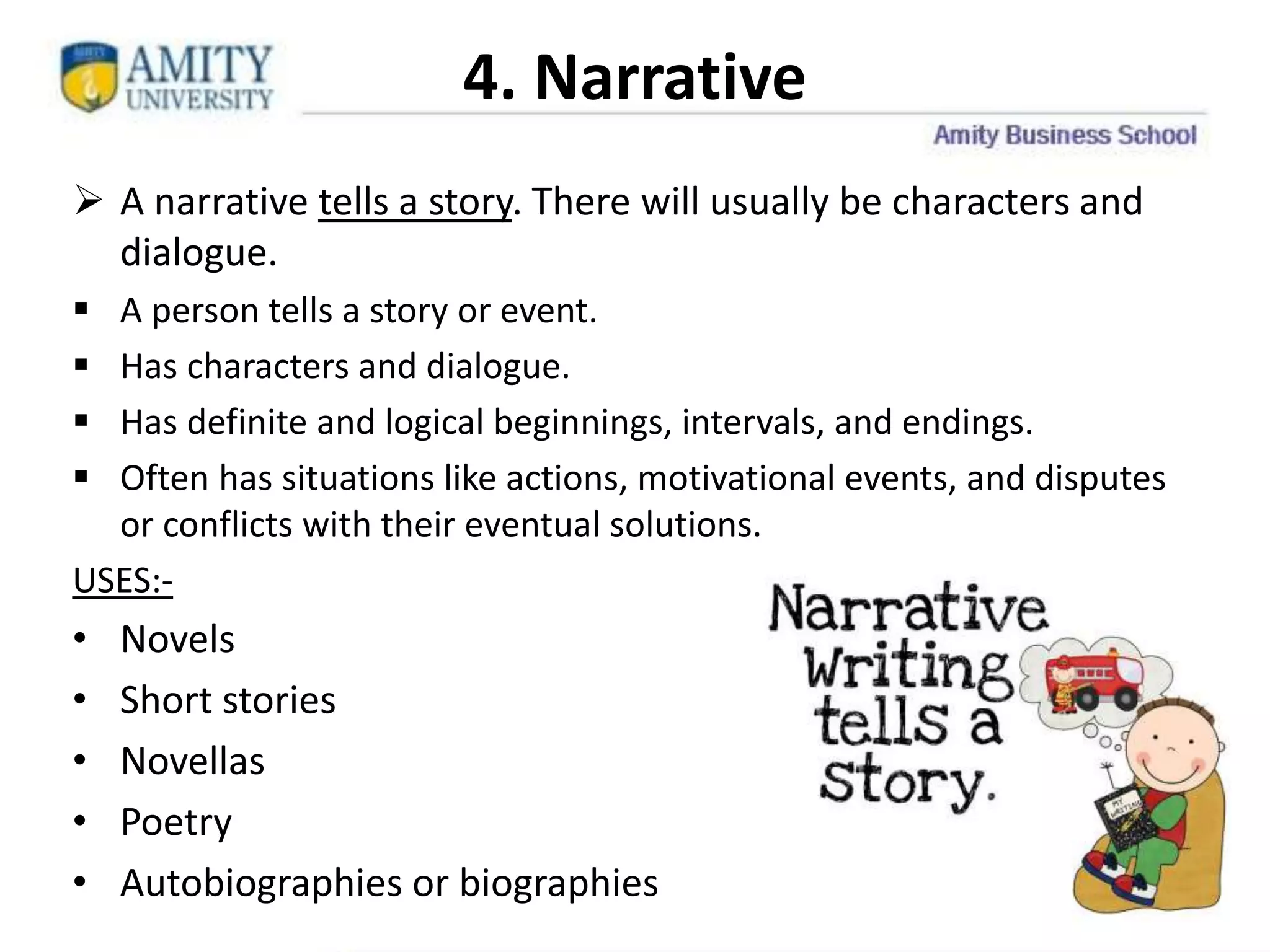
4. Narrative
 A narrative tells a story. There will usually be characters and
dialogue.
 A person tells a story or event.
 Has characters and dialogue.
 Has definite and logical beginnings, intervals, and endings.
 Often has situations like actions, motivational events, and disputes
or conflicts with their eventual solutions.
USES:-
• Novels
• Short stories
• Novellas
• Poetry
• Autobiographies or biographies 10
Audience and Format
• The first step to writing is choosing the
appropriate format.
• The format, as well as the audience, defines
the writing voice i.e., how formal or relaxed
the tone should be.
• With everything one writes, the readers/
recipients, should be able to define the tone
as well as aspects of the content.
11
Composition and Style
• Start with your audience- The reader should
be introduced with the subject.
• Create an outline- Outlines help to identify
which steps to take in which order.
• Use AIDA- Follow the AIDA formula. These
steps can help in the writing
process.
12
• Try some empathy- One should remember the
audience's needs at all times.
• Use the rhetorical triangle- One should make
sure that one communicates why people
should listen , the message should engage the
audience.
13
Structure
• The document should be as reader friendly as
possible
• Use headings, subheadings, bullet points, and
numbering whenever possible to break up the
text.
• Adding graphs and charts is also a smart way
to break up your text.
• Using questions is a good idea, questions help
keep the reader engaged and curious.
14
Grammatical Errors
• It's essential to learn grammar properly, and to
avoid common mistakes that the spell checker
won't find (ex; “affect” instead of “effect”).
• Everything that one writes should be of a
quality that every reader will find acceptable.
15
Proofing
• Proof your headers and sub headers – People
often skip these and focus on the text alone.
Just because headers are big and bold doesn't
mean they're error free!
• Read the document out loud –This way one is
more likely to catch mistakes.
16
• Use your finger to follow text as you read –
This is another trick that helps slow down.
• Start at the end of your document – Proofread
from the end to the beginning. This helps
focusing on errors, not on content.
17
Uses of Writing Skills
Write a report.
Plan or strategy at work.
Write a grant application.
Share experiences/views online.
Communicating through E-mails.
Preparing a well written CV or résumé.
18
Developing Writing Skills
Think About Your Readers' Needs.
Remember Basic Rules for Good Written
English.
Write Regularly to Develop Confidence and
Quality.
Have a Structure for Drafting and Re-Drafting.
Get Feedback on Your Writing and Use It.
19
Conclusion
• It's important to know how to communicate a
point quickly and professionally.
• Many people spend a lot of time writing and
reading, so the better writer one is, the more
successful he is likely to be.
• Identify the audience before even starting to
create the document.
20
• If one feels that there's too much information
to include, an outline should be created to
outline the thoughts.
• Learning grammatical and stylistic techniques
will also help in writing more clearly.
• Lastly, one should be sure to proof read the
document before sending it.
21
THANKYOU
22

Writing skills

  • 1.
    WRITING SKILLS Business Communication PRESENTEDBY:- ROHLUPUII RALTE (B03) CHARU SANCHETI (B04) APEE SINGH (B09) HIMANSHI DUA (B10) ZISHAN ALI (B27) FACULTY’S NAME:- DR. SHWETA AWASTHI
  • 2.
    Introduction 2 What is writing? Writingis a form of communication that allows us to put our feelings and ideas on paper, to organize our knowledge and beliefs into convincing arguments, and to convey meaning through well-constructed text.
  • 3.
    3 • Writing skillsare an important part of communication. • Good writing skills allow you to communicate your message with clarity and ease. • The communication takes place to a far larger audience than through face-to-face or telephone conversations.
  • 4.
    Why Writing? • Createsa permanent record. • Allows you to store information for future reference. • Easily distributed. • All recipients receive the same information. • Necessary for legal and binding documentation. 4
  • 5.
    Questions a WriterAsks • How do I begin? • What is my purpose? • How do I make my point clear? • How do I create a logical flow? • How do I avoid grammatical errors? • How can I make my message brief? • How can I create a visual effect? 5
  • 6.
    Types of Writing Awriter’s style is a reflection of his/her personality, unique voice, and way of approaching the audience and readers. There are four general purposes that lead someone to write a piece, and these are known as the four styles, or types, of writing. 6
  • 7.
    1. Informative  Informativewriting explains or informs. It talks about a subject without giving opinions.  Usually explains something in a process.  Is often equipped with facts and figures.  Is usually in a logical order and sequence. USES: - • Textbook writing • How-to articles • Recipes • News stories • Business or technicalwriting. 7
  • 8.
    2. Descriptive  Descriptivewriting focuses on communicating the details of a character, event, or place.  It is often poetic in nature  It describes places, people, events, situations, or locations in a highly-detailed manner.  The author visualizes what he/she sees, hears, tastes, smells, and feels. USES:- • Poetry • Journal or diary writing • Nature writing • Descriptive passages in fiction 8
  • 9.
    3. Persuasive  Persuasivewriting tries to bring other people around to your point of view.  Equipped with reasons, arguments, and justifications.  Author takes a stand and asks you to agree with his point of view.  Asks for readers to do something about the situation (this is called a call-to-action). USES:- • Opinion and editorial newspaper pieces. • Advertisements. • Reviews (of books, music, movie etc.) • Letter of recommendation. • Letter of complaint. • Cover letters 9
  • 10.
    4. Narrative  Anarrative tells a story. There will usually be characters and dialogue.  A person tells a story or event.  Has characters and dialogue.  Has definite and logical beginnings, intervals, and endings.  Often has situations like actions, motivational events, and disputes or conflicts with their eventual solutions. USES:- • Novels • Short stories • Novellas • Poetry • Autobiographies or biographies 10
  • 11.
    Audience and Format •The first step to writing is choosing the appropriate format. • The format, as well as the audience, defines the writing voice i.e., how formal or relaxed the tone should be. • With everything one writes, the readers/ recipients, should be able to define the tone as well as aspects of the content. 11
  • 12.
    Composition and Style •Start with your audience- The reader should be introduced with the subject. • Create an outline- Outlines help to identify which steps to take in which order. • Use AIDA- Follow the AIDA formula. These steps can help in the writing process. 12
  • 13.
    • Try someempathy- One should remember the audience's needs at all times. • Use the rhetorical triangle- One should make sure that one communicates why people should listen , the message should engage the audience. 13
  • 14.
    Structure • The documentshould be as reader friendly as possible • Use headings, subheadings, bullet points, and numbering whenever possible to break up the text. • Adding graphs and charts is also a smart way to break up your text. • Using questions is a good idea, questions help keep the reader engaged and curious. 14
  • 15.
    Grammatical Errors • It'sessential to learn grammar properly, and to avoid common mistakes that the spell checker won't find (ex; “affect” instead of “effect”). • Everything that one writes should be of a quality that every reader will find acceptable. 15
  • 16.
    Proofing • Proof yourheaders and sub headers – People often skip these and focus on the text alone. Just because headers are big and bold doesn't mean they're error free! • Read the document out loud –This way one is more likely to catch mistakes. 16
  • 17.
    • Use yourfinger to follow text as you read – This is another trick that helps slow down. • Start at the end of your document – Proofread from the end to the beginning. This helps focusing on errors, not on content. 17
  • 18.
    Uses of WritingSkills Write a report. Plan or strategy at work. Write a grant application. Share experiences/views online. Communicating through E-mails. Preparing a well written CV or résumé. 18
  • 19.
    Developing Writing Skills ThinkAbout Your Readers' Needs. Remember Basic Rules for Good Written English. Write Regularly to Develop Confidence and Quality. Have a Structure for Drafting and Re-Drafting. Get Feedback on Your Writing and Use It. 19
  • 20.
    Conclusion • It's importantto know how to communicate a point quickly and professionally. • Many people spend a lot of time writing and reading, so the better writer one is, the more successful he is likely to be. • Identify the audience before even starting to create the document. 20
  • 21.
    • If onefeels that there's too much information to include, an outline should be created to outline the thoughts. • Learning grammatical and stylistic techniques will also help in writing more clearly. • Lastly, one should be sure to proof read the document before sending it. 21
  • 22.

Editor's Notes

  • #6 One who can answer these questions, can write well.
  • #12 These are the steps to writing..