Grade 11
General
Mathematics
CHAPTER LESSON
6
Simple and
Compound
Interest
24 Simple Interest
25 Compound Interest
26 Compounding more than once a year
27 Finding interest rate and time in compound interest
7 Annuities
28 Simple Annuity
29 General Annuity
30 Deferred Annuity
8
Stocks and
Bonds
31 Stocks and Bonds
32 Market Indices and Stocks and Bonds
33 Theory of Efficient Market
9
Basic Concepts of
Laons
34 Business and Consumer Loans
35 Solving Problems on Business and Consumer Loans
10 Logic
36 Propositions
37 Logical Operations
38 Truth Table
39 Logical Equivalence and Conditional Propositions
40 Valid Arguments and Fallacies
41 Methods of Proof
8 Stocks and
Bonds
31 Stocks and Bonds
CHAPTER 8
STOCKS AND
BONDS
LESSON 31
STOCKS AND
BOND
At the end of the lesson, the
learner is able to illustrate
stocks and bonds and
distinguish between stocks
and bonds.
Definition of Terms
Stocks –
share in the ownership of a
company.
Definition of Terms
Stocks –
a form of equity financing or
raising money by allowing
investors to be part owners of
the company.
Definition of Terms
Bond –
a form of debt financing or
raising money by borrowing
from investors.
Comparison
Stock – vary everyday. These
prices are reported in various
media.
Bond – investors are guaranteed
interest payments and a return of
their money at the maturity date.
Comparison
Stock – higher risk but with the
possibility of higher returns.
Bond – lower risk but lower
returns.
Comparison
Stock – investors can earn if the stock
prices increase, or they can lose
money if the stock prices decrease or
worse, if the company goes bankrupt.
Bond – investors need to consider
the borrower’s credit rating.
Comparison
Stock – appropriate for long term (10
years or more) to allow investors to wait for
stock prices to increase if ever they go low.
Bond – appropriate for retirees because
of the guaranteed fixed income, or those
who need the money soon because they
cannot afford to take a chance at the stock
market.
Definition of Terms in relation to
Stocks:
Stock – share in the ownership of a
company.
Dividend – share in the company’s
profit.
Definition of Terms in relation to
Stocks:
Stock – share in the ownership of a
company.
Dividend Per Share – ratio of the
dividends to the number of shares
Definition of Terms in relation to
Stocks:
Dividend Per Share – ratio of the
dividends to the number of shares.
Stock Market – a place where stocks
can be bought or sold, governed by
the Philippine Stock Exchange (PSE).
Definition of Terms
Market Value –
the current price of a stock at
which it can be sold.
Definition of Terms
Stock/Current Yield Ratio –
ratio of the annual dividend
per share and the market
value per share.
Definition of Terms
Par Value –
the per share amount as stated
on the company certificate.
Unlike market value, it is
determined by the company and
remains stable over time.
LETS PRACTICE!
Sample Problem # 1
A certain corporation declared a
₱40,000,000 dividend for common
stocks. If there are a total of 900,000
shares of common stock, how much is
the dividend per share?
Dividend Per Share
= ₱40,000,000 / 900,000
= ₱44.44
Sample Problem # 2
A financial institution declared a dividend
of P75,000,000 for its common stock.
Suppose there are 900,000 shares of
common stock, how much is the dividend
per share?
Dividend Per Share
= ₱75,000,000 / 900,000
= ₱83.33
Sample Problem # 3
A certain corporation declared a 3%
dividend on a stock with a par value of
₱500. How much dividend did a
stockholder receive if he/she owns 200
shares of stock?
Dividend = (0.03)(500)(200)
= ₱3,000
Sample Problem # 4
Corporation A, with a current market
value of ₱52, gave a dividend of ₱8 per
share for its common stock. Corporation
B, with a current market value of ₱95,
gave a dividend of ₱12 per share. Use
the stock yield ratio to measure how
much dividends shareholders are getting
in relation to the amount invested.
Corporation A:
Stock Yield Ratio = 8 / 52
= 0.1538
= 15.38%
Corporation B:
Stock Yield Ratio = 12/95
= 0.1263
= 12.63%
Sample Problem # 5
The ABC corporation gave out P38
dividend per share for its common stock.
The market value of the stock is P108.
Determine the stock yield ratio.
Stock Yield Ratio = 38 / 108
= 0.35
Sample Problem # 6
A bank declared a dividend of P27 per
share for the common stock. If the
common stock closes at P93, how large
is the stock yield ratio on this investment?
Stock Yield Ratio = 27 / 93
= 0.29
Definition of Terms
in Relation to Bonds:
Bond – interest-bearing security which
promises to pay a stated money on the
maturity date, and a regular interest
payment.
Coupons – periodic interest payment,
usually semi-annually, that the bondholder
receives during the time between purchase
date and maturity date.
Definition of Terms
in Relation to Bonds:
Coupon Rate (r) – the rate per
coupon payment period.
Price of a Bond (P) – the price of the
bond at purchase time.
Definition of Terms
in Relation to Bonds:
Term of a Bond – fixed period of time (in
years) at which the bond is redeemable as
stated in the bond certificate; number of
years from time of purchase to maturity
date.
Fair Price of a Bond –present value of all
cash inflows to the bondholder.
Definition of Terms
in Relation to Bonds:
Par Value or Face Value (F) – the
amount payable on the maturity date.
If P = F, the bond is purchased at par.
If P < F, the bond is purchased at a discount.
If P > F, the bond is purchased at premium.
Sample Problem # 7
Determine the amount of the semi-annual
coupon for a bond with a face value of
P300,000 that pays 10%, payable semi-
annually for its coupons.
Annual coupon amount:
= 300,000(0.10)
= 30,000
Semi-annual coupon amount:
= 30,00 (1/2)
= 15,000
Sample Problem # 8
Suppose that a bond has a face value of
P100,000 and its maturity date is 10
years from now. The coupon rate is 5%
payable semi-annually. Find the fair price
of this bond, assuming that the annual
market rate is 4%.
Given:
Coupon rate r =5%, payable semi-annually
Face Value = 100,000
Time to maturity = 10 years
Number of periods = 2(10) = 20
Market rate = 4%
Amount of semi-annual coupon:
= 100,000 (0.5/2)
= 2,500
The bondholder receives 20 payments of
P2,500 each, and P100,000 at t = 10.
Present value of P100,000:
P = 67,556.42
P =
𝐹
1+𝑗 𝑛
P =
100,000
1+0.04 10
Present value of 20 payments of P2,500 each:
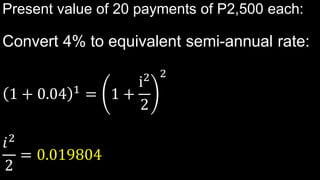
Convert 4% to equivalent semi-annual rate:
1 + 0.04 1
= 1 +
ⅈ2
2
2
𝑖2
2
= 0.019804
Present value of 20 payments of P2,500 each:
Convert 4% to equivalent semi-annual rate:
1 + 0.04 1
= 1 +
ⅈ2
2
2
𝑖2
2
= 0.019804
P= 𝑅
1− 1+𝑗 −𝑛
𝑗
𝑝 = 25001
1 − 1 + 0.019804 −20
0.019804
P = 40,956.01
Price = 67,556.42+40,956.01= 108,512.43
Please Answer
Worksheet # 31
See You Again Next
Time For Another
Exciting And Fun
Learning Experience!

Lesson-31.pdf

  • 1.
  • 2.
    CHAPTER LESSON 6 Simple and Compound Interest 24Simple Interest 25 Compound Interest 26 Compounding more than once a year 27 Finding interest rate and time in compound interest 7 Annuities 28 Simple Annuity 29 General Annuity 30 Deferred Annuity 8 Stocks and Bonds 31 Stocks and Bonds 32 Market Indices and Stocks and Bonds 33 Theory of Efficient Market 9 Basic Concepts of Laons 34 Business and Consumer Loans 35 Solving Problems on Business and Consumer Loans 10 Logic 36 Propositions 37 Logical Operations 38 Truth Table 39 Logical Equivalence and Conditional Propositions 40 Valid Arguments and Fallacies 41 Methods of Proof 8 Stocks and Bonds 31 Stocks and Bonds
  • 3.
  • 4.
  • 5.
    At the endof the lesson, the learner is able to illustrate stocks and bonds and distinguish between stocks and bonds.
  • 6.
    Definition of Terms Stocks– share in the ownership of a company.
  • 7.
    Definition of Terms Stocks– a form of equity financing or raising money by allowing investors to be part owners of the company.
  • 8.
    Definition of Terms Bond– a form of debt financing or raising money by borrowing from investors.
  • 9.
    Comparison Stock – varyeveryday. These prices are reported in various media. Bond – investors are guaranteed interest payments and a return of their money at the maturity date.
  • 10.
    Comparison Stock – higherrisk but with the possibility of higher returns. Bond – lower risk but lower returns.
  • 11.
    Comparison Stock – investorscan earn if the stock prices increase, or they can lose money if the stock prices decrease or worse, if the company goes bankrupt. Bond – investors need to consider the borrower’s credit rating.
  • 12.
    Comparison Stock – appropriatefor long term (10 years or more) to allow investors to wait for stock prices to increase if ever they go low. Bond – appropriate for retirees because of the guaranteed fixed income, or those who need the money soon because they cannot afford to take a chance at the stock market.
  • 13.
    Definition of Termsin relation to Stocks: Stock – share in the ownership of a company. Dividend – share in the company’s profit.
  • 14.
    Definition of Termsin relation to Stocks: Stock – share in the ownership of a company. Dividend Per Share – ratio of the dividends to the number of shares
  • 15.
    Definition of Termsin relation to Stocks: Dividend Per Share – ratio of the dividends to the number of shares. Stock Market – a place where stocks can be bought or sold, governed by the Philippine Stock Exchange (PSE).
  • 16.
    Definition of Terms MarketValue – the current price of a stock at which it can be sold.
  • 17.
    Definition of Terms Stock/CurrentYield Ratio – ratio of the annual dividend per share and the market value per share.
  • 18.
    Definition of Terms ParValue – the per share amount as stated on the company certificate. Unlike market value, it is determined by the company and remains stable over time.
  • 19.
  • 20.
  • 21.
    A certain corporationdeclared a ₱40,000,000 dividend for common stocks. If there are a total of 900,000 shares of common stock, how much is the dividend per share? Dividend Per Share = ₱40,000,000 / 900,000 = ₱44.44
  • 22.
  • 23.
    A financial institutiondeclared a dividend of P75,000,000 for its common stock. Suppose there are 900,000 shares of common stock, how much is the dividend per share? Dividend Per Share = ₱75,000,000 / 900,000 = ₱83.33
  • 24.
  • 25.
    A certain corporationdeclared a 3% dividend on a stock with a par value of ₱500. How much dividend did a stockholder receive if he/she owns 200 shares of stock? Dividend = (0.03)(500)(200) = ₱3,000
  • 26.
  • 27.
    Corporation A, witha current market value of ₱52, gave a dividend of ₱8 per share for its common stock. Corporation B, with a current market value of ₱95, gave a dividend of ₱12 per share. Use the stock yield ratio to measure how much dividends shareholders are getting in relation to the amount invested.
  • 28.
    Corporation A: Stock YieldRatio = 8 / 52 = 0.1538 = 15.38% Corporation B: Stock Yield Ratio = 12/95 = 0.1263 = 12.63%
  • 29.
  • 30.
    The ABC corporationgave out P38 dividend per share for its common stock. The market value of the stock is P108. Determine the stock yield ratio. Stock Yield Ratio = 38 / 108 = 0.35
  • 31.
  • 32.
    A bank declareda dividend of P27 per share for the common stock. If the common stock closes at P93, how large is the stock yield ratio on this investment? Stock Yield Ratio = 27 / 93 = 0.29
  • 33.
    Definition of Terms inRelation to Bonds: Bond – interest-bearing security which promises to pay a stated money on the maturity date, and a regular interest payment. Coupons – periodic interest payment, usually semi-annually, that the bondholder receives during the time between purchase date and maturity date.
  • 34.
    Definition of Terms inRelation to Bonds: Coupon Rate (r) – the rate per coupon payment period. Price of a Bond (P) – the price of the bond at purchase time.
  • 35.
    Definition of Terms inRelation to Bonds: Term of a Bond – fixed period of time (in years) at which the bond is redeemable as stated in the bond certificate; number of years from time of purchase to maturity date. Fair Price of a Bond –present value of all cash inflows to the bondholder.
  • 36.
    Definition of Terms inRelation to Bonds: Par Value or Face Value (F) – the amount payable on the maturity date. If P = F, the bond is purchased at par. If P < F, the bond is purchased at a discount. If P > F, the bond is purchased at premium.
  • 37.
  • 38.
    Determine the amountof the semi-annual coupon for a bond with a face value of P300,000 that pays 10%, payable semi- annually for its coupons.
  • 39.
    Annual coupon amount: =300,000(0.10) = 30,000 Semi-annual coupon amount: = 30,00 (1/2) = 15,000
  • 40.
  • 41.
    Suppose that abond has a face value of P100,000 and its maturity date is 10 years from now. The coupon rate is 5% payable semi-annually. Find the fair price of this bond, assuming that the annual market rate is 4%.
  • 42.
    Given: Coupon rate r=5%, payable semi-annually Face Value = 100,000 Time to maturity = 10 years Number of periods = 2(10) = 20 Market rate = 4%
  • 43.
    Amount of semi-annualcoupon: = 100,000 (0.5/2) = 2,500 The bondholder receives 20 payments of P2,500 each, and P100,000 at t = 10.
  • 44.
    Present value ofP100,000: P = 67,556.42 P = 𝐹 1+𝑗 𝑛 P = 100,000 1+0.04 10
  • 45.
    Present value of20 payments of P2,500 each: Convert 4% to equivalent semi-annual rate: 1 + 0.04 1 = 1 + ⅈ2 2 2 𝑖2 2 = 0.019804
  • 46.
    Present value of20 payments of P2,500 each: Convert 4% to equivalent semi-annual rate: 1 + 0.04 1 = 1 + ⅈ2 2 2 𝑖2 2 = 0.019804
  • 47.
    P= 𝑅 1− 1+𝑗−𝑛 𝑗 𝑝 = 25001 1 − 1 + 0.019804 −20 0.019804 P = 40,956.01 Price = 67,556.42+40,956.01= 108,512.43
  • 48.
  • 49.
    See You AgainNext Time For Another Exciting And Fun Learning Experience!