Lesson 1
Stocks and Bonds
Objectives
At the end of this lesson, the learner should be able to
• accurately identify the characteristics of stocks and
bonds;
• accurately differentiate stocks from bonds; and
• correctly solve cost of shares and ownership
percentage.
Essential Questions
• What is the difference between a stock and a bond?
• What are the advantages and disadvantages of owning a
preferred stock? How about owning a common stock?
• How will you determine the ownership of individuals
given their contribution?
Warm Up!
Let’s have a brief introduction to stock and bonds by
watching the following short video.
(Click the link to access the video.)
Fidelity Investments. “Stock and Bonds 101 | Fidelity.”
YouTube video, 1:42, December 2015. Retrieved 20 May 2019
from https://bit.ly/2IiZqI4
Guide Questions
• How do stocks work?
• How do bonds work?
• How can you differentiate stocks and bonds?
Learn about It!
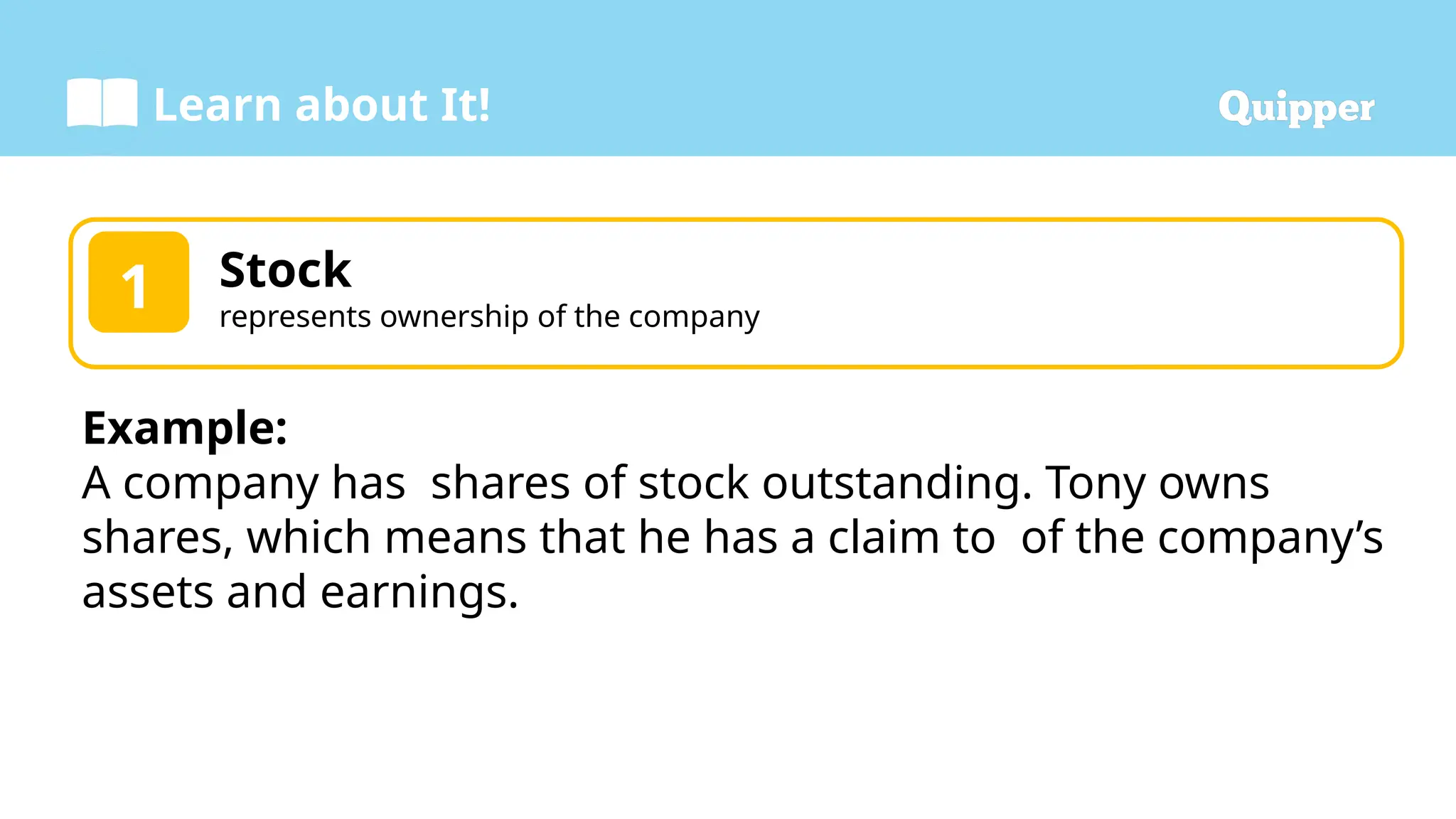
Stock
represents ownership of the company
1
Example:
A company has shares of stock outstanding. Tony owns
shares, which means that he has a claim to of the company’s
assets and earnings.
Learn about It!
Example:
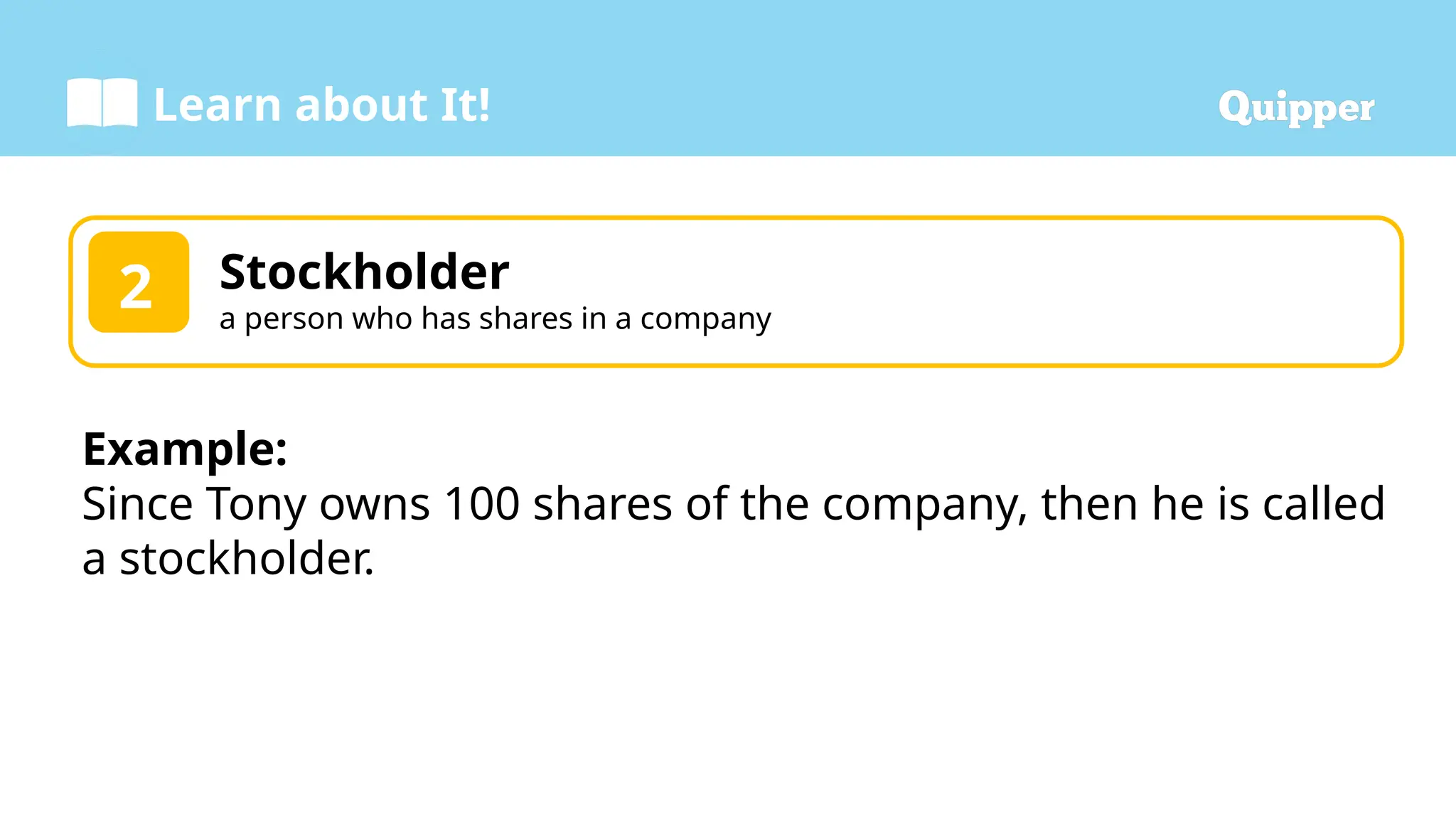
Since Tony owns 100 shares of the company, then he is called
a stockholder.
2 Stockholder
a person who has shares in a company
2
Learn about It!
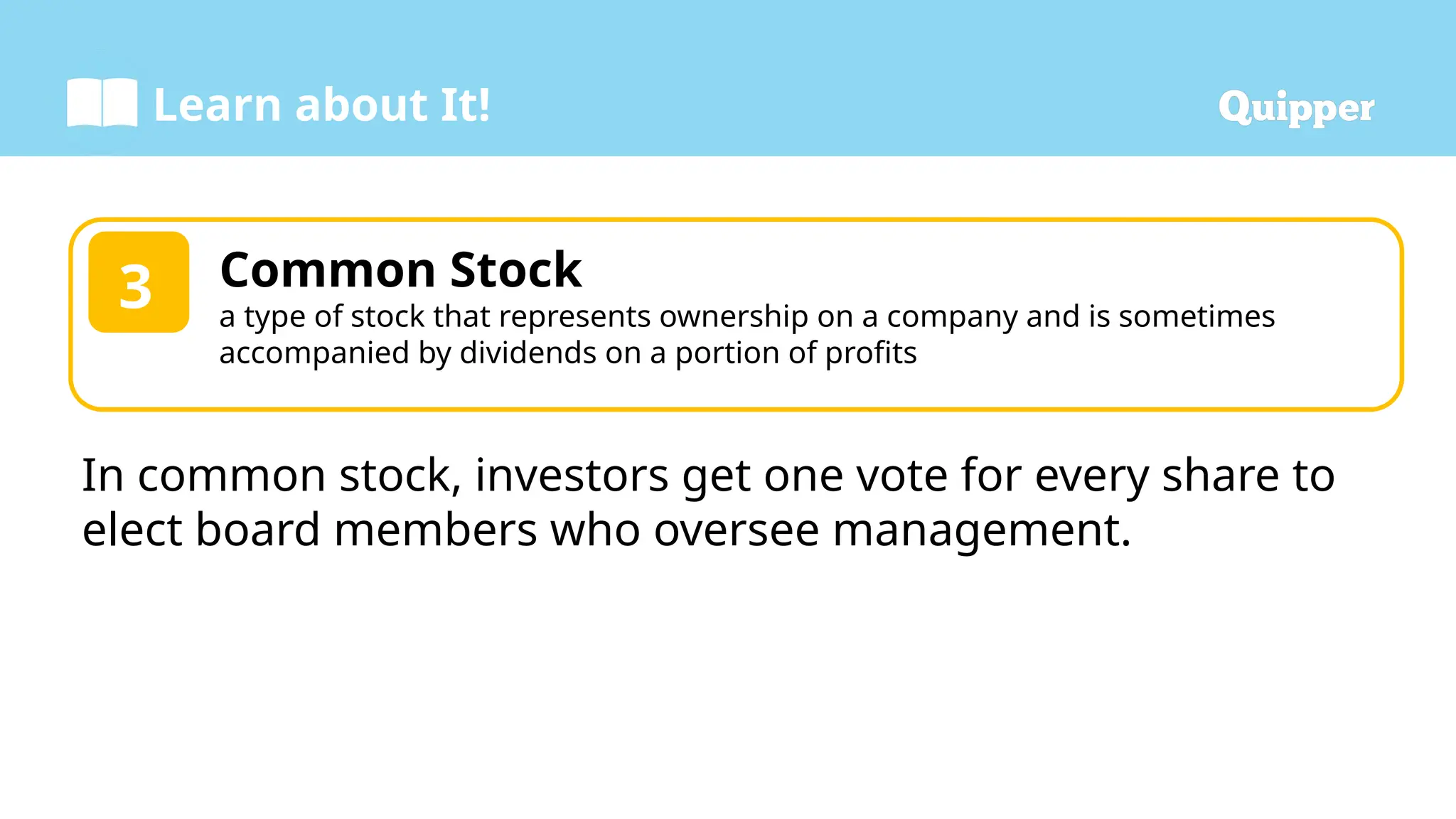
Common Stock
a type of stock that represents ownership on a company and is sometimes
accompanied by dividends on a portion of profits
3
In common stock, investors get one vote for every share to
elect board members who oversee management.
Learn about It!
Preferred Stock
a type of stock that represents ownership in a company but does not usually
come with voting rights
4
In preferred stock, investors are normally guaranteed
dividends as long as the investor holds ownership of shares.
In the event of liquidation, preferred shareholders are paid
off before the common shareholders.
Learn about It!
Bond
a debt financing instrument; it is interest-bearing security which promises to pay
an amount of money on certain maturity value as stated in the bond certificate
5
A stock represents fractional ownership of equity
in an organization. It is different from a bond,
which operates like a loan made by creditors to the
company in return for periodic payments.
Learn about It!
Government Bond
bond issued by governments to fund programs, deliver payrolls, and pay bills
6
There are times where the government issues bonds
publicly. They are sometimes referred to as “notes.”
Learn about It!
Corporate Bond
bond issued by businesses to help them pay expenses
7
Although these pose a higher risk than government bonds,
businesses still can earn a lot more in corporate bonds.
These bonds may be traded over-the-counter or privately
between the borrower and the lender.
Learn about It!
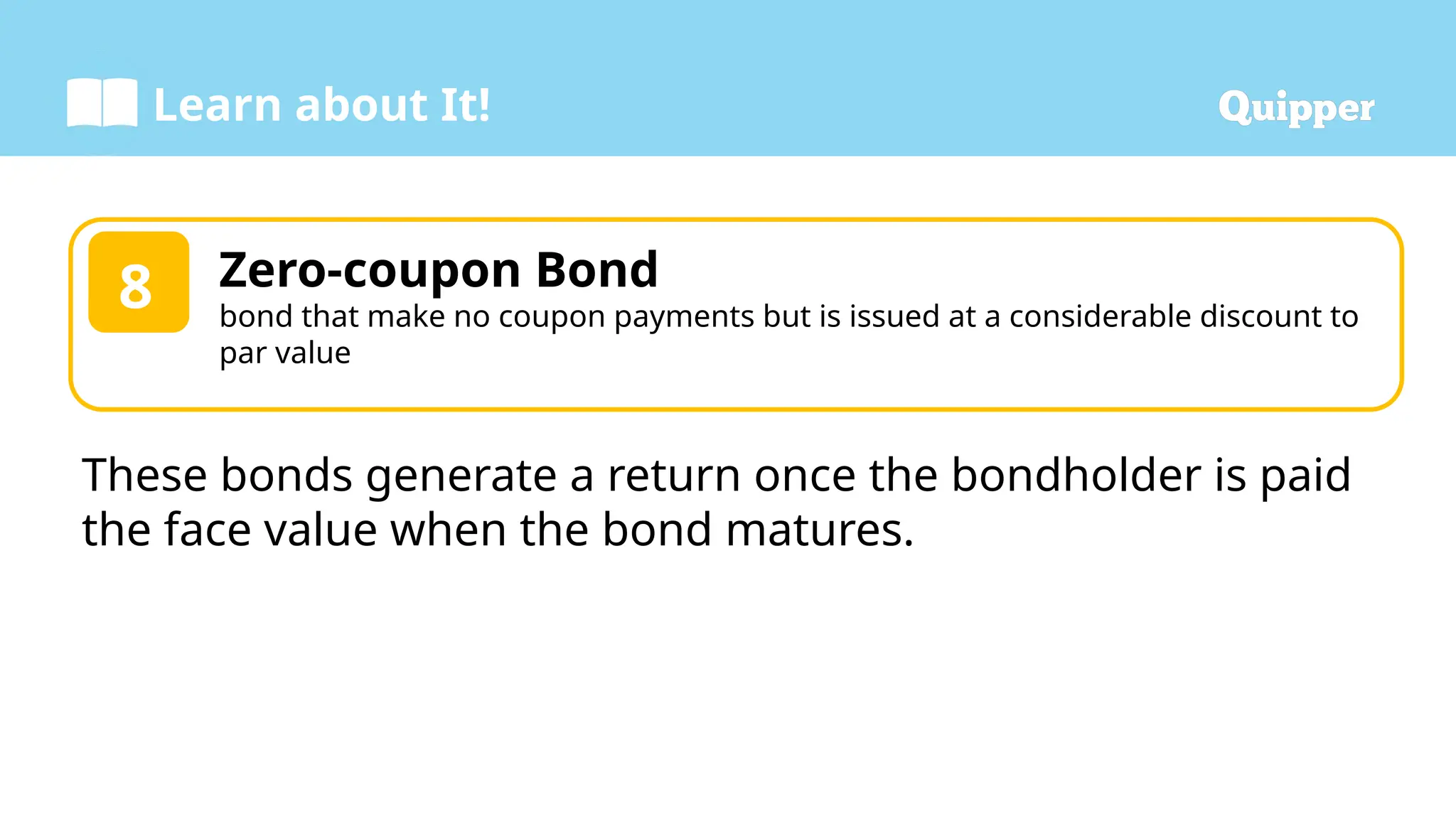
Zero-coupon Bond
bond that make no coupon payments but is issued at a considerable discount to
par value
8
These bonds generate a return once the bondholder is paid
the face value when the bond matures.
Try It!
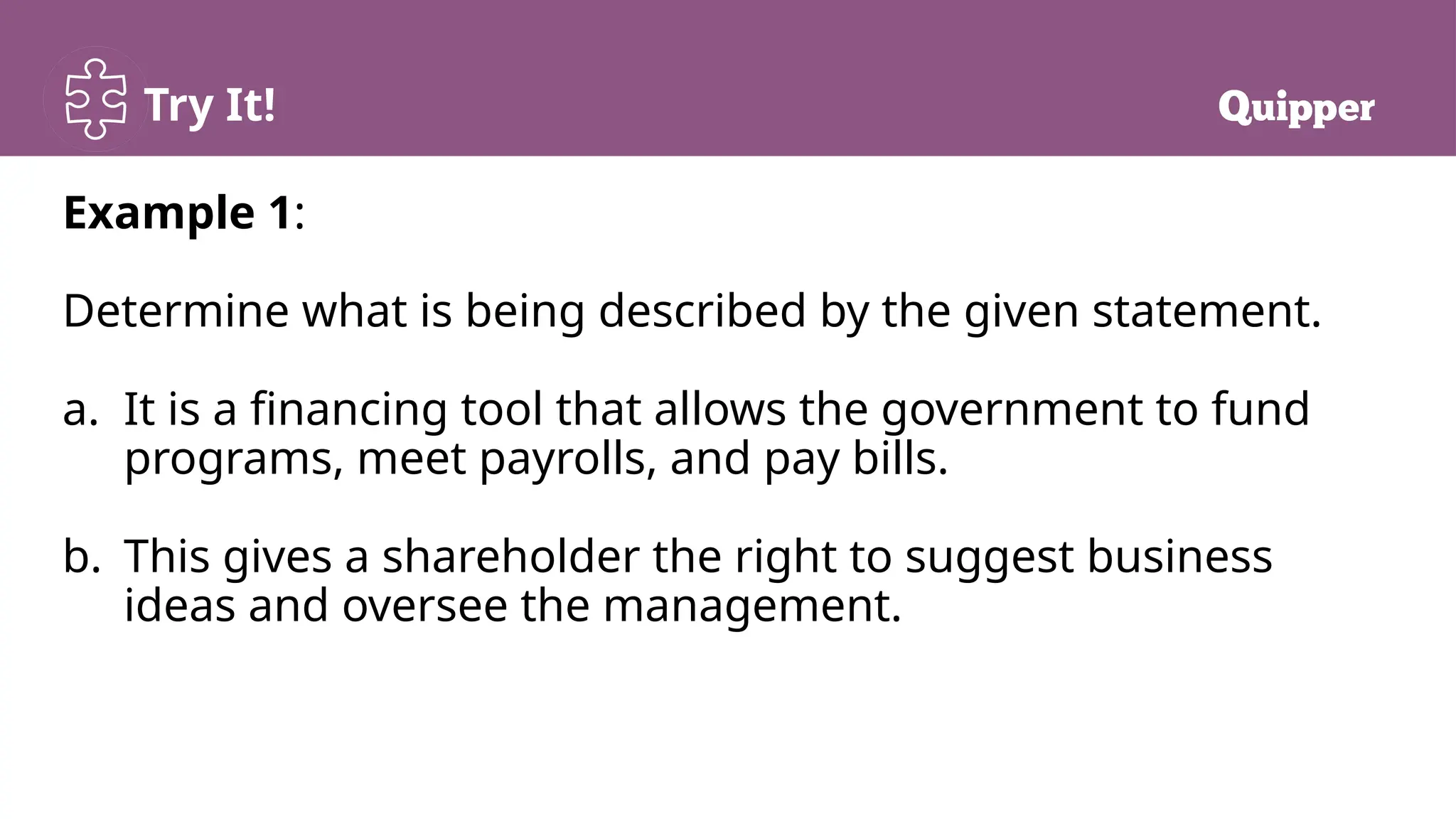
Example 1:
Determine what is being described by the given statement.
a. It is a financing tool that allows the government to fund
programs, meet payrolls, and pay bills.
b. This gives a shareholder the right to suggest business
ideas and oversee the management.
Try It!
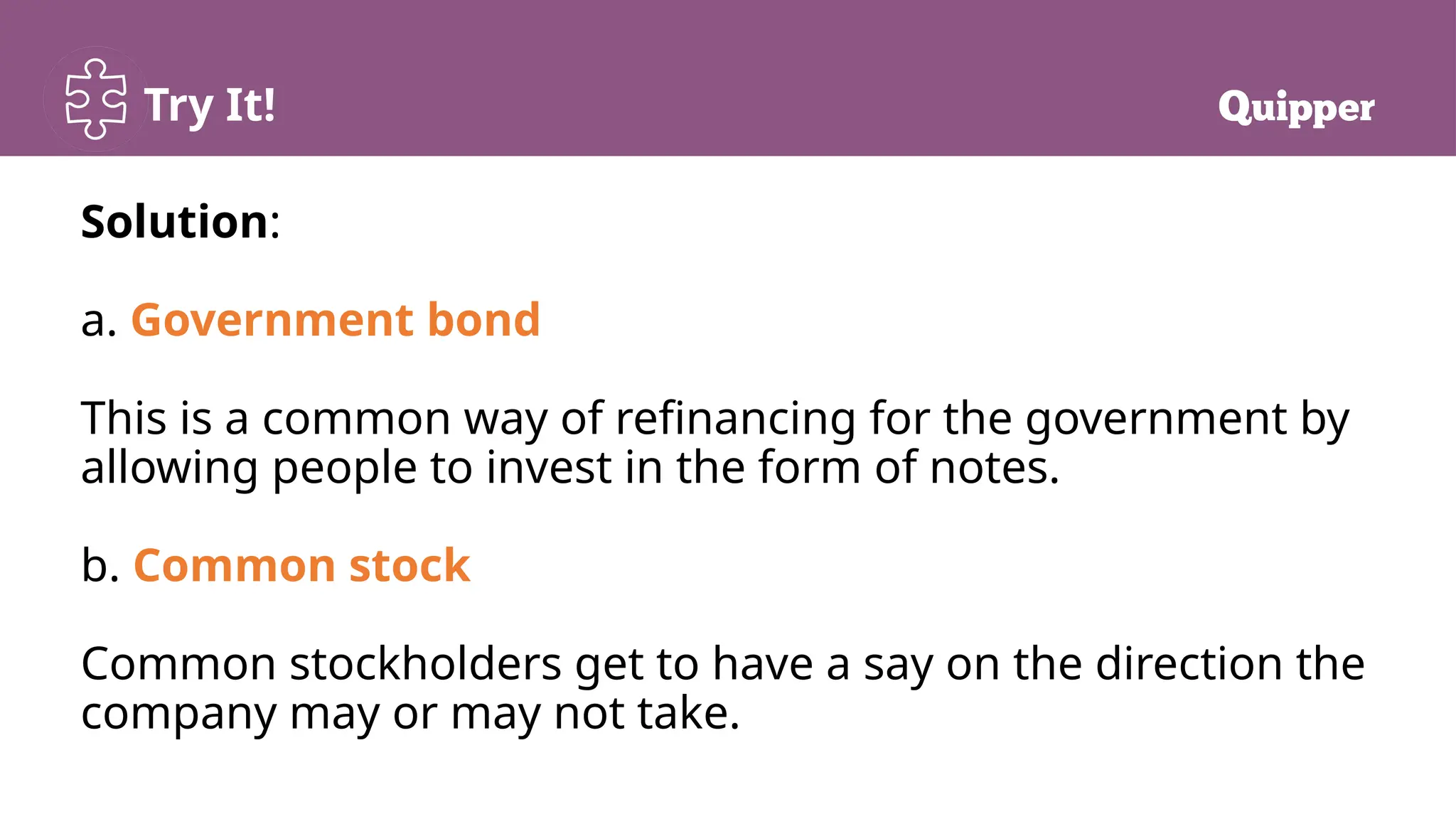
Solution:
a. Government bond
This is a common way of refinancing for the government by
allowing people to invest in the form of notes.
b. Common stock
Common stockholders get to have a say on the direction the
company may or may not take.
Try It!
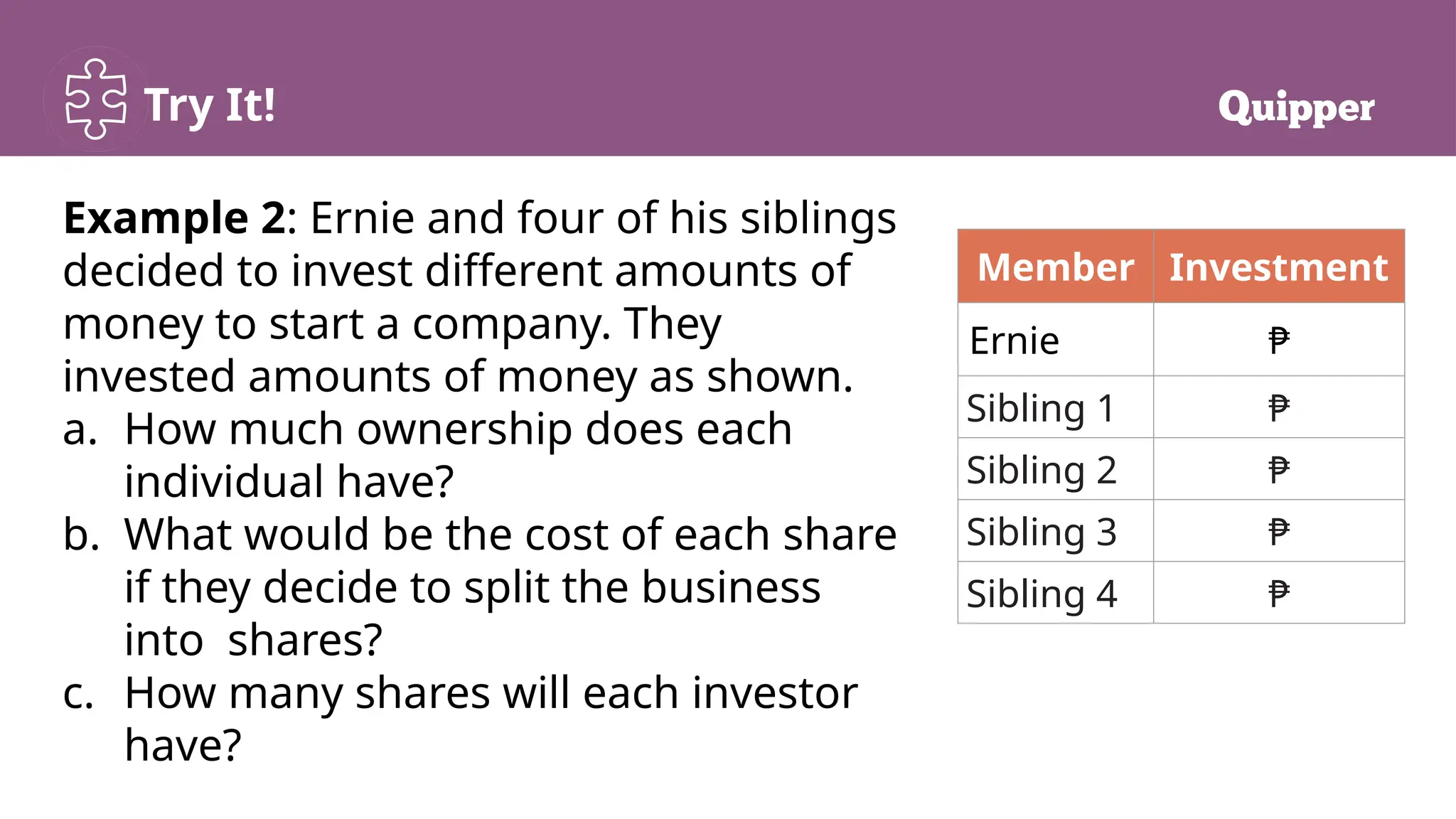
Example 2: Ernie and four of his siblings
decided to invest different amounts of
money to start a company. They
invested amounts of money as shown.
a. How much ownership does each
individual have?
b. What would be the cost of each share
if they decide to split the business
into shares?
c. How many shares will each investor
have?
Member Investment
Ernie ₱
Sibling 1 ₱
Sibling 2 ₱
Sibling 3 ₱
Sibling 4 ₱
Try It!
Solution:
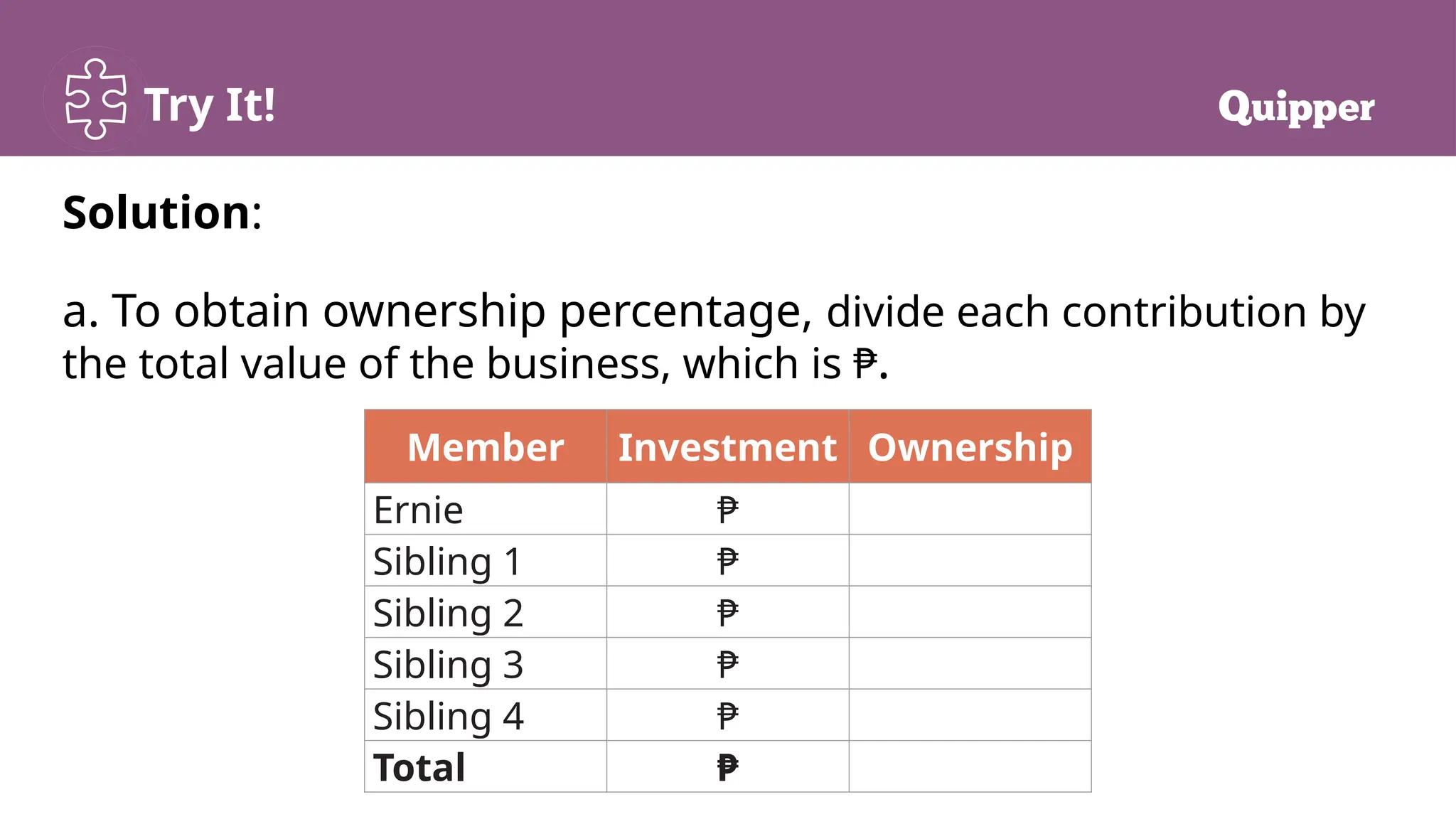
a. To obtain ownership percentage, divide each contribution by
the total value of the business, which is ₱.
Member Investment Ownership
Ernie ₱
Sibling 1 ₱
Sibling 2 ₱
Sibling 3 ₱
Sibling 4 ₱
Total ₱
Try It!
Solution:
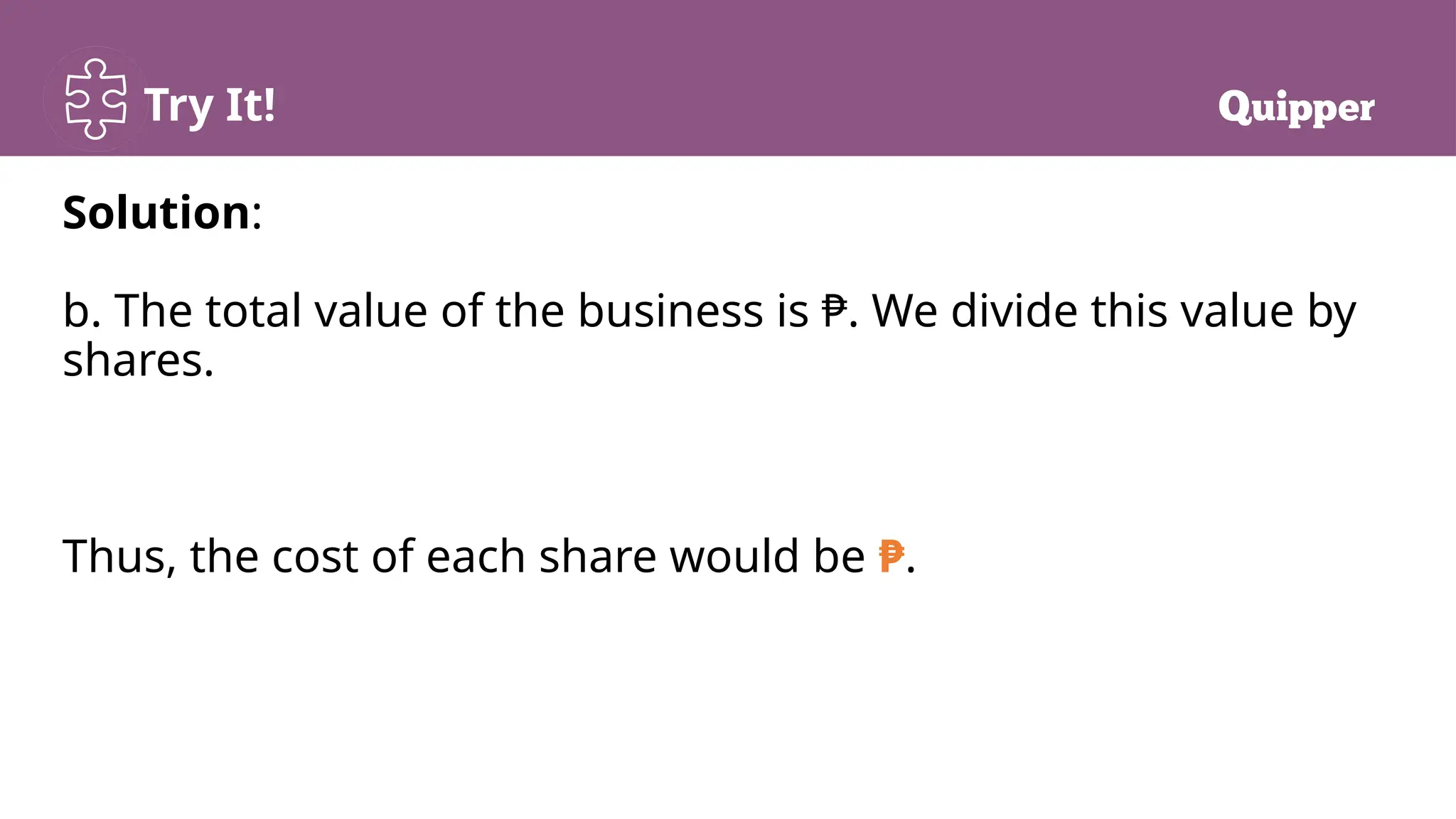
b. The total value of the business is ₱. We divide this value by
shares.
Thus, the cost of each share would be ₱.
Try It!
Solution:
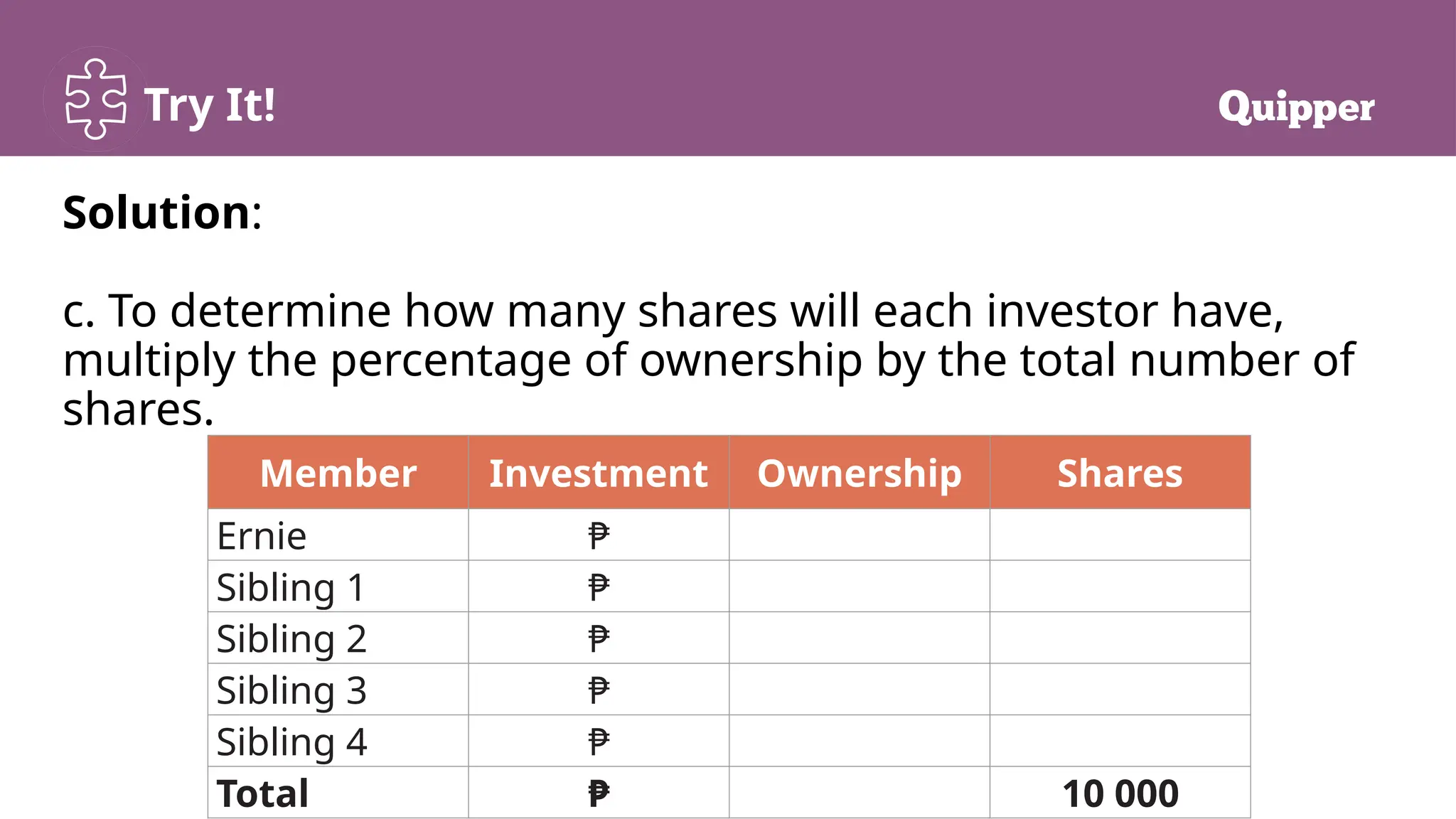
c. To determine how many shares will each investor have,
multiply the percentage of ownership by the total number of
shares.
Member Investment Ownership Shares
Ernie ₱
Sibling 1 ₱
Sibling 2 ₱
Sibling 3 ₱
Sibling 4 ₱
Total ₱ 10 000
Let’s Practice!
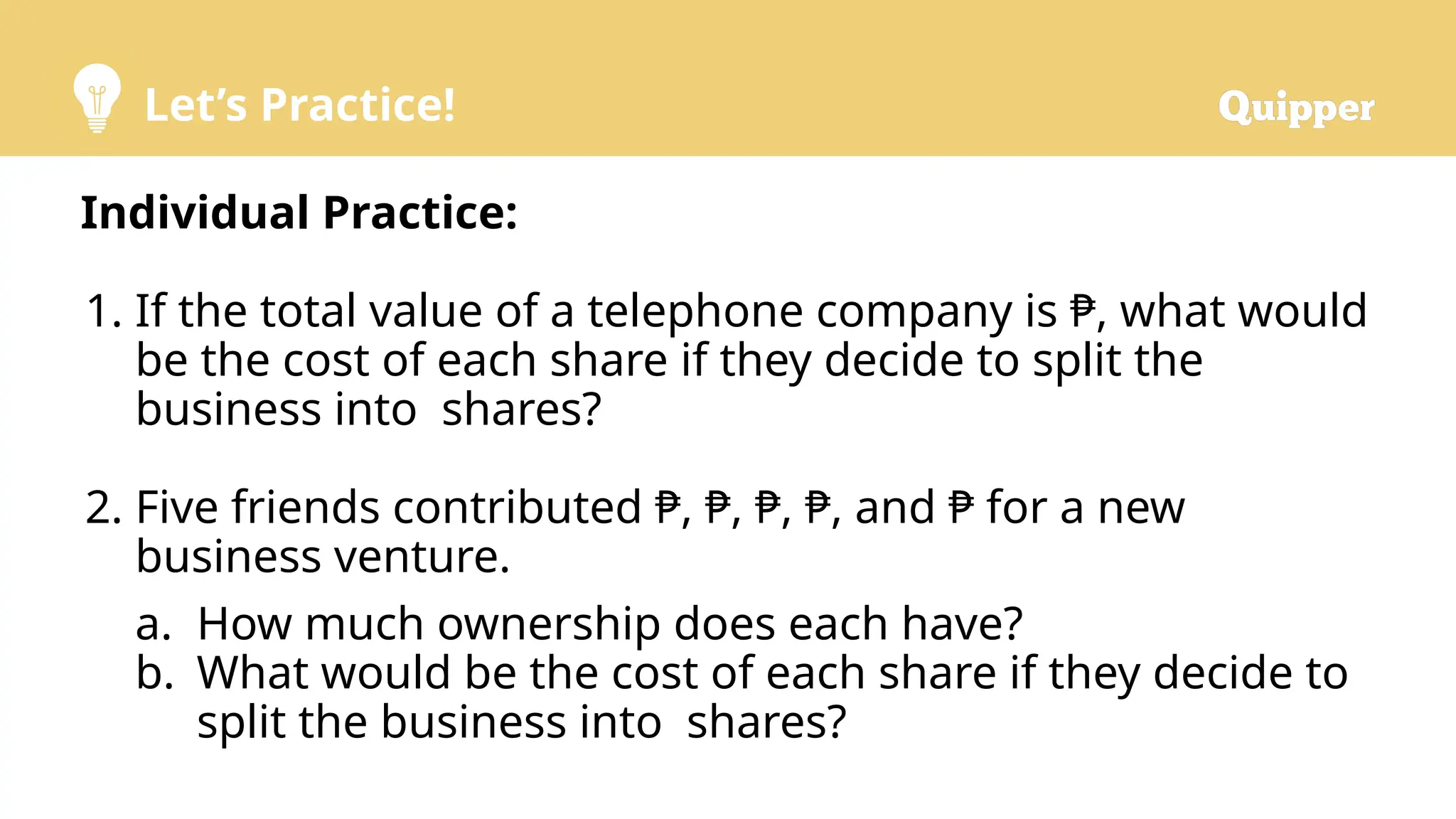
Individual Practice:
1. If the total value of a telephone company is ₱, what would
be the cost of each share if they decide to split the
business into shares?
2. Five friends contributed ₱, ₱, ₱, ₱, and ₱ for a new
business venture.
a. How much ownership does each have?
b. What would be the cost of each share if they decide to
split the business into shares?
Let’s Practice!
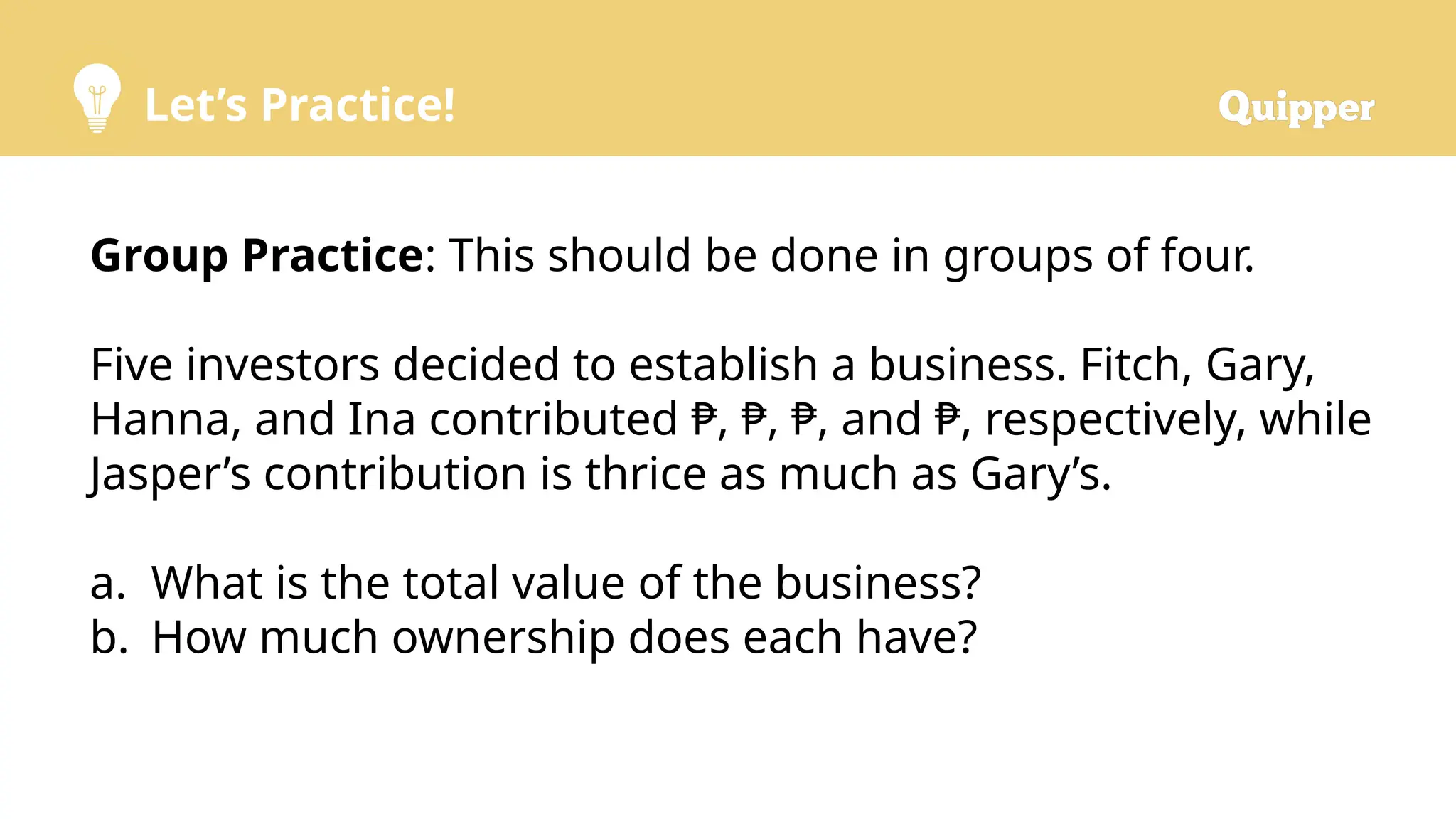
Group Practice: This should be done in groups of four.
Five investors decided to establish a business. Fitch, Gary,
Hanna, and Ina contributed ₱, ₱, ₱, and ₱, respectively, while
Jasper’s contribution is thrice as much as Gary’s.
a. What is the total value of the business?
b. How much ownership does each have?
Key Points
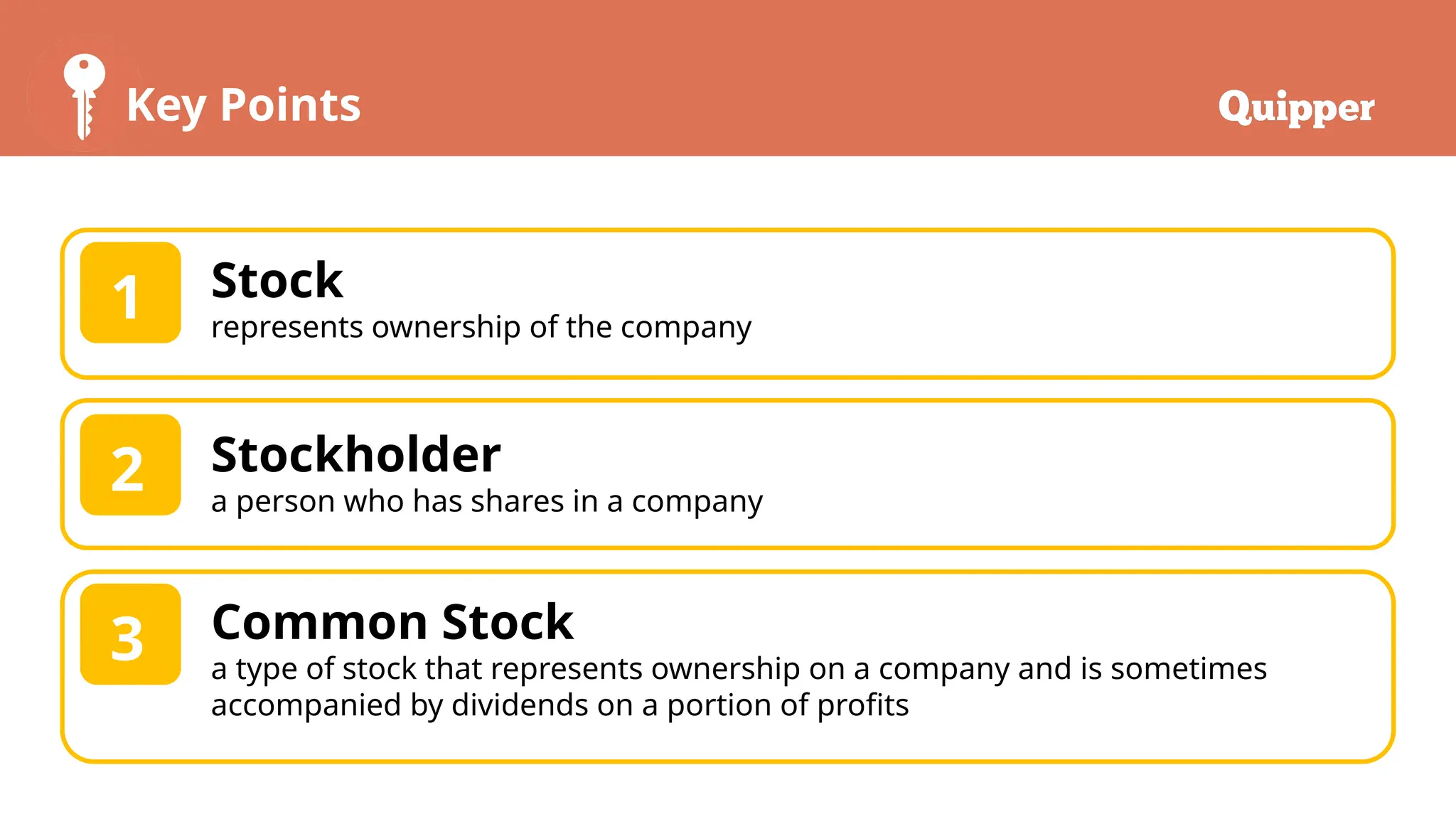
Stock
represents ownership of the company
1
2 Stockholder
a person who has shares in a company
2
Common Stock
a type of stock that represents ownership on a company and is sometimes
accompanied by dividends on a portion of profits
3
Key Points
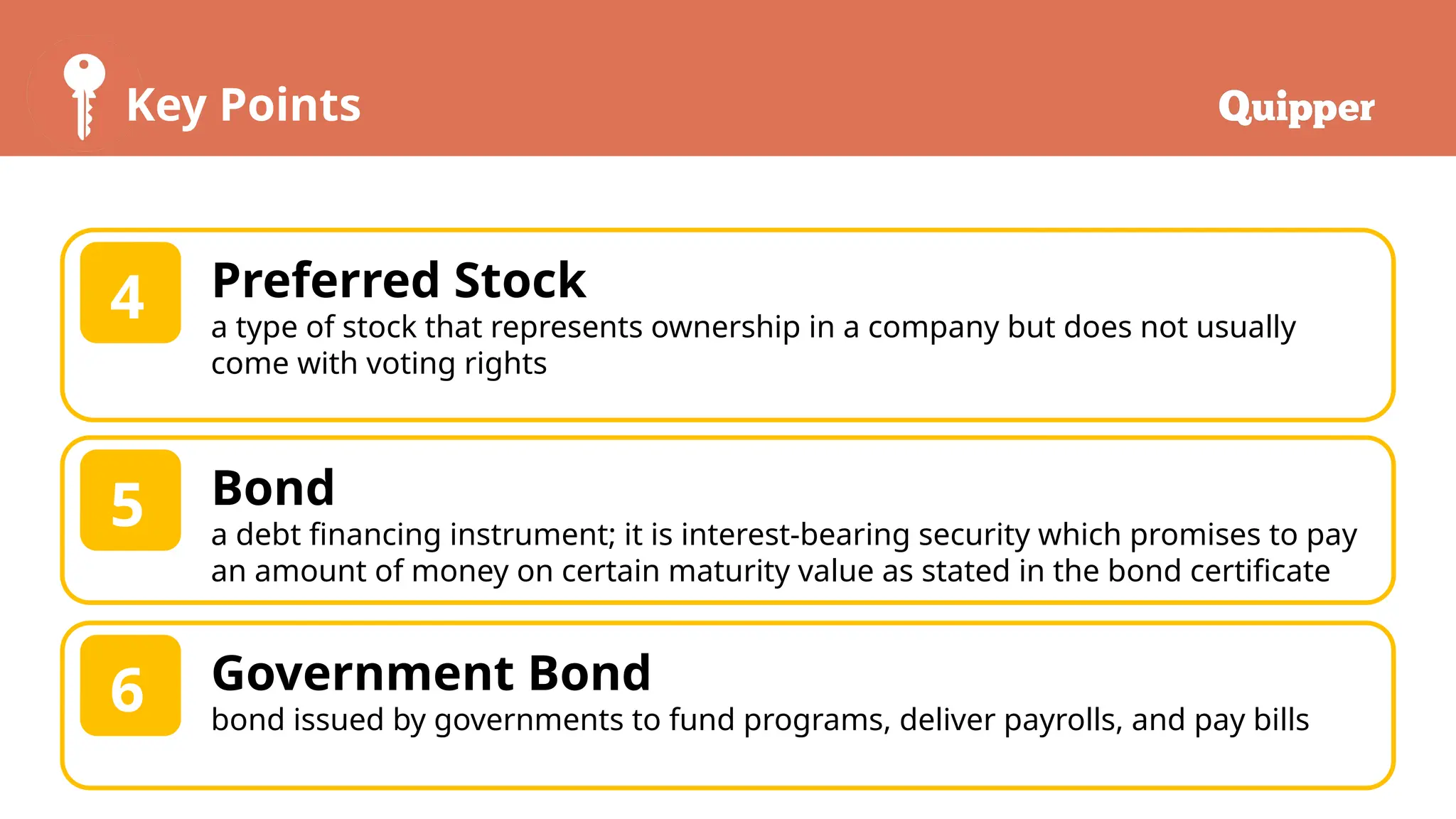
Preferred Stock
a type of stock that represents ownership in a company but does not usually
come with voting rights
4
Bond
a debt financing instrument; it is interest-bearing security which promises to pay
an amount of money on certain maturity value as stated in the bond certificate
5
Government Bond
bond issued by governments to fund programs, deliver payrolls, and pay bills
6
Key Points
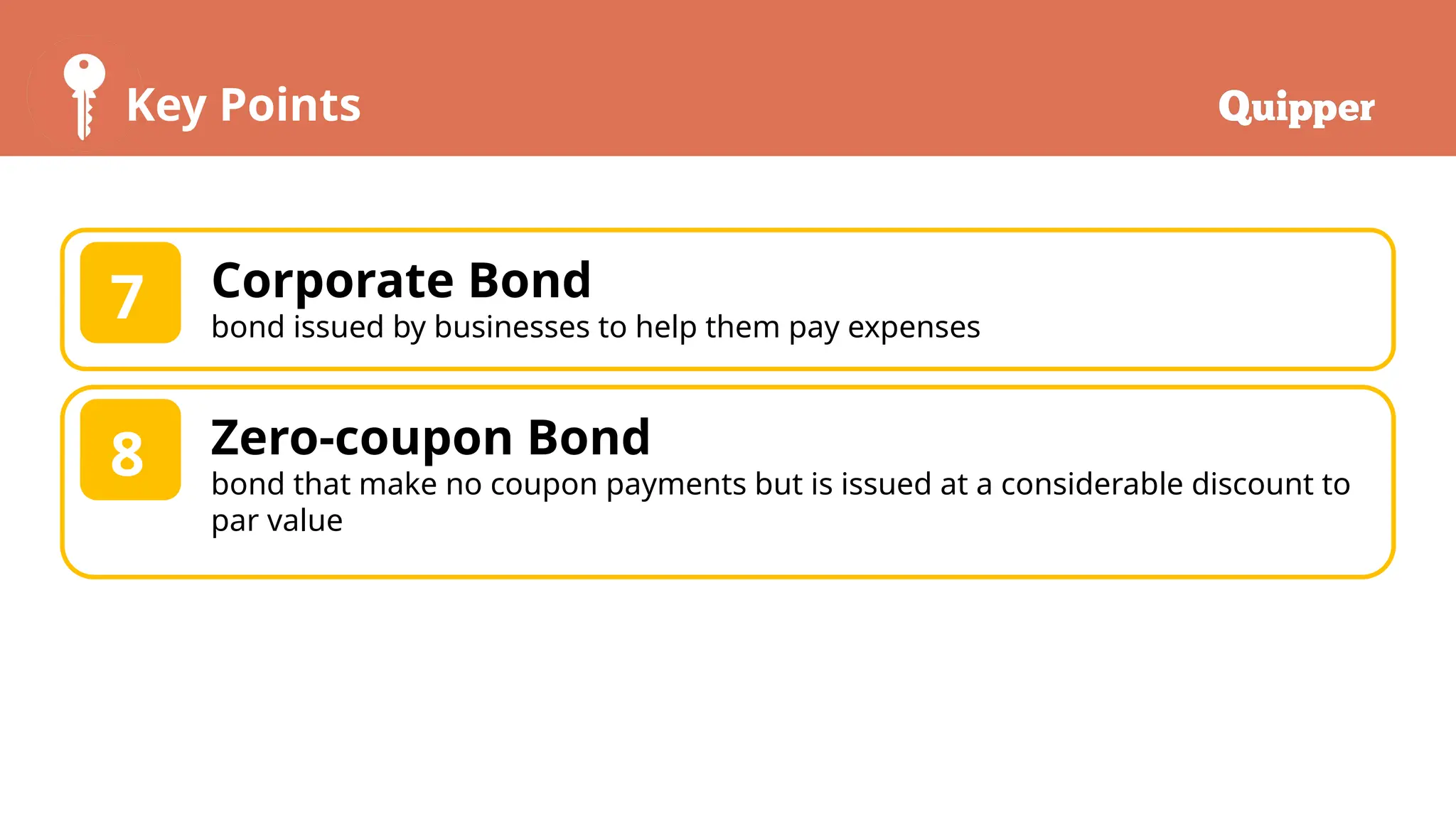
Corporate Bond
bond issued by businesses to help them pay expenses
7
Zero-coupon Bond
bond that make no coupon payments but is issued at a considerable discount to
par value
8
Synthesis
● What is the difference between a stock and a bond?
● As young as you are right now, should you start investing
in stocks and bonds already? Why do you think so?
● How can an investor earn money in stocks and bonds?

GMTC 1401 Q2 FPF.pptx presentation slides

  • 1.
  • 2.
    Objectives At the endof this lesson, the learner should be able to • accurately identify the characteristics of stocks and bonds; • accurately differentiate stocks from bonds; and • correctly solve cost of shares and ownership percentage.
  • 3.
    Essential Questions • Whatis the difference between a stock and a bond? • What are the advantages and disadvantages of owning a preferred stock? How about owning a common stock? • How will you determine the ownership of individuals given their contribution?
  • 4.
    Warm Up! Let’s havea brief introduction to stock and bonds by watching the following short video. (Click the link to access the video.) Fidelity Investments. “Stock and Bonds 101 | Fidelity.” YouTube video, 1:42, December 2015. Retrieved 20 May 2019 from https://bit.ly/2IiZqI4
  • 5.
    Guide Questions • Howdo stocks work? • How do bonds work? • How can you differentiate stocks and bonds?
  • 6.
    Learn about It! Stock representsownership of the company 1 Example: A company has shares of stock outstanding. Tony owns shares, which means that he has a claim to of the company’s assets and earnings.
  • 7.
    Learn about It! Example: SinceTony owns 100 shares of the company, then he is called a stockholder. 2 Stockholder a person who has shares in a company 2
  • 8.
    Learn about It! CommonStock a type of stock that represents ownership on a company and is sometimes accompanied by dividends on a portion of profits 3 In common stock, investors get one vote for every share to elect board members who oversee management.
  • 9.
    Learn about It! PreferredStock a type of stock that represents ownership in a company but does not usually come with voting rights 4 In preferred stock, investors are normally guaranteed dividends as long as the investor holds ownership of shares. In the event of liquidation, preferred shareholders are paid off before the common shareholders.
  • 10.
    Learn about It! Bond adebt financing instrument; it is interest-bearing security which promises to pay an amount of money on certain maturity value as stated in the bond certificate 5 A stock represents fractional ownership of equity in an organization. It is different from a bond, which operates like a loan made by creditors to the company in return for periodic payments.
  • 11.
    Learn about It! GovernmentBond bond issued by governments to fund programs, deliver payrolls, and pay bills 6 There are times where the government issues bonds publicly. They are sometimes referred to as “notes.”
  • 12.
    Learn about It! CorporateBond bond issued by businesses to help them pay expenses 7 Although these pose a higher risk than government bonds, businesses still can earn a lot more in corporate bonds. These bonds may be traded over-the-counter or privately between the borrower and the lender.
  • 13.
    Learn about It! Zero-couponBond bond that make no coupon payments but is issued at a considerable discount to par value 8 These bonds generate a return once the bondholder is paid the face value when the bond matures.
  • 14.
    Try It! Example 1: Determinewhat is being described by the given statement. a. It is a financing tool that allows the government to fund programs, meet payrolls, and pay bills. b. This gives a shareholder the right to suggest business ideas and oversee the management.
  • 15.
    Try It! Solution: a. Governmentbond This is a common way of refinancing for the government by allowing people to invest in the form of notes. b. Common stock Common stockholders get to have a say on the direction the company may or may not take.
  • 16.
    Try It! Example 2:Ernie and four of his siblings decided to invest different amounts of money to start a company. They invested amounts of money as shown. a. How much ownership does each individual have? b. What would be the cost of each share if they decide to split the business into shares? c. How many shares will each investor have? Member Investment Ernie ₱ Sibling 1 ₱ Sibling 2 ₱ Sibling 3 ₱ Sibling 4 ₱
  • 17.
    Try It! Solution: a. Toobtain ownership percentage, divide each contribution by the total value of the business, which is ₱. Member Investment Ownership Ernie ₱ Sibling 1 ₱ Sibling 2 ₱ Sibling 3 ₱ Sibling 4 ₱ Total ₱
  • 18.
    Try It! Solution: b. Thetotal value of the business is ₱. We divide this value by shares. Thus, the cost of each share would be ₱.
  • 19.
    Try It! Solution: c. Todetermine how many shares will each investor have, multiply the percentage of ownership by the total number of shares. Member Investment Ownership Shares Ernie ₱ Sibling 1 ₱ Sibling 2 ₱ Sibling 3 ₱ Sibling 4 ₱ Total ₱ 10 000
  • 20.
    Let’s Practice! Individual Practice: 1.If the total value of a telephone company is ₱, what would be the cost of each share if they decide to split the business into shares? 2. Five friends contributed ₱, ₱, ₱, ₱, and ₱ for a new business venture. a. How much ownership does each have? b. What would be the cost of each share if they decide to split the business into shares?
  • 21.
    Let’s Practice! Group Practice:This should be done in groups of four. Five investors decided to establish a business. Fitch, Gary, Hanna, and Ina contributed ₱, ₱, ₱, and ₱, respectively, while Jasper’s contribution is thrice as much as Gary’s. a. What is the total value of the business? b. How much ownership does each have?
  • 22.
    Key Points Stock represents ownershipof the company 1 2 Stockholder a person who has shares in a company 2 Common Stock a type of stock that represents ownership on a company and is sometimes accompanied by dividends on a portion of profits 3
  • 23.
    Key Points Preferred Stock atype of stock that represents ownership in a company but does not usually come with voting rights 4 Bond a debt financing instrument; it is interest-bearing security which promises to pay an amount of money on certain maturity value as stated in the bond certificate 5 Government Bond bond issued by governments to fund programs, deliver payrolls, and pay bills 6
  • 24.
    Key Points Corporate Bond bondissued by businesses to help them pay expenses 7 Zero-coupon Bond bond that make no coupon payments but is issued at a considerable discount to par value 8
  • 25.
    Synthesis ● What isthe difference between a stock and a bond? ● As young as you are right now, should you start investing in stocks and bonds already? Why do you think so? ● How can an investor earn money in stocks and bonds?