DAILY
LESSON
LOG
SENIOR HIGH SCHOOL
School ORIENTAL MINDORO NATIONAL HIGH SCHOOL Grade Level &
Quarter
11 /Quarter 3
Teacher FAITH ANGELICA O. TALICURAN SHS Track TVL- HE, GAS
Inclusive Dates February 12-15, 2024 Learning Area Understanding
Society, Culture,
and Politics
Scheduled Time Schedule Varies Topic CONCEPTS OF
SOCIETY
I. OBJECTIVES
1st DAY 2ND DAY 3RD DAY 4TH DAY
1. Explain the concept of society and culture in anthropological and sociological perspective.
2. Describe some major characteristics of society and culture.
3. Differentiate between the various meanings of culture within society; and
4. Appreciate the significance of culture in the society
A. Content Standard The learners demonstrate an understanding of:
1. human cultural variation, social differences, social change, and political identities
2. the significance of studying culture, society, and politics
3. the rationale for studying anthropology, political science, and sociology
B. Performance
Standards
The learners
1. acknowledge human cultural variation, social differences, social change, and political identities.
2. adopt an open and critical attitude toward different social, political, and cultural phenomena through observation and reflection
3. appreciates the value of disciplines of Anthropology, Sociology, and Political Science as social sciences
C. Learning
Competencies /
Objectives (Write
the LC Code)
Analyze the concepts, aspects and changes in/of culture and society (UCSP11/12SPU-lb-3).
1. CONTENT
Quarter 1 – Module 2: CONCEPTS OF SOCIETY
- Characteristics, Types, Functions of Society and Culture
2. LEARNING
RESOURCES
A. References  Supplementary Learning Material in USCP SLM (QUEZON & LA UNION)
1. Teacher’s Guide
pages
2. Learners’
Materials pages
Teacher initiated and self-made learning materials
3. Textbook pages Understanding Society, Politics, and Culture SLM pp. 3-15
4. Additional
Materials from
Learning
Resources
Portals
POWERPOINT, PICTURES, CHALKBOARD, LAPTOP, PROJECTOR
B. Other Learning
Resources
None
3. PROCEDURES
A. Revising previous
lesson or
presenting the
new lesson
Review of the Past Lesson
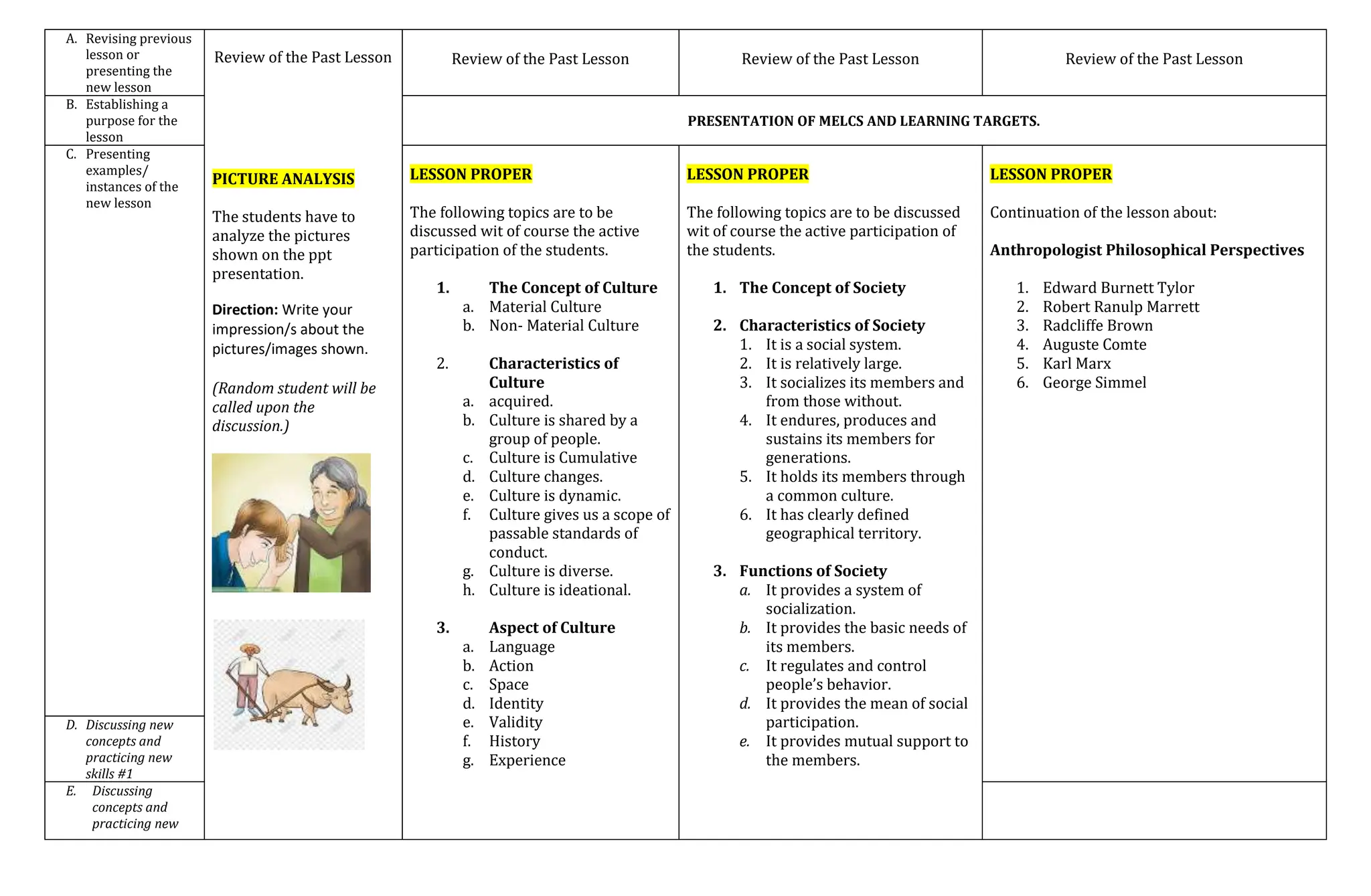
PICTURE ANALYSIS
The students have to
analyze the pictures
shown on the ppt
presentation.
Direction: Write your
impression/s about the
pictures/images shown.
(Random student will be
called upon the
discussion.)
Review of the Past Lesson Review of the Past Lesson Review of the Past Lesson
B. Establishing a
purpose for the
lesson
PRESENTATION OF MELCS AND LEARNING TARGETS.
C. Presenting
examples/
instances of the
new lesson
LESSON PROPER
The following topics are to be
discussed wit of course the active
participation of the students.
1. The Concept of Culture
a. Material Culture
b. Non- Material Culture
2. Characteristics of
Culture
a. acquired.
b. Culture is shared by a
group of people.
c. Culture is Cumulative
d. Culture changes.
e. Culture is dynamic.
f. Culture gives us a scope of
passable standards of
conduct.
g. Culture is diverse.
h. Culture is ideational.
3. Aspect of Culture
a. Language
b. Action
c. Space
d. Identity
e. Validity
f. History
g. Experience
LESSON PROPER
The following topics are to be discussed
wit of course the active participation of
the students.
1. The Concept of Society
2. Characteristics of Society
1. It is a social system.
2. It is relatively large.
3. It socializes its members and
from those without.
4. It endures, produces and
sustains its members for
generations.
5. It holds its members through
a common culture.
6. It has clearly defined
geographical territory.
3. Functions of Society
a. It provides a system of
socialization.
b. It provides the basic needs of
its members.
c. It regulates and control
people’s behavior.
d. It provides the mean of social
participation.
e. It provides mutual support to
the members.
LESSON PROPER
Continuation of the lesson about:
Anthropologist Philosophical Perspectives
1. Edward Burnett Tylor
2. Robert Ranulp Marrett
3. Radcliffe Brown
4. Auguste Comte
5. Karl Marx
6. George Simmel
D. Discussing new
concepts and
practicing new
skills #1
E. Discussing
concepts and
practicing new
skills #2
.
F. Developing
mastery
(Leads to
Formative
Assessment 3)
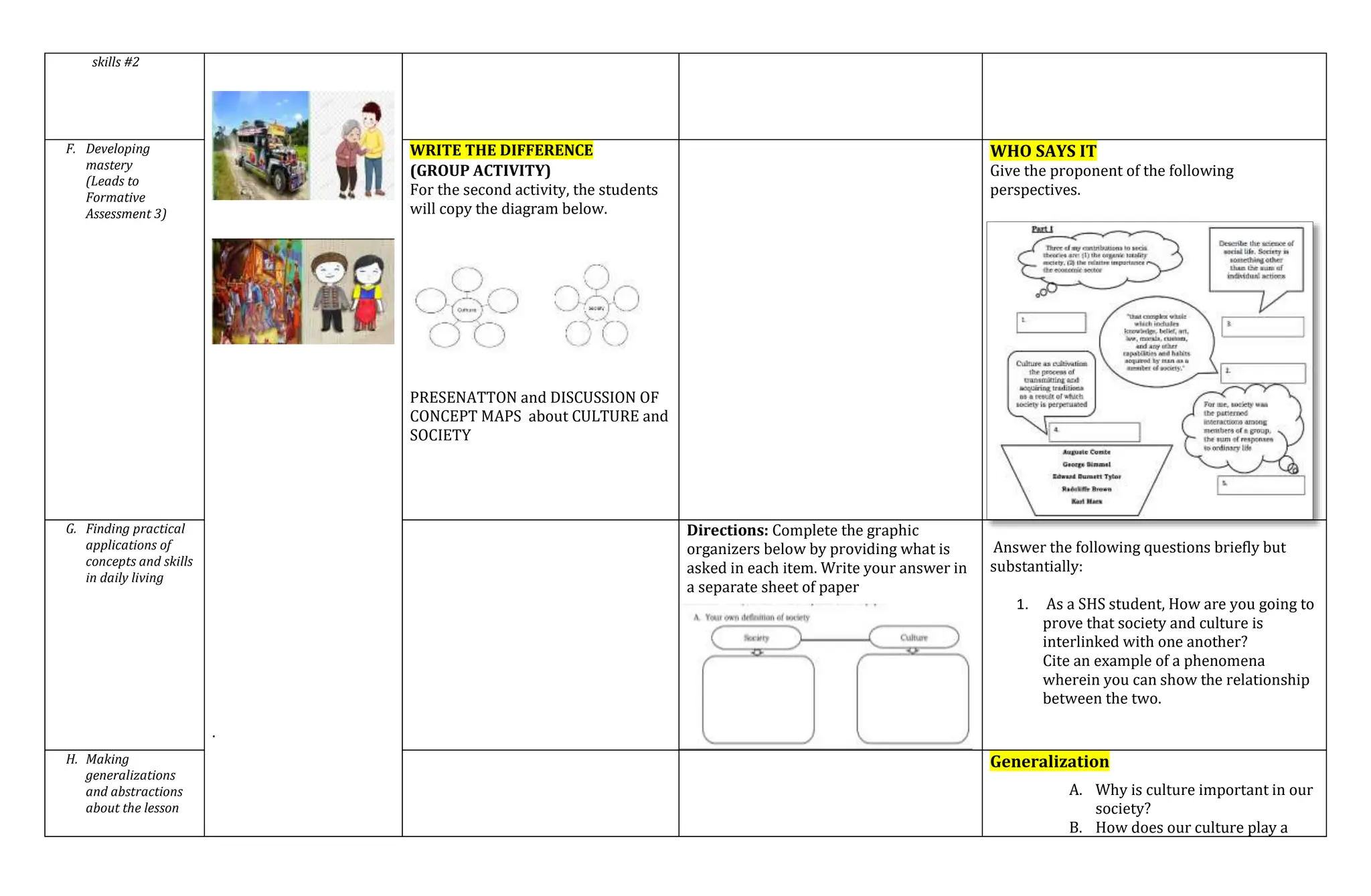
WRITE THE DIFFERENCE
(GROUP ACTIVITY)
For the second activity, the students
will copy the diagram below.
PRESENATTON and DISCUSSION OF
CONCEPT MAPS about CULTURE and
SOCIETY
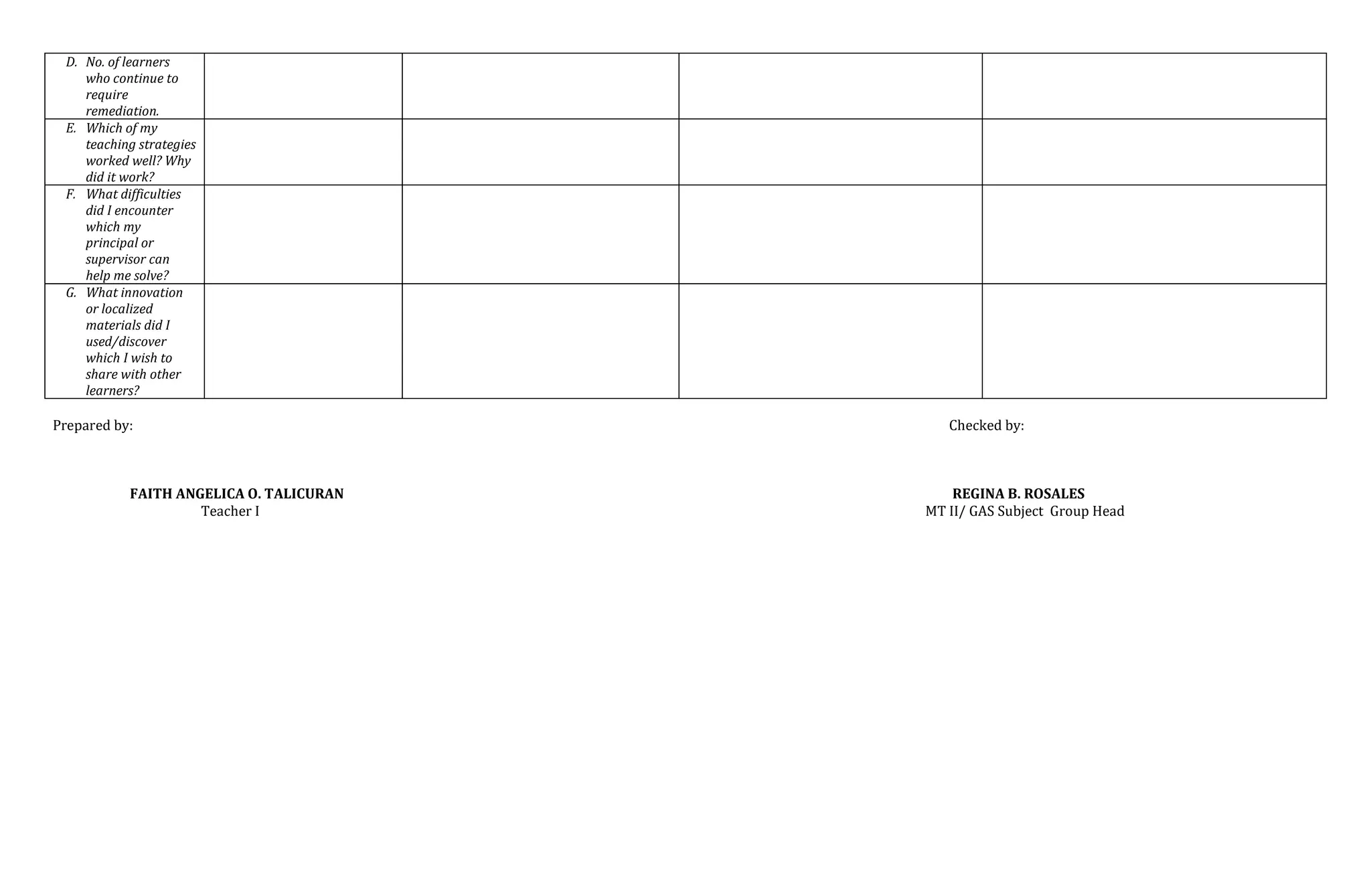
WHO SAYS IT
Give the proponent of the following
perspectives.
G. Finding practical
applications of
concepts and skills
in daily living
Directions: Complete the graphic
organizers below by providing what is
asked in each item. Write your answer in
a separate sheet of paper
Answer the following questions briefly but
substantially:
1. As a SHS student, How are you going to
prove that society and culture is
interlinked with one another?
Cite an example of a phenomena
wherein you can show the relationship
between the two.
H. Making
generalizations
and abstractions
about the lesson
Generalization
A. Why is culture important in our
society?
B. How does our culture play a
role in our fuctions in the
society?
I. Evaluating
learning
Enrichment Activity 2
Directions: List down characteristics of
society and culture. Write your answer in
aseparate sheet of paper.
DRAWING
Directions: Guided with the rubrics provided
below, draw and explain how you
can show that you are proud of your own
culture and what you can do to help
preserve tangible and intangible Filipino
culture. (100 pts.)
J. Additional
activities for
application or
remediation
4. REMARKS
5. REFLECTION
Reflect on your teaching and assess yourself as a teacher. Think about your students’ progress this week. What works? What else needs to be done to help the students learn? Identify what help
your Instructional Supervisors can provide for you so when you meet them, you can ask them relevant questions.
A. No. of learners
who earned 80%
in the evaluation.
B. No. of learners
who require
additional
activities for
remediation
C. Did the remedial
lessons work? No.
of learners who
have caught up
with the lesson.
Prepared by: Checked by:
FAITH ANGELICA O. TALICURAN REGINA B. ROSALES
Teacher I MT II/ GAS Subject Group Head
D. No. of learners
who continue to
require
remediation.
E. Which of my
teaching strategies
worked well? Why
did it work?
F. What difficulties
did I encounter
which my
principal or
supervisor can
help me solve?
G. What innovation
or localized
materials did I
used/discover
which I wish to
share with other
learners?

Lesson Plan-UCSP- (WK3- Feb. 12-16, 2024).docx

  • 1.
    DAILY LESSON LOG SENIOR HIGH SCHOOL SchoolORIENTAL MINDORO NATIONAL HIGH SCHOOL Grade Level & Quarter 11 /Quarter 3 Teacher FAITH ANGELICA O. TALICURAN SHS Track TVL- HE, GAS Inclusive Dates February 12-15, 2024 Learning Area Understanding Society, Culture, and Politics Scheduled Time Schedule Varies Topic CONCEPTS OF SOCIETY I. OBJECTIVES 1st DAY 2ND DAY 3RD DAY 4TH DAY 1. Explain the concept of society and culture in anthropological and sociological perspective. 2. Describe some major characteristics of society and culture. 3. Differentiate between the various meanings of culture within society; and 4. Appreciate the significance of culture in the society A. Content Standard The learners demonstrate an understanding of: 1. human cultural variation, social differences, social change, and political identities 2. the significance of studying culture, society, and politics 3. the rationale for studying anthropology, political science, and sociology B. Performance Standards The learners 1. acknowledge human cultural variation, social differences, social change, and political identities. 2. adopt an open and critical attitude toward different social, political, and cultural phenomena through observation and reflection 3. appreciates the value of disciplines of Anthropology, Sociology, and Political Science as social sciences C. Learning Competencies / Objectives (Write the LC Code) Analyze the concepts, aspects and changes in/of culture and society (UCSP11/12SPU-lb-3). 1. CONTENT Quarter 1 – Module 2: CONCEPTS OF SOCIETY - Characteristics, Types, Functions of Society and Culture 2. LEARNING RESOURCES A. References  Supplementary Learning Material in USCP SLM (QUEZON & LA UNION) 1. Teacher’s Guide pages 2. Learners’ Materials pages Teacher initiated and self-made learning materials 3. Textbook pages Understanding Society, Politics, and Culture SLM pp. 3-15 4. Additional Materials from Learning Resources Portals POWERPOINT, PICTURES, CHALKBOARD, LAPTOP, PROJECTOR B. Other Learning Resources None 3. PROCEDURES
  • 2.
    A. Revising previous lessonor presenting the new lesson Review of the Past Lesson PICTURE ANALYSIS The students have to analyze the pictures shown on the ppt presentation. Direction: Write your impression/s about the pictures/images shown. (Random student will be called upon the discussion.) Review of the Past Lesson Review of the Past Lesson Review of the Past Lesson B. Establishing a purpose for the lesson PRESENTATION OF MELCS AND LEARNING TARGETS. C. Presenting examples/ instances of the new lesson LESSON PROPER The following topics are to be discussed wit of course the active participation of the students. 1. The Concept of Culture a. Material Culture b. Non- Material Culture 2. Characteristics of Culture a. acquired. b. Culture is shared by a group of people. c. Culture is Cumulative d. Culture changes. e. Culture is dynamic. f. Culture gives us a scope of passable standards of conduct. g. Culture is diverse. h. Culture is ideational. 3. Aspect of Culture a. Language b. Action c. Space d. Identity e. Validity f. History g. Experience LESSON PROPER The following topics are to be discussed wit of course the active participation of the students. 1. The Concept of Society 2. Characteristics of Society 1. It is a social system. 2. It is relatively large. 3. It socializes its members and from those without. 4. It endures, produces and sustains its members for generations. 5. It holds its members through a common culture. 6. It has clearly defined geographical territory. 3. Functions of Society a. It provides a system of socialization. b. It provides the basic needs of its members. c. It regulates and control people’s behavior. d. It provides the mean of social participation. e. It provides mutual support to the members. LESSON PROPER Continuation of the lesson about: Anthropologist Philosophical Perspectives 1. Edward Burnett Tylor 2. Robert Ranulp Marrett 3. Radcliffe Brown 4. Auguste Comte 5. Karl Marx 6. George Simmel D. Discussing new concepts and practicing new skills #1 E. Discussing concepts and practicing new
  • 3.
    skills #2 . F. Developing mastery (Leadsto Formative Assessment 3) WRITE THE DIFFERENCE (GROUP ACTIVITY) For the second activity, the students will copy the diagram below. PRESENATTON and DISCUSSION OF CONCEPT MAPS about CULTURE and SOCIETY WHO SAYS IT Give the proponent of the following perspectives. G. Finding practical applications of concepts and skills in daily living Directions: Complete the graphic organizers below by providing what is asked in each item. Write your answer in a separate sheet of paper Answer the following questions briefly but substantially: 1. As a SHS student, How are you going to prove that society and culture is interlinked with one another? Cite an example of a phenomena wherein you can show the relationship between the two. H. Making generalizations and abstractions about the lesson Generalization A. Why is culture important in our society? B. How does our culture play a
  • 4.
    role in ourfuctions in the society? I. Evaluating learning Enrichment Activity 2 Directions: List down characteristics of society and culture. Write your answer in aseparate sheet of paper. DRAWING Directions: Guided with the rubrics provided below, draw and explain how you can show that you are proud of your own culture and what you can do to help preserve tangible and intangible Filipino culture. (100 pts.) J. Additional activities for application or remediation 4. REMARKS 5. REFLECTION Reflect on your teaching and assess yourself as a teacher. Think about your students’ progress this week. What works? What else needs to be done to help the students learn? Identify what help your Instructional Supervisors can provide for you so when you meet them, you can ask them relevant questions. A. No. of learners who earned 80% in the evaluation. B. No. of learners who require additional activities for remediation C. Did the remedial lessons work? No. of learners who have caught up with the lesson.
  • 5.
    Prepared by: Checkedby: FAITH ANGELICA O. TALICURAN REGINA B. ROSALES Teacher I MT II/ GAS Subject Group Head D. No. of learners who continue to require remediation. E. Which of my teaching strategies worked well? Why did it work? F. What difficulties did I encounter which my principal or supervisor can help me solve? G. What innovation or localized materials did I used/discover which I wish to share with other learners?