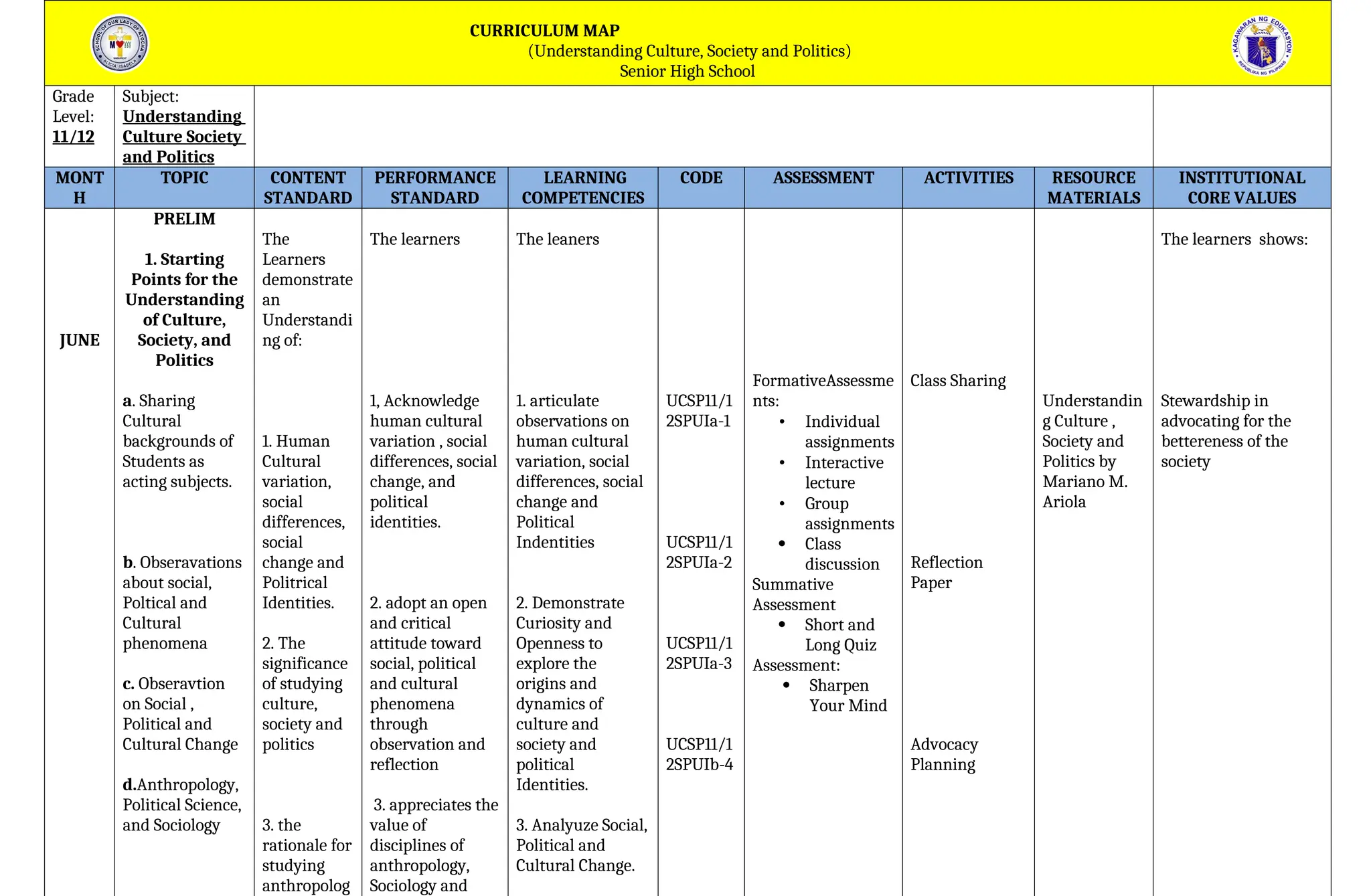
CURRICULUM MAP
(Understanding Culture,Society and Politics)
Senior High School
Grade
Level:
11/12
Subject:
Understanding
Culture Society
and Politics
MONT
H
TOPIC CONTENT
STANDARD
PERFORMANCE
STANDARD
LEARNING
COMPETENCIES
CODE ASSESSMENT ACTIVITIES RESOURCE
MATERIALS
INSTITUTIONAL
CORE VALUES
JUNE
PRELIM
1. Starting
Points for the
Understanding
of Culture,
Society, and
Politics
a. Sharing
Cultural
backgrounds of
Students as
acting subjects.
b. Obseravations
about social,
Poltical and
Cultural
phenomena
c. Obseravtion
on Social ,
Political and
Cultural Change
d.Anthropology,
Political Science,
and Sociology
The
Learners
demonstrate
an
Understandi
ng of:
1. Human
Cultural
variation,
social
differences,
social
change and
Politrical
Identities.
2. The
significance
of studying
culture,
society and
politics
3. the
rationale for
studying
anthropolog
The learners
1, Acknowledge
human cultural
variation , social
differences, social
change, and
political
identities.
2. adopt an open
and critical
attitude toward
social, political
and cultural
phenomena
through
observation and
reflection
3. appreciates the
value of
disciplines of
anthropology,
Sociology and
The leaners
1. articulate
observations on
human cultural
variation, social
differences, social
change and
Political
Indentities
2. Demonstrate
Curiosity and
Openness to
explore the
origins and
dynamics of
culture and
society and
political
Identities.
3. Analyuze Social,
Political and
Cultural Change.
UCSP11/1
2SPUIa-1
UCSP11/1
2SPUIa-2
UCSP11/1
2SPUIa-3
UCSP11/1
2SPUIb-4
FormativeAssessme
nts:
• Individual
assignments
• Interactive
lecture
• Group
assignments
Class
discussion
Summative
Assessment
Short and
Long Quiz
Assessment:
Sharpen
Your Mind
Class Sharing
Reflection
Paper
Advocacy
Planning
Understandin
g Culture ,
Society and
Politics by
Mariano M.
Ariola
The learners shows:
Stewardship in
advocating for the
bettereness of the
society
2.
MIDTE
RM
Augus
t
C.Looking
Back at
Human
Biocultural
and
sociological
Evolution
1. Biologicaland
Cultural
evolution: From
Homo Habilis
Homo Sapiens
in the Fossil
record.
2. Cultural and
sociopolitical
evolution: From
hunting and
gathering to the
agricultural;
industrial, and
post industrial
revolutions.
a. The Neolitic
Revolution.
b. Early
civilization and
the rise of state.
c.
Democratizatio
n.
1. The
Human
Origins and
the capacity
for culture
2. The role of
culture in
human
adaptation
3. Processes
of cultural
and
sociopolitical
evolution
1. Analyze key
features of
interrelationships
of biological,
cultural and
sociopolitical
processes in
human evolution
that can still be
used and
developed.
1. Trace the
biological and
cultural evolution
of early to modern
humans,
2. Explore the
significance of
human material
remains and
artefactual
evidence in
interpreting
cultural and social,
including political
and economic
processes
3. Recognize
national, local, and
specialized
museums, and
archaeological and
historical sites as
venues to
appreciateand
reflect on the
complexities of
biocultural and
social evolution as
part of being and
becoming human
UCSP11H
BS/Id-12
UCSP11H
BS/Id-13
UCSP11H
BS/Id-14
FormativeAssessm
ents:
• Individual
assignment
s
• Interactive
lecture
• Group
assignment
s
Class
discussion
Summative
Assessment
Short and
Long Quiz
Assessment:
Sharpen
Your Mind
Pre Learning
Activity
Group
Recitation
Photo Journal of
the
-Human
Evolution and
their definitions
-Big Museums
in the
Philippines
Shows Stewardship
in upholding the
Filipino Race and
history.
3.
MIDTE
RM
SEPTE
M-
BER
Becoming a
member of
society
1.
Enculturation/S
ocialization.
a.Identify
formation
(Identities,
Disciplines, and
aspirations)
b. Norms and
Values
c. statuses and
roles (e.g.
age,gender)
2. Confomity
and Deviance
a. Social Control
(Gossip, Social
Ostracism, Laws
and
Punishment)
b. Forms of
deviance
(ritualism,
retreatism,rebel
1. How
individuals
learn culture
and become
competent
members of
society.
2. How
individuals
should
behave as
part of
political
community.
1. Identify norms
and values to be
observed in the
interacting with
others society
and the
consequences of
ignoring these
rules.
2. Assess the rules
of social
interaction to
maintain stability
of everyday life
and the role of
innovation in
response to
problems and
challenges.
3. Recognize the
value of hyuman
rights and
promote the
common goal.
1. Explain the
development of
one’s self and
others as a product
of socialization of
enculturation
2. Identify the
content , context
and consequences
of enculturation
and socialization
3. Identifies the
Social Goals and
the socially
acceptable means
of achieving goals.
4. advocate
inclusive
citizenship
UCSP11B
MS/Ig-15
UCSP11B
MS/Ig-16
UCSP11B
MS/Ig-17
UCSP11B
MS/Ig-18
UCSP11B
MS/Ig-19
FormativeAssessm
ents:
• Individual
assignment
s
• Interactive
lecture
• Group
assignment
s
Class
discussion
Summative
Assessment
Short and
Long Quiz
Assessment:
Sharpen
Your Mind
Prelearning
Activity
Debate
( Gender Role
Male vs.
Female)
Reaction Paper
- Extra Judicial
Killing
-Justice in the
Philippine
society.
Be a disciples in
maintaining or
following the laws of
Philippine
government in
achieving peace in
the society.
4.
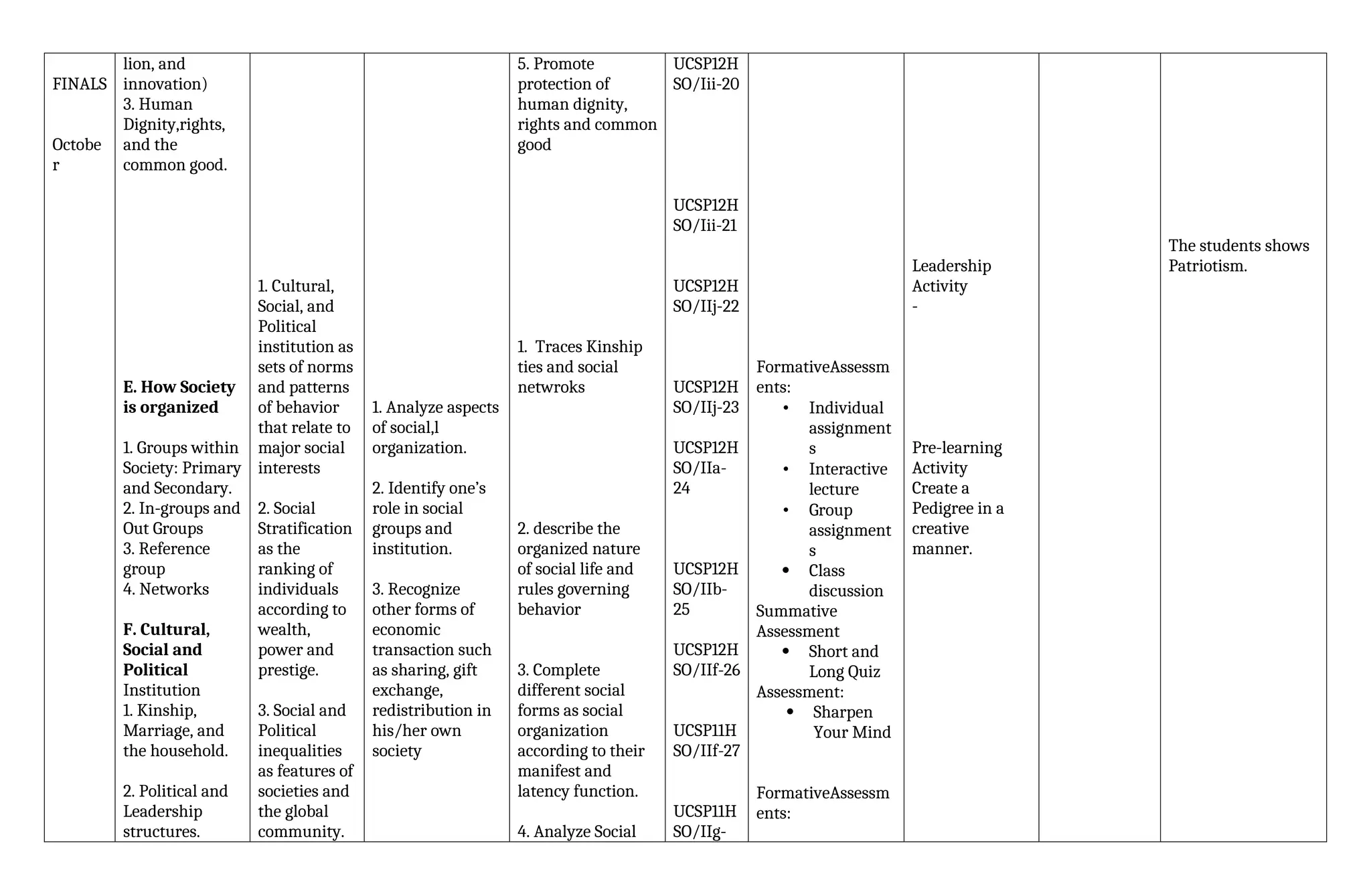
FINALS
Octobe
r
lion, and
innovation)
3. Human
Dignity,rights,
andthe
common good.
E. How Society
is organized
1. Groups within
Society: Primary
and Secondary.
2. In-groups and
Out Groups
3. Reference
group
4. Networks
F. Cultural,
Social and
Political
Institution
1. Kinship,
Marriage, and
the household.
2. Political and
Leadership
structures.
1. Cultural,
Social, and
Political
institution as
sets of norms
and patterns
of behavior
that relate to
major social
interests
2. Social
Stratification
as the
ranking of
individuals
according to
wealth,
power and
prestige.
3. Social and
Political
inequalities
as features of
societies and
the global
community.
1. Analyze aspects
of social,l
organization.
2. Identify one’s
role in social
groups and
institution.
3. Recognize
other forms of
economic
transaction such
as sharing, gift
exchange,
redistribution in
his/her own
society
5. Promote
protection of
human dignity,
rights and common
good
1. Traces Kinship
ties and social
netwroks
2. describe the
organized nature
of social life and
rules governing
behavior
3. Complete
different social
forms as social
organization
according to their
manifest and
latency function.
4. Analyze Social
UCSP12H
SO/Iii-20
UCSP12H
SO/Iii-21
UCSP12H
SO/IIj-22
UCSP12H
SO/IIj-23
UCSP12H
SO/IIa-
24
UCSP12H
SO/IIb-
25
UCSP12H
SO/IIf-26
UCSP11H
SO/IIf-27
UCSP11H
SO/IIg-
FormativeAssessm
ents:
• Individual
assignment
s
• Interactive
lecture
• Group
assignment
s
Class
discussion
Summative
Assessment
Short and
Long Quiz
Assessment:
Sharpen
Your Mind
FormativeAssessm
ents:
Leadership
Activity
-
Pre-learning
Activity
Create a
Pedigree in a
creative
manner.
The students shows
Patriotism.
5.
3.Economic
Institution
4. Nonstate
Institution
5. Education
6.Religion and
Belief system
7. Health
and Political
Structure.
5. Analyze
economic
organization and
its impacts on the
lives of people in
the society
6. differentiate
functions of
nonstate
institution in
society.
7. Evaluate how
functions of
education affect
the lives of people
8. Promote
Primary Education
as human rights
9. Conduct
participant
observation (e.g
attend describe
and reflect on a
religious ritual of a
different group:
observe election
practices)
10. Recognize the
practice of medical
28
UCSP11H
SO/IIg-
29
UCSP11H
SOI/IIc-
30
UCSP11H
SOI/IId-
31
• Individual
assignment
s
• Interactive
lecture
• Group
assignment
s
Class
discussion
Summative
Assessment
Short and
Long Quiz
Assessment:
Sharpen
Your Mind
FormativeAssessm
ents:
• Individual
assignment
s
• Interactive
lecture
• Group
assignment
s
Class
discussion
Summative
Assessment
Short and
Long Quiz
Assessment:
Sharpen
Your Mind
Impromtu
speech
6.
pluralism in light
ofcultural
diversity and
relativism
11. examine
stratification from
the functionalist
and conflict
perspectives.
12. Identify
characteristics of
the systems of
stratification
13. suggest ways to
address global
inequalities.
UCSP12H
SO/IIe-
32
UCSP11/1
2CSCO/
IIh-33
FormativeAssessm
ents:
• Individual
assignment
s
• Interactive
lecture
• Group
assignment
s
Class
discussion
Summative
Assessment
Short and
Long Quiz
Assessment:
Sharpen
Your Mind
FormativeAssessm
ents:
• Individual
assignment
s
• Interactive
lecture
• Group
assignment
s
Class
discussion
Summative
Assessment
Short and
Group
Reporting
Slogan Making
Reaction Paper
Journalizing
7.
G. Social and
Political
Stratification.
a.Social
Desirables
(Wealth,power
and Prestige)
b. Social
Mobility System
i. Open (class)
ii. Closed
(Caste)
c. Social
Inequality
i. Access to
social, political,
and symbolic
capital.
ii. Gender
inequalities
iii. Ethic
Minorities
The
agents/Instit
utions,
processes,
and
outcomes of
cultural,politi
cand Cultural
change.
1. Evaluates
factors causing
social, Poltical,
and Cultural
Change
2. Advocate how
human Societies
should adapt to
such changes
1. Identify new
challenges faced by
human
populations in
Contemporary
societies
UCSP11/1
2CSC-IIi-
34
UCSP11/1
2CSC/IIj-
35
Long Quiz
Assessment:
Sharpen
Your Mind
Top 10 Biggest
Problems of
Societies in
2000-to present
Group reporting
Uphold justice and
understanding in to
ones belief to avoid
prejudice and
injustice
8.
iv. other
minorities
(person with
disabilities)
v.Global
inequalities
(relationships
between states
and nonstate
actors in the
global
community)
H. Cultural,
Social, and
Political
Change
Sources of
social,
Cultural, and
Political
Change.
1. Innovation
2. Diffusion
3. Acculturation
and
Assimilation
4. Social
contradictions
and tensions
(e.g Inter-ethnic
conflicts, Class
(struggles,arme
d
conflict,terroris
m,protest,
gender issues)
2. Describe How
human societies
adapt to new
challenges in the
physical, social,
and cultural
environment
3. Develop a plan of
action for
community-based
response change
Advocacy
planning
Collaborative
Learning
Shows care and be a
soldier in advocating
in our nature and
respect to migrant
Filipino workers
9.
I. New
Challeges to
human
adaptation
andsocial
change.
1. Global
Warming and
Climate Change
2. Transnational
migration and
Overseas
Filipino
Workers
(OFW’s)
J. Responding
to social,
Political, and
Cultural
change
1. Inclusive
Citezenship and
participatory
governance
2.New forms of
media and
social and
networking
3.Social
movements (e.g,
environmentalis
m, Feminism)