PRE-COLONIAL
LITERATURE
(1564)
PRAYER
Mr. Aristotle A. Magnaye
NATIONALISTIC
SONG
PRE-COLONIAL
LITERATURE
(1564)
FOOD FOR
THOUGHT
PRE-COLONIAL
LITERATURE
(1564)
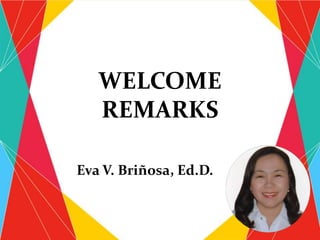
WELCOME
REMARKS
Eva V. Briñosa, Ed.D.
PRE-COLONIAL
LITERATURE
(1564)
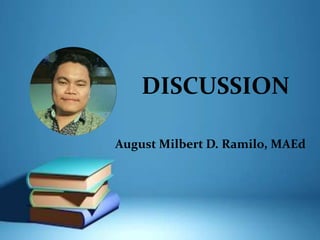
DISCUSSION
August Milbert D. Ramilo, MAEd
PRE-COLONIAL
LITERATURE
(1564)
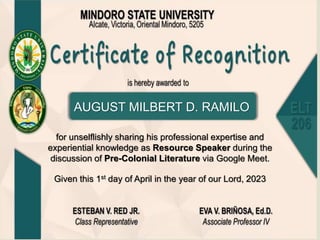
for unselflishly sharing his professional expertise and
experiential knowledge as Resource Speaker during the
discussion of Pre-Colonial Literature via Google Meet.
AUGUST MILBERT D. RAMILO
Given this 1st day of April in the year of our Lord, 2023
 Certain events in the Philippines during pre-
colonial period started to be recorded in the year
1521.
Folk speeches Folk songs Folk narratives
Indigenous rituals Mimetic dances
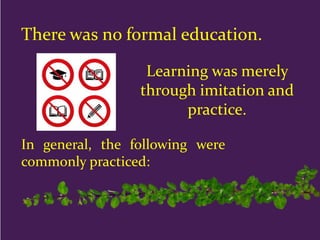
There was no formal education.
Learning was merely
through imitation and
practice.
In general, the following were
commonly practiced:
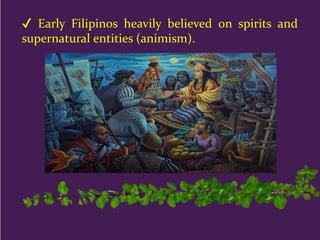
✔ Early Filipinos heavily believed on spirits and
supernatural entities (animism).
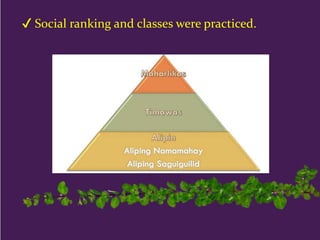
✔ Social ranking and classes were practiced.
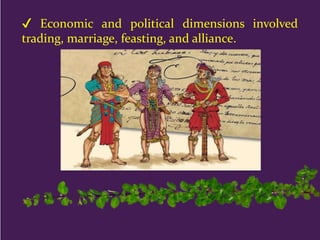
✔ Economic and political dimensions involved
trading, marriage, feasting, and alliance.
DIMENSIONS OF
PRE-COLONIAL
LITERATURE
 Philippine literature during the pre-colonial era
is mostly based on oral traditions passed down
from generation to generation.
 Common forms of oral literature are riddles,
proverbs, and songs to express a thought or
emotion.
 There are more than 100 epics discovered where
majority came from Palawan.
Majority of the proverbs
and epigrams
Tagalog, Cebuano and
Ilocano dialects.
COMMON SUBJECTS
IN ORAL LITERATURE
FOOD HUNTING
WORK AT HOME
CARING FOR THE CHILDREN
CREATURES OR OBJECTS OF NATURE
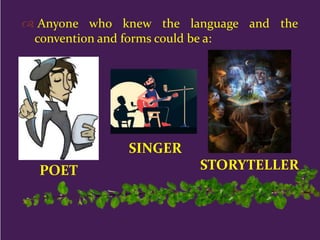
 Anyone who knew the language and the
convention and forms could be a:
POET
SINGER
STORYTELLER
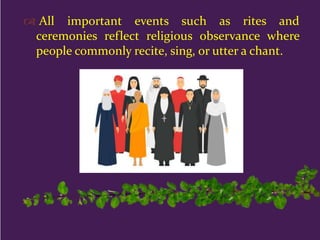
 All important events such as rites and
ceremonies reflect religious observance where
people commonly recite, sing, or utter a chant.
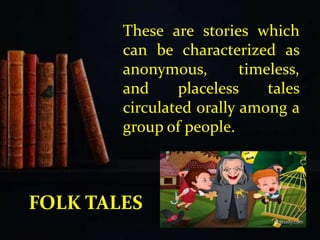
These are stories which
can be characterized as
anonymous, timeless,
and placeless tales
circulated orally among a
group of people.
FOLK TALES
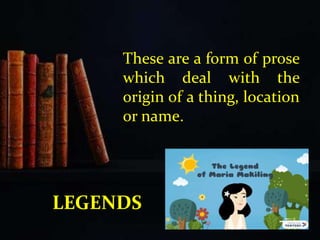
These are a form of prose
which deal with the
origin of a thing, location
or name.
LEGENDS
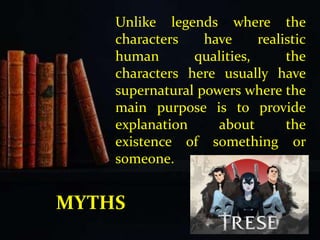
Unlike legends where the
characters have realistic
human qualities, the
characters here usually have
supernatural powers where the
main purpose is to provide
explanation about the
existence of something or
someone.
MYTHS
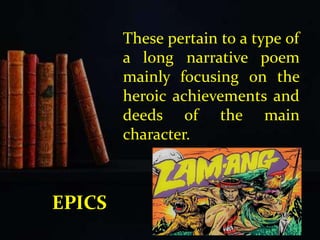
These pertain to a type of
a long narrative poem
mainly focusing on the
heroic achievements and
deeds of the main
character.
EPICS
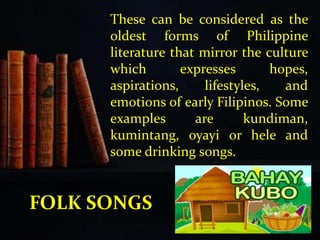
These can be considered as the
oldest forms of Philippine
literature that mirror the culture
which expresses hopes,
aspirations, lifestyles, and
emotions of early Filipinos. Some
examples are kundiman,
kumintang, oyayi or hele and
some drinking songs.
FOLK SONGS
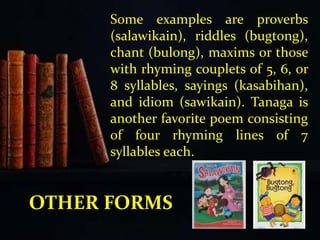
Some examples are proverbs
(salawikain), riddles (bugtong),
chant (bulong), maxims or those
with rhyming couplets of 5, 6, or
8 syllables, sayings (kasabihan),
and idiom (sawikain). Tanaga is
another favorite poem consisting
of four rhyming lines of 7
syllables each.
OTHER FORMS
PRE-COLONIAL
LITERATURE
(1564)
PRE-COLONIAL
LITERATURE
(1564)
PRE-COLONIAL
LITERATURE
(1564)

PRE-COLONIAL LITERATURE (1564).pptx