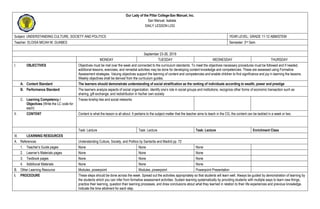
Our Lady of the Pillar College-San Manuel, Inc.
San Manuel, Isabela
DAILY LESSON LOG
Subject: UNDERSTANDING CULTURE, SOCIETY AND POLITICS YEAR LEVEL: GRADE 11-12 ABM/STEM
Teacher: ELOISA MICAH M. GUABES Semester: 2nd Sem
September 23-26, 2019
MONDAY TUESDAY WEDNESDAY THURSDAY
I. OBJECTIVES Objectives must be met over the week and connected to the curriculum standards. To meet the objectives necessary procedures must be followed and if needed,
additional lessons, exercises, and remedial activities may be done for developing content knowledge and competencies. These are assessed using Formative
Assessment strategies. Valuing objectives support the learning of content and competencies and enable children to find significance and joy in learning the lessons.
Weekly objectives shall be derived from the curriculum guides.
A. Content Standard The learners should demonstrate understanding of social stratification as the ranking of individuals according to wealth, power and prestige
B. Performance Standard The learners analyze aspects of social organization, identify one’s role in social groups and institutions, recognize other forms of economic transaction such as
sharing, gift exchange, and redistribution in his/her own society
C. Learning Competency /
Objectives (Write the LC code for
each)
Traces kinship ties and social networks
II. CONTENT Content is what the lesson is all about. It pertains to the subject matter that the teacher aims to teach in the CG, the content can be tackled in a week or two.
Task: Lecture Task: Lecture Task: Lecture Enrichment Class
III. LEARNING RESOURCES
A. References Understanding Culture, Society, and Politics by Santarita and Madrid pp. 72
1. Teacher’s Guide pages None None None
2. Learner’s Materials pages None None None
3. Textbook pages None None None
4. Additional Materials None None None
B. Other Learning Resource Modules, powerpoint Modules, powerpoint Powerpoint Presentation
I. PROCEDURE These steps should be done across the week. Spread out the activities appropriately so that students will learn well. Always be guided by demonstration of learning by
the students which you can infer from formative assessment activities. Sustain learning systematically by providing students with multiple ways to learn new things,
practice their learning, question their learning processes, and draw conclusions about what they learned in relation to their life experiences and previous knowledge.
Indicate the time allotment for each step.
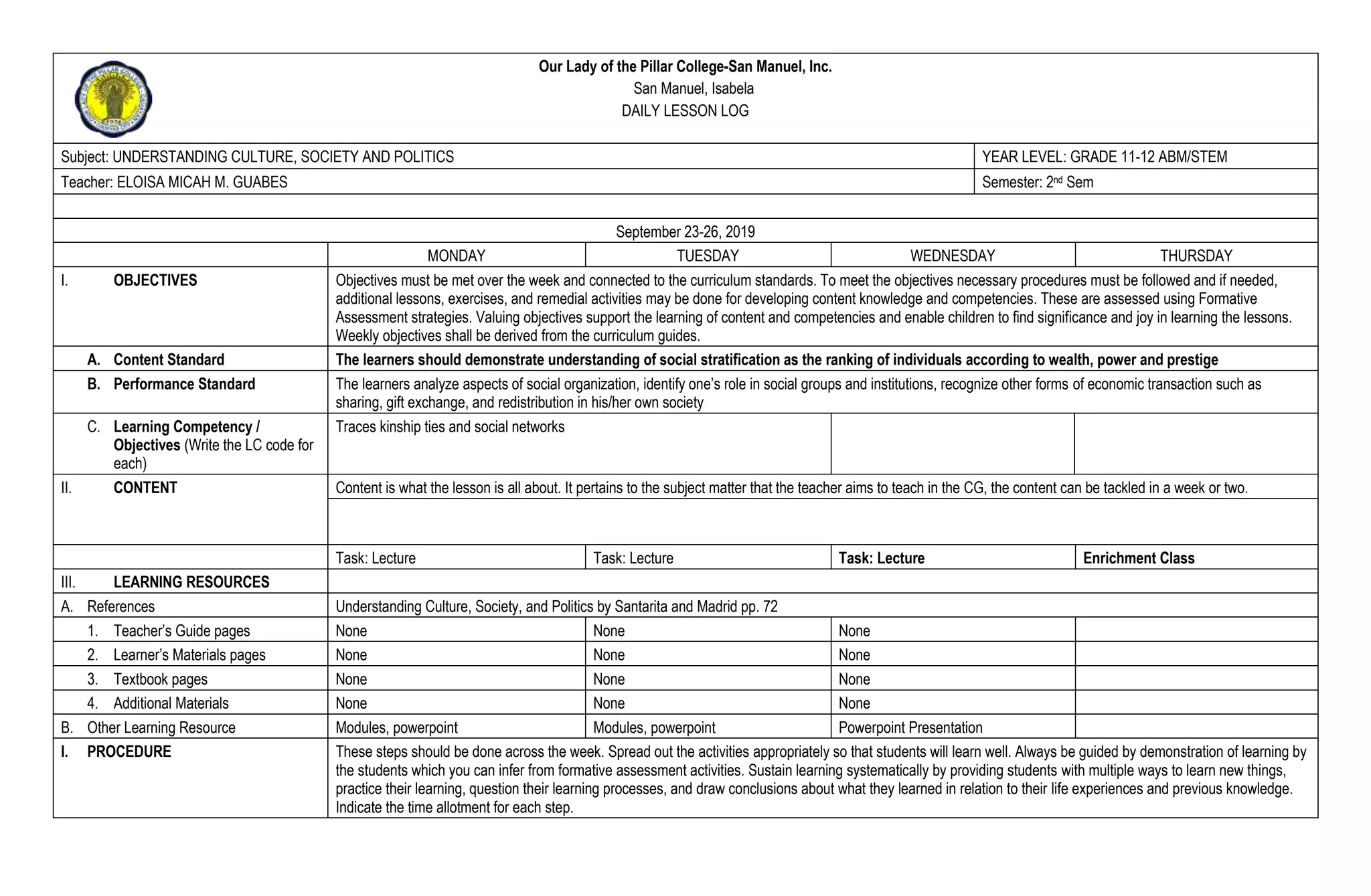
Preliminaries Preliminaries:
 Prayer
 Energizer
 Checking of Attendance
 Recapitulation
Management of Learning to be done
by students:
 Prayer
 Energizer
 Checking of Attendance
 Recapitulation
Management of Learning (MOL)
 Prayer
 Energizer
 Checking of Attendance
 Recapitulation
A. Reviewing previous lesson or
presenting the new lesson
Ask one student to summarize the
previous lesson.
Students will be asked about the
previous activity.
After presenting the lesson, activity will
be done to make the students recall
their past lesson.
B. Establishing purpose for the lesson Objectives of the lesson will be presented.
C. Presenting examples/Instances of the
new lesson
Discuss about how social networks are
formed.
“No man is an island”
Students will report the topic given to
them and they will be graded using the
following criteria:
Presentation – 15
Relevance – 15
Impact – 10
Cooperation – 10
Total of 50 points
The teacher will deepen the discussion
on kinship by marriage.
D. Discussing new concepts and
practicing new skills # 1
Students will be asked about their
families. The teacher should be
considerate in tackling this matter
because there might be students who
belong to broken families. Here are some
questions the teacher may ask?
1. Do you live together with your
parents?
2. With whom are you closer, mother of
father?
3. Are you close with your grandparents
in both sides?
With their groups, the students will be
submitting a video of an interview,
documentary, or movie of the following
kinship by marriage:
1. Monogamy
2. Polygamy
3. Polygyny
4. Polyandry
E. Discussing new concepts and
practicing new skills # 2
Selected students will share how they
are with their families.
F. Developing mastery
(leads to Formative Assessment)
Divide the class into 5 and give them the
following topics to be discussed:
1. Monogamy vs. polygamy
2. Post-marital residency rules
Students will be asked to answer
questions thrown by the teacher.
The students will be asked to
summarize what was discussed for the
day
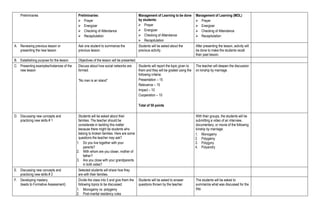
3. Preferred marriage partners and
divorce
4. Kinship by ritual
G. Finding practical application of
concepts and skills in daily living
Let the students search online or in the
library for articles that can help them
through their reports
The teacher will prepare the students
for a major quiz next meeting.
H. Making generalizations and
abstractions about the lesson
The class will then share insights on
the lesson discussed.
I. Evaluating learning
J. Additional activities for application or
remediation
II. REMARKS
III. REFLECTION Reflect on your teaching and assess yourself as a teacher. Think about your students’ progress this week. What works? What else needs to be done to help the
students learn? Identify what help your instructional supervisors can provide for you so when you meet them, you can ask them relevant questions.
A. No. of learners who earned 80% in the
evaluation
B. No. of learners who require additional
activities for remediation who scored
below 80%
C. Did the remedial lessons work? No. of
learners who have caught up with the
lesson
D. No. of learners who continue to require
remediation
E. Which of my teaching strategies
worked well? Why did these work?
F. What difficulties did I encounter which
my principal or supervisor can help me
solve?
G. What innovation or localized materials
did I use/discover which I wish to share
with other teachers?
Prepared by:
ELOISA MICAH M. GUABES, LPT
Subject Teacher
Checked by:
MARIJOE M. PIMENTEL, MAEd.
Academic Coordinator
Noted:
MARISSA F. PRUDENCIO, Ph.D.
Principal
433725411-UCSP-DLL-Q2-Week-7 (3).docx

433725411-UCSP-DLL-Q2-Week-7 (3).docx

  • 1.
    Our Lady ofthe Pillar College-San Manuel, Inc. San Manuel, Isabela DAILY LESSON LOG Subject: UNDERSTANDING CULTURE, SOCIETY AND POLITICS YEAR LEVEL: GRADE 11-12 ABM/STEM Teacher: ELOISA MICAH M. GUABES Semester: 2nd Sem September 23-26, 2019 MONDAY TUESDAY WEDNESDAY THURSDAY I. OBJECTIVES Objectives must be met over the week and connected to the curriculum standards. To meet the objectives necessary procedures must be followed and if needed, additional lessons, exercises, and remedial activities may be done for developing content knowledge and competencies. These are assessed using Formative Assessment strategies. Valuing objectives support the learning of content and competencies and enable children to find significance and joy in learning the lessons. Weekly objectives shall be derived from the curriculum guides. A. Content Standard The learners should demonstrate understanding of social stratification as the ranking of individuals according to wealth, power and prestige B. Performance Standard The learners analyze aspects of social organization, identify one’s role in social groups and institutions, recognize other forms of economic transaction such as sharing, gift exchange, and redistribution in his/her own society C. Learning Competency / Objectives (Write the LC code for each) Traces kinship ties and social networks II. CONTENT Content is what the lesson is all about. It pertains to the subject matter that the teacher aims to teach in the CG, the content can be tackled in a week or two. Task: Lecture Task: Lecture Task: Lecture Enrichment Class III. LEARNING RESOURCES A. References Understanding Culture, Society, and Politics by Santarita and Madrid pp. 72 1. Teacher’s Guide pages None None None 2. Learner’s Materials pages None None None 3. Textbook pages None None None 4. Additional Materials None None None B. Other Learning Resource Modules, powerpoint Modules, powerpoint Powerpoint Presentation I. PROCEDURE These steps should be done across the week. Spread out the activities appropriately so that students will learn well. Always be guided by demonstration of learning by the students which you can infer from formative assessment activities. Sustain learning systematically by providing students with multiple ways to learn new things, practice their learning, question their learning processes, and draw conclusions about what they learned in relation to their life experiences and previous knowledge. Indicate the time allotment for each step.
  • 2.
    Preliminaries Preliminaries:  Prayer Energizer  Checking of Attendance  Recapitulation Management of Learning to be done by students:  Prayer  Energizer  Checking of Attendance  Recapitulation Management of Learning (MOL)  Prayer  Energizer  Checking of Attendance  Recapitulation A. Reviewing previous lesson or presenting the new lesson Ask one student to summarize the previous lesson. Students will be asked about the previous activity. After presenting the lesson, activity will be done to make the students recall their past lesson. B. Establishing purpose for the lesson Objectives of the lesson will be presented. C. Presenting examples/Instances of the new lesson Discuss about how social networks are formed. “No man is an island” Students will report the topic given to them and they will be graded using the following criteria: Presentation – 15 Relevance – 15 Impact – 10 Cooperation – 10 Total of 50 points The teacher will deepen the discussion on kinship by marriage. D. Discussing new concepts and practicing new skills # 1 Students will be asked about their families. The teacher should be considerate in tackling this matter because there might be students who belong to broken families. Here are some questions the teacher may ask? 1. Do you live together with your parents? 2. With whom are you closer, mother of father? 3. Are you close with your grandparents in both sides? With their groups, the students will be submitting a video of an interview, documentary, or movie of the following kinship by marriage: 1. Monogamy 2. Polygamy 3. Polygyny 4. Polyandry E. Discussing new concepts and practicing new skills # 2 Selected students will share how they are with their families. F. Developing mastery (leads to Formative Assessment) Divide the class into 5 and give them the following topics to be discussed: 1. Monogamy vs. polygamy 2. Post-marital residency rules Students will be asked to answer questions thrown by the teacher. The students will be asked to summarize what was discussed for the day
  • 3.
    3. Preferred marriagepartners and divorce 4. Kinship by ritual G. Finding practical application of concepts and skills in daily living Let the students search online or in the library for articles that can help them through their reports The teacher will prepare the students for a major quiz next meeting. H. Making generalizations and abstractions about the lesson The class will then share insights on the lesson discussed. I. Evaluating learning J. Additional activities for application or remediation II. REMARKS III. REFLECTION Reflect on your teaching and assess yourself as a teacher. Think about your students’ progress this week. What works? What else needs to be done to help the students learn? Identify what help your instructional supervisors can provide for you so when you meet them, you can ask them relevant questions. A. No. of learners who earned 80% in the evaluation B. No. of learners who require additional activities for remediation who scored below 80% C. Did the remedial lessons work? No. of learners who have caught up with the lesson D. No. of learners who continue to require remediation E. Which of my teaching strategies worked well? Why did these work? F. What difficulties did I encounter which my principal or supervisor can help me solve? G. What innovation or localized materials did I use/discover which I wish to share with other teachers? Prepared by: ELOISA MICAH M. GUABES, LPT Subject Teacher Checked by: MARIJOE M. PIMENTEL, MAEd. Academic Coordinator Noted: MARISSA F. PRUDENCIO, Ph.D. Principal