Daily Lesson Plan
School: SIBALOM NATIONAL HIGH SCHOOL Grade Level: 12
Teacher: RUTHILIN D. RAMIRO Subject: PHILOSOPHY
Date and Time: January 8 - 9, 2024 Quarter: 2nd
I. OBJECTIVES
A. Content Standard  The learner understands the interplay between the individuality of human beings and their social contexts
B. Performance Standard
 The learner evaluates the formation of human relationships and how individuals are shaped by their social
contexts
C. Competency
 Compare different forms of societies and individualities (eg. Agrarian, industrial and virtual)
PPT11/12-IIg-7.2
D. Learning Objectives
At the end of the session, the students should be able to:
 recognize how individuals form societies and how individuals are transformed by societies
 compare different forms of societies and individualities
 explain how human relations are transformed by social systems; and
 evaluate how social systems transform human relationship and how societies transform individual human
beings.
II. CONTENT The Human Person in Society (Different forms of Society)
III. LEARNING RESOURCES
A. References Introduction to Philosophy of the Human Person Textbook by Roberto D. Abella, M.Div., D.Min
B. Other Learning
Resources
You tube, google
C. Subject Integration
Math, History
IV. PROCEDURES Teacher’s Activity Student’s Activity Annotations
Preliminaries
Preliminaries include:
1. Prayer
2. Greetings
3. Checking of Attendance
(Assigned student)
Class monitor checks the
attendance.
CO #5
Reviewing previous lesson
or presenting the new
lesson
Answer briefly.
1. What are the factors or influences that drove
human beings to establish societies?
2. What is being referred to as common good?
Possible Answers:
Safety and protection
Social conditions that enable
a person or group to fulfill
their goals and achieve well -
being
CO #1
Establishing a purpose for
the lesson
MOTIVATION:
GUESS WHAT?
ACTIVITY 1: Identify the forms of society shown.
Arrange the scrambled letters until you will get the
right term.
1. YTEICOS
2. NTINGHU
3. PASRALTO
4. DALUEF
5. RTLAUIV
Our objective for today’s lesson:
• recognize how individuals form societies and how
individuals are transformed by societies
• compare different forms of societies and
individualities
• explain how human relations are transformed by
social systems; and
• evaluate how social systems transform human
relationship and how societies transform
individual human beings.
.
SOCIETY
HUNTING
PASTORAL
FEUDAL
VIRTUAL
Presenting
Examples/Instances of the
new lesson
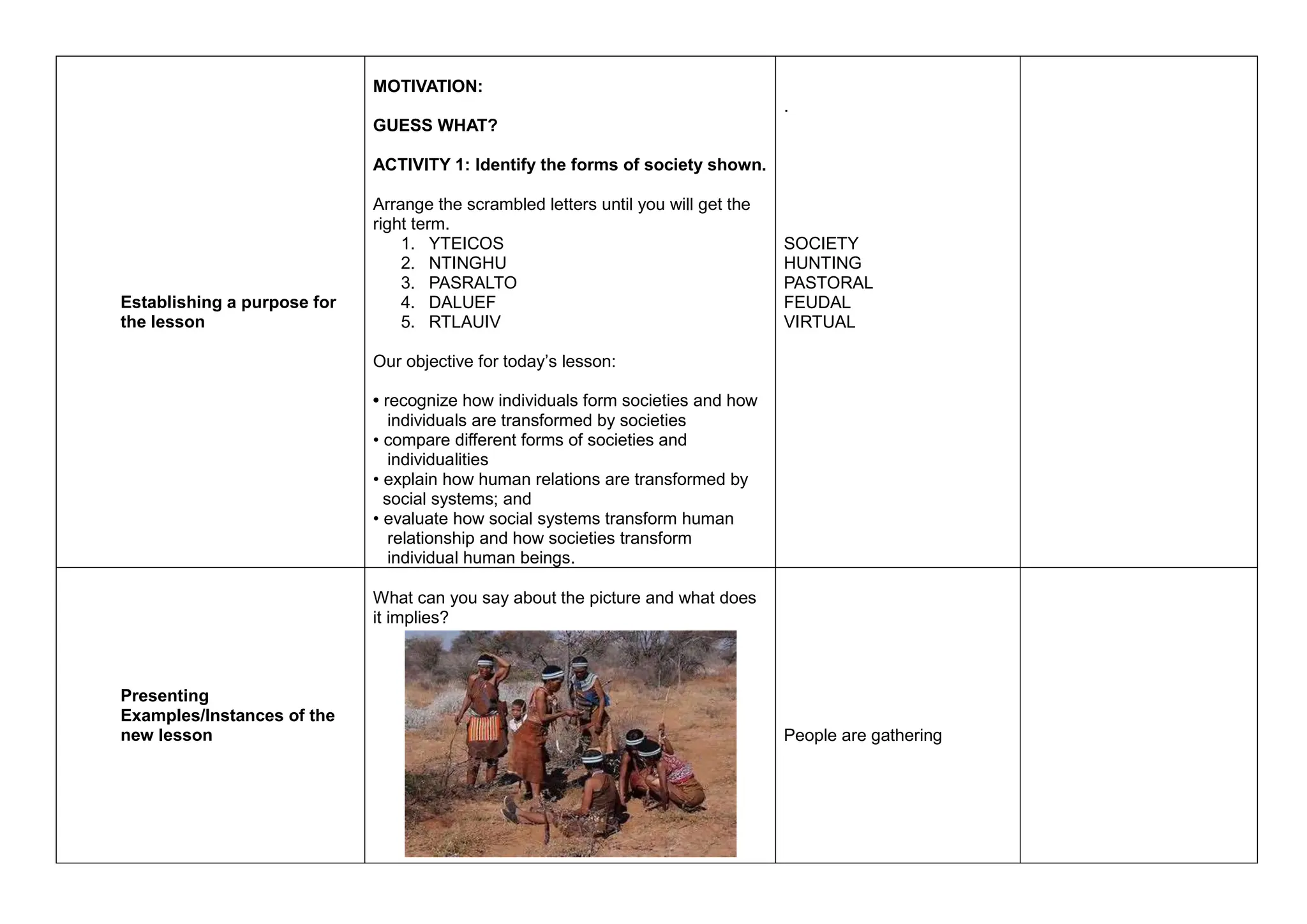
What can you say about the picture and what does
it implies?
People are gathering
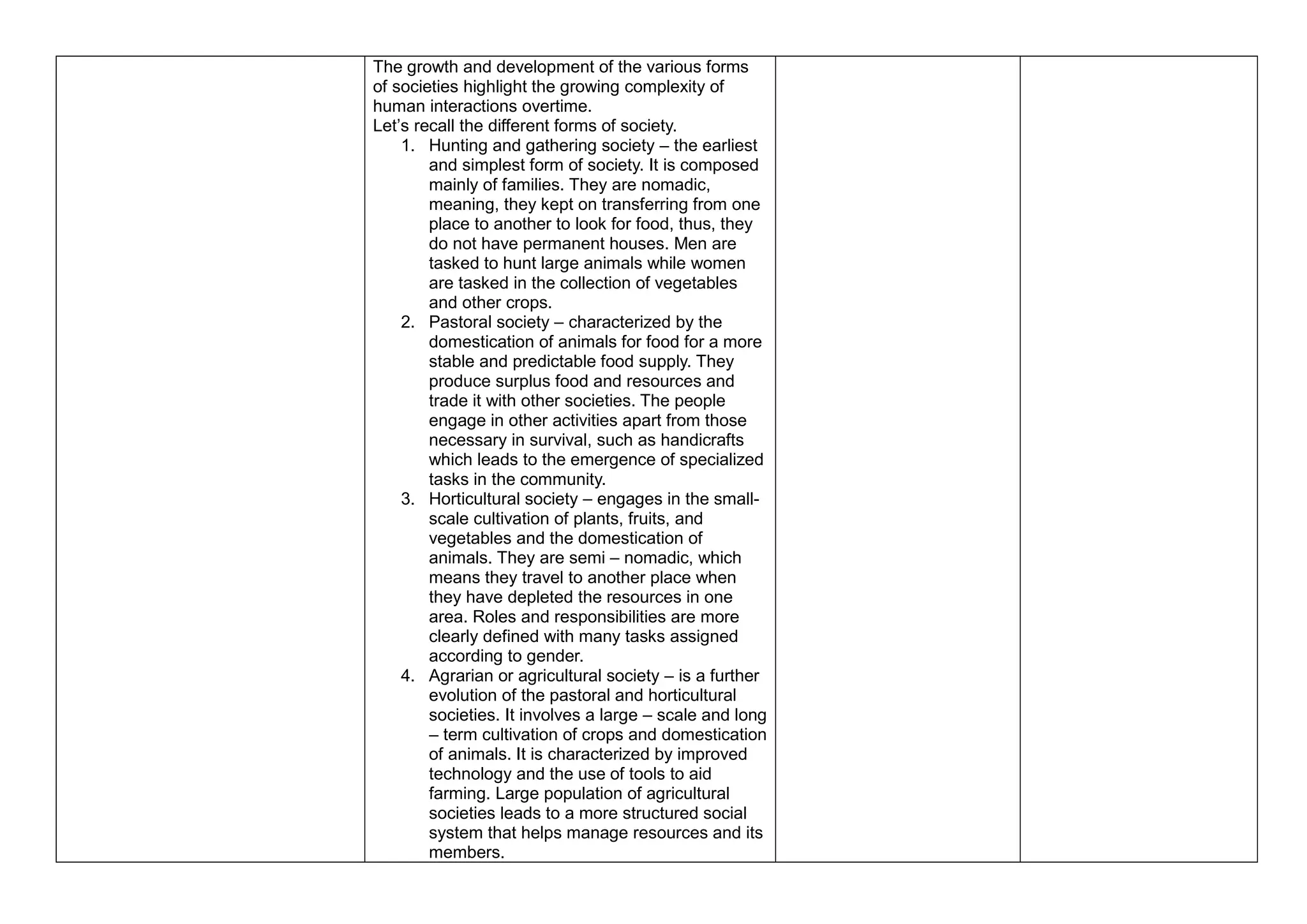
Medieval society
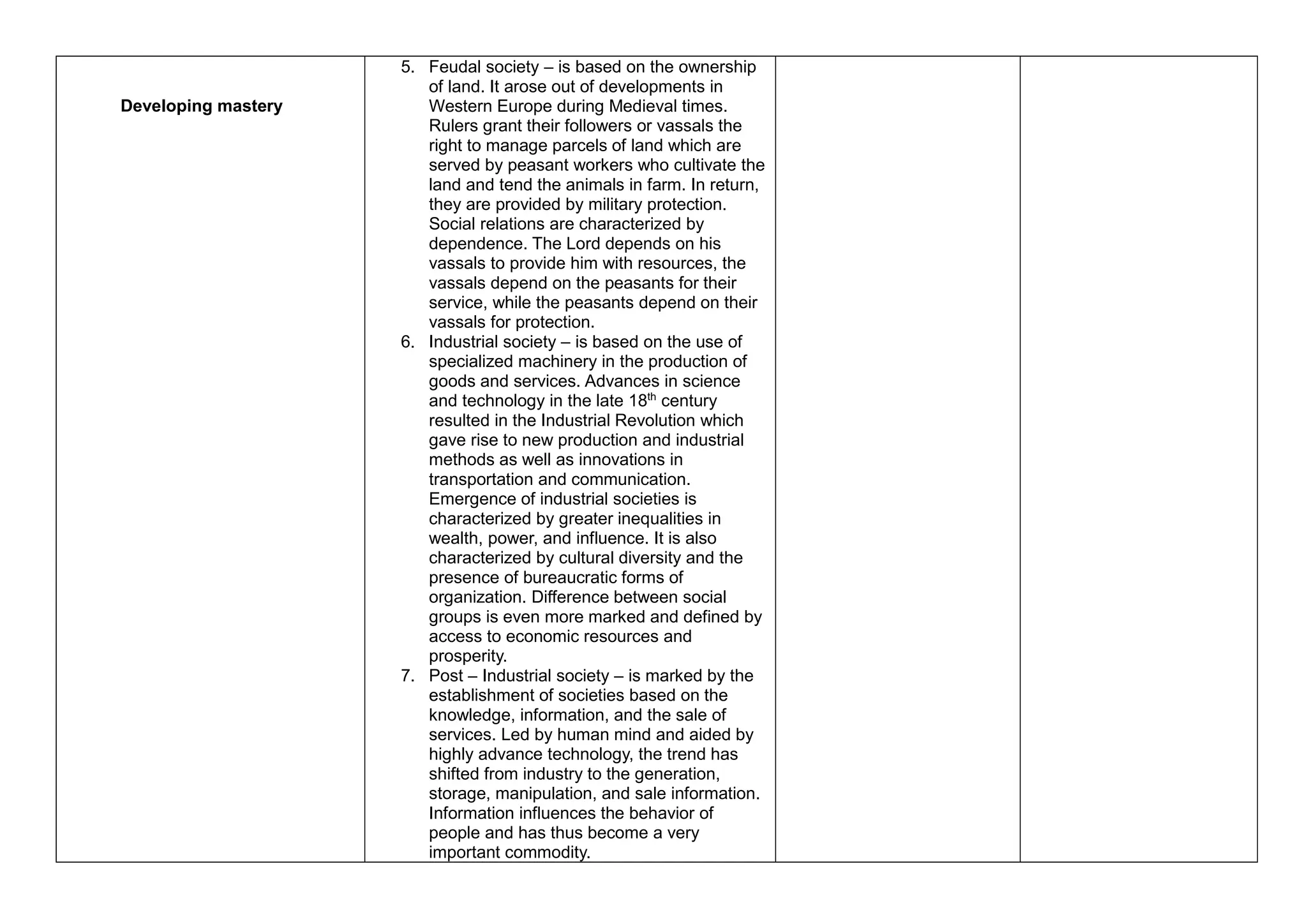
Virtual Society
Discussing new concepts and
practicing new skills #1 and/or #2
The development of societies shows the
development of humankind in response to changing
surroundings and historical developments.
Watch a video Presentation.
https://www.youtube.com/watch?v=CBjWqWOmHL
w
We will watch again a video of the different forms of
society.
https://www.youtube.com/watch?v=oBNeh_fRP2E
The growth and development of the various forms
of societies highlight the growing complexity of
human interactions overtime.
Let’s recall the different forms of society.
1. Hunting and gathering society – the earliest
and simplest form of society. It is composed
mainly of families. They are nomadic,
meaning, they kept on transferring from one
place to another to look for food, thus, they
do not have permanent houses. Men are
tasked to hunt large animals while women
are tasked in the collection of vegetables
and other crops.
2. Pastoral society – characterized by the
domestication of animals for food for a more
stable and predictable food supply. They
produce surplus food and resources and
trade it with other societies. The people
engage in other activities apart from those
necessary in survival, such as handicrafts
which leads to the emergence of specialized
tasks in the community.
3. Horticultural society – engages in the small-
scale cultivation of plants, fruits, and
vegetables and the domestication of
animals. They are semi – nomadic, which
means they travel to another place when
they have depleted the resources in one
area. Roles and responsibilities are more
clearly defined with many tasks assigned
according to gender.
4. Agrarian or agricultural society – is a further
evolution of the pastoral and horticultural
societies. It involves a large – scale and long
– term cultivation of crops and domestication
of animals. It is characterized by improved
technology and the use of tools to aid
farming. Large population of agricultural
societies leads to a more structured social
system that helps manage resources and its
members.
Developing mastery
5. Feudal society – is based on the ownership
of land. It arose out of developments in
Western Europe during Medieval times.
Rulers grant their followers or vassals the
right to manage parcels of land which are
served by peasant workers who cultivate the
land and tend the animals in farm. In return,
they are provided by military protection.
Social relations are characterized by
dependence. The Lord depends on his
vassals to provide him with resources, the
vassals depend on the peasants for their
service, while the peasants depend on their
vassals for protection.
6. Industrial society – is based on the use of
specialized machinery in the production of
goods and services. Advances in science
and technology in the late 18th
century
resulted in the Industrial Revolution which
gave rise to new production and industrial
methods as well as innovations in
transportation and communication.
Emergence of industrial societies is
characterized by greater inequalities in
wealth, power, and influence. It is also
characterized by cultural diversity and the
presence of bureaucratic forms of
organization. Difference between social
groups is even more marked and defined by
access to economic resources and
prosperity.
7. Post – Industrial society – is marked by the
establishment of societies based on the
knowledge, information, and the sale of
services. Led by human mind and aided by
highly advance technology, the trend has
shifted from industry to the generation,
storage, manipulation, and sale information.
Information influences the behavior of
people and has thus become a very
important commodity.
8. Virtual society – people organize themselves
through communication technology and the
Internet. It is a product of post – industrial
society. Individuals engage in complex
relationships. They have fluid identities and
do not necessarily subscribe to certain
norms or established standards of behavior.
The person is able to engage in various
activities, as well as access to various kinds
of information.
Finding
practical/applications of
concepts and skills in daily
living
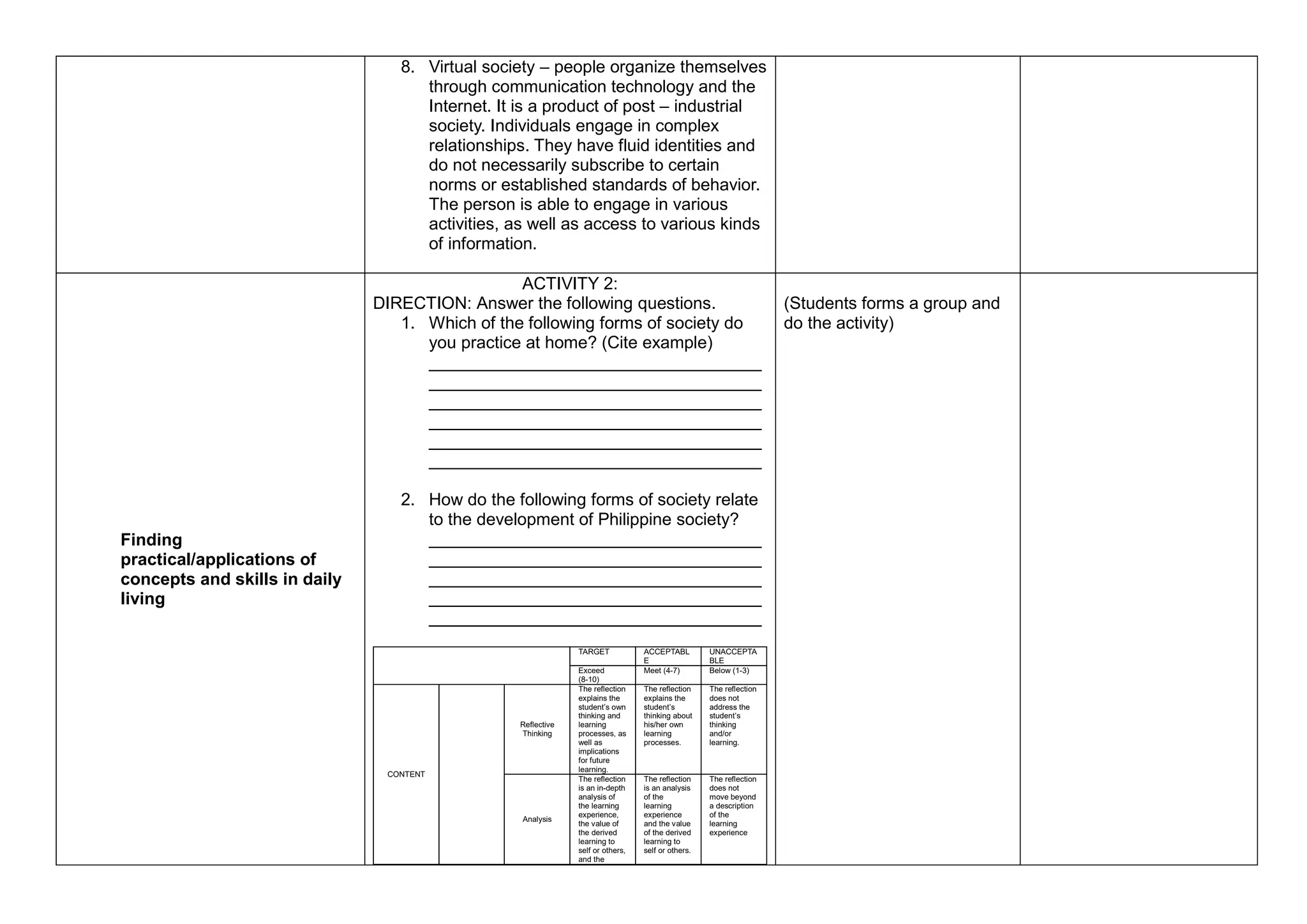
ACTIVITY 2:
DIRECTION: Answer the following questions.
1. Which of the following forms of society do
you practice at home? (Cite example)
___________________________________
___________________________________
___________________________________
___________________________________
___________________________________
___________________________________
2. How do the following forms of society relate
to the development of Philippine society?
___________________________________
___________________________________
___________________________________
___________________________________
___________________________________
TARGET ACCEPTABL
E
UNACCEPTA
BLE
Exceed
(8-10)
Meet (4-7) Below (1-3)
CONTENT
Reflective
Thinking
The reflection
explains the
student’s own
thinking and
learning
processes, as
well as
implications
for future
learning.
The reflection
explains the
student’s
thinking about
his/her own
learning
processes.
The reflection
does not
address the
student’s
thinking
and/or
learning.
Analysis
The reflection
is an in-depth
analysis of
the learning
experience,
the value of
the derived
learning to
self or others,
and the
The reflection
is an analysis
of the
learning
experience
and the value
of the derived
learning to
self or others.
The reflection
does not
move beyond
a description
of the
learning
experience
(Students forms a group and
do the activity)
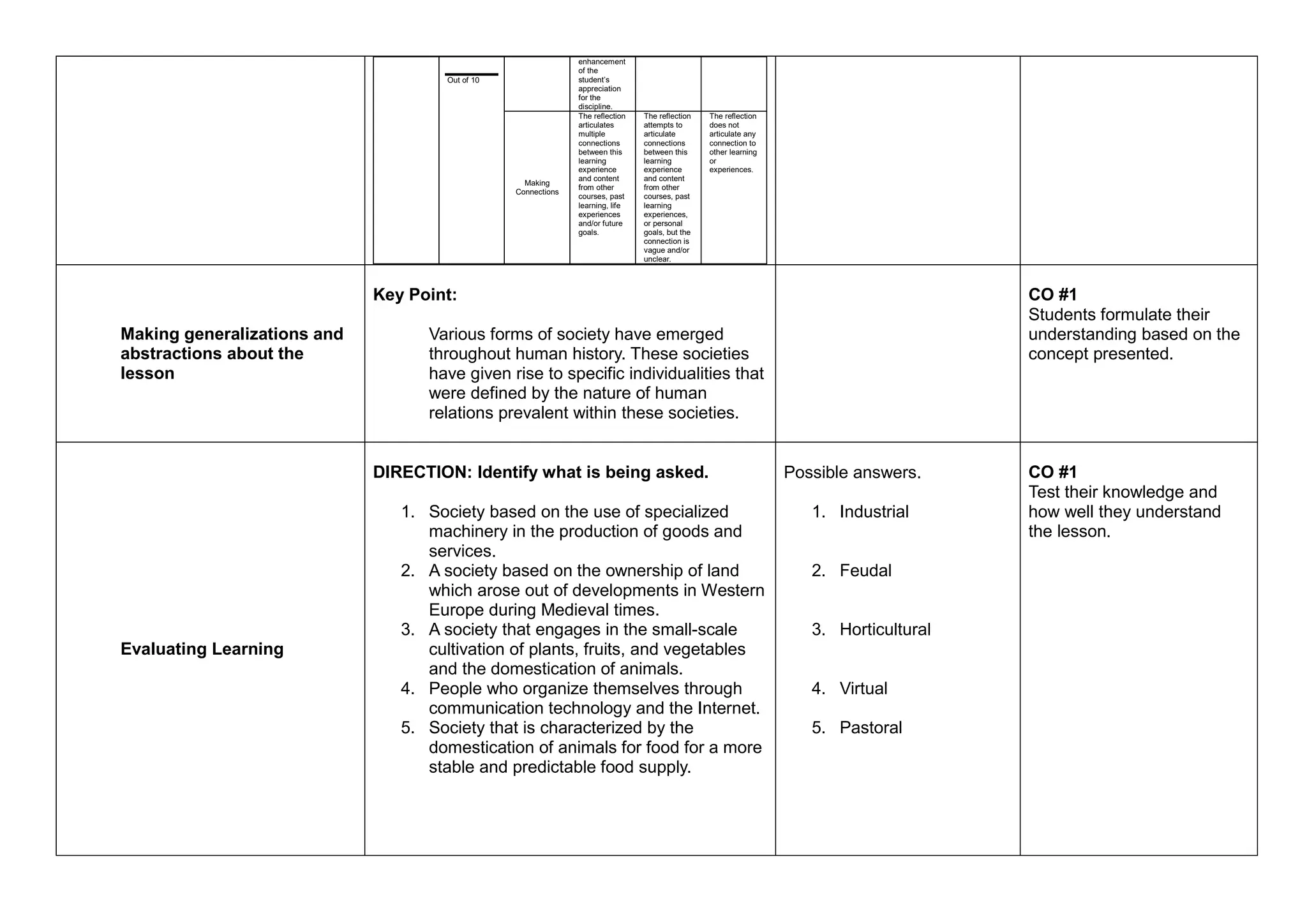
Out of 10
enhancement
of the
student’s
appreciation
for the
discipline.
Making
Connections
The reflection
articulates
multiple
connections
between this
learning
experience
and content
from other
courses, past
learning, life
experiences
and/or future
goals.
The reflection
attempts to
articulate
connections
between this
learning
experience
and content
from other
courses, past
learning
experiences,
or personal
goals, but the
connection is
vague and/or
unclear.
The reflection
does not
articulate any
connection to
other learning
or
experiences.
Making generalizations and
abstractions about the
lesson
Key Point:
Various forms of society have emerged
throughout human history. These societies
have given rise to specific individualities that
were defined by the nature of human
relations prevalent within these societies.
CO #1
Students formulate their
understanding based on the
concept presented.
Evaluating Learning
DIRECTION: Identify what is being asked.
1. Society based on the use of specialized
machinery in the production of goods and
services.
2. A society based on the ownership of land
which arose out of developments in Western
Europe during Medieval times.
3. A society that engages in the small-scale
cultivation of plants, fruits, and vegetables
and the domestication of animals.
4. People who organize themselves through
communication technology and the Internet.
5. Society that is characterized by the
domestication of animals for food for a more
stable and predictable food supply.
Possible answers.
1. Industrial
2. Feudal
3. Horticultural
4. Virtual
5. Pastoral
CO #1
Test their knowledge and
how well they understand
the lesson.
Additional Activities for
Application or Remediation
HOMEWORK:
Make a timeline identifying which period in
our history corresponds to each form of
society.
You will be graded using this rubric:
Criteria
Exemplary/
5
Good/ 4
Accept-
able/ 3
Unaccept-
able/ 1
Content
Balanced
Presentatio
n of
relevant
and
legitimate
information
that clearly
supports a
central
purpose or
argument
and shows
a
thoughtful,
in-depth
analysis of
a
significant
topic.
Reader
gains
important
insights.
Informatio
n provides
reasonabl
e support
for a
central
purpose or
argument
and
displays
evidence
of a basic
analysis of
a
significant
topic.
Reader
gains
some
insights.
Informatio
n
supports
a central
purpose
or
argument
at times.
Analysis
is basic
or
general.
Reader
gains few
insights.
Central
purpose or
argument
is not
clearly
identified.
Analysis is
vague or
not
evident.
Reader is
confused
or maybe
misinforme
d.
Organizati
on
The ideas
are
arranged
logically to
support the
purpose or
argument.
They flow
smoothly
from one to
another
and are
clearly
linked to
each other.
The reader
can follow
the line of
reasoning.
The ideas
are
arranged
logically to
support
the central
purpose or
argument.
They are
usually
clearly
linked to
each
other. For
the most
part, the
reader can
follow the
In
general,
the
writing is
arranged
logically,
although
occasion
ally ideas
fail to
make
sense
together.
The
reader is
fairly
clear
about
what
The writing
has little
personality
. The
reader
quickly
loses
interest
and stops
reading.
CO # 1
Students will be assigned to
search for some people who
had contributed something
for the community to
encourage them that they
could create their own
legacy in the society where
they belong.
line of
reasoning.
writer
intends.
Feel
The writing
is
compelling.
It hooks the
reader and
sustains
interests
throughout.
The writing
is
generally
engaging,
but has
some dry
spots. In
general, it
is focused
and keeps
the
reader’s
attention.
The
writing is
dull and
unengagi
ng.
Though
the paper
has some
interestin
g parts,
the
reader
finds it
difficult to
maintain
interest.
The writing
has little
personality
. The
reader
quickly
losses
interest
and stops
reading.
REMARKS:
V. REFLECTION
VI. No. of learners who earned 80%
on the formative assessment
A. No. of learners who require
additional activities for
remediation.
B. Did the remedial lessons
work? No. of learners who
have caught up with the
lesson.
C. No. of learners who
continue to require
remediation
D. Which of my teaching
strategies worked well?
Why did this work?
E. What difficulties did I
encounter which my
principal or supervisor can
help me solve?
F. What innovation or
localized materials did I
use/discover which I wish
to share with other
teachers?
Prepared by:
Ruthilin D. Ramiro
Subject Teacher
Reviewed by: Noted by:
SWEET EVEROSE E. ESTRELLA, MAEd ALJIM G. MILLAMENA, MAEd JAYSON N. GILLESANIA, MAEd
Subject Coordinator Master Teacher 1 Head Teacher Designate

Daily-Lesson-Plan-Human-Person-in-the-Society-Forms-of-Societies (1).docx

  • 1.
    Daily Lesson Plan School:SIBALOM NATIONAL HIGH SCHOOL Grade Level: 12 Teacher: RUTHILIN D. RAMIRO Subject: PHILOSOPHY Date and Time: January 8 - 9, 2024 Quarter: 2nd I. OBJECTIVES A. Content Standard  The learner understands the interplay between the individuality of human beings and their social contexts B. Performance Standard  The learner evaluates the formation of human relationships and how individuals are shaped by their social contexts C. Competency  Compare different forms of societies and individualities (eg. Agrarian, industrial and virtual) PPT11/12-IIg-7.2 D. Learning Objectives At the end of the session, the students should be able to:  recognize how individuals form societies and how individuals are transformed by societies  compare different forms of societies and individualities  explain how human relations are transformed by social systems; and  evaluate how social systems transform human relationship and how societies transform individual human beings. II. CONTENT The Human Person in Society (Different forms of Society) III. LEARNING RESOURCES A. References Introduction to Philosophy of the Human Person Textbook by Roberto D. Abella, M.Div., D.Min B. Other Learning Resources You tube, google C. Subject Integration Math, History IV. PROCEDURES Teacher’s Activity Student’s Activity Annotations Preliminaries Preliminaries include: 1. Prayer 2. Greetings 3. Checking of Attendance (Assigned student) Class monitor checks the attendance. CO #5 Reviewing previous lesson or presenting the new lesson Answer briefly. 1. What are the factors or influences that drove human beings to establish societies? 2. What is being referred to as common good? Possible Answers: Safety and protection Social conditions that enable a person or group to fulfill their goals and achieve well - being CO #1
  • 2.
    Establishing a purposefor the lesson MOTIVATION: GUESS WHAT? ACTIVITY 1: Identify the forms of society shown. Arrange the scrambled letters until you will get the right term. 1. YTEICOS 2. NTINGHU 3. PASRALTO 4. DALUEF 5. RTLAUIV Our objective for today’s lesson: • recognize how individuals form societies and how individuals are transformed by societies • compare different forms of societies and individualities • explain how human relations are transformed by social systems; and • evaluate how social systems transform human relationship and how societies transform individual human beings. . SOCIETY HUNTING PASTORAL FEUDAL VIRTUAL Presenting Examples/Instances of the new lesson What can you say about the picture and what does it implies? People are gathering
  • 3.
    Medieval society Virtual Society Discussingnew concepts and practicing new skills #1 and/or #2 The development of societies shows the development of humankind in response to changing surroundings and historical developments. Watch a video Presentation. https://www.youtube.com/watch?v=CBjWqWOmHL w We will watch again a video of the different forms of society. https://www.youtube.com/watch?v=oBNeh_fRP2E
  • 4.
    The growth anddevelopment of the various forms of societies highlight the growing complexity of human interactions overtime. Let’s recall the different forms of society. 1. Hunting and gathering society – the earliest and simplest form of society. It is composed mainly of families. They are nomadic, meaning, they kept on transferring from one place to another to look for food, thus, they do not have permanent houses. Men are tasked to hunt large animals while women are tasked in the collection of vegetables and other crops. 2. Pastoral society – characterized by the domestication of animals for food for a more stable and predictable food supply. They produce surplus food and resources and trade it with other societies. The people engage in other activities apart from those necessary in survival, such as handicrafts which leads to the emergence of specialized tasks in the community. 3. Horticultural society – engages in the small- scale cultivation of plants, fruits, and vegetables and the domestication of animals. They are semi – nomadic, which means they travel to another place when they have depleted the resources in one area. Roles and responsibilities are more clearly defined with many tasks assigned according to gender. 4. Agrarian or agricultural society – is a further evolution of the pastoral and horticultural societies. It involves a large – scale and long – term cultivation of crops and domestication of animals. It is characterized by improved technology and the use of tools to aid farming. Large population of agricultural societies leads to a more structured social system that helps manage resources and its members.
  • 5.
    Developing mastery 5. Feudalsociety – is based on the ownership of land. It arose out of developments in Western Europe during Medieval times. Rulers grant their followers or vassals the right to manage parcels of land which are served by peasant workers who cultivate the land and tend the animals in farm. In return, they are provided by military protection. Social relations are characterized by dependence. The Lord depends on his vassals to provide him with resources, the vassals depend on the peasants for their service, while the peasants depend on their vassals for protection. 6. Industrial society – is based on the use of specialized machinery in the production of goods and services. Advances in science and technology in the late 18th century resulted in the Industrial Revolution which gave rise to new production and industrial methods as well as innovations in transportation and communication. Emergence of industrial societies is characterized by greater inequalities in wealth, power, and influence. It is also characterized by cultural diversity and the presence of bureaucratic forms of organization. Difference between social groups is even more marked and defined by access to economic resources and prosperity. 7. Post – Industrial society – is marked by the establishment of societies based on the knowledge, information, and the sale of services. Led by human mind and aided by highly advance technology, the trend has shifted from industry to the generation, storage, manipulation, and sale information. Information influences the behavior of people and has thus become a very important commodity.
  • 6.
    8. Virtual society– people organize themselves through communication technology and the Internet. It is a product of post – industrial society. Individuals engage in complex relationships. They have fluid identities and do not necessarily subscribe to certain norms or established standards of behavior. The person is able to engage in various activities, as well as access to various kinds of information. Finding practical/applications of concepts and skills in daily living ACTIVITY 2: DIRECTION: Answer the following questions. 1. Which of the following forms of society do you practice at home? (Cite example) ___________________________________ ___________________________________ ___________________________________ ___________________________________ ___________________________________ ___________________________________ 2. How do the following forms of society relate to the development of Philippine society? ___________________________________ ___________________________________ ___________________________________ ___________________________________ ___________________________________ TARGET ACCEPTABL E UNACCEPTA BLE Exceed (8-10) Meet (4-7) Below (1-3) CONTENT Reflective Thinking The reflection explains the student’s own thinking and learning processes, as well as implications for future learning. The reflection explains the student’s thinking about his/her own learning processes. The reflection does not address the student’s thinking and/or learning. Analysis The reflection is an in-depth analysis of the learning experience, the value of the derived learning to self or others, and the The reflection is an analysis of the learning experience and the value of the derived learning to self or others. The reflection does not move beyond a description of the learning experience (Students forms a group and do the activity)
  • 7.
    Out of 10 enhancement ofthe student’s appreciation for the discipline. Making Connections The reflection articulates multiple connections between this learning experience and content from other courses, past learning, life experiences and/or future goals. The reflection attempts to articulate connections between this learning experience and content from other courses, past learning experiences, or personal goals, but the connection is vague and/or unclear. The reflection does not articulate any connection to other learning or experiences. Making generalizations and abstractions about the lesson Key Point: Various forms of society have emerged throughout human history. These societies have given rise to specific individualities that were defined by the nature of human relations prevalent within these societies. CO #1 Students formulate their understanding based on the concept presented. Evaluating Learning DIRECTION: Identify what is being asked. 1. Society based on the use of specialized machinery in the production of goods and services. 2. A society based on the ownership of land which arose out of developments in Western Europe during Medieval times. 3. A society that engages in the small-scale cultivation of plants, fruits, and vegetables and the domestication of animals. 4. People who organize themselves through communication technology and the Internet. 5. Society that is characterized by the domestication of animals for food for a more stable and predictable food supply. Possible answers. 1. Industrial 2. Feudal 3. Horticultural 4. Virtual 5. Pastoral CO #1 Test their knowledge and how well they understand the lesson.
  • 8.
    Additional Activities for Applicationor Remediation HOMEWORK: Make a timeline identifying which period in our history corresponds to each form of society. You will be graded using this rubric: Criteria Exemplary/ 5 Good/ 4 Accept- able/ 3 Unaccept- able/ 1 Content Balanced Presentatio n of relevant and legitimate information that clearly supports a central purpose or argument and shows a thoughtful, in-depth analysis of a significant topic. Reader gains important insights. Informatio n provides reasonabl e support for a central purpose or argument and displays evidence of a basic analysis of a significant topic. Reader gains some insights. Informatio n supports a central purpose or argument at times. Analysis is basic or general. Reader gains few insights. Central purpose or argument is not clearly identified. Analysis is vague or not evident. Reader is confused or maybe misinforme d. Organizati on The ideas are arranged logically to support the purpose or argument. They flow smoothly from one to another and are clearly linked to each other. The reader can follow the line of reasoning. The ideas are arranged logically to support the central purpose or argument. They are usually clearly linked to each other. For the most part, the reader can follow the In general, the writing is arranged logically, although occasion ally ideas fail to make sense together. The reader is fairly clear about what The writing has little personality . The reader quickly loses interest and stops reading. CO # 1 Students will be assigned to search for some people who had contributed something for the community to encourage them that they could create their own legacy in the society where they belong.
  • 9.
    line of reasoning. writer intends. Feel The writing is compelling. Ithooks the reader and sustains interests throughout. The writing is generally engaging, but has some dry spots. In general, it is focused and keeps the reader’s attention. The writing is dull and unengagi ng. Though the paper has some interestin g parts, the reader finds it difficult to maintain interest. The writing has little personality . The reader quickly losses interest and stops reading. REMARKS: V. REFLECTION VI. No. of learners who earned 80% on the formative assessment A. No. of learners who require additional activities for remediation. B. Did the remedial lessons work? No. of learners who have caught up with the lesson. C. No. of learners who continue to require remediation D. Which of my teaching strategies worked well? Why did this work? E. What difficulties did I encounter which my principal or supervisor can help me solve? F. What innovation or localized materials did I use/discover which I wish
  • 10.
    to share withother teachers? Prepared by: Ruthilin D. Ramiro Subject Teacher Reviewed by: Noted by: SWEET EVEROSE E. ESTRELLA, MAEd ALJIM G. MILLAMENA, MAEd JAYSON N. GILLESANIA, MAEd Subject Coordinator Master Teacher 1 Head Teacher Designate