I.F.D.C. LENGUAS VIVAS
TALLER DE PRÁCTICA DOCENTE
ALUMNO RESIDENTE: Dario Bressan
Período de Práctica: Nivel Inicial
Institución Educativa: Colegio Santa Eufrasia
Dirección: Maria Olguín 953
Sala / Grado / Año - sección: Sala de 5 años
Cantidad de alumnos: 25 estudiantes
Nivel lingüístico del curso: Principiantes
Tipo de Planificación: Clase
Unidad Temática: Partes de la casa
Clase Nº: 3
Fecha: 10/06/2015
Hora: 15:30-16:15
Duración de la clase: 45 minutos
Teaching points: Revising parts of the house (My house - Living room - Bedroom - Bathroom -
Kitchen)
Aims or goals:
During this lesson, learners will be able to…
- To revise the already learnt vocabulary by identify them in several images.
- To develop their speaking skills by naming the parts of the house.
- To practice their listening skills by listening to songs from a CD.
- To name parts of the house in meaningful contexts.
Language Focus:
Lexis Function Structure Pronunciation
Revision House
Living room
Bedroom
Bathroom
Naming parts of
the house.
My house
The living room
The bathroom
Room /u:/
New Kitchen Naming parts of
the house
This is my house
This is the living
room
This is the
bathroom
Kitchen / ʃ/
Teaching Approach: The lesson is based on Krashen's Natural Approach and organized under
PPP as proposed by Jeremy Harmer.
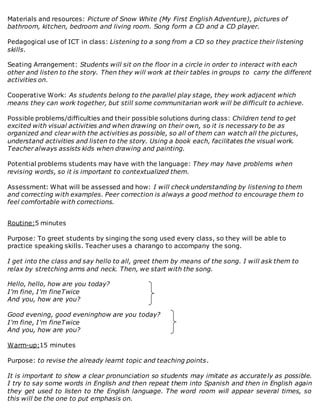
Materials and resources: Picture of Snow White (My First English Adventure), pictures of
bathroom, kitchen, bedroom and living room. Song form a CD and a CD player.
Pedagogical use of ICT in class: Listening to a song from a CD so they practice their listening
skills.
Seating Arrangement: Students will sit on the floor in a circle in order to interact with each
other and listen to the story. Then they will work at their tables in groups to carry the different
activities on.
Cooperative Work: As students belong to the parallel play stage, they work adjacent which
means they can work together, but still some communitarian work will be difficult to achieve.
Possible problems/difficulties and their possible solutions during class: Children tend to get
excited with visual activities and when drawing on their own, so it is necessary to be as
organized and clear with the activities as possible, so all of them can watch all the pictures,
understand activities and listen to the story. Using a book each, facilitates the visual work.
Teacher always assists kids when drawing and painting.
Potential problems students may have with the language: They may have problems when
revising words, so it is important to contextualized them.
Assessment: What will be assessed and how: I will check understanding by listening to them
and correcting with examples. Peer correction is always a good method to encourage them to
feel comfortable with corrections.
Routine:5 minutes
Purpose: To greet students by singing the song used every class, so they will be able to
practice speaking skills. Teacher uses a charango to accompany the song.
I get into the class and say hello to all, greet them by means of the song. I will ask them to
relax by stretching arms and neck. Then, we start with the song.
Hello, hello, how are you today?
I'm fine, I'm fineTwice
And you, how are you?
Good evening, good eveninghow are you today?
I'm fine, I'm fineTwice
And you, how are you?
Warm-up:15 minutes
Purpose: to revise the already learnt topic and teaching points.
It is important to show a clear pronunciation so students may imitate as accurately as possible.
I try to say some words in English and then repeat them into Spanish and then in English again
they get used to listen to the English language. The word room will appear several times, so
this will be the one to put emphasis on.
T: Hello children, how are you today? Do you remember the tale of last class? Sts: Yes, Snow
White! T: Excellent!! Look at the pictures.
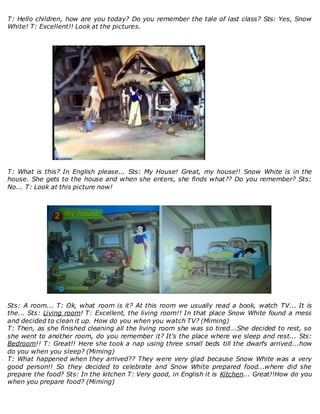
T: What is this? In English please... Sts: My House! Great, my house!! Snow White is in the
house. She gets to the house and when she enters, she finds what?? Do you remember? Sts:
No... T: Look at this picture now!
Sts: A room... T: Ok, what room is it? At this room we usually read a book, watch TV... It is
the... Sts: Living room! T: Excellent, the living room!! In that place Snow White found a mess
and decided to clean it up. How do you when you watch TV? (Miming)
T: Then, as she finished cleaning all the living room she was so tired...She decided to rest, so
she went to another room, do you remember it? It's the place where we sleep and rest... Sts:
Bedroom!! T: Great!! Here she took a nap using three small beds till the dwarfs arrived...how
do you when you sleep? (Miming)
T: What happened when they arrived?? They were very glad because Snow White was a very
good person!! So they decided to celebrate and Snow White prepared food...where did she
prepare the food? Sts: In the kitchen T: Very good, in English it is Kitchen... Great!!How do you
when you prepare food? (Miming)
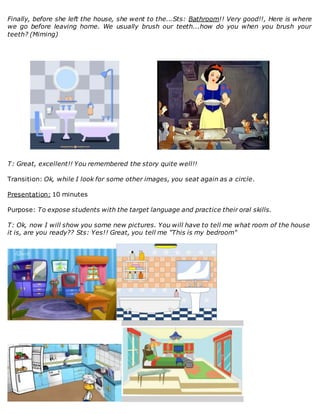
Finally, before she left the house, she went to the...Sts: Bathroom!! Very good!!, Here is where
we go before leaving home. We usually brush our teeth...how do you when you brush your
teeth? (Miming)
T: Great, excellent!! You remembered the story quite well!!
Transition: Ok, while I look for some other images, you seat again as a circle.
Presentation: 10 minutes
Purpose: To expose students with the target language and practice their oral skills.
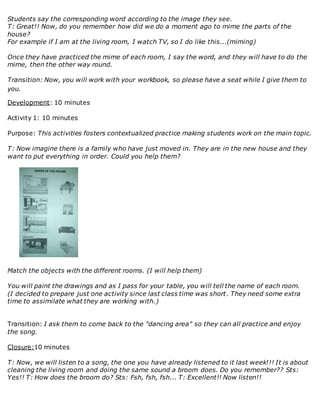
T: Ok, now I will show you some new pictures. You will have to tell me what room of the house
it is, are you ready?? Sts: Yes!! Great, you tell me "This is my bedroom"
Students say the corresponding word according to the image they see.
T: Great!! Now, do you remember how did we do a moment ago to mime the parts of the
house?
For example if I am at the living room, I watch TV, so I do like this...(miming)
Once they have practiced the mime of each room, I say the word, and they will have to do the
mime, then the other way round.
Transition: Now, you will work with your workbook, so please have a seat while I give them to
you.
Development: 10 minutes
Activity 1: 10 minutes
Purpose: This activities fosters contextualized practice making students work on the main topic.
T: Now imagine there is a family who have just moved in. They are in the new house and they
want to put everything in order. Could you help them?
Match the objects with the different rooms. (I will help them)
You will paint the drawings and as I pass for your table, you will tell the name of each room.
(I decided to prepare just one activity since last class time was short. They need some extra
time to assimilate what they are working with.)
Transition: I ask them to come back to the "dancing area" so they can all practice and enjoy
the song.
Closure:10 minutes
T: Now, we will listen to a song, the one you have already listened to it last week!!! It is about
cleaning the living room and doing the same sound a broom does. Do you remember?? Sts:
Yes!! T: How does the broom do? Sts: Fsh, fsh, fsh... T: Excellent!! Now listen!!
08-AudioTrack 08.mp3
The living room, the living room, let's clean the living room!!!
Fsh, fsh, fsh
The living room, the living room, let's clean the living room!!!
Fsh, fsh, fsh
The living room, the living room, let's clean the living room!!!
Fsh, fsh, fsh
Ok kids, it was very nice to work with you, see you later!!
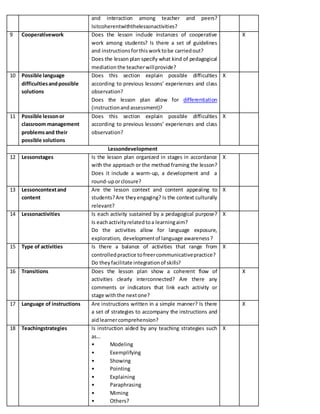
Taller de Práctica Docente 2015
Lessonplancriteria Peer and Self-check Yes No
1 Heading Does the lesson plan heading include all the required
information? HasitbeencompletedinSpanish?
X
2 Learningaims Are the aims for this lesson devised in terms of
development of language skills and language learning
/ acquisition?
Are they clearly written to explain what the learners
will learnandbe able to do?
X
3 Teachingpoints Are there any new teachingpoints?
Are the teaching points aligned with the course
syllabusandthe districtcurriculum?
Are theypresentedwithinameaningful context?
X
4 Languagefocuschart Are the newand revisionlanguage itemsspecified?
Are the newand revisionlanguage items related?
Is the pronunciationfocuscomplete?
x
5 TeachingApproach Is the approach you chose suitable for your teaching
context?
Are its aims and fundamentals coherent with the
lessonaims?
X
6 Materialsand resources Does the lesson plan include all the required
materialsandresourcesforthislesson?
Does it include handouts, links, video scripts and
sample flashcards?
Are these materials and resources
coherently/adequatelyincludedinthe lessonplan?
X
7 Pedagogical use of ICT Does the lesson plan make meaningful pedagogical
uses of ICT? Does it include a contingency plan in
case technologydoesnotwork?
x
8 Seatingarrangement Does the seating arrangement foster communication x
and interaction among teacher and peers?
Isitcoherentwiththelessonactivities?
9 Cooperativework Does the lesson include instances of cooperative
work among students? Is there a set of guidelines
and instructionsforthisworktobe carriedout?
Does the lesson plan specify what kind of pedagogical
mediation the teacherwillprovide?
X
10 Possible language
difficultiesandpossible
solutions
Does this section explain possible difficulties
according to previous lessons’ experiences and class
observation?
Does the lesson plan allow for differentiation
(instructionandassessment)?
X
11 Possible lessonor
classroom management
problemsand their
possible solutions
Does this section explain possible difficulties
according to previous lessons’ experiences and class
observation?
X
Lessondevelopment
12 Lessonstages Is the lesson plan organized in stages in accordance
with the approach or the method framing the lesson?
Does it include a warm-up, a development and a
round-uporclosure?
X
13 Lessoncontextand
content
Are the lesson context and content appealing to
students?Are theyengaging? Is the context culturally
relevant?
X
14 Lessonactivities Is each activity sustained by a pedagogical purpose?
Is eachactivityrelatedtoa learningaim?
Do the activities allow for language exposure,
exploration, developmentof language awareness?
X
15 Type of activities Is there a balance of activities that range from
controlledpractice tofreercommunicativepractice?
Do theyfacilitate integrationof skills?
X
16 Transitions Does the lesson plan show a coherent flow of
activities clearly interconnected? Are there any
comments or indicators that link each activity or
stage withthe nextone?
X
17 Language of instructions Are instructions written in a simple manner? Is there
a set of strategies to accompany the instructions and
aidlearnercomprehension?
X
18 Teachingstrategies Is instruction aided by any teaching strategies such
as…
• Modeling
• Exemplifying
• Showing
• Pointing
• Explaining
• Paraphrasing
• Miming
• Others?
X
19 Directspeech Are all instructions and possible anticipated dialogues
writtenindirectspeech?
X
20 Homework Does the lesson plan include any task to do at home?
Is the task engaging? Will students feel motivated to
perform it? Will the students be in direct contact
with the language? Willthey share
theirworkwiththeclass?
X
21 Active
learning:Bloom’sTaxonomy
2001
Are many learning tasks addressing a higher level of
Bloom’staxonomy?
X
22 Grammar, Appearance,
and Language
Does the lesson plan effectively communicate to the
intended audience? Has it gone through proof-
readingforgrammar and spellingmistakes?
x
Observations:
Dear Darío
Thisplan seemsto be fine andI can see your effort.However,there are certainaspects regardingaims,
purposesof activities andlanguage toimprove .
If you have any questions,donothesitate tocontact me.
I hope youhad a great class!
Eugenia
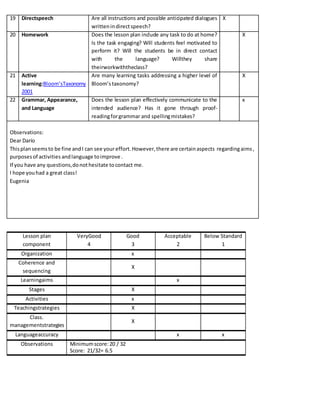
Lesson plan
component
VeryGood
4
Good
3
Acceptable
2
Below Standard
1
Organization x
Coherence and
sequencing
X
Learningaims x
Stages X
Activities x
Teachingstrategies X
Class.
managementstrategies
X
Languageaccuracy x x
Observations Minimumscore:20 / 32
Score: 21/32= 6.5

Lesson Plan Kinder 3

  • 1.
    I.F.D.C. LENGUAS VIVAS TALLERDE PRÁCTICA DOCENTE ALUMNO RESIDENTE: Dario Bressan Período de Práctica: Nivel Inicial Institución Educativa: Colegio Santa Eufrasia Dirección: Maria Olguín 953 Sala / Grado / Año - sección: Sala de 5 años Cantidad de alumnos: 25 estudiantes Nivel lingüístico del curso: Principiantes Tipo de Planificación: Clase Unidad Temática: Partes de la casa Clase Nº: 3 Fecha: 10/06/2015 Hora: 15:30-16:15 Duración de la clase: 45 minutos Teaching points: Revising parts of the house (My house - Living room - Bedroom - Bathroom - Kitchen) Aims or goals: During this lesson, learners will be able to… - To revise the already learnt vocabulary by identify them in several images. - To develop their speaking skills by naming the parts of the house. - To practice their listening skills by listening to songs from a CD. - To name parts of the house in meaningful contexts. Language Focus: Lexis Function Structure Pronunciation Revision House Living room Bedroom Bathroom Naming parts of the house. My house The living room The bathroom Room /u:/ New Kitchen Naming parts of the house This is my house This is the living room This is the bathroom Kitchen / ʃ/ Teaching Approach: The lesson is based on Krashen's Natural Approach and organized under PPP as proposed by Jeremy Harmer.
  • 2.
    Materials and resources:Picture of Snow White (My First English Adventure), pictures of bathroom, kitchen, bedroom and living room. Song form a CD and a CD player. Pedagogical use of ICT in class: Listening to a song from a CD so they practice their listening skills. Seating Arrangement: Students will sit on the floor in a circle in order to interact with each other and listen to the story. Then they will work at their tables in groups to carry the different activities on. Cooperative Work: As students belong to the parallel play stage, they work adjacent which means they can work together, but still some communitarian work will be difficult to achieve. Possible problems/difficulties and their possible solutions during class: Children tend to get excited with visual activities and when drawing on their own, so it is necessary to be as organized and clear with the activities as possible, so all of them can watch all the pictures, understand activities and listen to the story. Using a book each, facilitates the visual work. Teacher always assists kids when drawing and painting. Potential problems students may have with the language: They may have problems when revising words, so it is important to contextualized them. Assessment: What will be assessed and how: I will check understanding by listening to them and correcting with examples. Peer correction is always a good method to encourage them to feel comfortable with corrections. Routine:5 minutes Purpose: To greet students by singing the song used every class, so they will be able to practice speaking skills. Teacher uses a charango to accompany the song. I get into the class and say hello to all, greet them by means of the song. I will ask them to relax by stretching arms and neck. Then, we start with the song. Hello, hello, how are you today? I'm fine, I'm fineTwice And you, how are you? Good evening, good eveninghow are you today? I'm fine, I'm fineTwice And you, how are you? Warm-up:15 minutes Purpose: to revise the already learnt topic and teaching points. It is important to show a clear pronunciation so students may imitate as accurately as possible. I try to say some words in English and then repeat them into Spanish and then in English again they get used to listen to the English language. The word room will appear several times, so this will be the one to put emphasis on.
  • 3.
    T: Hello children,how are you today? Do you remember the tale of last class? Sts: Yes, Snow White! T: Excellent!! Look at the pictures. T: What is this? In English please... Sts: My House! Great, my house!! Snow White is in the house. She gets to the house and when she enters, she finds what?? Do you remember? Sts: No... T: Look at this picture now! Sts: A room... T: Ok, what room is it? At this room we usually read a book, watch TV... It is the... Sts: Living room! T: Excellent, the living room!! In that place Snow White found a mess and decided to clean it up. How do you when you watch TV? (Miming) T: Then, as she finished cleaning all the living room she was so tired...She decided to rest, so she went to another room, do you remember it? It's the place where we sleep and rest... Sts: Bedroom!! T: Great!! Here she took a nap using three small beds till the dwarfs arrived...how do you when you sleep? (Miming) T: What happened when they arrived?? They were very glad because Snow White was a very good person!! So they decided to celebrate and Snow White prepared food...where did she prepare the food? Sts: In the kitchen T: Very good, in English it is Kitchen... Great!!How do you when you prepare food? (Miming)
  • 4.
    Finally, before sheleft the house, she went to the...Sts: Bathroom!! Very good!!, Here is where we go before leaving home. We usually brush our teeth...how do you when you brush your teeth? (Miming) T: Great, excellent!! You remembered the story quite well!! Transition: Ok, while I look for some other images, you seat again as a circle. Presentation: 10 minutes Purpose: To expose students with the target language and practice their oral skills. T: Ok, now I will show you some new pictures. You will have to tell me what room of the house it is, are you ready?? Sts: Yes!! Great, you tell me "This is my bedroom"
  • 5.
    Students say thecorresponding word according to the image they see. T: Great!! Now, do you remember how did we do a moment ago to mime the parts of the house? For example if I am at the living room, I watch TV, so I do like this...(miming) Once they have practiced the mime of each room, I say the word, and they will have to do the mime, then the other way round. Transition: Now, you will work with your workbook, so please have a seat while I give them to you. Development: 10 minutes Activity 1: 10 minutes Purpose: This activities fosters contextualized practice making students work on the main topic. T: Now imagine there is a family who have just moved in. They are in the new house and they want to put everything in order. Could you help them? Match the objects with the different rooms. (I will help them) You will paint the drawings and as I pass for your table, you will tell the name of each room. (I decided to prepare just one activity since last class time was short. They need some extra time to assimilate what they are working with.) Transition: I ask them to come back to the "dancing area" so they can all practice and enjoy the song. Closure:10 minutes T: Now, we will listen to a song, the one you have already listened to it last week!!! It is about cleaning the living room and doing the same sound a broom does. Do you remember?? Sts: Yes!! T: How does the broom do? Sts: Fsh, fsh, fsh... T: Excellent!! Now listen!!
  • 6.
    08-AudioTrack 08.mp3 The livingroom, the living room, let's clean the living room!!! Fsh, fsh, fsh The living room, the living room, let's clean the living room!!! Fsh, fsh, fsh The living room, the living room, let's clean the living room!!! Fsh, fsh, fsh Ok kids, it was very nice to work with you, see you later!! Taller de Práctica Docente 2015 Lessonplancriteria Peer and Self-check Yes No 1 Heading Does the lesson plan heading include all the required information? HasitbeencompletedinSpanish? X 2 Learningaims Are the aims for this lesson devised in terms of development of language skills and language learning / acquisition? Are they clearly written to explain what the learners will learnandbe able to do? X 3 Teachingpoints Are there any new teachingpoints? Are the teaching points aligned with the course syllabusandthe districtcurriculum? Are theypresentedwithinameaningful context? X 4 Languagefocuschart Are the newand revisionlanguage itemsspecified? Are the newand revisionlanguage items related? Is the pronunciationfocuscomplete? x 5 TeachingApproach Is the approach you chose suitable for your teaching context? Are its aims and fundamentals coherent with the lessonaims? X 6 Materialsand resources Does the lesson plan include all the required materialsandresourcesforthislesson? Does it include handouts, links, video scripts and sample flashcards? Are these materials and resources coherently/adequatelyincludedinthe lessonplan? X 7 Pedagogical use of ICT Does the lesson plan make meaningful pedagogical uses of ICT? Does it include a contingency plan in case technologydoesnotwork? x 8 Seatingarrangement Does the seating arrangement foster communication x
  • 7.
    and interaction amongteacher and peers? Isitcoherentwiththelessonactivities? 9 Cooperativework Does the lesson include instances of cooperative work among students? Is there a set of guidelines and instructionsforthisworktobe carriedout? Does the lesson plan specify what kind of pedagogical mediation the teacherwillprovide? X 10 Possible language difficultiesandpossible solutions Does this section explain possible difficulties according to previous lessons’ experiences and class observation? Does the lesson plan allow for differentiation (instructionandassessment)? X 11 Possible lessonor classroom management problemsand their possible solutions Does this section explain possible difficulties according to previous lessons’ experiences and class observation? X Lessondevelopment 12 Lessonstages Is the lesson plan organized in stages in accordance with the approach or the method framing the lesson? Does it include a warm-up, a development and a round-uporclosure? X 13 Lessoncontextand content Are the lesson context and content appealing to students?Are theyengaging? Is the context culturally relevant? X 14 Lessonactivities Is each activity sustained by a pedagogical purpose? Is eachactivityrelatedtoa learningaim? Do the activities allow for language exposure, exploration, developmentof language awareness? X 15 Type of activities Is there a balance of activities that range from controlledpractice tofreercommunicativepractice? Do theyfacilitate integrationof skills? X 16 Transitions Does the lesson plan show a coherent flow of activities clearly interconnected? Are there any comments or indicators that link each activity or stage withthe nextone? X 17 Language of instructions Are instructions written in a simple manner? Is there a set of strategies to accompany the instructions and aidlearnercomprehension? X 18 Teachingstrategies Is instruction aided by any teaching strategies such as… • Modeling • Exemplifying • Showing • Pointing • Explaining • Paraphrasing • Miming • Others? X
  • 8.
    19 Directspeech Areall instructions and possible anticipated dialogues writtenindirectspeech? X 20 Homework Does the lesson plan include any task to do at home? Is the task engaging? Will students feel motivated to perform it? Will the students be in direct contact with the language? Willthey share theirworkwiththeclass? X 21 Active learning:Bloom’sTaxonomy 2001 Are many learning tasks addressing a higher level of Bloom’staxonomy? X 22 Grammar, Appearance, and Language Does the lesson plan effectively communicate to the intended audience? Has it gone through proof- readingforgrammar and spellingmistakes? x Observations: Dear Darío Thisplan seemsto be fine andI can see your effort.However,there are certainaspects regardingaims, purposesof activities andlanguage toimprove . If you have any questions,donothesitate tocontact me. I hope youhad a great class! Eugenia Lesson plan component VeryGood 4 Good 3 Acceptable 2 Below Standard 1 Organization x Coherence and sequencing X Learningaims x Stages X Activities x Teachingstrategies X Class. managementstrategies X Languageaccuracy x x Observations Minimumscore:20 / 32 Score: 21/32= 6.5