Dr. Seuss’ Hop on Pop Lesson Plan for the short vowel sounds “O” and “U” Michelle Norris Tech 110 12/19/08
California State Standards 1.5 Distinguish long- and short-vowel sounds in orally stated single-syllable words (e.g.,  bit/bite ). 1.10 Generate the sounds from all the letters and letter patterns, including consonant blends and long- and short-vowel patterns (i.e., phonograms), and blend those sounds into recognizable words.  For the purposes of this lesson we will be focusing on the  sounds for “o” and “u”
Students will: Identify rhyming words in a story Discriminate between short  u  and  o  sounds Produce rhyming words when given a keyword in the word family Blend onsets and rhymes aloud to create words Sort pictures based on their rhymes
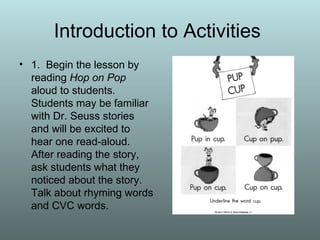
Instructional Sequence Print out copies of the  Hop on Pop  worksheet at www.readwritethink.org  Enlarge each section of the worksheet to be used as an example on the board. Create sentence strips to be used with the enlarged images. Pup is up. Pup in cup. Pup on cup. We like to hop. We like to hop on top of pop. Stop, you must not hop on pop.
Introduction to Activities  1.  Begin the lesson by reading  Hop on Pop  aloud to students. Students may be familiar with Dr. Seuss stories and will be excited to hear one read-aloud. After reading the story, ask students what they noticed about the story. Talk about rhyming words and CVC words.
Intro to Activities  cont. 2.  Choose a page in the book (or have a student volunteer choose a page) and reread it. Ask students to notice which words sound alike, or rhyme. 3.  Show students the cover of the book and reread the title. Ask students to identify the words that rhyme ( hop  and  pop ). Write these words on chart paper and ask students what they notice about the two words.
Intro to Activities  cont. Help students come up with more words that end in –op. Examples: slop, mop, stop Have students clap out the rhyming words. Example /h/ op. Students clap once for “h” sound and once for “op” ending
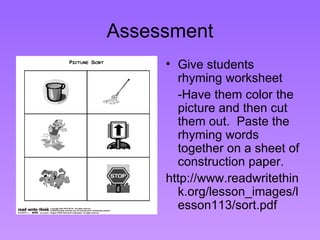
Assessment Give students rhyming worksheet -Have them color the picture and then cut them out.  Paste the rhyming words together on a sheet of construction paper. http://www.readwritethink.org/lesson_images/lesson113/sort.pdf

Hop on Pop

  • 1.
    Dr. Seuss’ Hopon Pop Lesson Plan for the short vowel sounds “O” and “U” Michelle Norris Tech 110 12/19/08
  • 2.
    California State Standards1.5 Distinguish long- and short-vowel sounds in orally stated single-syllable words (e.g., bit/bite ). 1.10 Generate the sounds from all the letters and letter patterns, including consonant blends and long- and short-vowel patterns (i.e., phonograms), and blend those sounds into recognizable words. For the purposes of this lesson we will be focusing on the sounds for “o” and “u”
  • 3.
    Students will: Identifyrhyming words in a story Discriminate between short u and o sounds Produce rhyming words when given a keyword in the word family Blend onsets and rhymes aloud to create words Sort pictures based on their rhymes
  • 4.
    Instructional Sequence Printout copies of the Hop on Pop worksheet at www.readwritethink.org Enlarge each section of the worksheet to be used as an example on the board. Create sentence strips to be used with the enlarged images. Pup is up. Pup in cup. Pup on cup. We like to hop. We like to hop on top of pop. Stop, you must not hop on pop.
  • 5.
    Introduction to Activities 1. Begin the lesson by reading Hop on Pop aloud to students. Students may be familiar with Dr. Seuss stories and will be excited to hear one read-aloud. After reading the story, ask students what they noticed about the story. Talk about rhyming words and CVC words.
  • 6.
    Intro to Activities cont. 2. Choose a page in the book (or have a student volunteer choose a page) and reread it. Ask students to notice which words sound alike, or rhyme. 3. Show students the cover of the book and reread the title. Ask students to identify the words that rhyme ( hop and pop ). Write these words on chart paper and ask students what they notice about the two words.
  • 7.
    Intro to Activities cont. Help students come up with more words that end in –op. Examples: slop, mop, stop Have students clap out the rhyming words. Example /h/ op. Students clap once for “h” sound and once for “op” ending
  • 8.
    Assessment Give studentsrhyming worksheet -Have them color the picture and then cut them out. Paste the rhyming words together on a sheet of construction paper. http://www.readwritethink.org/lesson_images/lesson113/sort.pdf