I.F.D.C. LENGUAS VIVAS
TALLER DE PRÁCTICA DOCENTE
ALUMNO RESIDENTE: Dario Bressan
Período de Práctica: Nivel Inicial
Institución Educativa: Colegio Santa Eufrasia
Dirección: Maria Olguín 953 Río Cuarto - Córdoba
Sala / Grado / Año - sección: Sala de 5 años
Cantidad de alumnos: 25 estudiantes
Nivel lingüístico del curso: Principiantes
Tipo de Planificación: Clase
Unidad Temática: Partes del cuerpo
Clase Nº: 2
Fecha: 26/08/2015
Hora: 15:30 - 16:15
Duración de la clase: 45 minutos
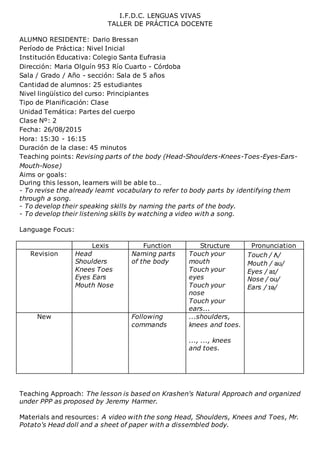
Teaching points: Revising parts of the body (Head-Shoulders-Knees-Toes-Eyes-Ears-
Mouth-Nose)
Aims or goals:
During this lesson, learners will be able to…
- To revise the already learnt vocabulary to refer to body parts by identifying them
through a song.
- To develop their speaking skills by naming the parts of the body.
- To develop their listening skills by watching a video with a song.
Language Focus:
Lexis Function Structure Pronunciation
Revision Head
Shoulders
Knees Toes
Eyes Ears
Mouth Nose
Naming parts
of the body
Touch your
mouth
Touch your
eyes
Touch your
nose
Touch your
ears...
Touch / ʌ/
Mouth / aʊ/
Eyes / aɪ/
Nose / oʊ/
Ears / ɪə/
New Following
commands
...shoulders,
knees and toes.
..., ..., knees
and toes.
Teaching Approach: The lesson is based on Krashen's Natural Approach and organized
under PPP as proposed by Jeremy Harmer.
Materials and resources: A video with the song Head, Shoulders, Knees and Toes, Mr.
Potato's Head doll and a sheet of paper with a dissembled body.
Pedagogical use of ICT in class: Sts will be watching and listening to a song from a
video so they can develop their listening skills.
Seating Arrangement: Students will stand on the floor at first, and then in a circle to
follow the song commands, linking the words with the correspondent's body parts.
Then they will work at their tables in groups to carry out the different activities.
Cooperative Work: As students belong to the parallel play stage, they work adjacently
which means they can work together, but still some cooperative work will be difficult
to achieve.
Possible problems/difficulties and their possible solutions during class: Children tend
to get excited with visual activities and when drawing on their own, so it is necessary
to be as organized and clear with the activities as possible, the same when watching
the video. Using a sheet each, facilitates the visual work. Teacher always assists kids
when drawing and painting.
Potential problems students may have with the language: They may have problems
related to memory when revising words, so it is important to contextualize them.
Assessment: What will be assessed and how: I will check understanding by listening
to them individually as much as possible. Although it may be a bit difficult to achieve,
encouraging peer correction is a good method to help students in the learning
process. If a student fails, another one may say the correct word. This always has to
be controlled by the teacher.
Routine: 5 minutes
Purpose: To greet students by singing the song used every class, so they will be able
to practice speaking skills. Teacher uses a charango to accompany the song.
I get into the class and say hello to all, greet them by means of the song. I will ask
them to relax by stretching arms and neck. I will also explain we will try to
communicate through English as much as possible, but telling them I will help in the
process. Then, we start with the song.
Hello, hello, how are you today?
I'm fine, I'm fine Twice
And you, how are you?
Good afternoon, good afternoon how are you today?
I'm fine, I'm fine Twice
And you, how are you?
Warm-up: 15 minutes
Purpose: to revise the already learnt topic and teaching points.
It is important to show a clear pronunciation so students may imitate as accurately as
possible.
T: Hello children, how are you today? Do you remember what you did last class? Sts:
A game with the body parts! T: Excellent!! We will now work on that again, but this
time we will use a video with a song you may know. But before watching at it, you
will have to tell me about your body parts. I brought you a very famous character, do
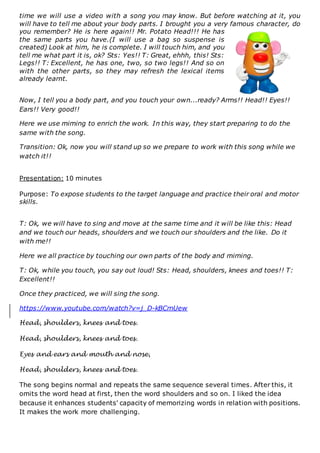
you remember? He is here again!! Mr. Potato Head!!! He has
the same parts you have.(I will use a bag so suspense is
created) Look at him, he is complete. I will touch him, and you
tell me what part it is, ok? Sts: Yes!! T: Great, ehhh, this! Sts:
Legs!! T: Excellent, he has one, two, so two legs!! And so on
with the other parts, so they may refresh the lexical items
already learnt.
Now, I tell you a body part, and you touch your own...ready? Arms!! Head!! Eyes!!
Ears!! Very good!!
Here we use miming to enrich the work. In this way, they start preparing to do the
same with the song.
Transition: Ok, now you will stand up so we prepare to work with this song while we
watch it!!
Presentation: 10 minutes
Purpose: To expose students to the target language and practice their oral and motor
skills.
T: Ok, we will have to sing and move at the same time and it will be like this: Head
and we touch our heads, shoulders and we touch our shoulders and the like. Do it
with me!!
Here we all practice by touching our own parts of the body and miming.
T: Ok, while you touch, you say out loud! Sts: Head, shoulders, knees and toes!! T:
Excellent!!
Once they practiced, we will sing the song.
https://www.youtube.com/watch?v=j_D-kBCmUew
Head, shoulders, knees and toes.
Eyes and ears and mouth and nose,
Head, shoulders, knees and toes.
The song begins normal and repeats the same sequence several times. After this, it
omits the word head at first, then the word shoulders and so on. I liked the idea
because it enhances students' capacity of memorizing words in relation with positions.
It makes the work more challenging.
T: Pay attention, it will avoid one word, but we still have to do the movement!! I will
be telling you the word/s we have to avoid.
After the stage where words are avoided, the song speeds up so children have to do
the movements faster, this makes the activity even funnier.
T: Ok, great!! Very nice work!! You did it great!!
Transition: Now, I ask students to have a seat for a moment so they can slow down
and pay attention to me. Meanwhile I look for the sheet where they will work at the
following stage.
Development: 13 minutes
Activity 1: 10 minutes
Purpose: This activity fosters contextualized practice making students work on the
main topic.
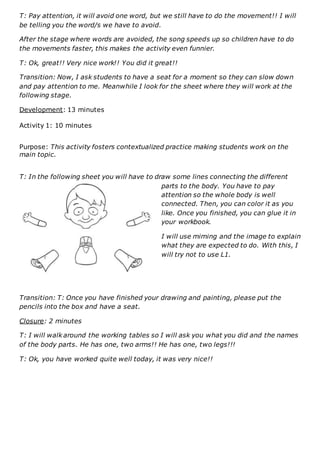
T: In the following sheet you will have to draw some lines connecting the different
parts to the body. You have to pay
attention so the whole body is well
connected. Then, you can color it as you
like. Once you finished, you can glue it in
your workbook.
I will use miming and the image to explain
what they are expected to do. With this, I
will try not to use L1.
Transition: T: Once you have finished your drawing and painting, please put the
pencils into the box and have a seat.
Closure: 2 minutes
T: I will walk around the working tables so I will ask you what you did and the names
of the body parts. He has one, two arms!! He has one, two legs!!!
T: Ok, you have worked quite well today, it was very nice!!
Taller de Práctica Docente 2015
Lessonplancriteria Peer and Self-check Yes No
1 Heading Doesthe lessonplanheadingincludeall the required information?
Has it been completed in Spanish?

2 Learning aims Are the aims for this lesson devised in terms of development of
language skills and language learning / acquisition?
Are theyclearlywrittentoexplainwhatthe learnerswilllearnand
be able to do?

3 Teaching points Are there any new teaching points?
Are the teaching points aligned with the course syllabus and the
district curriculum?
Are they presented within a meaningful context?

4 Language focus chart Are the new and revision language items specified?
Are the new and revision language items related?
Is the pronunciation focus complete?

5 Teaching Approach Is the approach you chose suitable for your teaching context?
Are its aims and fundamentals coherent with the lesson aims?

6 Materialsand
resources
Does the lesson plan include all the required materials and
resources for this lesson?
Does it include handouts, links, video scripts and sample
flashcards?
Are these materials and resources coherently/adequately
included in the lesson plan?

7 Pedagogical use of ICT Does the lesson plan make meaningful pedagogical uses of ICT?
Does it include a contingency plan in case technology does not
work?

8 Seatingarrangement Does the seating arrangement foster communication and
interaction among teacher and peers? Is it coherent with the
lesson activities?

9 Cooperative work Does the lesson include instances of cooperative work among
students?Isthere a setof guidelinesandinstructionsforthiswork
to be carried out?
Doesthe lesson plan specify what kind of pedagogical mediation
the teacher will provide?

10 Possible language
difficultiesand
possible solutions
Doesthissectionexplainpossible difficultiesaccordingtoprevious
lessons’ experiences and class observation?
Does the lesson plan allow for differentiation (instruction and
assessment)?

11 Possible lessonor
classroom
management
problemsand their
possible solutions
Doesthissectionexplainpossible difficultiesaccordingtoprevious
lessons’ experiences and class observation?

Lesson development
12 Lessonstages Is the lesson plan organized in stages in accordance with the
approach or the method framing the lesson? Does it include a
warm-up, a development and a round-up or closure?

13 Lessoncontext and
content
Are the lesson context and content appealing to students? Are
they engaging? Is the context culturally relevant?

14 Lessonactivities Is each activity sustained by a pedagogical purpose? Is each
activity related to a learning aim?
Do the activities allow for language exposure, exploration,
development of language awareness ?

15 Type of activities Is there a balance of activitiesthat range from controlled practice
to freer communicative practice?

Do they facilitate integration of skills?
16 Transitions Does the lesson plan show a coherent flow of activities clearly
interconnected? Are there any comments or indicators that link
each activity or stage with the next one?

17 Language of
instructions
Are instructions written in a simple manner? Is there a set of
strategies to accompany the instructions and aid learner
comprehension?

18 Teaching strategies Is instruction aided by any teaching strategies such as…
- Modeling
- Exemplifying
- Showing
- Pointing
- Explaining
- Paraphrasing
- Miming
- Others?

19 Direct speech Are all instructions and possible anticipated dialogues written in
direct speech?

20 Homework Does the lesson plan include any task to do at home? Is the task
engaging? Will students feel motivated to perform it? Will the
students be in direct contact with the language? Will they share
their work with the class?

21 Active learning:
Bloom’sTaxonomy
2001
Are many learning tasks addressing a higher level of Bloom’s
taxonomy?

22 Grammar,
Appearance,and
Language
Does the lesson plan effectively communicate to the intended
audience? Has it gone through proof-reading for grammar and
spelling mistakes?

Observations:
Congratulationsonyourwork,Darío! Thislessonplanshowsyouhave reflectedonpreviousfeedbacks.
Have a greatclass!
Cecilia
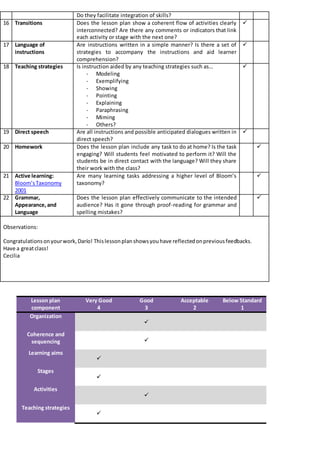
Lesson plan
component
Very Good
4
Good
3
Acceptable
2
Below Standard
1
Organization

Coherence and
sequencing 
Learning aims

Stages

Activities

Teaching strategies

Class. management
strategies 
Language accuracy

Observations Minimumscore:20 / 32
Score:25 /32 = 8

Lesson Plan Kinder 5

  • 1.
    I.F.D.C. LENGUAS VIVAS TALLERDE PRÁCTICA DOCENTE ALUMNO RESIDENTE: Dario Bressan Período de Práctica: Nivel Inicial Institución Educativa: Colegio Santa Eufrasia Dirección: Maria Olguín 953 Río Cuarto - Córdoba Sala / Grado / Año - sección: Sala de 5 años Cantidad de alumnos: 25 estudiantes Nivel lingüístico del curso: Principiantes Tipo de Planificación: Clase Unidad Temática: Partes del cuerpo Clase Nº: 2 Fecha: 26/08/2015 Hora: 15:30 - 16:15 Duración de la clase: 45 minutos Teaching points: Revising parts of the body (Head-Shoulders-Knees-Toes-Eyes-Ears- Mouth-Nose) Aims or goals: During this lesson, learners will be able to… - To revise the already learnt vocabulary to refer to body parts by identifying them through a song. - To develop their speaking skills by naming the parts of the body. - To develop their listening skills by watching a video with a song. Language Focus: Lexis Function Structure Pronunciation Revision Head Shoulders Knees Toes Eyes Ears Mouth Nose Naming parts of the body Touch your mouth Touch your eyes Touch your nose Touch your ears... Touch / ʌ/ Mouth / aʊ/ Eyes / aɪ/ Nose / oʊ/ Ears / ɪə/ New Following commands ...shoulders, knees and toes. ..., ..., knees and toes. Teaching Approach: The lesson is based on Krashen's Natural Approach and organized under PPP as proposed by Jeremy Harmer. Materials and resources: A video with the song Head, Shoulders, Knees and Toes, Mr. Potato's Head doll and a sheet of paper with a dissembled body.
  • 2.
    Pedagogical use ofICT in class: Sts will be watching and listening to a song from a video so they can develop their listening skills. Seating Arrangement: Students will stand on the floor at first, and then in a circle to follow the song commands, linking the words with the correspondent's body parts. Then they will work at their tables in groups to carry out the different activities. Cooperative Work: As students belong to the parallel play stage, they work adjacently which means they can work together, but still some cooperative work will be difficult to achieve. Possible problems/difficulties and their possible solutions during class: Children tend to get excited with visual activities and when drawing on their own, so it is necessary to be as organized and clear with the activities as possible, the same when watching the video. Using a sheet each, facilitates the visual work. Teacher always assists kids when drawing and painting. Potential problems students may have with the language: They may have problems related to memory when revising words, so it is important to contextualize them. Assessment: What will be assessed and how: I will check understanding by listening to them individually as much as possible. Although it may be a bit difficult to achieve, encouraging peer correction is a good method to help students in the learning process. If a student fails, another one may say the correct word. This always has to be controlled by the teacher. Routine: 5 minutes Purpose: To greet students by singing the song used every class, so they will be able to practice speaking skills. Teacher uses a charango to accompany the song. I get into the class and say hello to all, greet them by means of the song. I will ask them to relax by stretching arms and neck. I will also explain we will try to communicate through English as much as possible, but telling them I will help in the process. Then, we start with the song. Hello, hello, how are you today? I'm fine, I'm fine Twice And you, how are you? Good afternoon, good afternoon how are you today? I'm fine, I'm fine Twice And you, how are you? Warm-up: 15 minutes Purpose: to revise the already learnt topic and teaching points. It is important to show a clear pronunciation so students may imitate as accurately as possible. T: Hello children, how are you today? Do you remember what you did last class? Sts: A game with the body parts! T: Excellent!! We will now work on that again, but this
  • 3.
    time we willuse a video with a song you may know. But before watching at it, you will have to tell me about your body parts. I brought you a very famous character, do you remember? He is here again!! Mr. Potato Head!!! He has the same parts you have.(I will use a bag so suspense is created) Look at him, he is complete. I will touch him, and you tell me what part it is, ok? Sts: Yes!! T: Great, ehhh, this! Sts: Legs!! T: Excellent, he has one, two, so two legs!! And so on with the other parts, so they may refresh the lexical items already learnt. Now, I tell you a body part, and you touch your own...ready? Arms!! Head!! Eyes!! Ears!! Very good!! Here we use miming to enrich the work. In this way, they start preparing to do the same with the song. Transition: Ok, now you will stand up so we prepare to work with this song while we watch it!! Presentation: 10 minutes Purpose: To expose students to the target language and practice their oral and motor skills. T: Ok, we will have to sing and move at the same time and it will be like this: Head and we touch our heads, shoulders and we touch our shoulders and the like. Do it with me!! Here we all practice by touching our own parts of the body and miming. T: Ok, while you touch, you say out loud! Sts: Head, shoulders, knees and toes!! T: Excellent!! Once they practiced, we will sing the song. https://www.youtube.com/watch?v=j_D-kBCmUew Head, shoulders, knees and toes. Head, shoulders, knees and toes. Eyes and ears and mouth and nose, Head, shoulders, knees and toes. The song begins normal and repeats the same sequence several times. After this, it omits the word head at first, then the word shoulders and so on. I liked the idea because it enhances students' capacity of memorizing words in relation with positions. It makes the work more challenging.
  • 4.
    T: Pay attention,it will avoid one word, but we still have to do the movement!! I will be telling you the word/s we have to avoid. After the stage where words are avoided, the song speeds up so children have to do the movements faster, this makes the activity even funnier. T: Ok, great!! Very nice work!! You did it great!! Transition: Now, I ask students to have a seat for a moment so they can slow down and pay attention to me. Meanwhile I look for the sheet where they will work at the following stage. Development: 13 minutes Activity 1: 10 minutes Purpose: This activity fosters contextualized practice making students work on the main topic. T: In the following sheet you will have to draw some lines connecting the different parts to the body. You have to pay attention so the whole body is well connected. Then, you can color it as you like. Once you finished, you can glue it in your workbook. I will use miming and the image to explain what they are expected to do. With this, I will try not to use L1. Transition: T: Once you have finished your drawing and painting, please put the pencils into the box and have a seat. Closure: 2 minutes T: I will walk around the working tables so I will ask you what you did and the names of the body parts. He has one, two arms!! He has one, two legs!!! T: Ok, you have worked quite well today, it was very nice!!
  • 5.
    Taller de PrácticaDocente 2015 Lessonplancriteria Peer and Self-check Yes No 1 Heading Doesthe lessonplanheadingincludeall the required information? Has it been completed in Spanish?  2 Learning aims Are the aims for this lesson devised in terms of development of language skills and language learning / acquisition? Are theyclearlywrittentoexplainwhatthe learnerswilllearnand be able to do?  3 Teaching points Are there any new teaching points? Are the teaching points aligned with the course syllabus and the district curriculum? Are they presented within a meaningful context?  4 Language focus chart Are the new and revision language items specified? Are the new and revision language items related? Is the pronunciation focus complete?  5 Teaching Approach Is the approach you chose suitable for your teaching context? Are its aims and fundamentals coherent with the lesson aims?  6 Materialsand resources Does the lesson plan include all the required materials and resources for this lesson? Does it include handouts, links, video scripts and sample flashcards? Are these materials and resources coherently/adequately included in the lesson plan?  7 Pedagogical use of ICT Does the lesson plan make meaningful pedagogical uses of ICT? Does it include a contingency plan in case technology does not work?  8 Seatingarrangement Does the seating arrangement foster communication and interaction among teacher and peers? Is it coherent with the lesson activities?  9 Cooperative work Does the lesson include instances of cooperative work among students?Isthere a setof guidelinesandinstructionsforthiswork to be carried out? Doesthe lesson plan specify what kind of pedagogical mediation the teacher will provide?  10 Possible language difficultiesand possible solutions Doesthissectionexplainpossible difficultiesaccordingtoprevious lessons’ experiences and class observation? Does the lesson plan allow for differentiation (instruction and assessment)?  11 Possible lessonor classroom management problemsand their possible solutions Doesthissectionexplainpossible difficultiesaccordingtoprevious lessons’ experiences and class observation?  Lesson development 12 Lessonstages Is the lesson plan organized in stages in accordance with the approach or the method framing the lesson? Does it include a warm-up, a development and a round-up or closure?  13 Lessoncontext and content Are the lesson context and content appealing to students? Are they engaging? Is the context culturally relevant?  14 Lessonactivities Is each activity sustained by a pedagogical purpose? Is each activity related to a learning aim? Do the activities allow for language exposure, exploration, development of language awareness ?  15 Type of activities Is there a balance of activitiesthat range from controlled practice to freer communicative practice? 
  • 6.
    Do they facilitateintegration of skills? 16 Transitions Does the lesson plan show a coherent flow of activities clearly interconnected? Are there any comments or indicators that link each activity or stage with the next one?  17 Language of instructions Are instructions written in a simple manner? Is there a set of strategies to accompany the instructions and aid learner comprehension?  18 Teaching strategies Is instruction aided by any teaching strategies such as… - Modeling - Exemplifying - Showing - Pointing - Explaining - Paraphrasing - Miming - Others?  19 Direct speech Are all instructions and possible anticipated dialogues written in direct speech?  20 Homework Does the lesson plan include any task to do at home? Is the task engaging? Will students feel motivated to perform it? Will the students be in direct contact with the language? Will they share their work with the class?  21 Active learning: Bloom’sTaxonomy 2001 Are many learning tasks addressing a higher level of Bloom’s taxonomy?  22 Grammar, Appearance,and Language Does the lesson plan effectively communicate to the intended audience? Has it gone through proof-reading for grammar and spelling mistakes?  Observations: Congratulationsonyourwork,Darío! Thislessonplanshowsyouhave reflectedonpreviousfeedbacks. Have a greatclass! Cecilia Lesson plan component Very Good 4 Good 3 Acceptable 2 Below Standard 1 Organization  Coherence and sequencing  Learning aims  Stages  Activities  Teaching strategies 
  • 7.
    Class. management strategies  Languageaccuracy  Observations Minimumscore:20 / 32 Score:25 /32 = 8