I.F.D.C. LENGUAS VIVAS
TALLER DE PRÁCTICA DOCENTE
ALUMNO RESIDENTE: Dario Bressan
Período de Práctica: Nivel Inicial
Institución Educativa: Colegio Santa Eufrasia
Dirección: Maria Olguín 953
Sala / Grado / Año - sección: Sala de 5 años
Cantidad de alumnos: 25 estudiantes
Nivel lingüístico del curso: Principiantes
Tipo de Planificación: Clase
Unidad Temática: Partes de la casa
Clase Nº: 1
Fecha: 12/08/2015
Hora: 15:30 - 16:15
Duración de la clase: 45 minutos
Teaching points: Revising parts of the body (Head-Arms-Legs) Introduce new ones
(Mouth-ears-nose-eyes)
Aims or goals:
During this lesson, learners will be able to…
- To revise the already learnt vocabulary to refer to the body parts by identifying it
through a song.
- To develop their speaking skills by naming the parts of the body.
- To develop their listening skills by listening to songs from a CD.
Language Focus:
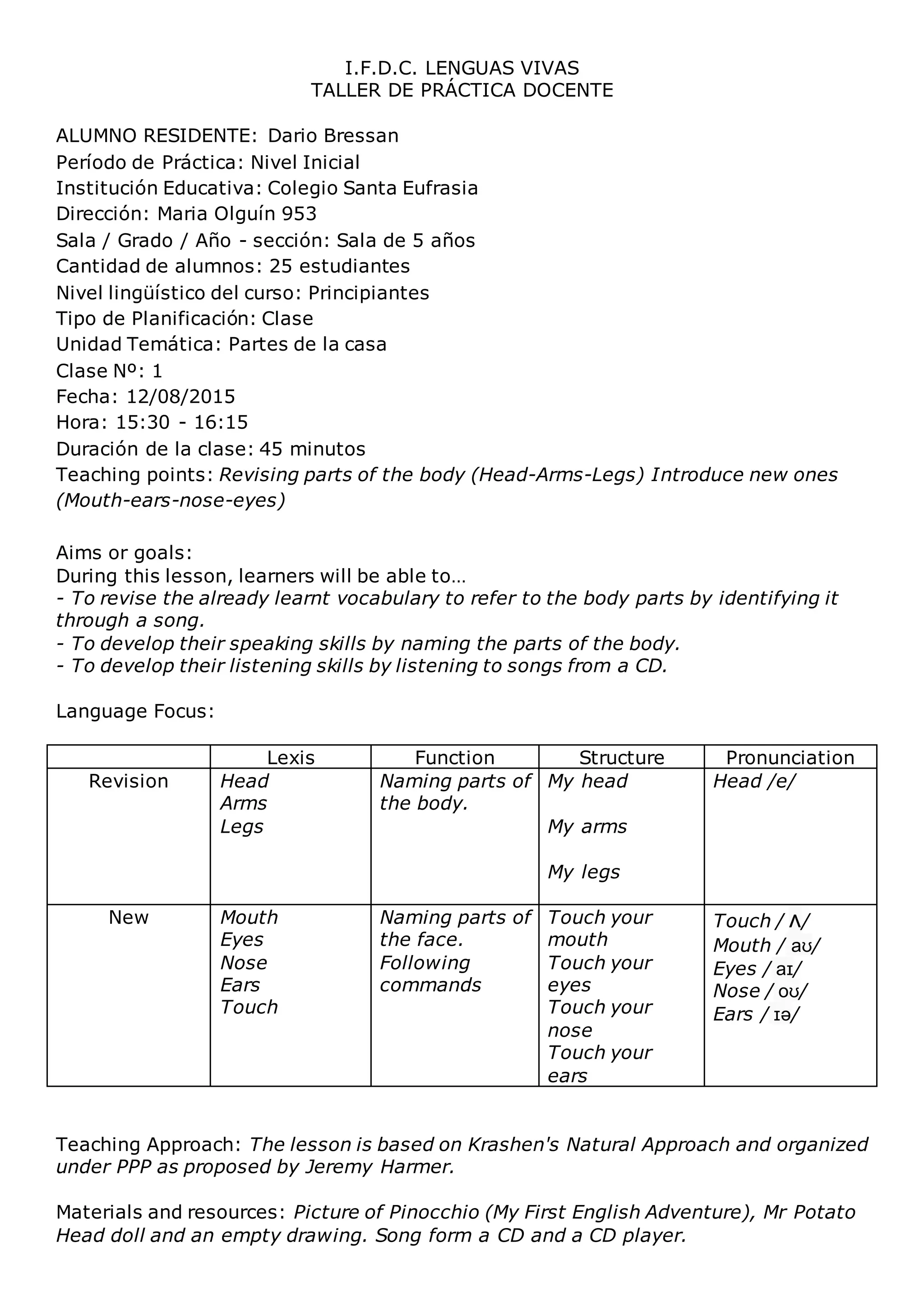
Lexis Function Structure Pronunciation
Revision Head
Arms
Legs
Naming parts of
the body.
My head
My arms
My legs
Head /e/
New Mouth
Eyes
Nose
Ears
Touch
Naming parts of
the face.
Following
commands
Touch your
mouth
Touch your
eyes
Touch your
nose
Touch your
ears
Touch / ʌ/
Mouth / aʊ/
Eyes / aɪ/
Nose / oʊ/
Ears / ɪə/
Teaching Approach: The lesson is based on Krashen's Natural Approach and organized
under PPP as proposed by Jeremy Harmer.
Materials and resources: Picture of Pinocchio (My First English Adventure), Mr Potato
Head doll and an empty drawing. Song form a CD and a CD player.
Pedagogical use of ICT in class: Listening to a song from a CD so they develop their
listening skills.
Seating Arrangement: Students will sit on the floor in a circle to interact with each
other and listen to the story. Then they will work at their tables in groups to carry out
the different activities.
Cooperative Work: As students belong to the parallel play stage, they work adjacently
which means they can work together, but still some communitarian work will be
difficult to achieve.
Possible problems/difficulties and their possible solutions during class: Children tend
to get excited with visual activities and when drawing on their own, so it is necessary
to be as organized and clear with the activities as possible, so all of them can look at
all the pictures, understand activities and listen to the story. Using a book each,
facilitates the visual work. Teacher always assists kids when drawing and painting.
Potential problems students may have with the language: They may have problems
when revising words, so it is important to contextualize them.
Assessment: What will be assessed and how: I will check understanding by listening
to them and correcting with examples. Peer correction is always a good method to
encourage them to feel comfortable with corrections.
Routine: 5 minutes
Purpose: To greet students by singing the song used every class, so they will be able
to practice speaking skills. Teacher uses a charango to accompany the song.
I get into the class and say hello to all, greet them by means of the song. I will ask
them to relax by stretching arms and neck. Then, we start with the song.
Hello, hello, how are you today?
I'm fine, I'm fine Twice
And you, how are you?
Good evening, good evening how are you today?
I'm fine, I'm fine Twice
And you, how are you?
Warm-up: 15 minutes
Purpose: to revise the already learnt topic and teaching points and to introduce the
new ones.
It is important to show a clear pronunciation so students may imitate as accurately as
possible. I try to say some words in English and then repeat them into Spanish and
then in English again, so they get used to listen to the English language.
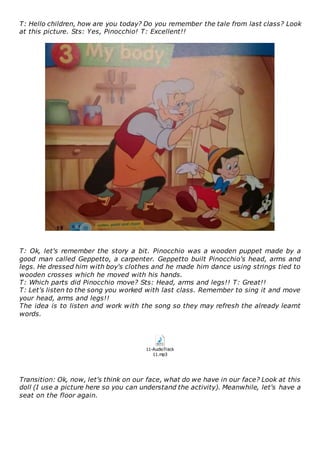
T: Hello children, how are you today? Do you remember the tale from last class? Look
at this picture. Sts: Yes, Pinocchio! T: Excellent!!
T: Ok, let's remember the story a bit. Pinocchio was a wooden puppet made by a
good man called Geppetto, a carpenter. Geppetto built Pinocchio's head, arms and
legs. He dressed him with boy's clothes and he made him dance using strings tied to
wooden crosses which he moved with his hands.
T: Which parts did Pinocchio move? Sts: Head, arms and legs!! T: Great!!
T: Let's listen to the song you worked with last class. Remember to sing it and move
your head, arms and legs!!
The idea is to listen and work with the song so they may refresh the already learnt
words.
11-AudioTrack
11.mp3
Transition: Ok, now, let's think on our face, what do we have in our face? Look at this
doll (I use a picture here so you can understand the activity). Meanwhile, let's have a
seat on the floor again.
Presentation: 10 minutes
Purpose: To expose students to the new target language and practice their oral skills.
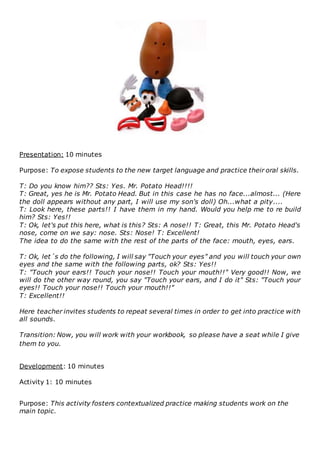
T: Do you know him?? Sts: Yes. Mr. Potato Head!!!!
T: Great, yes he is Mr. Potato Head. But in this case he has no face...almost... (Here
the doll appears without any part, I will use my son's doll) Oh...what a pity....
T: Look here, these parts!! I have them in my hand. Would you help me to re build
him? Sts: Yes!!
T: Ok, let's put this here, what is this? Sts: A nose!! T: Great, this Mr. Potato Head's
nose, come on we say: nose. Sts: Nose! T: Excellent!
The idea to do the same with the rest of the parts of the face: mouth, eyes, ears.
T: Ok, let´s do the following, I will say "Touch your eyes" and you will touch your own
eyes and the same with the following parts, ok? Sts: Yes!!
T: "Touch your ears!! Touch your nose!! Touch your mouth!!" Very good!! Now, we
will do the other way round, you say "Touch your ears, and I do it" Sts: "Touch your
eyes!! Touch your nose!! Touch your mouth!!"
T: Excellent!!
Here teacher invites students to repeat several times in order to get into practice with
all sounds.
Transition: Now, you will work with your workbook, so please have a seat while I give
them to you.
Development: 10 minutes
Activity 1: 10 minutes
Purpose: This activity fosters contextualized practice making students work on the
main topic.
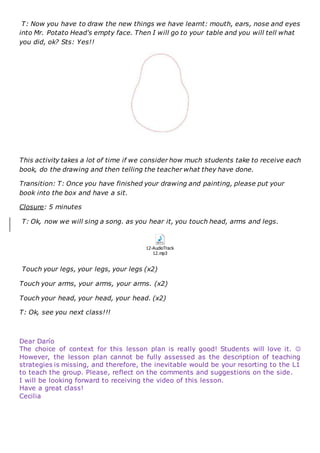
T: Now you have to draw the new things we have learnt: mouth, ears, nose and eyes
into Mr. Potato Head's empty face. Then I will go to your table and you will tell what
you did, ok? Sts: Yes!!
This activity takes a lot of time if we consider how much students take to receive each
book, do the drawing and then telling the teacher what they have done.
Transition: T: Once you have finished your drawing and painting, please put your
book into the box and have a sit.
Closure: 5 minutes
T: Ok, now we will sing a song. as you hear it, you touch head, arms and legs.
12-AudioTrack
12.mp3
Touch your legs, your legs, your legs (x2)
Touch your arms, your arms, your arms. (x2)
Touch your head, your head, your head. (x2)
T: Ok, see you next class!!!
Dear Darío
The choice of context for this lesson plan is really good! Students will love it. 
However, the lesson plan cannot be fully assessed as the description of teaching
strategies is missing, and therefore, the inevitable would be your resorting to the L1
to teach the group. Please, reflect on the comments and suggestions on the side.
I will be looking forward to receiving the video of this lesson.
Have a great class!
Cecilia

Lesson Plan Kinder 4

  • 1.
    I.F.D.C. LENGUAS VIVAS TALLERDE PRÁCTICA DOCENTE ALUMNO RESIDENTE: Dario Bressan Período de Práctica: Nivel Inicial Institución Educativa: Colegio Santa Eufrasia Dirección: Maria Olguín 953 Sala / Grado / Año - sección: Sala de 5 años Cantidad de alumnos: 25 estudiantes Nivel lingüístico del curso: Principiantes Tipo de Planificación: Clase Unidad Temática: Partes de la casa Clase Nº: 1 Fecha: 12/08/2015 Hora: 15:30 - 16:15 Duración de la clase: 45 minutos Teaching points: Revising parts of the body (Head-Arms-Legs) Introduce new ones (Mouth-ears-nose-eyes) Aims or goals: During this lesson, learners will be able to… - To revise the already learnt vocabulary to refer to the body parts by identifying it through a song. - To develop their speaking skills by naming the parts of the body. - To develop their listening skills by listening to songs from a CD. Language Focus: Lexis Function Structure Pronunciation Revision Head Arms Legs Naming parts of the body. My head My arms My legs Head /e/ New Mouth Eyes Nose Ears Touch Naming parts of the face. Following commands Touch your mouth Touch your eyes Touch your nose Touch your ears Touch / ʌ/ Mouth / aʊ/ Eyes / aɪ/ Nose / oʊ/ Ears / ɪə/ Teaching Approach: The lesson is based on Krashen's Natural Approach and organized under PPP as proposed by Jeremy Harmer. Materials and resources: Picture of Pinocchio (My First English Adventure), Mr Potato Head doll and an empty drawing. Song form a CD and a CD player.
  • 2.
    Pedagogical use ofICT in class: Listening to a song from a CD so they develop their listening skills. Seating Arrangement: Students will sit on the floor in a circle to interact with each other and listen to the story. Then they will work at their tables in groups to carry out the different activities. Cooperative Work: As students belong to the parallel play stage, they work adjacently which means they can work together, but still some communitarian work will be difficult to achieve. Possible problems/difficulties and their possible solutions during class: Children tend to get excited with visual activities and when drawing on their own, so it is necessary to be as organized and clear with the activities as possible, so all of them can look at all the pictures, understand activities and listen to the story. Using a book each, facilitates the visual work. Teacher always assists kids when drawing and painting. Potential problems students may have with the language: They may have problems when revising words, so it is important to contextualize them. Assessment: What will be assessed and how: I will check understanding by listening to them and correcting with examples. Peer correction is always a good method to encourage them to feel comfortable with corrections. Routine: 5 minutes Purpose: To greet students by singing the song used every class, so they will be able to practice speaking skills. Teacher uses a charango to accompany the song. I get into the class and say hello to all, greet them by means of the song. I will ask them to relax by stretching arms and neck. Then, we start with the song. Hello, hello, how are you today? I'm fine, I'm fine Twice And you, how are you? Good evening, good evening how are you today? I'm fine, I'm fine Twice And you, how are you? Warm-up: 15 minutes Purpose: to revise the already learnt topic and teaching points and to introduce the new ones. It is important to show a clear pronunciation so students may imitate as accurately as possible. I try to say some words in English and then repeat them into Spanish and then in English again, so they get used to listen to the English language.
  • 3.
    T: Hello children,how are you today? Do you remember the tale from last class? Look at this picture. Sts: Yes, Pinocchio! T: Excellent!! T: Ok, let's remember the story a bit. Pinocchio was a wooden puppet made by a good man called Geppetto, a carpenter. Geppetto built Pinocchio's head, arms and legs. He dressed him with boy's clothes and he made him dance using strings tied to wooden crosses which he moved with his hands. T: Which parts did Pinocchio move? Sts: Head, arms and legs!! T: Great!! T: Let's listen to the song you worked with last class. Remember to sing it and move your head, arms and legs!! The idea is to listen and work with the song so they may refresh the already learnt words. 11-AudioTrack 11.mp3 Transition: Ok, now, let's think on our face, what do we have in our face? Look at this doll (I use a picture here so you can understand the activity). Meanwhile, let's have a seat on the floor again.
  • 4.
    Presentation: 10 minutes Purpose:To expose students to the new target language and practice their oral skills. T: Do you know him?? Sts: Yes. Mr. Potato Head!!!! T: Great, yes he is Mr. Potato Head. But in this case he has no face...almost... (Here the doll appears without any part, I will use my son's doll) Oh...what a pity.... T: Look here, these parts!! I have them in my hand. Would you help me to re build him? Sts: Yes!! T: Ok, let's put this here, what is this? Sts: A nose!! T: Great, this Mr. Potato Head's nose, come on we say: nose. Sts: Nose! T: Excellent! The idea to do the same with the rest of the parts of the face: mouth, eyes, ears. T: Ok, let´s do the following, I will say "Touch your eyes" and you will touch your own eyes and the same with the following parts, ok? Sts: Yes!! T: "Touch your ears!! Touch your nose!! Touch your mouth!!" Very good!! Now, we will do the other way round, you say "Touch your ears, and I do it" Sts: "Touch your eyes!! Touch your nose!! Touch your mouth!!" T: Excellent!! Here teacher invites students to repeat several times in order to get into practice with all sounds. Transition: Now, you will work with your workbook, so please have a seat while I give them to you. Development: 10 minutes Activity 1: 10 minutes Purpose: This activity fosters contextualized practice making students work on the main topic.
  • 5.
    T: Now youhave to draw the new things we have learnt: mouth, ears, nose and eyes into Mr. Potato Head's empty face. Then I will go to your table and you will tell what you did, ok? Sts: Yes!! This activity takes a lot of time if we consider how much students take to receive each book, do the drawing and then telling the teacher what they have done. Transition: T: Once you have finished your drawing and painting, please put your book into the box and have a sit. Closure: 5 minutes T: Ok, now we will sing a song. as you hear it, you touch head, arms and legs. 12-AudioTrack 12.mp3 Touch your legs, your legs, your legs (x2) Touch your arms, your arms, your arms. (x2) Touch your head, your head, your head. (x2) T: Ok, see you next class!!! Dear Darío The choice of context for this lesson plan is really good! Students will love it.  However, the lesson plan cannot be fully assessed as the description of teaching strategies is missing, and therefore, the inevitable would be your resorting to the L1 to teach the group. Please, reflect on the comments and suggestions on the side. I will be looking forward to receiving the video of this lesson. Have a great class! Cecilia