Lesson plan
Teacher: Estela Braun
Trainees: Moggia Giovanna, Sala Yohanna
School: School N°6
Course: 6th
grade.
Textbook: Howdy Friends
Date: August, 31st
2016
Topic: Wild animals and their habitats
Class: N° 4
LEARNING OBJECTIVES
• To recognize the difference between wild animals and domesticated animals.
• To learn the animals´ abilities by introducing CAN/CAN NOT.
• To practice the speaking, reading and writing macro-skills.
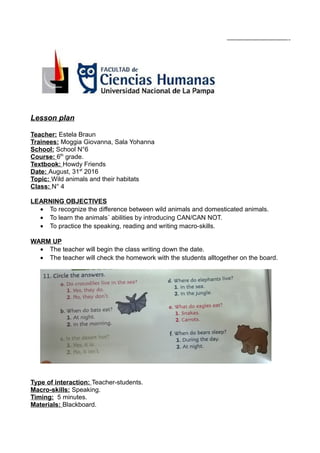
WARM UP
• The teacher will begin the class writing down the date.
• The teacher will check the homework with the students alltogether on the board.
Type of interaction: Teacher-students.
Macro-skills: Speaking.
Timing: 5 minutes.
Materials: Blackboard.
DEVELOPMENT
First activity:
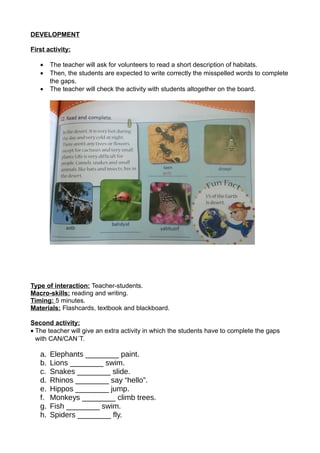
• The teacher will ask for volunteers to read a short description of habitats.
• Then, the students are expected to write correctly the misspelled words to complete
the gaps.
• The teacher will check the activity with students altogether on the board.
Type of interaction: Teacher-students.
Macro-skills: reading and writing.
Timing: 5 minutes.
Materials: Flashcards, textbook and blackboard.
Second activity:
• The teacher will give an extra activity in which the students have to complete the gaps
with CAN/CAN´T.
a. Elephants ________ paint.
b. Lions ________ swim.
c. Snakes ________ slide.
d. Rhinos ________ say “hello”.
e. Hippos ________ jump.
f. Monkeys ________ climb trees.
g. Fish ________ swim.
h. Spiders ________ fly.
i. Mice ________ play baseball.
j. Dogs ________ catch cats.
k. Cats ________ catch mice.
l. Giraffes ________ drive.
m. Leopards ________ paint.
n. Gorillas ________ speak English.
o. Fish ________ run.
p. Zebras ________ climb trees.
q. Tigers ________ jump.
r. Eagles ________ fly.
Type of interaction: Students individually.
Macro-skills: Reading and writing
Timing: 10 minutes.
Materials: Extra sheet of paper.
Third activity:
• The teacher will explain the differences between statements and questions with CAN.
• The teacher will ask the students to work in pairs to produce questions orally (can
you...?).
Type of interaction: Students in pairs.
Macro-skills: Speaking
Timing: 10 minutes.
Materials: Extra sheet of paper
Fourth activity:
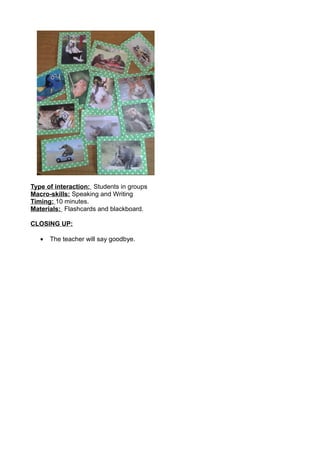
• The teacher will explain a game in which students will be devided into four groups.
• Each group will be provided with four flaschcards about animals.
• Then, each of the members of each group will have to run to the board, glue the
flashcard on the board and then write a sentence about what that animal can and can´t
do.
Type of interaction: Students in groups
Macro-skills: Speaking and Writing
Timing: 10 minutes.
Materials: Flashcards and blackboard.
CLOSING UP:
• The teacher will say goodbye.

Lesson Plan 4 sala-moggia

  • 1.
    Lesson plan Teacher: EstelaBraun Trainees: Moggia Giovanna, Sala Yohanna School: School N°6 Course: 6th grade. Textbook: Howdy Friends Date: August, 31st 2016 Topic: Wild animals and their habitats Class: N° 4 LEARNING OBJECTIVES • To recognize the difference between wild animals and domesticated animals. • To learn the animals´ abilities by introducing CAN/CAN NOT. • To practice the speaking, reading and writing macro-skills. WARM UP • The teacher will begin the class writing down the date. • The teacher will check the homework with the students alltogether on the board. Type of interaction: Teacher-students. Macro-skills: Speaking. Timing: 5 minutes. Materials: Blackboard.
  • 2.
    DEVELOPMENT First activity: • Theteacher will ask for volunteers to read a short description of habitats. • Then, the students are expected to write correctly the misspelled words to complete the gaps. • The teacher will check the activity with students altogether on the board. Type of interaction: Teacher-students. Macro-skills: reading and writing. Timing: 5 minutes. Materials: Flashcards, textbook and blackboard. Second activity: • The teacher will give an extra activity in which the students have to complete the gaps with CAN/CAN´T. a. Elephants ________ paint. b. Lions ________ swim. c. Snakes ________ slide. d. Rhinos ________ say “hello”. e. Hippos ________ jump. f. Monkeys ________ climb trees. g. Fish ________ swim. h. Spiders ________ fly.
  • 3.
    i. Mice ________play baseball. j. Dogs ________ catch cats. k. Cats ________ catch mice. l. Giraffes ________ drive. m. Leopards ________ paint. n. Gorillas ________ speak English. o. Fish ________ run. p. Zebras ________ climb trees. q. Tigers ________ jump. r. Eagles ________ fly. Type of interaction: Students individually. Macro-skills: Reading and writing Timing: 10 minutes. Materials: Extra sheet of paper. Third activity: • The teacher will explain the differences between statements and questions with CAN. • The teacher will ask the students to work in pairs to produce questions orally (can you...?). Type of interaction: Students in pairs. Macro-skills: Speaking Timing: 10 minutes. Materials: Extra sheet of paper Fourth activity: • The teacher will explain a game in which students will be devided into four groups. • Each group will be provided with four flaschcards about animals. • Then, each of the members of each group will have to run to the board, glue the flashcard on the board and then write a sentence about what that animal can and can´t do.
  • 4.
    Type of interaction:Students in groups Macro-skills: Speaking and Writing Timing: 10 minutes. Materials: Flashcards and blackboard. CLOSING UP: • The teacher will say goodbye.