Mónica Anza & Adriana Uslenghi
We support our work in the Post Method Condition(B. KUMARAVADIVELU SunJose'
Slate University) TESOL QUARTERLY Vol. 28, No. 1, Spring 1994’ which has inspired
these teachers to think the lesson from the practice to the theory.
It has made us make deep insights about our way of teaching, and the way students
learn to learn. ‘…The post method condition can also reshape the character and content
of L2 teaching, teacher education, and classroom research. In practical terms, it
motivates a search for an open-ended, coherent framework based on current
theoretical, empirical, and pedagogical insights that will enable teachers to theorize from
practice and practice what they theorize. …’
Additionally we fully concur with Freeman´s concept referring to teachers autonomy
and expertise. (Freeman, 1991, pp. 34-35) which it is fully recognized in the Post
Method frame work.’…The post method condition, however, recognizes. the teachers'
potential to know not only how to teach but also know how to act autonomously within
the academic and administrative constraints imposed by institutions, curricula, and
textbooks…
Theoretical framework
The focus of our work relates to the ten macro strategies of the Post Method.
Macrostrategy 1: Maximize Learning Opportunities
Macrostrategy 2: Facilitate Negotiated Interaction
Macrostrategy 3: Minimize Perceptual Mismatches
Macrostrategy 4: Activate Intuitive Heuristics
Macrostrategy 5: Foster Language Awareness
Macrostrategy 6: Contextualize Linguistic Input
Macrostrategy 7: Integrate Language Skills
Macrostrategy 8: Promote Learner Autonomy.
Macrostrategy 9: Raise Cultural Consciousness.
Macrostrategy 10: Ensure Social Relevance.
Objectives:
• To promote collaborative Reading working.
• To teach reading strategies in order to improve reading skill and develop
comprehension.
• To involve students in interactive activities: Working in centres.
• To make students read and role-play the scripts of the plays.
• To engage students in different reading activities taking into consideration
multiple intelligences.
• To make students read and infer collaboratively.
• To scaffold reading skill.
• To teach animal, food and weather nouns in context (6th grade)
• To teach places, jobs, and routine actions in context. (5th grade)
• To improve fluency and focus on word recognition.
• To help students to appreciate the pleasure of reading.
• To make students take advance of prior knowledge. (6th grades have
worked on the author in Spanish).
Language purpose:
• To continue to redesign the use of the past simple.
• To enable students work collaboratively in a positive environment.
• To promote critical thinking into the classroom setting.
• To encourage students to develop reading strategies such as some
tools in order to construct meaning.
• To promote and develop SLFL project: Reading.
• To teach vocabulary related to geography.
• To develop comprehension through students background knowledge.
Language content:
• La comprensión global del texto.(R)
• Información implícita y explícita.(W)
• Las biografías.(R)
• Las inferencias semánticas de los textos a nivel local y proposicional.
(R)
• El cuestionario. (W)
Function(s):
• Describing habits and lifestyles.
• Making requests and asking questions to obtain information in different contexts.
• Obtaining information using different reading strategies.
• Telling about past events.
• Telling about future events. (Fifth grade invent the following chapter and write
about it. The tasks will be stuck in the book.) This task is connected with the school
project.
Working in centres. (5th)
https://fawesome.tv/kids-edutainment/10072810-around-the-world-in-80-days-1-london-england-
1872#LmG3TxMUmCwr5vWJ.99
Teacher gives students a worksheet to work in different centres (5 stages)
First week:
Task 1: Put in order the different parts of the first part of a chapter of the book.
Task 2: Put in order the different parts of the second part of a chapter of the book.
Task 3: Answer some questions about the chapter that ss have read.
Task 4: Find the infinitive and the past tense of the verbs they find in the text.
Task 5: Draw some of the scenes of this chapter.
Second week:
Task 1: Oral and listening activity : Practice a dialogue between Mr Fogg and Mr
Sean. (First part)
Task 2: Oral and listening activity : Practice a dialogue between Mr Fogg and Mr
Sean. (Second part)
Task 3: Writing activity: Describe Mr Fogg. (He was…)
Task 4: Writing activity: Describe Mr Sean (He was…)
Task 5: Reading activity: complete some sentences with the words in the box.
(Get up/ got up, have/had. Eat/ate, drink/drank, go/went, take/took…
Because…)
Task 6: Reading activity : Jules Verne biography.
The tasks (1-5) take more time than the teacher has expected. As a consequence the teacher decides
to postpone the task number 6 to the next week and divided in sub-stages.
Notes: the activities 3 and 4 are connected with the School Project. (reading-writing)
Third week:
Task 6: Reading activity: To read the biography of Jules Verne.
Ss read the text and answer the questions. (Photocopy activity)
Part 1: Answer the questions. ( Connect the questions and answers)
Part 2: True or false statements.
Part 3: What facts did happen in those dates? Students complete with
information.
Part 4: CREA 2: (Individual tasks).
-Multiple choice
-True or false.
Fourth week:
WORKING IN CENTRES: Teacher divides the text en 5 parts. Each group
receives one of them. Students focus on pronunciation, how they can
divide the group in order to read and select the draws that they have
which can match with this part of the history . This task will be done during
the week.
• Reading activity: each student receives a piece of the text of the story
“Around the world in 80 days”.
• Listening activity: Students find the different pronunciations and
underline them.
• Oral activity: Students read aloud using the pronunciation.
• Writing activity: some students write some dialogues between the
characters.
Task 1. First part of the text.
Task 2. Second part of the text.
Task 3. Third part of the text.
Task 4. Fourth part of the text.
Task 5. Fifth part of the text.
Then, next week students will start to make the big book.
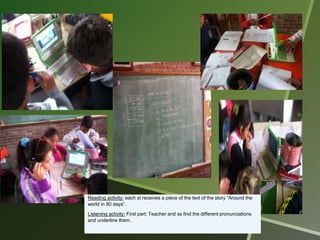
Reading activity: each st receives a piece of the text of the story “Around the
world in 80 days”.
Listening activity: First part: Teacher and ss find the different pronunciations
and underline them.
Fourth week:
Students review the story of the chapter of the book
that we were working.
Working in centres. (New groups)
Group 1: Reading activity: read aloud(teacher is in
this centre) (Records)
Group 2: paint the sheets of the book.
Group 3: using the computer as a tool students colour
and draw some parts of the story.(All the pictures are
together).
Group 4: select some pictures according to the piece
of the book.(Beginning, etc).
Fifth and sixth week: Working in centres: continue with the previous week.
Centre 1 Reading activity: students read aloud parts of the chapter one of the
book which they are preparing about Julio Verne.
Centre 2: Reading activity: students read aloud and the teacher records them.
Centre 3: Writing activity: students invent what would happen next with the main
character (Mr Fogg) using “Will”, in a logical sequence ( first, second. Later…..)
Centre 4: Writing activity: students invent what would happen next with the new
servant using “Will”, in a logical sequence ( first, second. Later…..)
Centre 5: Reading activity: students answer the questions (people who didn´t
finish the task about news of previous class).
RECORDS
Writing activity:
groupwork.
Seventh and eight week: Working in centres.
Group 1_ students do the corrections in their writings of the story that they
had invented following chapter 1 of the book “Around the world in 80 days”.
Group 2._ students stick parts of the story of chapter 1 and select the
pictures to stick that they had done before.
Group 3._students stick other parts of the story of chapter 1 and select the
pictures to stick that they had done before.
Group 4: students practice to reading, and teacher helps them with the
pronunciation.
Group 5: students write some inventions about what would happen after Mr
Fogg leave London. ( some students didn´t finish this activity last week).
The book is divided in two parts: one with the part of the chapter 1 of the
original book and the other part is a chapter which is invented by the
students using future tense.
Students finished the book.
They read aloud.
Working in centres. (6th)
Teacher gives students a worksheet (Penguin Reader) about Verne´s book:
‘The Mysterious Island’.
http://www.penguinreaders.com/pdf/downloads/pr/teachers-
notes/9781405878623.pdf.
Teacher divides the reader into four different big chapters.
Each lesson is planned based on one of the chapters of the reader.
At the end of the project students will have worked on:
Lesson 1: Chapters 1-4
Lesson 2: Chapters 5-7
Lesson3: Chapters 8-10
Lesson 4: Chapters 11-13
Activities.
1.Questionnaire.
2-Find the verbs in the past tense.
3-Find the infinitive.
4-Drawing activities for the dinosaurs.
5-Write a summary about the chapters.
6-Pronunciation .
Warm up: Teacher explains the activity. (Working in centres)
Activity1: Students read the text and order the paragraphs.
Activity 2: Students find verbs into the past tense and write the infinitive.
Activity 3: Students answer questions about the text.
Wrap up: Collaborative assessment. Verne´s biography to read and order.
Spelling.
Text stick on the board. Student read and the rest write. Spelling.
Crea activities to do.
‘The mysterious island’ by
Jules Verne.
Reading Comprehension-
Chapters 1-4-
READING ALOUD
Sounds
.
READING ALOUD
Reading project finished. (1)

Reading project finished. (1)

  • 1.
    Mónica Anza &Adriana Uslenghi
  • 2.
    We support ourwork in the Post Method Condition(B. KUMARAVADIVELU SunJose' Slate University) TESOL QUARTERLY Vol. 28, No. 1, Spring 1994’ which has inspired these teachers to think the lesson from the practice to the theory. It has made us make deep insights about our way of teaching, and the way students learn to learn. ‘…The post method condition can also reshape the character and content of L2 teaching, teacher education, and classroom research. In practical terms, it motivates a search for an open-ended, coherent framework based on current theoretical, empirical, and pedagogical insights that will enable teachers to theorize from practice and practice what they theorize. …’ Additionally we fully concur with Freeman´s concept referring to teachers autonomy and expertise. (Freeman, 1991, pp. 34-35) which it is fully recognized in the Post Method frame work.’…The post method condition, however, recognizes. the teachers' potential to know not only how to teach but also know how to act autonomously within the academic and administrative constraints imposed by institutions, curricula, and textbooks… Theoretical framework
  • 3.
    The focus ofour work relates to the ten macro strategies of the Post Method. Macrostrategy 1: Maximize Learning Opportunities Macrostrategy 2: Facilitate Negotiated Interaction Macrostrategy 3: Minimize Perceptual Mismatches Macrostrategy 4: Activate Intuitive Heuristics Macrostrategy 5: Foster Language Awareness Macrostrategy 6: Contextualize Linguistic Input Macrostrategy 7: Integrate Language Skills Macrostrategy 8: Promote Learner Autonomy. Macrostrategy 9: Raise Cultural Consciousness. Macrostrategy 10: Ensure Social Relevance.
  • 4.
    Objectives: • To promotecollaborative Reading working. • To teach reading strategies in order to improve reading skill and develop comprehension. • To involve students in interactive activities: Working in centres. • To make students read and role-play the scripts of the plays. • To engage students in different reading activities taking into consideration multiple intelligences. • To make students read and infer collaboratively. • To scaffold reading skill.
  • 5.
    • To teachanimal, food and weather nouns in context (6th grade) • To teach places, jobs, and routine actions in context. (5th grade) • To improve fluency and focus on word recognition. • To help students to appreciate the pleasure of reading. • To make students take advance of prior knowledge. (6th grades have worked on the author in Spanish).
  • 6.
    Language purpose: • Tocontinue to redesign the use of the past simple. • To enable students work collaboratively in a positive environment. • To promote critical thinking into the classroom setting. • To encourage students to develop reading strategies such as some tools in order to construct meaning. • To promote and develop SLFL project: Reading. • To teach vocabulary related to geography. • To develop comprehension through students background knowledge.
  • 7.
    Language content: • Lacomprensión global del texto.(R) • Información implícita y explícita.(W) • Las biografías.(R) • Las inferencias semánticas de los textos a nivel local y proposicional. (R) • El cuestionario. (W)
  • 8.
    Function(s): • Describing habitsand lifestyles. • Making requests and asking questions to obtain information in different contexts. • Obtaining information using different reading strategies. • Telling about past events. • Telling about future events. (Fifth grade invent the following chapter and write about it. The tasks will be stuck in the book.) This task is connected with the school project.
  • 11.
    Working in centres.(5th) https://fawesome.tv/kids-edutainment/10072810-around-the-world-in-80-days-1-london-england- 1872#LmG3TxMUmCwr5vWJ.99 Teacher gives students a worksheet to work in different centres (5 stages) First week: Task 1: Put in order the different parts of the first part of a chapter of the book. Task 2: Put in order the different parts of the second part of a chapter of the book. Task 3: Answer some questions about the chapter that ss have read. Task 4: Find the infinitive and the past tense of the verbs they find in the text. Task 5: Draw some of the scenes of this chapter.
  • 13.
    Second week: Task 1:Oral and listening activity : Practice a dialogue between Mr Fogg and Mr Sean. (First part) Task 2: Oral and listening activity : Practice a dialogue between Mr Fogg and Mr Sean. (Second part) Task 3: Writing activity: Describe Mr Fogg. (He was…) Task 4: Writing activity: Describe Mr Sean (He was…) Task 5: Reading activity: complete some sentences with the words in the box. (Get up/ got up, have/had. Eat/ate, drink/drank, go/went, take/took… Because…) Task 6: Reading activity : Jules Verne biography. The tasks (1-5) take more time than the teacher has expected. As a consequence the teacher decides to postpone the task number 6 to the next week and divided in sub-stages. Notes: the activities 3 and 4 are connected with the School Project. (reading-writing)
  • 15.
    Third week: Task 6:Reading activity: To read the biography of Jules Verne. Ss read the text and answer the questions. (Photocopy activity) Part 1: Answer the questions. ( Connect the questions and answers) Part 2: True or false statements. Part 3: What facts did happen in those dates? Students complete with information. Part 4: CREA 2: (Individual tasks). -Multiple choice -True or false.
  • 17.
    Fourth week: WORKING INCENTRES: Teacher divides the text en 5 parts. Each group receives one of them. Students focus on pronunciation, how they can divide the group in order to read and select the draws that they have which can match with this part of the history . This task will be done during the week. • Reading activity: each student receives a piece of the text of the story “Around the world in 80 days”. • Listening activity: Students find the different pronunciations and underline them. • Oral activity: Students read aloud using the pronunciation. • Writing activity: some students write some dialogues between the characters. Task 1. First part of the text. Task 2. Second part of the text. Task 3. Third part of the text. Task 4. Fourth part of the text. Task 5. Fifth part of the text. Then, next week students will start to make the big book.
  • 18.
    Reading activity: eachst receives a piece of the text of the story “Around the world in 80 days”. Listening activity: First part: Teacher and ss find the different pronunciations and underline them.
  • 19.
    Fourth week: Students reviewthe story of the chapter of the book that we were working. Working in centres. (New groups) Group 1: Reading activity: read aloud(teacher is in this centre) (Records) Group 2: paint the sheets of the book. Group 3: using the computer as a tool students colour and draw some parts of the story.(All the pictures are together). Group 4: select some pictures according to the piece of the book.(Beginning, etc).
  • 20.
    Fifth and sixthweek: Working in centres: continue with the previous week. Centre 1 Reading activity: students read aloud parts of the chapter one of the book which they are preparing about Julio Verne. Centre 2: Reading activity: students read aloud and the teacher records them. Centre 3: Writing activity: students invent what would happen next with the main character (Mr Fogg) using “Will”, in a logical sequence ( first, second. Later…..) Centre 4: Writing activity: students invent what would happen next with the new servant using “Will”, in a logical sequence ( first, second. Later…..) Centre 5: Reading activity: students answer the questions (people who didn´t finish the task about news of previous class).
  • 21.
  • 22.
  • 23.
    Seventh and eightweek: Working in centres. Group 1_ students do the corrections in their writings of the story that they had invented following chapter 1 of the book “Around the world in 80 days”. Group 2._ students stick parts of the story of chapter 1 and select the pictures to stick that they had done before. Group 3._students stick other parts of the story of chapter 1 and select the pictures to stick that they had done before. Group 4: students practice to reading, and teacher helps them with the pronunciation. Group 5: students write some inventions about what would happen after Mr Fogg leave London. ( some students didn´t finish this activity last week). The book is divided in two parts: one with the part of the chapter 1 of the original book and the other part is a chapter which is invented by the students using future tense.
  • 25.
    Students finished thebook. They read aloud.
  • 28.
    Working in centres.(6th) Teacher gives students a worksheet (Penguin Reader) about Verne´s book: ‘The Mysterious Island’. http://www.penguinreaders.com/pdf/downloads/pr/teachers- notes/9781405878623.pdf. Teacher divides the reader into four different big chapters. Each lesson is planned based on one of the chapters of the reader. At the end of the project students will have worked on: Lesson 1: Chapters 1-4 Lesson 2: Chapters 5-7 Lesson3: Chapters 8-10 Lesson 4: Chapters 11-13 Activities. 1.Questionnaire. 2-Find the verbs in the past tense. 3-Find the infinitive. 4-Drawing activities for the dinosaurs. 5-Write a summary about the chapters. 6-Pronunciation .
  • 29.
    Warm up: Teacherexplains the activity. (Working in centres) Activity1: Students read the text and order the paragraphs. Activity 2: Students find verbs into the past tense and write the infinitive. Activity 3: Students answer questions about the text. Wrap up: Collaborative assessment. Verne´s biography to read and order. Spelling. Text stick on the board. Student read and the rest write. Spelling. Crea activities to do.
  • 30.
    ‘The mysterious island’by Jules Verne. Reading Comprehension- Chapters 1-4-
  • 32.
  • 34.
  • 36.