I.S.F.D LENGUAS VIVAS BARILOCHE –
PRÁCTICA DOCENTE II
ENTREGA DE PLANIFICACIÓN
ALUMNO PRACTICANTE: Soledad González
Institución educativa: EP N°3 “José de San Martín”
Año y sección: 5to “B”
Nivel lingüístico del curso: beginners
Cantidad de alumnos: 23
Tipo de Planificación: Clase
Unidad Temática: It’s ok to love animals
Clase Nº: 2
Duración de la clase: 45’
Fecha de la clase: 05/10
Fecha de entrega de la planificación: 27/09
Learning Aims
During this lesson, learners will be able to…
- Consolidate vocabulary related to animals
- Consolidate language structures “Have/has got” “can”
- Acquire new vocabulary related to Domestic and Wild animals
- PractiSe their speaking, listening, reading and writing skills
- Compare and contrast animals by using conjunctions AND/BUT
- Develop awareness about being respectful with the animals
Language Focus
LEXIS FUNCTIONS STRUCTURE
R
E
V
Adjectives: strong
personalities/ unique styles/
mood / sad / tallest trees and
highest walls
Nouns: trees / walls / stars /
night / tail / whiskers
Description of cats
To-be / have-has got / can
Yes/no questions and
answers
N
E
W
Cow, sheep, horse, rabbit, hen,
chicken, duck
Bear, tiger, lion, snake, parrot,
monkey.
Conjunctions
Describing one animal in
comparison with another
one.
Simple present
But/and
Materials
- Picture from the students’ English course book (page 55) printed in colour
- Students’ English course book
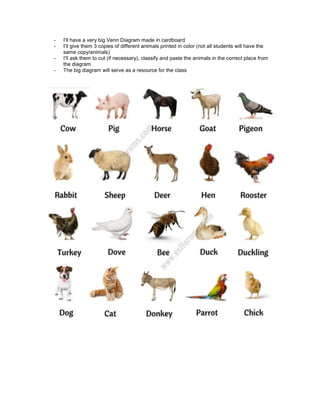
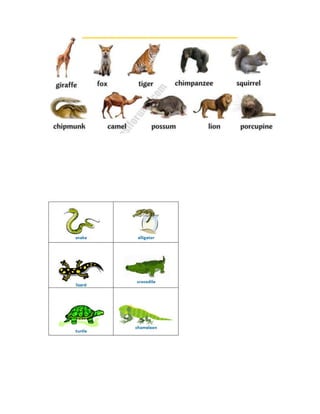
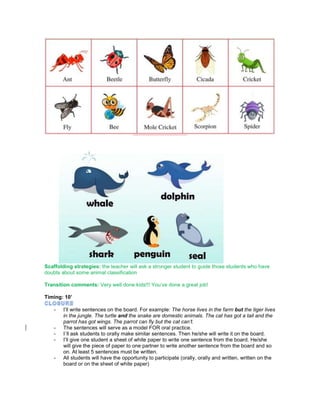
- Color photocopies of different animals
- A big Venn Diagram made in cardboard
- Downloaded song “The jungle of Brazil”
Procedures
Timing: 5’
- I’ll sing the “Hello song”
- I’ll encourage the whole class to greet some mates using the song
Timing: 5’
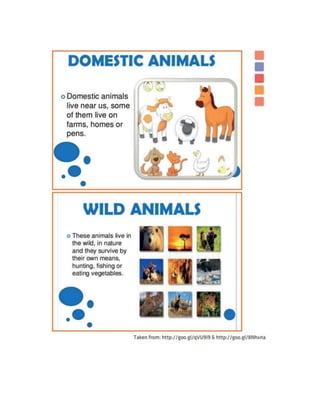
- I’ll show them the Picture from their English course book (page 55) printed in color.
THE BIG QUESTIONS:
- Are cats domestic animals?
- What is wild and what is not?
- What is the difference between a wild animal and a domestic animal?
Scaffolding strategies: animals are beautiful! They have different habitats! It’s Ok to love them all!
The teacher will name and point to the animals and their habitats on the picture.
Transition comments: Great job kids! Now we are going to draw a chart
Timing: 10’
- I’ll ask them to listen to the song “Jungles of Brazil”
- I’ll ask them to listen to the song again, but this time I’ll encourage them to sing and mime
the animals’ sounds.
- I’ll ask them to write the animals in order (as they are said in the song)
Scaffolding strategies: The teacher mimes the song every time. She encourages those shy
students to mime or sing by exaggerating the actions. She’ll play the song as many times as
necessary.
Transition comments: Great job kids! Now we are going to draw a chart on the board to describe
and compare animals.
Timing: 20’
- I’ll ask them questions from the picture. For example, How are wild animals and domestic
animals different? How are domestic animals similar to wild animals?
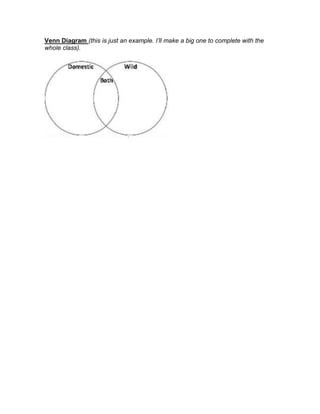
- I’ll draw a Venn Diagram on the board
- I’ll ask them to say and list 10 wild animals.
- I’ll ask them to say and list 10 domestic animals.
- I’ll ask them to say and list 10 animals that are both domestic and wild.
- I’ll have a very big Venn Diagram made in cardboard
- I’ll give them 3 copies of different animals printed in color (not all students will have the
same copy/animals)
- I’ll ask them to cut (if necessary), classify and paste the animals in the correct place from
the diagram
- The big diagram will serve as a resource for the class
Scaffolding strategies: the teacher will ask a stronger student to guide those students who have
doubts about some animal classification
Transition comments: Very well done kids!!! You’ve done a great job!
Timing: 10’
- I’ll write sentences on the board. For example: The horse lives in the farm but the tiger lives
in the jungle. The turtle and the snake are domestic animals. The cat has got a tail and the
parrot has got wings. The parrot can fly but the cat can’t.
- The sentences will serve as a model FOR oral practice.
- I´ll ask students to orally make similar sentences. Then he/she will write it on the board.
- I’ll give one student a sheet of white paper to write one sentence from the board. He/she
will give the piece of paper to one partner to write another sentence from the board and so
on. At least 5 sentences must be written.
- All students will have the opportunity to participate (orally, orally and written, written on the
board or on the sheet of white paper)
Scaffolding strategies: students will use the language they have just learnt. They will use the
diagram to support their speaking and writing.
Transition comments: Great job kids! It’s time to say goodbye! See you on Friday…Bye bye!!!
Each activity must be described in terms of the following components:
 Timing
 Activity description and instructions as they will be said to students
(include direct speech)
 Scaffolding strategies
 Transition comment to link each stage of the lesson with the next one
To be completed by your tutor:
Lesson plan
component
Excellent
5
Very Good
4
Good
3
Acceptable
2
Needs
improvement
1
Visual
organization
X
Coherence
and
sequencing
X
Variety of
resources
X
Stages and
activities
X
Scaffolding
strategies
X
Language
accuracy
X
Observations
Good! Just check a few comments.
Materials:
Venn Diagram (this is just an example. I’ll make a big one to complete with the
whole class).

Lesson 2 - GONZALEZ Soledad - Pass (1).docx

  • 1.
    I.S.F.D LENGUAS VIVASBARILOCHE – PRÁCTICA DOCENTE II ENTREGA DE PLANIFICACIÓN ALUMNO PRACTICANTE: Soledad González Institución educativa: EP N°3 “José de San Martín” Año y sección: 5to “B” Nivel lingüístico del curso: beginners Cantidad de alumnos: 23 Tipo de Planificación: Clase Unidad Temática: It’s ok to love animals Clase Nº: 2 Duración de la clase: 45’ Fecha de la clase: 05/10 Fecha de entrega de la planificación: 27/09 Learning Aims During this lesson, learners will be able to… - Consolidate vocabulary related to animals - Consolidate language structures “Have/has got” “can” - Acquire new vocabulary related to Domestic and Wild animals - PractiSe their speaking, listening, reading and writing skills - Compare and contrast animals by using conjunctions AND/BUT - Develop awareness about being respectful with the animals Language Focus LEXIS FUNCTIONS STRUCTURE R E V Adjectives: strong personalities/ unique styles/ mood / sad / tallest trees and highest walls Nouns: trees / walls / stars / night / tail / whiskers Description of cats To-be / have-has got / can Yes/no questions and answers N E W Cow, sheep, horse, rabbit, hen, chicken, duck Bear, tiger, lion, snake, parrot, monkey. Conjunctions Describing one animal in comparison with another one. Simple present But/and
  • 2.
    Materials - Picture fromthe students’ English course book (page 55) printed in colour - Students’ English course book - Color photocopies of different animals - A big Venn Diagram made in cardboard - Downloaded song “The jungle of Brazil” Procedures Timing: 5’ - I’ll sing the “Hello song” - I’ll encourage the whole class to greet some mates using the song Timing: 5’ - I’ll show them the Picture from their English course book (page 55) printed in color. THE BIG QUESTIONS: - Are cats domestic animals? - What is wild and what is not? - What is the difference between a wild animal and a domestic animal? Scaffolding strategies: animals are beautiful! They have different habitats! It’s Ok to love them all! The teacher will name and point to the animals and their habitats on the picture. Transition comments: Great job kids! Now we are going to draw a chart Timing: 10’ - I’ll ask them to listen to the song “Jungles of Brazil” - I’ll ask them to listen to the song again, but this time I’ll encourage them to sing and mime the animals’ sounds. - I’ll ask them to write the animals in order (as they are said in the song) Scaffolding strategies: The teacher mimes the song every time. She encourages those shy students to mime or sing by exaggerating the actions. She’ll play the song as many times as necessary. Transition comments: Great job kids! Now we are going to draw a chart on the board to describe and compare animals. Timing: 20’ - I’ll ask them questions from the picture. For example, How are wild animals and domestic animals different? How are domestic animals similar to wild animals? - I’ll draw a Venn Diagram on the board - I’ll ask them to say and list 10 wild animals. - I’ll ask them to say and list 10 domestic animals. - I’ll ask them to say and list 10 animals that are both domestic and wild.
  • 3.
    - I’ll havea very big Venn Diagram made in cardboard - I’ll give them 3 copies of different animals printed in color (not all students will have the same copy/animals) - I’ll ask them to cut (if necessary), classify and paste the animals in the correct place from the diagram - The big diagram will serve as a resource for the class
  • 5.
    Scaffolding strategies: theteacher will ask a stronger student to guide those students who have doubts about some animal classification Transition comments: Very well done kids!!! You’ve done a great job! Timing: 10’ - I’ll write sentences on the board. For example: The horse lives in the farm but the tiger lives in the jungle. The turtle and the snake are domestic animals. The cat has got a tail and the parrot has got wings. The parrot can fly but the cat can’t. - The sentences will serve as a model FOR oral practice. - I´ll ask students to orally make similar sentences. Then he/she will write it on the board. - I’ll give one student a sheet of white paper to write one sentence from the board. He/she will give the piece of paper to one partner to write another sentence from the board and so on. At least 5 sentences must be written. - All students will have the opportunity to participate (orally, orally and written, written on the board or on the sheet of white paper)
  • 6.
    Scaffolding strategies: studentswill use the language they have just learnt. They will use the diagram to support their speaking and writing. Transition comments: Great job kids! It’s time to say goodbye! See you on Friday…Bye bye!!! Each activity must be described in terms of the following components:  Timing  Activity description and instructions as they will be said to students (include direct speech)  Scaffolding strategies  Transition comment to link each stage of the lesson with the next one To be completed by your tutor: Lesson plan component Excellent 5 Very Good 4 Good 3 Acceptable 2 Needs improvement 1 Visual organization X Coherence and sequencing X Variety of resources X Stages and activities X Scaffolding strategies X Language accuracy X Observations Good! Just check a few comments. Materials:
  • 8.
    Venn Diagram (thisis just an example. I’ll make a big one to complete with the whole class).