THEME UNIT: ANIMALS
                          LEVEL OF STUDENTS: 3rd (Bilingual School)


 Objectives:
   For students to:
   - be able to recognize and describe animals using colours and parts of the body.
   - be able to describe what animals can and can’t do.
   - be able to classify animals (mammals, amphibians, reptiles, fish and birds).
   - be able to use technological tools to investigate and practice the content of the unit.
   - have fun while learning.


 LESSON 1:

  -WARM UP: Guessing game.
  Group scheme: two groups.
  The teacher will stick on the blackboard a poster of a zoo. She will show students a brochure
  and she will tell them that the names of the animals on it are blurred so she cannot read
  them and wants students to help her. Then, she will read the description of different animals
  and she will ask students to guess their names. The one who says it first gets a point to his/
  her group and sticks the name of the animal next to its corresponding picture on the poster.
  It has got four short legs but it hasn’t got arms. It has got a very long tail and a big mouth. It
  is green. What animal is it?
  It has got two legs and two long arms. It has a strong and big body and it hasn’t got a tail. It
  is black and white. What animal is it?
  It has got four legs and a long tail. It is orange and black and it has got stripes. What animal
  is it?


   -ACTIVITY#1:
  Group scheme: students will be divided into groups according to the number of computers
  available.
  Students will watch the following video:
  http://www.youtube.com/watch?v=W7uWsbcxHHQ


  -ACTIVITY#2:
  Group scheme: students will be divided into groups according to the number of computers
  available.
  Jmatch
  Objective: for students to be able to recognize different animals.

  Students will listen to different sounds and they will match them to the corresponding
  animals. (Bird, seal, lion, owl, wolf, elephant, donkey, monkey, cow, cock)
 LESSON 2:

  -WARM UP: Matching game.
  Group scheme: two groups
  The teacher will stick on the blackboard pictures of different animals and next to them all
  their names mixed up. Taking turns; one student of each group will come to the board and
  will match them. Points will be assigned.


  -ACTIVITY#1:
  Group scheme: students will be divided into groups according to the number of computers
  available.

  The teacher will ask students to visit the following site to investigate about animals’
  classification:
  http://www.sheppardsoftware.com/content/animals/kidscorner/classification/kc_classifica
  tion_main.htm


  -ACTIVITY#2:
  Group scheme: the whole class
  The teacher will ask students to classify the animals of the warm up into mammals, birds,
  fish, amphibians and reptiles.


  -ACTIVITY#3:
  Group scheme: students will be divided into groups according to the number of computers
  available.

  Jcross
  Objective: for students to be able to practice vocabulary connected to animals’ classification
  into mammals, amphibians, reptiles, fish and birds.

  Students will have to find the words that will solve the crossword.

                                   Content of the crossword:

            1- …. nurse their young with milk. (MAMMALS)
            2- They have dry skin (REPTILES)
            3- They lay eggs and have feathers and wings.(BIRDS)
            4- They can live in water or on land.(AMPHIBIANS)
            5- They can swim and breathe under water using gills. (FISH)
            6- Mammals have got ---- blood.(WARM)
            7- Amphibians have ---- feet. (WEBBED)
            8- Reptiles have ----, not fur.(SCALES)
            9- Mammals give birth to ‘live young’ but birds --- eggs. (LAY)
            10- Fish, amphibians and reptiles are cold-…… (BLOODED)
-ACTIVITY#4:
  Group scheme: same groups of the previous activity

  Each group will be in charge of describing orally a particular group of animals. The rest will
  have to guess which group it is.


 LESSON 3:

  -WARM UP: What animal I am?
  Group scheme: In pairs or in small groups according to the number of computers available.
  The teacher will ask students to visit the following link:
  http://www.scribd.com/doc/22796648/Animals. She will ask them to play the game “What
  animal I am?”

  -ACTIVITY#1:
  Group scheme: two groups
  The teacher will show flashcards of animals and she will ask: Can it…? Taking turns, one
  student of each group will answer (Yes, it can/No, it can’t). If it does so correctly he will get a
  point. Then, the teacher will show flashcards of animals and she will say: It can run very
  fast. Taking turns, one student of each group will say if it is true or false. Points will be
  assigned.

  -ACTIVITY#2:
  Group scheme: students will be divided into groups according to the number of computers
  available.

  Jquiz
  Objective: for students to be able to describe what animals can/can’t do -affirmative,
  negative and interrogative form-.

  Students will have to choose the correct option/answer for each point.

                                         Content of the quiz

                               1-   Can the snake walk?
                               -    Yes, it can
                               -    No, it can
                               -    No, it can’t (x)

                               2-   Can the sheep jump very high?
                               -    Yes, it can’t
                               -    No, it can’t (x)
                               -    Yes, it can.

                               3-   Can the shark climb a tree?
                               -    No, it can
                               -    Yes, it can
                               -    No, it can’t (x)
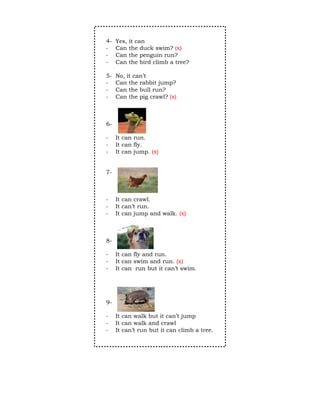
4-   Yes,   it can
-    Can    the duck swim? (x)
-    Can    the penguin run?
-    Can    the bird climb a tree?

5-   No, it can’t
-    Can the rabbit jump?
-    Can the bull run?
-    Can the pig crawl? (x)


6-

-    It can run.
-    It can fly.
-    It can jump. (x)


7-


-    It can crawl.
-    It can’t run.
-    It can jump and walk. (x)


8-

-    It can fly and run.
-    It can swim and run. (x)
-    It can run but it can’t swim.


9-

-    It can walk but it can’t jump
-    It can walk and crawl
-    It can’t run but it can climb a tree.
10-


                              -     It can walk and crawl
                              -     It can jump and swim
                              -     It can swim but it can’t jump


  -ACTIVITY#3:
  Group scheme: students will be divided into groups according to the number of computers
  available.

  Jmix
  Objective: for students to be able to use can in the affirmative, negative and interrogative
  form.

  Words in the sentences will appear all mixed up. Students will have to put them in the
  correct order.

                                         Content of the mix

                                    The kangaroo can jump high.
                                    The Octopus can’t fly.
                                    Can the cheetah climb a tree?
                                    The penguin can’t fly.
                                    The frog can swim and jump.
                                    The monkey can climb trees but it can’t fly.
                                    Can lions and zebras run very fast?
                                    The worm can crawl but it can’t walk.
                                    The turtle can’t walk fast.
                                    Can the seal crawl and swim?


 LESSON 4:

  -WARM UP: Look and write.
  Group scheme: two groups
  The teacher will stick on the board some flashcards of animals and she will write a sentence
  for students to complete (using can/can’t) next to each of them. Points will be assigned.
  For example:
  [PENGUIN PHOTO] It …… fly.
  [SHARK PHOTO]         It …… swim.
-ACTIVITY#1:
Group scheme:
Jcloze
Objective: for students to be able to use all the knowledge they have learnt during the
different lesson and apply it in order to complete the following text.


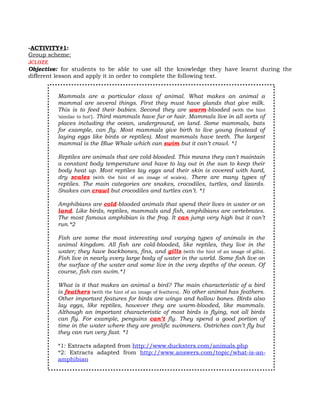
         Mammals are a particular class of animal. What makes an animal a
         mammal are several things. First they must have glands that give milk.
         This is to feed their babies. Second they are warm-blooded (with the hint
         ‘similar to hot’). Third mammals have fur or hair. Mammals live in all sorts of
         places including the ocean, underground, on land. Some mammals, bats
         for example, can fly. Most mammals give birth to live young (instead of
         laying eggs like birds or reptiles). Most mammals have teeth. The largest
         mammal is the Blue Whale which can swim but it can’t crawl. *1

         Reptiles are animals that are cold-blooded. This means they can't maintain
         a constant body temperature and have to lay out in the sun to keep their
         body heat up. Most reptiles lay eggs and their skin is covered with hard,
         dry scales (with the hint of an image of scales). There are many types of
         reptiles. The main categories are snakes, crocodiles, turtles, and lizards.
         Snakes can crawl but crocodiles and turtles can’t. *1

         Amphibians are cold-blooded animals that spend their lives in water or on
         land. Like birds, reptiles, mammals and fish, amphibians are vertebrates.
         The most famous amphibian is the frog. It can jump very high but it can’t
         run.*2

         Fish are some the most interesting and varying types of animals in the
         animal kingdom. All fish are cold-blooded, like reptiles, they live in the
         water; they have backbones, fins, and gills (with the hint of an image of gills).
         Fish live in nearly every large body of water in the world. Some fish live on
         the surface of the water and some live in the very depths of the ocean. Of
         course, fish can swim.*1

         What is it that makes an animal a bird? The main characteristic of a bird
         is feathers (with the hint of an image of feathers). No other animal has feathers.
         Other important features for birds are wings and hollow bones. Birds also
         lay eggs, like reptiles, however they are warm-blooded, like mammals.
         Although an important characteristic of most birds is flying, not all birds
         can fly. For example, penguins can’t fly. They spend a good portion of
         time in the water where they are prolific swimmers. Ostriches can’t fly but
         they can run very fast. *1

         *1: Extracts adapted from http://www.ducksters.com/animals.php
         *2: Extracts adapted from http://www.answers.com/topic/what-is-an-
         amphibian
 FINAL TASK:
  Each student will choose 5 animals (one of each group). They will draw them and describe
  them using can (‘t), action verbs and characteristics of the animals of each group. Then, they
  will create a kind of portfolio.

Lesson Plan (Hot Potatoes)

  • 1.
    THEME UNIT: ANIMALS LEVEL OF STUDENTS: 3rd (Bilingual School)  Objectives: For students to: - be able to recognize and describe animals using colours and parts of the body. - be able to describe what animals can and can’t do. - be able to classify animals (mammals, amphibians, reptiles, fish and birds). - be able to use technological tools to investigate and practice the content of the unit. - have fun while learning.  LESSON 1: -WARM UP: Guessing game. Group scheme: two groups. The teacher will stick on the blackboard a poster of a zoo. She will show students a brochure and she will tell them that the names of the animals on it are blurred so she cannot read them and wants students to help her. Then, she will read the description of different animals and she will ask students to guess their names. The one who says it first gets a point to his/ her group and sticks the name of the animal next to its corresponding picture on the poster. It has got four short legs but it hasn’t got arms. It has got a very long tail and a big mouth. It is green. What animal is it? It has got two legs and two long arms. It has a strong and big body and it hasn’t got a tail. It is black and white. What animal is it? It has got four legs and a long tail. It is orange and black and it has got stripes. What animal is it? -ACTIVITY#1: Group scheme: students will be divided into groups according to the number of computers available. Students will watch the following video: http://www.youtube.com/watch?v=W7uWsbcxHHQ -ACTIVITY#2: Group scheme: students will be divided into groups according to the number of computers available. Jmatch Objective: for students to be able to recognize different animals. Students will listen to different sounds and they will match them to the corresponding animals. (Bird, seal, lion, owl, wolf, elephant, donkey, monkey, cow, cock)
  • 2.
     LESSON 2: -WARM UP: Matching game. Group scheme: two groups The teacher will stick on the blackboard pictures of different animals and next to them all their names mixed up. Taking turns; one student of each group will come to the board and will match them. Points will be assigned. -ACTIVITY#1: Group scheme: students will be divided into groups according to the number of computers available. The teacher will ask students to visit the following site to investigate about animals’ classification: http://www.sheppardsoftware.com/content/animals/kidscorner/classification/kc_classifica tion_main.htm -ACTIVITY#2: Group scheme: the whole class The teacher will ask students to classify the animals of the warm up into mammals, birds, fish, amphibians and reptiles. -ACTIVITY#3: Group scheme: students will be divided into groups according to the number of computers available. Jcross Objective: for students to be able to practice vocabulary connected to animals’ classification into mammals, amphibians, reptiles, fish and birds. Students will have to find the words that will solve the crossword. Content of the crossword: 1- …. nurse their young with milk. (MAMMALS) 2- They have dry skin (REPTILES) 3- They lay eggs and have feathers and wings.(BIRDS) 4- They can live in water or on land.(AMPHIBIANS) 5- They can swim and breathe under water using gills. (FISH) 6- Mammals have got ---- blood.(WARM) 7- Amphibians have ---- feet. (WEBBED) 8- Reptiles have ----, not fur.(SCALES) 9- Mammals give birth to ‘live young’ but birds --- eggs. (LAY) 10- Fish, amphibians and reptiles are cold-…… (BLOODED)
  • 3.
    -ACTIVITY#4: Groupscheme: same groups of the previous activity Each group will be in charge of describing orally a particular group of animals. The rest will have to guess which group it is.  LESSON 3: -WARM UP: What animal I am? Group scheme: In pairs or in small groups according to the number of computers available. The teacher will ask students to visit the following link: http://www.scribd.com/doc/22796648/Animals. She will ask them to play the game “What animal I am?” -ACTIVITY#1: Group scheme: two groups The teacher will show flashcards of animals and she will ask: Can it…? Taking turns, one student of each group will answer (Yes, it can/No, it can’t). If it does so correctly he will get a point. Then, the teacher will show flashcards of animals and she will say: It can run very fast. Taking turns, one student of each group will say if it is true or false. Points will be assigned. -ACTIVITY#2: Group scheme: students will be divided into groups according to the number of computers available. Jquiz Objective: for students to be able to describe what animals can/can’t do -affirmative, negative and interrogative form-. Students will have to choose the correct option/answer for each point. Content of the quiz 1- Can the snake walk? - Yes, it can - No, it can - No, it can’t (x) 2- Can the sheep jump very high? - Yes, it can’t - No, it can’t (x) - Yes, it can. 3- Can the shark climb a tree? - No, it can - Yes, it can - No, it can’t (x)
  • 4.
    4- Yes, it can - Can the duck swim? (x) - Can the penguin run? - Can the bird climb a tree? 5- No, it can’t - Can the rabbit jump? - Can the bull run? - Can the pig crawl? (x) 6- - It can run. - It can fly. - It can jump. (x) 7- - It can crawl. - It can’t run. - It can jump and walk. (x) 8- - It can fly and run. - It can swim and run. (x) - It can run but it can’t swim. 9- - It can walk but it can’t jump - It can walk and crawl - It can’t run but it can climb a tree.
  • 5.
    10- - It can walk and crawl - It can jump and swim - It can swim but it can’t jump -ACTIVITY#3: Group scheme: students will be divided into groups according to the number of computers available. Jmix Objective: for students to be able to use can in the affirmative, negative and interrogative form. Words in the sentences will appear all mixed up. Students will have to put them in the correct order. Content of the mix The kangaroo can jump high. The Octopus can’t fly. Can the cheetah climb a tree? The penguin can’t fly. The frog can swim and jump. The monkey can climb trees but it can’t fly. Can lions and zebras run very fast? The worm can crawl but it can’t walk. The turtle can’t walk fast. Can the seal crawl and swim?  LESSON 4: -WARM UP: Look and write. Group scheme: two groups The teacher will stick on the board some flashcards of animals and she will write a sentence for students to complete (using can/can’t) next to each of them. Points will be assigned. For example: [PENGUIN PHOTO] It …… fly. [SHARK PHOTO] It …… swim.
  • 6.
    -ACTIVITY#1: Group scheme: Jcloze Objective: forstudents to be able to use all the knowledge they have learnt during the different lesson and apply it in order to complete the following text. Mammals are a particular class of animal. What makes an animal a mammal are several things. First they must have glands that give milk. This is to feed their babies. Second they are warm-blooded (with the hint ‘similar to hot’). Third mammals have fur or hair. Mammals live in all sorts of places including the ocean, underground, on land. Some mammals, bats for example, can fly. Most mammals give birth to live young (instead of laying eggs like birds or reptiles). Most mammals have teeth. The largest mammal is the Blue Whale which can swim but it can’t crawl. *1 Reptiles are animals that are cold-blooded. This means they can't maintain a constant body temperature and have to lay out in the sun to keep their body heat up. Most reptiles lay eggs and their skin is covered with hard, dry scales (with the hint of an image of scales). There are many types of reptiles. The main categories are snakes, crocodiles, turtles, and lizards. Snakes can crawl but crocodiles and turtles can’t. *1 Amphibians are cold-blooded animals that spend their lives in water or on land. Like birds, reptiles, mammals and fish, amphibians are vertebrates. The most famous amphibian is the frog. It can jump very high but it can’t run.*2 Fish are some the most interesting and varying types of animals in the animal kingdom. All fish are cold-blooded, like reptiles, they live in the water; they have backbones, fins, and gills (with the hint of an image of gills). Fish live in nearly every large body of water in the world. Some fish live on the surface of the water and some live in the very depths of the ocean. Of course, fish can swim.*1 What is it that makes an animal a bird? The main characteristic of a bird is feathers (with the hint of an image of feathers). No other animal has feathers. Other important features for birds are wings and hollow bones. Birds also lay eggs, like reptiles, however they are warm-blooded, like mammals. Although an important characteristic of most birds is flying, not all birds can fly. For example, penguins can’t fly. They spend a good portion of time in the water where they are prolific swimmers. Ostriches can’t fly but they can run very fast. *1 *1: Extracts adapted from http://www.ducksters.com/animals.php *2: Extracts adapted from http://www.answers.com/topic/what-is-an- amphibian
  • 7.
     FINAL TASK: Each student will choose 5 animals (one of each group). They will draw them and describe them using can (‘t), action verbs and characteristics of the animals of each group. Then, they will create a kind of portfolio.