I.F.D.C. LENGUAS VIVAS
TALLER DE PRÁCTICA DOCENTE
Tutora: Aurelia Velázquez
ALUMNO RESIDENTE: Marzol, Mirari Macarena
Período de Práctica: Nivel Primario
Institución Educativa: Escuela Primaria N° 5 Vicente López y Planes
Dirección: Los Sauces S/N - Iriarte
Sala / Grado / Año - sección: 5to Grado
Cantidad de alumnos: 6
Nivel lingüístico del curso: Beginner
Tipo de Planificación: Clase
Unidad Temática: Los Animales
Clase Nº: 2
Fecha: 13 de Julio de 2018
Hora: 9:00 a 10:00
Duración de la clase: 60 minutos
 Teaching points: Animals (Farm and Safari animals)

 Aims or goals: 
During this lesson, learners will be able to…
- Develop speaking skills by repetition and interaction.
- Develop listening skills by listening to a song and listening to the teacher.
- Develop writing skills by answering questions.
- Recognize the animals in English.
- Recognize Farm animals and Wild animals.
- Develop collaborative skills by interacting.
 Language focus:
Functions Lexis Structures Pronunciation
Revision Greetings
Animals
Hello
Bye
How are
you?
Hello, How
are you?
What’s the
weather like
Hello
/əʊ/ sound
Bye
Cat, dog,
fish, frog,
goat, horse,
mouse,
panda, tiger,
fox, lion, pig.
today?
What is it?
It’s a…
/ aɪ/ sound
New Animals Elephant,
crocodile,
cheetah,
rhino,
monkey,
zebra,
giraffe,
chicken,
bee, duck,
sheep,
Where does
the [cat]
live?
The [cat]
lives on the
farm/ in the
safari
 Teaching approach: My lesson plan is based on the PPP method and the
communicative approach.

 Integration of skills: What skills will be integrated and
how?Communicative skills will be developed through interaction.
Students will develop listening and speaking skills by listening and
singing songs, and by listening to the teacher and repeating. Reading and
writing skills will be also developed by answering questions.
 Materials and resources: I’ll use a computer to watch a video. I’ll also use
worksheets in photocopy and different pictures of animals (cards). 

 Pedagogical use of ICT in class or at home: I will use a video to support
the teaching points. The use of videos is a motivating tool for students. 

 Seating arrangement: At the beginning of the lesson students will be on
their usual seats. They always sit in groups of three boys and three girls.
Then I’ll ask them to sit all together and I’ll sit with them to do the
different activities. 

 Assessment: what will be assessed and how: I’ll monitor all my students
through the lesson and I’ll check whether if they understand what I say or
not. I’ll try to make them repeat the different patterns and encourage
them to use the chunks meaningfully. Although they are in 5th grade they
are beginners and they don’t speak English. Their teacher doesn’t speak
English in the lessons so they don’t understand the language. According
to this, I’ll try to use gestures as much as possible to help them
understand.
Warm up (10 minutes)
Purpose: To begin the lesson and create a comfortable atmosphere; to
introduce the students to the topic.
The students will enter the classroom and I’ll greet them. “Good morning! How
are you? Are you fine or bad?” Once they are all in their seats I’ll ask one of the
students to write the date on the board and I’ll encourage the other students to
help him/her. Then, I’ll ask the students to sit in all together as the previous
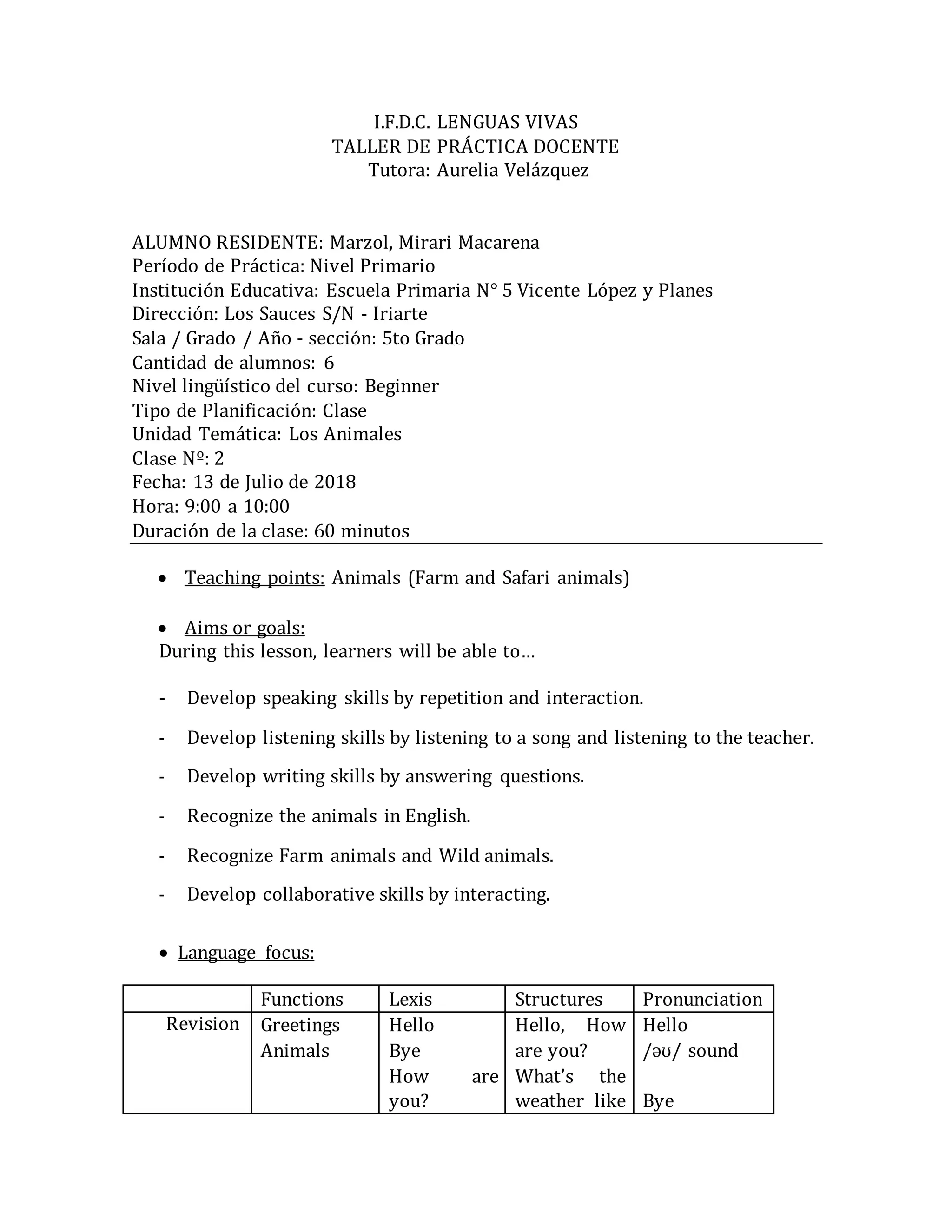
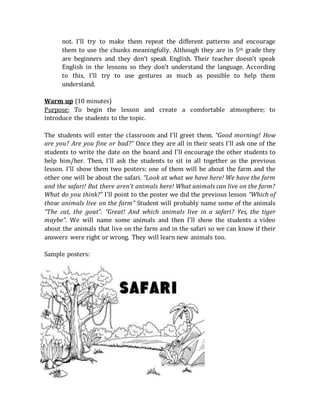
lesson. I’ll show them two posters: one of them will be about the farm and the
other one will be about the safari. “Look at what we have here! We have the farm
and the safari! But there aren’t animals here! What animals can live on the farm?
What do you think?” I’ll point to the poster we did the previous lesson “Which of
those animals live on the farm” Student will probably name some of the animals
“The cat, the goat”. “Great! And which animals live in a safari? Yes, the tiger
maybe”. We will name some animals and then I’ll show the students a video
about the animals that live on the farm and in the safari so we can know if their
answers were right or wrong. They will learn new animals too.
Sample posters:
Transition: “We’ll watch a video now so we can know where the animals live!”
Presentation (10 minutes)
Purpose: To Expose the students to the language; to enhance students’
communicative skills and to develop or improve comprehensive skills.
At this stage of the lesson I’ll reproduce a video so the kids can differentiate the
animals that live on the farm and the ones that life in the safari. While we watch
the video I’ll repeat the names of the animals. Once we have watched the video
I’ll ask them some questions. “Well, so does the cat live on the farm? Yes or no?,
and what about the elephant? Where does the elephant live?” I’ll ask about some
of the new animals so the students can listen and repeat the new vocabulary.
Video: https://www.youtube.com/watch?v=_Xrrz9tHtmE
Transition: “Good job! Now let’s set the animals in their place!”
Development (30 minutes)
Purpose: to develop communicative skills; to foster interaction and to check
students’ knowledge of new vocabulary.
1) Activity 1 (15 minutes)
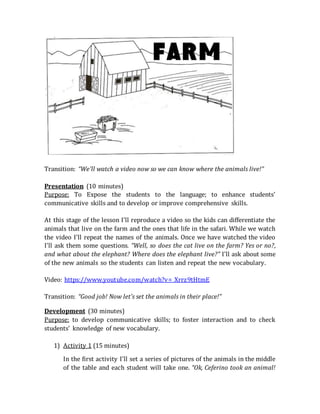
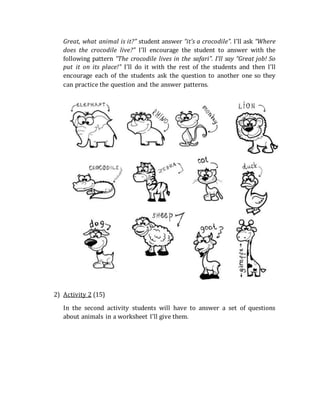
In the first activity I’ll set a series of pictures of the animals in the middle
of the table and each student will take one. “Ok, Ceferino took an animal!
Great, what animal is it?” student answer “it’s a crocodile”. I’ll ask “Where
does the crocodile live?” I’ll encourage the student to answer with the
following pattern “The crocodile lives in the safari”. I’ll say “Great job! So
put it on its place!” I’ll do it with the rest of the students and then I’ll
encourage each of the students ask the question to another one so they
can practice the question and the answer patterns.
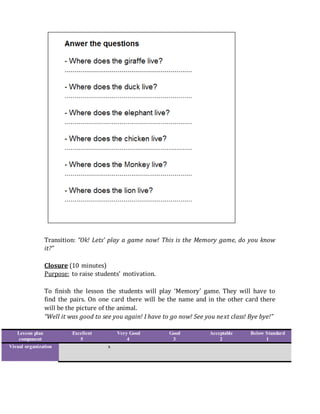
2) Activity 2 (15)
In the second activity students will have to answer a set of questions
about animals in a worksheet I’ll give them.
Transition: “Ok! Lets’ play a game now! This is the Memory game, do you know
it?”
Closure (10 minutes)
Purpose: to raise students’ motivation.
To finish the lesson the students will play ‘Memory’ game. They will have to
find the pairs. On one card there will be the name and in the other card there
will be the picture of the animal.
“Well it was good to see you again! I have to go now! See you next class! Bye bye!”
Lesson plan
component
Excellent
5
Very Good
4
Good
3
Acceptable
2
Below Standard
1
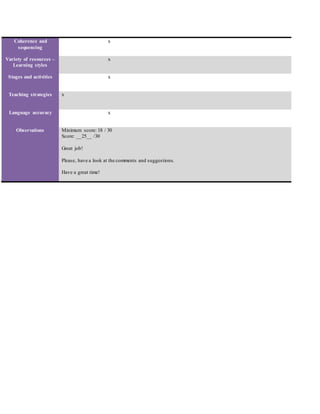
Visual organization x
Coherence and
sequencing
x
Variety of resources –
Learning styles
x
Stages and activities x
Teaching strategies x
Language accuracy x
Observations Minimum score: 18 / 30
Score: __25__ /30
Great job!
Please, have a look at the comments and suggestions.
Have a great time!

Marzol lesson plan class 2 - primary

  • 1.
    I.F.D.C. LENGUAS VIVAS TALLERDE PRÁCTICA DOCENTE Tutora: Aurelia Velázquez ALUMNO RESIDENTE: Marzol, Mirari Macarena Período de Práctica: Nivel Primario Institución Educativa: Escuela Primaria N° 5 Vicente López y Planes Dirección: Los Sauces S/N - Iriarte Sala / Grado / Año - sección: 5to Grado Cantidad de alumnos: 6 Nivel lingüístico del curso: Beginner Tipo de Planificación: Clase Unidad Temática: Los Animales Clase Nº: 2 Fecha: 13 de Julio de 2018 Hora: 9:00 a 10:00 Duración de la clase: 60 minutos  Teaching points: Animals (Farm and Safari animals)   Aims or goals:  During this lesson, learners will be able to… - Develop speaking skills by repetition and interaction. - Develop listening skills by listening to a song and listening to the teacher. - Develop writing skills by answering questions. - Recognize the animals in English. - Recognize Farm animals and Wild animals. - Develop collaborative skills by interacting.  Language focus: Functions Lexis Structures Pronunciation Revision Greetings Animals Hello Bye How are you? Hello, How are you? What’s the weather like Hello /əʊ/ sound Bye
  • 2.
    Cat, dog, fish, frog, goat,horse, mouse, panda, tiger, fox, lion, pig. today? What is it? It’s a… / aɪ/ sound New Animals Elephant, crocodile, cheetah, rhino, monkey, zebra, giraffe, chicken, bee, duck, sheep, Where does the [cat] live? The [cat] lives on the farm/ in the safari  Teaching approach: My lesson plan is based on the PPP method and the communicative approach.   Integration of skills: What skills will be integrated and how?Communicative skills will be developed through interaction. Students will develop listening and speaking skills by listening and singing songs, and by listening to the teacher and repeating. Reading and writing skills will be also developed by answering questions.  Materials and resources: I’ll use a computer to watch a video. I’ll also use worksheets in photocopy and different pictures of animals (cards).    Pedagogical use of ICT in class or at home: I will use a video to support the teaching points. The use of videos is a motivating tool for students.    Seating arrangement: At the beginning of the lesson students will be on their usual seats. They always sit in groups of three boys and three girls. Then I’ll ask them to sit all together and I’ll sit with them to do the different activities.    Assessment: what will be assessed and how: I’ll monitor all my students through the lesson and I’ll check whether if they understand what I say or
  • 3.
    not. I’ll tryto make them repeat the different patterns and encourage them to use the chunks meaningfully. Although they are in 5th grade they are beginners and they don’t speak English. Their teacher doesn’t speak English in the lessons so they don’t understand the language. According to this, I’ll try to use gestures as much as possible to help them understand. Warm up (10 minutes) Purpose: To begin the lesson and create a comfortable atmosphere; to introduce the students to the topic. The students will enter the classroom and I’ll greet them. “Good morning! How are you? Are you fine or bad?” Once they are all in their seats I’ll ask one of the students to write the date on the board and I’ll encourage the other students to help him/her. Then, I’ll ask the students to sit in all together as the previous lesson. I’ll show them two posters: one of them will be about the farm and the other one will be about the safari. “Look at what we have here! We have the farm and the safari! But there aren’t animals here! What animals can live on the farm? What do you think?” I’ll point to the poster we did the previous lesson “Which of those animals live on the farm” Student will probably name some of the animals “The cat, the goat”. “Great! And which animals live in a safari? Yes, the tiger maybe”. We will name some animals and then I’ll show the students a video about the animals that live on the farm and in the safari so we can know if their answers were right or wrong. They will learn new animals too. Sample posters:
  • 4.
    Transition: “We’ll watcha video now so we can know where the animals live!” Presentation (10 minutes) Purpose: To Expose the students to the language; to enhance students’ communicative skills and to develop or improve comprehensive skills. At this stage of the lesson I’ll reproduce a video so the kids can differentiate the animals that live on the farm and the ones that life in the safari. While we watch the video I’ll repeat the names of the animals. Once we have watched the video I’ll ask them some questions. “Well, so does the cat live on the farm? Yes or no?, and what about the elephant? Where does the elephant live?” I’ll ask about some of the new animals so the students can listen and repeat the new vocabulary. Video: https://www.youtube.com/watch?v=_Xrrz9tHtmE Transition: “Good job! Now let’s set the animals in their place!” Development (30 minutes) Purpose: to develop communicative skills; to foster interaction and to check students’ knowledge of new vocabulary. 1) Activity 1 (15 minutes) In the first activity I’ll set a series of pictures of the animals in the middle of the table and each student will take one. “Ok, Ceferino took an animal!
  • 5.
    Great, what animalis it?” student answer “it’s a crocodile”. I’ll ask “Where does the crocodile live?” I’ll encourage the student to answer with the following pattern “The crocodile lives in the safari”. I’ll say “Great job! So put it on its place!” I’ll do it with the rest of the students and then I’ll encourage each of the students ask the question to another one so they can practice the question and the answer patterns. 2) Activity 2 (15) In the second activity students will have to answer a set of questions about animals in a worksheet I’ll give them.
  • 6.
    Transition: “Ok! Lets’play a game now! This is the Memory game, do you know it?” Closure (10 minutes) Purpose: to raise students’ motivation. To finish the lesson the students will play ‘Memory’ game. They will have to find the pairs. On one card there will be the name and in the other card there will be the picture of the animal. “Well it was good to see you again! I have to go now! See you next class! Bye bye!” Lesson plan component Excellent 5 Very Good 4 Good 3 Acceptable 2 Below Standard 1 Visual organization x
  • 7.
    Coherence and sequencing x Variety ofresources – Learning styles x Stages and activities x Teaching strategies x Language accuracy x Observations Minimum score: 18 / 30 Score: __25__ /30 Great job! Please, have a look at the comments and suggestions. Have a great time!