
LESSON PLAN 2
By Marina Michael
Dali B’ Primary School, Cyprus
UNIT: 4, RELATIONSHIPS
SUBUNIT: Family
Lesson 2
Age group 11-12 years old
Time: 40 minutes
New Language: past simple
(affirmative), family members
(daughter, grandaughter, son,
grandson, wife, husband),
action verbs, time connectives
(first, then after, finally, etc.),
enormous.
Recycledlanguage: Family
members: mum, dad, brother,
sister, grandma, grandpa, other
vocabulary: huge, gigantic,
food vocabulary: lunch, dinner,
breakfast, soup, adverbials of
time: today, tomorrow, always,
usually, often, sometimes,
never, every
week/Monday/month/year, next
week / month / year/ summer /
etc., days of the week
Resources-Materials: mini
whiteboards, markers, “cut”
storybook “the enormous
turnip”, ppt presentation, film
strips, a handout with the story
For Lessons 1 & 2
Success Indicators
Students should be able to:
Adequacy Targets
Listening
Comprehend short stories Pre and While – storytelling
activities: predictions,
questions, main idea, still
scenes
Speaking
Narrate events which take
place in the past
After – storytelling activities:
story retelling with the use of
time connectives and other
“tools” (pictures)
Reading
Enjoy, follow and participate
actively in the narration of
literary stories
Pre and while – storytelling
activities: predictions,
questions, main idea, still
scenes
Writing
Write a short story Storybird: Digital writing tool
with the use of art pictures
Learning Strategies
Deduce rules on the function of
language based on its use
Transform the text to present
simple and compare the
function of the two tenses in
storytelling
Objectives:
Pupils should be able to:
 Transform the “The enormous turnip” to make their own
story (e.g. change characters, setting, etc)
 Draft their own stories on film strips, or other story
templates
 Create their “storytelling bags” based upon their own story
line
Time Procedure Class Organization
10΄
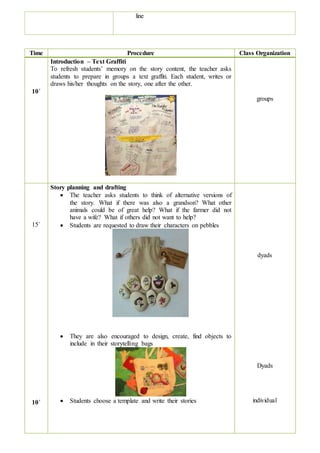
Introduction – Text Graffiti
To refresh students’ memory on the story content, the teacher asks
students to prepare in groups a text graffiti. Each student, writes or
draws his/her thoughts on the story, one after the other.
groups
15΄
10΄
Story planning and drafting
 The teacher asks students to think of alternative versions of
the story. What if there was also a grandson? What other
animals could be of great help? What if the farmer did not
have a wife? What if others did not want to help?
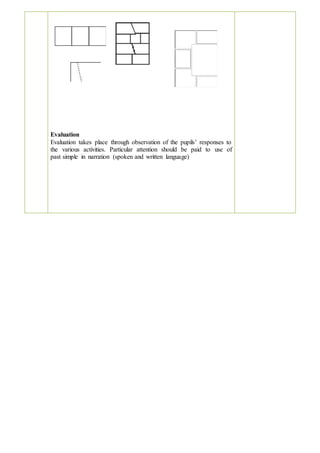
 Students are requested to draw their characters on pebbles
 They are also encouraged to design, create, find objects to
include in their storytelling bags
 Students choose a template and write their stories
dyads
Dyads
individual
Evaluation
Evaluation takes place through observation of the pupils’ responses to
the various activities. Particular attention should be paid to use of
past simple in narration (spoken and written language)
Lesson plan 2 Family Relationships LS

Lesson plan 2 Family Relationships LS

  • 1.
    LESSON PLAN 2 ByMarina Michael Dali B’ Primary School, Cyprus UNIT: 4, RELATIONSHIPS SUBUNIT: Family Lesson 2 Age group 11-12 years old Time: 40 minutes New Language: past simple (affirmative), family members (daughter, grandaughter, son, grandson, wife, husband), action verbs, time connectives (first, then after, finally, etc.), enormous. Recycledlanguage: Family members: mum, dad, brother, sister, grandma, grandpa, other vocabulary: huge, gigantic, food vocabulary: lunch, dinner, breakfast, soup, adverbials of time: today, tomorrow, always, usually, often, sometimes, never, every week/Monday/month/year, next week / month / year/ summer / etc., days of the week Resources-Materials: mini whiteboards, markers, “cut” storybook “the enormous turnip”, ppt presentation, film strips, a handout with the story For Lessons 1 & 2 Success Indicators Students should be able to: Adequacy Targets Listening Comprehend short stories Pre and While – storytelling activities: predictions, questions, main idea, still scenes Speaking Narrate events which take place in the past After – storytelling activities: story retelling with the use of time connectives and other “tools” (pictures) Reading Enjoy, follow and participate actively in the narration of literary stories Pre and while – storytelling activities: predictions, questions, main idea, still scenes Writing Write a short story Storybird: Digital writing tool with the use of art pictures Learning Strategies Deduce rules on the function of language based on its use Transform the text to present simple and compare the function of the two tenses in storytelling Objectives: Pupils should be able to:  Transform the “The enormous turnip” to make their own story (e.g. change characters, setting, etc)  Draft their own stories on film strips, or other story templates  Create their “storytelling bags” based upon their own story
  • 2.
    line Time Procedure ClassOrganization 10΄ Introduction – Text Graffiti To refresh students’ memory on the story content, the teacher asks students to prepare in groups a text graffiti. Each student, writes or draws his/her thoughts on the story, one after the other. groups 15΄ 10΄ Story planning and drafting  The teacher asks students to think of alternative versions of the story. What if there was also a grandson? What other animals could be of great help? What if the farmer did not have a wife? What if others did not want to help?  Students are requested to draw their characters on pebbles  They are also encouraged to design, create, find objects to include in their storytelling bags  Students choose a template and write their stories dyads Dyads individual
  • 3.
    Evaluation Evaluation takes placethrough observation of the pupils’ responses to the various activities. Particular attention should be paid to use of past simple in narration (spoken and written language)