Half Hollow Hills Elementary Curriculum Renewal English Language Arts Presented by Rochelle DeMuccio , Coordinator, ELA and READING, K-5 Leadership Council - Fall 2008 CHECK IT OUT http: www.hhh.k12.ny.us
What is our thinking about cultivating literacy learners?
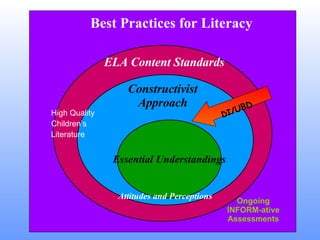
Essential Understandings Best Practices for Literacy Constructivist Approach ELA Content Standards Attitudes and Perceptions High Quality Children’s Literature Ongoing INFORM-ative Assessments DI/ UBD
Independent Reading and Writing Best Practices • Students need models • Students need choice • Students need a lot of practice • Students need time  • Students need authentic purposes • Students need real audiences; feedback  • Students need to slow down; go deeper
    SOLUTION ! Design a rich literacy curriculum  that reflects our beliefs…
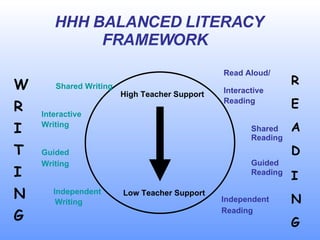
HHH BALANCED LITERACY FRAMEWORK  High Teacher Support Low Teacher Support W R I T I N G R E A D I N G   Shared Writing Interactive  Writing Guided  Writing   Independent Writing Read Aloud/    Interactive  Reading Shared  Reading Guided  Reading Independent  Reading
INDEPENDENT  READING AND WRITING WORKSHOP   … is a model/  framework that provides a common understanding and language related to learning.
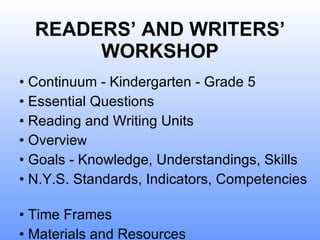
READERS’ AND WRITERS’ WORKSHOP •  Continuum - Kindergarten - Grade 5 •  Essential Questions  •  Reading and Writing Units •  Overvie w •  Goals - Knowledge, Understandings, Skills •  N.Y.S. Standards, Indicators, Competencies  •  Time Frames  •  Materials and Resources
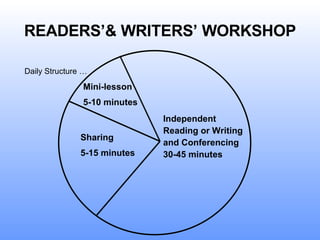
READERS’& WRITERS’ WORKSHOP Mini-lesson 5-10 minutes Independent Reading or Writing and Conferencing 30-45 minutes Sharing 5-15 minutes Daily Structure …
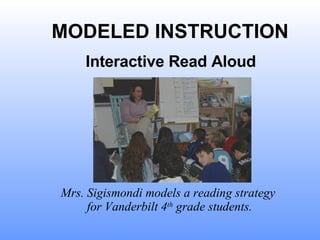
Mrs. Sigismondi models a reading strategy  for Vanderbilt 4 th  grade students. MODELED INSTRUCTION Interactive Read Aloud
THE READ ALOUD Wh en we read aloud to children, we can mentor them on the thinking processes that are common among proficient readers.  The read-aloud gives us opportunities to work with youngsters as apprentices, demonstrating the tools of thoughtful, skilled readers and inviting children to try these out.  ~ Lucy Calkins
INTERACTIVE WRITING Mrs. Kienenger conducting an editing skills review with Chestnut Hill 4 th  graders .
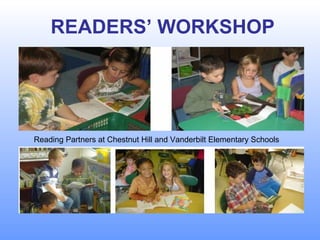
READERS’ WORKSHOP Reading Partners at Chestnut Hill and Vanderbilt Elementary Schools
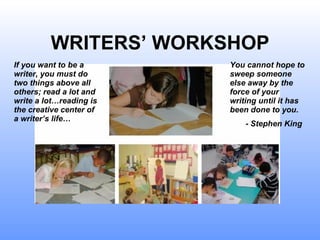
WRITERS’ WORKSHOP If you want to be a writer, you must do two things above all others; read a lot and write a lot…reading is the creative center of a writer’s life… You cannot hope to sweep someone else away by the force of your writing until it has been done to you.  - Stephen King
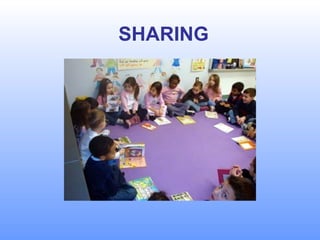
  SHARING
As a result… Students should see knowledge in new ways and be able to express insights, understandings, ideas or discoveries related to that knowledge Students deepen their understanding of content Students increase their understanding of learning as a process
 
HOW DO WE EXTEND  AND REFINE? SPRING 2008 Survey Teachers K-5
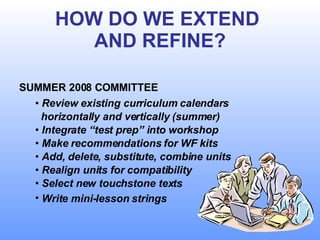
HOW DO WE EXTEND  AND REFINE? SUMMER 2008 COMMITTEE Review existing curriculum calendars horizontally and vertically (summer) Integrate “test prep” into workshop Make recommendations for WF kits  Add, delete, substitute, combine units Realign units for compatibility  Select new touchstone texts  Write mini-lesson strings
Curriculum Calendar 2008 – 2009 FIRST GRADE WRITER’S WORKSHOP
GRADE ONE - UNIT 2 WRITING OVERVIEW Students will learn to be better writers by studying the work of mentor authors.  Students will learn the craft of mentor authors and practice incorporating these elements into their own writing.  Craft lessons may include the use of repetition, descriptive language, labeling, metaphors, ellipses, dialogue, use of commas, etc.
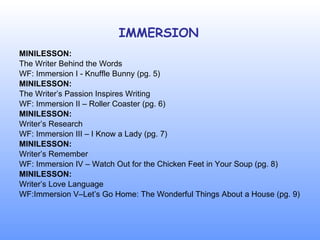
IMMERSION MINILESSON: The Writer Behind the Words WF: Immersion I - Knuffle Bunny (pg. 5) MINILESSON: The Writer’s Passion Inspires Writing WF: Immersion II – Roller Coaster (pg. 6) MINILESSON: Writer’s Research WF: Immersion III – I Know a Lady (pg. 7) MINILESSON: Writer’s Remember WF: Immersion IV – Watch Out for the Chicken Feet in Your Soup (pg. 8) MINILESSON: Writer’s Love Language WF:Immersion V–Let’s Go Home: The Wonderful Things About a House (pg. 9)
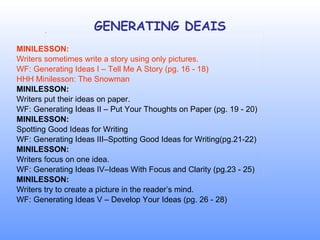
GENERATING DEAIS MINILESSON: Writers sometimes write a story using only pictures. WF: Generating Ideas I – Tell Me A Story (pg. 16 - 18) HHH Minilesson: The Snowman MINILESSON: Writers put their ideas on paper. WF: Generating Ideas II – Put Your Thoughts on Paper (pg. 19 - 20) MINILESSON: Spotting Good Ideas for Writing WF: Generating Ideas III–Spotting Good Ideas for Writing(pg.21-22) MINILESSON: Writers focus on one idea. WF: Generating Ideas IV–Ideas With Focus and Clarity (pg.23 - 25) MINILESSON: Writers try to create a picture in the reader’s mind. WF: Generating Ideas V – Develop Your Ideas (pg. 26 - 28)
SELECTING IDEAS MINILESSON: Writers pick one idea to write more about. WF: Selecting – Decide What to Stick With (pg. 29 - 30) DRAFTING IDEAS REVISING IDEAS
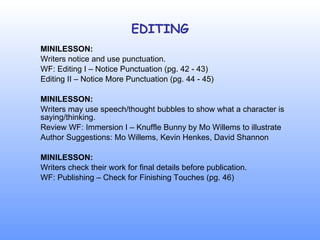
EDITING MINILESSON: Writers notice and use punctuation. WF: Editing I – Notice Punctuation (pg. 42 - 43) Editing II – Notice More Punctuation (pg. 44 - 45) MINILESSON: Writers may use speech/thought bubbles to show what a character is saying/thinking. Review WF: Immersion I – Knuffle Bunny by Mo Willems to illustrate Author Suggestions: Mo Willems, Kevin Henkes, David Shannon MINILESSON: Writers check their work for final details before publication. WF: Publishing – Check for Finishing Touches (pg. 46)
EVALUATION MINILESSON: Writers reflect on their own work. WF: Evaluation I – How Have I Grown? (pg. 48) RUBRIC FOR TEACHER EVALUATION: WF: Evaluation II – (pg. 50)
GRADE ONE   Writing UNIT #2 – The Craft of Writing MINILESSON:  Writers sometimes write a story using only pictures. BOOK TITLE/AUTHOR:  The Snowman, Raymond Briggs ADDITIONAL RESOURCES:  None listed LEARNING OBJECTIVES Students will KNOW  that some authors use pictures to tell a story. Students will UNDERSTAND  that pictures tell stories. Students will BE ABLE  to   tell a story through their own drawings.
MINI-LESSON PROCEDURE Connection: W e ’ve been learning about different ways that writers tell their story. Today I am going to show you how Raymond Briggs told his story about a snowman, just using pictures. Teach: L e t me show you how Raymond Briggs tells his story. I want you to pay attention to all of the details in his pictures. (Open book, slowly turning pages so students can  read  the pictures.)  N o tice all of the details he includes to help us understand his story. As writers, you can do the exact same thing. You too  can write a story using only pictures.
Active Engagement: Ask the children to think about a topic and imagine what the  p i ctures would look like.  W i ll each of you think about your  topic, and ask your partner if he or she can imagine what the  pictures would look like? What details might you include? Allow partners to discuss, while teacher circulates and listens  in for good examples to share. During the share, teacher will  say,  I   heard great ideas. Many of you will be including a lot of  details in your picture stories. Link: Remind students that when they plan their picture stories,  they should think about what information their details would  tell the reader.  S o  today, as you begin your story, remember  that whenever you start a new page, you need to think, What  details do I need to add to help the reader understand my  story?
NOTES: You may wish to introduce types of paper. ASSESSMENTS: 1. Listen in on children’s discussions during the minilesson.  Assess whether students generated ideas and details to  incorporate into their stories. 2. Assess children’s  p i cture stories to discover whether  or not they actually incorporated details to support their  story.  Determine if the details support the meaning and help to  tell the story.

Hhh Curriculum Renewal Project 2008

  • 1.
    Half Hollow HillsElementary Curriculum Renewal English Language Arts Presented by Rochelle DeMuccio , Coordinator, ELA and READING, K-5 Leadership Council - Fall 2008 CHECK IT OUT http: www.hhh.k12.ny.us
  • 2.
    What is ourthinking about cultivating literacy learners?
  • 3.
    Essential Understandings BestPractices for Literacy Constructivist Approach ELA Content Standards Attitudes and Perceptions High Quality Children’s Literature Ongoing INFORM-ative Assessments DI/ UBD
  • 4.
    Independent Reading andWriting Best Practices • Students need models • Students need choice • Students need a lot of practice • Students need time • Students need authentic purposes • Students need real audiences; feedback • Students need to slow down; go deeper
  • 5.
    SOLUTION ! Design a rich literacy curriculum that reflects our beliefs…
  • 6.
    HHH BALANCED LITERACYFRAMEWORK High Teacher Support Low Teacher Support W R I T I N G R E A D I N G Shared Writing Interactive Writing Guided Writing Independent Writing Read Aloud/ Interactive Reading Shared Reading Guided Reading Independent Reading
  • 7.
    INDEPENDENT READINGAND WRITING WORKSHOP … is a model/ framework that provides a common understanding and language related to learning.
  • 8.
    READERS’ AND WRITERS’WORKSHOP • Continuum - Kindergarten - Grade 5 • Essential Questions • Reading and Writing Units • Overvie w • Goals - Knowledge, Understandings, Skills • N.Y.S. Standards, Indicators, Competencies • Time Frames • Materials and Resources
  • 9.
    READERS’& WRITERS’ WORKSHOPMini-lesson 5-10 minutes Independent Reading or Writing and Conferencing 30-45 minutes Sharing 5-15 minutes Daily Structure …
  • 10.
    Mrs. Sigismondi modelsa reading strategy for Vanderbilt 4 th grade students. MODELED INSTRUCTION Interactive Read Aloud
  • 11.
    THE READ ALOUDWh en we read aloud to children, we can mentor them on the thinking processes that are common among proficient readers. The read-aloud gives us opportunities to work with youngsters as apprentices, demonstrating the tools of thoughtful, skilled readers and inviting children to try these out. ~ Lucy Calkins
  • 12.
    INTERACTIVE WRITING Mrs.Kienenger conducting an editing skills review with Chestnut Hill 4 th graders .
  • 13.
    READERS’ WORKSHOP ReadingPartners at Chestnut Hill and Vanderbilt Elementary Schools
  • 14.
    WRITERS’ WORKSHOP Ifyou want to be a writer, you must do two things above all others; read a lot and write a lot…reading is the creative center of a writer’s life… You cannot hope to sweep someone else away by the force of your writing until it has been done to you. - Stephen King
  • 15.
  • 16.
    As a result…Students should see knowledge in new ways and be able to express insights, understandings, ideas or discoveries related to that knowledge Students deepen their understanding of content Students increase their understanding of learning as a process
  • 17.
  • 18.
    HOW DO WEEXTEND AND REFINE? SPRING 2008 Survey Teachers K-5
  • 19.
    HOW DO WEEXTEND AND REFINE? SUMMER 2008 COMMITTEE Review existing curriculum calendars horizontally and vertically (summer) Integrate “test prep” into workshop Make recommendations for WF kits Add, delete, substitute, combine units Realign units for compatibility Select new touchstone texts Write mini-lesson strings
  • 20.
    Curriculum Calendar 2008– 2009 FIRST GRADE WRITER’S WORKSHOP
  • 21.
    GRADE ONE -UNIT 2 WRITING OVERVIEW Students will learn to be better writers by studying the work of mentor authors. Students will learn the craft of mentor authors and practice incorporating these elements into their own writing. Craft lessons may include the use of repetition, descriptive language, labeling, metaphors, ellipses, dialogue, use of commas, etc.
  • 22.
    IMMERSION MINILESSON: TheWriter Behind the Words WF: Immersion I - Knuffle Bunny (pg. 5) MINILESSON: The Writer’s Passion Inspires Writing WF: Immersion II – Roller Coaster (pg. 6) MINILESSON: Writer’s Research WF: Immersion III – I Know a Lady (pg. 7) MINILESSON: Writer’s Remember WF: Immersion IV – Watch Out for the Chicken Feet in Your Soup (pg. 8) MINILESSON: Writer’s Love Language WF:Immersion V–Let’s Go Home: The Wonderful Things About a House (pg. 9)
  • 23.
    GENERATING DEAIS MINILESSON:Writers sometimes write a story using only pictures. WF: Generating Ideas I – Tell Me A Story (pg. 16 - 18) HHH Minilesson: The Snowman MINILESSON: Writers put their ideas on paper. WF: Generating Ideas II – Put Your Thoughts on Paper (pg. 19 - 20) MINILESSON: Spotting Good Ideas for Writing WF: Generating Ideas III–Spotting Good Ideas for Writing(pg.21-22) MINILESSON: Writers focus on one idea. WF: Generating Ideas IV–Ideas With Focus and Clarity (pg.23 - 25) MINILESSON: Writers try to create a picture in the reader’s mind. WF: Generating Ideas V – Develop Your Ideas (pg. 26 - 28)
  • 24.
    SELECTING IDEAS MINILESSON:Writers pick one idea to write more about. WF: Selecting – Decide What to Stick With (pg. 29 - 30) DRAFTING IDEAS REVISING IDEAS
  • 25.
    EDITING MINILESSON: Writersnotice and use punctuation. WF: Editing I – Notice Punctuation (pg. 42 - 43) Editing II – Notice More Punctuation (pg. 44 - 45) MINILESSON: Writers may use speech/thought bubbles to show what a character is saying/thinking. Review WF: Immersion I – Knuffle Bunny by Mo Willems to illustrate Author Suggestions: Mo Willems, Kevin Henkes, David Shannon MINILESSON: Writers check their work for final details before publication. WF: Publishing – Check for Finishing Touches (pg. 46)
  • 26.
    EVALUATION MINILESSON: Writersreflect on their own work. WF: Evaluation I – How Have I Grown? (pg. 48) RUBRIC FOR TEACHER EVALUATION: WF: Evaluation II – (pg. 50)
  • 27.
    GRADE ONE Writing UNIT #2 – The Craft of Writing MINILESSON: Writers sometimes write a story using only pictures. BOOK TITLE/AUTHOR: The Snowman, Raymond Briggs ADDITIONAL RESOURCES: None listed LEARNING OBJECTIVES Students will KNOW that some authors use pictures to tell a story. Students will UNDERSTAND that pictures tell stories. Students will BE ABLE to tell a story through their own drawings.
  • 28.
    MINI-LESSON PROCEDURE Connection:W e ’ve been learning about different ways that writers tell their story. Today I am going to show you how Raymond Briggs told his story about a snowman, just using pictures. Teach: L e t me show you how Raymond Briggs tells his story. I want you to pay attention to all of the details in his pictures. (Open book, slowly turning pages so students can read the pictures.) N o tice all of the details he includes to help us understand his story. As writers, you can do the exact same thing. You too can write a story using only pictures.
  • 29.
    Active Engagement: Askthe children to think about a topic and imagine what the p i ctures would look like. W i ll each of you think about your topic, and ask your partner if he or she can imagine what the pictures would look like? What details might you include? Allow partners to discuss, while teacher circulates and listens in for good examples to share. During the share, teacher will say, I heard great ideas. Many of you will be including a lot of details in your picture stories. Link: Remind students that when they plan their picture stories, they should think about what information their details would tell the reader. S o today, as you begin your story, remember that whenever you start a new page, you need to think, What details do I need to add to help the reader understand my story?
  • 30.
    NOTES: You maywish to introduce types of paper. ASSESSMENTS: 1. Listen in on children’s discussions during the minilesson. Assess whether students generated ideas and details to incorporate into their stories. 2. Assess children’s p i cture stories to discover whether or not they actually incorporated details to support their story. Determine if the details support the meaning and help to tell the story.