Download to read offline
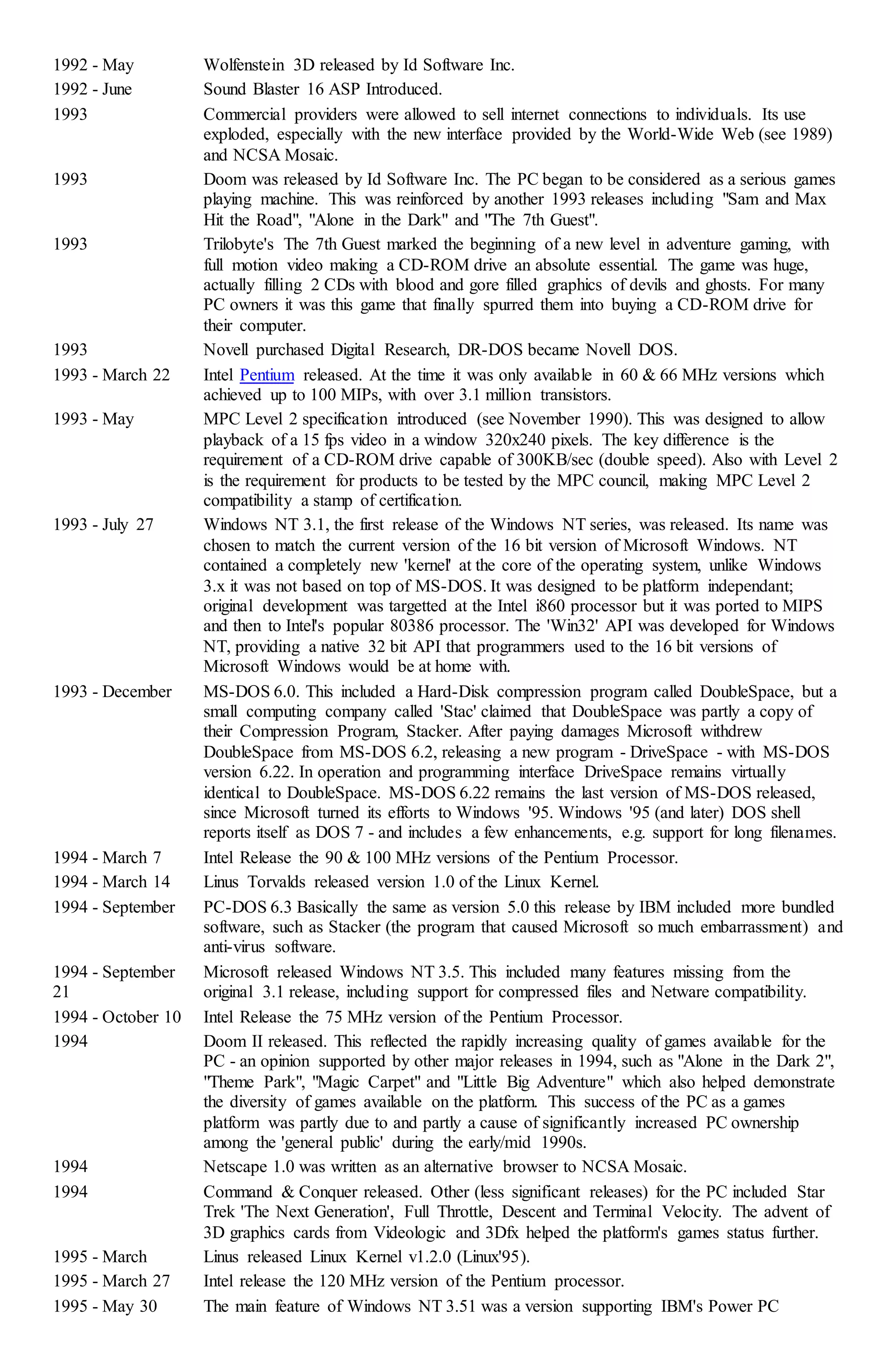
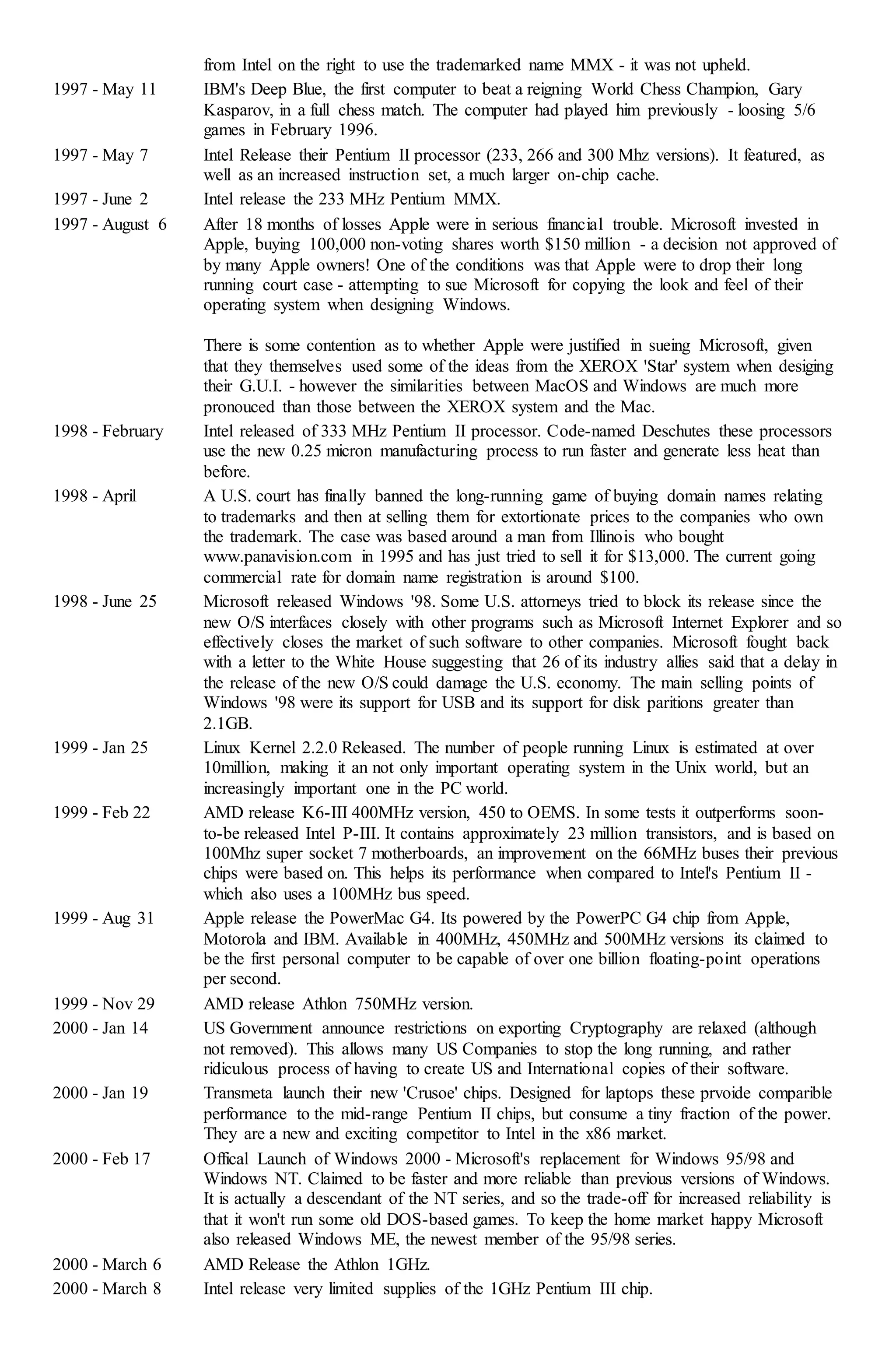
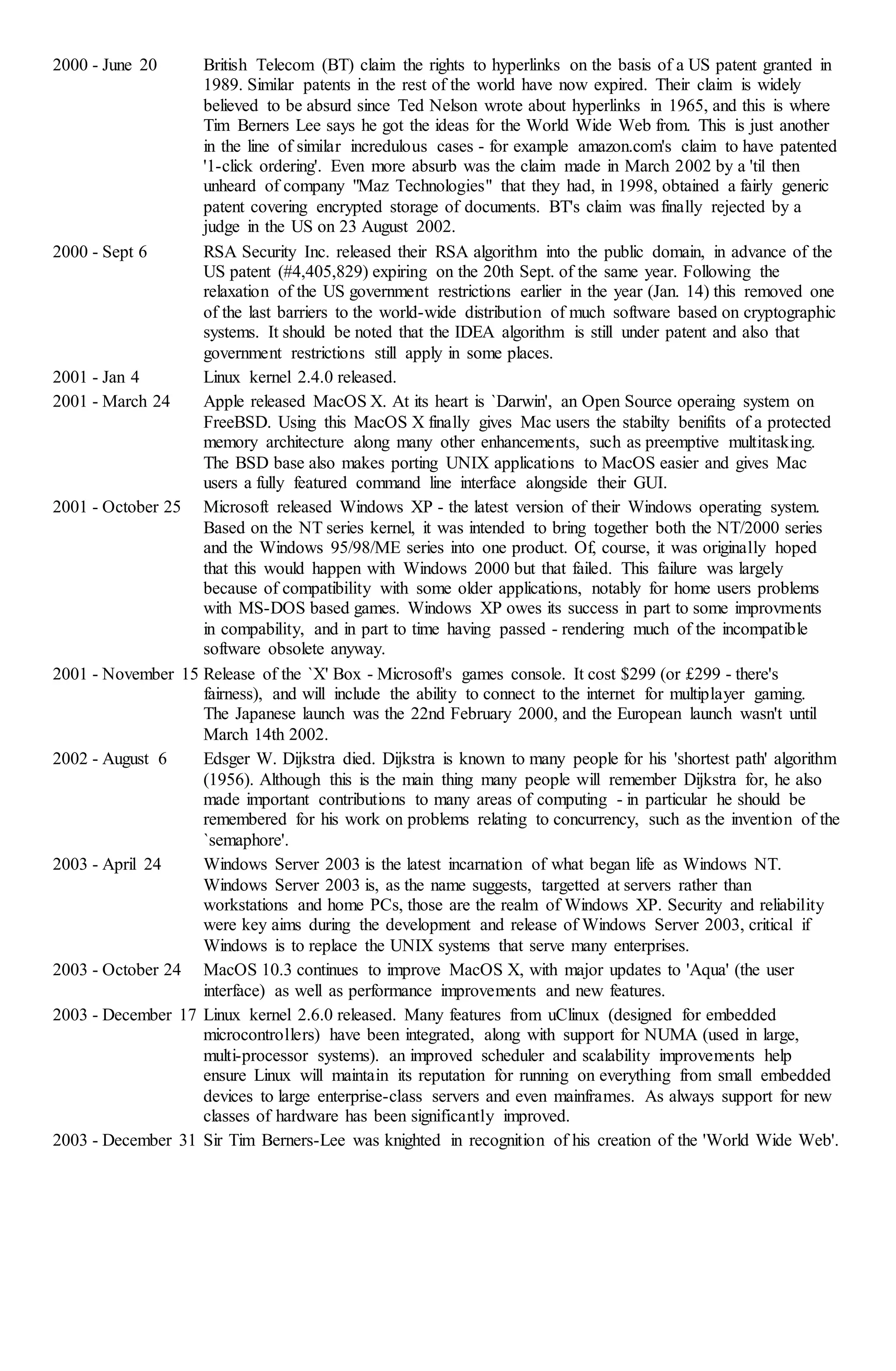
![processor. Delays in the release of the processor meant delays in the release of Windows
NT 3.51 (NT 3.51 only exists because the processor wasn't ready in time for NT 3.5). As
the development team waited for the release of the processor they fixed bugs in the
existing codebase. This made NT 3.51 reliable and therefore popular with customers.
1995 - June 1 Intel release the 133 MHz version of the Pentium processor.
1995 - August 21
[poss. 23]
Windows '95 was launched by Bill Gates & Microsoft. Unlike previous versions of
Windows, Windows '95 is an entire operating system - it does not rely on MS-DOS
(although some remnants of the old operating system still exist). Windows '95 was written
specially for the 80386 and compatible computers to make 'full' use of its 32 bit processing
and multitasking capabilities, and thus in some respects it is much more similar to
Windows NT than Windows 3.x. Both Windows 95 and Windows NT provide the Win32
API for programmers, and when Windows NT 4 was released it had an almost identical
user interface to Windows 95. Unfortunately, in order to maintain backwards
compatibility, Windows 95 doesn't impose the same memory protection and security
measures that NT does and so suffers from much worse stability, reliability and security.
Despite being remarkable similar in function to OS/2 Warp (produced by IBM and
Microsoft several years earlier, but marketed by IBM), Windows '95 has proved very
popular.
1995 - November 1 Pentium Pro released. At introduction it achieved a clock speed of up to 200 MHz (there
were also 150, 166 and 180 MHz variants released on the same date), but is basically the
same as the Pentium in terms of instruction set and capabilities. It achieves 440 MIPs and
contains 5.5 million transistors - this is nearly 2400 times as many as the first
microprocessor, the 4004 - and capable of 70,000 times as many instructions per second.
1995 - December 28 CompuServe blocked access to over 200 sexually explicit sites, partly to avoid
confrontation with the German Government. Access to all but 5 was restored on Feb. 13
1996.
1995 - December JavaScript development announced by Netscape.
1996 Quake released - representing the dramatic increases in both software and hardware
technology since Doom, of 3 years previous. Other notable releases included "Civilization
2", "Command & Conquer - Red Alert", "Grand Prix 2" and "Tomb Raider". On the more
controversial front "Battle Cruiser 3000" was also released, but its advertising had to be
censored.
1996 - January Netscape Navigator 2.0 released. First browser to support JavaScript.
1996 - January 4 Intel release the 150 & 166 MHz versions of the Pentium Processor. They contain the
equivalent of over 3.3 million transistors.
1996 Windows '95 OSR2 (OEM System Release 2) was released - partly to fix bugs found in
release 1 - but only to computer retailers for sale with new systems. There were actually
two separated releases of Windows 95 OSR2 before the introduction of Windows '98, the
second of which contained both USB and FAT32 support - the main selling points of
Windows '98. FAT32 is a new filing system that provides support for disk paritions bigger
than 2.1GB and is better at coping with large disks (especially in terms of wasted space).
1996 - June 9 Linux 2.0 released. 2.0 was a significant improvement over the earlier versions: it was the
first to support multiple architectures (originally developed for the Intel 386 processor, it
now supported the Digital Alpha and would very soon support Sun SPARC many others).
It was also the first stable kernel to support SMP, kernel modules, and much more.
1996 - July 31 Windows NT 4.0 was released. The main feature was an update of the user interface to
match Windows 95.
1996 - October 6 Intel release the 200 Mhz version of the Pentium Processor.
1997 Tim Berners-Lee awarded the Institute of Physics' 1997 Duddell Medal for inventing the
World Wide Web (see 1989).
1997 "Grand Theft Auto", "Quake 2" and "Blade Runner" were all released while Lara Croft
returned in "Tomb Raider 2". As the standards for graphics kept increasing, 3d graphics
cards were beginning to become mandatory for games players.
1997 - January 8 Intel released Pentium MMX (originally 166 and 200 Mhz versions), for games and
multimedia enhancement. To most people MMX is simply another 3-letter acronym and
people wearing coloured suits on Intel ads, and to programmers in meant an even further
expanded instruction set that provides, amongst other functions, enhanced 64-bit support -
but software needs to be specially written to work with the new functions. A major rival
clone, the AMD-K6-MMX containing a similar instruction set, caused a legal challenge](https://image.slidesharecdn.com/abriefhistoryofcomputing-140715220344-phpapp02/75/A-brief-history-of-computing-18-2048.jpg)

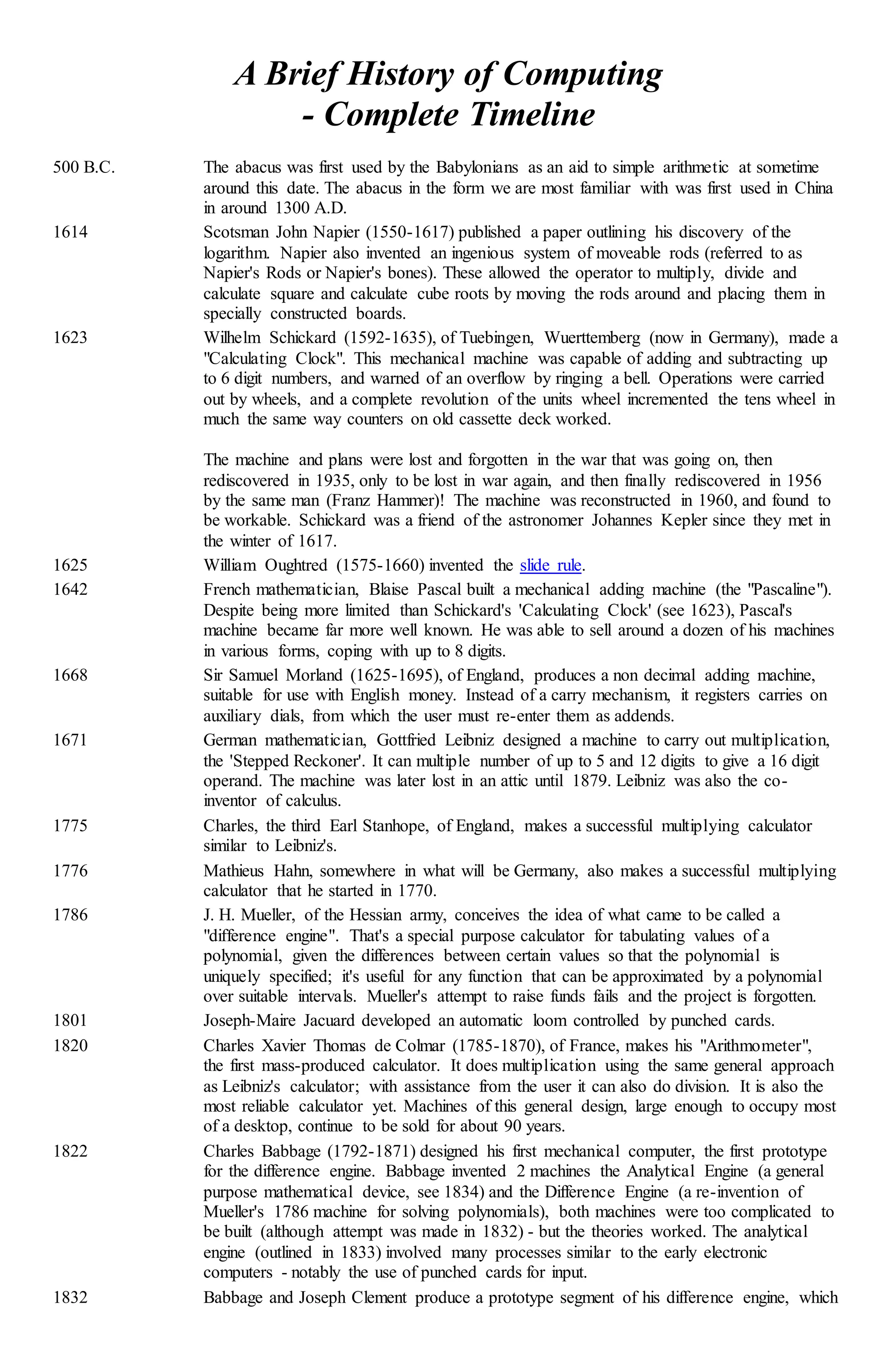
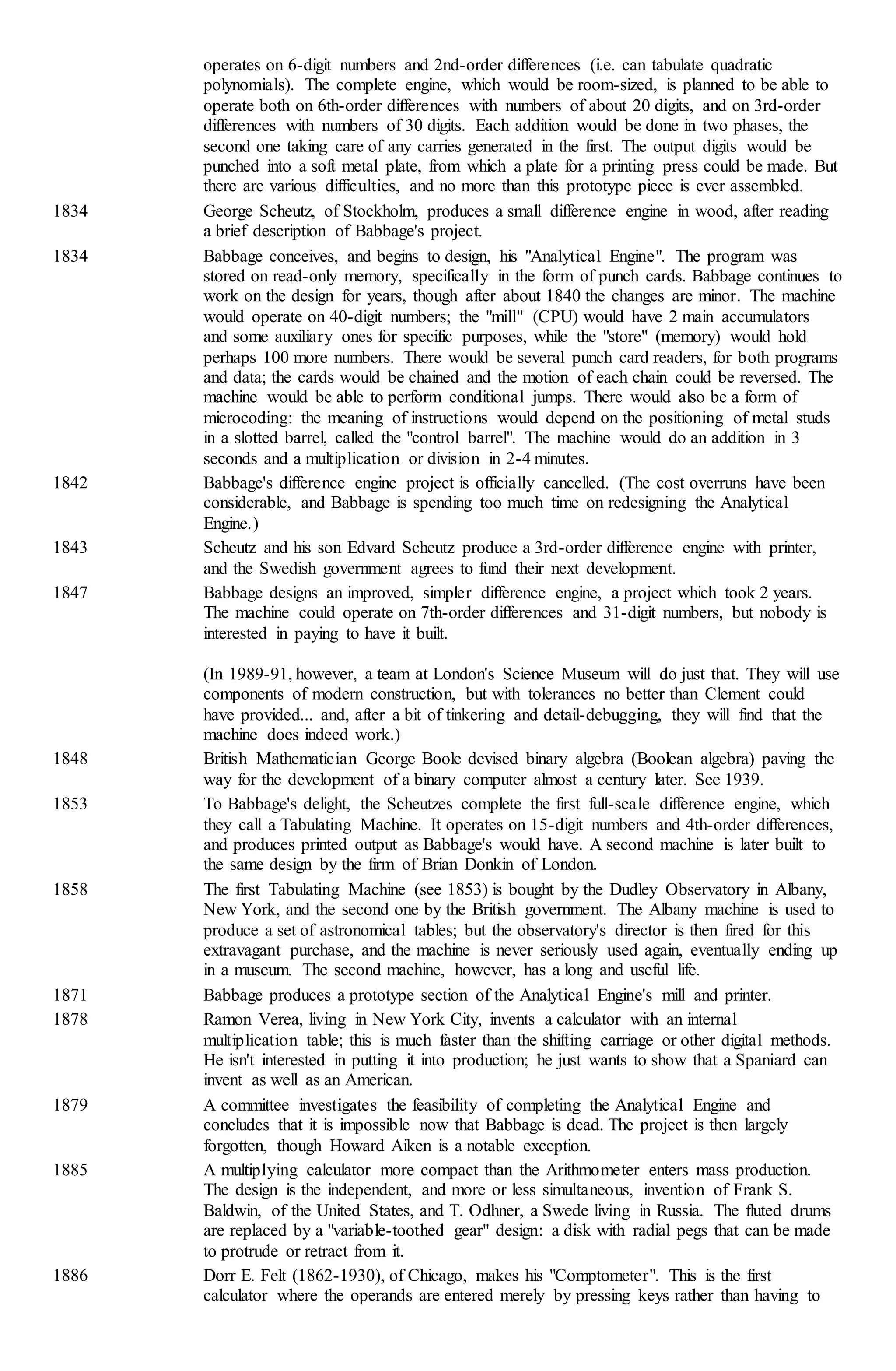
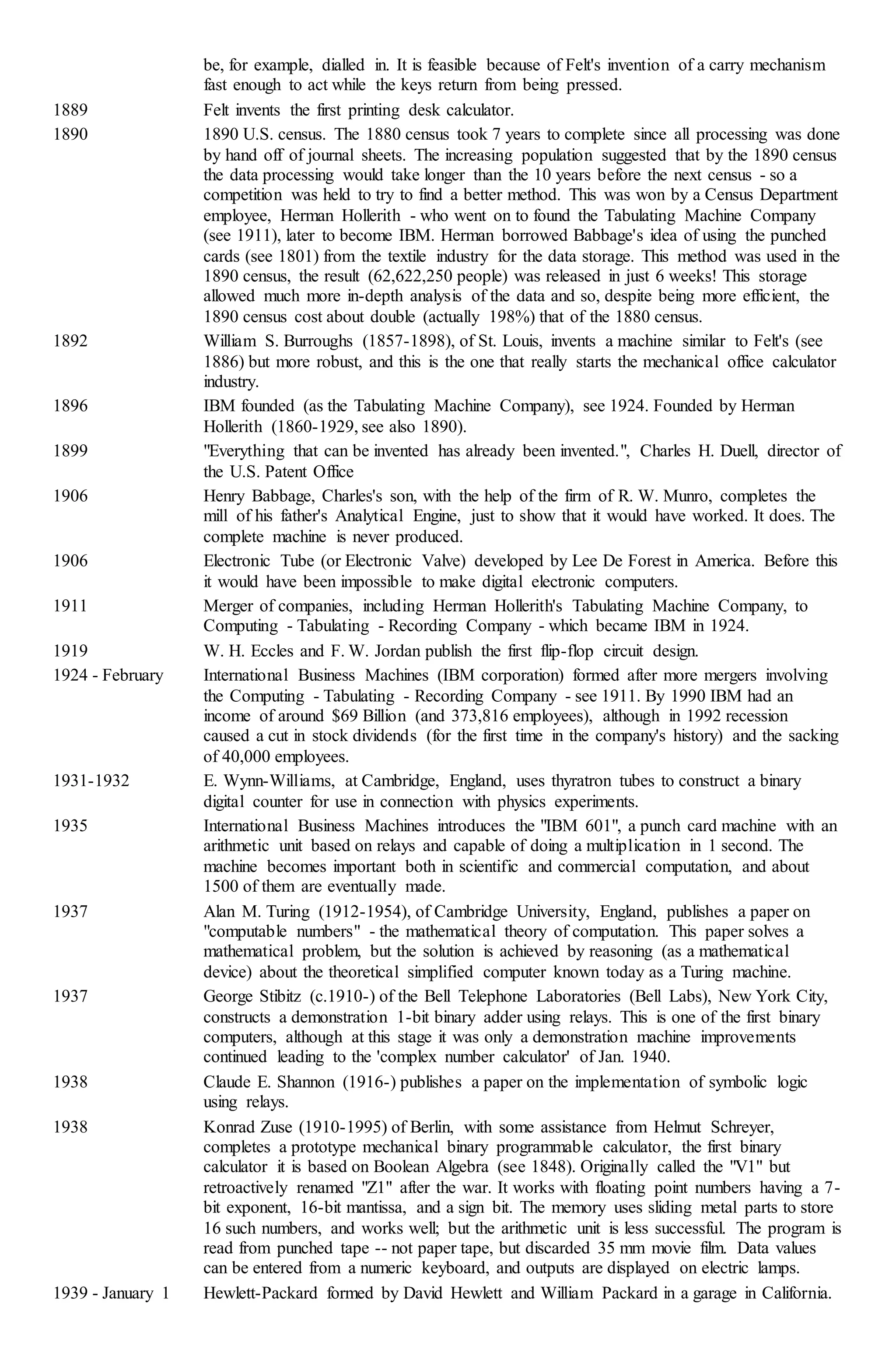
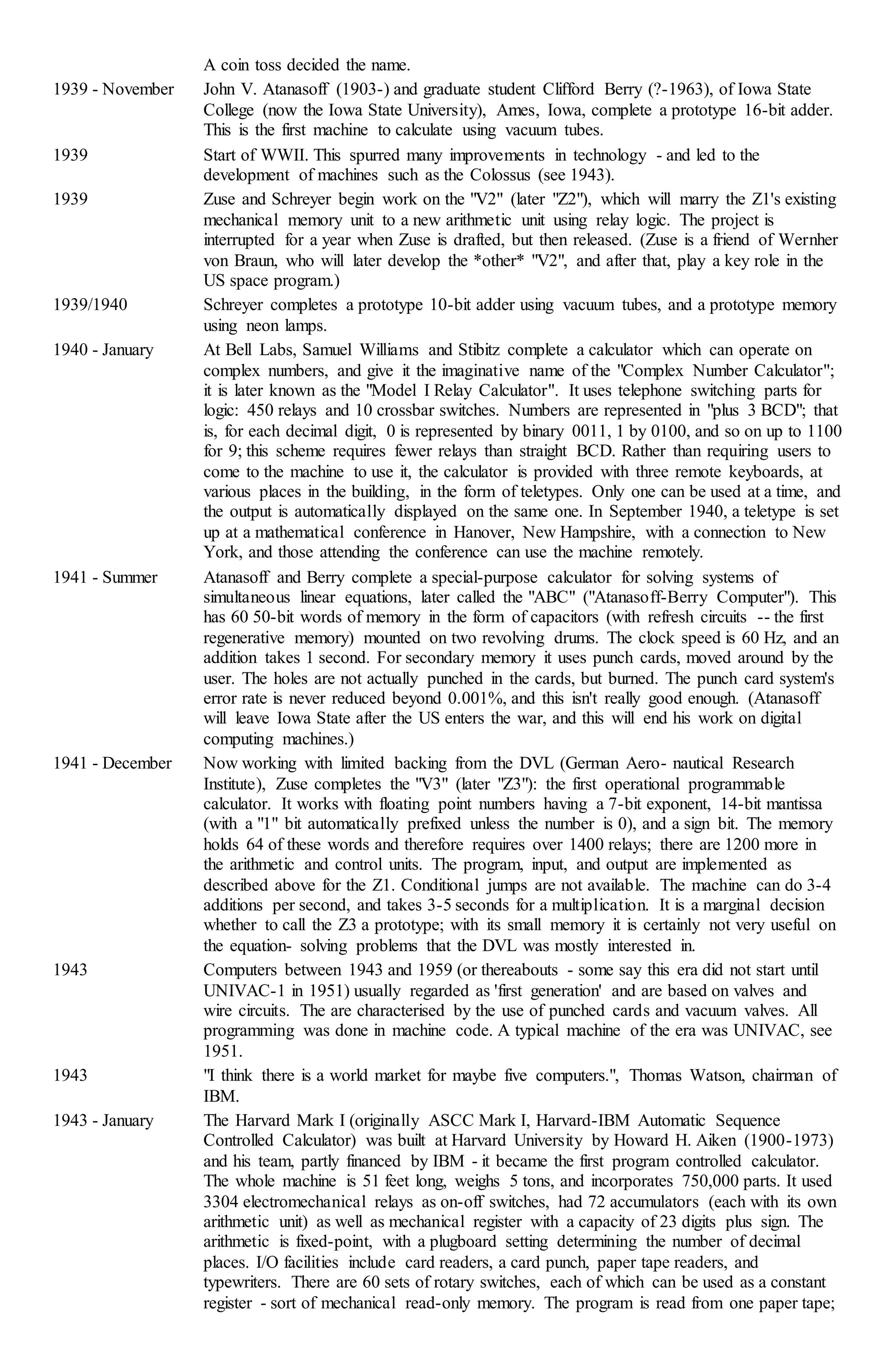
This document provides a brief timeline history of important developments in computing from 500 BC to 1941. Some key events and inventions include: the abacus (500 BC), Napier's bones for multiplication and division (1614), Wilhelm Schickard's early mechanical calculator (1623), Charles Babbage's conceptualization and early work on analytical engines (1822-1834), Ada Lovelace's work programming the analytical engine (1843), Herman Hollerith's use of punched cards for census data processing (1890), the development of vacuum tubes enabling digital electronics (1906, 1937), Konrad Zuse's completed the first programmable, fully automatic digital calculating machine, the Z1 (1938), and John Atanas


