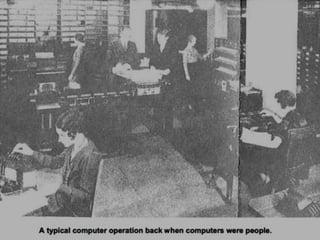
"Computer" was originally a job title: it
was used to describe those human beings
(usually women  ) whose job it was to
perform the repetitive calculations.
The first computers
were … people
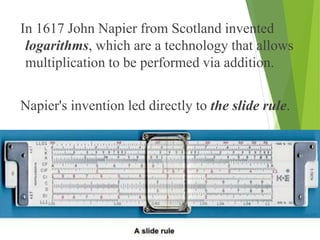
In 1617 John Napier from Scotland invented
logarithms, which are a technology that allows
multiplication to be performed via addition.
Napier's invention led directly to the slide rule.
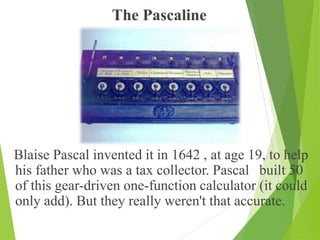
The Pascaline
Blaise Pascal invented it in 1642 , at age 19, to help
his father who was a tax collector. Pascal built 50
of this gear-driven one-function calculator (it could
only add). But they really weren't that accurate.
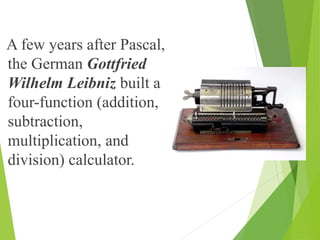
A few years after Pascal,
the German Gottfried
Wilhelm Leibniz built a
four-function (addition,
subtraction,
multiplication, and
division) calculator.
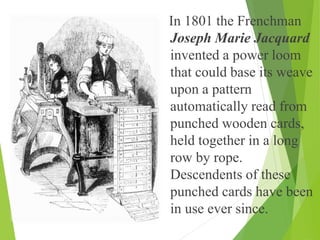
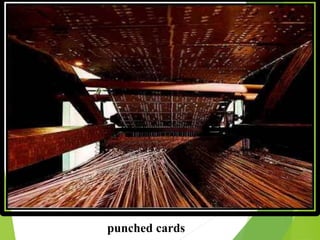
In 1801 the Frenchman
Joseph Marie Jacquard
invented a power loom
that could base its weave
upon a pattern
automatically read from
punched wooden cards,
held together in a long
row by rope.
Descendents of these
punched cards have been
in use ever since.
punched cards
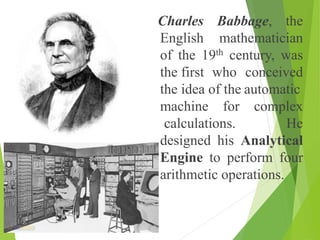
Charles Babbage, the
English mathematician
of the 19th century, was
the first who conceived
the idea of the automatic
machine for complex
calculations. He
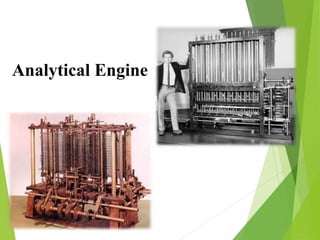
designed his Analytical
Engine to perform four
arithmetic operations.
Analytical Engine
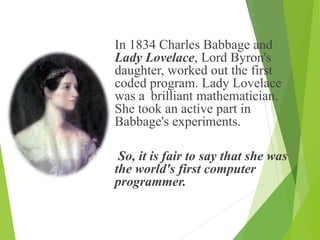
In 1834 Charles Babbage and
Lady Lovelace, Lord Byron's
daughter, worked out the first
coded program. Lady Lovelace
was a brilliant mathematician.
She took an active part in
Babbage's experiments.
So, it is fair to say that she was
the world's first computer
programmer.
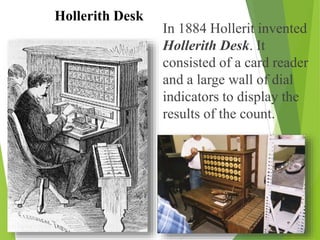
In 1884 Hollerit invented
Hollerith Desk. It
consisted of a card reader
and a large wall of dial
indicators to display the
results of the count.
Hollerith Desk
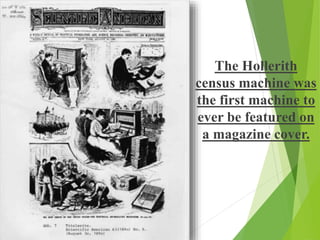
The Hollerith
census machine was
the first machine to
ever be featured on
a magazine cover.
Hollerith built a company, the
Tabulating Machine Company
which eventually became
International Business Machines,
known today as IBM.
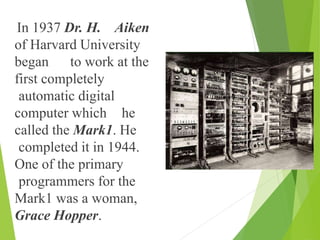
In 1937 Dr. H. Aiken
of Harvard University
began to work at the
first completely
automatic digital
computer which he
called the Mark1. He
completed it in 1944.
One of the primary
programmers for the
Mark1 was a woman,
Grace Hopper.
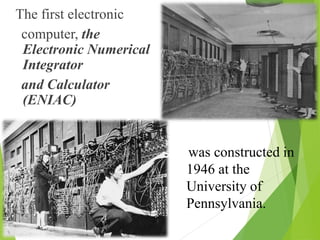
The first electronic
computer, the
Electronic Numerical
Integrator
and Calculator
(ENIAC)
was constructed in
1946 at the
University of
Pennsylvania.
In 1945 John von
Neuman worked out
the concept of the
stored program.
Today we can speak about 5 generations of
computer development:
The
first
The
second
The
third
The
fourth
The fifth
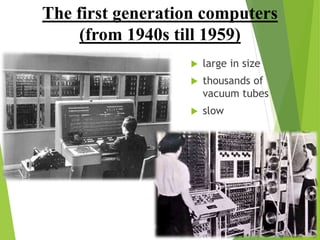
The first generation computers
(from 1940s till 1959)
 large in size
 thousands of
vacuum tubes
 slow
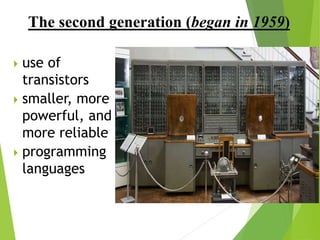
The second generation (began in 1959)
 use of
transistors
 smaller, more
powerful, and
more reliable
 programming
languages
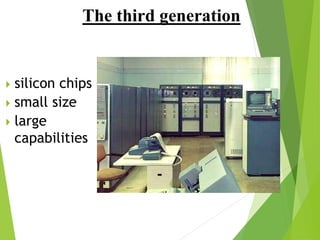
The third generation
 silicon chips
 small size
 large
capabilities
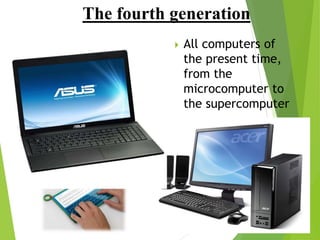
The fourth generation
 All computers of
the present time,
from the
microcomputer to
the supercomputer
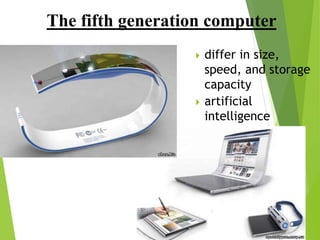
The fifth generation computer
 differ in size,
speed, and storage
capacity
 artificial
intelligence
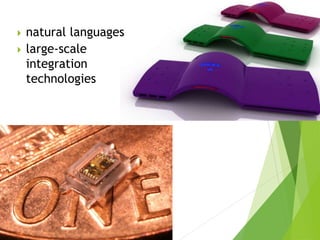
 natural languages
 large-scale
integration
technologies
Computer
Architecture
CENTRAL PROCESSING UNIT
 The central processing unit (CPU) is the portion of
a computer system that carries out the instructions
of a computer program, and is the primary element
carrying out the computer's functions.
 The form, design and implementation of CPUs have
changed dramatically since the earliest examples,
but their fundamental operation remains much the
same.
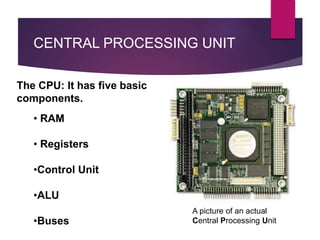
The CPU: It has five basic
components.
• RAM
• Registers
•Control Unit
•ALU
•Buses
A picture of an actual
Central Processing Unit
CENTRAL PROCESSING UNIT
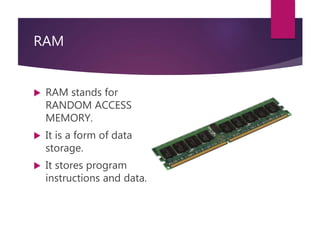
RAM
 RAM stands for
RANDOM ACCESS
MEMORY.
 It is a form of data
storage.
 It stores program
instructions and data.
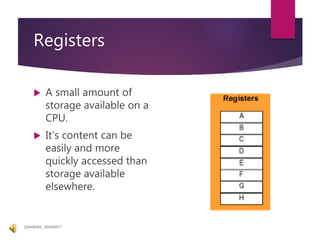
Registers
 A small amount of
storage available on a
CPU.
 It’s content can be
easily and more
quickly accessed than
storage available
elsewhere.
20046062 20046617
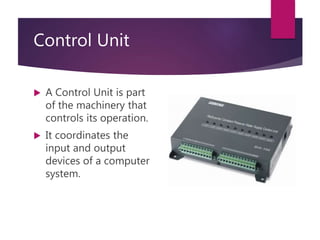
Control Unit
 A Control Unit is part
of the machinery that
controls its operation.
 It coordinates the
input and output
devices of a computer
system.
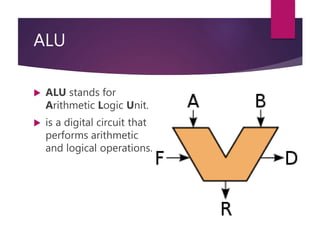
ALU
 ALU stands for
Arithmetic Logic Unit.
 is a digital circuit that
performs arithmetic
and logical operations.
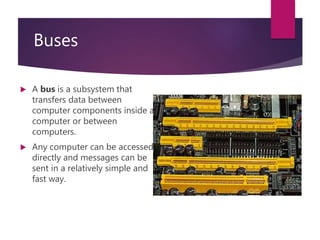
Buses
 A bus is a subsystem that
transfers data between
computer components inside a
computer or between
computers.
 Any computer can be accessed
directly and messages can be
sent in a relatively simple and
fast way.
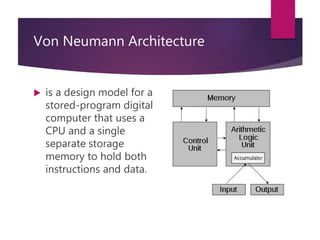
Von Neumann Architecture
 is a design model for a
stored-program digital
computer that uses a
CPU and a single
separate storage
memory to hold both
instructions and data.
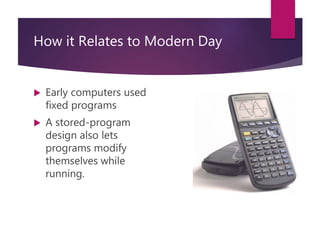
How it Relates to Modern Day
 Early computers used
fixed programs
 A stored-program
design also lets
programs modify
themselves while
running.
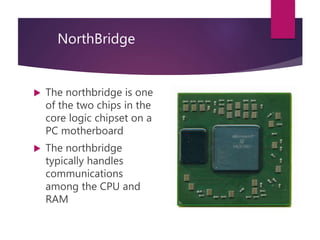
NorthBridge
 The northbridge is one
of the two chips in the
core logic chipset on a
PC motherboard
 The northbridge
typically handles
communications
among the CPU and
RAM
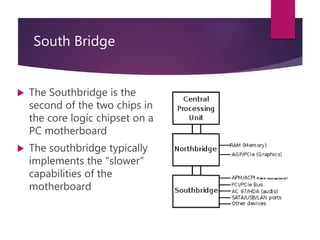
South Bridge
 The Southbridge is the
second of the two chips in
the core logic chipset on a
PC motherboard
 The southbridge typically
implements the "slower"
capabilities of the
motherboard
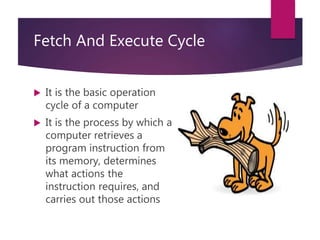
Fetch And Execute Cycle
 It is the basic operation
cycle of a computer
 It is the process by which a
computer retrieves a
program instruction from
its memory, determines
what actions the
instruction requires, and
carries out those actions
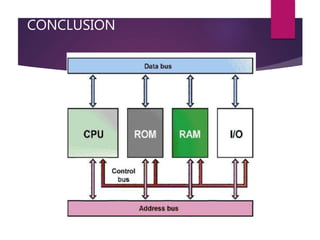
CONCLUSION
20046062 20046617
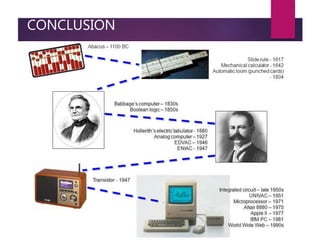
CONCLUSION

History of computer development

  • 2.
    "Computer" was originallya job title: it was used to describe those human beings (usually women  ) whose job it was to perform the repetitive calculations. The first computers were … people
  • 4.
    In 1617 JohnNapier from Scotland invented logarithms, which are a technology that allows multiplication to be performed via addition. Napier's invention led directly to the slide rule.
  • 5.
    The Pascaline Blaise Pascalinvented it in 1642 , at age 19, to help his father who was a tax collector. Pascal built 50 of this gear-driven one-function calculator (it could only add). But they really weren't that accurate.
  • 6.
    A few yearsafter Pascal, the German Gottfried Wilhelm Leibniz built a four-function (addition, subtraction, multiplication, and division) calculator.
  • 7.
    In 1801 theFrenchman Joseph Marie Jacquard invented a power loom that could base its weave upon a pattern automatically read from punched wooden cards, held together in a long row by rope. Descendents of these punched cards have been in use ever since.
  • 8.
  • 9.
    Charles Babbage, the Englishmathematician of the 19th century, was the first who conceived the idea of the automatic machine for complex calculations. He designed his Analytical Engine to perform four arithmetic operations.
  • 10.
  • 11.
    In 1834 CharlesBabbage and Lady Lovelace, Lord Byron's daughter, worked out the first coded program. Lady Lovelace was a brilliant mathematician. She took an active part in Babbage's experiments. So, it is fair to say that she was the world's first computer programmer.
  • 12.
    In 1884 Holleritinvented Hollerith Desk. It consisted of a card reader and a large wall of dial indicators to display the results of the count. Hollerith Desk
  • 13.
    The Hollerith census machinewas the first machine to ever be featured on a magazine cover.
  • 14.
    Hollerith built acompany, the Tabulating Machine Company which eventually became International Business Machines, known today as IBM.
  • 15.
    In 1937 Dr.H. Aiken of Harvard University began to work at the first completely automatic digital computer which he called the Mark1. He completed it in 1944. One of the primary programmers for the Mark1 was a woman, Grace Hopper.
  • 16.
    The first electronic computer,the Electronic Numerical Integrator and Calculator (ENIAC) was constructed in 1946 at the University of Pennsylvania.
  • 17.
    In 1945 Johnvon Neuman worked out the concept of the stored program.
  • 18.
    Today we canspeak about 5 generations of computer development: The first The second The third The fourth The fifth
  • 19.
    The first generationcomputers (from 1940s till 1959)  large in size  thousands of vacuum tubes  slow
  • 20.
    The second generation(began in 1959)  use of transistors  smaller, more powerful, and more reliable  programming languages
  • 21.
    The third generation silicon chips  small size  large capabilities
  • 22.
    The fourth generation All computers of the present time, from the microcomputer to the supercomputer
  • 23.
    The fifth generationcomputer  differ in size, speed, and storage capacity  artificial intelligence
  • 24.
     natural languages large-scale integration technologies
  • 25.
  • 26.
    CENTRAL PROCESSING UNIT The central processing unit (CPU) is the portion of a computer system that carries out the instructions of a computer program, and is the primary element carrying out the computer's functions.  The form, design and implementation of CPUs have changed dramatically since the earliest examples, but their fundamental operation remains much the same.
  • 27.
    The CPU: Ithas five basic components. • RAM • Registers •Control Unit •ALU •Buses A picture of an actual Central Processing Unit CENTRAL PROCESSING UNIT
  • 28.
    RAM  RAM standsfor RANDOM ACCESS MEMORY.  It is a form of data storage.  It stores program instructions and data.
  • 29.
    Registers  A smallamount of storage available on a CPU.  It’s content can be easily and more quickly accessed than storage available elsewhere. 20046062 20046617
  • 30.
    Control Unit  AControl Unit is part of the machinery that controls its operation.  It coordinates the input and output devices of a computer system.
  • 31.
    ALU  ALU standsfor Arithmetic Logic Unit.  is a digital circuit that performs arithmetic and logical operations.
  • 32.
    Buses  A busis a subsystem that transfers data between computer components inside a computer or between computers.  Any computer can be accessed directly and messages can be sent in a relatively simple and fast way.
  • 33.
    Von Neumann Architecture is a design model for a stored-program digital computer that uses a CPU and a single separate storage memory to hold both instructions and data.
  • 34.
    How it Relatesto Modern Day  Early computers used fixed programs  A stored-program design also lets programs modify themselves while running.
  • 35.
    NorthBridge  The northbridgeis one of the two chips in the core logic chipset on a PC motherboard  The northbridge typically handles communications among the CPU and RAM
  • 36.
    South Bridge  TheSouthbridge is the second of the two chips in the core logic chipset on a PC motherboard  The southbridge typically implements the "slower" capabilities of the motherboard
  • 37.
    Fetch And ExecuteCycle  It is the basic operation cycle of a computer  It is the process by which a computer retrieves a program instruction from its memory, determines what actions the instruction requires, and carries out those actions
  • 38.
  • 39.