1. Algebra is the branch of mathematics involving symbols and equations. The word comes from Arabic meaning "reunion of broken parts".
2. The roots of algebra can be traced back to ancient Babylonians who developed algorithms to solve linear and quadratic equations. Diophantus is considered the "father of algebra".
3. Algebra involves variables, terms, exponents, polynomials including monomials, binomials and trinomials, as well as operations like addition, subtraction, multiplication and division following the order of BODMAS.
Algebra involves symbols for numbers/quantities. Its name comes from Arabic al-jabr, meaning 'reunion of broken parts', linked to Muhammad ibn Musa al-Khwarizmi.
Algebra's roots trace to Babylonians with algorithmic calculations. Diophantus, called the 'father of algebra,' furthered the theory of equations.
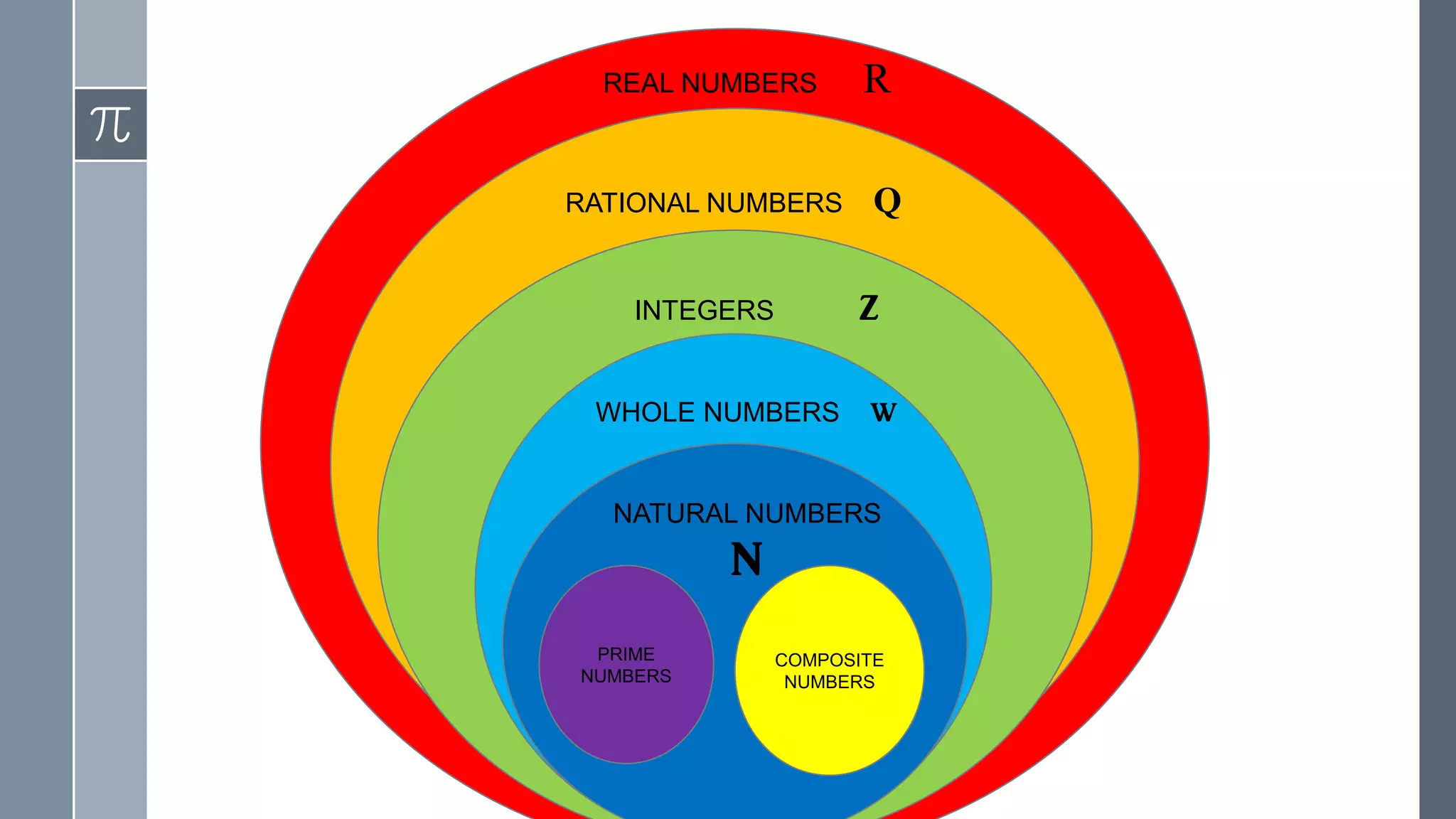
Categorizes numbers: Natural (N), Whole (W), Integers (Z), Rational (Q), Real (R), Prime and Composite numbers.
Details different number sets (Natural, Integers, etc.), their operations and properties such as closure and identity.
Introduces key concepts like Exponents, Expressions, Polynomials, and the distinction between Like and Unlike Terms.
Defines equations as identities with '=' sign, contrasting them with expressions characterized by '+' or '-'.
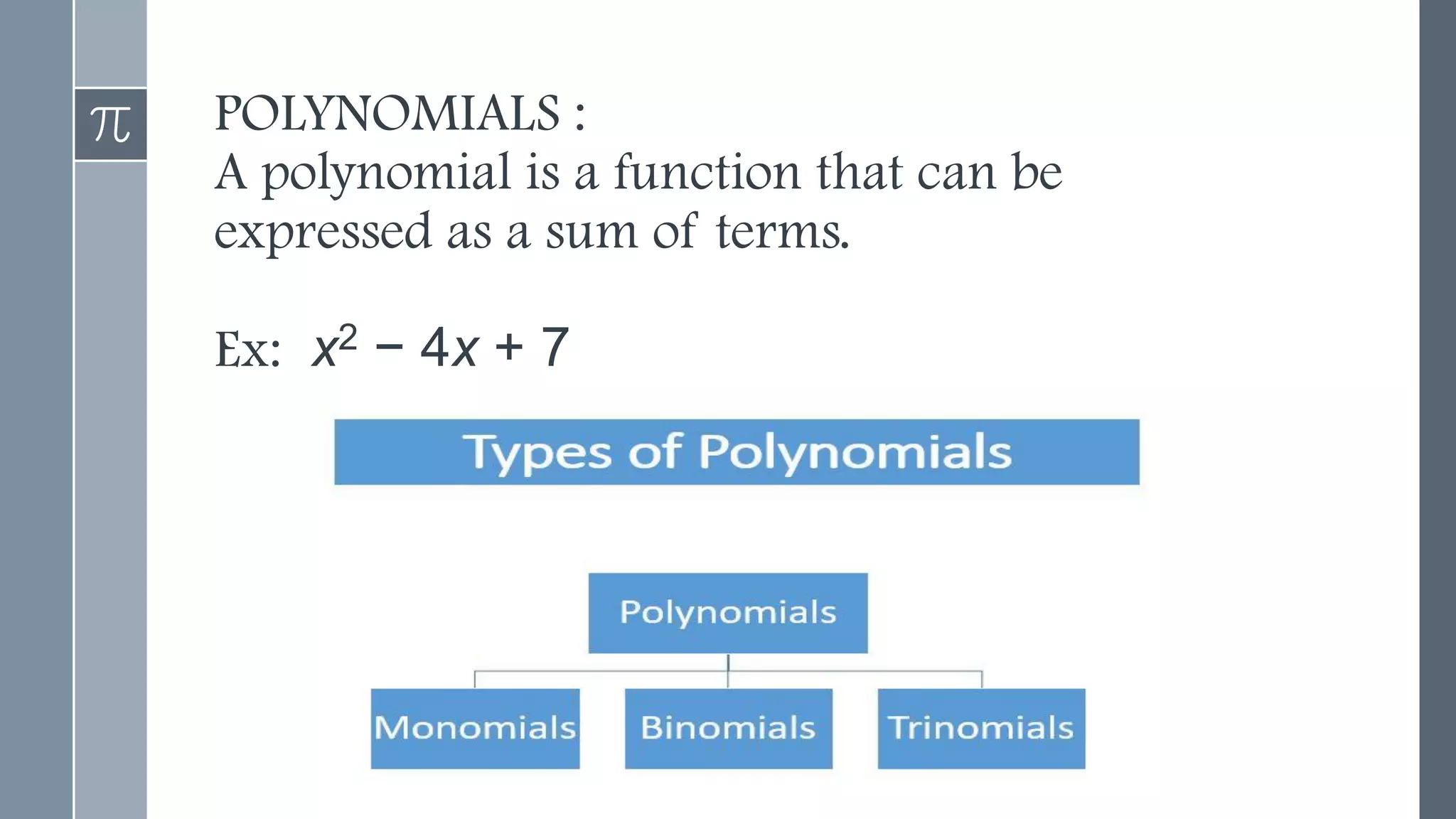
Defines polynomials as sums of terms, provides examples of different polynomial types such as Monomial, Binomial, and Trinomial (Slides 10-12).
Explains Like Terms (same variables/exponents) vs. Unlike Terms (different coefficients) in algebraic equations.
Lists algebraic operations: Addition, Subtraction, Multiplication, Division, emphasizing the BODMAS rule for order of operations.
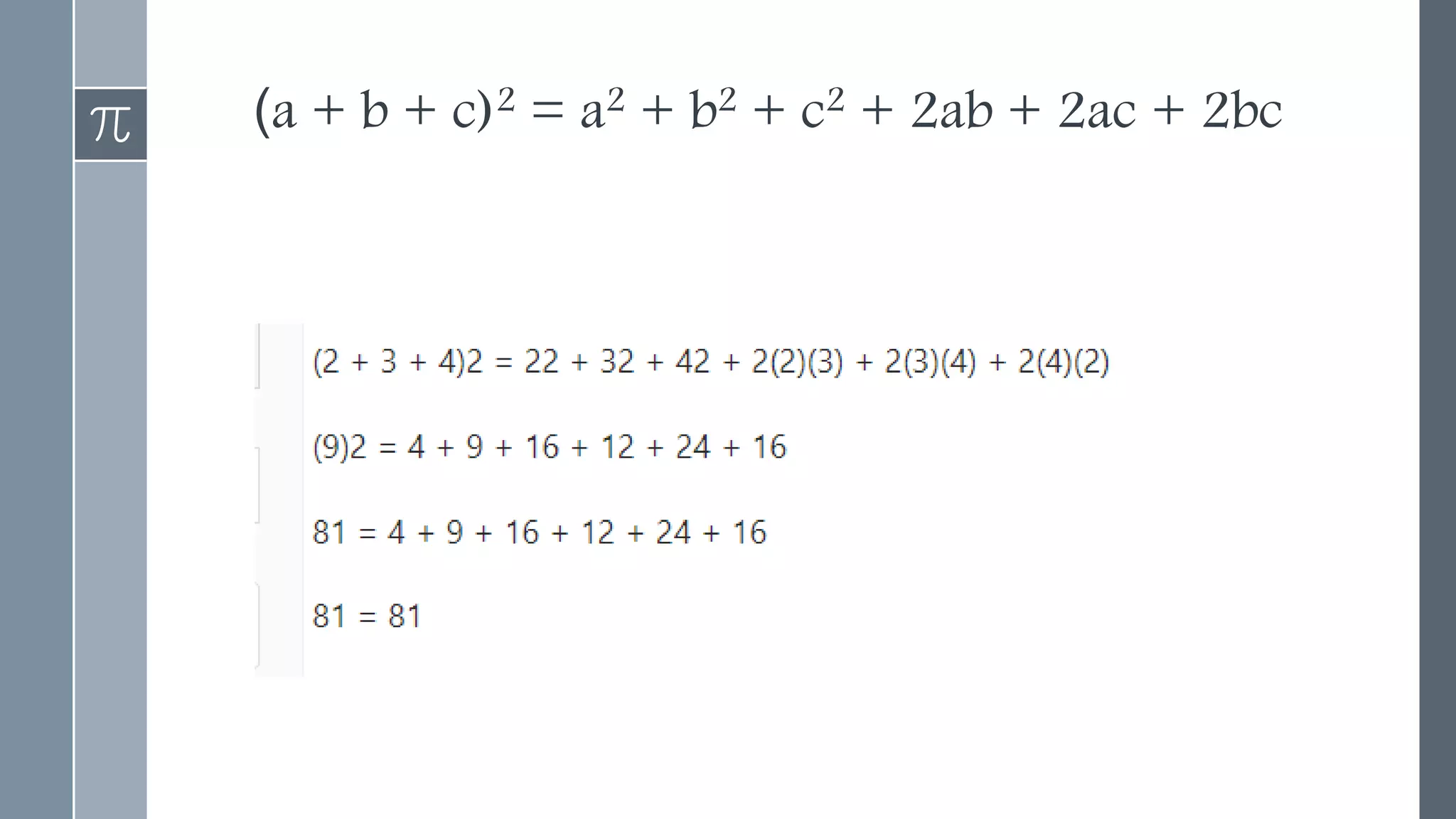
Presents basic algebra formulas involving squares, sums, and differences of terms crucial for algebra computations.
Presented by: Samsthuthi Singh, acknowledging the speaker's contribution.
DEFINATION :
› Thepart of mathematics in which letters and other general
symbols are used to represent numbers and quantities in formulae
and equations.
› The word algebra comes from the Arabic الج
بر [al-jabr] i.e..
‘reunion of broken parts’.
The word algebra comes from the title of a book
by Muhammad ibn Musa al-Khwarizmi.[5]
3.
Early history ofalgebra :
• The roots of algebra can be traced to the ancient Babylonians, who
developed an advanced arithmetical system with which they were able to
do calculations in an algorithmic fashion. The Babylonians developed
formulas to calculate solutions for problems typically solved today by
using linear equations, quadratic equations, and indeterminate linear
equations.
• In the context where algebra is identified with the theory of equations,
the Greek mathematician Diophantus has traditionally been known as
the "father of algebra" and in the context where it is identified with rules
for manipulating and solving equations
Set
Natural
numbers N
Integers Z
Rationalnumbers Q
Real numbers R
Complex numbers C
Integers modulo
3
Z/3Z = {0, 1, 2}
Operation + × + × + − × ÷ + ×
Closed Yes Yes Yes Yes Yes Yes Yes No Yes Yes
Identity 0 1 0 1 0 N/A 1 N/A 0 1
Inverse N/A N/A −a N/A −a N/A
1/a
(a ≠ 0)
N/A
0, 2,
1,
respec
tively
N/A, 1,
2,
respect
ively
Associativ
e
Yes Yes Yes Yes Yes No Yes No Yes Yes
Commutat
ive
Yes Yes Yes Yes Yes No Yes No Yes Yes
6.
Basics of algebra
•EXPONENT
• EXPRESSIONS
• POLYNOMIALS [ MONOMIAL , BINOMIAL , TRINOMIAL
• LIKE TERMS AND UNLIKE TERMS
• CONSTANTS
7.
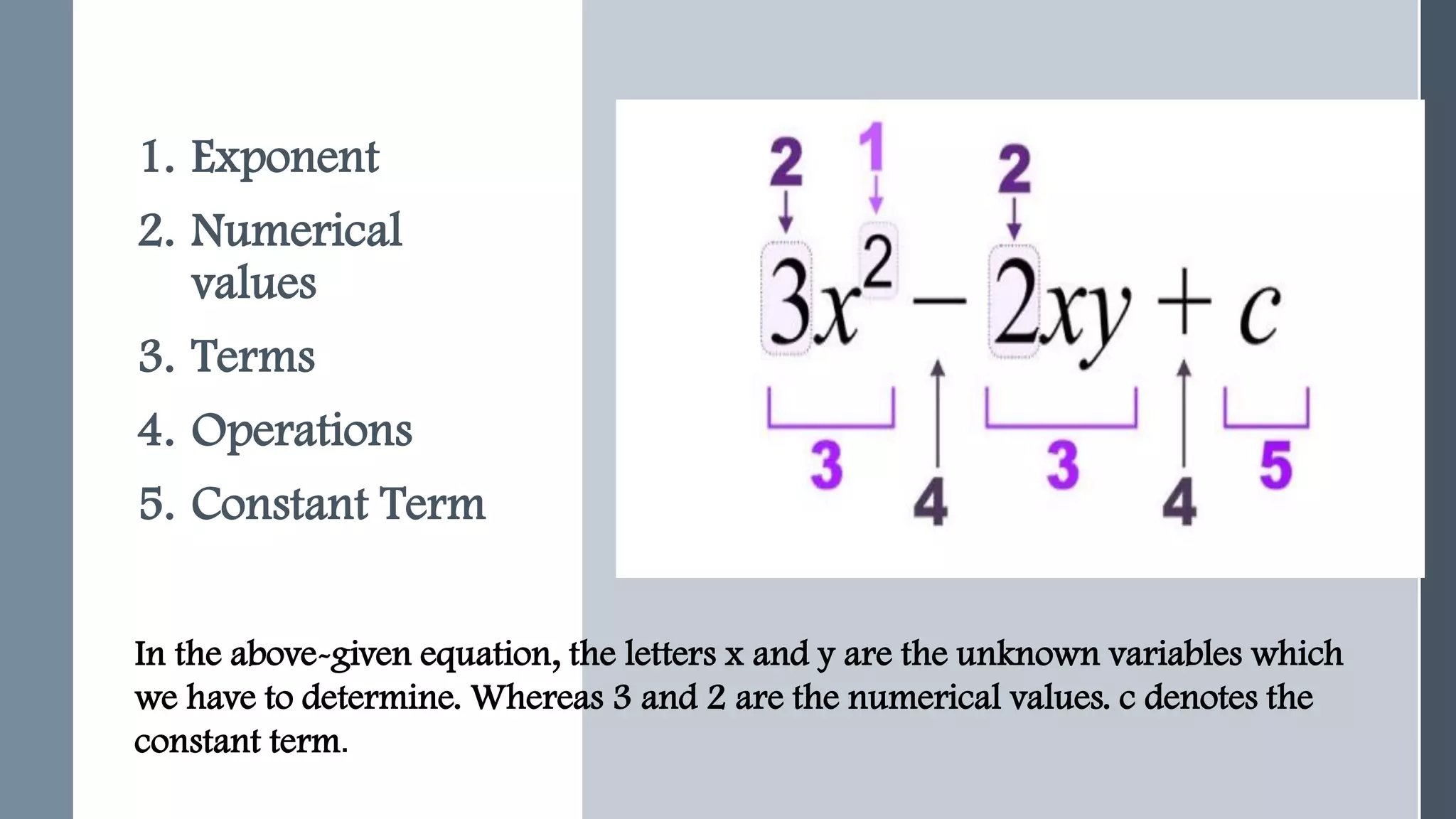
1. Exponent
2. Numerical
values
3.Terms
4. Operations
5. Constant Term
In the above-given equation, the letters x and y are the unknown variables which
we have to determine. Whereas 3 and 2 are the numerical values. c denotes the
constant term.
8.
EQUATION:
An equation isa statement which implies two same
identities separated by “=” sign. Whereas an
expression is a group of different terms separated
by ‘+’ or ‘-‘ sign.
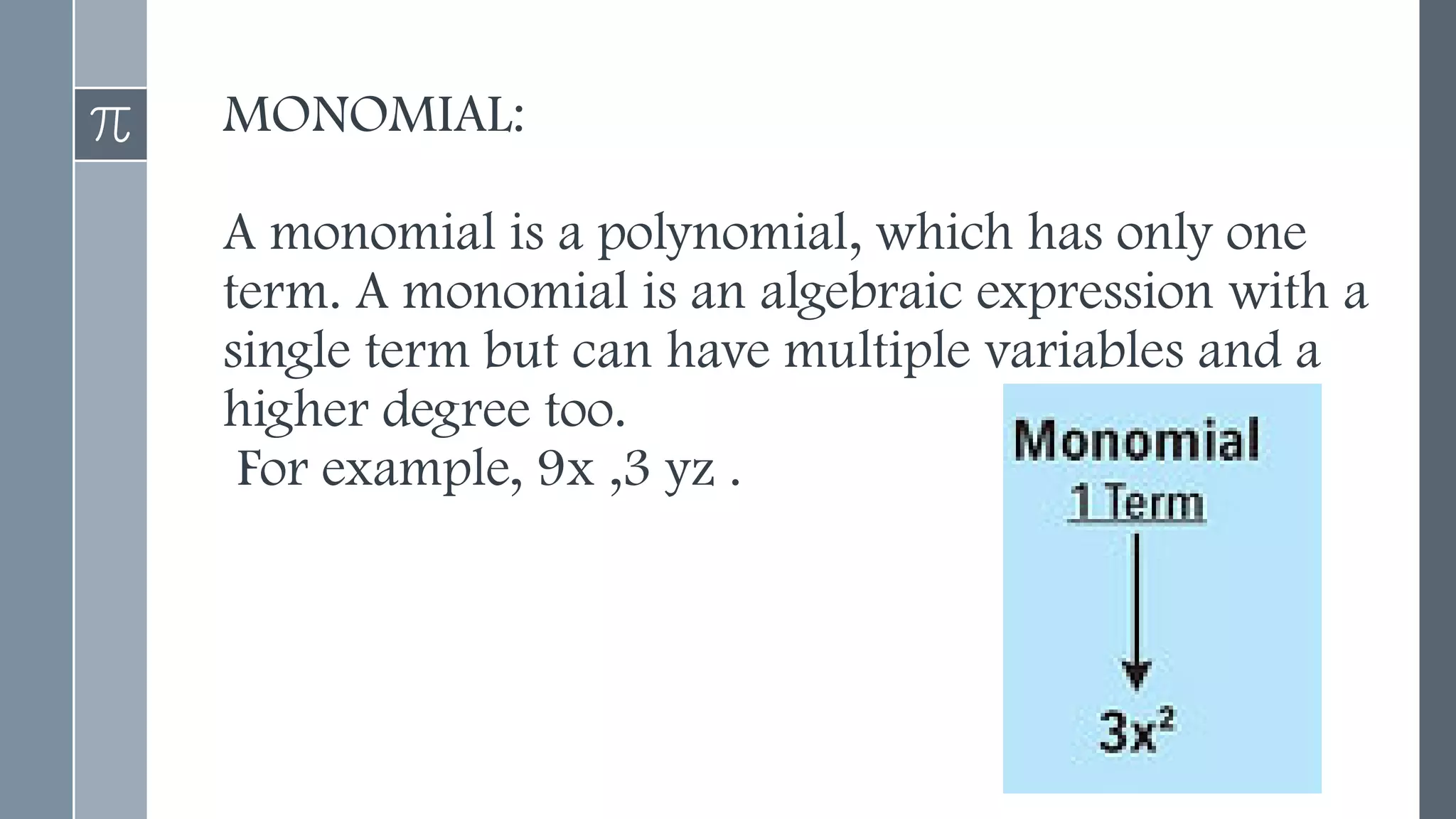
MONOMIAL:
A monomial isa polynomial, which has only one
term. A monomial is an algebraic expression with a
single term but can have multiple variables and a
higher degree too.
For example, 9x ,3 yz .
11.
BINOMIAL:
A binomial isa polynomial or algebraic
expression, which has a maximum of two non-
zero terms. It consists of only two variables.
Ex: 4x2+5y2 , xy2+xy
12.
TRINOMIAL :
A trinomialis a polynomial with three terms.[OR]
A polynomial with three terms is called a
trinomial.
Ex: x2 + 5x - 2, - x2 - 2x - 3,
13.
LIKE AND UNLIKE
TERMS:
Like terms are those
terms which have the
same variable and
same exponent raised
to power.
Unlike terms are
those where the
coefficients are
different in an
algebraic equation
14.
Basic Algebra Operations:
Addition:x + y
Subtraction: x – y
Multiplication: xy
Division: x/y or x ÷ y
where x and y are the variables.
The order of these operations will follow the BODMAS rule, which
means the terms inside the brackets are considered first. Then, roots
and exponents are operated on second priority. Solve all the division
and multiplication operations and later addition and subtraction.
15.
Basic Algebra Formula:
•a2 – b2 = (a – b)(a + b)
• (a+b)2 = a2 + 2ab + b2
• a2 + b2 = (a – b)2 + 2ab
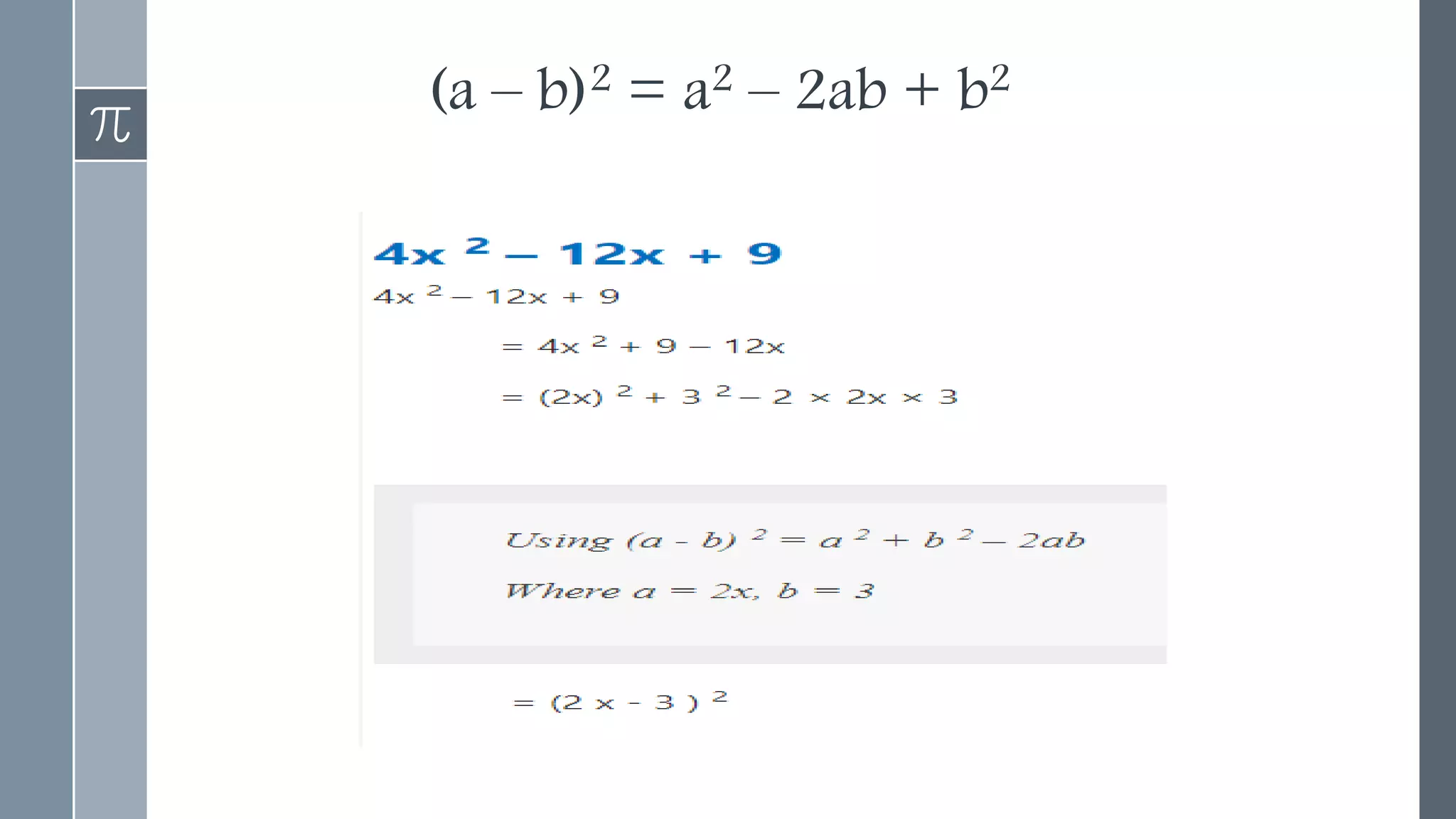
• (a – b)2 = a2 – 2ab + b2
• (a + b + c)2 = a2 + b2 + c2 + 2ab + 2ac + 2bc
• (a – b – c)2 = a2 + b2 + c2 – 2ab – 2ac + 2bc
• (a + b)3 = a3 + 3a2b + 3ab2 + b3
• (a – b)3 = a3 – 3a2b + 3ab2 – b3
![DEFINATION :
› The part of mathematics in which letters and other general
symbols are used to represent numbers and quantities in formulae
and equations.
› The word algebra comes from the Arabic الج
بر [al-jabr] i.e..
‘reunion of broken parts’.
The word algebra comes from the title of a book
by Muhammad ibn Musa al-Khwarizmi.[5]](https://image.slidesharecdn.com/algebrabasic-220428135409/75/Algebra-basic-pdf-2-2048.jpg)





![TRINOMIAL :
A trinomial is a polynomial with three terms.[OR]
A polynomial with three terms is called a
trinomial.
Ex: x2 + 5x - 2, - x2 - 2x - 3,](https://image.slidesharecdn.com/algebrabasic-220428135409/75/Algebra-basic-pdf-12-2048.jpg)


![[a+b]2 = a2+2ab+b2](https://image.slidesharecdn.com/algebrabasic-220428135409/75/Algebra-basic-pdf-17-2048.jpg)