Food Chains and
Food Web
What is Food Chain
• Food chain, in ecology, the
sequence of transfers of matter
and energy in the form of food
from organism to organism.
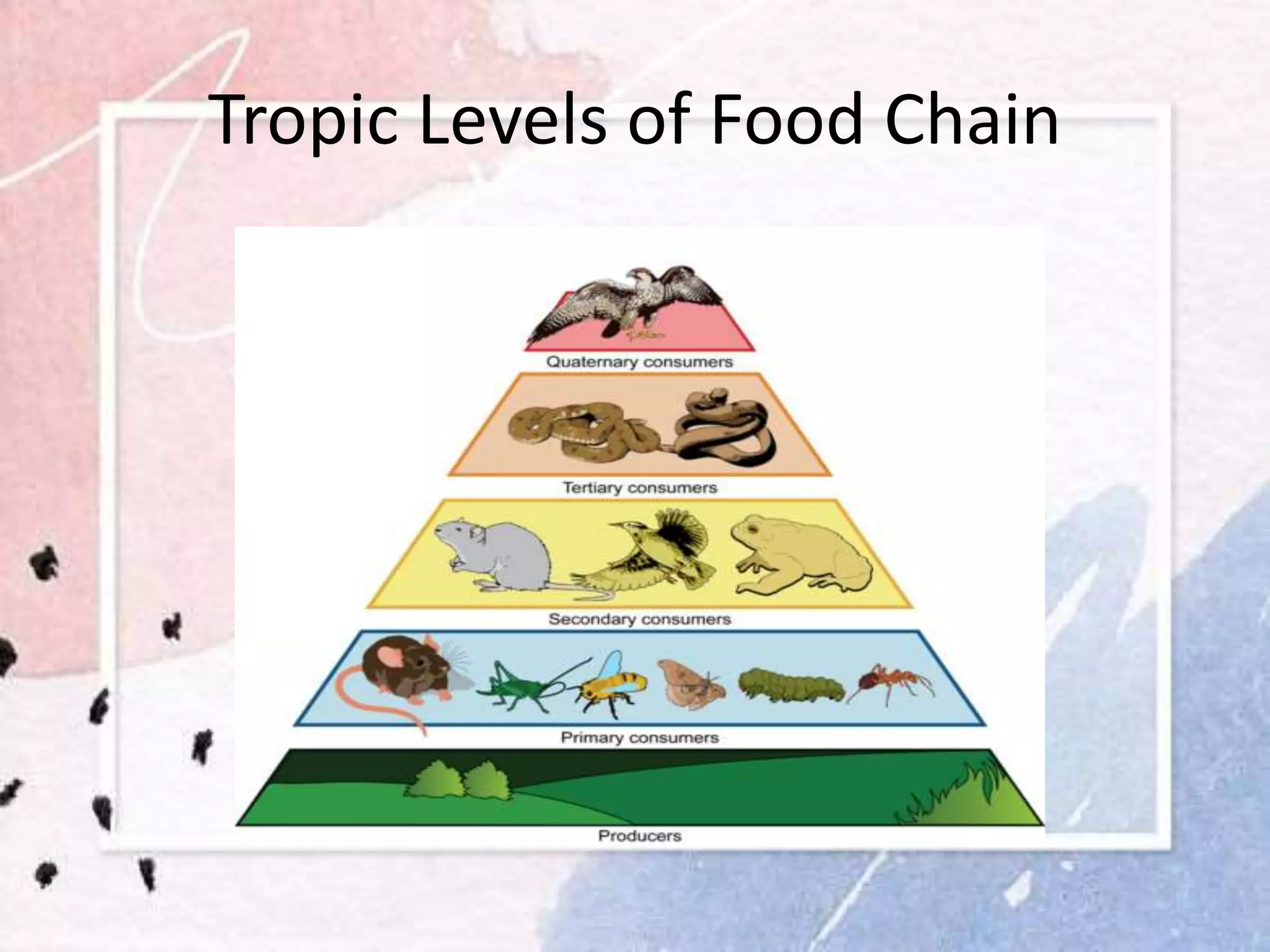
Tropic Levels of Food Chain
Types of Food Chain
• Aquatic- is a food chain is a simple linkage
of producers to consumers through
feeding relationships.
• Terrestrial- land- related food chains with
land plants and animals.
What’s In the Food Chain
• Producers
• Consumers
• Decomposers
Producers
• Producers, also known as autotrophs, make
their own food. They make up the first
level of every food chain.
• Green Plants use energy from the sun to
make food.
Consumers
• Consumer in a food chain are living
creatures that eat organisms from a
different population.
• Consumers hunt and gather food because
they cannot make their own food.
Three Types of Consumers:
• Herbivores
• Carnivores
• Omnivores
Herbivores
• A herbivore is an animal anatomically and
physiologically adapted to eating plant
such as:
 Deer
 cows
 sheep
 goats
 horses
Carnivores
• An animal who only eat other animals
o Examples:
 Lions and tigers
 Praying mantis
 Eagles
 Owls
 Sharks
Omnivores
• An omnivore is an animal that eats both plants
and animals, which may include eggs, insects,
fungi, and algae
o Examples
 Bears
 civets
 hedgehogs
 squirrels raccoons
Decomposers
• an organism, usually a bacterium or
fungus, that breaks down the cells of dead
plants and animals into simpler substances.
• Decomposers return to the nutrients that
are in a living thing in to the soil.
Predator and Prey
• A predator is an animal that hunts and eats
other animals.
• A prey is an animal that gets eaten by the
predator.
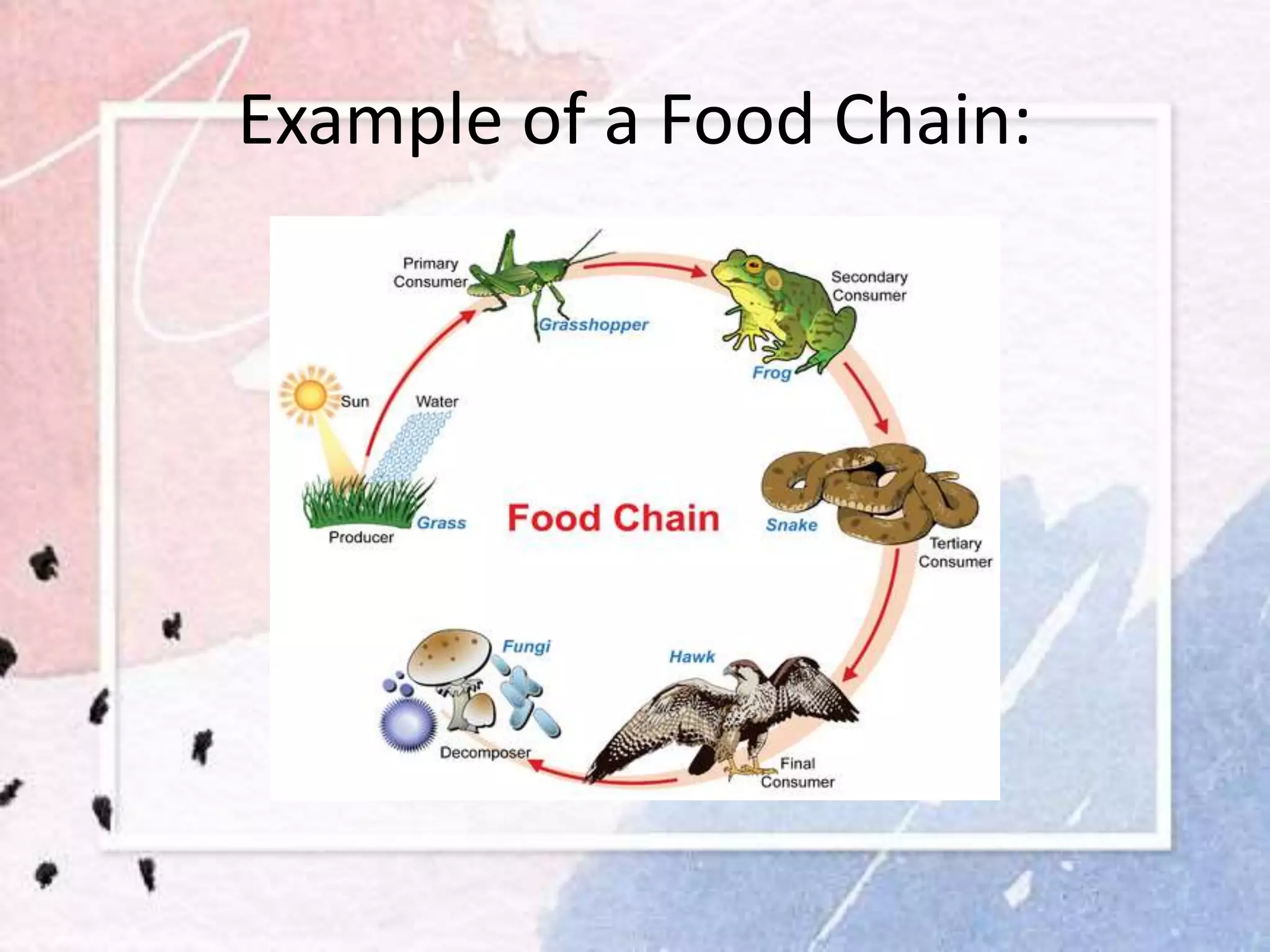
Example of a Food Chain:
Why does Food Chain is important to
humans?
• A food chain shows how energy is transferred
from one living organism to another via food.
It is important for us to understand how the
food chain works so that we know what are
the important living organisms that make up
the food chain and how the ecology is
balanced.
What is Food Web
• A food web (or food cycle) is the natural
interconnection of food chains and a
graphical representation (usually an
image) of what-eats-what in an
ecological community.
Types of food web representation
• TYPOLOGICAL WEBS - These food webs
simply indicate a feeding relationship.
• FLOW WEBS- Bio-energetic webs or flow
webs, include information on the strength
of feeding information.
• INTERACTION WEB – In interaction the
arrows show how one group influences
another.
Importance of Food Web
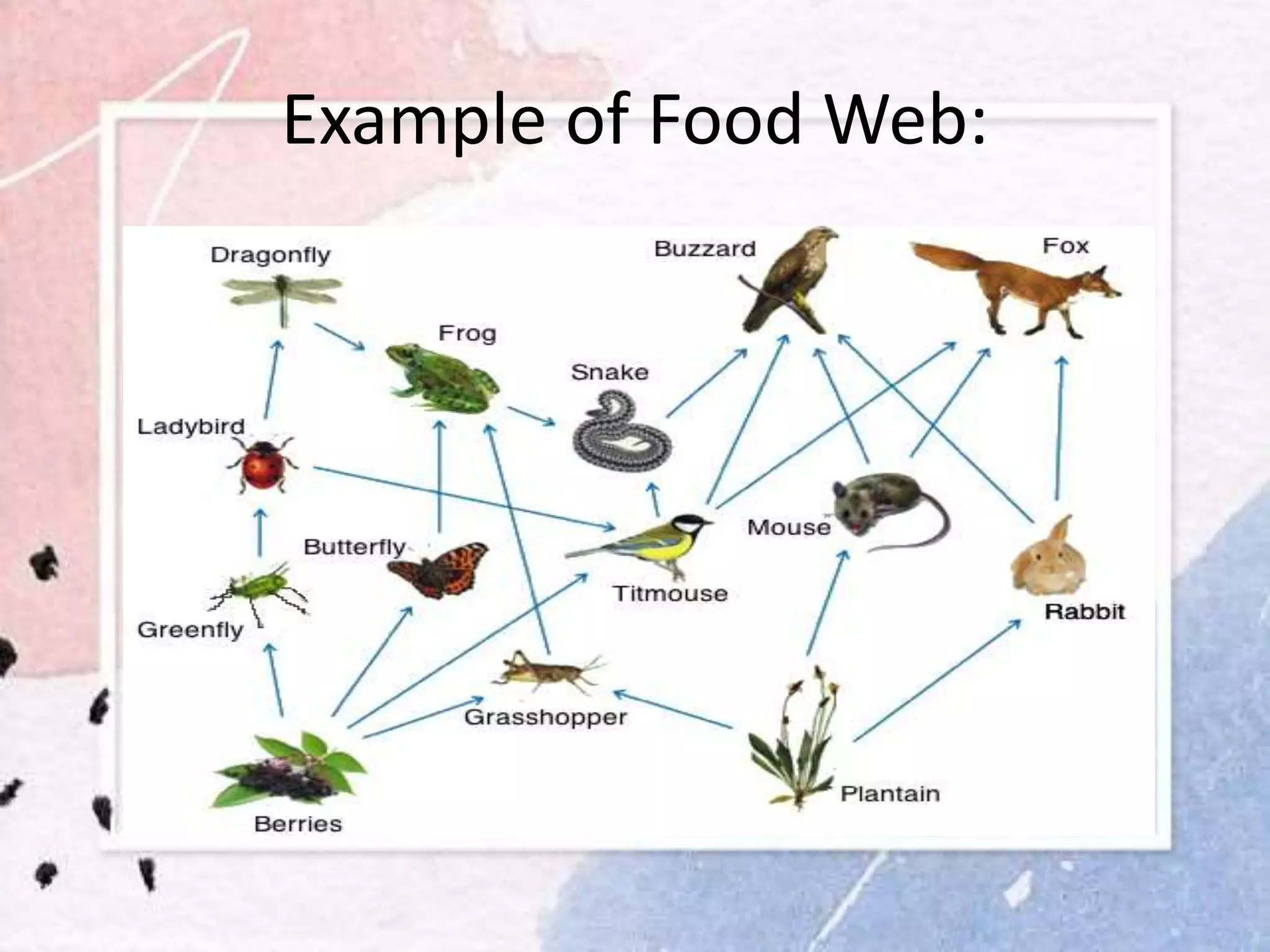
• Food web is an important conceptual tool
for illustrating the feeding relationships
among species within a community,
revealing species interactions and
community structure, and understanding
the dynamics of energy transfer in an
ecosystem.
Example of Food Web:
References
• https://www.google.com/url?sa=i&url=https%3A%2F%2Fsocratic.org%2Fqu
estions%2Fwhat-would-a-drawing-of-a-food-chain-with-4-trophic-levels-
look-
like&psig=AOvVaw2RT21Ss1cwZklB1usDLcFF&ust=1607140828597000&sour
ce=images&cd=vfe&ved=0CAIQjRxqFwoTCNDOu6G4s-
0CFQAAAAAdAAAAABAK
• https://image.slidesharecdn.com/foodchainfoodwebandecologicalcycle-
140302224948-phpapp02/95/food-chainfood-web-and-ecological-pyramids-
14-638.jpg?cb=1393800653
• https://www.google.com/imgres?imgurl=https%3A%2F%2Fuseruploads.socr
atic.org%2Fb7TQJZwGTiencxcyH0No_food_web01.png&imgrefurl=https%3A
%2F%2Fsocratic.org%2Fquestions%2Fwill-you-define-food-chain-food-web-
and-food-pyramid&tbnid=gAEVPmK-
WbevNM&vet=12ahUKEwiMydmT1rPtAhUF95QKHfCkBKIQMygEegUIARCsA
Q..i&docid=0Jmi-
GGEpzC11M&w=521&h=405&q=food%20web%20example&ved=2ahUKEwi
MydmT1rPtAhUF95QKHfCkBKIQMygEegUIARCsAQ

Food Chains and Food WEB