Population structure in a haplo-diploid
fungus farming beetle
New insights from genotype-by-sequencing

male

Caroline Storer & Jiri Hulcr
University of Florida

female
Ambrosia beetles build galleries in the xylem of
dying trees for farming their symbiotic fungus
The Xyleborini are a hyper-diverse (~1,200 species) tribe of
Ambrosia beetles
The Xyleborini have bizarre genetics

Haplo-diploid: Females
produce many diploid
daughters and one haploid
son

haploid son
diploid
mother
The Xyleborini have bizarre genetics

Haplo-diploid: Females
produce many diploid
daughters and one haploid
son
Inbreed: The haploid son
mates with its sisters
haploid son
diploid
mother
1)  What is the effect of haplo-diploid
inbreeding on genetic diversity and
population structure?
1)  What is the effect of haplo-diploid
inbreeding on genetic diversity and
population structure?
2)  Are new high-throughput genotype-bysequencing methods suitable for these
near-clonal organisms?
Why genotype-by-sequencing?
o  Fast

-  No marker development
-  Sample prep takes days
Why genotype-by-sequencing?
o  Fast

-  No marker development
-  Sample prep takes days

o  High-throughput

-  100s of individuals
-  100s of genotypes
Why genotype-by-sequencing?
o  Fast

-  No marker development
-  Sample prep takes days

o  High-throughput

-  100s of individuals
-  100s of genotypes

o  Robust

-  High-quality sequence data
-  Biological signals are recoverable (Buerkle & Gompert 2013)
Why genotype-by-sequencing?
o  Fast

-  No marker development
-  Sample prep takes days

o  High-throughput

-  100s of individuals
-  100s of genotypes

o  Robust

-  High-quality sequence data
-  Biological signals are recoverable (Buerkle & Gompert 2013)
Xylosandrus crassiusculus

1	
  mm	
  
Xylosandrus crassiusculus

1	
  mm	
  

o  Abundant
Xylosandrus crassiusculus

1	
  mm	
  

o  Abundant
o  Exotic (in the US)
Xylosandrus crassiusculus

1	
  mm	
  

o  Abundant
o  Exotic (in the US)
o  Sometimes pest
Xylosandrus crassiusculus

Maryland
Northern NC

1	
  mm	
  

Southern NC
South Carolina

o  Abundant
o  Exotic (in the US)

North Florida
Central Florida

o  Sometimes pest
2-3 beetles sequenced
from 6 locations
restriction-site associated sequencing
(RADseq)
restriction-site associated sequencing
(RADseq)

Petterson et al. 2012
restriction-site associated sequencing
(RADseq)

ddRADseq enables the sequencing of the same genomic region in
many taxonomically related individuals

Petterson et al. 2012
1

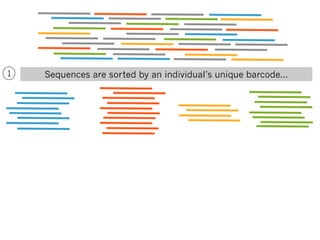
Sequences are sorted by an individual’s unique barcode...
1

Sequences are sorted by an individual’s unique barcode...

2

then assembled into locus stacks based on sequence similarity

Stack 1

Stack 2

Stack X
89,429 stacks in
catalog
89,429 stacks in
catalog
89,429 stacks in
catalog

21,860 stacks
shared across
individuals
89,429 stacks in
catalog

21,860 stacks
shared across
individuals

2,984
SNP loci
genotyped
Inbreeding detected at most loci
1	
  
0.8	
  
0.6	
  

FIS

0.4	
  

FIS > 0
inbreeding

0.2	
  
0	
  
-­‐0.2	
  
-­‐0.4	
  
-­‐0.6	
  

FIS < 0
outbreeding

-­‐0.8	
  
-­‐1	
  

locus
No population structure associated with
geographic location
Central Florida
North Florida
South Carolina
Southern North Carolina
Northern North Carolina
Maryland

Principal
coordinate 2
(14.54%)

Principal coordinate 1 (35.34%)
In summary...
In summary...
o  Genotype-by-sequencing is possible
In summary...
o  Genotype-by-sequencing is possible
o  High inbreeding (>0.8) at most loci, but
some outbreeding may occur
In summary...
o  Genotype-by-sequencing is possible
o  High inbreeding (>0.8) at most loci, but
some outbreeding may occur
o  No genetic structure associated with
geographic location
In summary...
o  Genotype-by-sequencing is possible
o  High inbreeding (>0.8) at most loci, but
some outbreeding may occur
o  No genetic structure associated with
geographic location
o  High genetic similarity between some
individuals, but not clonal
o  What is the global population structure
ambrosia beetles?
o  What is the global population structure
ambrosia beetles?
o  How does population structure differ between
outbreeding and inbreeding ambrosia
beetles?
o  What is the global population structure
ambrosia beetles?
o  How does population structure differ between
outbreeding and inbreeding ambrosia
beetles? Native and exotic?
o  What is the global population structure
ambrosia beetles?
o  How does population structure differ between
outbreeding and inbreeding ambrosia
beetles? Native and exotic?
o  Is population structure correlated with fungal
symbiont biodiversity?
o  What is the global population structure
ambrosia beetles?
o  How does population structure differ between
outbreeding and inbreeding ambrosia
beetles? Native and exotic?
o  Is population structure correlated with fungal
symbiont biodiversity?
o  Are species complexes a phenotypically
plastic single species or distinct cryptic
species?
The Forest Entomology
Lab at University of
Florida

Dr. Jiri
Hulcr
Andrew
Johnson


Martin
Kostovcik
Polly Harding (not shown)

Craig
Bateman


UF
Graduate
Student
Council
Thanks!

cgstorer@gmail.com
http://about.me/caroline.storer
1e+06
8e+05

stacks per
library

6e+05

sequences
per library

00005

50,000

800,000

00006

60,000

1,000,000

600,000

4e+05

00004

40,000

400,000

2e+05

200,000

total
sequences
total_seqs

quality
filtered
sequences
filtered_seqs

used
sequences
used_seqs

stacks
unique_seqs

> 40,000 sequence targets for marker discovery

00002

20,000

00003

30,000
o  58% of stacks identical between individuals
o  9,054 stacks contain putative SNPs
o  Calling genotypes:
–  Present in > 80% of individuals
–  5 sequences (RAD-tags) required to confirm each
genotype within an individual
–  Minimum minor allele frequency of 0.1

o  2,948 loci genotyped in 16 individuals

Ambrosia Beetle Genotype-by-sequencing