Consumer Behaviour	

Part II: The Individual Perspective


            Preparation for the Consumer Behaviour exam at Edinburgh Business School
           Content extracted from the ‘Consumer Behaviour’ text book by David A. Statt
        All pictures used for educational purposes only. No copyright infringement intended.
PART II The Individual Perspective


4) Perception 5) Personality 6) Learning, Memory & Thinking 7) Motivation
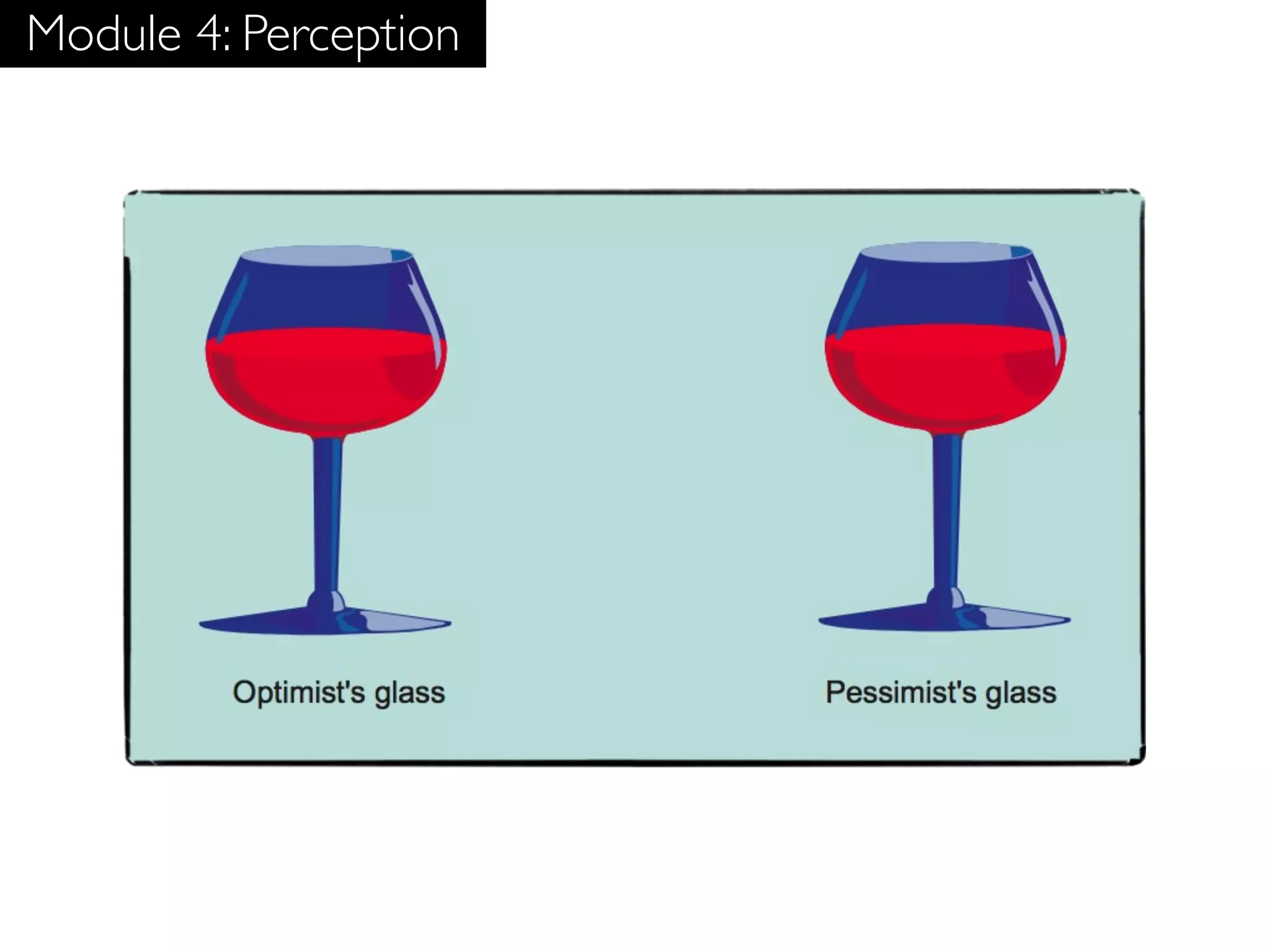
Module 4: Perception
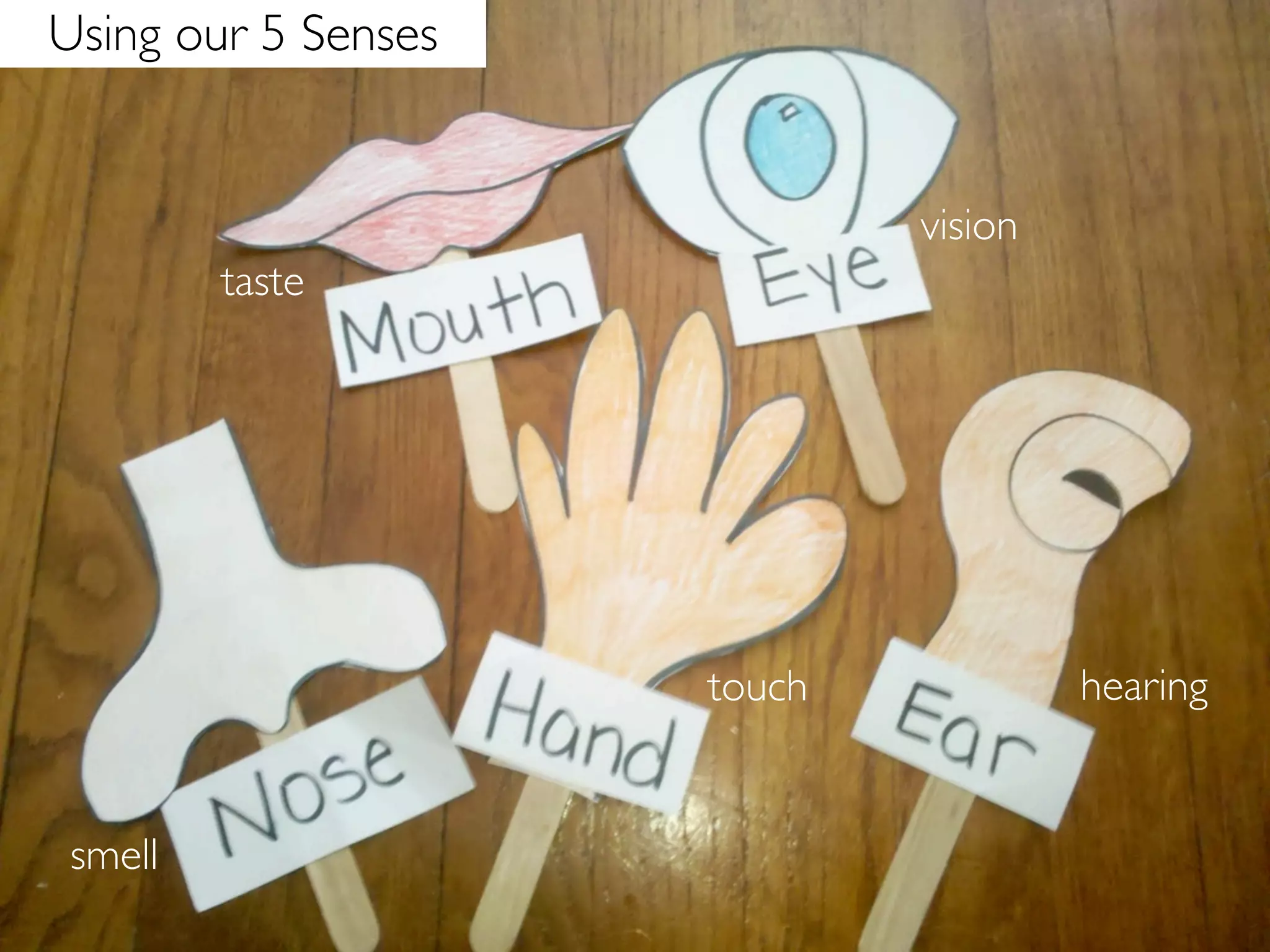
Using our 5 Senses


                             vision
         taste


                     touch            hearing


 smell
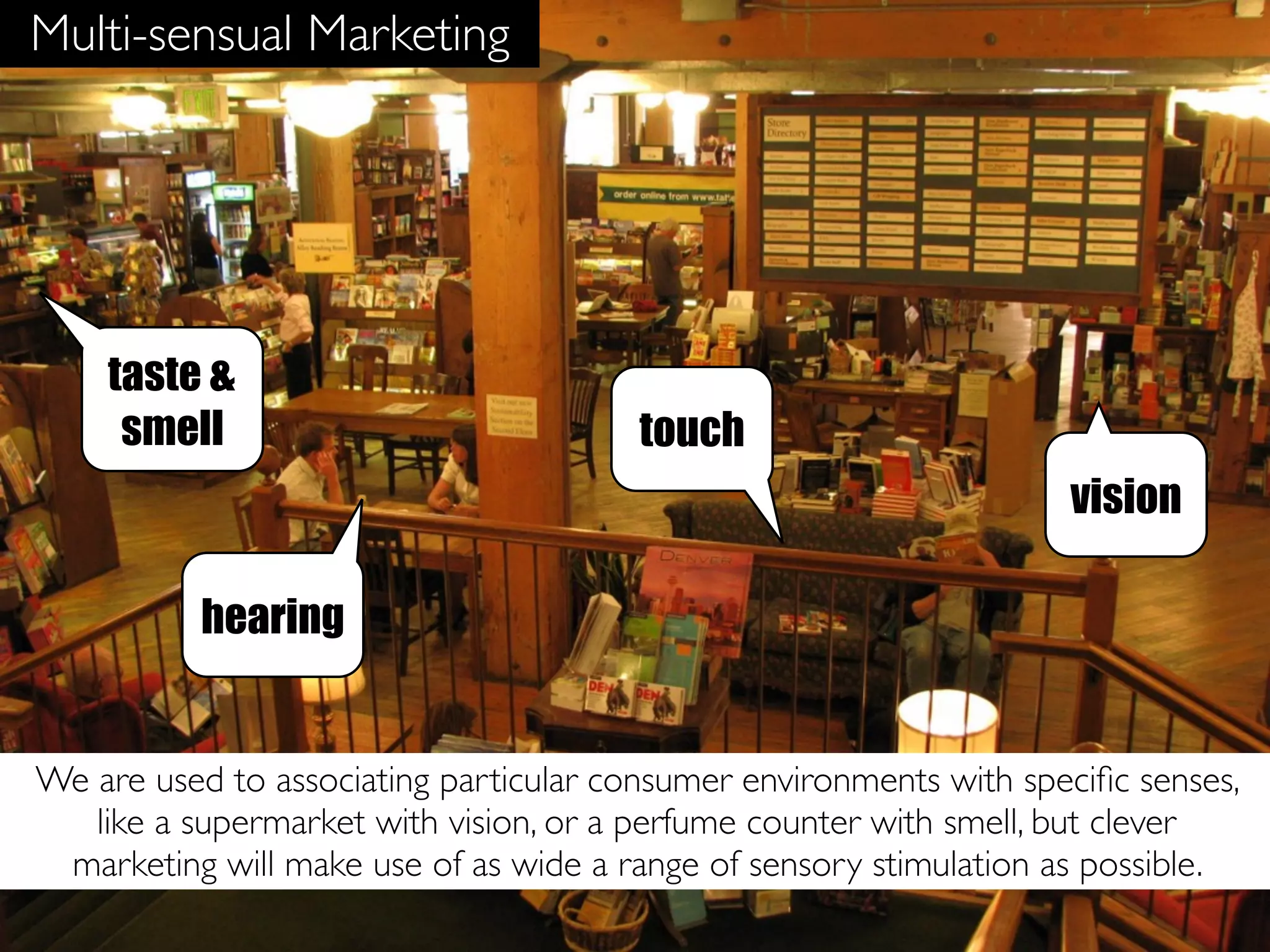
Multi-sensual Marketing


    taste &
     smell                              touch
                                                                    vision

          hearing


We are used to associating particular consumer environments with specific senses,
   like a supermarket with vision, or a perfume counter with smell, but clever
 marketing will make use of as wide a range of sensory stimulation as possible.
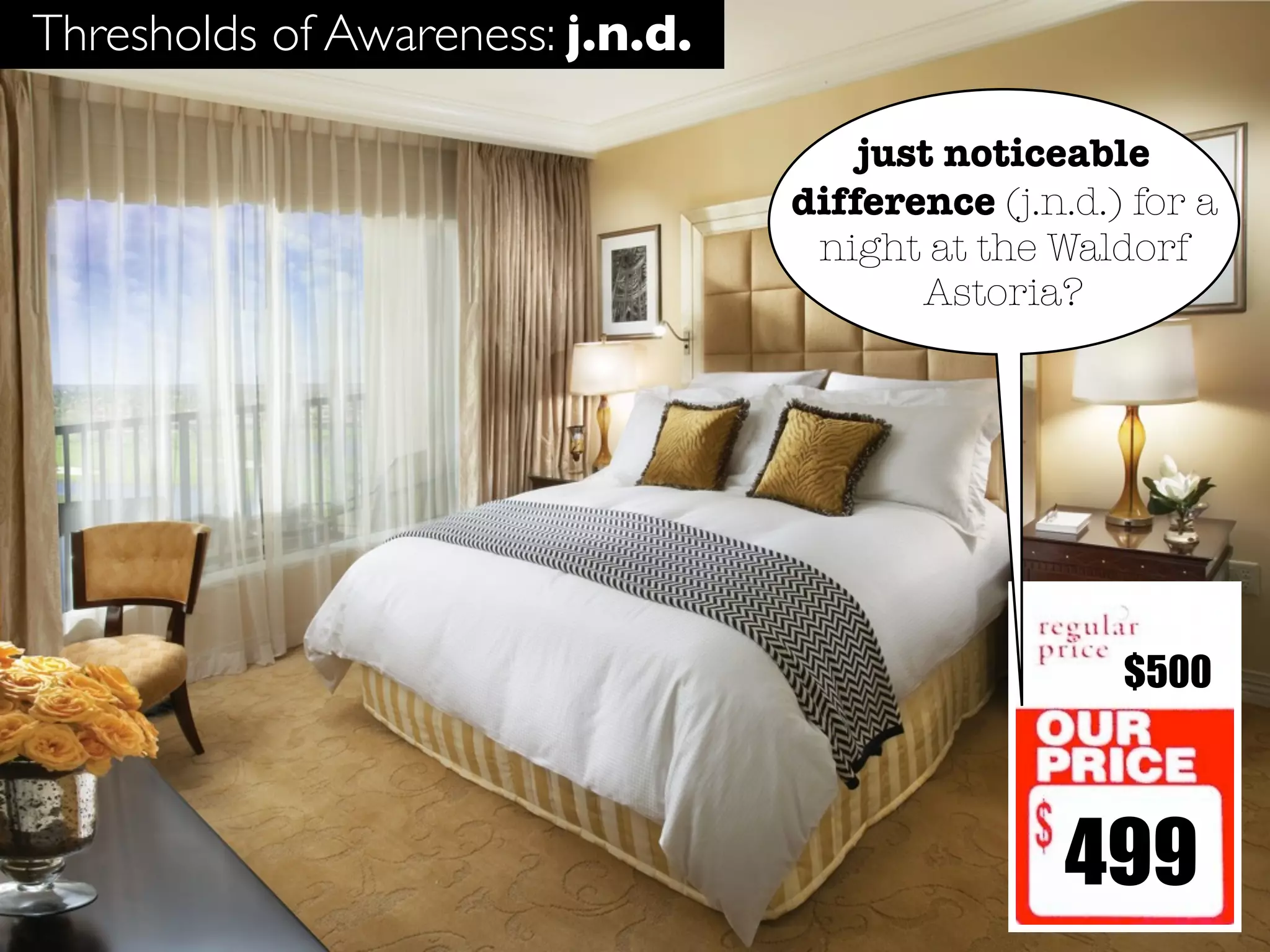
Thresholds of Awareness: j.n.d.

                                      just noticeable
                                  difference (j.n.d.) for a
                                   night at the Waldorf
                                         Astoria?


                                                     $500


                                                  499
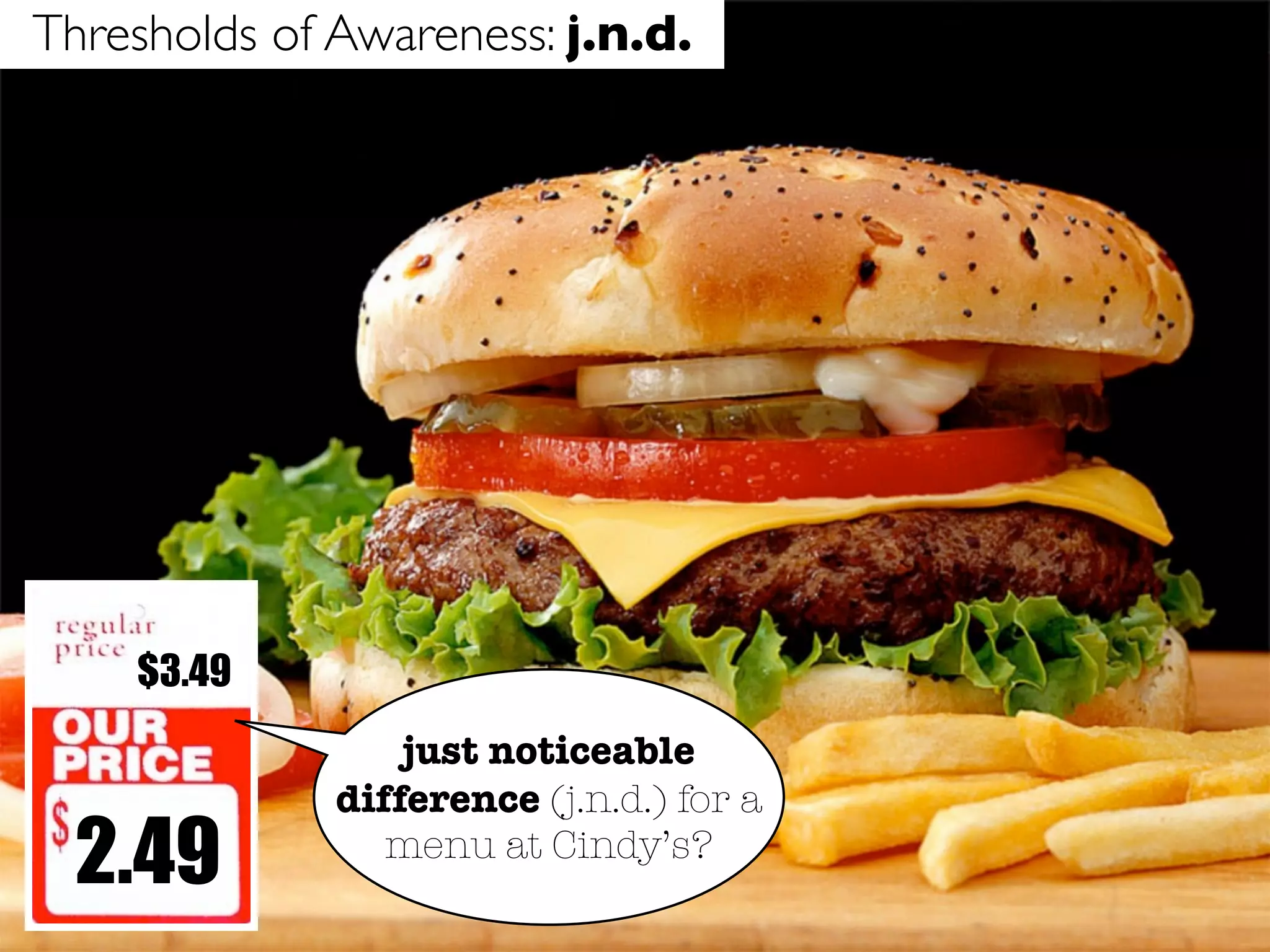
Thresholds of Awareness: j.n.d.


    $3.49
                  just noticeable
              difference (j.n.d.) for a
  2.49           menu at Cindy’s?
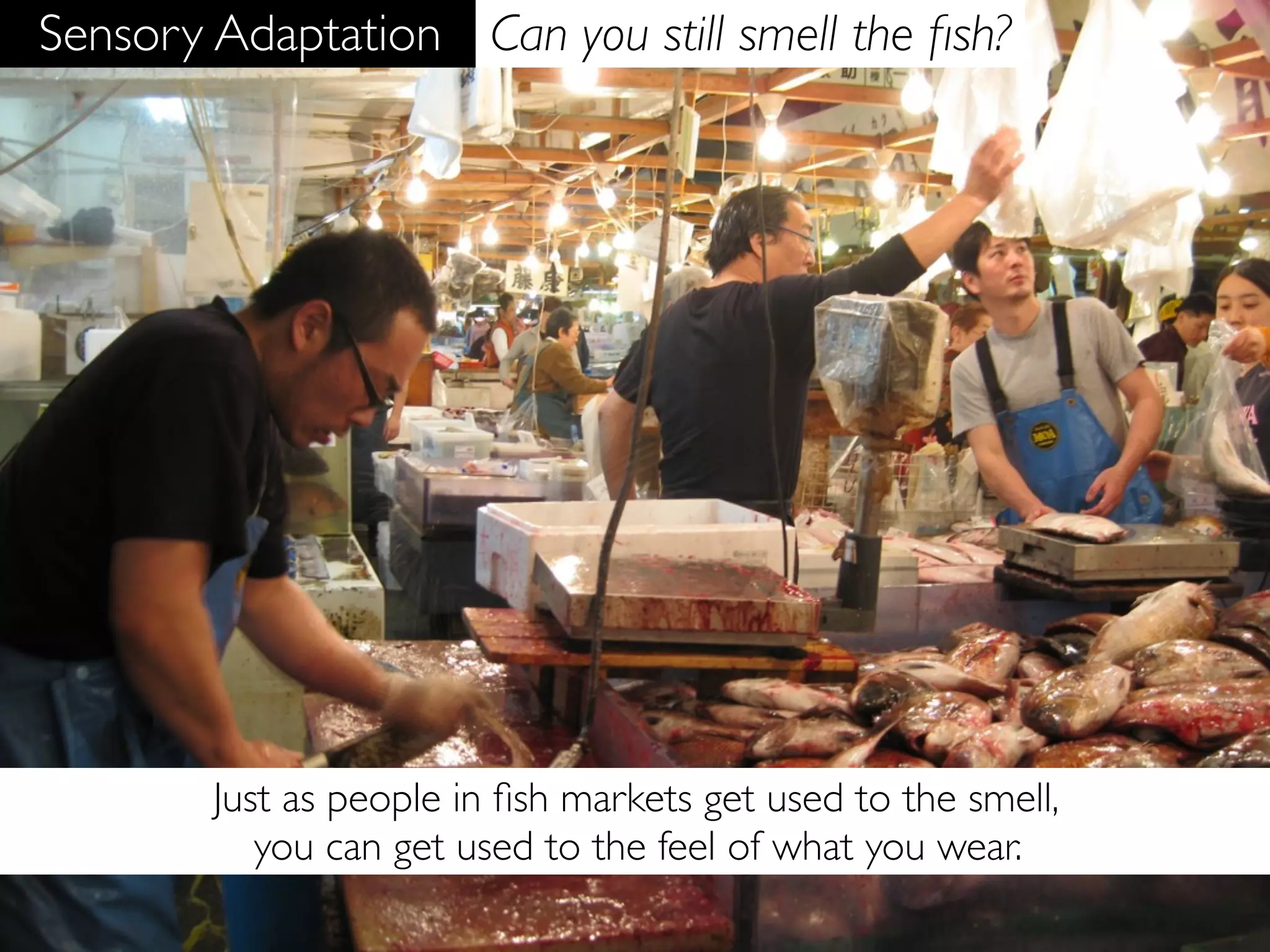
Sensory Adaptation Can you still smell the fish?


        Just as people in fish markets get used to the smell,
           you can get used to the feel of what you wear.
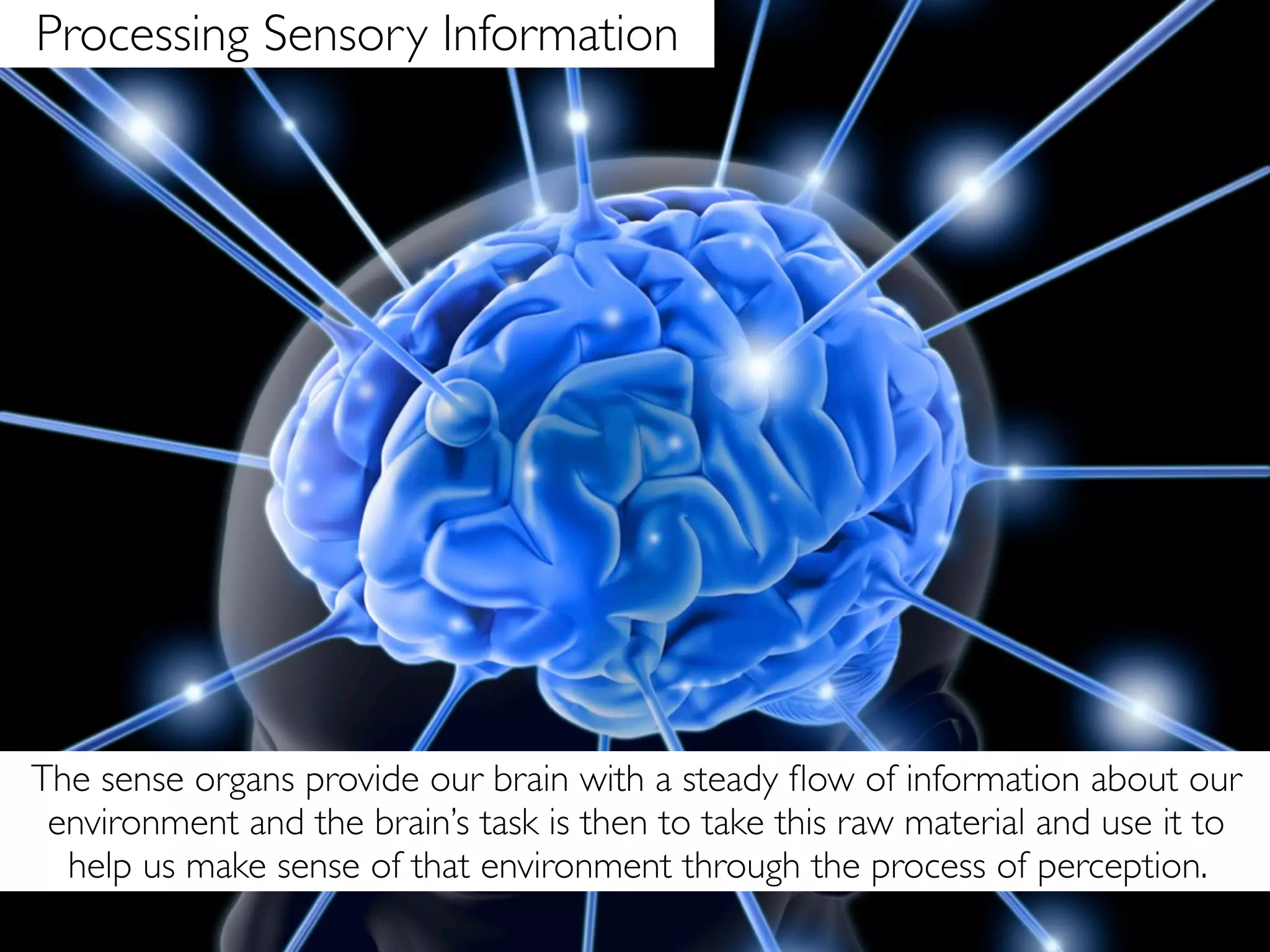
Processing Sensory Information


The sense organs provide our brain with a steady flow of information about our
 environment and the brain’s task is then to take this raw material and use it to
  help us make sense of that environment through the process of perception.
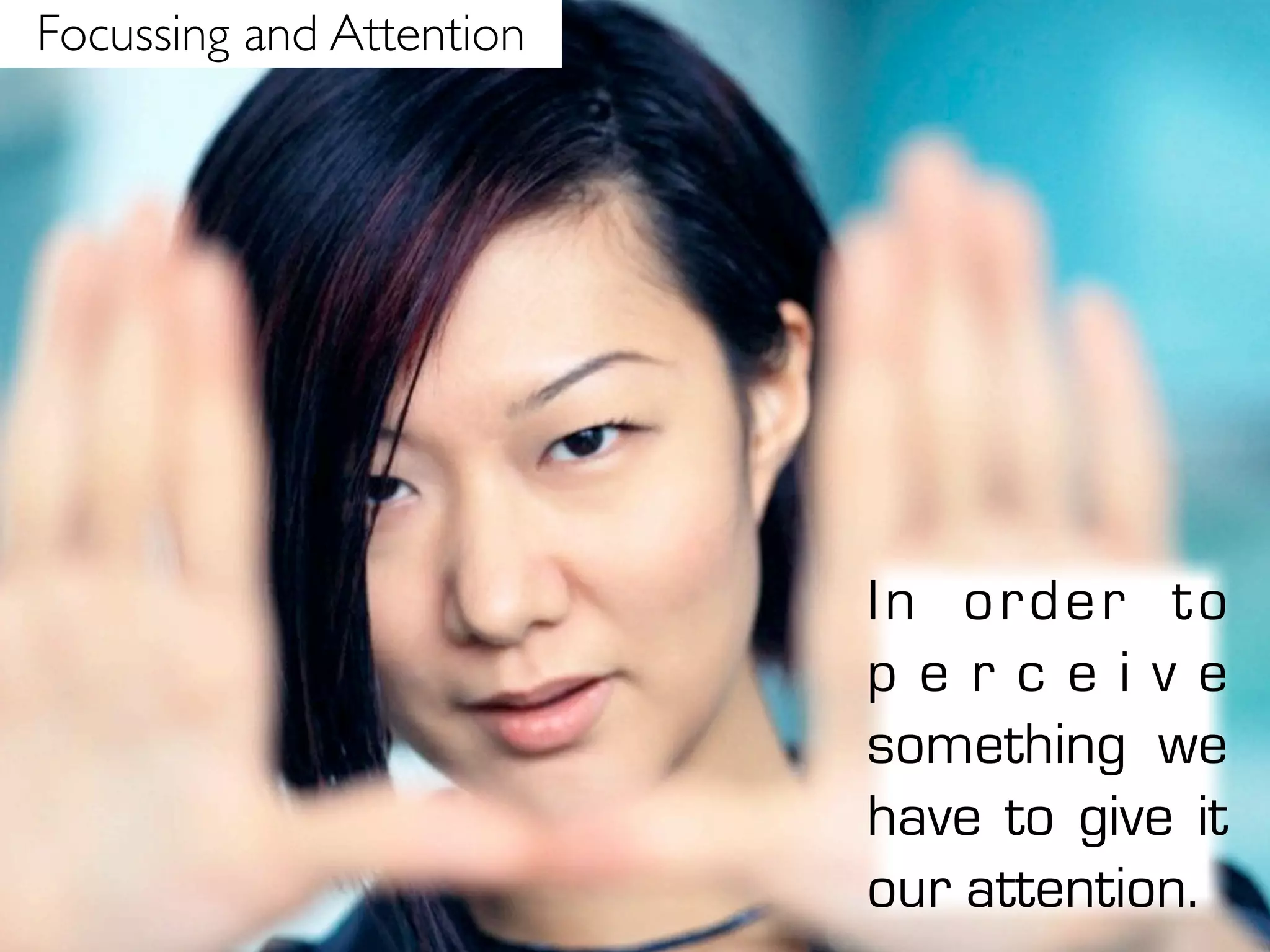
Focussing and Attention


                          In or d e r to
                          perceive
                          something we
                          have to give it
                          our attention.
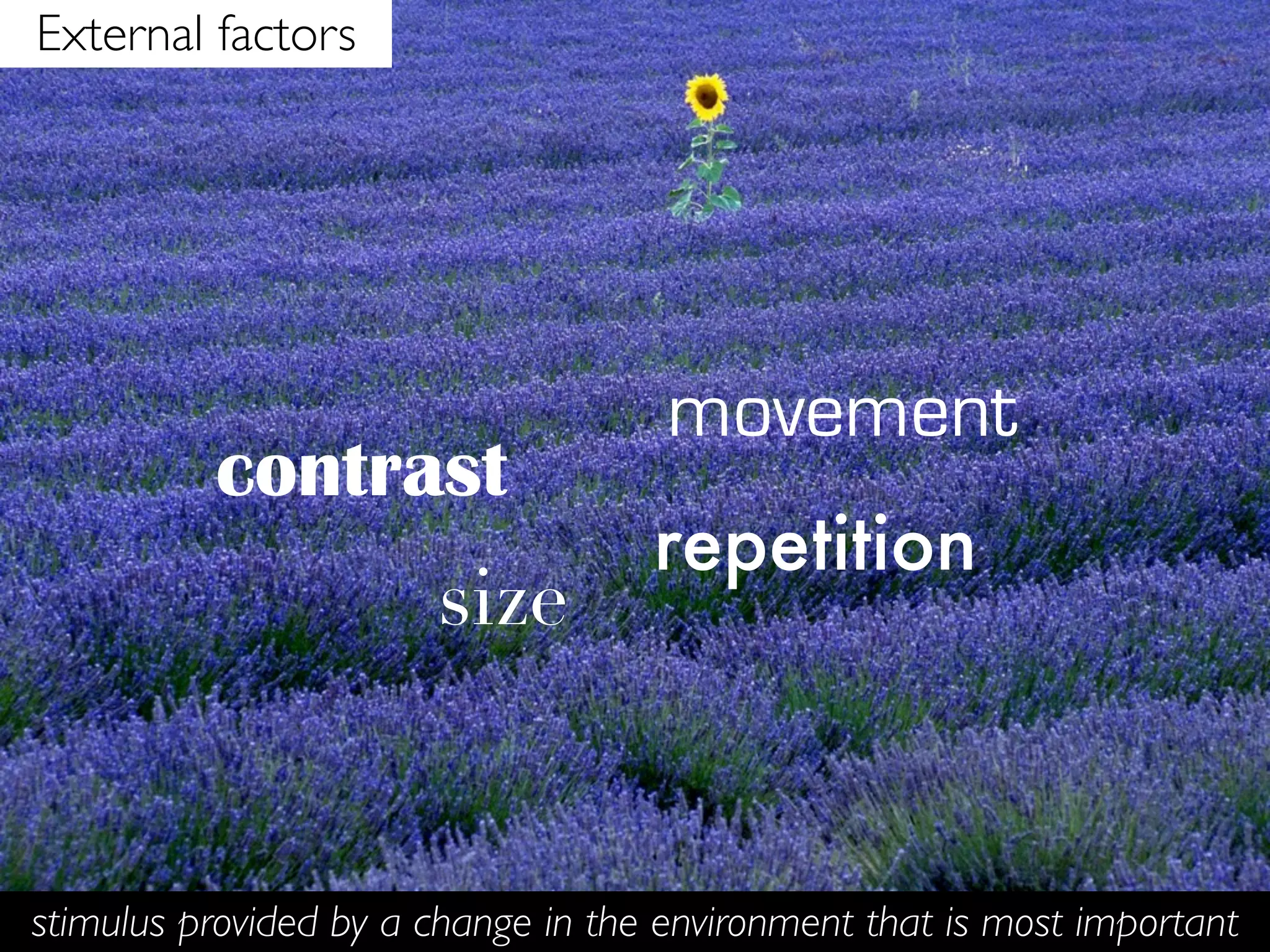
External factors


                                     movement
          contrast
                                    repetition
                       size


stimulus provided by a change in the environment that is most important
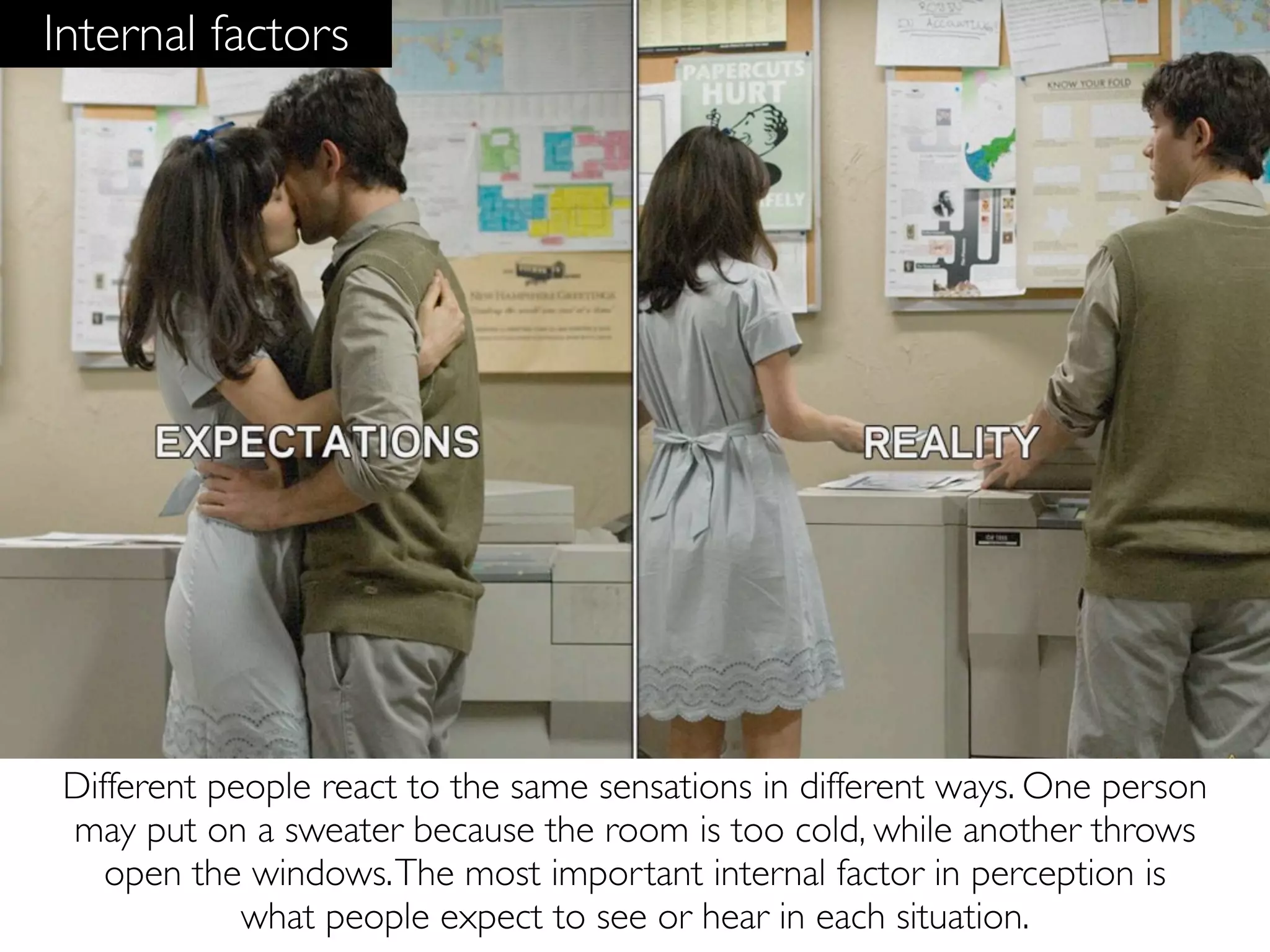
Internal factors


 Different people react to the same sensations in different ways. One person
 may put on a sweater because the room is too cold, while another throws
    open the windows. The most important internal factor in perception is
             what people expect to see or hear in each situation.
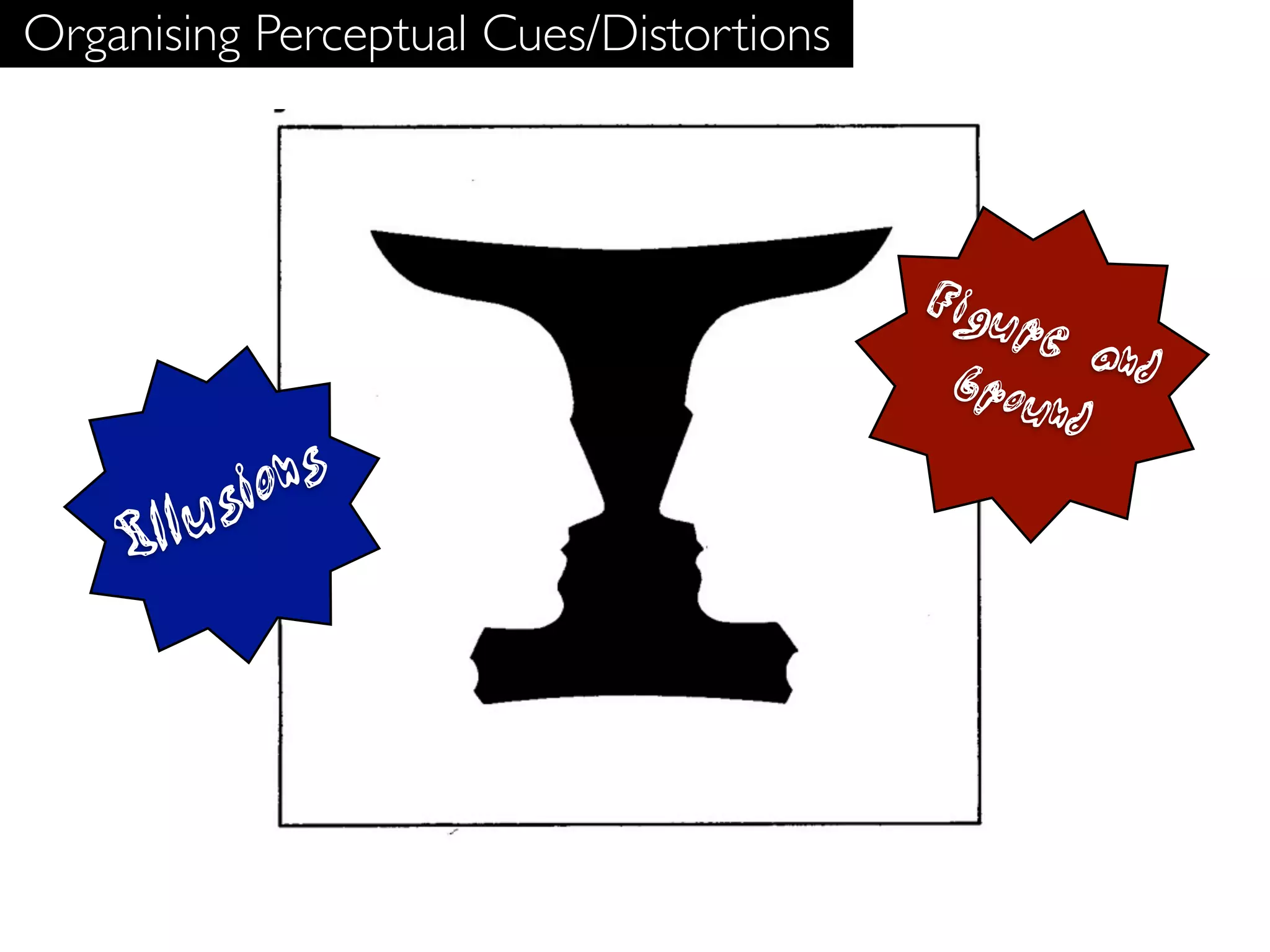
Organising Perceptual Cues/Distortions


                                         Figu
                                              re a
                                          Grou     nd
                                               nd
          sio ns
     I llu
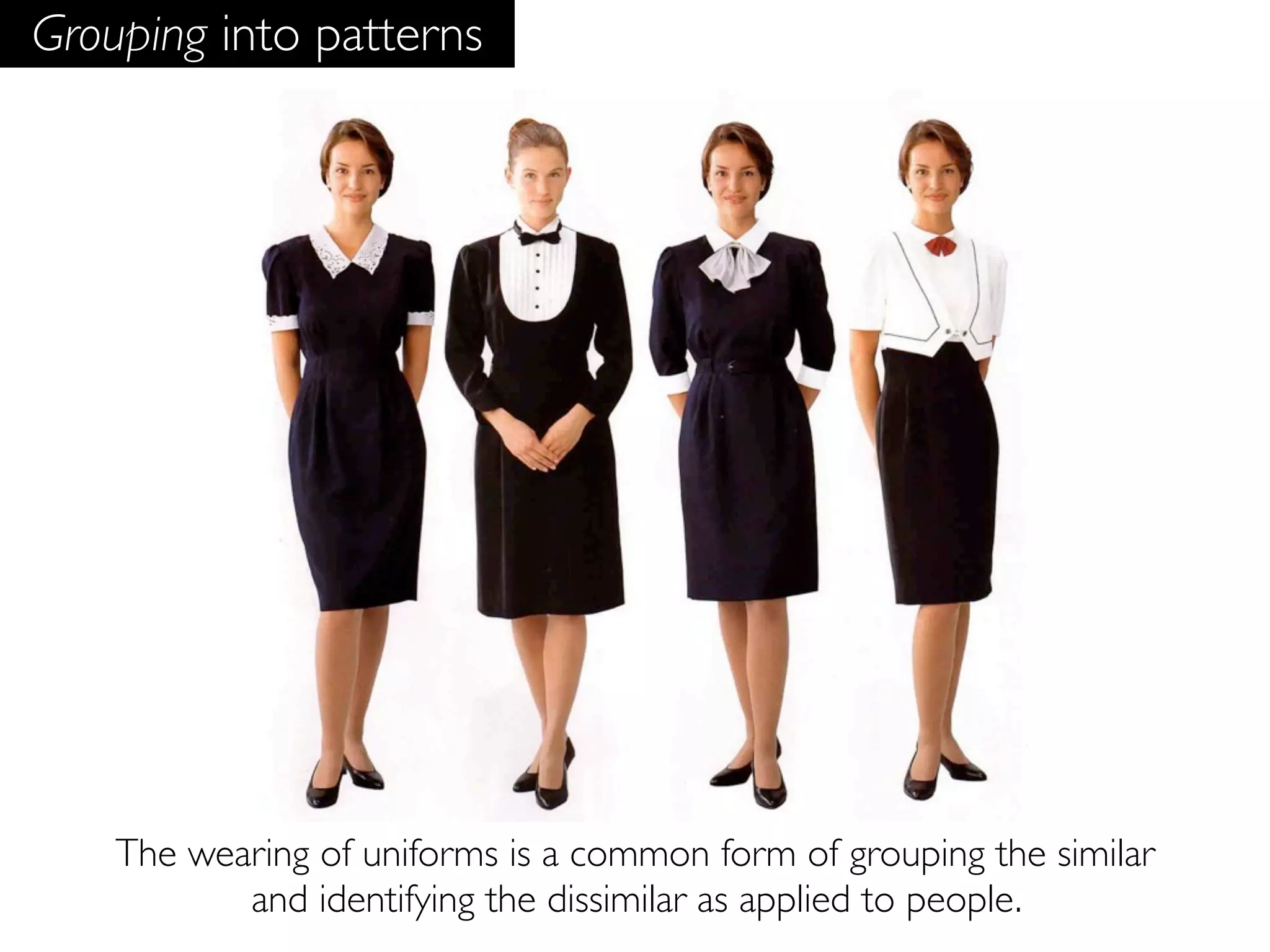
Grouping into patterns


    The wearing of uniforms is a common form of grouping the similar
           and identifying the dissimilar as applied to people.
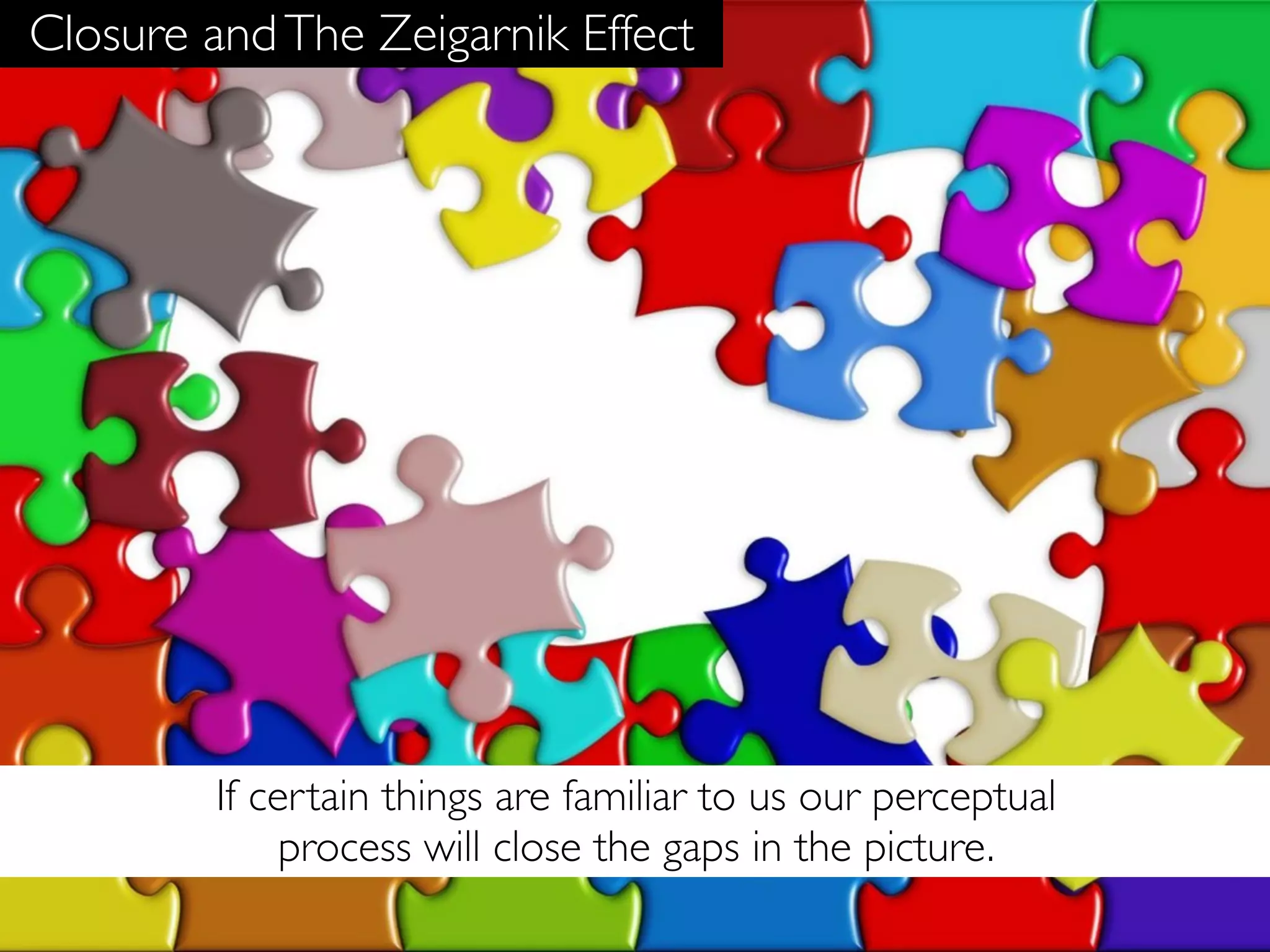
Closure and The Zeigarnik Effect


        If certain things are familiar to us our perceptual
             process will close the gaps in the picture.
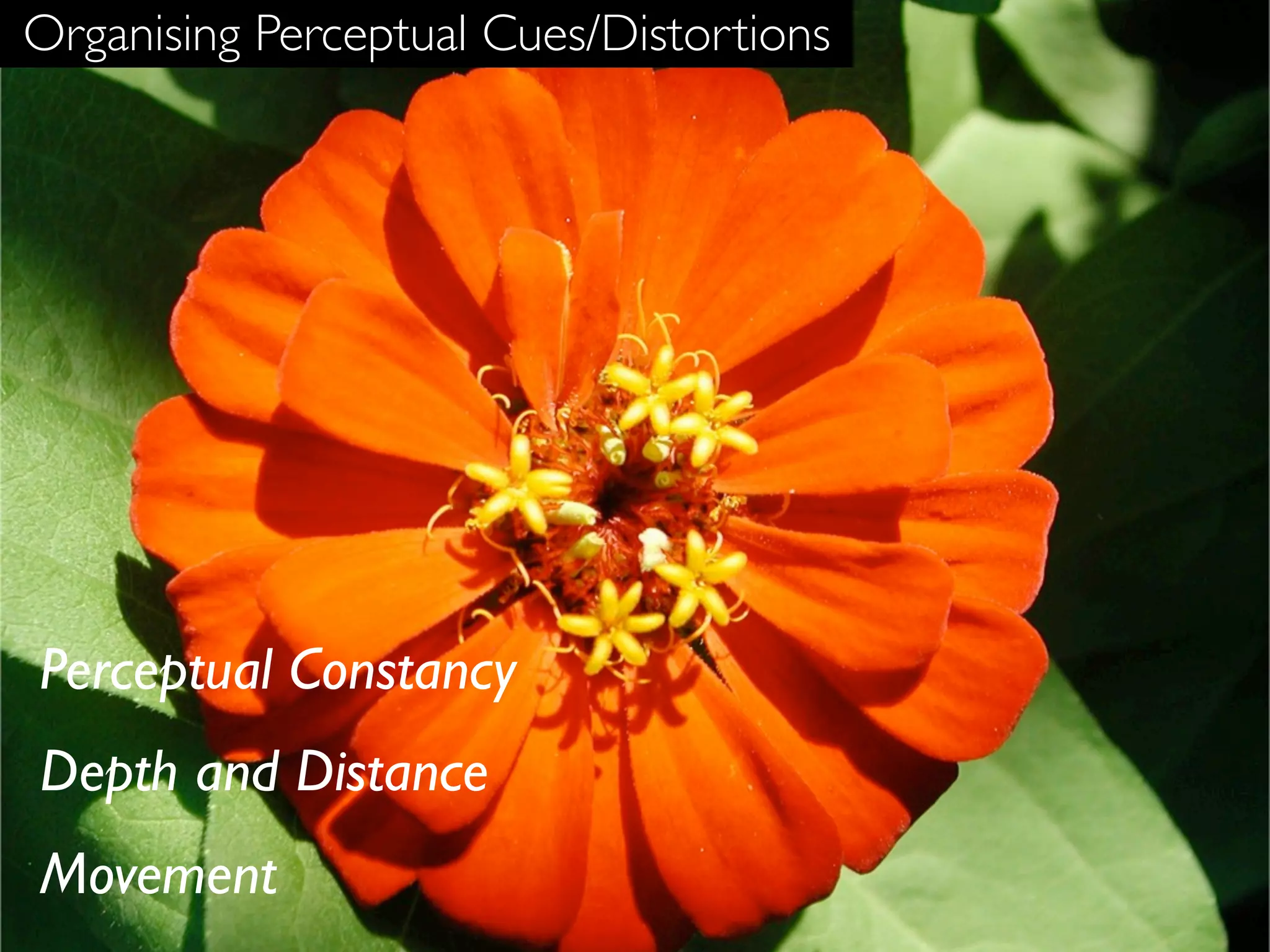
Organising Perceptual Cues/Distortions


Perceptual Constancy
Depth and Distance
Movement
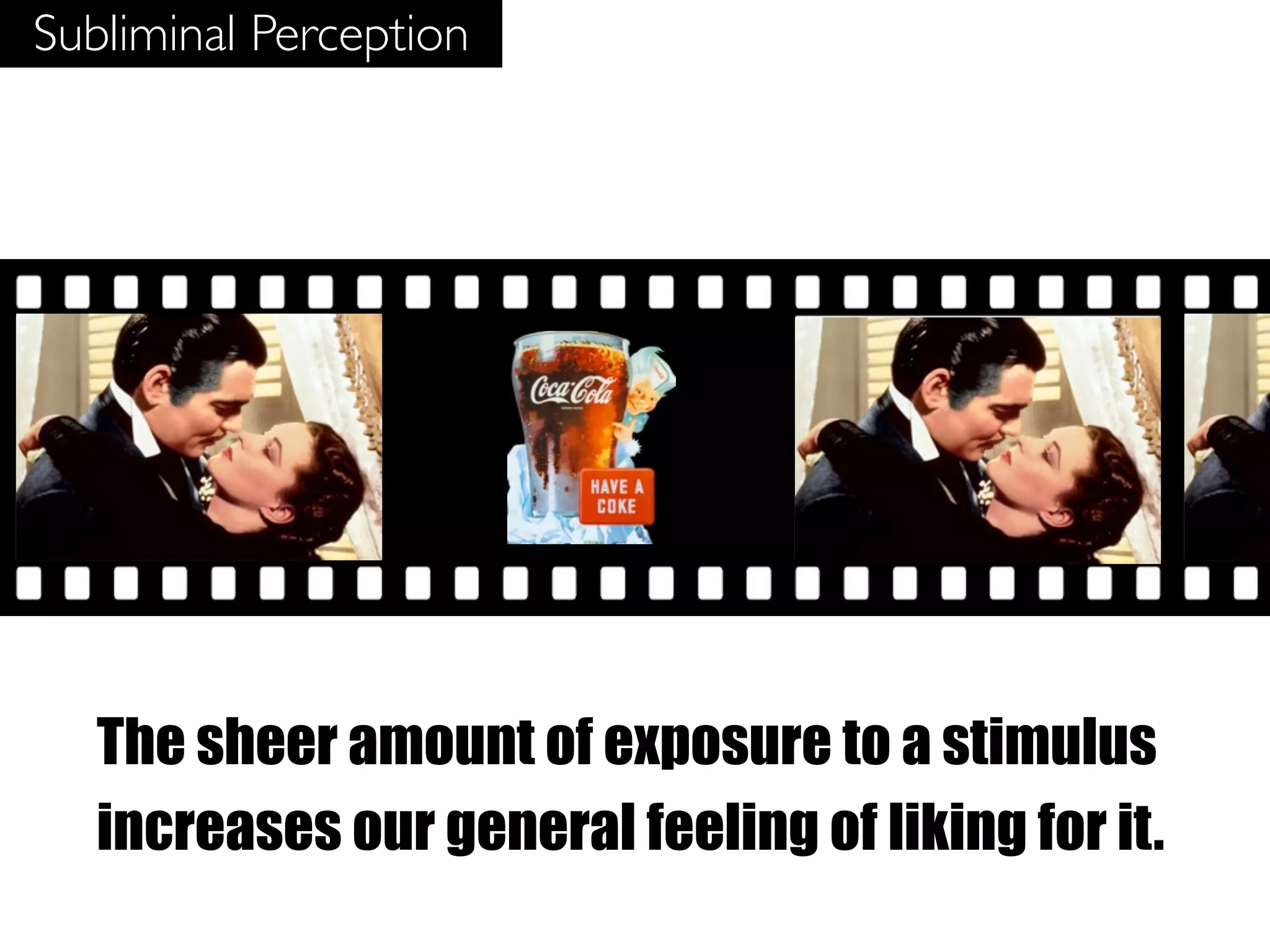
Subliminal Perception


   The sheer amount of exposure to a stimulus
   increases our general feeling of liking for it.
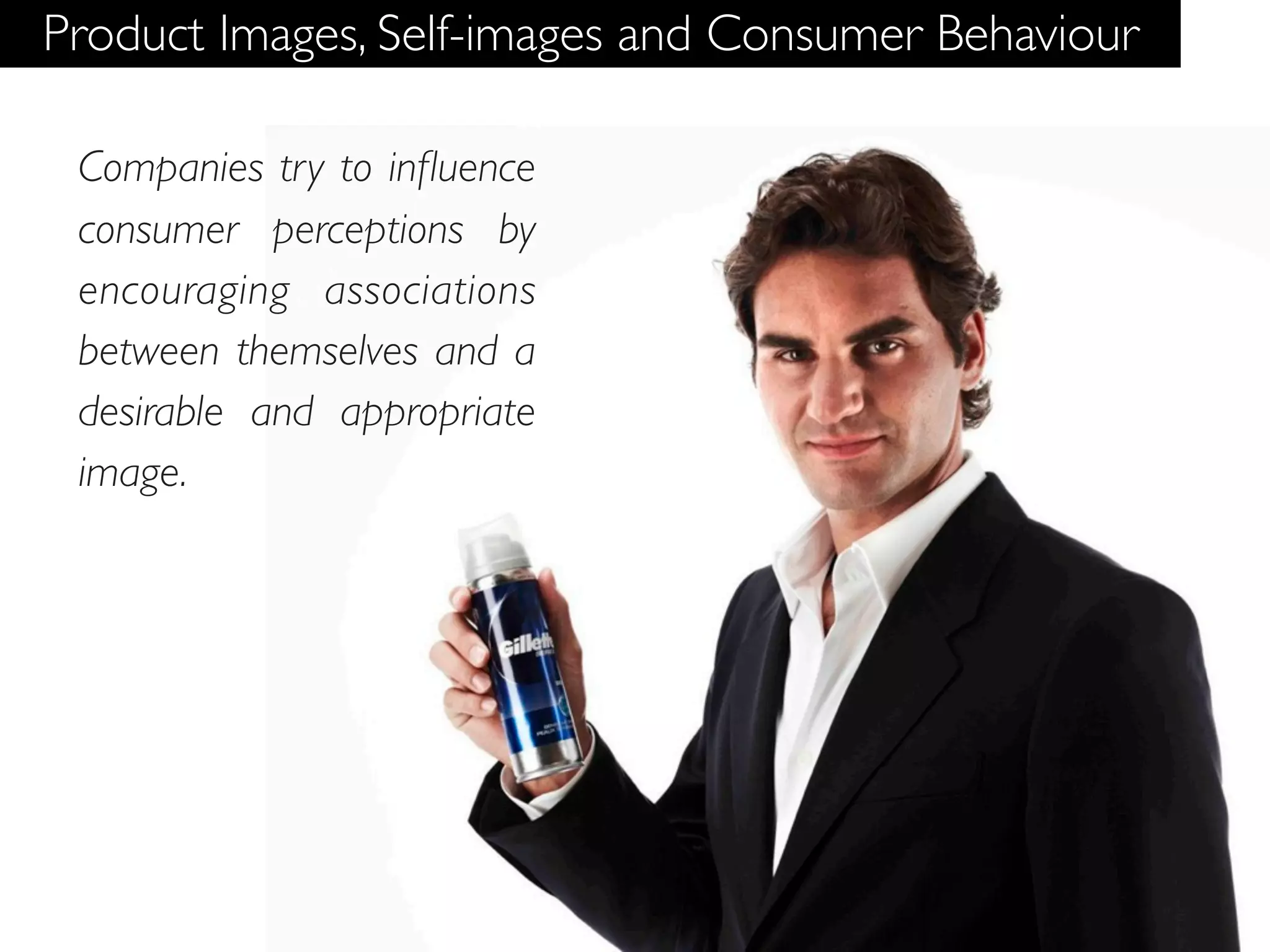
Product Images, Self-images and Consumer Behaviour

 Companies try to influence
 consumer perceptions by
 encouraging associations
 between themselves and a
 desirable and appropriate
 image.
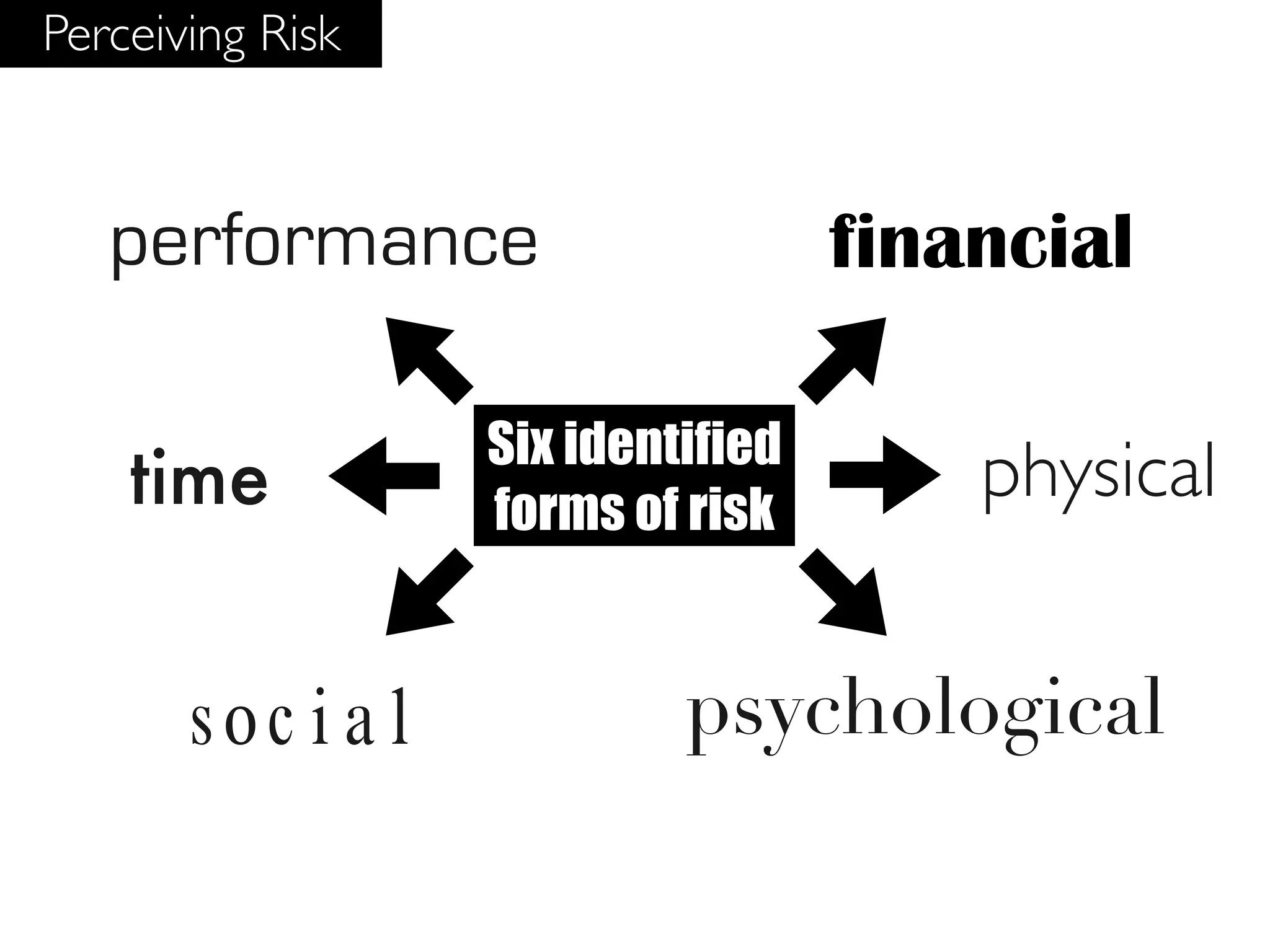
Perceiving Risk


   performance                     financial

                  Six identified
    time          forms of risk
                                       physical

                           psychological
Coping with Risk


     Relying on brand
     loyalty is the most
     popular strategy
     for reducing
     perceived risk.
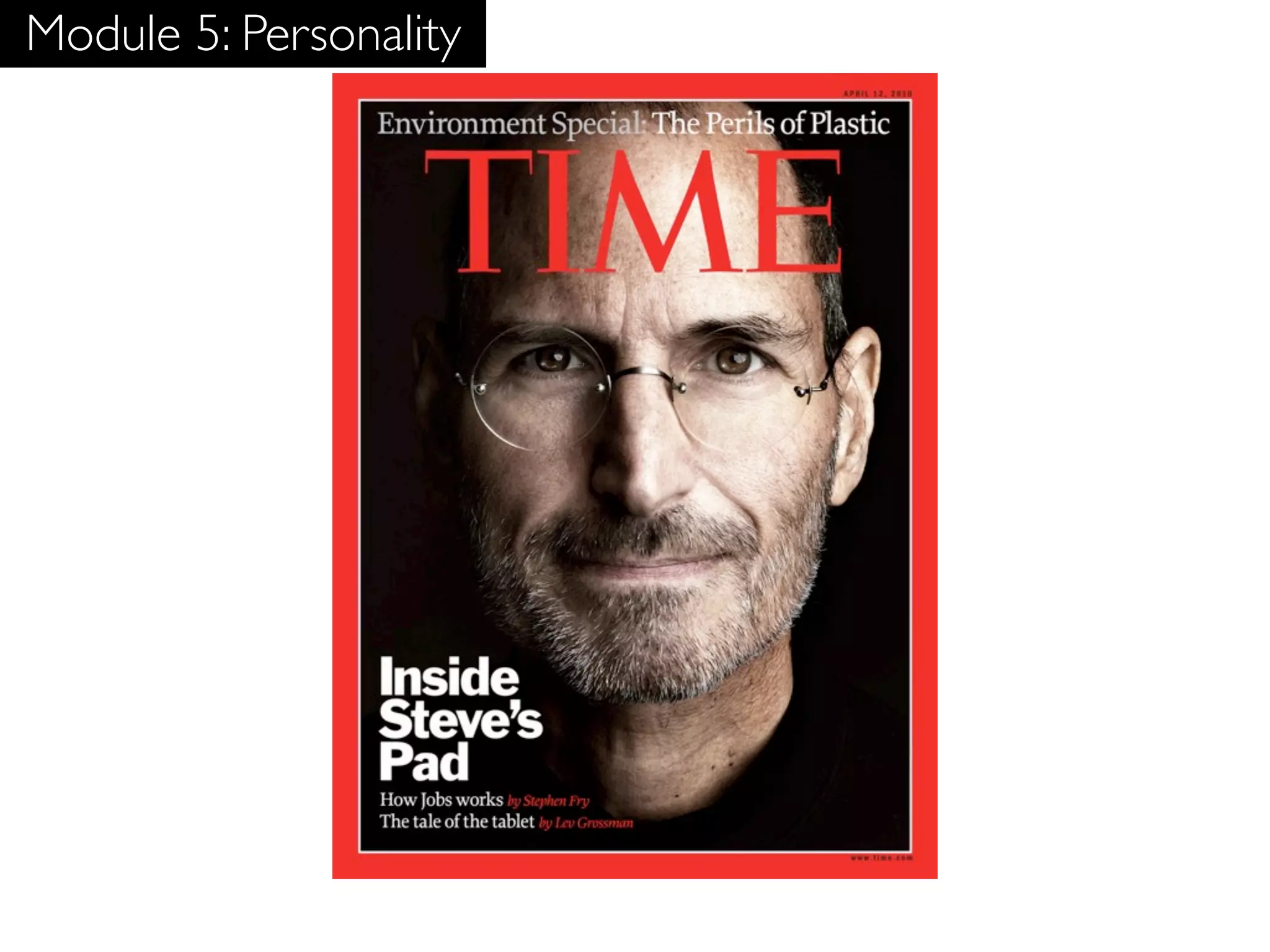
Module 5: Personality
What makes someone a unique person?


   The psychologist and the layman use the term personality
          to make sense of an individual’s behaviour.
Define ‘Personality’


     The sum total of all the
     factors that make an
     individual human being
     both individual & human.
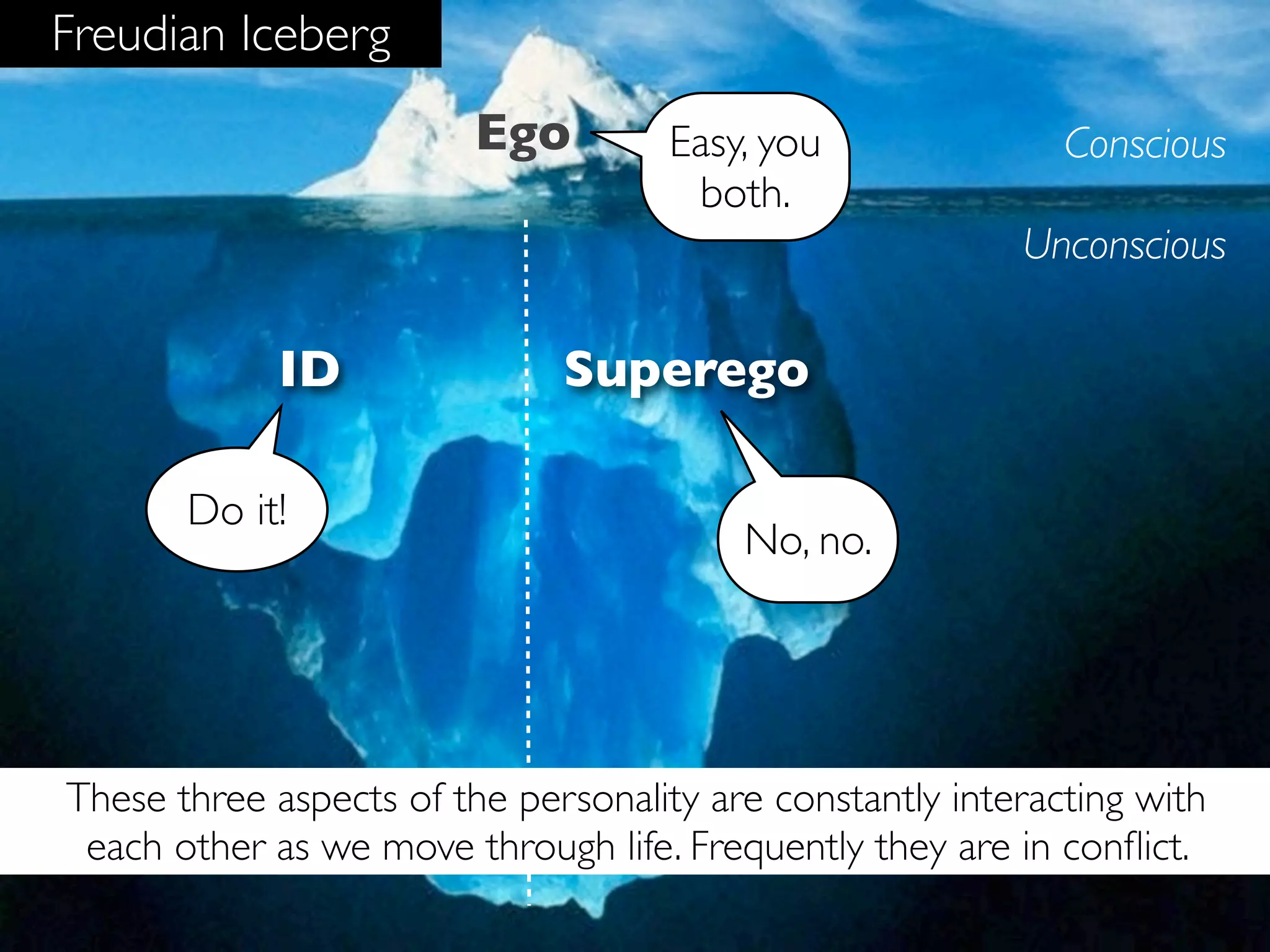
Freudian Iceberg
                         Ego         Easy, you               Conscious
                                      both.
                                                          Unconscious

             ID               Superego

       Do it!
                                         No, no.


These three aspects of the personality are constantly interacting with
 each other as we move through life. Frequently they are in conflict.
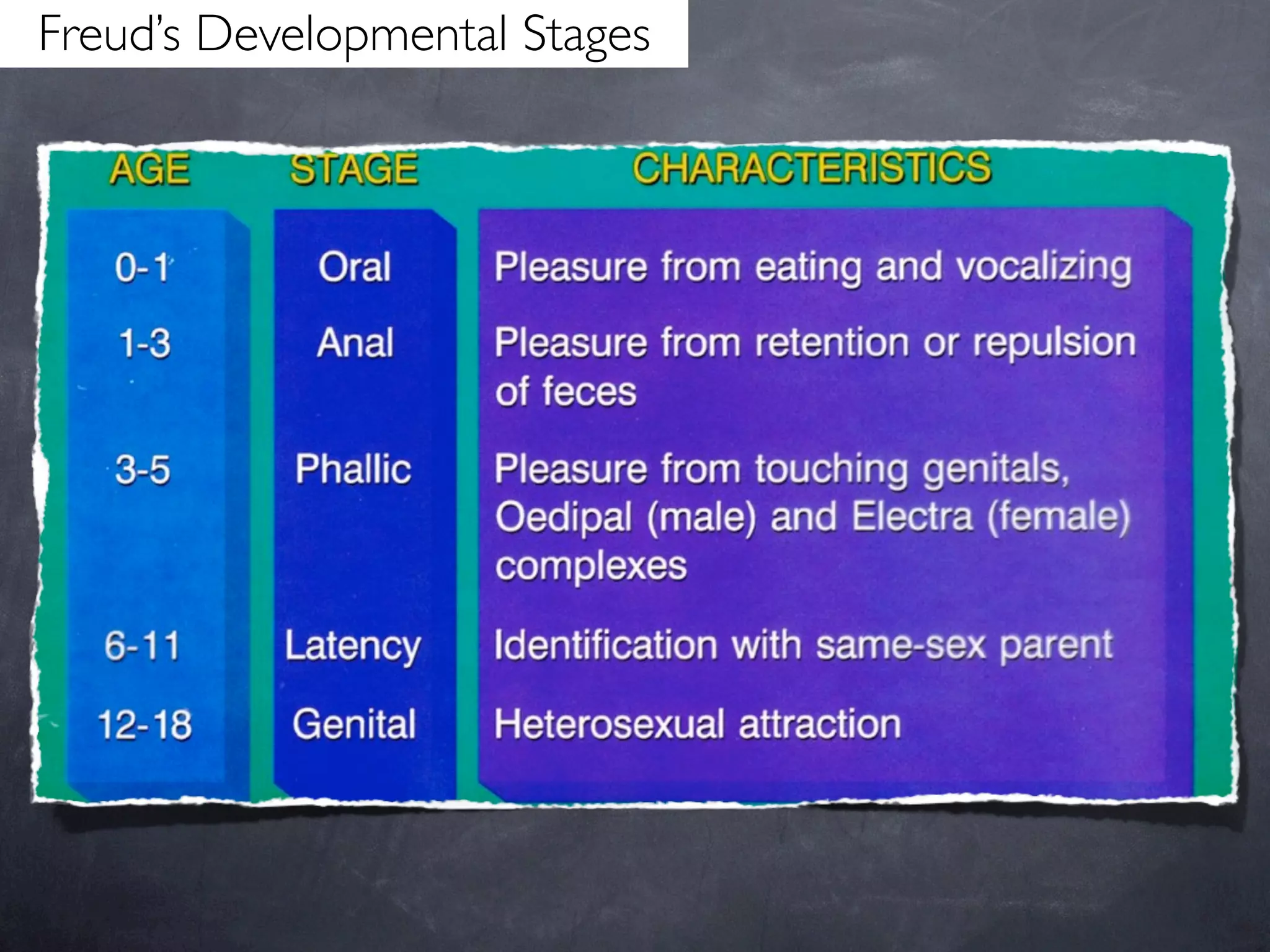
Freud’s Developmental Stages
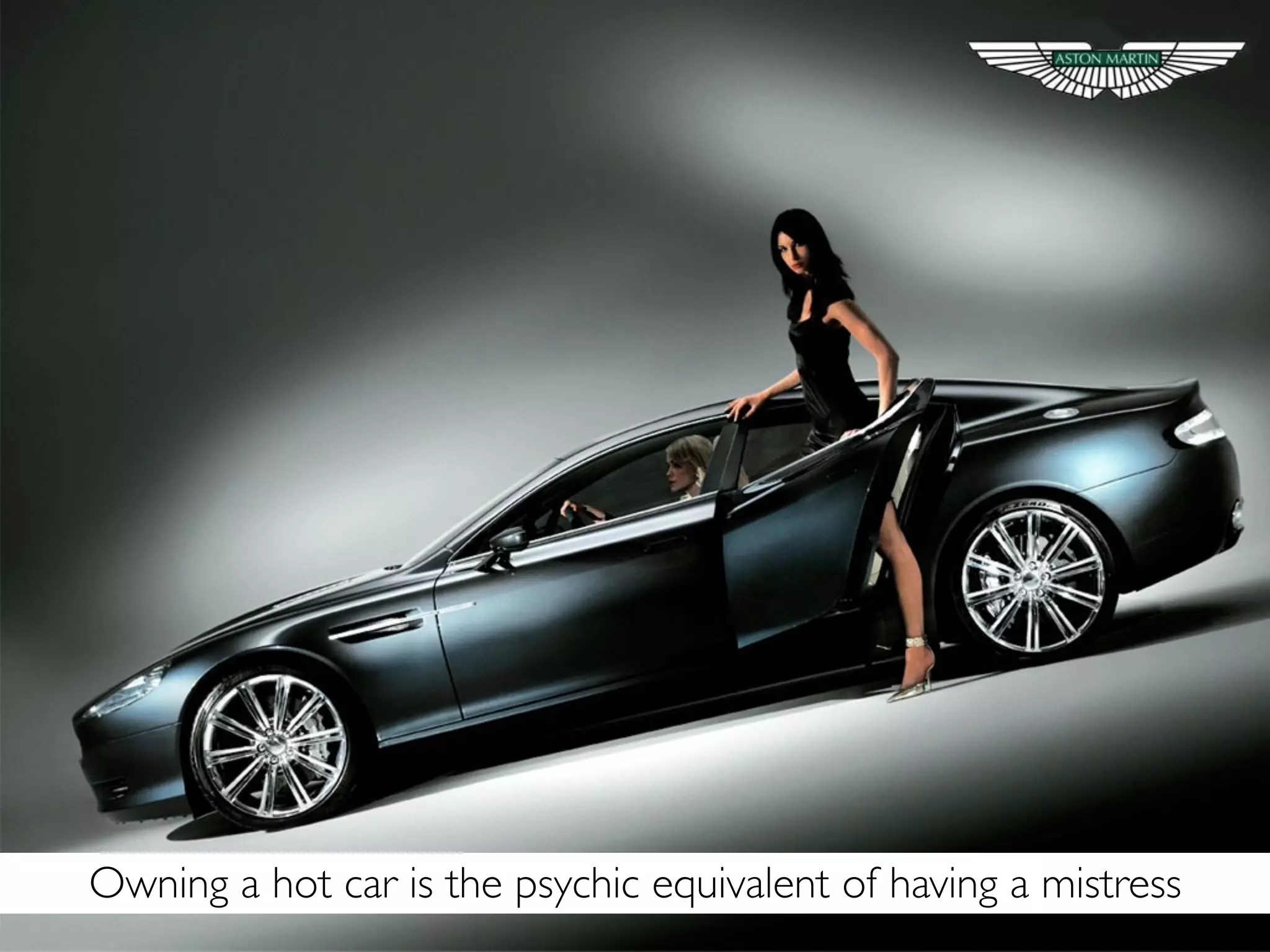
Owning a hot car is the psychic equivalent of having a mistress
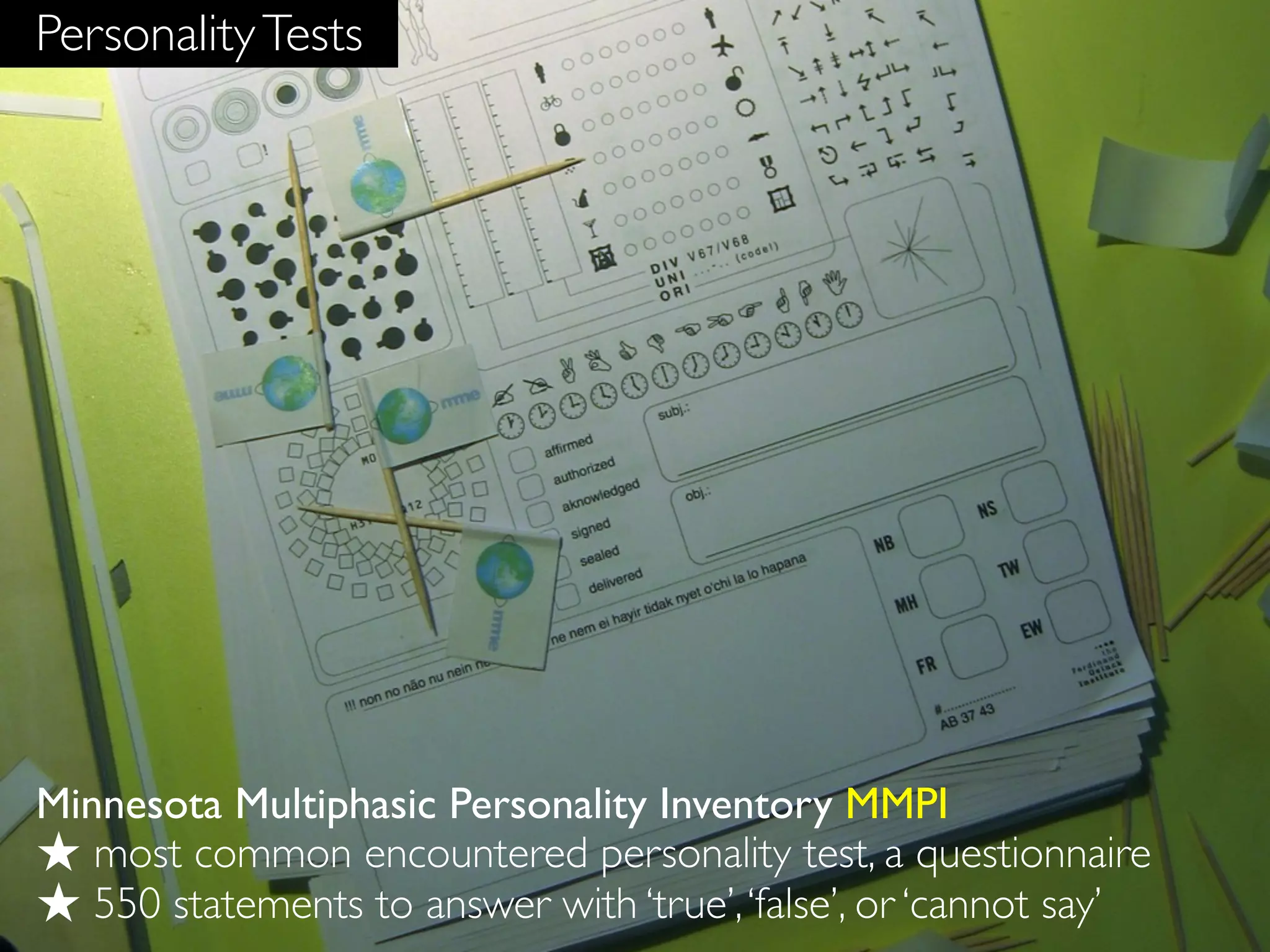
Personality Tests


Minnesota Multiphasic Personality Inventory MMPI
★ most common encountered personality test, a questionnaire
★ 550 statements to answer with ‘true’, ‘false’, or ‘cannot say’
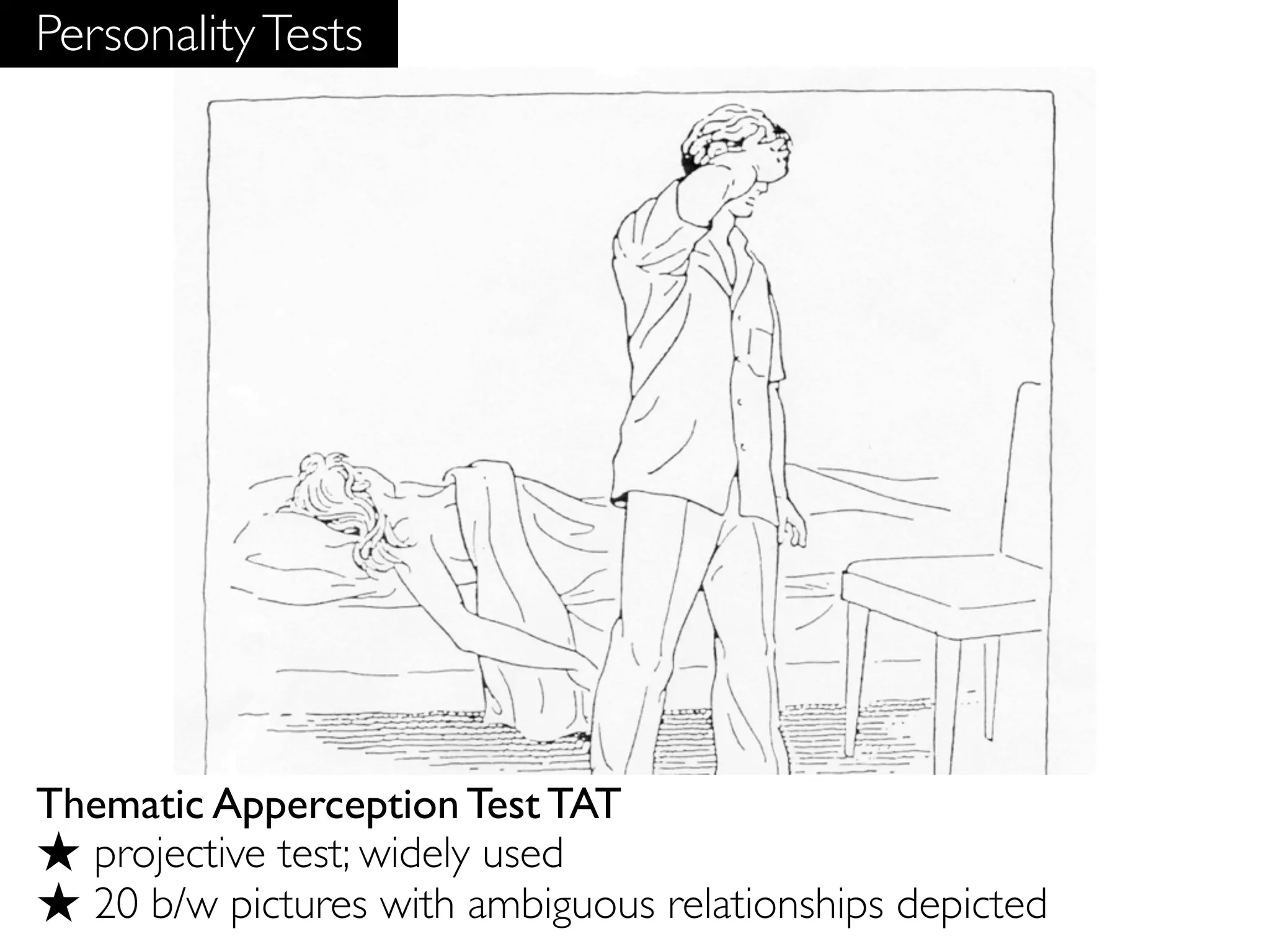
Personality Tests


Thematic Apperception Test TAT
★ projective test; widely used
★ 20 b/w pictures with ambiguous relationships depicted
Personality Tests


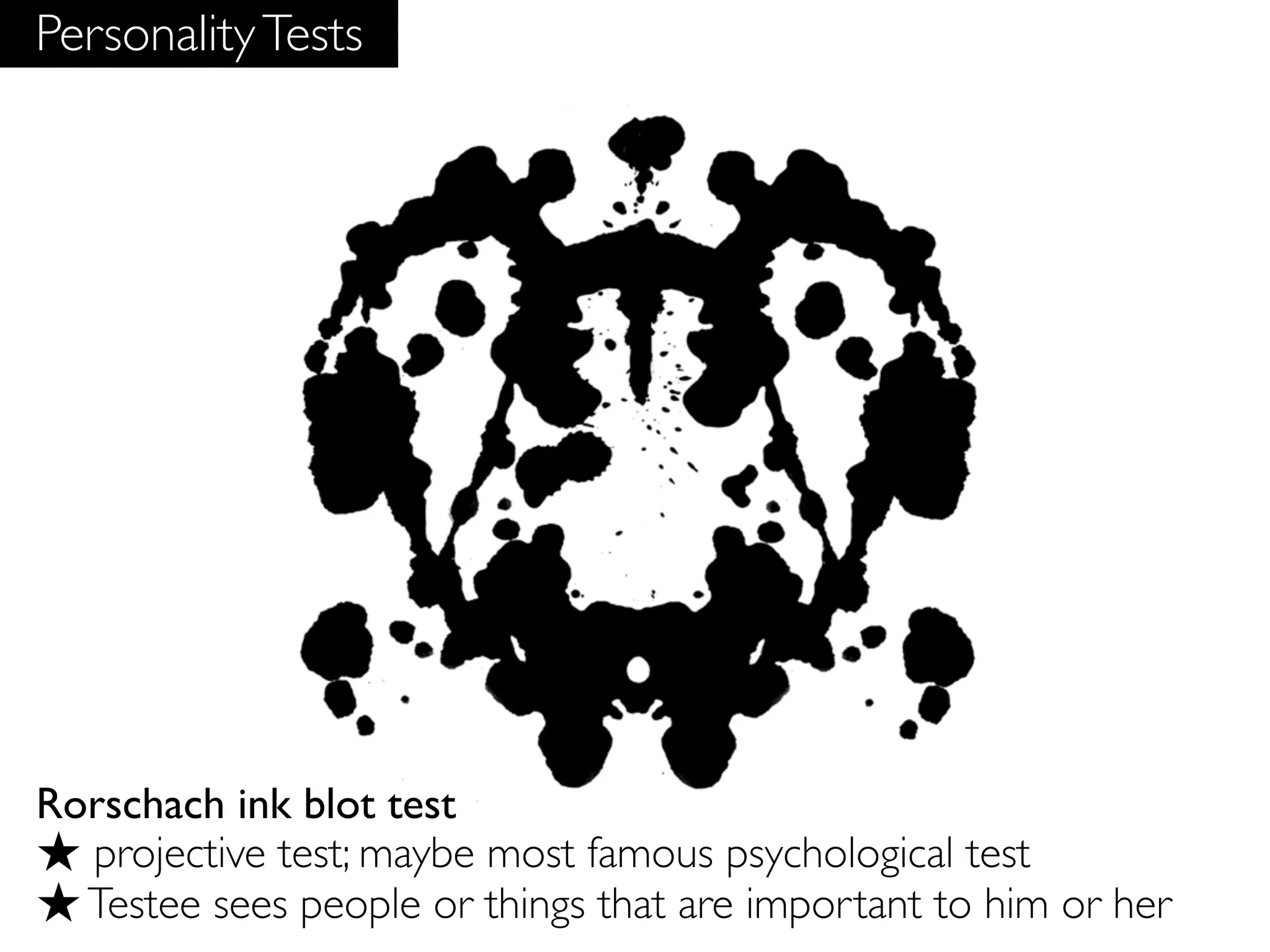
Rorschach ink blot test
★ projective test; maybe most famous psychological test
★ Testee sees people or things that are important to him or her
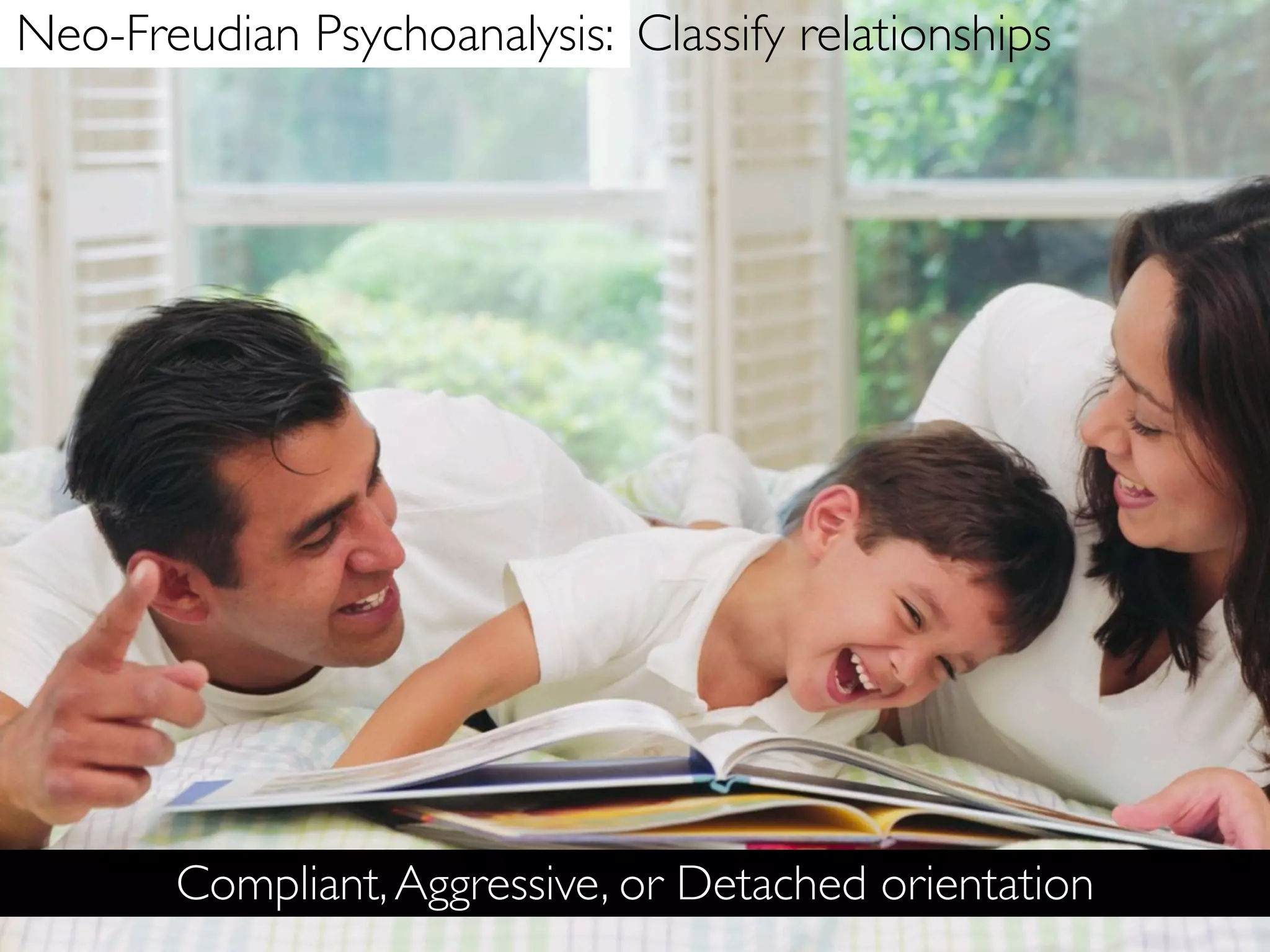
Neo-Freudian Psychoanalysis: Classify relationships


       Compliant, Aggressive, or Detached orientation
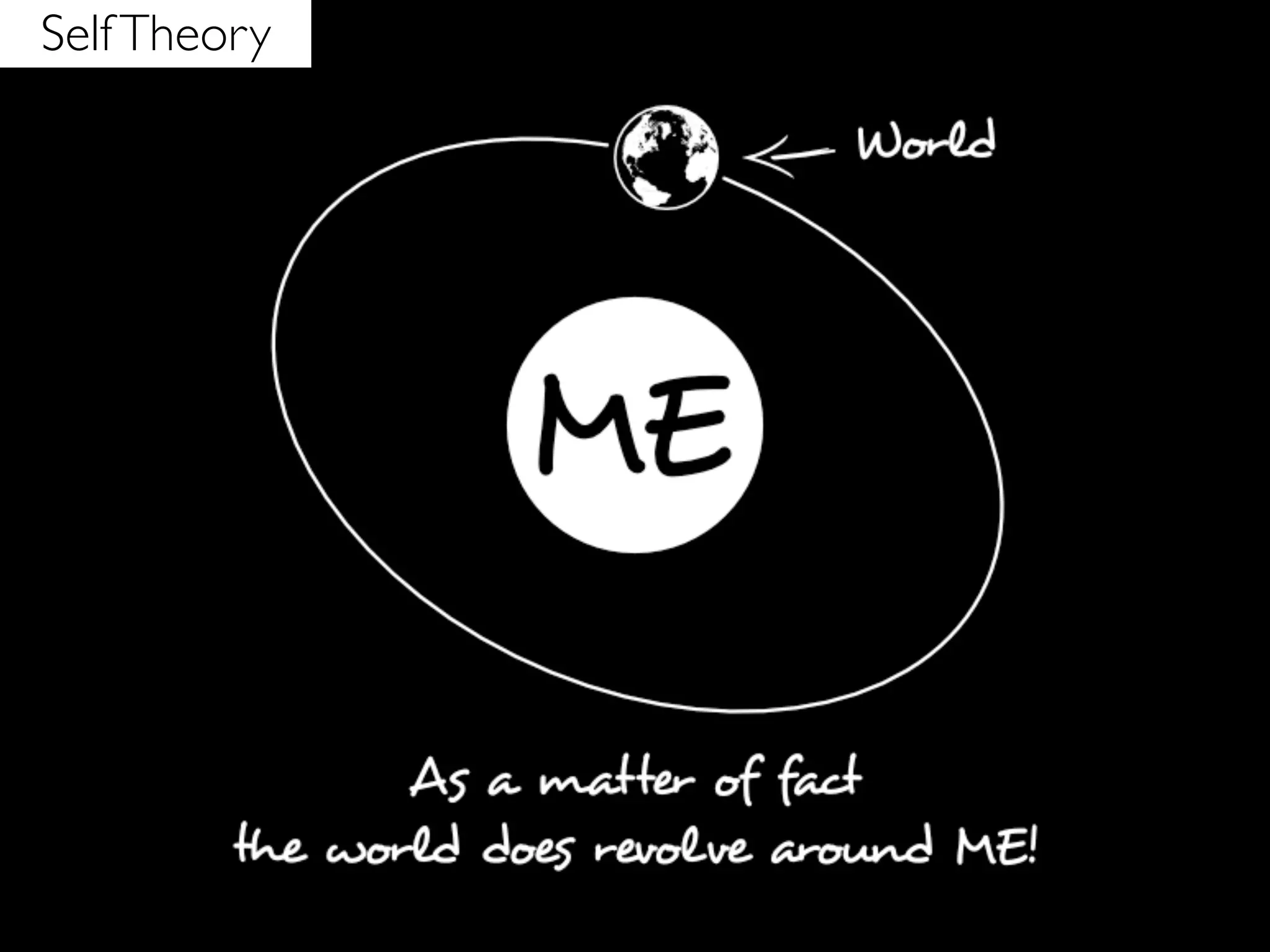
Self Theory
Marketing and the Concept of Self


 Actual self image:         trad. concept of how people see themselves

 Ideal self image:          how people would like to see themselves

 Social self image:         how people think others see them

 Ideal social self image:   how people would like others see them
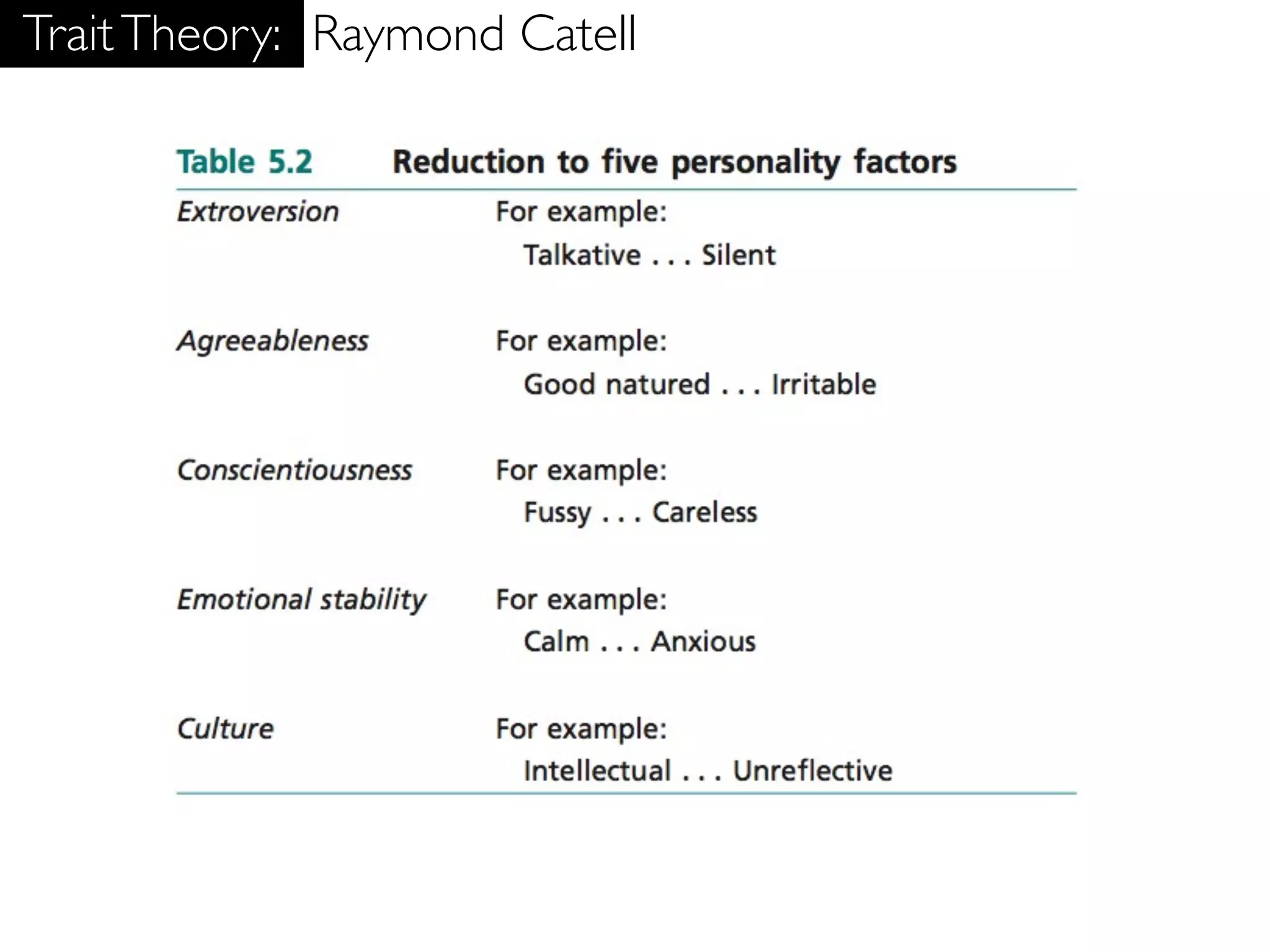
Trait Theory: Raymond Catell
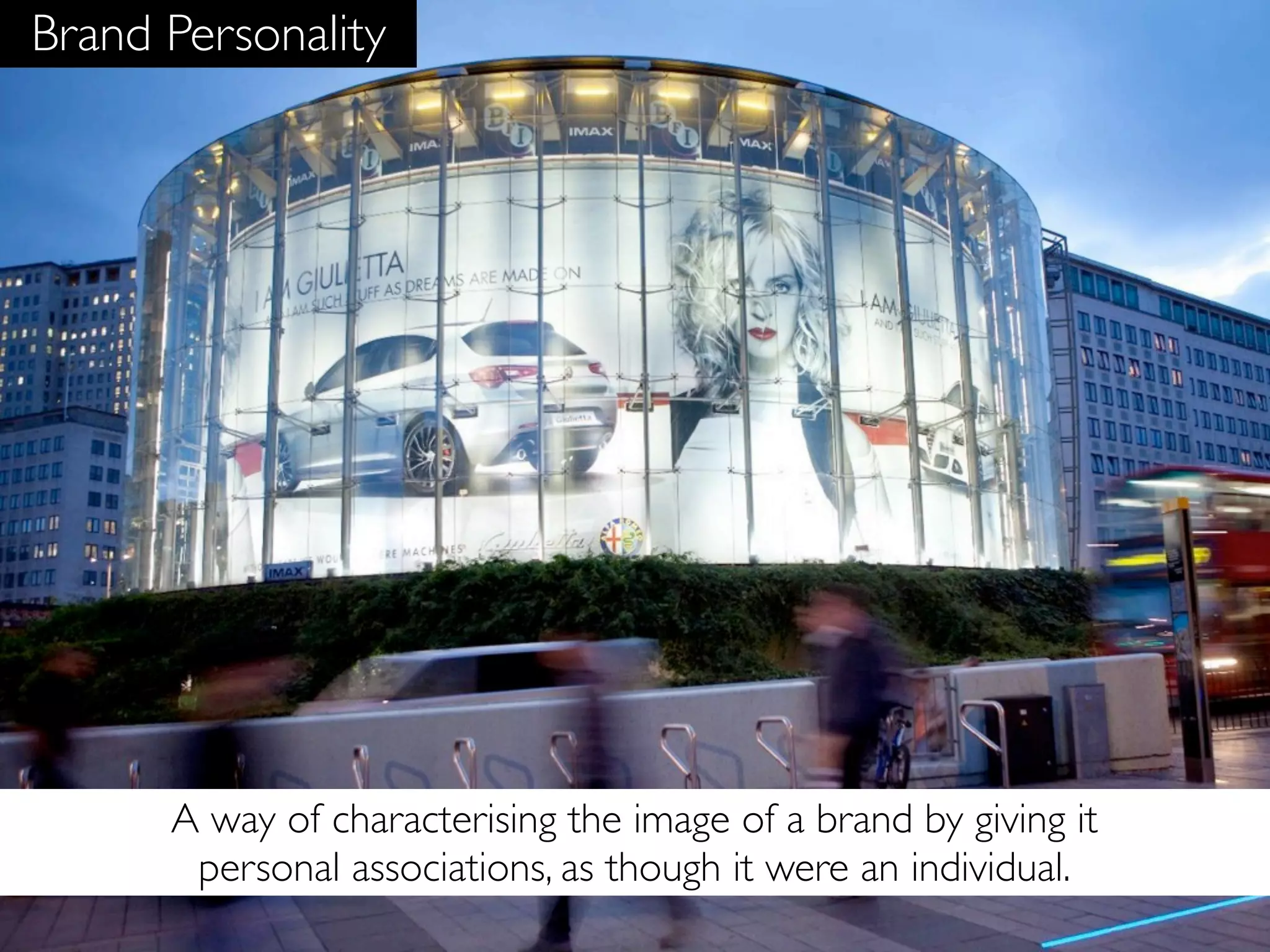
Brand Personality


      A way of characterising the image of a brand by giving it
       personal associations, as though it were an individual.
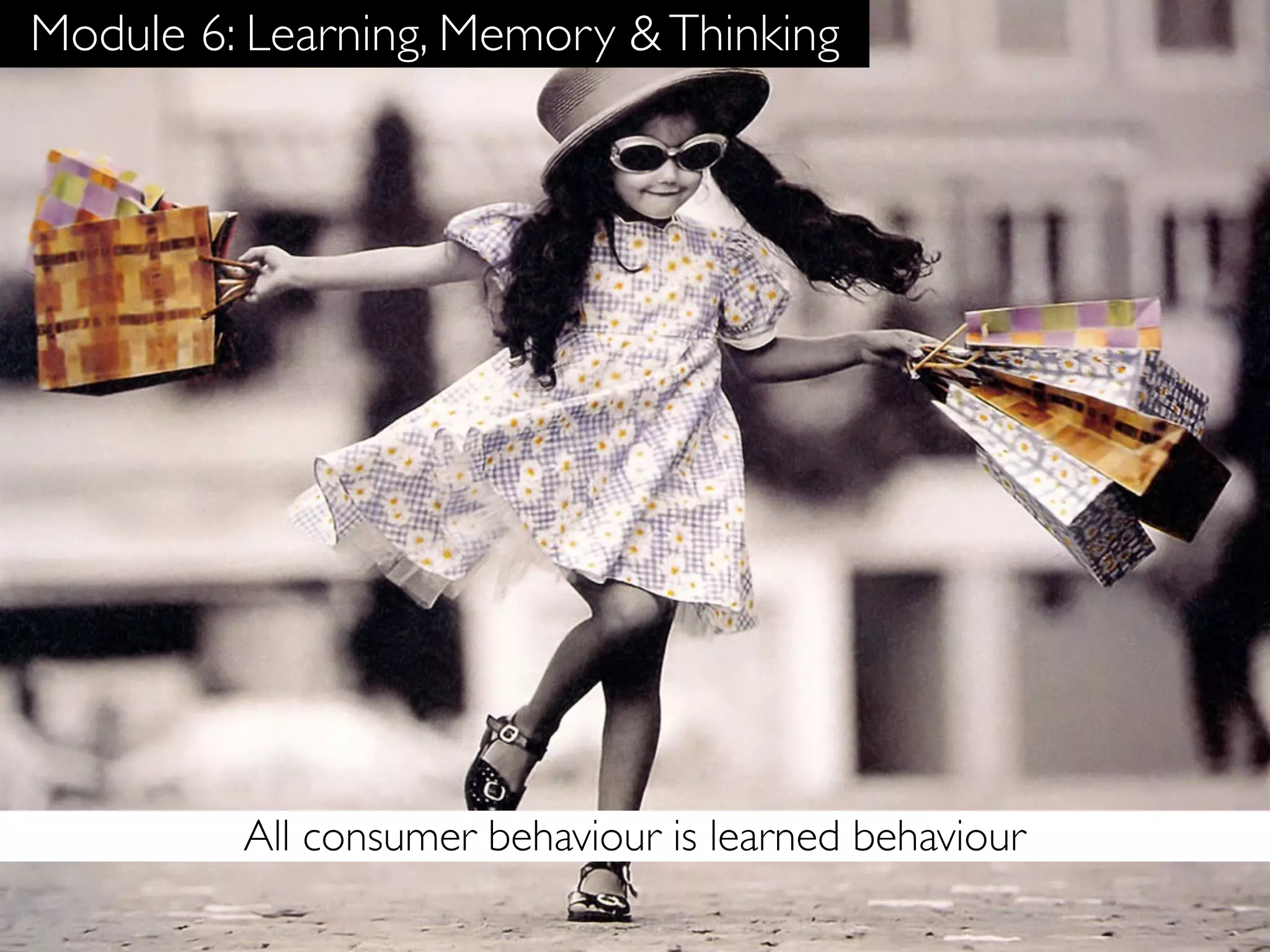
Module 6: Learning, Memory & Thinking


         All consumer behaviour is learned behaviour
Learning is...

...the relatively permanent
process by which changes
in behaviour, knowledge,
feelings or attitudes occur
as the result of prior
experience.
The Behaviourist Approach


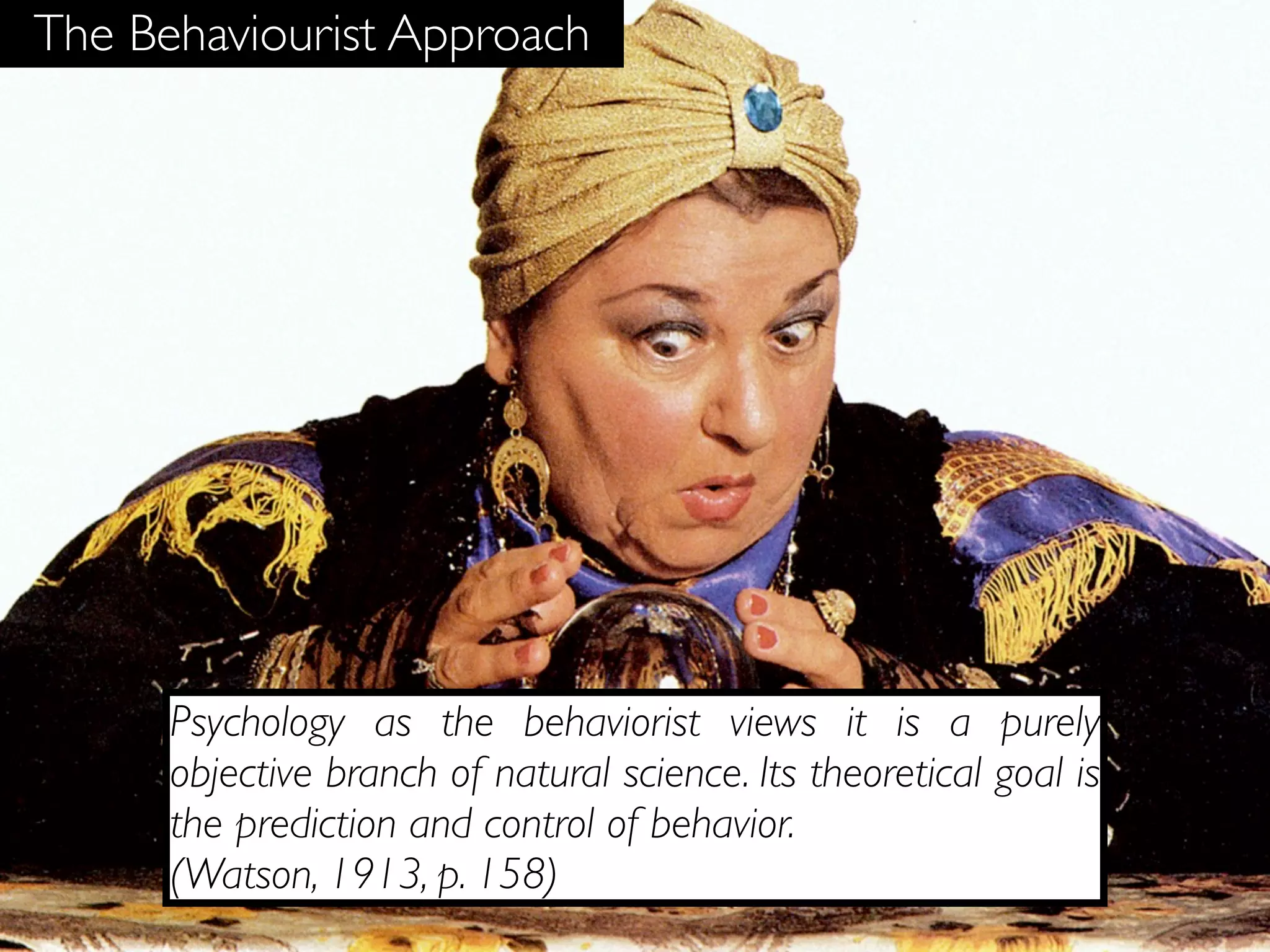
      Psychology as the behaviorist views it is a purely
      objective branch of natural science. Its theoretical goal is
      the prediction and control of behavior.
      (Watson, 1913, p. 158)
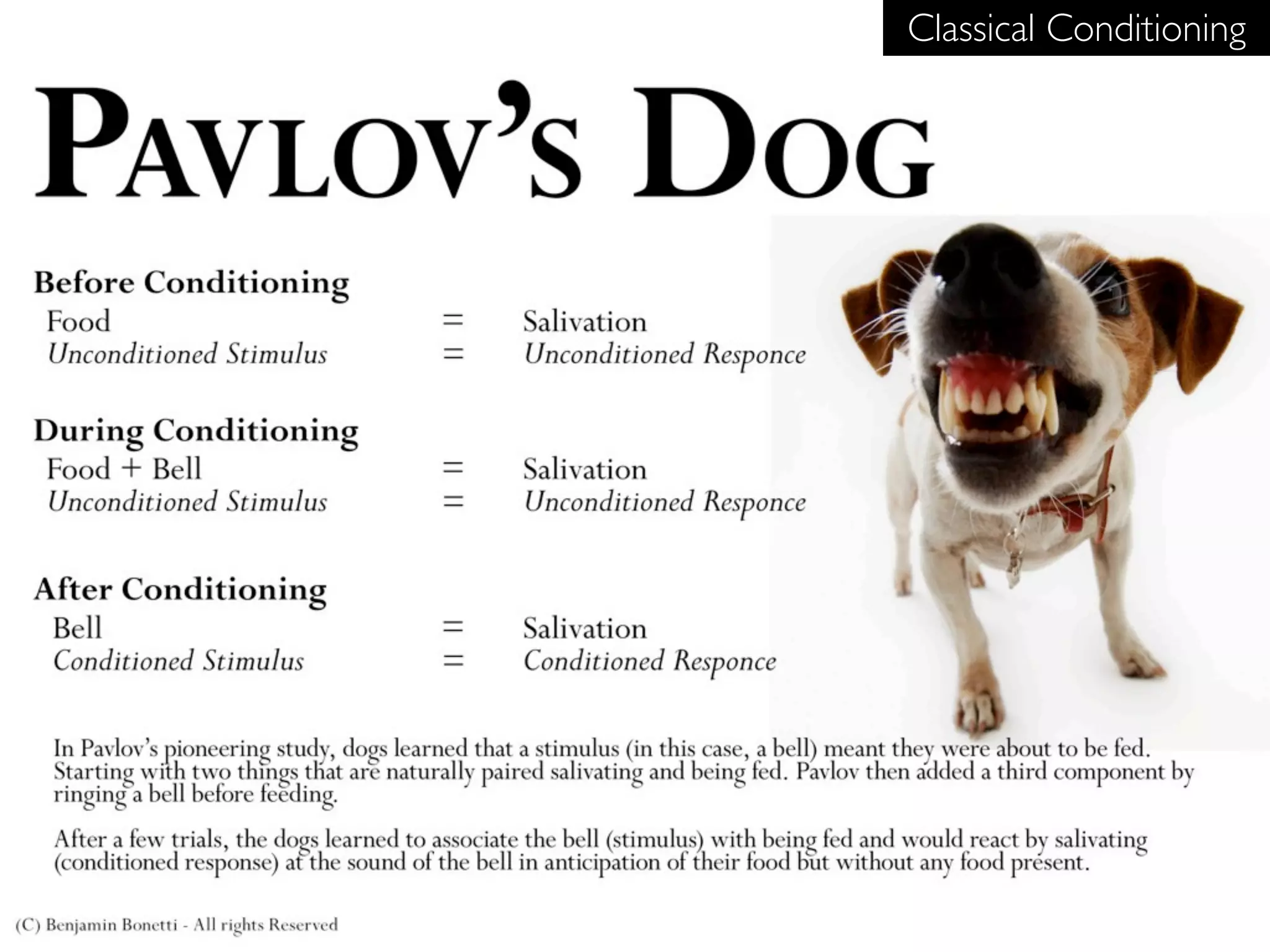
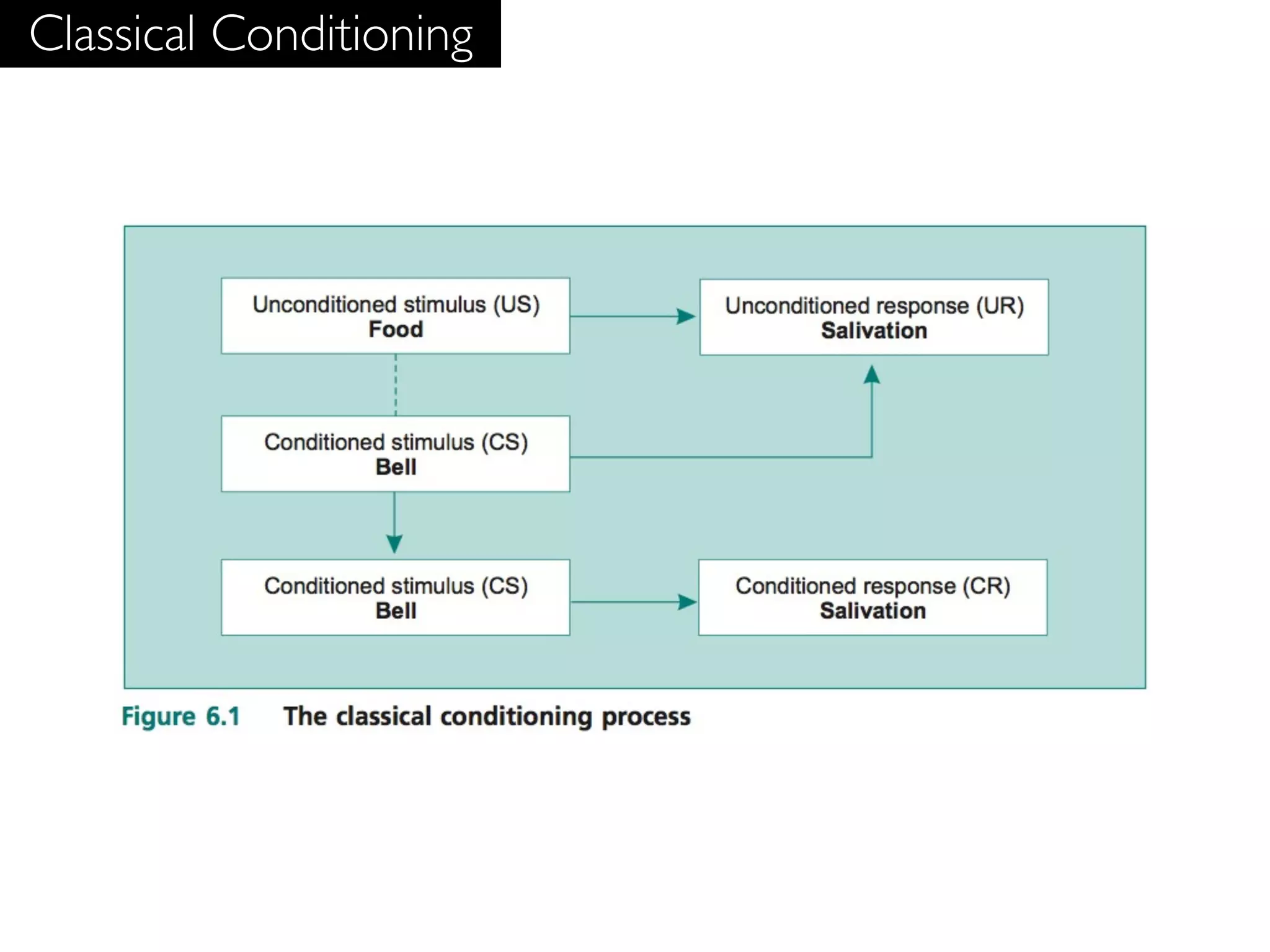
Classical Conditioning
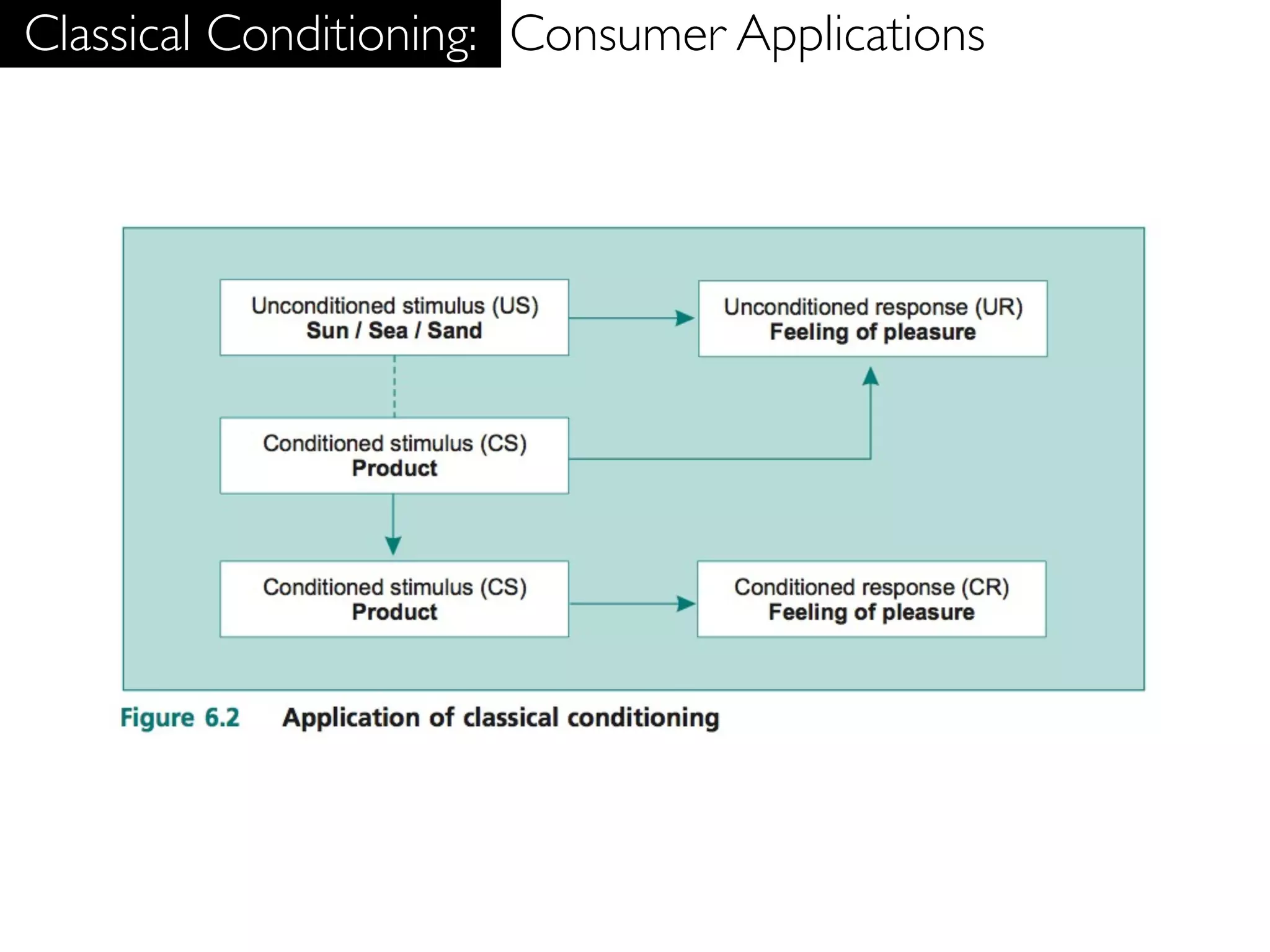
Classical Conditioning: Consumer Applications
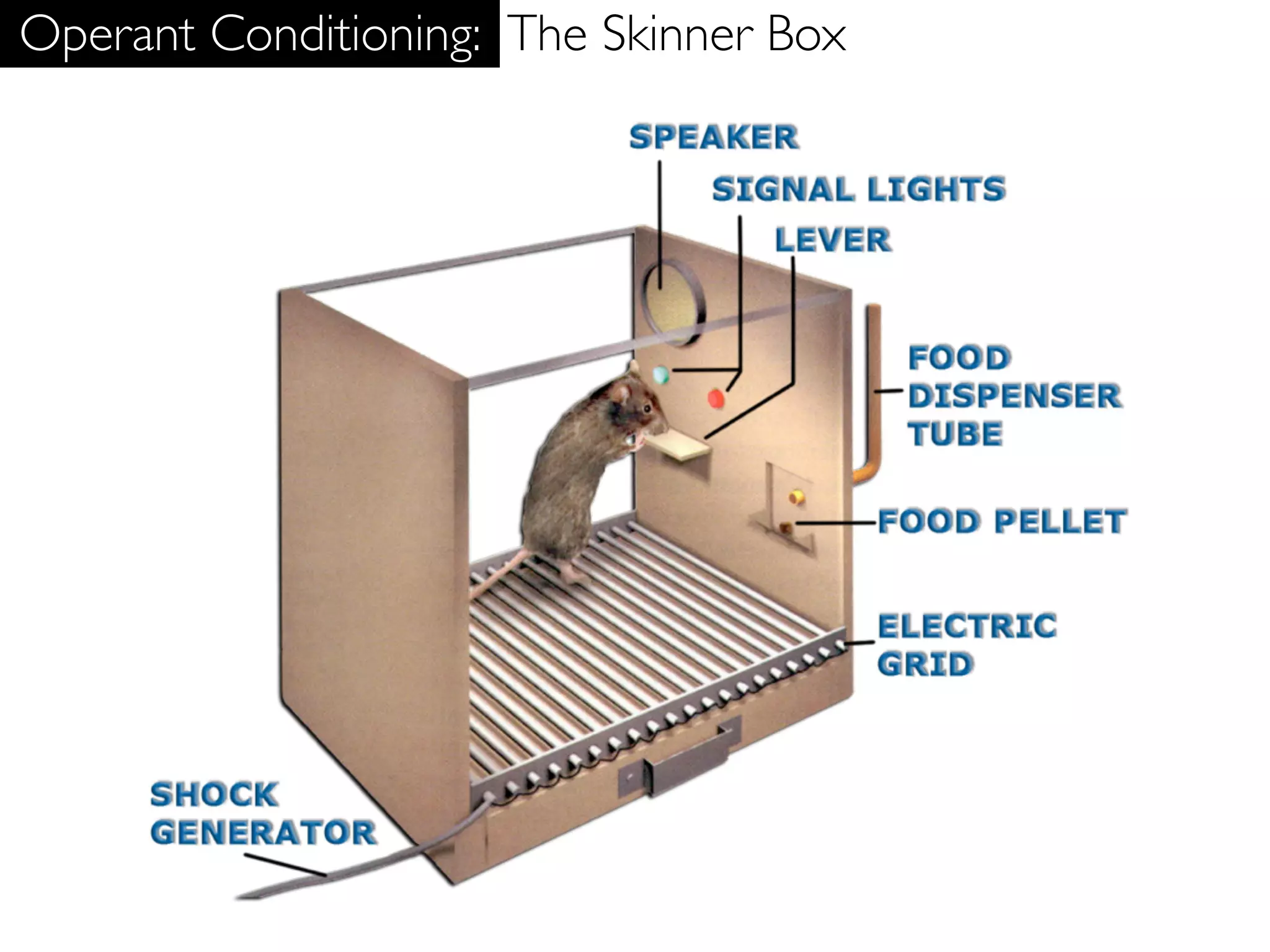
Operant Conditioning: The Skinner Box
Operant Conditioning: Consumer Applications

    Your supermarket has a new
    brand of yoghurt on offer and
   you decide to try it, your future
    purchases of the product will
      depend on whether your
       response is reinforced or
      rewarded by your liking it.
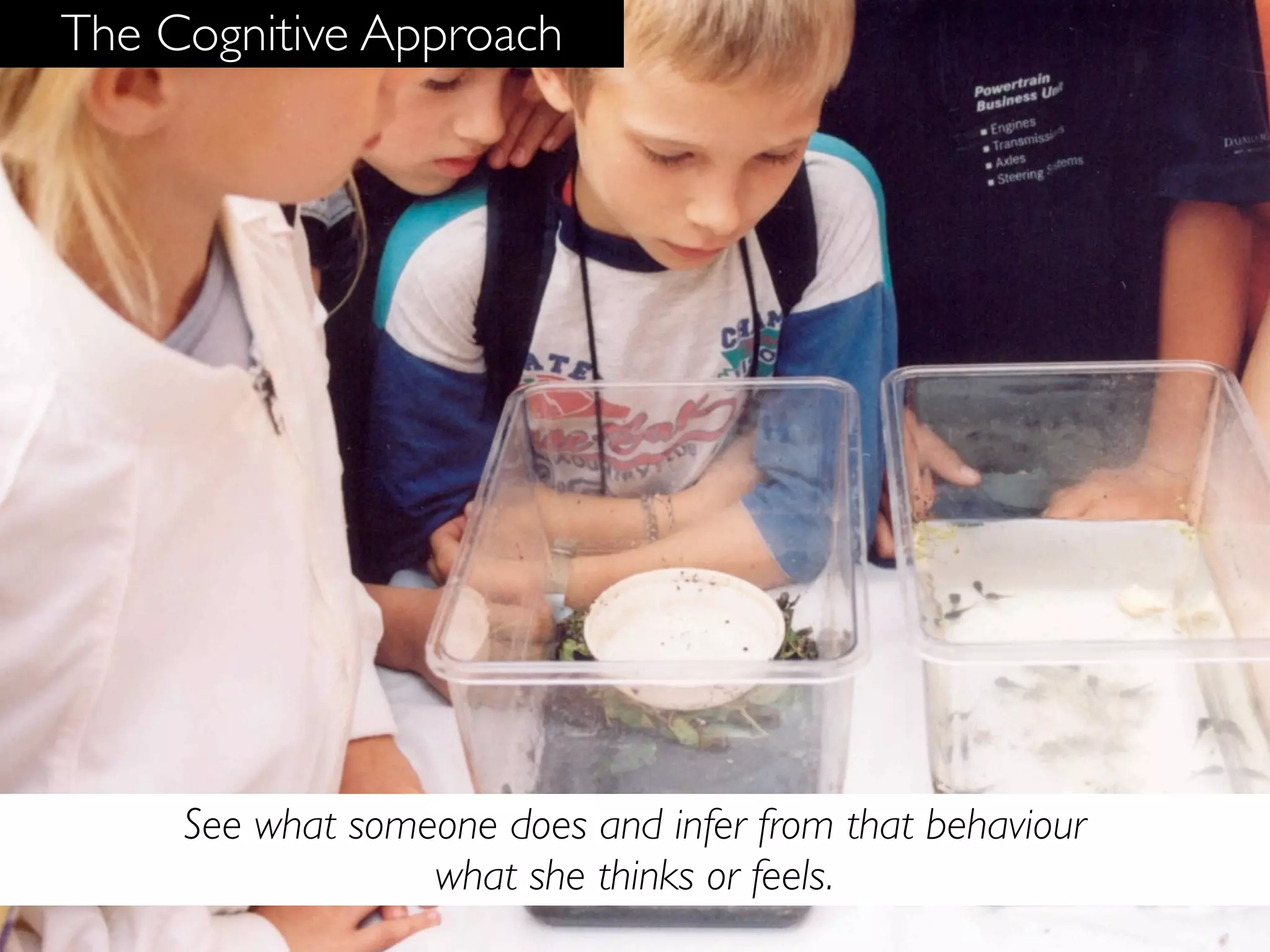
The Cognitive Approach


     See what someone does and infer from that behaviour
                  what she thinks or feels.
The Cognitive Approach


                         reaction
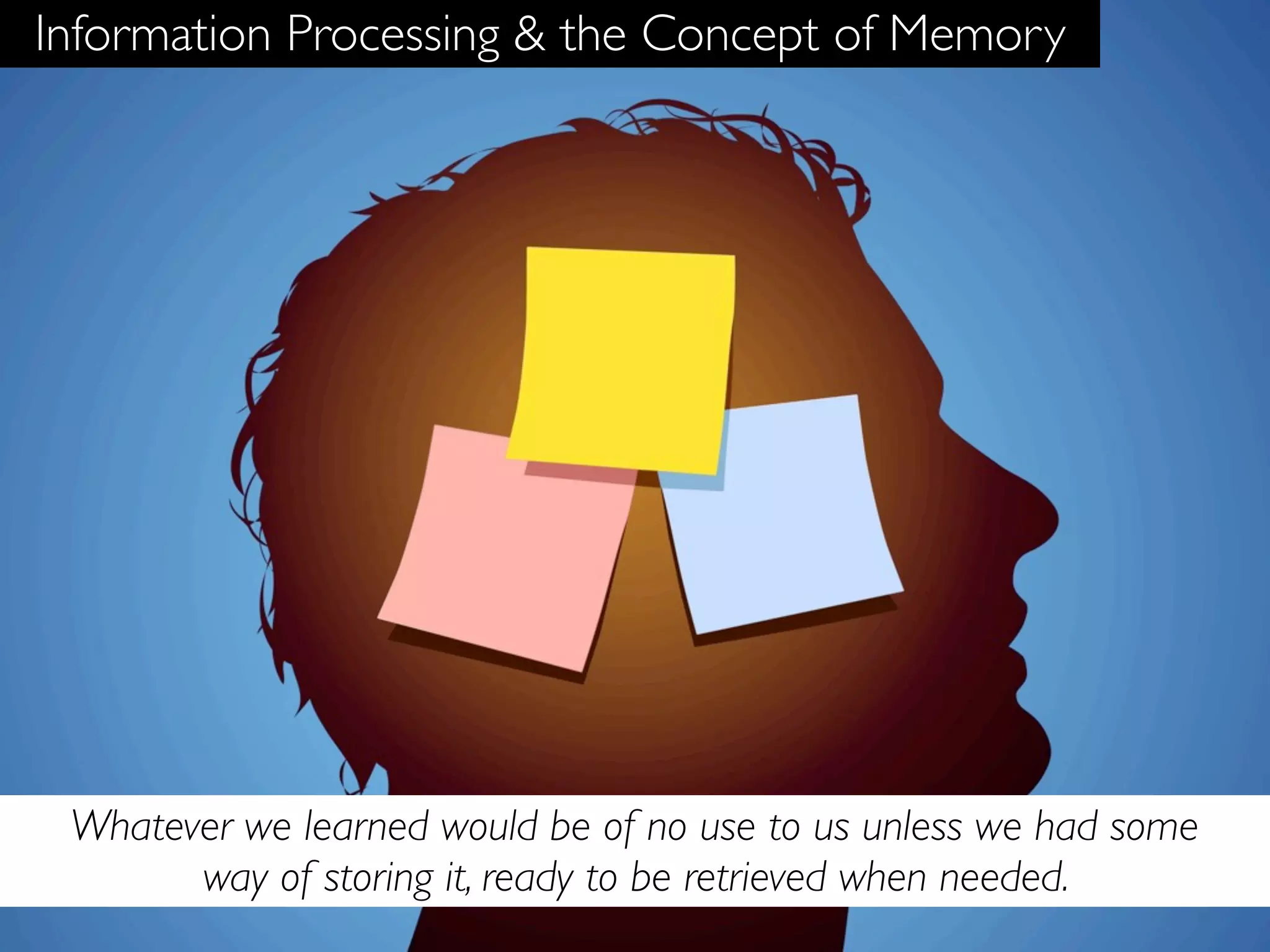
Information Processing & the Concept of Memory


 Whatever we learned would be of no use to us unless we had some
       way of storing it, ready to be retrieved when needed.
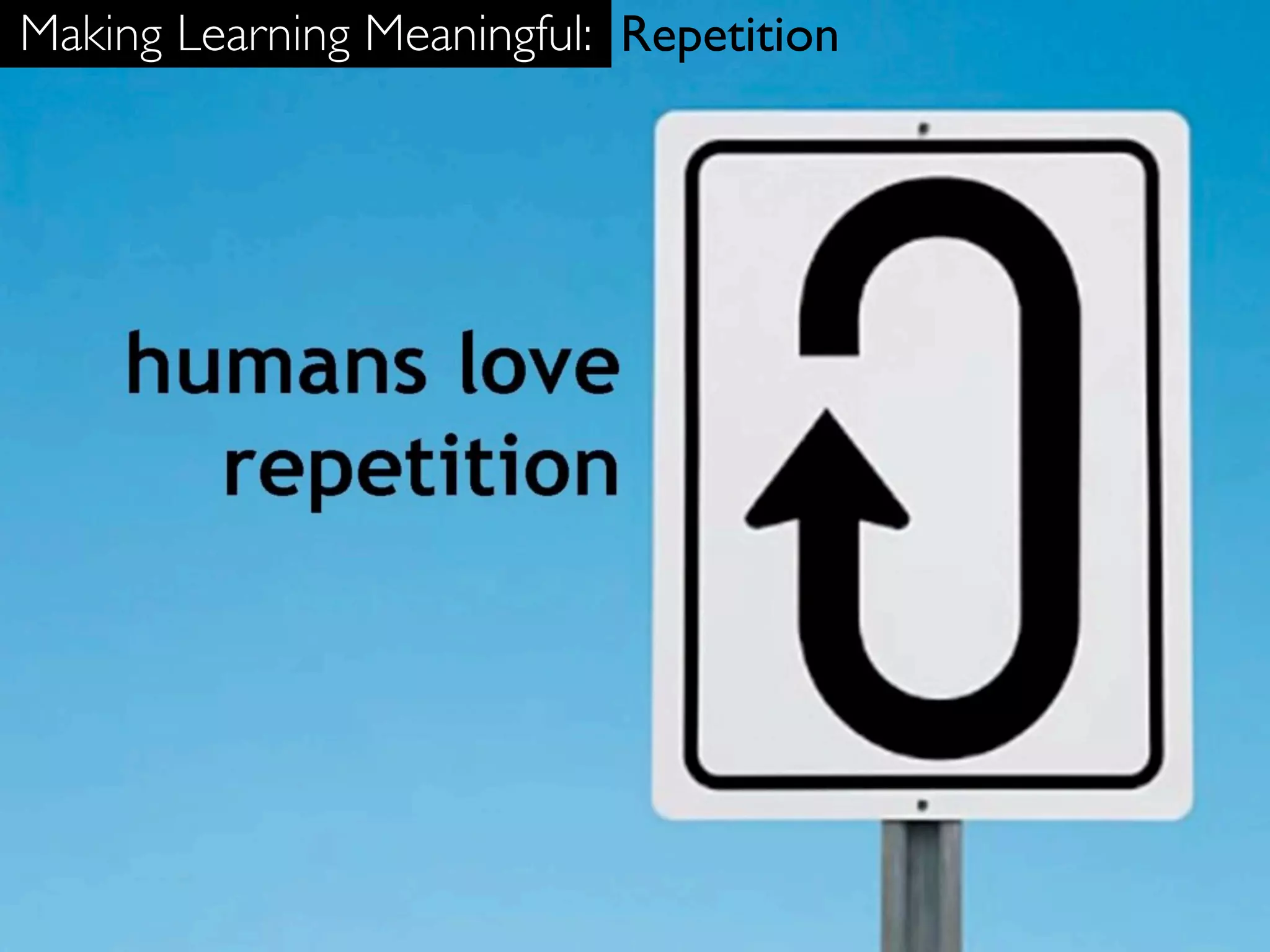
Making Learning Meaningful: Repetition
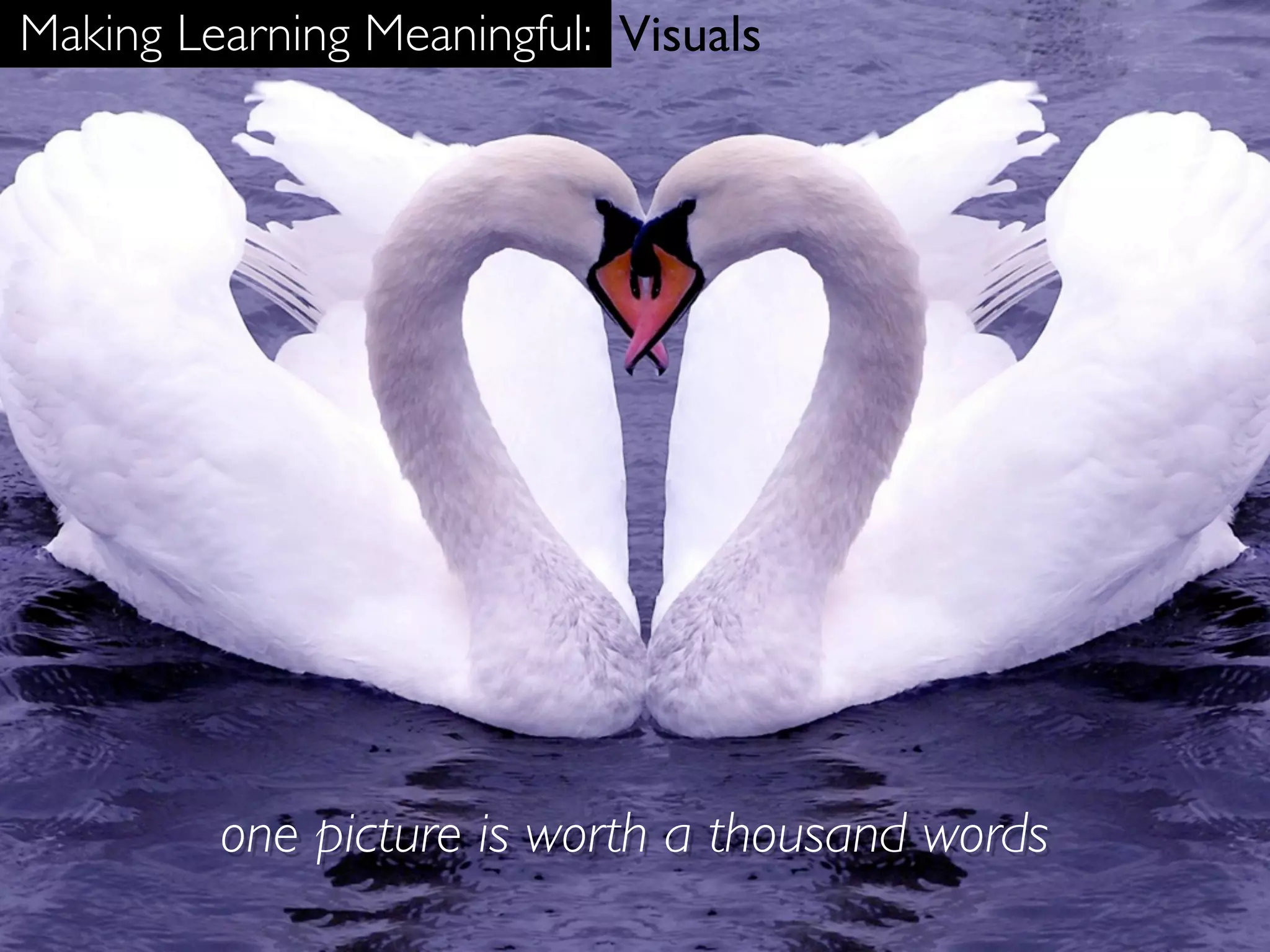
Making Learning Meaningful: Visuals


         one picture is worth a thousand words
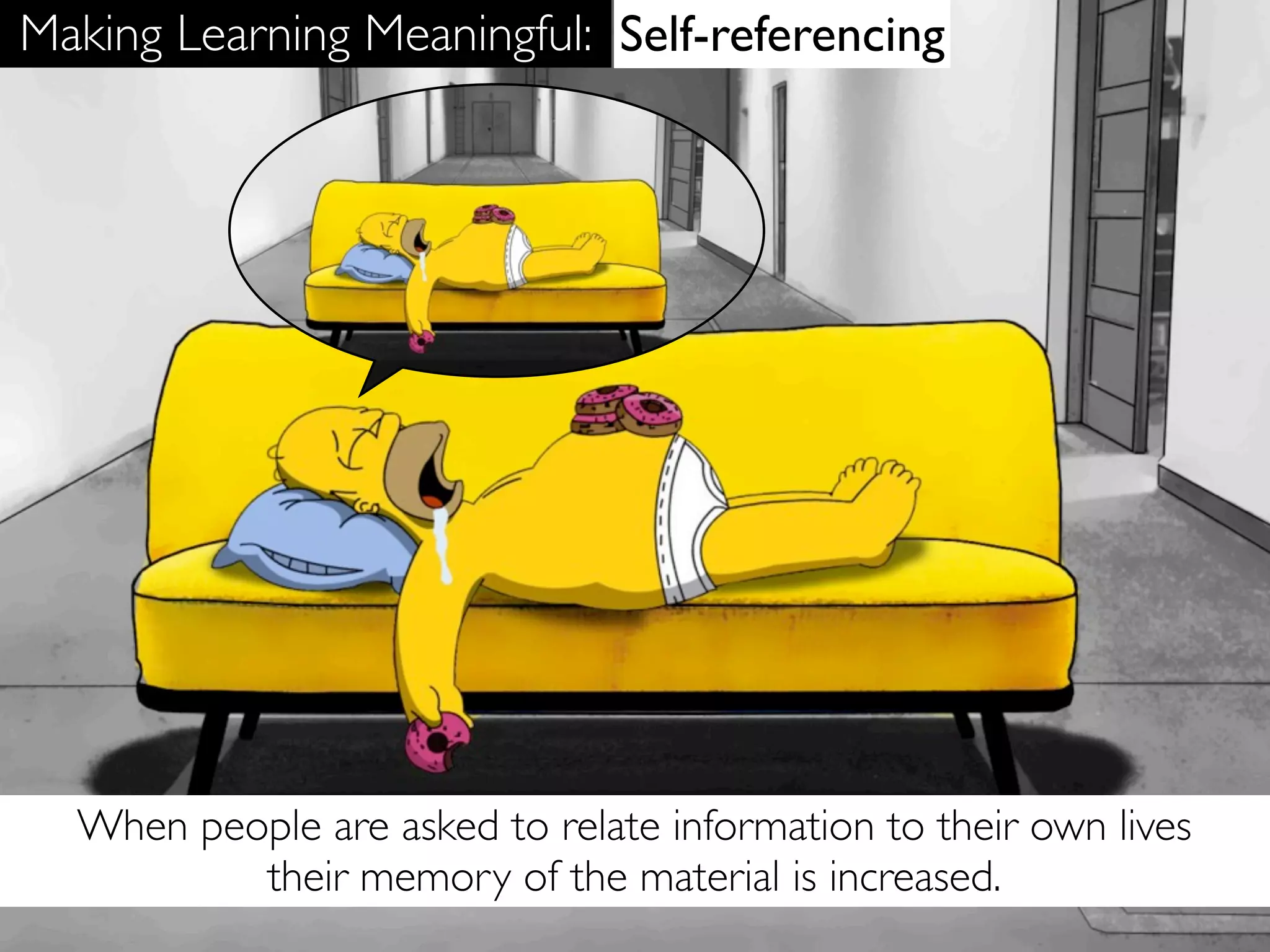
Making Learning Meaningful: Self-referencing


  When people are asked to relate information to their own lives
          their memory of the material is increased.
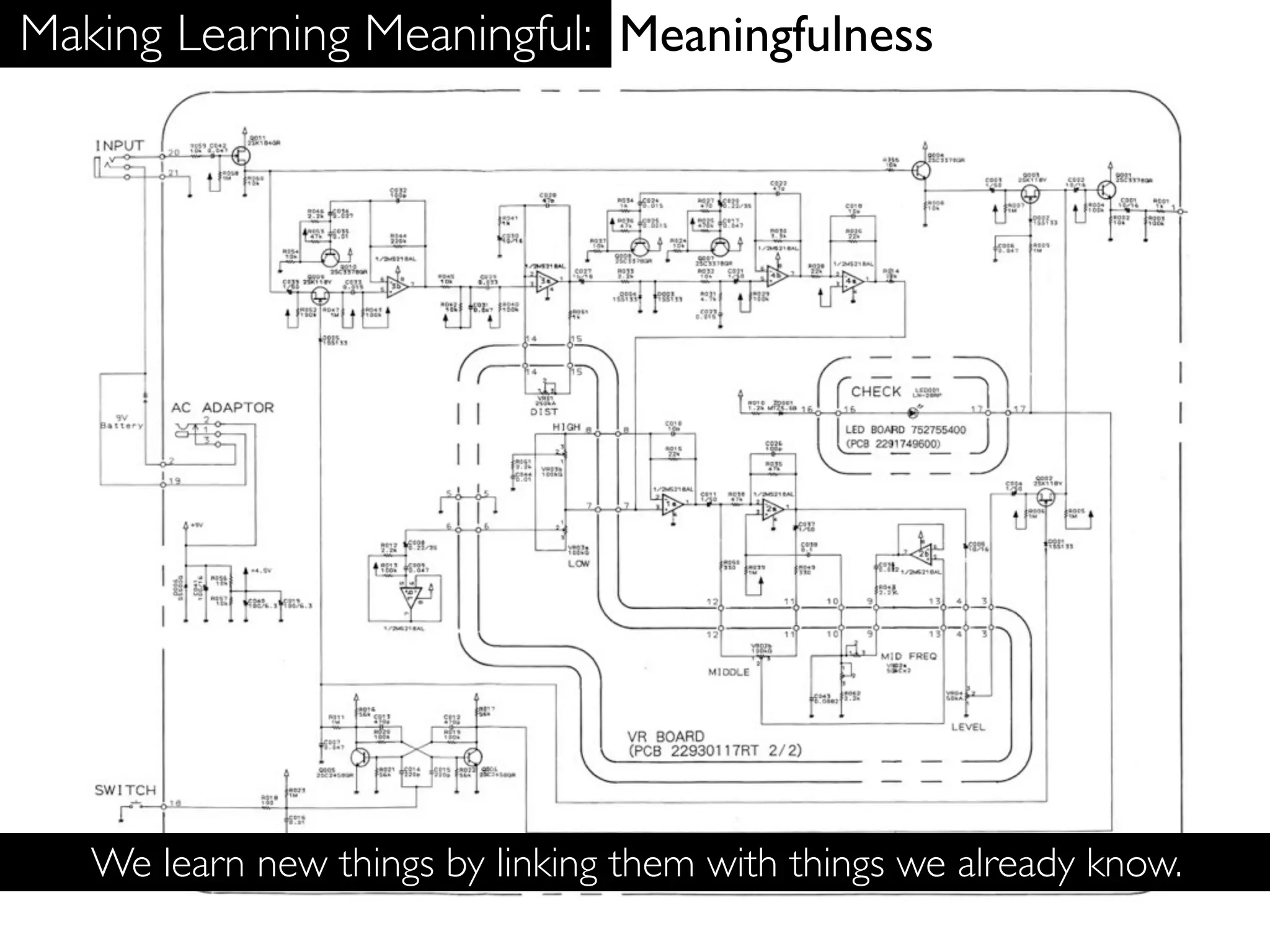
Making Learning Meaningful: Meaningfulness


   We learn new things by linking them with things we already know.
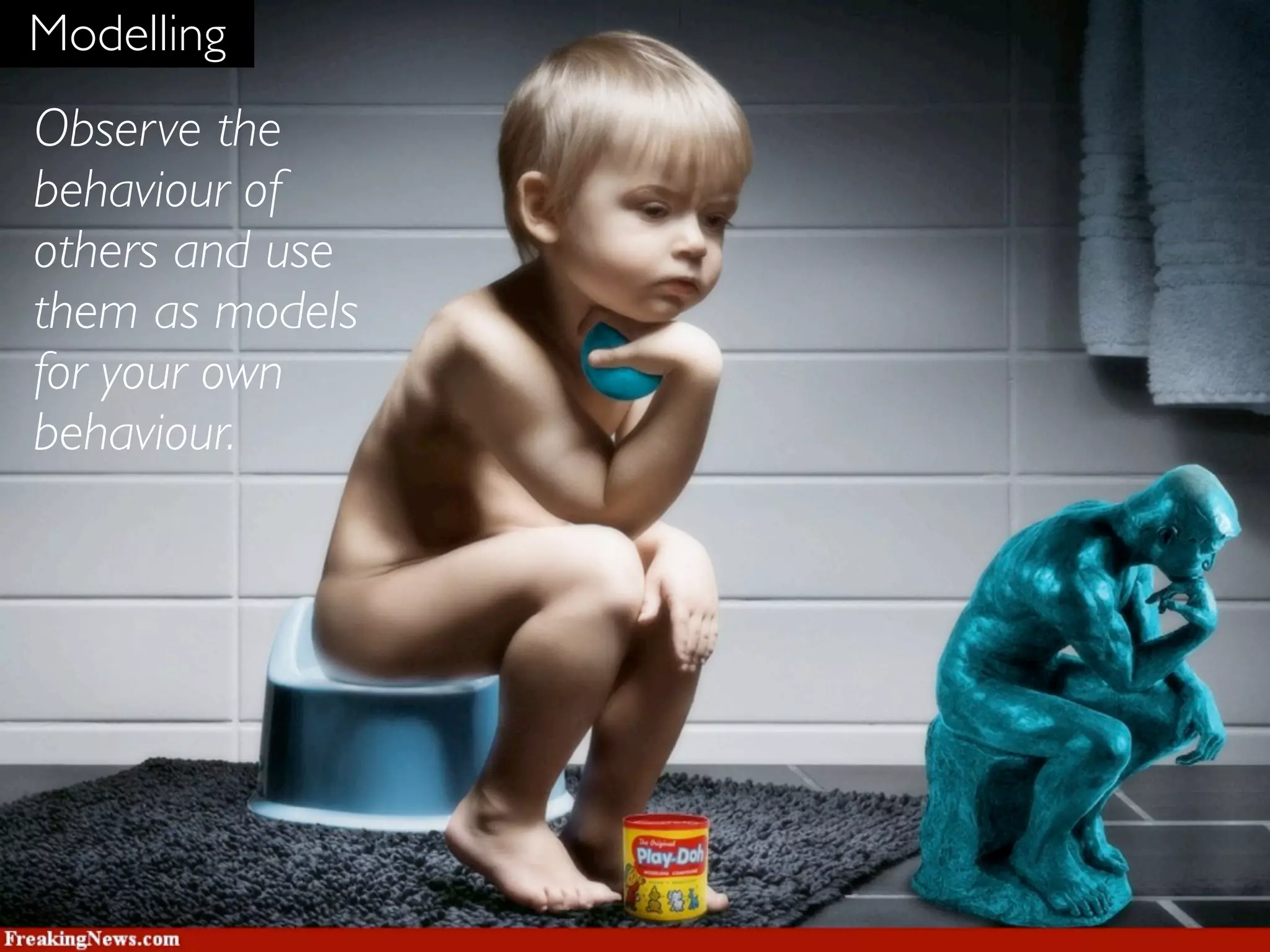
Modelling
Observe the
behaviour of
others and use
them as models
for your own
behaviour.
Module 7: Motivation


   ‘Why’
           do people buy what they buy?
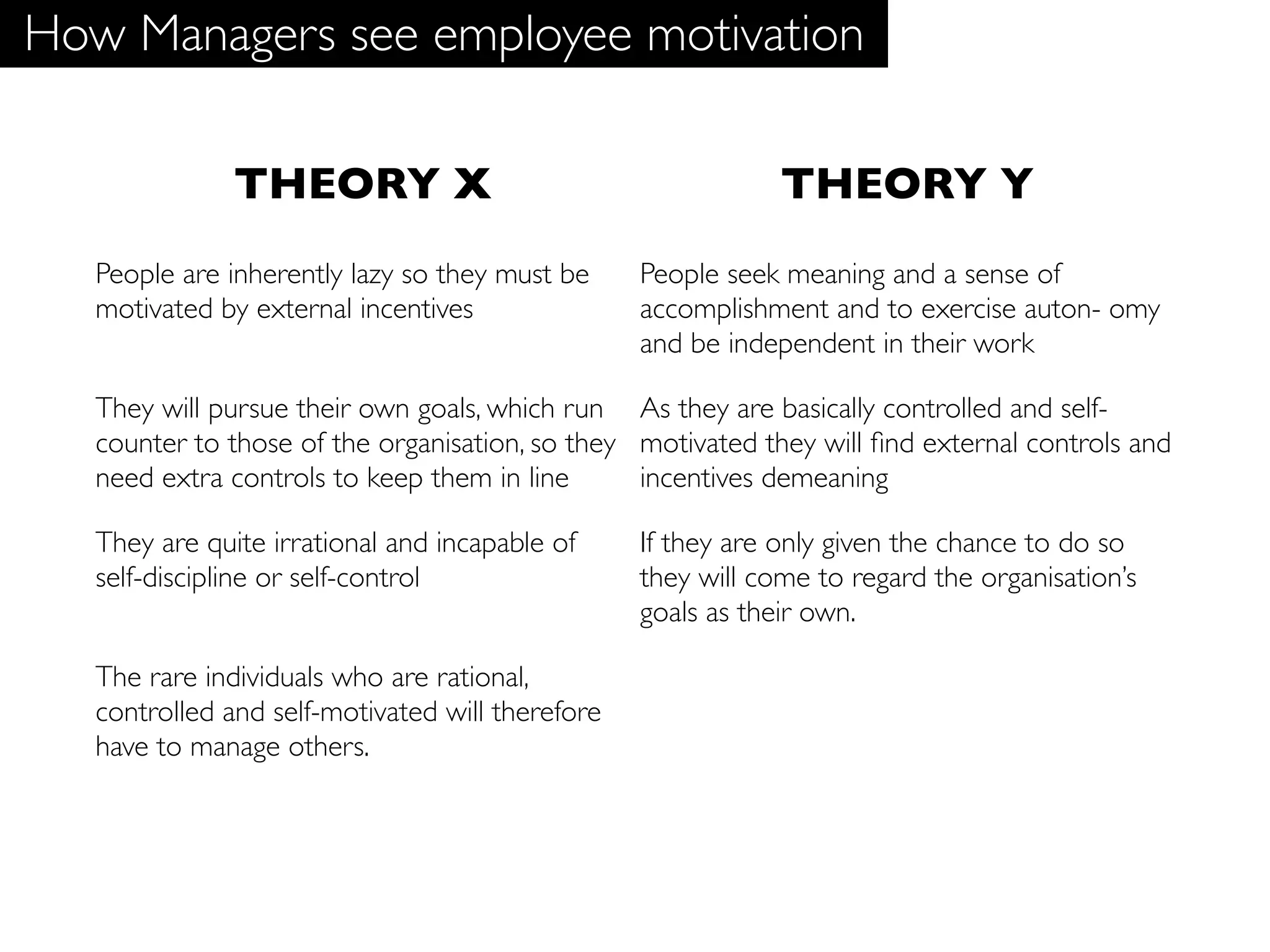
How Managers see employee motivation

               THEORY X                                       THEORY Y
   People are inherently lazy so they must be     People seek meaning and a sense of
   motivated by external incentives               accomplishment and to exercise auton- omy
                                                  and be independent in their work

   They will pursue their own goals, which run As they are basically controlled and self-
   counter to those of the organisation, so they motivated they will find external controls and
   need extra controls to keep them in line      incentives demeaning

   They are quite irrational and incapable of     If they are only given the chance to do so
   self-discipline or self-control                they will come to regard the organisation’s
                                                  goals as their own.

   The rare individuals who are rational,
   controlled and self-motivated will therefore
   have to manage others.
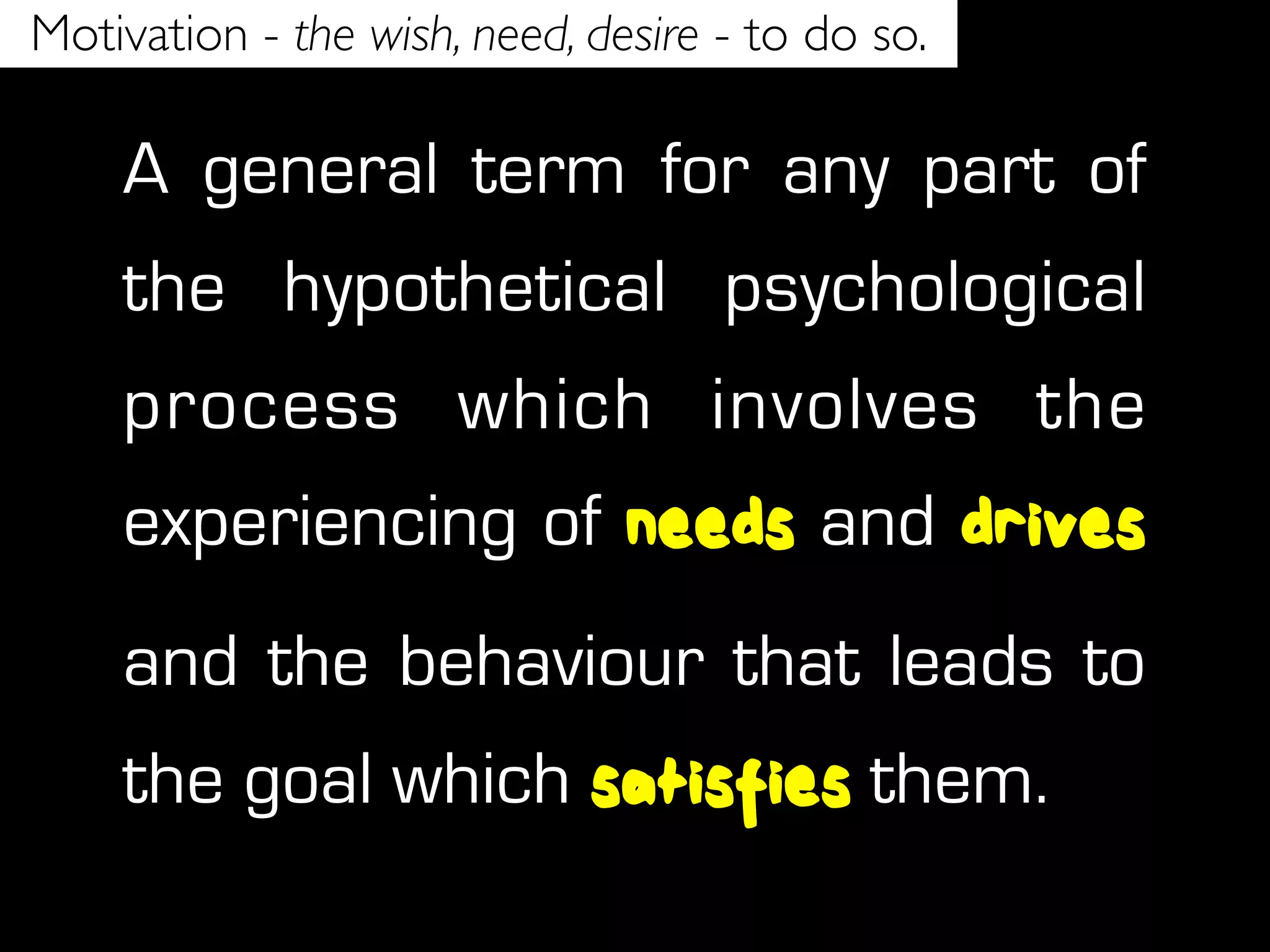
Motivation - the wish, need, desire - to do so.

    A general term for any part of
    the hypothetical psychological
    process which involves the
    experiencing of needs and drives
    and the behaviour that leads to
    the goal which satisfies them.
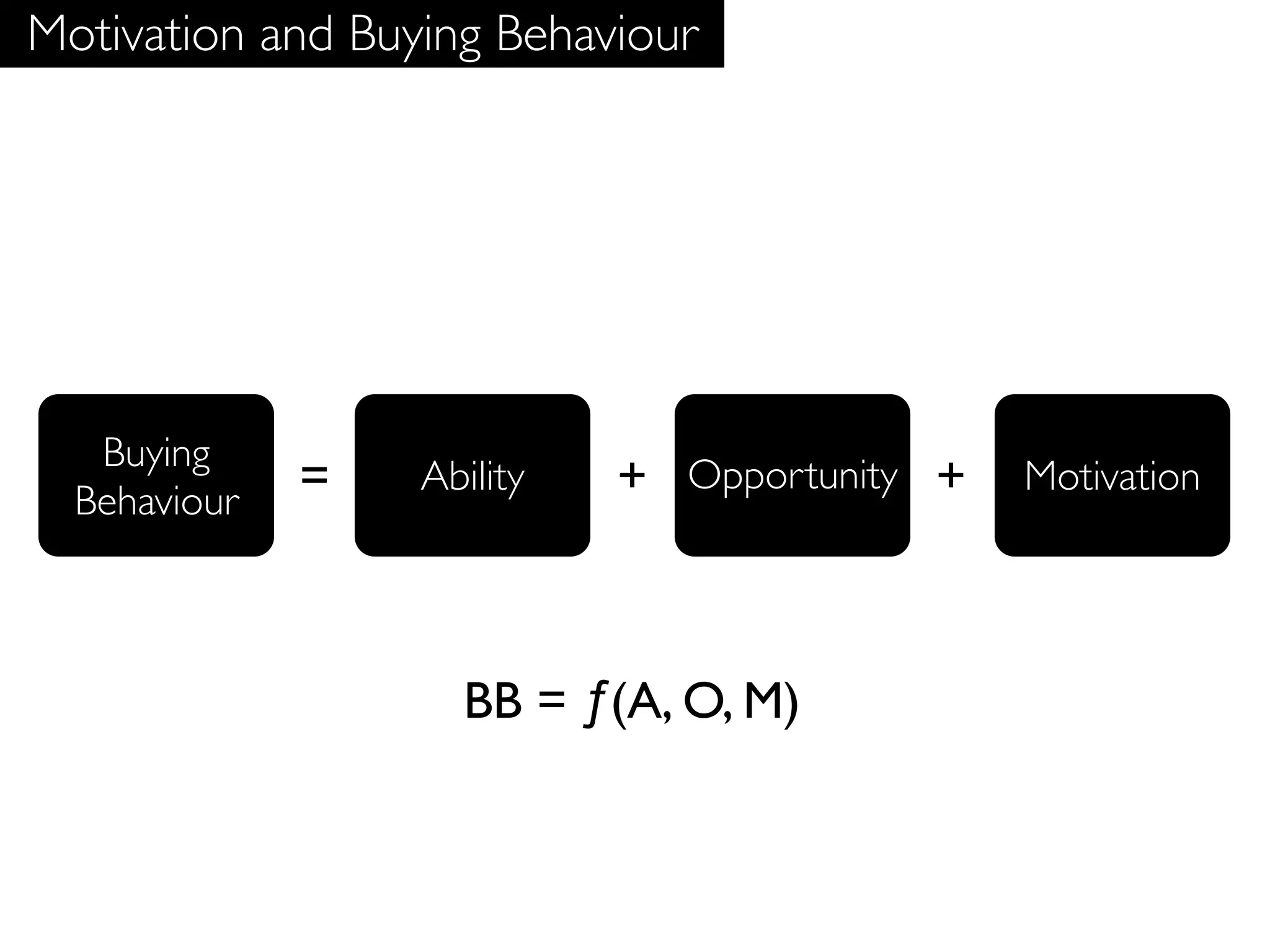
Motivation and Buying Behaviour


   Buying
  Behaviour   =   Ability   + Opportunity +   Motivation


                    BB = ƒ(A, O, M)
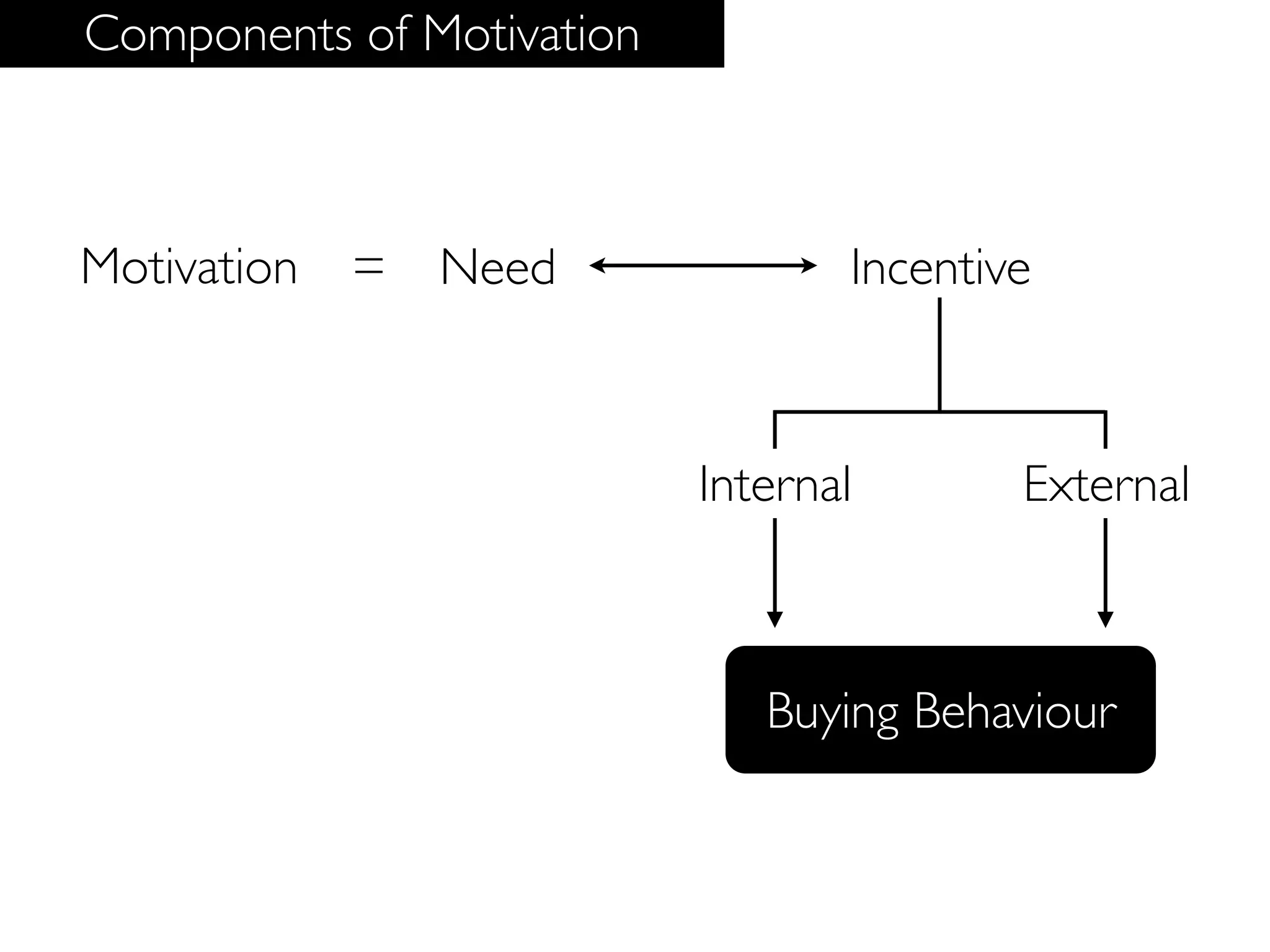
Components of Motivation


Motivation   =   Need             Incentive


                           Internal       External


                              Buying Behaviour
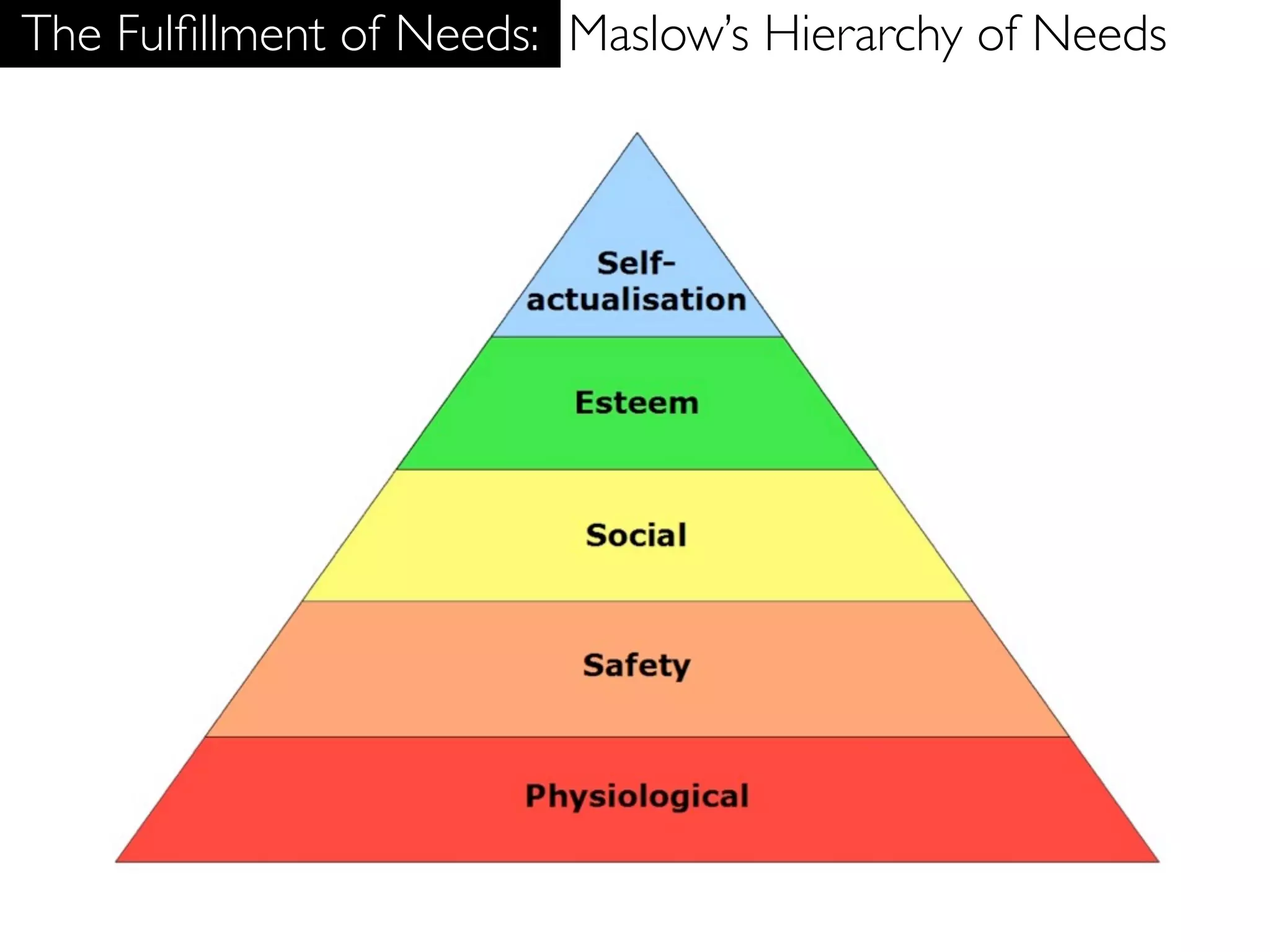
The Fulfillment of Needs: Maslow’s Hierarchy of Needs
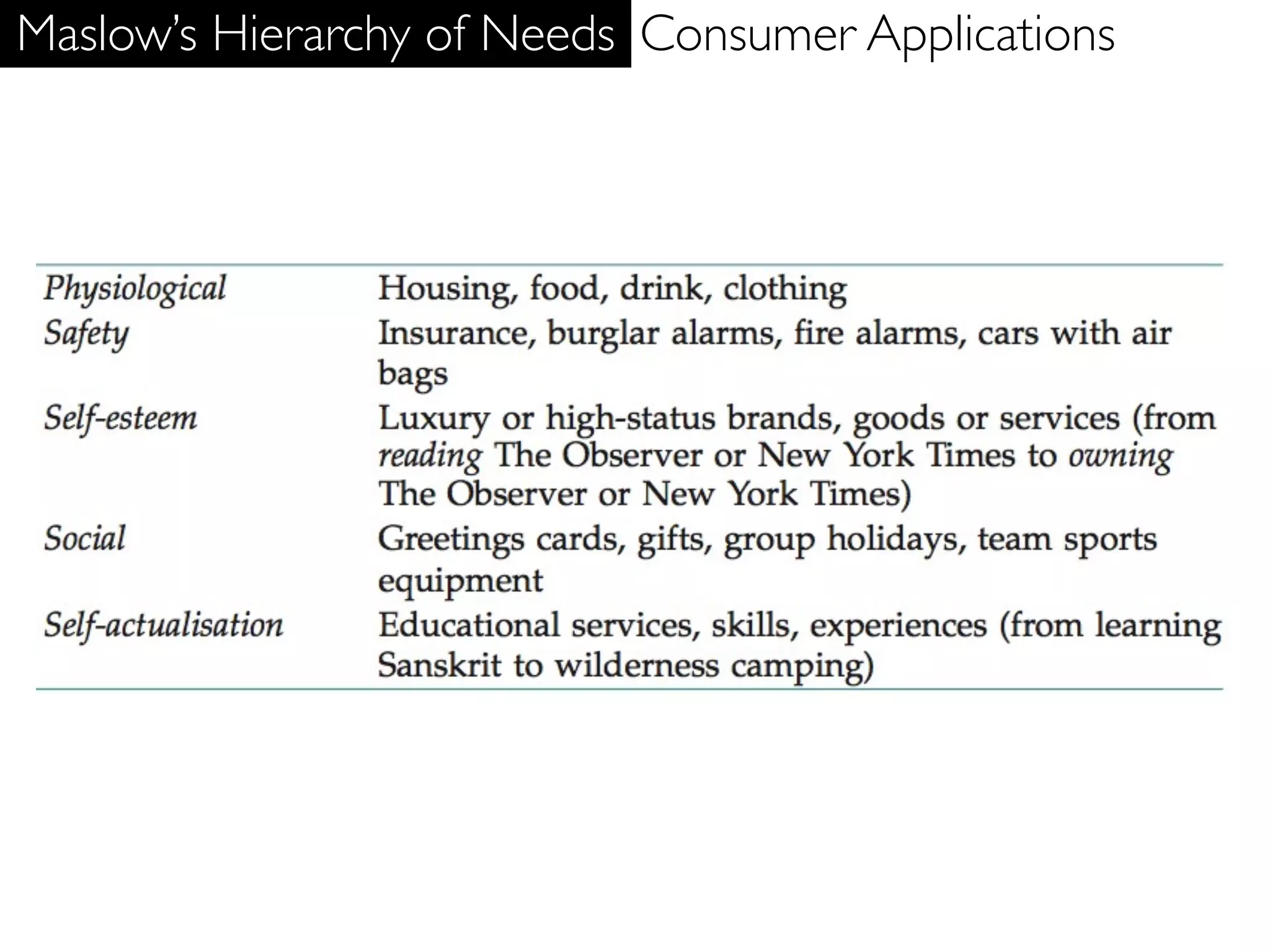
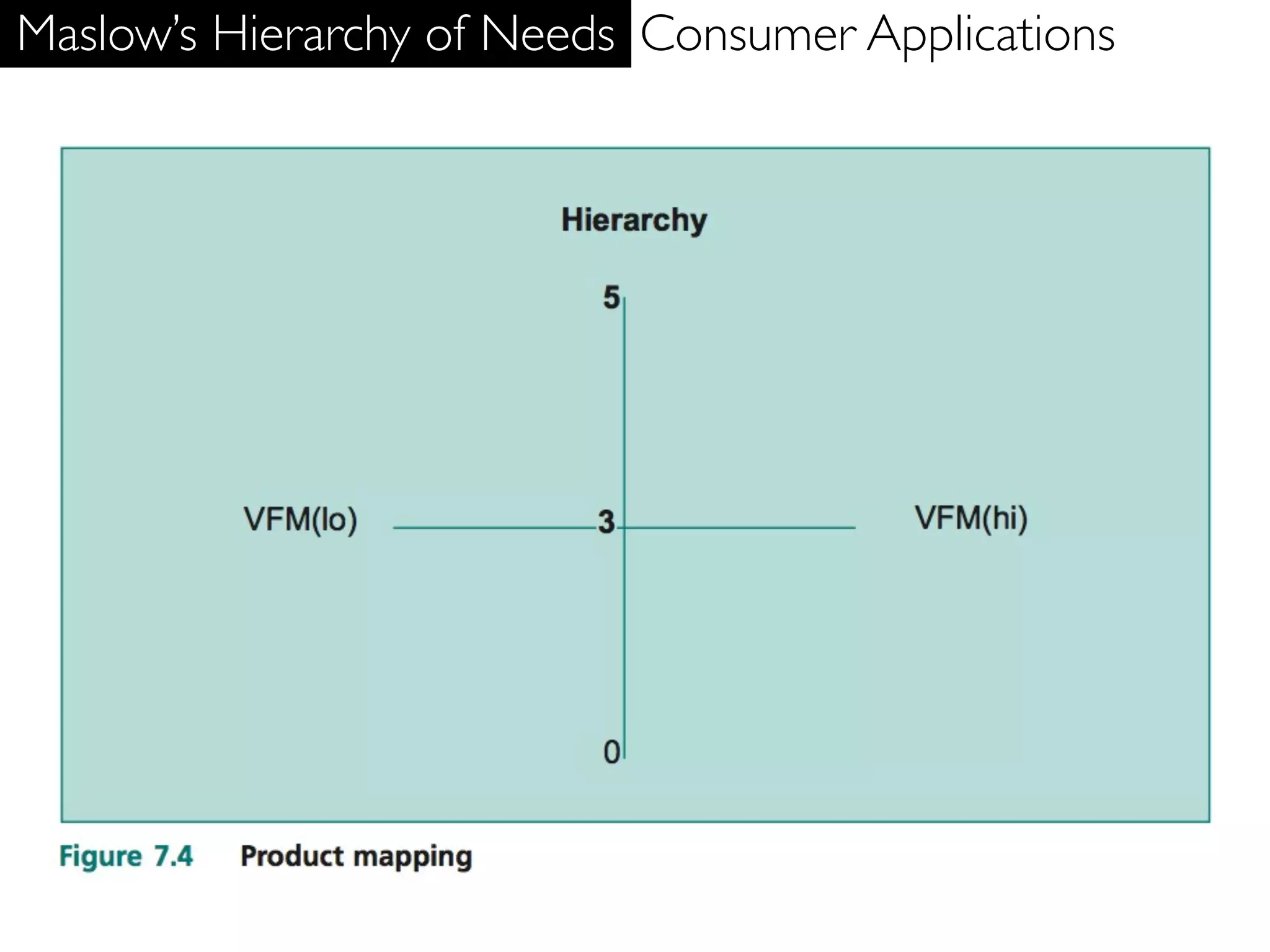
Maslow’s Hierarchy of Needs Consumer Applications
The Motivational Mix: Multiple Motives


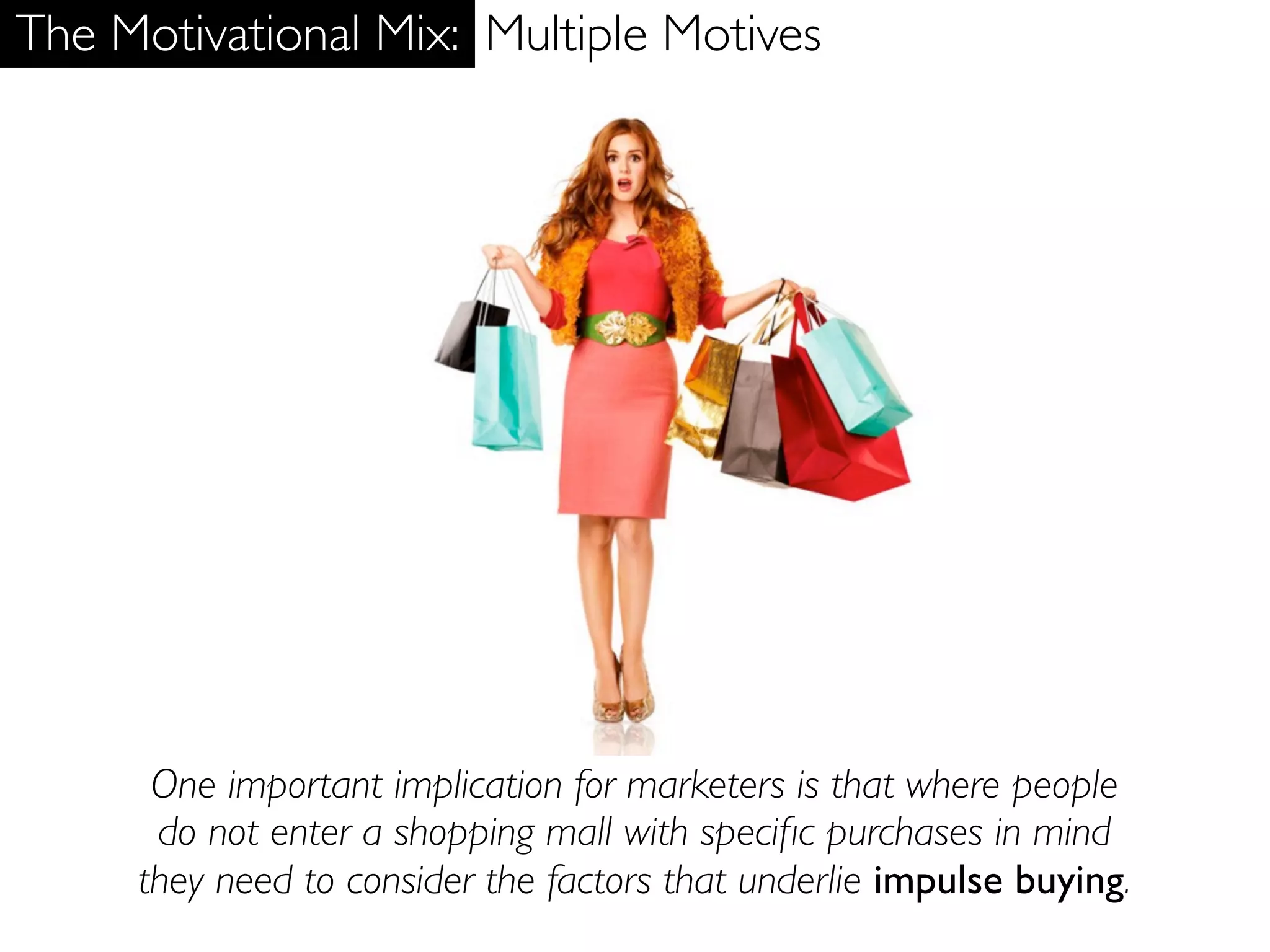
      One important implication for marketers is that where people
      do not enter a shopping mall with specific purchases in mind
     they need to consider the factors that underlie impulse buying.
The Motivational Mix: Approach & Avoidance


    Approach-Approach conflict
            -        conflict

     Approach-                               conflict
The Motivational Mix The Force of Inertia


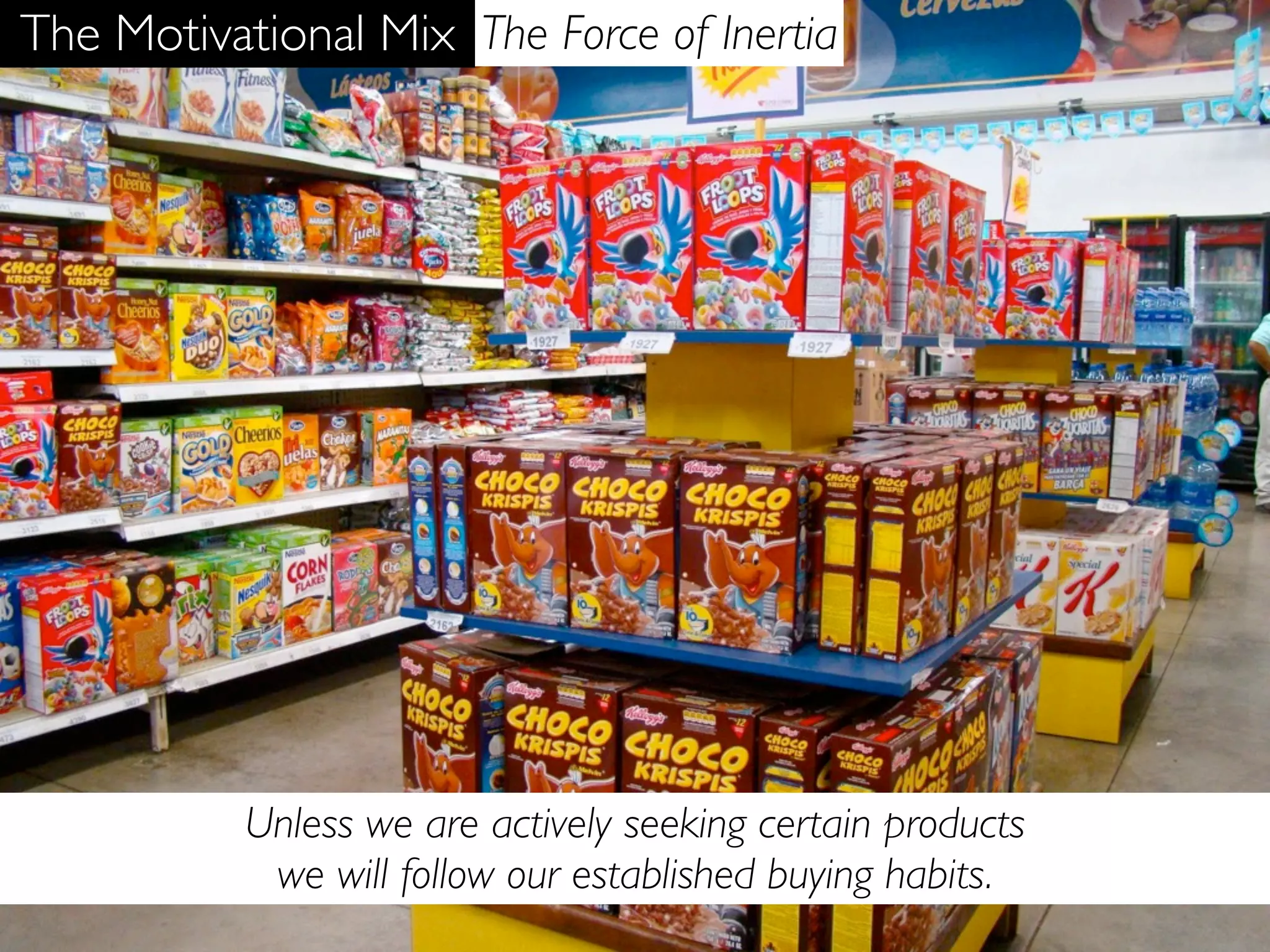
           Unless we are actively seeking certain products
            we will follow our established buying habits.
The Motivational Mix: Antecedents of Involvement 1/3


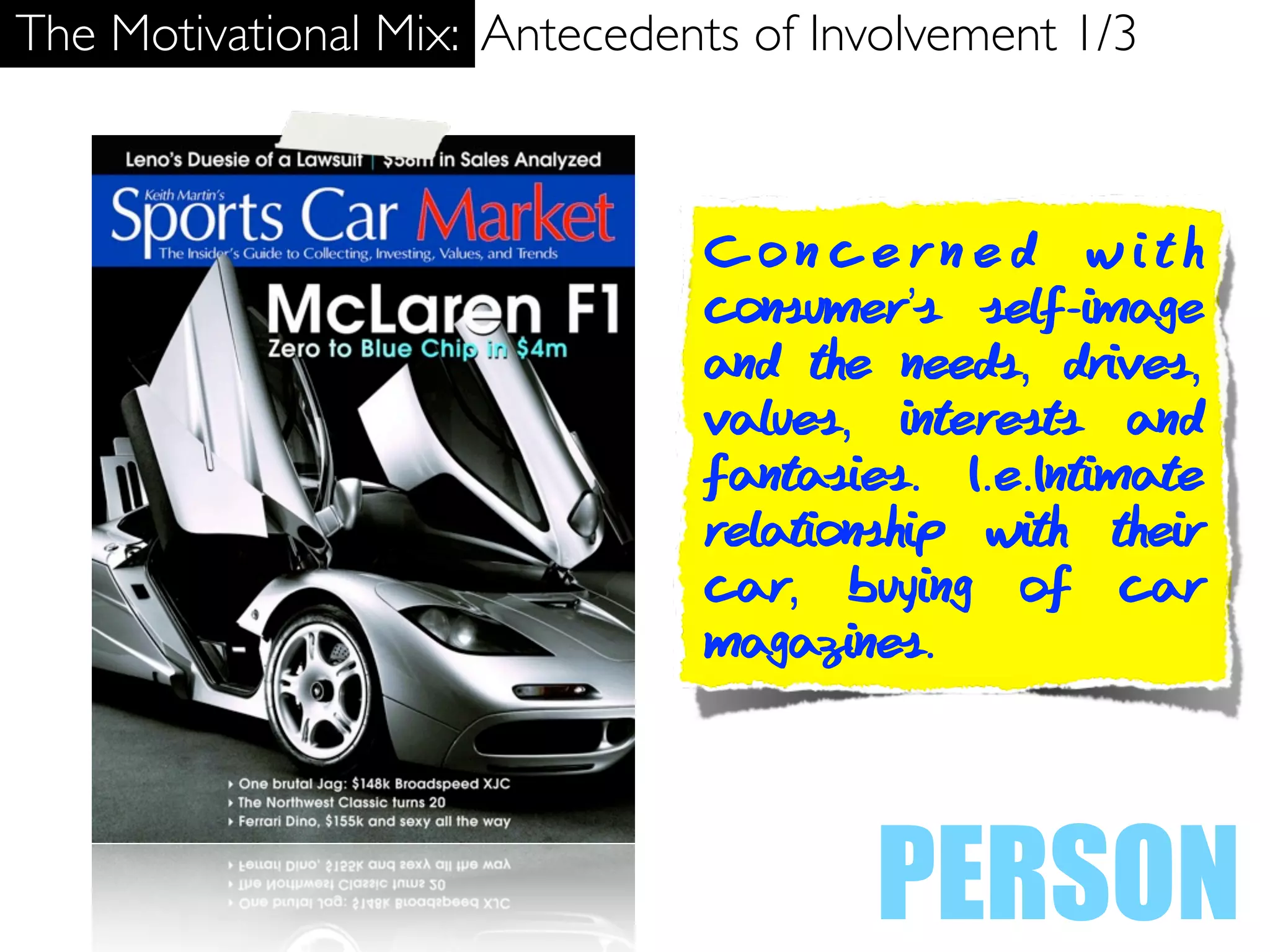
                               Concerned with
                               consumer’s self-image
                               and the needs, drives,
                               values, interests and
                               fantasies. I.e.Intimate
                               relationship with their
                               car, buying of car
                               magazines.


                                       PERSON
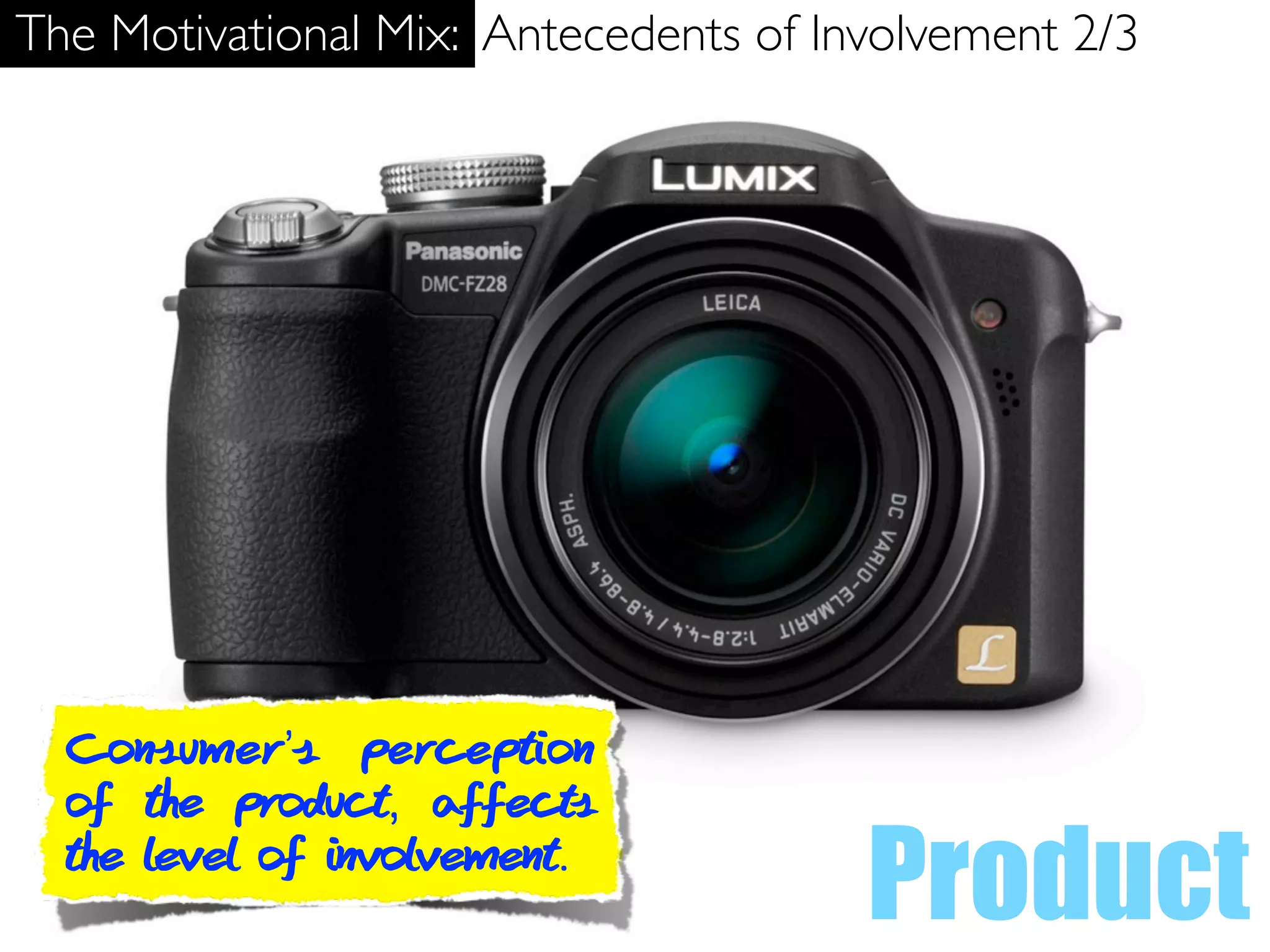
The Motivational Mix: Antecedents of Involvement 2/3


  Consumer’s perception
  of the product, affects
  the level of involvement.
                                       Product
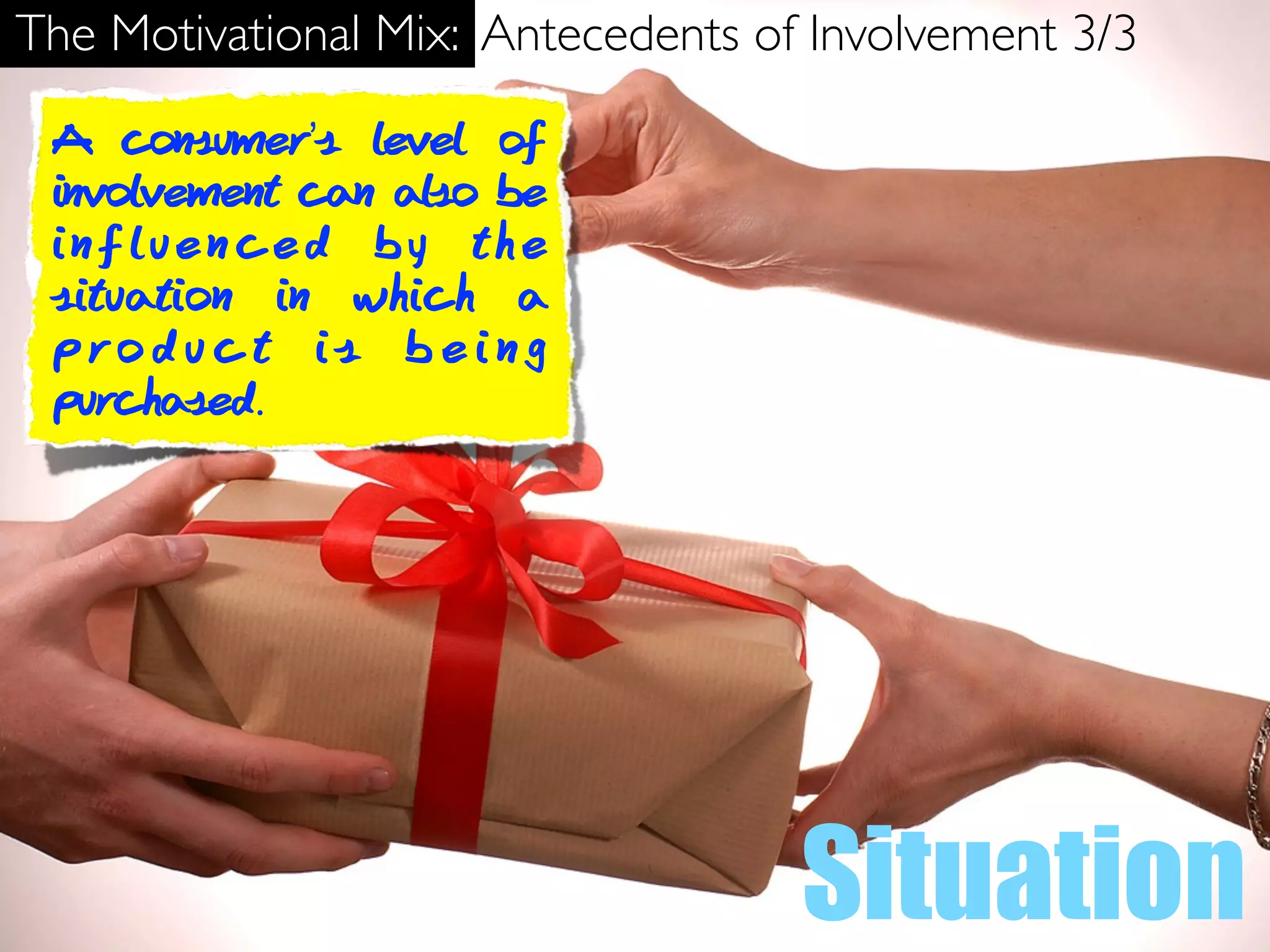
The Motivational Mix: Antecedents of Involvement 3/3

 A consumer’s level of
 involvement can also be
 influenced by the
 situation in which a
 product is being
 purchased.


                                    Situation
The Motivational Mix: Properties of Involvement

                                  Consumers who
                                  are highly involved
                                  will spend a great
                                  deal of time and
                                  effort on making
                                  purchase decisions.
The Motivational Mix: Outcomes of Involvement


 The outcomes of involvement will depend on the interaction
         between the preceding two sets of factors.
The Motivational Mix: Specific Needs


               Achievement
                  Affiliation

                     Power
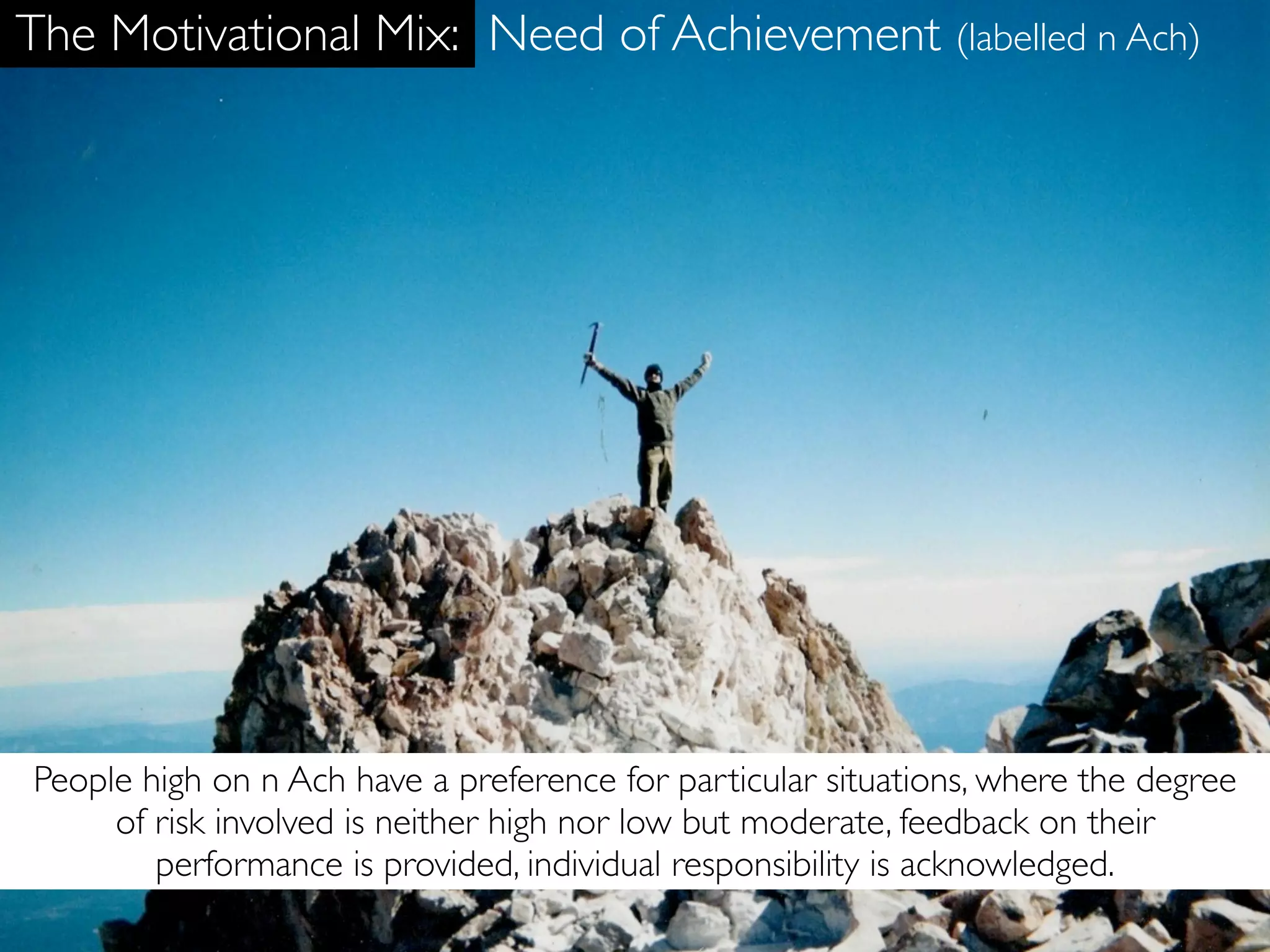
The Motivational Mix: Need of Achievement (labelled n Ach)


People high on n Ach have a preference for particular situations, where the degree
     of risk involved is neither high nor low but moderate, feedback on their
        performance is provided, individual responsibility is acknowledged.
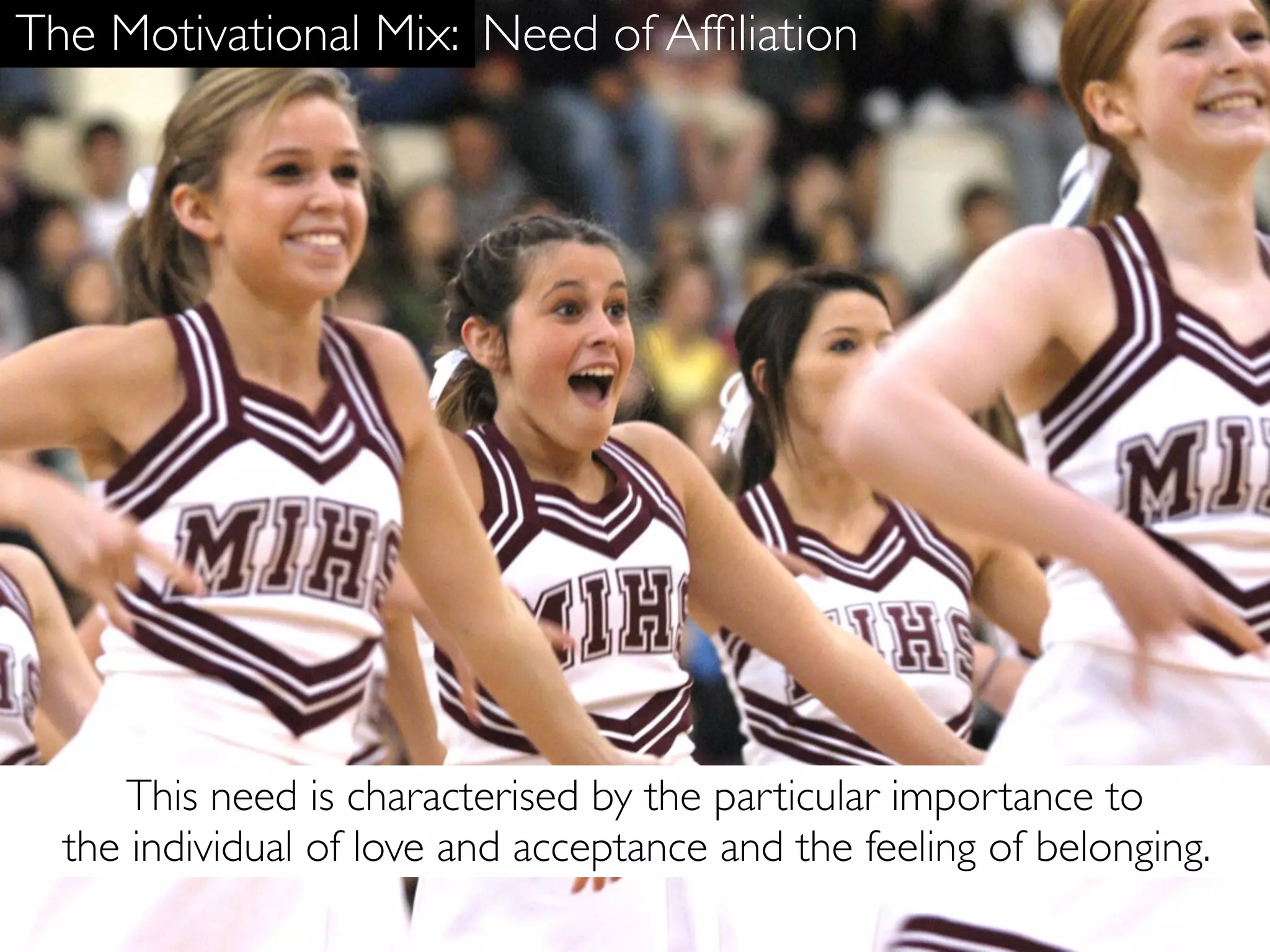
The Motivational Mix: Need of Affiliation


      This need is characterised by the particular importance to
  the individual of love and acceptance and the feeling of belonging.
The Motivational Mix: Need of Power


 Maslow’s level of Safety. That is, people who are high on this need seek
 a feeling of security by trying to control as much of their lives and their
                          environment as possible.
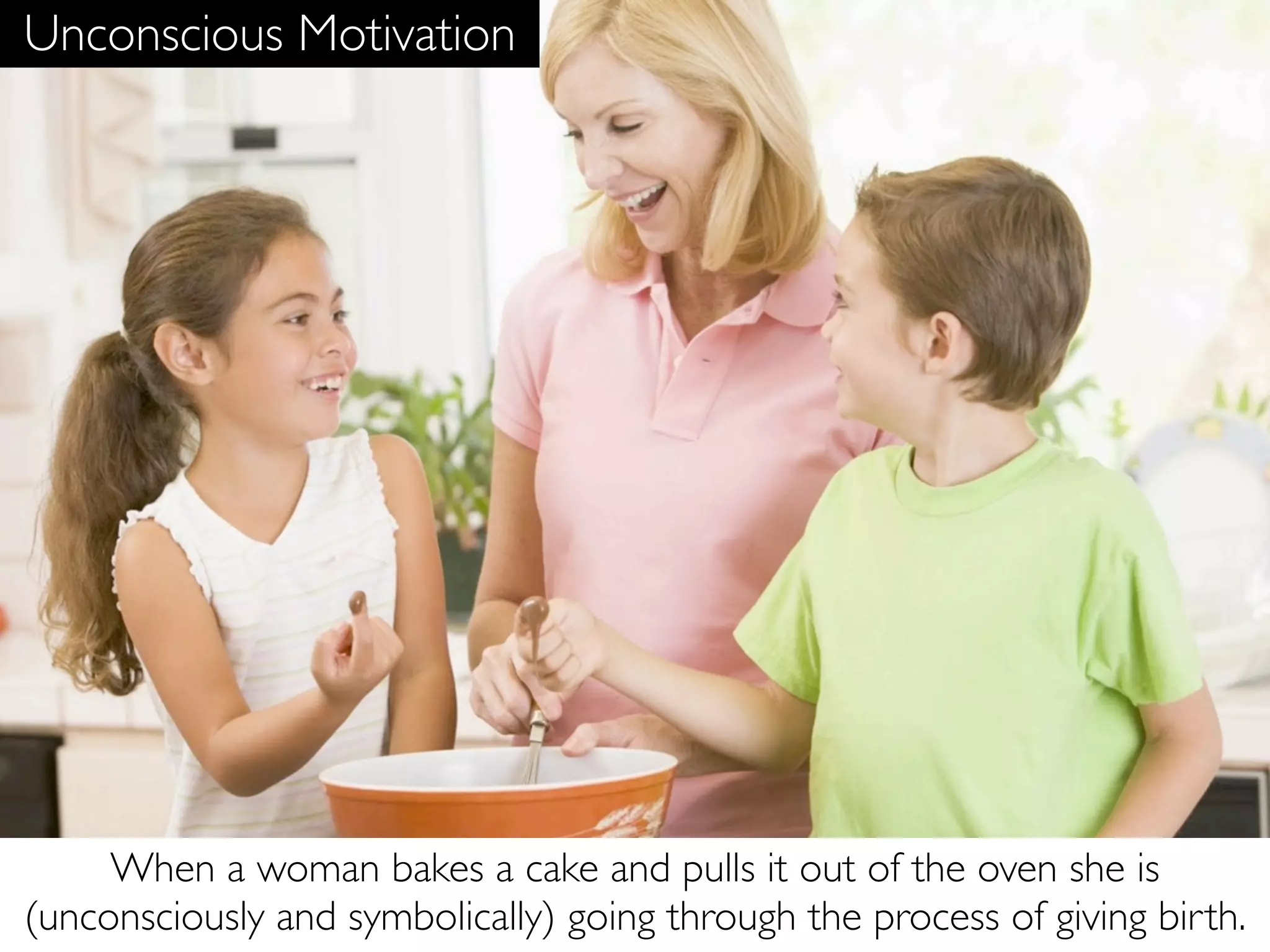
Unconscious Motivation


     When a woman bakes a cake and pulls it out of the oven she is
(unconsciously and symbolically) going through the process of giving birth.
also...
Unconscious Motivation


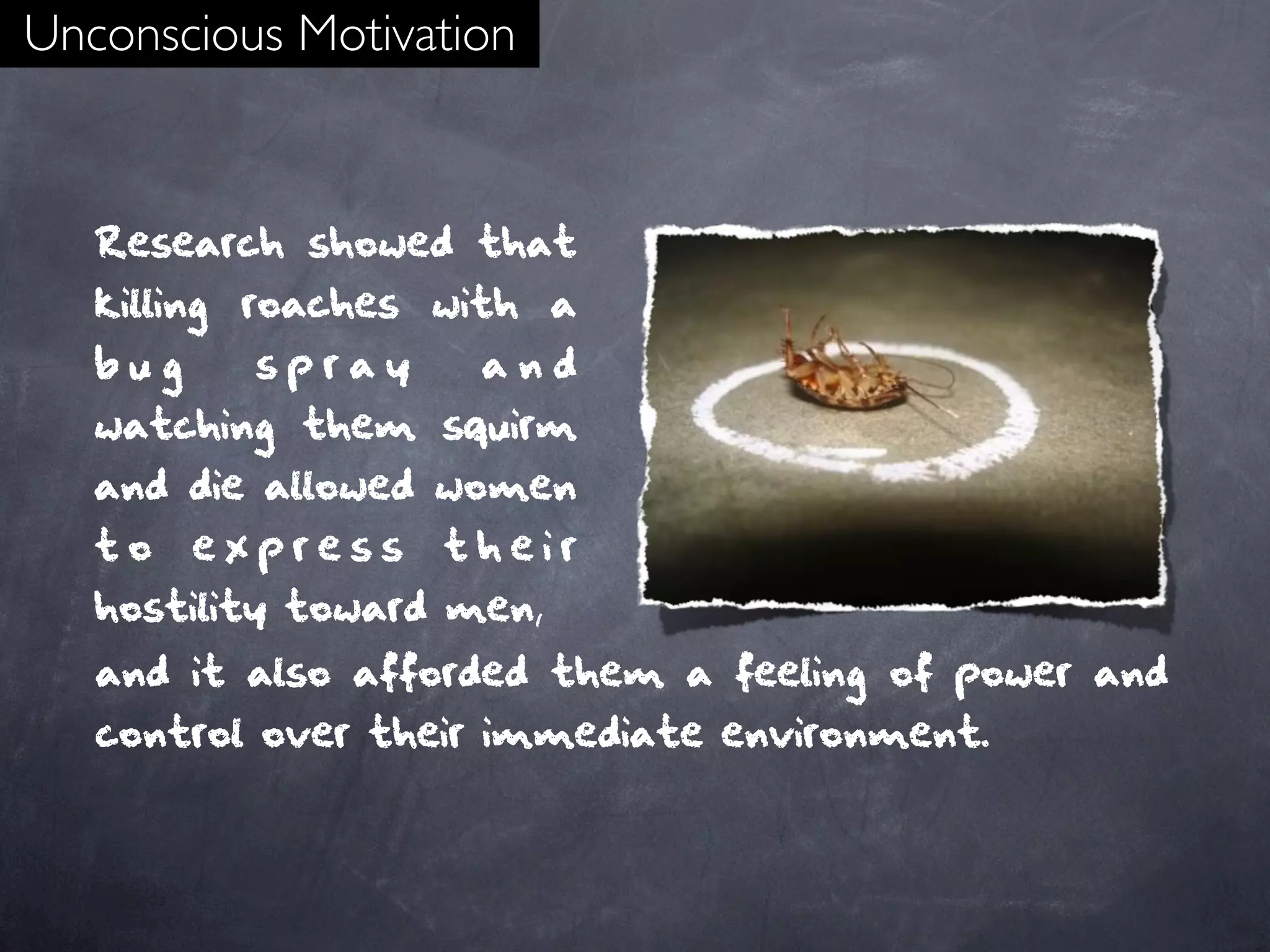
   Research showed that
   killing roaches with a
   bug     spray     and
   watching them squirm
   and die allowed women
   to    express   their
   hostility toward men,
   and it also afforded them a feeling of power and
   control over their immediate environment.
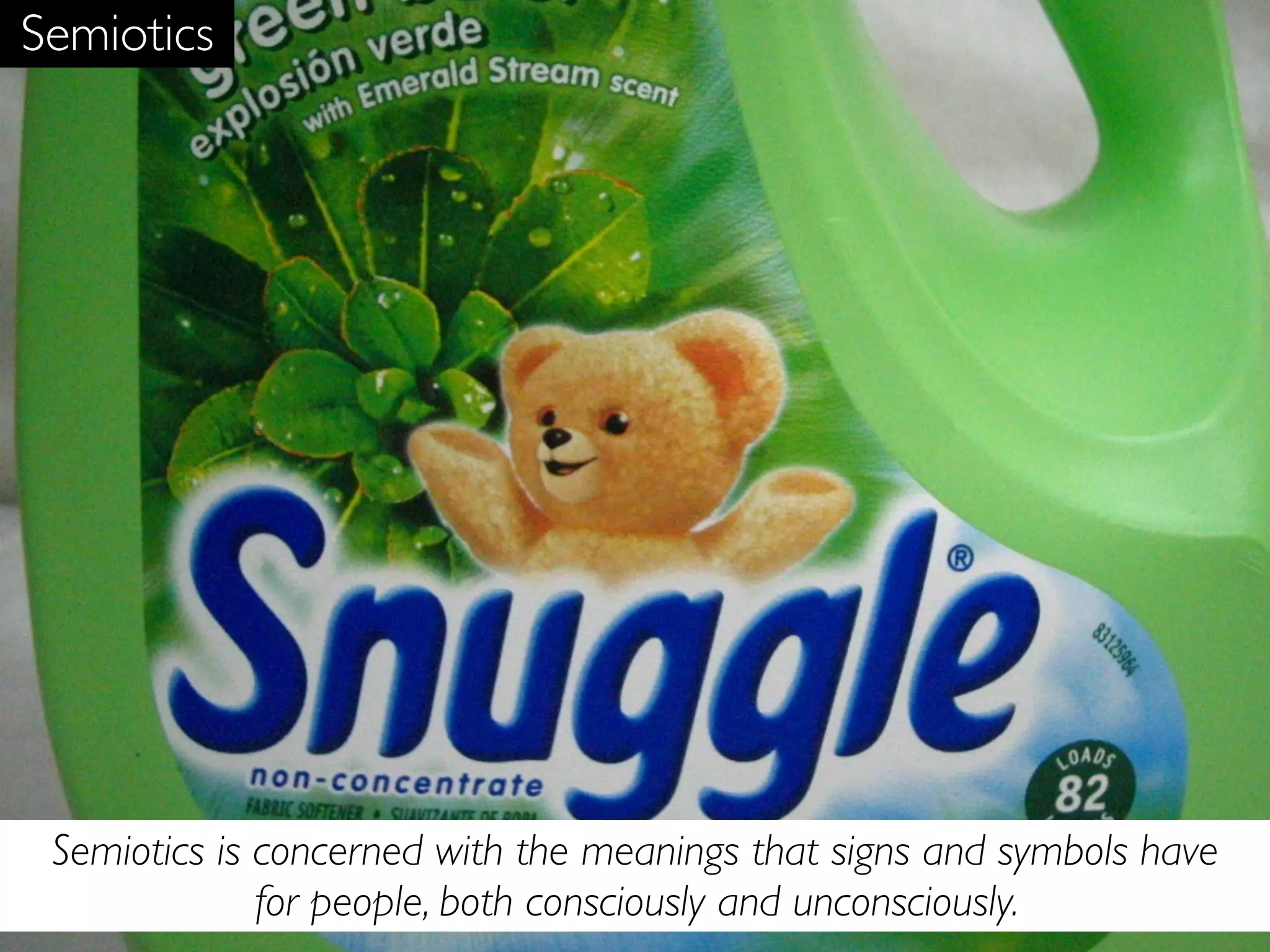
Semiotics


 Semiotics is concerned with the meanings that signs and symbols have
              for people, both consciously and unconsciously.
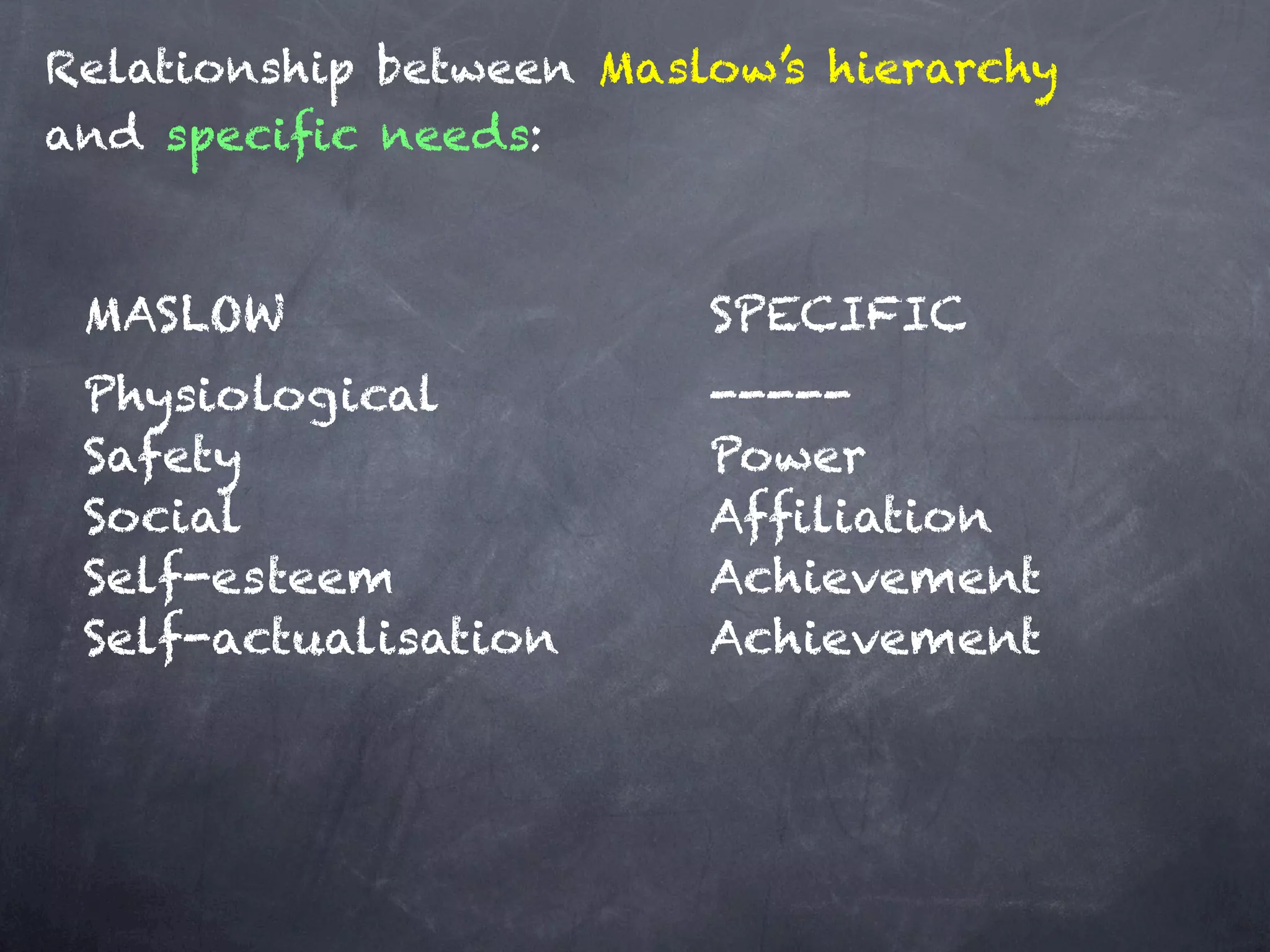
Relationship between Maslow’s hierarchy
and specific needs:


 MASLOW                  SPECIFIC
 Physiological           -----
 Safety                  Power
 Social                  Affiliation
 Self-esteem             Achievement
 Self-actualisation      Achievement
Congrats! You finished Consumer Behaviour part II.
www.sebinomics.com

Consumer Behaviour Part2: The Individual Perspective

  • 1.
    Consumer Behaviour Part II:The Individual Perspective Preparation for the Consumer Behaviour exam at Edinburgh Business School Content extracted from the ‘Consumer Behaviour’ text book by David A. Statt All pictures used for educational purposes only. No copyright infringement intended.
  • 2.
    PART II TheIndividual Perspective 4) Perception 5) Personality 6) Learning, Memory & Thinking 7) Motivation
  • 3.
  • 4.
    Using our 5Senses vision taste touch hearing smell
  • 5.
    Multi-sensual Marketing taste & smell touch vision hearing We are used to associating particular consumer environments with specific senses, like a supermarket with vision, or a perfume counter with smell, but clever marketing will make use of as wide a range of sensory stimulation as possible.
  • 6.
    Thresholds of Awareness:j.n.d. just noticeable difference (j.n.d.) for a night at the Waldorf Astoria? $500 499
  • 7.
    Thresholds of Awareness:j.n.d. $3.49 just noticeable difference (j.n.d.) for a 2.49 menu at Cindy’s?
  • 8.
    Sensory Adaptation Canyou still smell the fish? Just as people in fish markets get used to the smell, you can get used to the feel of what you wear.
  • 9.
    Processing Sensory Information Thesense organs provide our brain with a steady flow of information about our environment and the brain’s task is then to take this raw material and use it to help us make sense of that environment through the process of perception.
  • 10.
    Focussing and Attention In or d e r to perceive something we have to give it our attention.
  • 11.
    External factors movement contrast repetition size stimulus provided by a change in the environment that is most important
  • 12.
    Internal factors Differentpeople react to the same sensations in different ways. One person may put on a sweater because the room is too cold, while another throws open the windows. The most important internal factor in perception is what people expect to see or hear in each situation.
  • 13.
    Organising Perceptual Cues/Distortions Figu re a Grou nd nd sio ns I llu
  • 14.
    Grouping into patterns The wearing of uniforms is a common form of grouping the similar and identifying the dissimilar as applied to people.
  • 15.
    Closure and TheZeigarnik Effect If certain things are familiar to us our perceptual process will close the gaps in the picture.
  • 16.
    Organising Perceptual Cues/Distortions PerceptualConstancy Depth and Distance Movement
  • 17.
    Subliminal Perception The sheer amount of exposure to a stimulus increases our general feeling of liking for it.
  • 18.
    Product Images, Self-imagesand Consumer Behaviour Companies try to influence consumer perceptions by encouraging associations between themselves and a desirable and appropriate image.
  • 19.
    Perceiving Risk performance financial Six identified time forms of risk physical psychological
  • 20.
    Coping with Risk Relying on brand loyalty is the most popular strategy for reducing perceived risk.
  • 21.
  • 22.
    What makes someonea unique person? The psychologist and the layman use the term personality to make sense of an individual’s behaviour.
  • 23.
    Define ‘Personality’ The sum total of all the factors that make an individual human being both individual & human.
  • 24.
    Freudian Iceberg Ego Easy, you Conscious both. Unconscious ID Superego Do it! No, no. These three aspects of the personality are constantly interacting with each other as we move through life. Frequently they are in conflict.
  • 25.
  • 26.
    Owning a hotcar is the psychic equivalent of having a mistress
  • 27.
    Personality Tests Minnesota MultiphasicPersonality Inventory MMPI ★ most common encountered personality test, a questionnaire ★ 550 statements to answer with ‘true’, ‘false’, or ‘cannot say’
  • 28.
    Personality Tests Thematic ApperceptionTest TAT ★ projective test; widely used ★ 20 b/w pictures with ambiguous relationships depicted
  • 29.
    Personality Tests Rorschach inkblot test ★ projective test; maybe most famous psychological test ★ Testee sees people or things that are important to him or her
  • 30.
    Neo-Freudian Psychoanalysis: Classifyrelationships Compliant, Aggressive, or Detached orientation
  • 31.
  • 32.
    Marketing and theConcept of Self Actual self image: trad. concept of how people see themselves Ideal self image: how people would like to see themselves Social self image: how people think others see them Ideal social self image: how people would like others see them
  • 33.
  • 34.
    Brand Personality A way of characterising the image of a brand by giving it personal associations, as though it were an individual.
  • 35.
    Module 6: Learning,Memory & Thinking All consumer behaviour is learned behaviour
  • 36.
    Learning is... ...the relativelypermanent process by which changes in behaviour, knowledge, feelings or attitudes occur as the result of prior experience.
  • 37.
    The Behaviourist Approach Psychology as the behaviorist views it is a purely objective branch of natural science. Its theoretical goal is the prediction and control of behavior. (Watson, 1913, p. 158)
  • 38.
  • 39.
  • 40.
  • 41.
  • 42.
    Operant Conditioning: ConsumerApplications Your supermarket has a new brand of yoghurt on offer and you decide to try it, your future purchases of the product will depend on whether your response is reinforced or rewarded by your liking it.
  • 43.
    The Cognitive Approach See what someone does and infer from that behaviour what she thinks or feels.
  • 44.
  • 45.
    Information Processing &the Concept of Memory Whatever we learned would be of no use to us unless we had some way of storing it, ready to be retrieved when needed.
  • 46.
  • 47.
    Making Learning Meaningful:Visuals one picture is worth a thousand words
  • 48.
    Making Learning Meaningful:Self-referencing When people are asked to relate information to their own lives their memory of the material is increased.
  • 49.
    Making Learning Meaningful:Meaningfulness We learn new things by linking them with things we already know.
  • 50.
    Modelling Observe the behaviour of othersand use them as models for your own behaviour.
  • 51.
    Module 7: Motivation ‘Why’ do people buy what they buy?
  • 52.
    How Managers seeemployee motivation THEORY X THEORY Y People are inherently lazy so they must be People seek meaning and a sense of motivated by external incentives accomplishment and to exercise auton- omy and be independent in their work They will pursue their own goals, which run As they are basically controlled and self- counter to those of the organisation, so they motivated they will find external controls and need extra controls to keep them in line incentives demeaning They are quite irrational and incapable of If they are only given the chance to do so self-discipline or self-control they will come to regard the organisation’s goals as their own. The rare individuals who are rational, controlled and self-motivated will therefore have to manage others.
  • 53.
    Motivation - thewish, need, desire - to do so. A general term for any part of the hypothetical psychological process which involves the experiencing of needs and drives and the behaviour that leads to the goal which satisfies them.
  • 54.
    Motivation and BuyingBehaviour Buying Behaviour = Ability + Opportunity + Motivation BB = ƒ(A, O, M)
  • 55.
    Components of Motivation Motivation = Need Incentive Internal External Buying Behaviour
  • 56.
    The Fulfillment ofNeeds: Maslow’s Hierarchy of Needs
  • 57.
    Maslow’s Hierarchy ofNeeds Consumer Applications
  • 58.
    Maslow’s Hierarchy ofNeeds Consumer Applications
  • 59.
    The Motivational Mix:Multiple Motives One important implication for marketers is that where people do not enter a shopping mall with specific purchases in mind they need to consider the factors that underlie impulse buying.
  • 60.
    The Motivational Mix:Approach & Avoidance Approach-Approach conflict - conflict Approach- conflict
  • 61.
    The Motivational MixThe Force of Inertia Unless we are actively seeking certain products we will follow our established buying habits.
  • 62.
    The Motivational Mix:Antecedents of Involvement 1/3 Concerned with consumer’s self-image and the needs, drives, values, interests and fantasies. I.e.Intimate relationship with their car, buying of car magazines. PERSON
  • 63.
    The Motivational Mix:Antecedents of Involvement 2/3 Consumer’s perception of the product, affects the level of involvement. Product
  • 64.
    The Motivational Mix:Antecedents of Involvement 3/3 A consumer’s level of involvement can also be influenced by the situation in which a product is being purchased. Situation
  • 65.
    The Motivational Mix:Properties of Involvement Consumers who are highly involved will spend a great deal of time and effort on making purchase decisions.
  • 66.
    The Motivational Mix:Outcomes of Involvement The outcomes of involvement will depend on the interaction between the preceding two sets of factors.
  • 67.
    The Motivational Mix:Specific Needs Achievement Affiliation Power
  • 68.
    The Motivational Mix:Need of Achievement (labelled n Ach) People high on n Ach have a preference for particular situations, where the degree of risk involved is neither high nor low but moderate, feedback on their performance is provided, individual responsibility is acknowledged.
  • 69.
    The Motivational Mix:Need of Affiliation This need is characterised by the particular importance to the individual of love and acceptance and the feeling of belonging.
  • 70.
    The Motivational Mix:Need of Power Maslow’s level of Safety. That is, people who are high on this need seek a feeling of security by trying to control as much of their lives and their environment as possible.
  • 71.
    Unconscious Motivation When a woman bakes a cake and pulls it out of the oven she is (unconsciously and symbolically) going through the process of giving birth.
  • 72.
  • 73.
    Unconscious Motivation Research showed that killing roaches with a bug spray and watching them squirm and die allowed women to express their hostility toward men, and it also afforded them a feeling of power and control over their immediate environment.
  • 74.
    Semiotics Semiotics isconcerned with the meanings that signs and symbols have for people, both consciously and unconsciously.
  • 75.
    Relationship between Maslow’shierarchy and specific needs: MASLOW SPECIFIC Physiological ----- Safety Power Social Affiliation Self-esteem Achievement Self-actualisation Achievement
  • 76.
    Congrats! You finishedConsumer Behaviour part II.
  • 77.