Lesson 6 RESEARCH METHODS 3
Students will … list sampling types select representative samples reduce sample errors plan the survey ask the questions L e arning Out c om e s
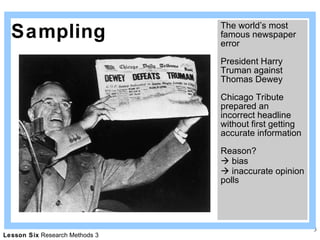
The world’s most famous newspaper error President Harry Truman against Thomas Dewey Chicago Tribute prepared an incorrect headline without first getting accurate information Reason?     bias    inaccurate opinion polls Sampling
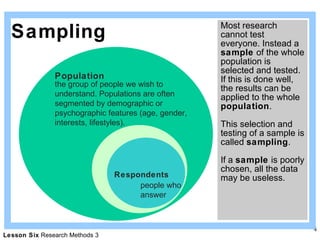
Most research cannot test everyone. Instead a  sample  of the whole population is selected and tested. If this is done well, the results can be applied to the whole  population . This selection and testing of a sample is called  sampling .  If a  sample  is poorly chosen, all the data may be useless.  Sampling Population the group of people we wish to understand. Populations are often segmented by demographic or psychographic features (age, gender, interests, lifestyles). Sample a subset of the population that represents the whole group Respondents people who answer
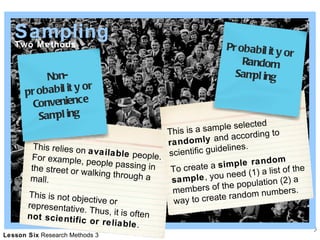
Two Methods Sampling This relies on  available  people. For example, people passing in the street or walking through a mall.  This is not objective or representative. Thus, it is often  not scientific or reliable . Non-probability or Convenience Sampling   This is a sample selected  randomly  and according to scientific guidelines. To create a  simple random sample , you need (1) a list of the members of the population (2) a way to create random numbers.  Probability or Random Sampling
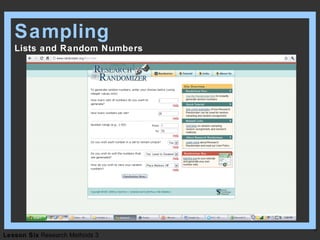
Sampling Lists and Random Numbers
 
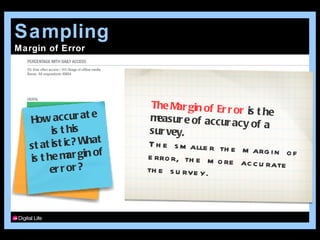
The Margin of Error  is the measure of accuracy of a survey.   The smaller the margin of error, the more accurate the survey.   Sampling Margin of Error What is your primary daily media channel? How accurate is this statistic? What is the margin of error?
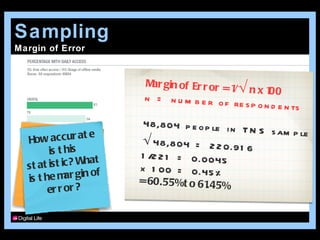
Margin of Error = 1/ √ n x 100 n = number of respondents 48,804 people in TNS sample √ 48,804 = 220.916 1/221 = 0.0045 x 100 = 0.45% = 60.55% to 61.45%  Sampling Margin of Error What is your primary daily media channel? How accurate is this statistic? What is the margin of error?
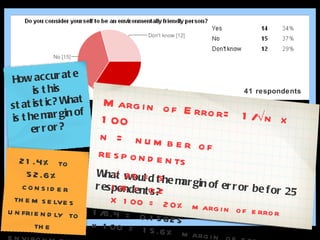
41 respondents Margin of Error= 1/ √ n x 100 n = number of respondents 41  respondents √ 41 = 6.403124237432848686488 1/6.4 = 0.15625 x 100 = 15.6% margin of error √   25 = 5 1/5 = 0.2 X 100 = 20% margin of error How accurate is this statistic? What is the margin of error?   21.4% to  52.6%  consider themselves unfriendly to the environment Margin of Error= 1/ √ n x 100 n = number of respondents What would the margin of error be for 25 respondents?
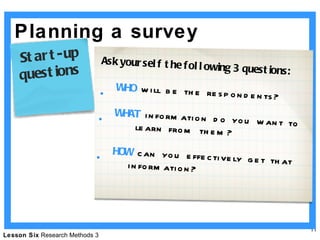
Planning a survey Ask yourself the following 3 questions: WHO  will be the respondents? WHAT  information do you want to  learn from them? HOW  can you effectively get that information? Start-up questions
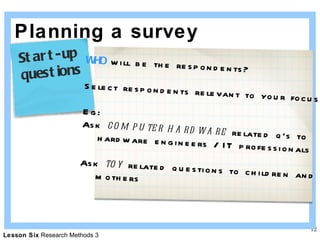
Planning a survey WHO  will be the respondents? Select respondents relevant to your focus Eg:  Ask  computer hardware  related q’s to hardware engineers / IT professionals Ask  toy  related questions to children and mothers Start-up  questions
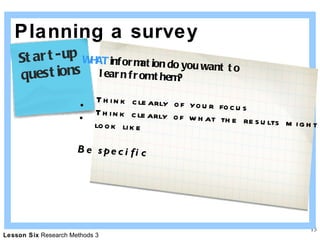
Planning a survey WHAT  information do you want to  learn from them? Think clearly of your focus Think clearly of what the results might  look like Be specific Start-up  questions
Planning a survey Be specific Example: This research is done to ascertain the: -  Awareness  of /  knowledge  of -  Attitude  towards /  perception  of -  Demand  for etc Start-up  questions
Planning a survey HOW  can you effectively get that information? Choose effective questions Decide on type of survey  (mail, interview, telephone, online) Decide on response categories Design layout Decide on target population Decide on sample size Select sample Start-up  questions
Planning a survey Online Surveys Advantages  of online surveys: Access to a large number of people,  Quick Disadvantages  of online surveys: You cannot control the conditions   - someone else may answer   - not physically there to clarify or probe further Start-up  questions
The Questions Asking questions Avoid jargon, slang, abbreviations Avoid ambiguity, confusion and vagueness Avoid writing double-barreled questions Avoid leading  Avoid treating a respondent’s belief  about a hypothesis as a test of the hypothesis Start-up  questions
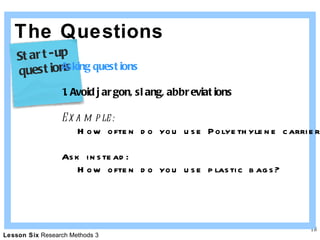
The Questions Asking questions 1. Avoid jargon, slang, abbreviations Example: How often do you use Polyethylene carriers? Ask instead: How often do you use plastic bags? Start-up  questions
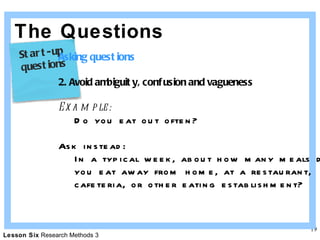
The Questions Asking questions 2. Avoid ambiguity, confusion and vagueness Example: Do you eat out often? Ask instead: In a typical week, about how many meals do  you eat away from home, at a restaurant, cafeteria, or other eating establishment? Start-up  questions
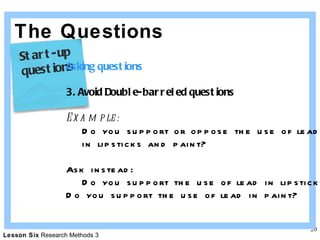
The Questions Asking questions 3. Avoid Double-barreled questions Example: Do you support or oppose the use of lead  in lipsticks and paint? Ask instead: Do you support the use of lead in lipsticks? Do you support the use of lead in paint? Start-up  questions
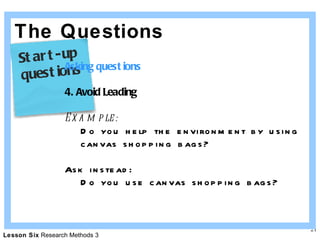
The Questions Asking questions 4. Avoid Leading Example: Do you help the environment by using  canvas shopping bags? Ask instead: Do you use canvas shopping bags? Start-up  questions
The Questions Asking questions 5. Beliefs as real Example: Do you think more educated people wear  fur clothing? Ask instead: What is your education level? Do you wear fur clothing? Start-up  questions
The Questions Organising questions Question types: Closed – Likert scales   Semantic scales   Ranking scales Structured questions  (age, income, education level, etc) Open – Opinion Overall / final comments Start-up  questions
The Introduction [Fashion and the Environment] We are a team of  [Fashion Marketing]  students from Raffles College of Higher Education.  We are conducting this survey as part of our research project for our Academic Research and Communication Skills module under our lecturer and research supervisor Kavita Parwani.  The questionnaire should take about 5 minutes to complete.  Our research project examines  [the attitudes of the students of Raffles College of Higher Education towards the reuse, reduction and recycling of clothing.]  We hope that your response will help us understand our subject in greater depth.  The information we gather is confidential and anonymous, in other words, we will not name you or identify you in connection with the information you provide.  If you have any questions about the survey or our research project, please feel free to contact me,  [Josephine Lim, at josephinelim@gmail.com]  or our supervisor Kavita Parwani at kavitaparwani@raffles-college.edu.sg
REFERENCES Babbie, E. (2008).  The Basics of Social Research (4 th  ed .) USA: Cengage. Dewey Defeats Truman (2009) Deweydefeatstruman.  http:// www.deweydefeatstruman.com / Ghauri, P. & Gronhaug, K. (2005). Research Methods in Business Studies – A Practical Guide, Essex: Pearson Neuman, WL. (2009).  Understanding Research . London: Pearson.  Visocky O’Grady, K. & Visocky O’Grady, J. (2009).  A Designer’s Research Manual , USA: Rockport.
Exercise  Question: Japan and its recent tsunami victims do not need the world’s interest, sympathy and financial assistance as Japan is a wealthy nation that can take care of itself. In groups: Part 1: Conduct secondary research (Lesson 3) Part 2: Conduct primary research (Lesson 4-5) Part 3: Evaluate the research (Lesson 6) Part 4: Submit a short report on your findings (Lesson 7)
Group Exercise: Select your topic (Japan / Random) Select your focus Write 7-10 research questions  Mix of Demographic and Psychograpic areas Select 10 respondents Do the survey Tabulate and analyse the results Optional: Calculate margin of error Findings? Write out your findings, and the analysis of these findings.
Project Step 3: Presentation 3:  Research Methods Prepare a 5-6 minute presentation explaining your  primary research   methods .  Explain how you will collect  information/data  on the topic. Explain whether you decided to do  quantitative  or  qualitative  research and why.  Which  method(s)  will you use? Why? Who will you  sample ? How? Why?  What  questions  will you ask? Give  examples .  What  problems  do you foresee?  Detail your  sources .  Design PowerPoint  slides .  homework
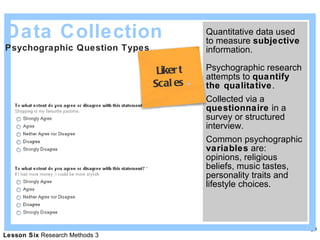
Quantitative data used to measure  subjective  information. Psychographic research attempts to  quantify the qualitative . Collected via a  questionnaire  in a survey or structured interview. Common psychographic  variables  are: opinions, religious beliefs, music tastes, personality traits and lifestyle choices. Data Collection Psychographic Question Types  Likert  Scales  
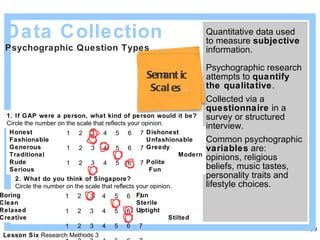
Quantitative data used to measure  subjective  information. Psychographic research attempts to  quantify the qualitative . Collected via a  questionnaire  in a survey or structured interview. Common psychographic  variables  are: opinions, religious beliefs, music tastes, personality traits and lifestyle choices. Data Collection Psychographic Question Types  Likert  Scales 1. If GAP were a person, what kind of person would it be? Circle the number on the scale that reflects your opinion. Honest     Dishonest Fashionable    Unfashionable Generous     Greedy Traditional       Modern Rude      Polite Serious     Fun 1  2  3  4  5  6  7  1  2  3  4  5  6  7  1  2  3  4  5  6  7  1  2  3  4  5  6  7  1  2  3  4  5  6  7  1  2  3  4  5  6  7  Semantic  Scales   2. What do you think of Singapore? Circle the number on the scale that reflects your opinion. Boring     Fun Clean      Sterile Relaxed        Uptight Creative        Stilted 1  2  3  4  5  6  7  1  2  3  4  5  6  7  1  2  3  4  5  6  7  1  2  3  4  5  6  7

Lesson 6 - Primary Research Methods 2

  • 1.
  • 2.
    Students will …list sampling types select representative samples reduce sample errors plan the survey ask the questions L e arning Out c om e s
  • 3.
    The world’s mostfamous newspaper error President Harry Truman against Thomas Dewey Chicago Tribute prepared an incorrect headline without first getting accurate information Reason?  bias  inaccurate opinion polls Sampling
  • 4.
    Most research cannottest everyone. Instead a sample of the whole population is selected and tested. If this is done well, the results can be applied to the whole population . This selection and testing of a sample is called sampling . If a sample is poorly chosen, all the data may be useless. Sampling Population the group of people we wish to understand. Populations are often segmented by demographic or psychographic features (age, gender, interests, lifestyles). Sample a subset of the population that represents the whole group Respondents people who answer
  • 5.
    Two Methods SamplingThis relies on available people. For example, people passing in the street or walking through a mall. This is not objective or representative. Thus, it is often not scientific or reliable . Non-probability or Convenience Sampling This is a sample selected randomly and according to scientific guidelines. To create a simple random sample , you need (1) a list of the members of the population (2) a way to create random numbers. Probability or Random Sampling
  • 6.
    Sampling Lists andRandom Numbers
  • 7.
  • 8.
    The Margin ofError is the measure of accuracy of a survey. The smaller the margin of error, the more accurate the survey. Sampling Margin of Error What is your primary daily media channel? How accurate is this statistic? What is the margin of error?
  • 9.
    Margin of Error= 1/ √ n x 100 n = number of respondents 48,804 people in TNS sample √ 48,804 = 220.916 1/221 = 0.0045 x 100 = 0.45% = 60.55% to 61.45% Sampling Margin of Error What is your primary daily media channel? How accurate is this statistic? What is the margin of error?
  • 10.
    41 respondents Marginof Error= 1/ √ n x 100 n = number of respondents 41 respondents √ 41 = 6.403124237432848686488 1/6.4 = 0.15625 x 100 = 15.6% margin of error √ 25 = 5 1/5 = 0.2 X 100 = 20% margin of error How accurate is this statistic? What is the margin of error? 21.4% to 52.6% consider themselves unfriendly to the environment Margin of Error= 1/ √ n x 100 n = number of respondents What would the margin of error be for 25 respondents?
  • 11.
    Planning a surveyAsk yourself the following 3 questions: WHO will be the respondents? WHAT information do you want to learn from them? HOW can you effectively get that information? Start-up questions
  • 12.
    Planning a surveyWHO will be the respondents? Select respondents relevant to your focus Eg: Ask computer hardware related q’s to hardware engineers / IT professionals Ask toy related questions to children and mothers Start-up questions
  • 13.
    Planning a surveyWHAT information do you want to learn from them? Think clearly of your focus Think clearly of what the results might look like Be specific Start-up questions
  • 14.
    Planning a surveyBe specific Example: This research is done to ascertain the: - Awareness of / knowledge of - Attitude towards / perception of - Demand for etc Start-up questions
  • 15.
    Planning a surveyHOW can you effectively get that information? Choose effective questions Decide on type of survey (mail, interview, telephone, online) Decide on response categories Design layout Decide on target population Decide on sample size Select sample Start-up questions
  • 16.
    Planning a surveyOnline Surveys Advantages of online surveys: Access to a large number of people, Quick Disadvantages of online surveys: You cannot control the conditions - someone else may answer - not physically there to clarify or probe further Start-up questions
  • 17.
    The Questions Askingquestions Avoid jargon, slang, abbreviations Avoid ambiguity, confusion and vagueness Avoid writing double-barreled questions Avoid leading Avoid treating a respondent’s belief about a hypothesis as a test of the hypothesis Start-up questions
  • 18.
    The Questions Askingquestions 1. Avoid jargon, slang, abbreviations Example: How often do you use Polyethylene carriers? Ask instead: How often do you use plastic bags? Start-up questions
  • 19.
    The Questions Askingquestions 2. Avoid ambiguity, confusion and vagueness Example: Do you eat out often? Ask instead: In a typical week, about how many meals do you eat away from home, at a restaurant, cafeteria, or other eating establishment? Start-up questions
  • 20.
    The Questions Askingquestions 3. Avoid Double-barreled questions Example: Do you support or oppose the use of lead in lipsticks and paint? Ask instead: Do you support the use of lead in lipsticks? Do you support the use of lead in paint? Start-up questions
  • 21.
    The Questions Askingquestions 4. Avoid Leading Example: Do you help the environment by using canvas shopping bags? Ask instead: Do you use canvas shopping bags? Start-up questions
  • 22.
    The Questions Askingquestions 5. Beliefs as real Example: Do you think more educated people wear fur clothing? Ask instead: What is your education level? Do you wear fur clothing? Start-up questions
  • 23.
    The Questions Organisingquestions Question types: Closed – Likert scales  Semantic scales  Ranking scales Structured questions (age, income, education level, etc) Open – Opinion Overall / final comments Start-up questions
  • 24.
    The Introduction [Fashionand the Environment] We are a team of [Fashion Marketing] students from Raffles College of Higher Education. We are conducting this survey as part of our research project for our Academic Research and Communication Skills module under our lecturer and research supervisor Kavita Parwani. The questionnaire should take about 5 minutes to complete. Our research project examines [the attitudes of the students of Raffles College of Higher Education towards the reuse, reduction and recycling of clothing.] We hope that your response will help us understand our subject in greater depth. The information we gather is confidential and anonymous, in other words, we will not name you or identify you in connection with the information you provide. If you have any questions about the survey or our research project, please feel free to contact me, [Josephine Lim, at josephinelim@gmail.com] or our supervisor Kavita Parwani at kavitaparwani@raffles-college.edu.sg
  • 25.
    REFERENCES Babbie, E.(2008). The Basics of Social Research (4 th ed .) USA: Cengage. Dewey Defeats Truman (2009) Deweydefeatstruman. http:// www.deweydefeatstruman.com / Ghauri, P. & Gronhaug, K. (2005). Research Methods in Business Studies – A Practical Guide, Essex: Pearson Neuman, WL. (2009). Understanding Research . London: Pearson. Visocky O’Grady, K. & Visocky O’Grady, J. (2009). A Designer’s Research Manual , USA: Rockport.
  • 26.
    Exercise Question:Japan and its recent tsunami victims do not need the world’s interest, sympathy and financial assistance as Japan is a wealthy nation that can take care of itself. In groups: Part 1: Conduct secondary research (Lesson 3) Part 2: Conduct primary research (Lesson 4-5) Part 3: Evaluate the research (Lesson 6) Part 4: Submit a short report on your findings (Lesson 7)
  • 27.
    Group Exercise: Selectyour topic (Japan / Random) Select your focus Write 7-10 research questions Mix of Demographic and Psychograpic areas Select 10 respondents Do the survey Tabulate and analyse the results Optional: Calculate margin of error Findings? Write out your findings, and the analysis of these findings.
  • 28.
    Project Step 3:Presentation 3: Research Methods Prepare a 5-6 minute presentation explaining your primary research methods . Explain how you will collect information/data on the topic. Explain whether you decided to do quantitative or qualitative research and why. Which method(s) will you use? Why? Who will you sample ? How? Why? What questions will you ask? Give examples . What problems do you foresee? Detail your sources . Design PowerPoint slides . homework
  • 29.
    Quantitative data usedto measure subjective information. Psychographic research attempts to quantify the qualitative . Collected via a questionnaire in a survey or structured interview. Common psychographic variables are: opinions, religious beliefs, music tastes, personality traits and lifestyle choices. Data Collection Psychographic Question Types Likert Scales 
  • 30.
    Quantitative data usedto measure subjective information. Psychographic research attempts to quantify the qualitative . Collected via a questionnaire in a survey or structured interview. Common psychographic variables are: opinions, religious beliefs, music tastes, personality traits and lifestyle choices. Data Collection Psychographic Question Types Likert Scales 1. If GAP were a person, what kind of person would it be? Circle the number on the scale that reflects your opinion. Honest Dishonest Fashionable Unfashionable Generous Greedy Traditional Modern Rude Polite Serious Fun 1 2 3 4 5 6 7 1 2 3 4 5 6 7 1 2 3 4 5 6 7 1 2 3 4 5 6 7 1 2 3 4 5 6 7 1 2 3 4 5 6 7 Semantic Scales  2. What do you think of Singapore? Circle the number on the scale that reflects your opinion. Boring Fun Clean Sterile Relaxed Uptight Creative Stilted 1 2 3 4 5 6 7 1 2 3 4 5 6 7 1 2 3 4 5 6 7 1 2 3 4 5 6 7