Solutions to Worksheet for Section 5.5
                               Integration by Substitution
                                                V63.0121, Calculus I
                                                    December 7, 2009


  Find the following integrals. In the case of an indefinite integral, your answer should be the
most general antiderivative. In the case of a definite integral, your answer should be a number.


In these problems, a substitution is given.

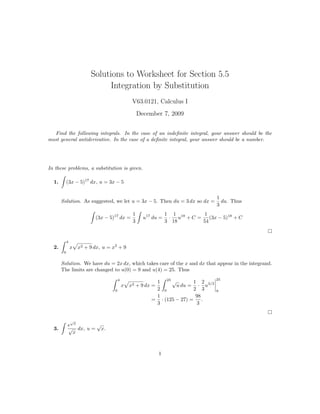
  1.        (3x − 5)17 dx, u = 3x − 5


                                                                                   1
       Solution. As suggested, we let u = 3x − 5. Then du = 3 dx so dx =             du. Thus
                                                                                   3
                                                1                1 1 18     1
                           (3x − 5)17 dx =            u17 du =    · u +C =    (3x − 5)18 + C
                                                3                3 18      54


            4
  2.            x   x2 + 9 dx, u = x2 + 9
        0


       Solution. We have du = 2x dx, which takes care of the x and dx that appear in the integrand.
       The limits are changed to u(0) = 9 and u(4) = 25. Thus
                                        4                                         25
                                                          1 25 √          1 2
                                            x x2 + 9 dx =         u du = · u3/2
                                    0                     2 9             2 3     9
                                                          1                98
                                                         = · (125 − 27) =     .
                                                          3                 3


                √
            e x      √
  3.        √ dx, u = x.
              x


                                                            1
1
       Solution. We have du = √ dx, which means that
                             2 x
                                                 √
                                                e x
                                                √ dx = 2          eu du = 2eu + C
                                                  x


          cos 3x dx
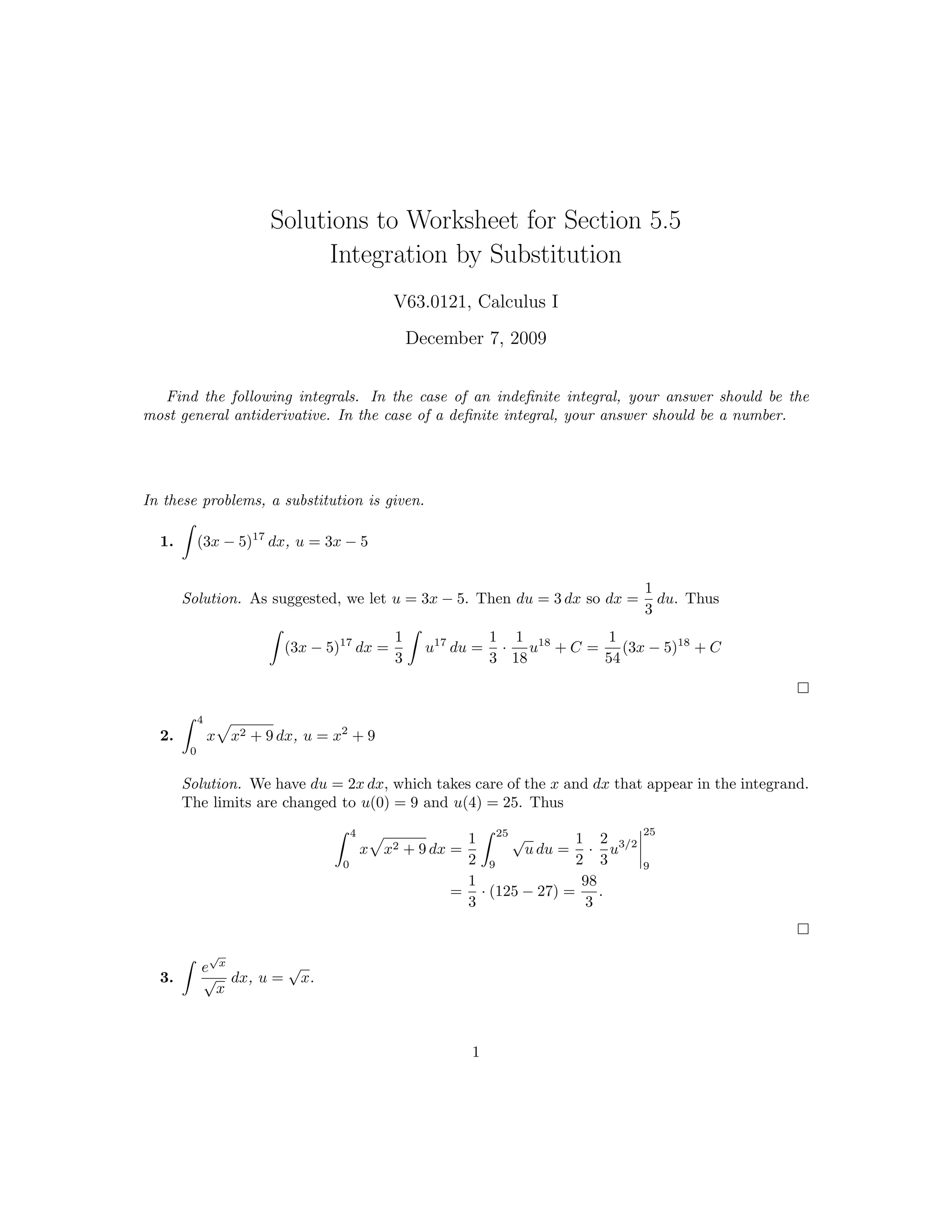
  4.                  , u = 5 + 2 sin 3x
         5 + 2 sin 3x

       Solution. We have du = 6 cos 3x dx, so
                               cos 3x dx     1       du  1            1
                                           =            = ln |u| + C = ln |5 + 2 sin 3x| + C
                              5 + 2 sin 3x   6        u  6            6


In these problems, you need to determine the substitution yourself.

  5.     (4 − 3x)7 dx.

                                                          1
       Solution. Let u = 4 − 3x, so du = −3x dx and dx = − du. Thus
                                                          3
                                                 1                   u8         1
                              (4 − 3x)7 dx = −         u7 du = −        + C = − (4 − 3x)8 + C
                                                 3                   24        24


         π/3
  6.           csc2 (5x) dx
        π/4

                                                                 1
       Solution. Let u = 5x, so du = 5 dx and dx =                 du. So
                                                                 5
                                      π/3                         5π/3
                                                             1
                                            csc2 (5x) dx =               csc2 u du
                                     π/4                     5   5π/4
                                                                           5π/3
                                                                 1
                                                        =−         cot u
                                                                 5         5π/4
                                                             1  5π                    5π
                                                        =      cot            − cot
                                                             5   4                     3
                                                               √
                                                          1      3
                                                        =   1+
                                                          5     3


                                                             2
3
                         −1
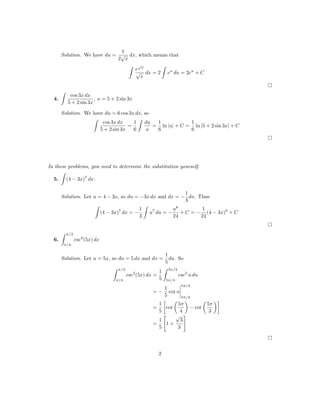
  7.        x2 e3x            dx


                                                                          1
       Solution. Let u = 3x3 − 1, so du = 9x2 dx and dx =                   du. So
                                                                          9
                                                   3
                                                       −1      1          1
                                          x2 e3x            dx =   eu du = eu + C
                                                               9          9
                                                               1 3x3 −1
                                                              = e       .
                                                               9


Sometimes there is more than one way to skin a cat:
                      x
  8. Find                dx, both by long division and by substituting u = 1 + x.
                     1+x

       Solution. Long division yields
                                                         x       1
                                                            =1−
                                                        1+x     1+x
       So
                                                        x                   dx
                                                           dx = x −
                                                       1+x                 1+x
       To find the leftover integral, let u = 1 + x. Then du = dx and so
                                                dx                 du
                                                   =                  = ln |u| + C
                                               1+x                  u
       Therefore
                                               x
                                                  dx = x − ln |x + 1| + C
                                              1+x
       Making the substitution immediately gives du = dx and x = u − 1. So

                                         x                    u−1                    1
                                            dx =                  du =        1−         du
                                        1+x                    u                     u
                                                       = u − ln |u| + C
                                                       = x + 1 − ln |x + 1| + C

       It may appear that the two solutions are “different.” But the difference is a constant, and we
       know that antiderivatives are only unique up to addition of a constant.

                       2z dz
                              , both by substituting u = z 2 + 1 and u =
                                                                                3
  9. Find            √
                     3
                                                                                    z 2 + 1.
                       z2 + 1


                                                               3
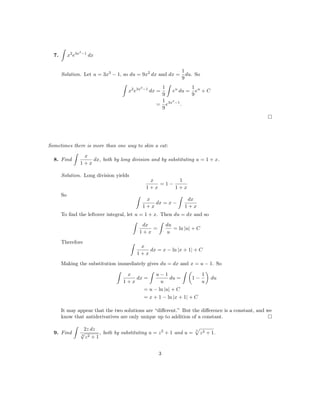
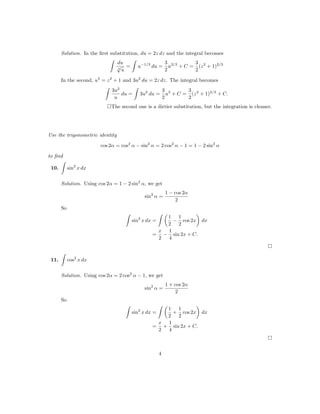
Solution. In the first substitution, du = 2z dz and the integral becomes
                                 du                       3 2/3    3
                                 √ =     u−1/3 du =         u + C = (z 2 + 1)2/3
                                 3
                                   u                      2        2

       In the second, u3 = z 2 + 1 and 3u2 du = 2z dz. The integral becomes
                             3u2                         3 3      3
                                 du =     3u2 du =         u + C = (z 2 + 1)2/3 + C.
                              u                          2        2
                             The second one is a dirtier substitution, but the integration is cleaner.


Use the trigonometric identity

                        cos 2α = cos2 α − sin2 α = 2 cos2 α − 1 = 1 − 2 sin2 α

to find

 10.        sin2 x dx


       Solution. Using cos 2α = 1 − 2 sin2 α, we get
                                                          1 − cos 2α
                                            sin2 α =
                                                              2
       So
                                                   1 1
                                       sin2 x dx =   − cos 2x dx
                                                   2 2
                                                 x 1
                                                = − sin 2x + C.
                                                 2 4


 11.        cos2 x dx

       Solution. Using cos 2α = 2 cos2 α − 1, we get
                                                          1 + cos 2α
                                            sin2 α =
                                                              2
       So
                                                   1 1
                                       sin2 x dx =   + cos 2x dx
                                                   2 2
                                                 x 1
                                                = + sin 2x + C.
                                                 2 4


                                                     4
12.   Find
                                              sec x dx

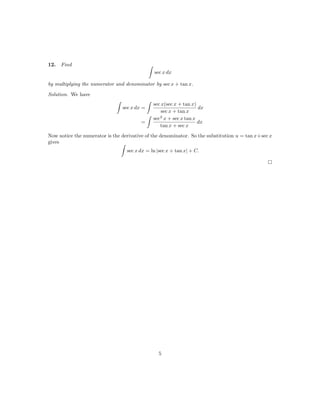
by multiplying the numerator and denominator by sec x + tan x.
Solution. We have
                                              sec x(sec x + tan x)
                                sec x dx =                         dx
                                                  sec x + tan x
                                              sec2 x + sec x tan x
                                        =                          dx
                                                 tan x + sec x
Now notice the numerator is the derivative of the denominator. So the substitution u = tan x+sec x
gives
                                  sec x dx = ln |sec x + tan x| + C.


                                                5

Lesson 29: Integration by Substition (worksheet solutions)

  • 1.
    Solutions to Worksheetfor Section 5.5 Integration by Substitution V63.0121, Calculus I December 7, 2009 Find the following integrals. In the case of an indefinite integral, your answer should be the most general antiderivative. In the case of a definite integral, your answer should be a number. In these problems, a substitution is given. 1. (3x − 5)17 dx, u = 3x − 5 1 Solution. As suggested, we let u = 3x − 5. Then du = 3 dx so dx = du. Thus 3 1 1 1 18 1 (3x − 5)17 dx = u17 du = · u +C = (3x − 5)18 + C 3 3 18 54 4 2. x x2 + 9 dx, u = x2 + 9 0 Solution. We have du = 2x dx, which takes care of the x and dx that appear in the integrand. The limits are changed to u(0) = 9 and u(4) = 25. Thus 4 25 1 25 √ 1 2 x x2 + 9 dx = u du = · u3/2 0 2 9 2 3 9 1 98 = · (125 − 27) = . 3 3 √ e x √ 3. √ dx, u = x. x 1
  • 2.
    1 Solution. We have du = √ dx, which means that 2 x √ e x √ dx = 2 eu du = 2eu + C x cos 3x dx 4. , u = 5 + 2 sin 3x 5 + 2 sin 3x Solution. We have du = 6 cos 3x dx, so cos 3x dx 1 du 1 1 = = ln |u| + C = ln |5 + 2 sin 3x| + C 5 + 2 sin 3x 6 u 6 6 In these problems, you need to determine the substitution yourself. 5. (4 − 3x)7 dx. 1 Solution. Let u = 4 − 3x, so du = −3x dx and dx = − du. Thus 3 1 u8 1 (4 − 3x)7 dx = − u7 du = − + C = − (4 − 3x)8 + C 3 24 24 π/3 6. csc2 (5x) dx π/4 1 Solution. Let u = 5x, so du = 5 dx and dx = du. So 5 π/3 5π/3 1 csc2 (5x) dx = csc2 u du π/4 5 5π/4 5π/3 1 =− cot u 5 5π/4 1 5π 5π = cot − cot 5 4 3 √ 1 3 = 1+ 5 3 2
  • 3.
    3 −1 7. x2 e3x dx 1 Solution. Let u = 3x3 − 1, so du = 9x2 dx and dx = du. So 9 3 −1 1 1 x2 e3x dx = eu du = eu + C 9 9 1 3x3 −1 = e . 9 Sometimes there is more than one way to skin a cat: x 8. Find dx, both by long division and by substituting u = 1 + x. 1+x Solution. Long division yields x 1 =1− 1+x 1+x So x dx dx = x − 1+x 1+x To find the leftover integral, let u = 1 + x. Then du = dx and so dx du = = ln |u| + C 1+x u Therefore x dx = x − ln |x + 1| + C 1+x Making the substitution immediately gives du = dx and x = u − 1. So x u−1 1 dx = du = 1− du 1+x u u = u − ln |u| + C = x + 1 − ln |x + 1| + C It may appear that the two solutions are “different.” But the difference is a constant, and we know that antiderivatives are only unique up to addition of a constant. 2z dz , both by substituting u = z 2 + 1 and u = 3 9. Find √ 3 z 2 + 1. z2 + 1 3
  • 4.
    Solution. In thefirst substitution, du = 2z dz and the integral becomes du 3 2/3 3 √ = u−1/3 du = u + C = (z 2 + 1)2/3 3 u 2 2 In the second, u3 = z 2 + 1 and 3u2 du = 2z dz. The integral becomes 3u2 3 3 3 du = 3u2 du = u + C = (z 2 + 1)2/3 + C. u 2 2 The second one is a dirtier substitution, but the integration is cleaner. Use the trigonometric identity cos 2α = cos2 α − sin2 α = 2 cos2 α − 1 = 1 − 2 sin2 α to find 10. sin2 x dx Solution. Using cos 2α = 1 − 2 sin2 α, we get 1 − cos 2α sin2 α = 2 So 1 1 sin2 x dx = − cos 2x dx 2 2 x 1 = − sin 2x + C. 2 4 11. cos2 x dx Solution. Using cos 2α = 2 cos2 α − 1, we get 1 + cos 2α sin2 α = 2 So 1 1 sin2 x dx = + cos 2x dx 2 2 x 1 = + sin 2x + C. 2 4 4
  • 5.
    12. Find sec x dx by multiplying the numerator and denominator by sec x + tan x. Solution. We have sec x(sec x + tan x) sec x dx = dx sec x + tan x sec2 x + sec x tan x = dx tan x + sec x Now notice the numerator is the derivative of the denominator. So the substitution u = tan x+sec x gives sec x dx = ln |sec x + tan x| + C. 5