Unsolved Mathematics Problems
K.THIYAGU
Assistant Professor
Department of Education
Central University of Kerala, Kasaragod
Catalan’s Conjecture
An integer is a perfect power if it is of the form m^n where m and n are
integers and n>1. It is conjectured that 8=2^3 and 9=3^2 are the only
consecutive integers that are perfect powers. The conjecture was finally proved
by Preda Mihailescu in a manuscript privately circulated on April 18, 2002.
Are 8 and 9 the only consecutive perfect powers?
CC-BY-SA (Unsolved Problems) 2
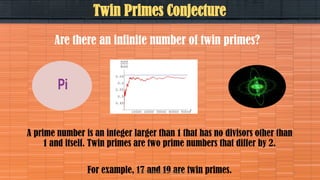
Twin Primes Conjecture
A prime number is an integer larger than 1 that has no divisors other than
1 and itself. Twin primes are two prime numbers that differ by 2.
For example, 17 and 19 are twin primes.
Are there an infinite number of twin primes?
CC-BY-SA (Unsolved Problems) 3
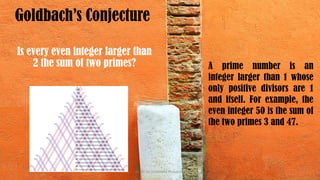
Goldbach’s Conjecture
Is every even integer larger than
2 the sum of two primes? A prime number is an
integer larger than 1 whose
only positive divisors are 1
and itself. For example, the
even integer 50 is the sum of
the two primes 3 and 47.
CC-BY-SA (Unsolved Problems) 4
Odd Perfect Numbers
A perfect number is a positive
integer that is equal to the sum of
all its positive divisors, other than
itself. For example, 28 is perfect
because 28=1+2+4+7+14.
Are there any odd perfect numbers?
CC-BY-SA (Unsolved Problems) 5
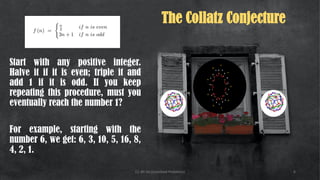
The Collatz Conjecture
Start with any positive integer.
Halve it if it is even; triple it and
add 1 if it is odd. If you keep
repeating this procedure, must you
eventually reach the number 1?
For example, starting with the
number 6, we get: 6, 3, 10, 5, 16, 8,
4, 2, 1.
CC-BY-SA (Unsolved Problems) 6
Expressing 3 as the Sum of Three Cubes
The number 3 can be written as
1^3+1^3+1^3
and also as
4^3+4^3+(-5)^3.
Is there any other way of
expressing 3 as the sum of three
(positive or negative) cubes?
CC-BY-SA (Unsolved Problems) 7
Diophantine Equation of Degree Five
Are there distinct positive integers,
a, b, c, and, d such that
a^5+b^5=c^5+d^5?
It is known that
1^3+12^3=9^3+10^3 and
133^4+134^4=59^4+158^4,
but no similar relation is known for fifth powers.
CC-BY-SA (Unsolved Problems) 8
Thank You
K.THIYAGU
Assistant Professor
Department of Education
Central University of Kerala, Kasaragod
CC-BY-SA (Unsolved Problems) 9

Unsolved Mathematical Problems

  • 1.
    Unsolved Mathematics Problems K.THIYAGU AssistantProfessor Department of Education Central University of Kerala, Kasaragod
  • 2.
    Catalan’s Conjecture An integeris a perfect power if it is of the form m^n where m and n are integers and n>1. It is conjectured that 8=2^3 and 9=3^2 are the only consecutive integers that are perfect powers. The conjecture was finally proved by Preda Mihailescu in a manuscript privately circulated on April 18, 2002. Are 8 and 9 the only consecutive perfect powers? CC-BY-SA (Unsolved Problems) 2
  • 3.
    Twin Primes Conjecture Aprime number is an integer larger than 1 that has no divisors other than 1 and itself. Twin primes are two prime numbers that differ by 2. For example, 17 and 19 are twin primes. Are there an infinite number of twin primes? CC-BY-SA (Unsolved Problems) 3
  • 4.
    Goldbach’s Conjecture Is everyeven integer larger than 2 the sum of two primes? A prime number is an integer larger than 1 whose only positive divisors are 1 and itself. For example, the even integer 50 is the sum of the two primes 3 and 47. CC-BY-SA (Unsolved Problems) 4
  • 5.
    Odd Perfect Numbers Aperfect number is a positive integer that is equal to the sum of all its positive divisors, other than itself. For example, 28 is perfect because 28=1+2+4+7+14. Are there any odd perfect numbers? CC-BY-SA (Unsolved Problems) 5
  • 6.
    The Collatz Conjecture Startwith any positive integer. Halve it if it is even; triple it and add 1 if it is odd. If you keep repeating this procedure, must you eventually reach the number 1? For example, starting with the number 6, we get: 6, 3, 10, 5, 16, 8, 4, 2, 1. CC-BY-SA (Unsolved Problems) 6
  • 7.
    Expressing 3 asthe Sum of Three Cubes The number 3 can be written as 1^3+1^3+1^3 and also as 4^3+4^3+(-5)^3. Is there any other way of expressing 3 as the sum of three (positive or negative) cubes? CC-BY-SA (Unsolved Problems) 7
  • 8.
    Diophantine Equation ofDegree Five Are there distinct positive integers, a, b, c, and, d such that a^5+b^5=c^5+d^5? It is known that 1^3+12^3=9^3+10^3 and 133^4+134^4=59^4+158^4, but no similar relation is known for fifth powers. CC-BY-SA (Unsolved Problems) 8
  • 9.
    Thank You K.THIYAGU Assistant Professor Departmentof Education Central University of Kerala, Kasaragod CC-BY-SA (Unsolved Problems) 9