Chapter 1 Lesson 1 Your First Trip to the Number Line Copyright 2010 MIND Research Institute  For use only by licensed users EE.1 Understand that an expression is a path to a point on the number line. EE.2 Understand that an equation is a statement that two expressions are equal. EE.3 Understand that a variable represents an unknown or unspecified number. EE.4 Represent expressions and equations with number line diagrams. Translate number line representations of expressions and equations into symbolic notation.
Objectives Use variables in simple expressions and equations. Represent expressions and equations on the number line.
Remember from Before How do symbolic notation and the number line fit into our strategy for success this year?
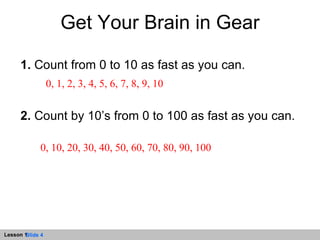
Get Your Brain in Gear 1.  Count from 0 to 10 as fast as you can. 2.  Count by 10’s from 0 to 100 as fast as you can. 0, 10, 20, 30, 40, 50, 60, 70, 80, 90, 100 0, 1, 2, 3, 4, 5, 6, 7, 8, 9, 10
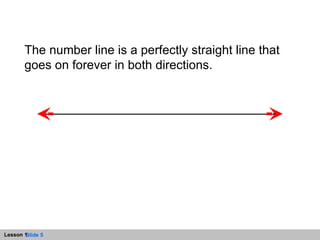
The number line is a perfectly straight line that goes on forever in both directions.
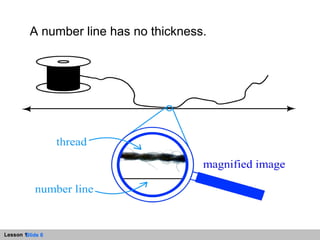
A number line has no thickness.
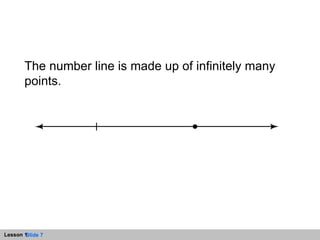
The number line is made up of infinitely many points.
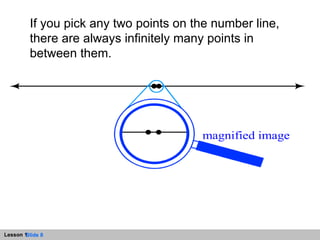
If you pick any two points on the number line, there are always infinitely many points in between them.
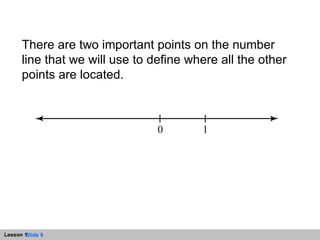
There are two important points on the number line that we will use to define where all the other points are located.
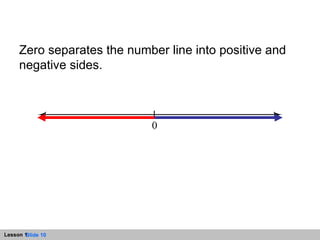
Zero separates the number line into positive and negative sides.
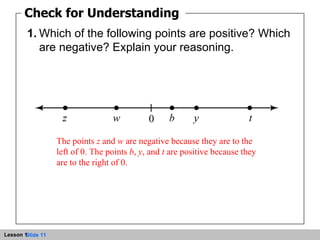
Check for Understanding 1 1. Which of the following points are positive? Which are negative? Explain your reasoning. Check for Understanding The points  z  and  w  are negative because they are to the left of 0. The points  b ,  y , and  t  are positive because they are to the right of 0.
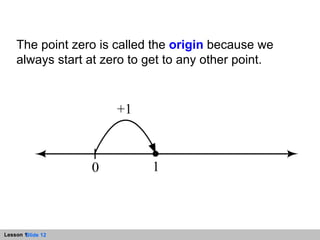
The point zero is called the  origin  because we always start at zero to get to any other point.
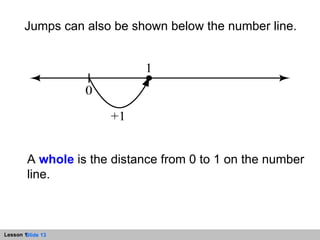
Jumps can also be shown below the number line. A  whole  is the distance from 0 to 1 on the number line.
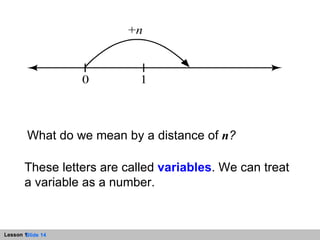
What do we mean by a distance of  n ? These letters are called  variables . We can treat a variable as a number.
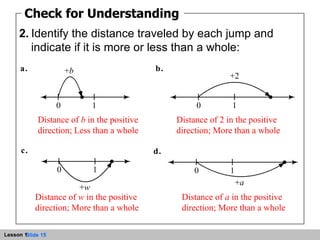
2. Identify the distance traveled by each jump and indicate if it is more or less than a whole: Check for Understanding Distance of  b  in the positive direction; Less than a whole Distance of 2 in the positive direction; More than a whole Distance of  w  in the positive direction; More than a whole Distance of  a  in the positive direction; More than a whole
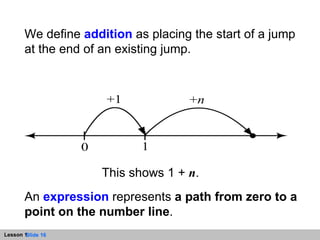
We define  addition  as placing the start of a jump at the end of an existing jump. This shows 1 +  n . An  expression  represents  a path from zero to a point on the number line .
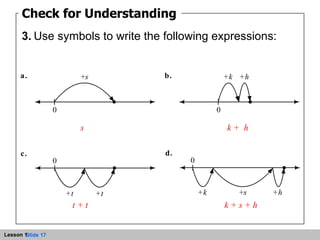
3. Use symbols to write the following expressions: Check for Understanding s k +  h t + t k + s + h
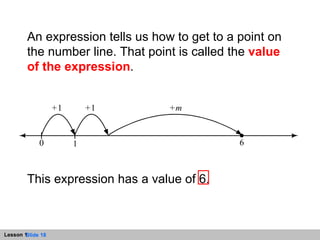
An expression tells us how to get to a point on the number line. That point is called the  value of the expression . This expression has a value of 6.
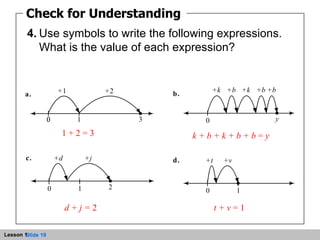
4. Use symbols to write the following expressions. What is the value of each expression? Check for Understanding 1 + 2 = 3 k + b + k + b + b  =  y d + j =  2 t + v  = 1
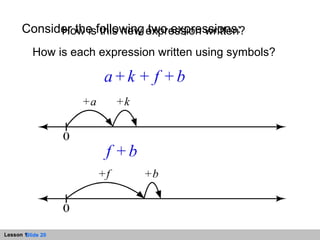
How is this new expression written? How is each expression written using symbols? Consider the following two expressions:
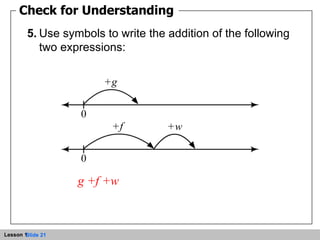
Check for Understanding 5 5. Use symbols to write the addition of the following two expressions: Check for Understanding g +f +w
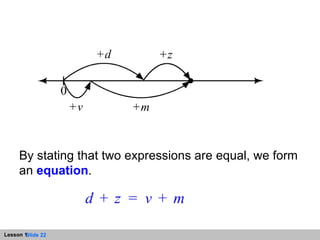
By stating that two expressions are equal, we form an  equation .
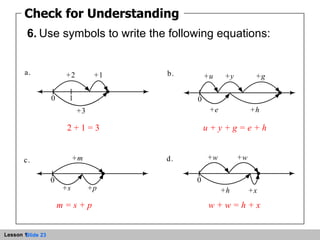
6. Use symbols to write the following equations: Check for Understanding 2 + 1 = 3 u + y + g = e + h m = s + p w + w = h + x
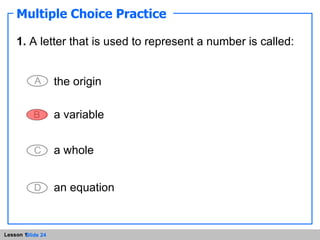
Multiple Choice Practice 1.  A letter that is used to represent a number is called:  the origin a variable a whole an equation
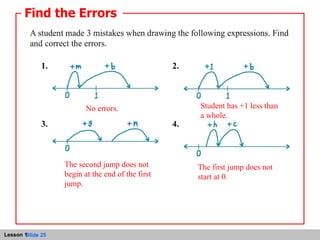
Find the Errors 1 Find the Errors No errors. The second jump does not begin at the end of the first jump.  Student has +1 less than a whole. The first jump does not start at 0.

Lesson 1

  • 1.
    Chapter 1 Lesson1 Your First Trip to the Number Line Copyright 2010 MIND Research Institute For use only by licensed users EE.1 Understand that an expression is a path to a point on the number line. EE.2 Understand that an equation is a statement that two expressions are equal. EE.3 Understand that a variable represents an unknown or unspecified number. EE.4 Represent expressions and equations with number line diagrams. Translate number line representations of expressions and equations into symbolic notation.
  • 2.
    Objectives Use variablesin simple expressions and equations. Represent expressions and equations on the number line.
  • 3.
    Remember from BeforeHow do symbolic notation and the number line fit into our strategy for success this year?
  • 4.
    Get Your Brainin Gear 1. Count from 0 to 10 as fast as you can. 2. Count by 10’s from 0 to 100 as fast as you can. 0, 10, 20, 30, 40, 50, 60, 70, 80, 90, 100 0, 1, 2, 3, 4, 5, 6, 7, 8, 9, 10
  • 5.
    The number lineis a perfectly straight line that goes on forever in both directions.
  • 6.
    A number linehas no thickness.
  • 7.
    The number lineis made up of infinitely many points.
  • 8.
    If you pickany two points on the number line, there are always infinitely many points in between them.
  • 9.
    There are twoimportant points on the number line that we will use to define where all the other points are located.
  • 10.
    Zero separates thenumber line into positive and negative sides.
  • 11.
    Check for Understanding1 1. Which of the following points are positive? Which are negative? Explain your reasoning. Check for Understanding The points z and w are negative because they are to the left of 0. The points b , y , and t are positive because they are to the right of 0.
  • 12.
    The point zerois called the origin because we always start at zero to get to any other point.
  • 13.
    Jumps can alsobe shown below the number line. A whole is the distance from 0 to 1 on the number line.
  • 14.
    What do wemean by a distance of n ? These letters are called variables . We can treat a variable as a number.
  • 15.
    2. Identify thedistance traveled by each jump and indicate if it is more or less than a whole: Check for Understanding Distance of b in the positive direction; Less than a whole Distance of 2 in the positive direction; More than a whole Distance of w in the positive direction; More than a whole Distance of a in the positive direction; More than a whole
  • 16.
    We define addition as placing the start of a jump at the end of an existing jump. This shows 1 + n . An expression represents a path from zero to a point on the number line .
  • 17.
    3. Use symbolsto write the following expressions: Check for Understanding s k + h t + t k + s + h
  • 18.
    An expression tellsus how to get to a point on the number line. That point is called the value of the expression . This expression has a value of 6.
  • 19.
    4. Use symbolsto write the following expressions. What is the value of each expression? Check for Understanding 1 + 2 = 3 k + b + k + b + b = y d + j = 2 t + v = 1
  • 20.
    How is thisnew expression written? How is each expression written using symbols? Consider the following two expressions:
  • 21.
    Check for Understanding5 5. Use symbols to write the addition of the following two expressions: Check for Understanding g +f +w
  • 22.
    By stating thattwo expressions are equal, we form an equation .
  • 23.
    6. Use symbolsto write the following equations: Check for Understanding 2 + 1 = 3 u + y + g = e + h m = s + p w + w = h + x
  • 24.
    Multiple Choice Practice1. A letter that is used to represent a number is called: the origin a variable a whole an equation
  • 25.
    Find the Errors1 Find the Errors No errors. The second jump does not begin at the end of the first jump. Student has +1 less than a whole. The first jump does not start at 0.

Editor's Notes

  • #6 Page 8 -We can draw only a small part of it here: The arrows drawn at the ends mean the line continues on and on forever.
  • #7 Page 8 -Normal things in the world have thickness, but a number line has no thickness.
  • #8 Page 8 -To show a number on the number line it will be marked with a dash or a dot. Each unique point represents a unique number.
  • #9 Page 9 -No two points touch each other.
  • #10 - Page 9 -These important points are the numbers 0 and 1.
  • #11 Page 9 -The zero point is sometimes called the origin. -Zero is neither positive or negative. -Going to the right takes you in the positive ( + ) direction. These numbers to the right of zero are called positive numbers. -Going to the left takes you in the negative ( - ) direction. These numbers to the left of zero are called negative numbers.
  • #12 Page 9
  • #13 Page 9 - Origin means “the place where something begins”. -In this book we will move along the number line using jumps. -A jump is indicated by a curved arrow. Here is a jump that takes us from zero to one. -The distance traveled is shown above the jump.
  • #14 Page 10 - Jumps can also be shown below the number line. -The distance of +1 is called a whole .
  • #15 Page 10 -The following jump has a distance of more than a whole. -In math, we use letters to represent unknown values.
  • #16 Page 10 The jump traveled a distance of b in the positive direction. This is less than a whole since the jump ends to the left of 1. The jump traveled a distance of 2 in the positive direction. This is more than a whole since the jump ends to the right of 1. The jump traveled a distance of w in the positive direction. This is more than a whole since the jump ends to the right of 1. The jump traveled a distance of a in the positive direction. This is more than a whole since the jump ends to the right of 1.
  • #17 Page 11 -The + sign represents addition because we are adding +1 and + n together. -1 + n is an expression . An expression represents a path from zero to a point on the number line.
  • #18 Page 11
  • #19 Page 11 -We can write the expression as 1 + 1 + m . -The value is 6 because the final jump lands on 6.
  • #20 Page 11
  • #21 Page 12 -When added together, we get a new expression -Adding two expressions means placing the start of one expression at the end of another expression.
  • #22 Page 12
  • #23 Page 13 -When two expressions arrive at the same point on the number line, we say that the expressions are equal. - An equation states that two expressions lead to the same point on the number line.
  • #24 Page 13
  • #25 Page 16
  • #26 Page 16