Welcome
Multiculturalism
Group Members
 Reyad Hossain
 Faeeza Ahmed Miftah
 Sharmin Akhter Natasha
 Mahiuddin Jaber
 Shammi Islam
Key Contents:
 Introduction
 Understanding Multiculturalism
 Moral Monism & Multiculturalism
 Multiculturalism as a way of cultural diversity
 Theories of Multiculturalism
 The political structure of Multicultural society
 Multiculturalism in USA
 Multiculturalism in Bangladesh
 Multicultural recognition and Ethnic Minority rights
 Conclusion
Introduction
 The term multiculturalism has a range of meanings within the contexts of
sociology, of political philosophy, and of everyday use. In sociology and in
everyday usage, it is a synonym for "ethnic pluralism“.
 It can describe a mixed ethnic community area where multiple cultural traditions
exist or a single country within which they do.
 In reference to sociology, multiculturalism is the end-state of either a natural or
artificial process and occurs on either a large national scale or on a smaller scale
within a nation's communities.
 On a smaller scale this can occur artificially when a jurisdiction is established or
expanded by combining areas with two or more different cultures .
 On a large scale, it can occur as a result of either legal or illegal migration to and
from different jurisdictions around the world.
Multiculturalism
 Multiculturalism, the view that cultures, races, and ethnicity, particularly those of
minority groups, deserve special acknowledgement of their differences within a
dominant political culture. (Encyclopedia Britannica)
 Multiculturalism is a situation in which all the different cultural or racial groups in
a society have equal rights and opportunities, and none is ignored or regarded
as unimportant.
(Collins dictionary)
 Multiculturalism refers to the state of affairs present in contemporary societies:
of cultural diversity. (Oxford Research Encyclopedias)
Moral Monism is a philosophy of morality that
basically asserts a single framework for
morality that applies to all people, in all
places, at all times. It states that this moral
framework is objectively true regardless of
whether or not anyone accurately recognizes
it.
Moral Monism
The policy or practice of giving equal
attention or representation to the cultural
needs and contributions of all the groups in a
society: special emphasis may be given to
minority groups underrepresented in the past,
as through bilingual education.
Multiculturalism
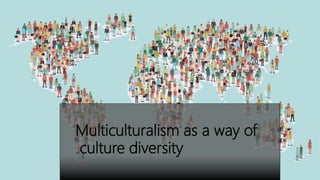
Multiculturalism as a way of
culture diversity
Theories of multiculturailsm
Taylor (1994b, p. 37) mainly discusses the idea of public
recognition or recognition in the public sphere. This form of
recognition is about respect and esteem for one’s identity in
the public realm; being misrecognized in the public realm
means to have one’s identity disrespected in a way whereby
one is treated as a second-class citizen
Taylor's Politics of Recognition
In Kymlicka’s perspective
(1995, p. 80), societal cultures
promote freedom. From
Kymlicka’s point of view, the
reason why societal cultures
are important for freedom is
because they give individuals
the groundwork from which
they can make choices.
 According to Shachar, this
model relies on four
assumptions. First,
individuals have a
multiplicity of identities.
For example, Malcolm X
was a Muslim, a male, an
African-American, and a
heterosexual.
 Shachar's
Transformative
Accommodation
The second assumption is that both the group
and the state have normative and legal reasons to
shape behavior. There may be a variety of reasons
for this, but at least one of them is that individuals
have a strong interest both in preserving their
cultures and protecting their individual rights.
Third, both what the state and the group
do impact on each other.
 Fourth, both the state and the group
have an interest in supporting their
members (Shachar, 2001a, p. 118).
Political Structure of Multiculturalism
 The term multiculturalism has a range of meanings within the contexts of sociology,
of political philosophy, and of colloquial use. Multiculturalism as apolitical philosophy involves
ideologies and policies which vary widely.
 Since the 1960s, The America government has admitted, encouraged and supported cultural
diversity. Fair policies allowed all citizens to have the right to preserve their cultural inheritance.

 In the political philosophy of multiculturalism, ideas are focused on the ways in which societies are
either believed to or should, respond to cultural and religious differences. It is often associated with
"identity politics", "the politics of difference", and "the politics of recognition".
Multiculturalism in USA
 In the United States, multiculturalism is not clearly established in policy at the federal level, but ethnic
diversity is common in both rural and urban areas.
 Continuous mass immigration was a feature of the United States economy and society since the first
half of the 19th century.
 The educational approach to multiculturalism has since spread
to the grade school system, as school systems try to rework
their curricula to introduce students to diversity earlier – often
on the grounds that it is important for minority students to see
themselves represented in the classroom.
 Studies estimated 46 million Americans ages 14 to 24 to be
the most diverse generation in American society.
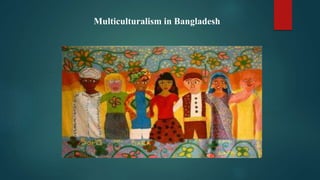
Multiculturalism in Bangladesh
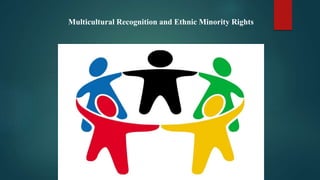
Multicultural Recognition and Ethnic Minority Rights
Multiculturism
Multiculturism
Multiculturism

Multiculturism

  • 1.
  • 2.
  • 3.
    Group Members  ReyadHossain  Faeeza Ahmed Miftah  Sharmin Akhter Natasha  Mahiuddin Jaber  Shammi Islam
  • 4.
    Key Contents:  Introduction Understanding Multiculturalism  Moral Monism & Multiculturalism  Multiculturalism as a way of cultural diversity  Theories of Multiculturalism  The political structure of Multicultural society  Multiculturalism in USA  Multiculturalism in Bangladesh  Multicultural recognition and Ethnic Minority rights  Conclusion
  • 5.
    Introduction  The termmulticulturalism has a range of meanings within the contexts of sociology, of political philosophy, and of everyday use. In sociology and in everyday usage, it is a synonym for "ethnic pluralism“.  It can describe a mixed ethnic community area where multiple cultural traditions exist or a single country within which they do.  In reference to sociology, multiculturalism is the end-state of either a natural or artificial process and occurs on either a large national scale or on a smaller scale within a nation's communities.  On a smaller scale this can occur artificially when a jurisdiction is established or expanded by combining areas with two or more different cultures .  On a large scale, it can occur as a result of either legal or illegal migration to and from different jurisdictions around the world.
  • 6.
    Multiculturalism  Multiculturalism, theview that cultures, races, and ethnicity, particularly those of minority groups, deserve special acknowledgement of their differences within a dominant political culture. (Encyclopedia Britannica)  Multiculturalism is a situation in which all the different cultural or racial groups in a society have equal rights and opportunities, and none is ignored or regarded as unimportant. (Collins dictionary)  Multiculturalism refers to the state of affairs present in contemporary societies: of cultural diversity. (Oxford Research Encyclopedias)

  • 7.
    Moral Monism isa philosophy of morality that basically asserts a single framework for morality that applies to all people, in all places, at all times. It states that this moral framework is objectively true regardless of whether or not anyone accurately recognizes it. Moral Monism
  • 8.
    The policy orpractice of giving equal attention or representation to the cultural needs and contributions of all the groups in a society: special emphasis may be given to minority groups underrepresented in the past, as through bilingual education. Multiculturalism
  • 9.
    Multiculturalism as away of culture diversity
  • 10.
  • 11.
    Taylor (1994b, p.37) mainly discusses the idea of public recognition or recognition in the public sphere. This form of recognition is about respect and esteem for one’s identity in the public realm; being misrecognized in the public realm means to have one’s identity disrespected in a way whereby one is treated as a second-class citizen Taylor's Politics of Recognition
  • 12.
    In Kymlicka’s perspective (1995,p. 80), societal cultures promote freedom. From Kymlicka’s point of view, the reason why societal cultures are important for freedom is because they give individuals the groundwork from which they can make choices.
  • 13.
     According toShachar, this model relies on four assumptions. First, individuals have a multiplicity of identities. For example, Malcolm X was a Muslim, a male, an African-American, and a heterosexual.  Shachar's Transformative Accommodation
  • 14.
    The second assumptionis that both the group and the state have normative and legal reasons to shape behavior. There may be a variety of reasons for this, but at least one of them is that individuals have a strong interest both in preserving their cultures and protecting their individual rights.
  • 15.
    Third, both whatthe state and the group do impact on each other.  Fourth, both the state and the group have an interest in supporting their members (Shachar, 2001a, p. 118).
  • 16.
    Political Structure ofMulticulturalism  The term multiculturalism has a range of meanings within the contexts of sociology, of political philosophy, and of colloquial use. Multiculturalism as apolitical philosophy involves ideologies and policies which vary widely.  Since the 1960s, The America government has admitted, encouraged and supported cultural diversity. Fair policies allowed all citizens to have the right to preserve their cultural inheritance.  In the political philosophy of multiculturalism, ideas are focused on the ways in which societies are either believed to or should, respond to cultural and religious differences. It is often associated with "identity politics", "the politics of difference", and "the politics of recognition".

  • 17.
    Multiculturalism in USA In the United States, multiculturalism is not clearly established in policy at the federal level, but ethnic diversity is common in both rural and urban areas.  Continuous mass immigration was a feature of the United States economy and society since the first half of the 19th century.  The educational approach to multiculturalism has since spread to the grade school system, as school systems try to rework their curricula to introduce students to diversity earlier – often on the grounds that it is important for minority students to see themselves represented in the classroom.  Studies estimated 46 million Americans ages 14 to 24 to be the most diverse generation in American society.
  • 18.
  • 19.
    Multicultural Recognition andEthnic Minority Rights