Speech and Theater
Arts
Prepared by: Ms. Aira Mae R. Sarita
Lesson 1: Speech Arts
– An Overview
Prepared by: Ms. Aira Mae R. Sarita
Educational Background/Qualifications
3
Undergraduate Degree: Bachelor of Secondary Education with specialization in English at
Lyceum of the Philippines University – Cavite
Post Graduate Degree: Master of Arts in English as a Second Language at De La Salle
University – Dasmariñas Cavite (Thesis Writing)
License: Licensed Professional Teacher
Work Experiences:
 Full-Time DepEd Teacher, Research Department Luis Y. Ferrer Jr. Senior High School
 Part-Time Lecturer, Samuel Christian College
 Former Instructor, Department of Arts and Sciences Cavite State University – CCAT
Campus for three years handling major, professional, and general courses.
 Former Instructor, Department of Teacher Education Cavite State University –
General Trias City Campus handled major courses – education.
 Former Part-Time English Lecturer for Civil Service Examination at Community’s
Holistic Qualitative Inc. (CHQ Tutorial and Review Center)
 In-House Reviewer for LET (Competency Appraisal for BSE)
 Accredited English Critic and Research Consultant.
Contents
Review on Speech Sounds
Focus on the
Suprasegmentals as Tools
for Speech and Theater –
Stress, Pitch, Volume,
Enunciation, etc.
Public Speaking
Concepts of Speech and
Communication
Levels of Context of
Communication
Modes of Communication
Review on the
Communication Process
01
02
03
04
05
06
07
Intended Learning Outcomes:
At the end of these weeks, students should
be able to:
 discuss major concepts in speech and
communication contexts, modes, processes, and
the segmentals and suprasegmentals;
 recognize public speaking as a relevant linguistic
activity in society; and
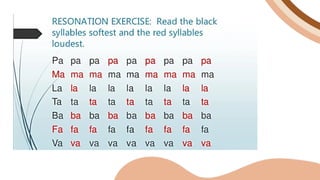
 express speech arts through sound drills,
communication modes and processes simple
simulations, and public speaking tasks.
The Concept of
Communication
Speech
Communication
Speech Communication derived from Latin
"communis", meaning to share.
Defined as a process by which we assign and
convey meaning in an attempt to create shared
understanding. This process requires a vast
repertoire of skills in intrapersonal and
interpersonal processing, listening, observing,
speaking, questioning, analyzing, and
evaluating.
 Communication derived from the Latin word
"common" which means "belonging to many"
and "communico” means to confer with
others.
 The act of conveying meaning to a person or
group of people using a mutually understood
symbols, gestures, behaviors and semiotic
rules.
Levels of
Context of
Communication
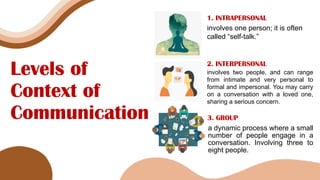
1. INTRAPERSONAL
involves one person; it is often
called “self-talk.”
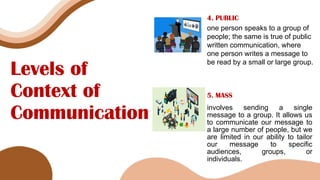
2. INTERPERSONAL
involves two people, and can range
from intimate and very personal to
formal and impersonal. You may carry
on a conversation with a loved one,
sharing a serious concern.
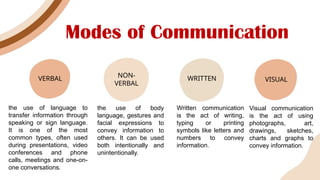
3. GROUP
a dynamic process where a small
number of people engage in a
conversation. Involving three to
eight people.
Levels of
Context of
Communication
4. PUBLIC
one person speaks to a group of
people; the same is true of public
written communication, where
one person writes a message to
be read by a small or large group.
5. MASS
involves sending a single
message to a group. It allows us
to communicate our message to
a large number of people, but we
are limited in our ability to tailor
our message to specific
audiences, groups, or
individuals.
Modes of Communication
the use of language to
transfer information through
speaking or sign language.
It is one of the most
common types, often used
during presentations, video
conferences and phone
calls, meetings and one-on-
one conversations.
the use of body
language, gestures and
facial expressions to
convey information to
others. It can be used
both intentionally and
unintentionally.
Written communication
is the act of writing,
typing or printing
symbols like letters and
numbers to convey
information.
Visual communication
is the act of using
photographs, art,
drawings, sketches,
charts and graphs to
convey information.
VERBAL NON-
VERBAL
WRITTEN VISUAL
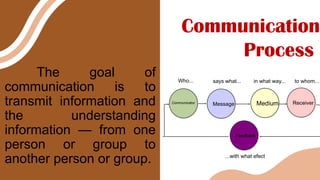
The goal of
communication is to
transmit information and
the understanding
information — from one
person or group to
another person or group.
Communication
Process
Message Medium Receiver
Feedback
Who... says what... in what way... to whom...
...with what efect
Communicator
Characteristics of Communication
 Schemata-driven – begin with what you already know.
 Interpretative act - The role of the receiver is just to interpret
- Does not guarantee a direct or automatic links between two minds
- Knowledge becomes meaningful only when you initiate
communication
 Active, powerful, or forceful - Messages have varied effects on all
participants in any communication event
- Elicits different meaning or reactions; messages are prone to
changes
Characteristics of Communication
 Symbolic - Any objects that represent or stand for ideas
 Irreversible - Once its uttered, its susceptible to different
integration/meanings
 Contextual - Time, place, topic, occasion, purpose and manner of
communication
 Developmental/ progressive - To communicate is to go through
different stages of language learning
 Process - Stages of communication take place when people
exchange ideas with another
 Ethical - Guided by standards agreed upon societal members
Principles of Communication
 Interpersonal communication is inescapable.
 Interpersonal communication is irreversible.
 Interpersonal communication is complicated.
 Interpersonal communication is contextual.
 Psychological context – who you are and what you bring to the interaction.
 Relational context – concerns your reaction to the other person.
 Situational context – deals with the psycho-social where you are
communicating.
 Environmental context – deals with the physical where you are
communicating.
 Cultural context – includes all the learned behaviors and rules that affect the
interaction.
The Speech Production Mechanism
Organs of Speech
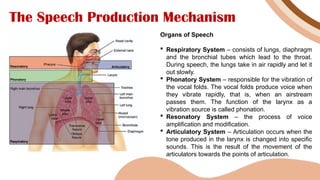
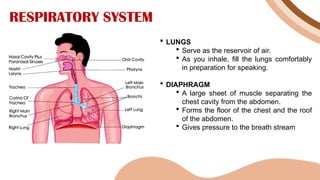
 Respiratory System – consists of lungs, diaphragm
and the bronchial tubes which lead to the throat.
During speech, the lungs take in air rapidly and let it
out slowly.
 Phonatory System – responsible for the vibration of
the vocal folds. The vocal folds produce voice when
they vibrate rapidly, that is, when an airstream
passes them. The function of the larynx as a
vibration source is called phonation.
 Resonatory System – the process of voice
amplification and modification.
 Articulatory System – Articulation occurs when the
tone produced in the larynx is changed into specific
sounds. This is the result of the movement of the
articulators towards the points of articulation.
RESPIRATORY SYSTEM
 LUNGS
 Serve as the reservoir of air.
 As you inhale, fill the lungs comfortably
in preparation for speaking.
 DIAPHRAGM
 A large sheet of muscle separating the
chest cavity from the abdomen.
 Forms the floor of the chest and the roof
of the abdomen.
 Gives pressure to the breath stream
PHONATORY SYSTEM
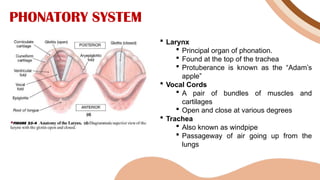
 Larynx
 Principal organ of phonation.
 Found at the top of the trachea
 Protuberance is known as the “Adam’s
apple”
 Vocal Cords
 A pair of bundles of muscles and
cartilages
 Open and close at various degrees
 Trachea
 Also known as windpipe
 Passageway of air going up from the
lungs
RESONATORY SYSTEM
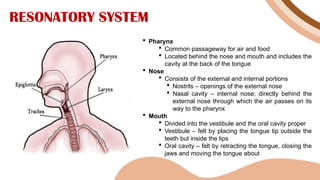
 Pharynx
 Common passageway for air and food
 Located behind the nose and mouth and includes the
cavity at the back of the tongue
 Nose
 Consists of the external and internal portions
 Nostrils – openings of the external nose
 Nasal cavity – internal nose; directly behind the
external nose through which the air passes on its
way to the pharynx
 Mouth
 Divided into the vestibule and the oral cavity proper
 Vestibule – felt by placing the tongue tip outside the
teeth but inside the lips
 Oral cavity – felt by retracting the tongue, closing the
jaws and moving the tongue about
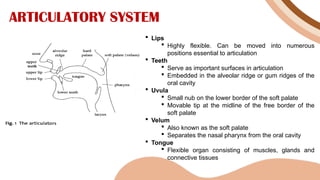
ARTICULATORY SYSTEM
 Lips
 Highly flexible. Can be moved into numerous
positions essential to articulation
 Teeth
 Serve as important surfaces in articulation
 Embedded in the alveolar ridge or gum ridges of the
oral cavity
 Uvula
 Small nub on the lower border of the soft palate
 Movable tip at the midline of the free border of the
soft palate
 Velum
 Also known as the soft palate
 Separates the nasal pharynx from the oral cavity
 Tongue
 Flexible organ consisting of muscles, glands and
connective tissues
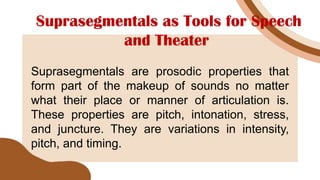
Suprasegmentals as Tools for Speech
and Theater
Suprasegmentals are prosodic properties that
form part of the makeup of sounds no matter
what their place or manner of articulation is.
These properties are pitch, intonation, stress,
and juncture. They are variations in intensity,
pitch, and timing.
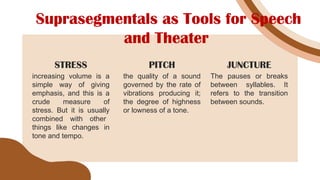
Suprasegmentals as Tools for Speech
and Theater
increasing volume is a
simple way of giving
emphasis, and this is a
crude measure of
stress. But it is usually
combined with other
things like changes in
tone and tempo.
STRESS
the quality of a sound
governed by the rate of
vibrations producing it;
the degree of highness
or lowness of a tone.
PITCH
The pauses or breaks
between syllables. It
refers to the transition
between sounds.
JUNCTURE
Suprasegmentals as Tools for Speech
and Theater
how fast or slow a person
speaks. Rate is part of the
paralanguage of speech along
with loudness and pitch. It is not
language but it accompanies all
of your spoken use of language
and can convey attitude and
emotion.
RATE
how clearly and distinctly a
particular individual forms the
sounds that make up a word.
ENUNCIATION
Public
Speaking
Involves communicating
information before a large audience.
What makes public speaking different
than, say, just talking to a crowd of
people, is in the way information is
conveyed. In public speaking, the
information is purposeful and meant to
inform, influence or entertain a group
of listeners.
End of Presentation!
Thank you!

Lesson 1 Speech Arts – An Overview.pptkx

  • 1.
    Speech and Theater Arts Preparedby: Ms. Aira Mae R. Sarita
  • 2.
    Lesson 1: SpeechArts – An Overview Prepared by: Ms. Aira Mae R. Sarita
  • 3.
    Educational Background/Qualifications 3 Undergraduate Degree:Bachelor of Secondary Education with specialization in English at Lyceum of the Philippines University – Cavite Post Graduate Degree: Master of Arts in English as a Second Language at De La Salle University – Dasmariñas Cavite (Thesis Writing) License: Licensed Professional Teacher Work Experiences:  Full-Time DepEd Teacher, Research Department Luis Y. Ferrer Jr. Senior High School  Part-Time Lecturer, Samuel Christian College  Former Instructor, Department of Arts and Sciences Cavite State University – CCAT Campus for three years handling major, professional, and general courses.  Former Instructor, Department of Teacher Education Cavite State University – General Trias City Campus handled major courses – education.  Former Part-Time English Lecturer for Civil Service Examination at Community’s Holistic Qualitative Inc. (CHQ Tutorial and Review Center)  In-House Reviewer for LET (Competency Appraisal for BSE)  Accredited English Critic and Research Consultant.
  • 4.
    Contents Review on SpeechSounds Focus on the Suprasegmentals as Tools for Speech and Theater – Stress, Pitch, Volume, Enunciation, etc. Public Speaking Concepts of Speech and Communication Levels of Context of Communication Modes of Communication Review on the Communication Process 01 02 03 04 05 06 07
  • 5.
    Intended Learning Outcomes: Atthe end of these weeks, students should be able to:  discuss major concepts in speech and communication contexts, modes, processes, and the segmentals and suprasegmentals;  recognize public speaking as a relevant linguistic activity in society; and  express speech arts through sound drills, communication modes and processes simple simulations, and public speaking tasks.
  • 6.
    The Concept of Communication Speech Communication SpeechCommunication derived from Latin "communis", meaning to share. Defined as a process by which we assign and convey meaning in an attempt to create shared understanding. This process requires a vast repertoire of skills in intrapersonal and interpersonal processing, listening, observing, speaking, questioning, analyzing, and evaluating.  Communication derived from the Latin word "common" which means "belonging to many" and "communico” means to confer with others.  The act of conveying meaning to a person or group of people using a mutually understood symbols, gestures, behaviors and semiotic rules.
  • 7.
    Levels of Context of Communication 1.INTRAPERSONAL involves one person; it is often called “self-talk.” 2. INTERPERSONAL involves two people, and can range from intimate and very personal to formal and impersonal. You may carry on a conversation with a loved one, sharing a serious concern. 3. GROUP a dynamic process where a small number of people engage in a conversation. Involving three to eight people.
  • 8.
    Levels of Context of Communication 4.PUBLIC one person speaks to a group of people; the same is true of public written communication, where one person writes a message to be read by a small or large group. 5. MASS involves sending a single message to a group. It allows us to communicate our message to a large number of people, but we are limited in our ability to tailor our message to specific audiences, groups, or individuals.
  • 9.
    Modes of Communication theuse of language to transfer information through speaking or sign language. It is one of the most common types, often used during presentations, video conferences and phone calls, meetings and one-on- one conversations. the use of body language, gestures and facial expressions to convey information to others. It can be used both intentionally and unintentionally. Written communication is the act of writing, typing or printing symbols like letters and numbers to convey information. Visual communication is the act of using photographs, art, drawings, sketches, charts and graphs to convey information. VERBAL NON- VERBAL WRITTEN VISUAL
  • 10.
    The goal of communicationis to transmit information and the understanding information — from one person or group to another person or group. Communication Process Message Medium Receiver Feedback Who... says what... in what way... to whom... ...with what efect Communicator
  • 11.
    Characteristics of Communication Schemata-driven – begin with what you already know.  Interpretative act - The role of the receiver is just to interpret - Does not guarantee a direct or automatic links between two minds - Knowledge becomes meaningful only when you initiate communication  Active, powerful, or forceful - Messages have varied effects on all participants in any communication event - Elicits different meaning or reactions; messages are prone to changes
  • 12.
    Characteristics of Communication Symbolic - Any objects that represent or stand for ideas  Irreversible - Once its uttered, its susceptible to different integration/meanings  Contextual - Time, place, topic, occasion, purpose and manner of communication  Developmental/ progressive - To communicate is to go through different stages of language learning  Process - Stages of communication take place when people exchange ideas with another  Ethical - Guided by standards agreed upon societal members
  • 13.
    Principles of Communication Interpersonal communication is inescapable.  Interpersonal communication is irreversible.  Interpersonal communication is complicated.  Interpersonal communication is contextual.  Psychological context – who you are and what you bring to the interaction.  Relational context – concerns your reaction to the other person.  Situational context – deals with the psycho-social where you are communicating.  Environmental context – deals with the physical where you are communicating.  Cultural context – includes all the learned behaviors and rules that affect the interaction.
  • 14.
    The Speech ProductionMechanism Organs of Speech  Respiratory System – consists of lungs, diaphragm and the bronchial tubes which lead to the throat. During speech, the lungs take in air rapidly and let it out slowly.  Phonatory System – responsible for the vibration of the vocal folds. The vocal folds produce voice when they vibrate rapidly, that is, when an airstream passes them. The function of the larynx as a vibration source is called phonation.  Resonatory System – the process of voice amplification and modification.  Articulatory System – Articulation occurs when the tone produced in the larynx is changed into specific sounds. This is the result of the movement of the articulators towards the points of articulation.
  • 15.
    RESPIRATORY SYSTEM  LUNGS Serve as the reservoir of air.  As you inhale, fill the lungs comfortably in preparation for speaking.  DIAPHRAGM  A large sheet of muscle separating the chest cavity from the abdomen.  Forms the floor of the chest and the roof of the abdomen.  Gives pressure to the breath stream
  • 16.
    PHONATORY SYSTEM  Larynx Principal organ of phonation.  Found at the top of the trachea  Protuberance is known as the “Adam’s apple”  Vocal Cords  A pair of bundles of muscles and cartilages  Open and close at various degrees  Trachea  Also known as windpipe  Passageway of air going up from the lungs
  • 17.
    RESONATORY SYSTEM  Pharynx Common passageway for air and food  Located behind the nose and mouth and includes the cavity at the back of the tongue  Nose  Consists of the external and internal portions  Nostrils – openings of the external nose  Nasal cavity – internal nose; directly behind the external nose through which the air passes on its way to the pharynx  Mouth  Divided into the vestibule and the oral cavity proper  Vestibule – felt by placing the tongue tip outside the teeth but inside the lips  Oral cavity – felt by retracting the tongue, closing the jaws and moving the tongue about
  • 20.
    ARTICULATORY SYSTEM  Lips Highly flexible. Can be moved into numerous positions essential to articulation  Teeth  Serve as important surfaces in articulation  Embedded in the alveolar ridge or gum ridges of the oral cavity  Uvula  Small nub on the lower border of the soft palate  Movable tip at the midline of the free border of the soft palate  Velum  Also known as the soft palate  Separates the nasal pharynx from the oral cavity  Tongue  Flexible organ consisting of muscles, glands and connective tissues
  • 21.
    Suprasegmentals as Toolsfor Speech and Theater Suprasegmentals are prosodic properties that form part of the makeup of sounds no matter what their place or manner of articulation is. These properties are pitch, intonation, stress, and juncture. They are variations in intensity, pitch, and timing.
  • 22.
    Suprasegmentals as Toolsfor Speech and Theater increasing volume is a simple way of giving emphasis, and this is a crude measure of stress. But it is usually combined with other things like changes in tone and tempo. STRESS the quality of a sound governed by the rate of vibrations producing it; the degree of highness or lowness of a tone. PITCH The pauses or breaks between syllables. It refers to the transition between sounds. JUNCTURE
  • 23.
    Suprasegmentals as Toolsfor Speech and Theater how fast or slow a person speaks. Rate is part of the paralanguage of speech along with loudness and pitch. It is not language but it accompanies all of your spoken use of language and can convey attitude and emotion. RATE how clearly and distinctly a particular individual forms the sounds that make up a word. ENUNCIATION
  • 24.
    Public Speaking Involves communicating information beforea large audience. What makes public speaking different than, say, just talking to a crowd of people, is in the way information is conveyed. In public speaking, the information is purposeful and meant to inform, influence or entertain a group of listeners.
  • 25.

Editor's Notes

  • #7 1. Intrapersonal is the level of communication involves only himself/herself. It includes his/her inner thoughts, beliefs, and feeling. It is undertaken in order to clarify ideas, analyze situations, or reflect upon something. Intrapersonal communication explains how, as we use language to reflect on our own experiences, we talk ourselves through situations. For example, the voice within you that tells you, “Keep on Going! I can DO IT!” when you are putting your all into completing a five-mile race; or that says, “This report I’ve written is pretty good.” Interpersonal This level of communication involves an exchange between a sender and a receiver of a message, who are in a interdependent relation   Group The larger the group, the more likely it is to break down into smaller groups. To take a page from marketing, does your audience have segments or any points of convergence/divergence? We could consider factors like age, education, sex, and location to learn more about groups and their general preferences as well as dislikes. You may find several groups within the larger audience, such as specific areas of education, and use this knowledge to increase your effectiveness as a business communicator.  
  • #8 Public. The speaker or writer may ask questions, and engage the audience in a discussion (in writing, examples are an e-mail discussion or a point-counter-point series of letters to the editor), but the dynamics of the conversation are distinct from group communication, where different rules apply. In a public speaking situation, the group normally defers to the speaker. For example, the boss speaks to everyone, and the sales team quietly listens without interruption.   Mass. Mass media is a powerful force in modern society and our daily lives, and is adapting rapidly to new technologies. As a business communicator, you can use multimedia as a visual aid or reference common programs, films, or other images that your audience finds familiar yet engaging. You can tweet a picture that is worth far more than 140 characters, and you are just as likely to elicit a significant response.
  • #14 PHONETICS A branch of linguistics that focuses on the production and classification of the world’s speech sounds.  The production of speech looks at the interaction of different vocal organs, for example the lips, tongue and teeth, to produce particular sounds. The field of phonetics studies the sounds of human speech. When we study speech sounds we can consider them from two angles – Acoustic and Articulatory Phonetics.   Acoustic Phonetics – It’s concerned with the physical, acoustic properties of the sound waves that we produce. Articulatory Phonetics – how we humans use our bodies to produce speech sounds. Respiratory - This is a system primarily responsible for breathing, but we can use the exhaled air for speech Phonatory - This is a system of throat valves and protective cartilage repurposed to create the sounds we recognize as the human voice. Articulatory - This is a system that uses a variety of parts in and around the mouth to shape vocal sounds into the vowel and consonant sounds we use to make words
  • #15 The entire process of breathing begins with the diaphragm, a muscular wall dividing the chest cavity from the abdominal cavity. Movement of the diaphragm expands the lungs, sucking in air through the nasal and oral cavities. The air travels through the trachea, or windpipe, to the lungs.
  • #16 The second system of interest in speech production is the phonatory system, responsible for producing sound with the air that's pumping through the throat thanks to the respiratory system. This system includes the throat and the larynx, which is actually quite complicated. At CATEGORIES OF SOUND Voiced – Voiced sounds require a vibration of the vocal cords, which are located in your throat. Many consonant sounds are voiced, and all vowel sounds are voiced. Voiceless – Voiceless sounds do not have vibration of the vocal cords. Some consonant sounds are voiceless.
  • #17 The resonatory system provides the voice with its distinct quality, and it is why we all sound different from each other. The resonance system is made up of the open spaces within the throat, mouth, and nose, so you can think of this system as an open space. 
  • #20 ARTICULATION OF SOUNDS Obstruent – all sounds with a high degree of obstruction (condition of being blocked) usually comes in pair. Sonorant – less obstruction and are all voiced therefore more sonorous (deep, loud and pleasing)
  • #21 Suprasegmental, also called prosodic feature, in phonetics, a speech feature such as stress, tone, or word juncture that accompanies or is added over consonants and vowels; these features are not limited to single sounds but often extend over syllables, words, or phrases.
  • #22 Stress is the relative emphasis that may be given to certain syllables in a word, or to certain words in a phrase or sentence. In English, stressed syllables are louder than non-stressed syllables. Syllables (σ) - units of phonological organization and smaller than words. THREE PARTS OF A SYLLABIC STRUCTURE 1. ONSET – initial consonant sounds. 2. NUCLEUS – vowel sounds 3. CODA – end consonant sounds Pitch In addition to speaking clearly, finding vocal variety in your speaking voice will help the audience stay awake. A voice that lacks variety can be described as monotone.   JUNCTURE The pauses or breaks between syllables. It refers to the transition between sounds. The term juncture distinguishes word boundaries and is represented by the /+/ symbol. Close Juncture – is movement from sound to sound which has no intervening pauses or delay. Examples: TRAIN NIGHT BLAME BRIGHT MERRY BLOOM Open Juncture – is movement which is not continuous. There is a slight stoppage of the last sound till it blends with the next. Examples: a + name vs. an + aim night + rate vs. nitrate shore + train vs. short + rain Black + bird vs. blackbird
  • #23 Rate Next to being loud enough, the most commonly identified speech problem is speaking too quickly. Raise your hand if you’ve ever been told you’re a fast talker. Controlling the rate at which one speaks is often one of the most challenging things a speaker has to do. According to The National Center for Voice and Speech, the average speaking rate for English speakers in the U.S. is around 150 words per minute. In a public speaking situation, you’ll want to speak slower than average, around 125–150 words per minute. One of the ways to control your rate of speech is to make sure you are taking enough breaths. As we discussed before, if you lose control of your breathing, the rate of speech also gets out of control.    Pronunciation is related to the word itself, focusing on which syllables should be emphasized and how certain letters (or combinations of letters) should sound when spoken. Enunciation refers to how clearly and distinctly a particular individual forms the sounds that make up a word.
  • #24 It is a way of making your ideas public – of sharing them with other people and of influencing other people.