Principles of Information Security,
Fifth Edition
Chapter 8
Cryptography
Lesson 1 – Foundations
of Cryptography
Learning Objectives
• Upon completion of this material, you should be
able to:
– Chronicle the most significant events and
discoveries in the history of cryptology
– Explain the basic principles of cryptography
– Describe the operating principles of the most popular
cryptographic tools
– List and explicate the major protocols used for
secure communications
Principles of Information Security, Fifth Edition 2
Introduction
• Cryptology: science of encryption; encompasses
cryptography and cryptanalysis
• Cryptography involves making and using codes to
secure messages.
• Cryptanalysis involves cracking or breaking
encrypted messages back into their unencrypted
origins.
Principles of Information Security, Fifth Edition 3
Foundations of Cryptology
• Cryptology has an extensive and multicultural
history.
• All popular Web browsers use built-in encryption
features for secure e-commerce applications.
• Restrictions on the export of cryptosystems began
after WWII.
Principles of Information Security, Fifth Edition 4
Terminology
• Must know the following:
– Algorithm
– Bit stream cipher
– Block cipher
– Cipher or cryptosystem
– Ciphertext/cryptogram
– Code
– Decipher
– Decrypt
– Encipher
Principles of Information Security, Fifth Edition 5
– Encrypt
– Key/Cryptovariable
– Keyspace
– Link encryption
– Plaintext/cleartext
– Steganography
– Work factor
Cipher Methods
• Plaintext can be encrypted through bit stream or
block cipher method.
• Bit stream: Each plaintext bit is transformed into
cipher bit one bit at a time.
• Block cipher: Message is divided into blocks (e.g.,
sets of 8- or 16-bit blocks), and each is transformed
into encrypted block of cipher bits using algorithm
and key.
Principles of Information Security, Fifth Edition 6
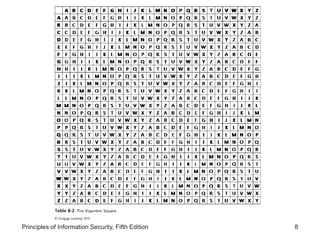
Substitution Cipher
• Exchanges one value for another
• Monoalphabetic substitution: uses only one
alphabet during encryption process
• Polyalphabetic substitution: more advanced; uses
two or more alphabets
• Vigenère cipher: advanced substitution cipher that
uses simple polyalphabetic code; made up of 26
distinct cipher alphabets
Principles of Information Security, Fifth Edition 7
Principles of Information Security, Fifth Edition 8
Transposition Cipher
• Simple to understand, but if properly used,
produces ciphertext that is difficult to decipher
• Rearranges values within a block to create
ciphertext
• Can be done at the bit level or at the byte
(character) level
• To make the encryption even stronger, the keys
and block sizes can be increased to 128 bits or
more.
– Uses block padding method to facilitate algorithm
Principles of Information Security, Fifth Edition 9
Exclusive OR (XOR)
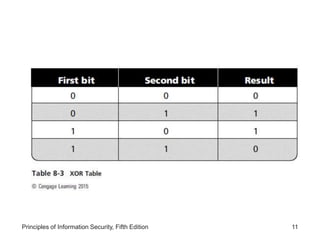
• Function of Boolean algebra; two bits are
compared and binary result is generated.
– If two bits are identical, the result is binary 0.
– If two bits are not identical, the result is binary 1.
• Very simple to implement and simple to break;
should not be used by itself when organization is
transmitting/storing sensitive data
Principles of Information Security, Fifth Edition 10
Principles of Information Security, Fifth Edition 11
Vernam Cipher
• Developed at AT&T Bell Labs
• Uses a set of characters once per encryption process
• To perform:
– The pad values are added to numeric values that
represent the plaintext that needs to be encrypted.
– Each character of the plaintext is turned into a number
and a pad value for that position is added.
– The resulting sum for that character is then converted
back to a ciphertext letter for transmission.
– If the sum of the two values exceeds 26, then 26 is
subtracted from the total.
Principles of Information Security, Fifth Edition 12
Book-Based Ciphers
• Uses text in book as key to decrypt a message
• Book cipher: ciphertext consists of list of codes
representing page, line, and word numbers of
plaintext word.
• Running key cipher: uses a book for passing key to
cipher similar to Vigenère cipher; sender provides
encrypted message with sequence of numbers
from predetermined book to be used as an
indicator block.
• Template Cipher: involves use of hidden message
in book, letter, or other message; requires page
with specific number of holes cut into it
Principles of Information Security, Fifth Edition 13
Hash Functions
• Mathematical algorithms used to confirm specific
message identity and that no content has changed
• Hash algorithms: public functions that create hash
value
• Use of keys not required
– Message authentication code (MAC), however, may
be attached to a message.
• Used in password verification systems to confirm
the identity of the user
Principles of Information Security, Fifth Edition 14
Cryptographic Algorithms
• Often grouped into two broad categories,
symmetric and asymmetric
– Today’s popular cryptosystems use a combination of
both symmetric and asymmetric algorithms.
• Symmetric and asymmetric algorithms are
distinguished by the types of keys used for
encryption and decryption operations.
Principles of Information Security, Fifth Edition 15
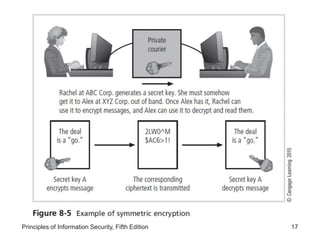
Symmetric Encryption
• Requires same “secret key” to encipher and
decipher message; also known as private-key
encryption
– Can be programmed into fast computing algorithms
and executed quickly
– Both sender and receiver must possess secret key.
– If either copy of key is compromised, an intermediate
can decrypt and read messages without
sender/receiver knowledge.
Principles of Information Security, Fifth Edition 16
Principles of Information Security, Fifth Edition 17
Symmetric Encryption (cont’d)
• Data Encryption Standard (DES): one of the most
popular symmetric encryption cryptosystems
– 64-bit block size; 56-bit key
– Adopted by NIST in 1976 as federal standard for
encrypting non-classified information
• Triple DES (3DES): created to provide security far
beyond DES
• Advanced Encryption Standard (AES): developed
to replace both DES and 3DES
Principles of Information Security, Fifth Edition 18
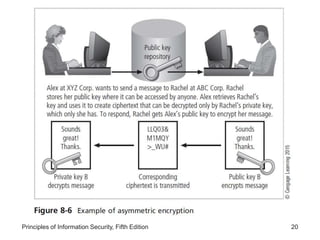
Asymmetric Encryption
• Also known as public-key encryption
• Uses two different but related keys
– Either key can encrypt or decrypt a message
– If Key A encrypts message, only Key B can decrypt
– Greatest value when one key serves as private key
and the other serves as public key
• RSA algorithm was the first public-key encryption
algorithm developed/published for commercial use.
Principles of Information Security, Fifth Edition 19
Principles of Information Security, Fifth Edition 20
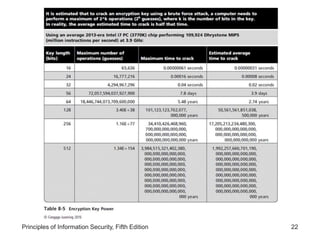
Encryption Key Size
• When deploying ciphers, the size of cryptovariable
or key is very important.
• The strength of many encryption applications and
cryptosystems is measured by key size.
• For cryptosystems, the security of encrypted data
is not dependent on keeping the encrypting
algorithm secret.
• Cryptosystem security depends on keeping some
or all of elements of cryptovariable(s) or key(s)
secret.
Principles of Information Security, Fifth Edition 21
Principles of Information Security, Fifth Edition 22

Lesson 1

  • 1.
    Principles of InformationSecurity, Fifth Edition Chapter 8 Cryptography Lesson 1 – Foundations of Cryptography
  • 2.
    Learning Objectives • Uponcompletion of this material, you should be able to: – Chronicle the most significant events and discoveries in the history of cryptology – Explain the basic principles of cryptography – Describe the operating principles of the most popular cryptographic tools – List and explicate the major protocols used for secure communications Principles of Information Security, Fifth Edition 2
  • 3.
    Introduction • Cryptology: scienceof encryption; encompasses cryptography and cryptanalysis • Cryptography involves making and using codes to secure messages. • Cryptanalysis involves cracking or breaking encrypted messages back into their unencrypted origins. Principles of Information Security, Fifth Edition 3
  • 4.
    Foundations of Cryptology •Cryptology has an extensive and multicultural history. • All popular Web browsers use built-in encryption features for secure e-commerce applications. • Restrictions on the export of cryptosystems began after WWII. Principles of Information Security, Fifth Edition 4
  • 5.
    Terminology • Must knowthe following: – Algorithm – Bit stream cipher – Block cipher – Cipher or cryptosystem – Ciphertext/cryptogram – Code – Decipher – Decrypt – Encipher Principles of Information Security, Fifth Edition 5 – Encrypt – Key/Cryptovariable – Keyspace – Link encryption – Plaintext/cleartext – Steganography – Work factor
  • 6.
    Cipher Methods • Plaintextcan be encrypted through bit stream or block cipher method. • Bit stream: Each plaintext bit is transformed into cipher bit one bit at a time. • Block cipher: Message is divided into blocks (e.g., sets of 8- or 16-bit blocks), and each is transformed into encrypted block of cipher bits using algorithm and key. Principles of Information Security, Fifth Edition 6
  • 7.
    Substitution Cipher • Exchangesone value for another • Monoalphabetic substitution: uses only one alphabet during encryption process • Polyalphabetic substitution: more advanced; uses two or more alphabets • Vigenère cipher: advanced substitution cipher that uses simple polyalphabetic code; made up of 26 distinct cipher alphabets Principles of Information Security, Fifth Edition 7
  • 8.
    Principles of InformationSecurity, Fifth Edition 8
  • 9.
    Transposition Cipher • Simpleto understand, but if properly used, produces ciphertext that is difficult to decipher • Rearranges values within a block to create ciphertext • Can be done at the bit level or at the byte (character) level • To make the encryption even stronger, the keys and block sizes can be increased to 128 bits or more. – Uses block padding method to facilitate algorithm Principles of Information Security, Fifth Edition 9
  • 10.
    Exclusive OR (XOR) •Function of Boolean algebra; two bits are compared and binary result is generated. – If two bits are identical, the result is binary 0. – If two bits are not identical, the result is binary 1. • Very simple to implement and simple to break; should not be used by itself when organization is transmitting/storing sensitive data Principles of Information Security, Fifth Edition 10
  • 11.
    Principles of InformationSecurity, Fifth Edition 11
  • 12.
    Vernam Cipher • Developedat AT&T Bell Labs • Uses a set of characters once per encryption process • To perform: – The pad values are added to numeric values that represent the plaintext that needs to be encrypted. – Each character of the plaintext is turned into a number and a pad value for that position is added. – The resulting sum for that character is then converted back to a ciphertext letter for transmission. – If the sum of the two values exceeds 26, then 26 is subtracted from the total. Principles of Information Security, Fifth Edition 12
  • 13.
    Book-Based Ciphers • Usestext in book as key to decrypt a message • Book cipher: ciphertext consists of list of codes representing page, line, and word numbers of plaintext word. • Running key cipher: uses a book for passing key to cipher similar to Vigenère cipher; sender provides encrypted message with sequence of numbers from predetermined book to be used as an indicator block. • Template Cipher: involves use of hidden message in book, letter, or other message; requires page with specific number of holes cut into it Principles of Information Security, Fifth Edition 13
  • 14.
    Hash Functions • Mathematicalalgorithms used to confirm specific message identity and that no content has changed • Hash algorithms: public functions that create hash value • Use of keys not required – Message authentication code (MAC), however, may be attached to a message. • Used in password verification systems to confirm the identity of the user Principles of Information Security, Fifth Edition 14
  • 15.
    Cryptographic Algorithms • Oftengrouped into two broad categories, symmetric and asymmetric – Today’s popular cryptosystems use a combination of both symmetric and asymmetric algorithms. • Symmetric and asymmetric algorithms are distinguished by the types of keys used for encryption and decryption operations. Principles of Information Security, Fifth Edition 15
  • 16.
    Symmetric Encryption • Requiressame “secret key” to encipher and decipher message; also known as private-key encryption – Can be programmed into fast computing algorithms and executed quickly – Both sender and receiver must possess secret key. – If either copy of key is compromised, an intermediate can decrypt and read messages without sender/receiver knowledge. Principles of Information Security, Fifth Edition 16
  • 17.
    Principles of InformationSecurity, Fifth Edition 17
  • 18.
    Symmetric Encryption (cont’d) •Data Encryption Standard (DES): one of the most popular symmetric encryption cryptosystems – 64-bit block size; 56-bit key – Adopted by NIST in 1976 as federal standard for encrypting non-classified information • Triple DES (3DES): created to provide security far beyond DES • Advanced Encryption Standard (AES): developed to replace both DES and 3DES Principles of Information Security, Fifth Edition 18
  • 19.
    Asymmetric Encryption • Alsoknown as public-key encryption • Uses two different but related keys – Either key can encrypt or decrypt a message – If Key A encrypts message, only Key B can decrypt – Greatest value when one key serves as private key and the other serves as public key • RSA algorithm was the first public-key encryption algorithm developed/published for commercial use. Principles of Information Security, Fifth Edition 19
  • 20.
    Principles of InformationSecurity, Fifth Edition 20
  • 21.
    Encryption Key Size •When deploying ciphers, the size of cryptovariable or key is very important. • The strength of many encryption applications and cryptosystems is measured by key size. • For cryptosystems, the security of encrypted data is not dependent on keeping the encrypting algorithm secret. • Cryptosystem security depends on keeping some or all of elements of cryptovariable(s) or key(s) secret. Principles of Information Security, Fifth Edition 21
  • 22.
    Principles of InformationSecurity, Fifth Edition 22