1
MPYANA MWAMBA MERLEC
Department of Computer and Engineering
Korea University
Dec. 12, 2017
Blockchain Security Issues
and Challenges
Bitcoin Key Management
Security Issues and Challenges
Project Goal
2
 We aim to figure out the following questions :
 What are the BTC key management security threats ?
 How these security risks/issues can be addressed ?
 What are the existing approaches and their limitations ?
 What are the related challenges ?
 The main purpose of this study is to investigate on :
 Private key management related security issues and challenges
 Bitcoin (BTC) as a BlockChain (BC) application use case
Problem Statement
3
 Private Key Security[6]
 With BC, a private key is regarded as user identity and security credential
 Generated and maintained by the user instead of 3rd party agencies
 Hartwig et al.[1] discover a vulnerability in ECDSA* scheme
 Side-channel attack and invalid-curve attack might be possible
 Does not generate enough randomness during the signature process
 Attacker can be able to recover the user’s private key
* Elliptic Curve Digital Signature Algorithm
Problem Statement
4
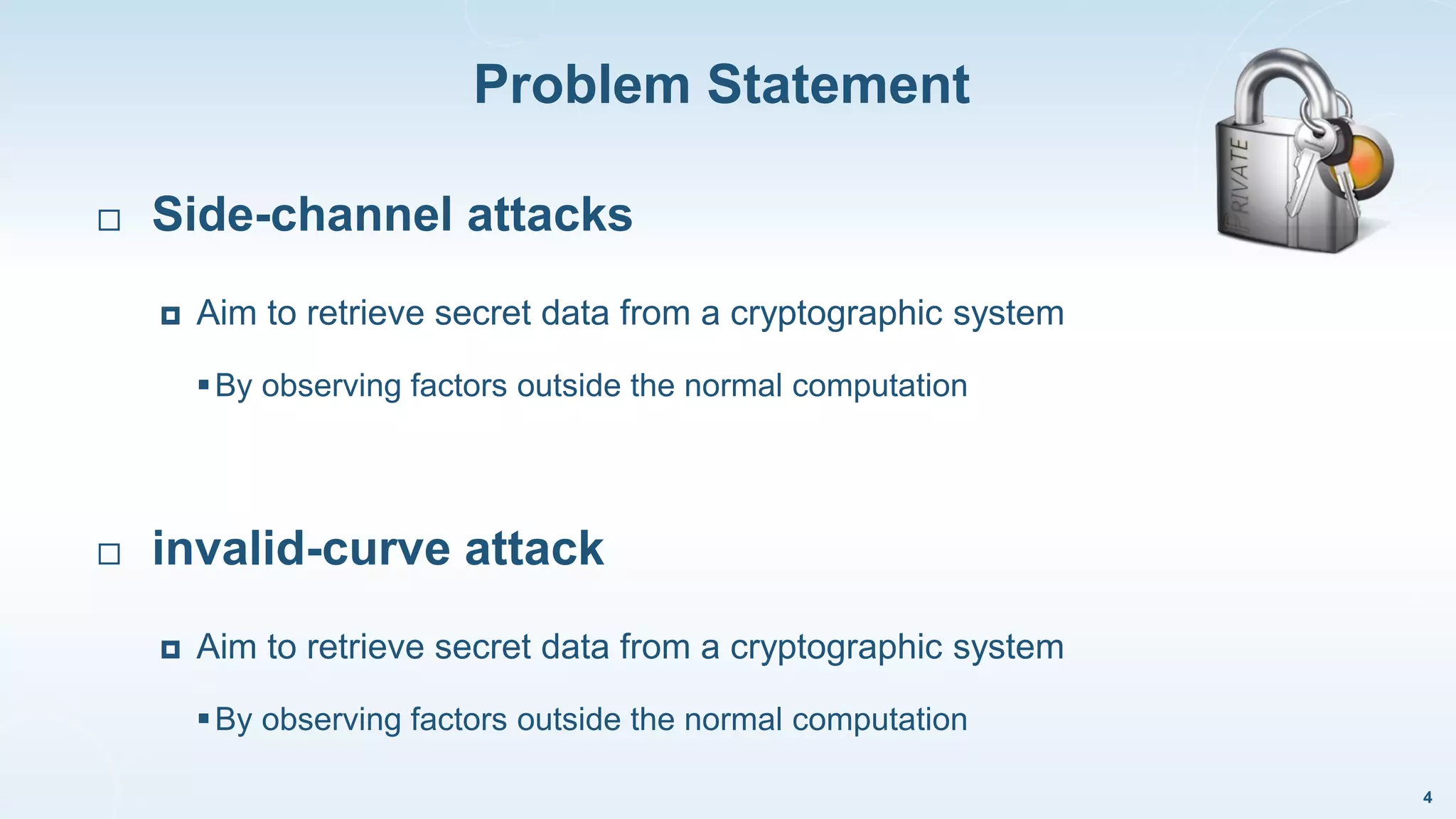
 Side-channel attacks
 Aim to retrieve secret data from a cryptographic system
By observing factors outside the normal computation
 invalid-curve attack
 Aim to retrieve secret data from a cryptographic system
By observing factors outside the normal computation
Problem Statement
5
 Private Key Security[6]
 Once a user’s private key is lost, it will not be able to recovered
 User’s BCT account will face the risks of being tampered by others
 If a private key is stolen by criminals
 BCT doesn’t dependent on any centralized 3rd party trusted infrastructure
 Difficult to track the criminal’s behaviors and recover modified BC information
 Decentralized aspect of BC makes the key management task very challenging
Bitcoin Keys and Addresses
6
With bitcoin, keys come in pairs:
 Private (secret) key = secret PIN or signature on a check
 Provides a control over the account and sign TXs
 Public key = bank account number
 Unique and derived from private key
 Bitcoin address = K recipient, represented by its digital fingerprint
 Similar to a beneficiary name on a check (i.e. “Pay to the order of”)
 Bitcoin address is generated form and corresponds to a public key
Conversion of a public key into a bitcoin
address [2]
A = RIPEMD160(SHA256(K ))K = k * G
G : is the generator point
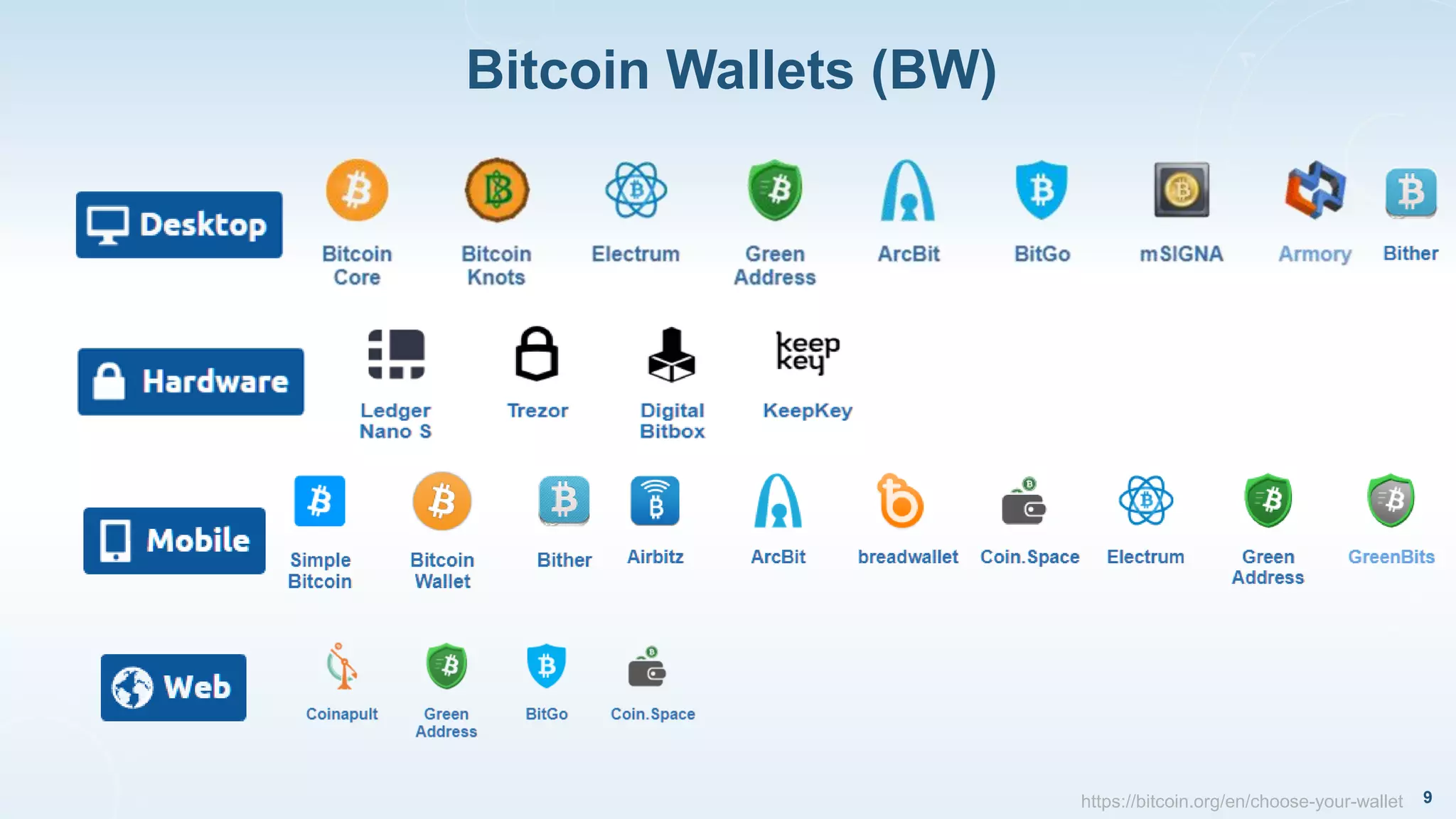
Bitcoin Wallet (BW)
7
Type-2 deterministic (seeded) wallet [2]:
a tree of keys generated from a single seed
Type-0 nondeterministic (random) wallet [2]:
a collection of randomly generated keys
 Contains and manages a collection of key pairs
 Mostly, k and K are stored together as a Key pair for convenience
Randomly generated number
combined with other data
(i.e. index or chain code)
Master Keys Creation & PK extension
8http://chimera.labs.oreilly.com/books/1234000001802/ch04.html#hd_wallets
Creating master keys and chain code from a
root seed [2]
Extending a parent private key to create a
child private key [2]
HMAC : Hash Message Authentication Code
Chain code is used to introduce entropy in the
function that creates child keys from parent keys.
Bitcoin Wallets (BW)
9https://bitcoin.org/en/choose-your-wallet
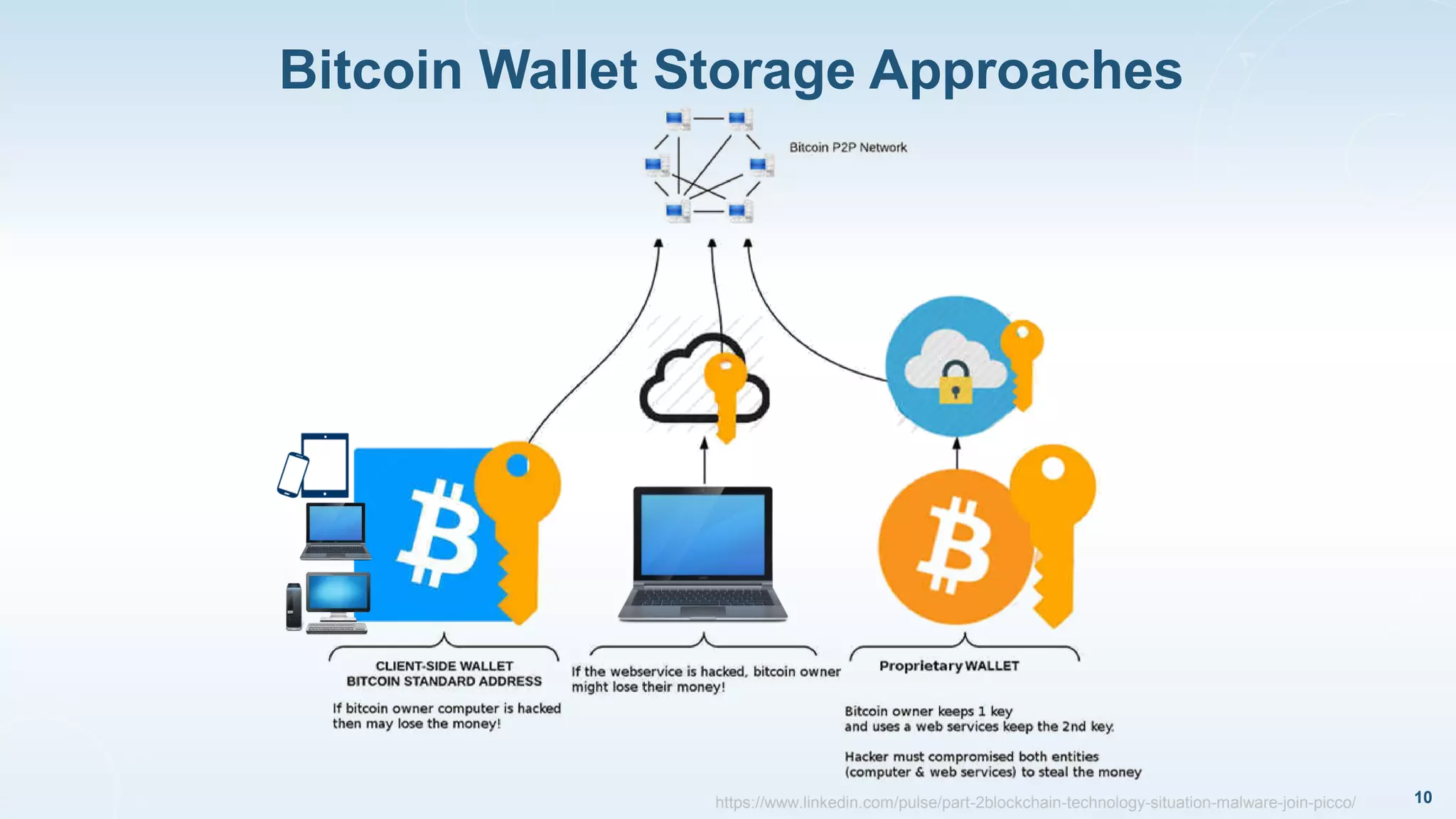
Bitcoin Wallet Storage Approaches
10https://www.linkedin.com/pulse/part-2blockchain-technology-situation-malware-join-picco/
BTC Key Management Approaches
11
 Works in [3-5] surveyed on the BTC Key management approaches
 Found that BTC has several fundamental issues and challenges
 It offers opportunities to rethink the key management for end users
 First investigation [3] on the usability issues of BTC’s key management
 Survey and categorize most known BTC key management proposals
 Propose a set of evaluation criteria for BTC key management
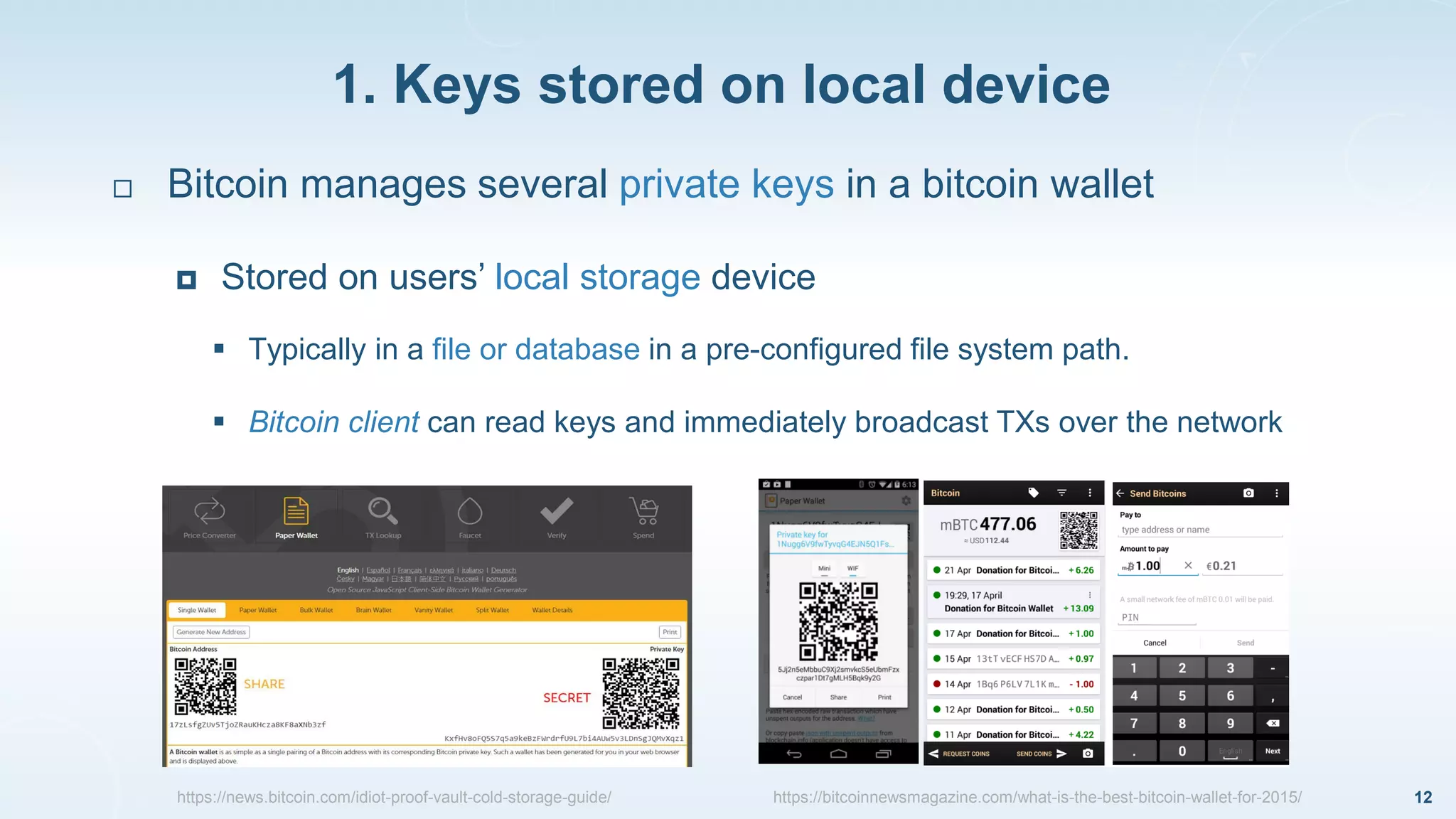
1. Keys stored on local device
12
 Bitcoin manages several private keys in a bitcoin wallet
 Stored on users’ local storage device
 Typically in a file or database in a pre-configured file system path.
 Bitcoin client can read keys and immediately broadcast TXs over the network
https://news.bitcoin.com/idiot-proof-vault-cold-storage-guide/ https://bitcoinnewsmagazine.com/what-is-the-best-bitcoin-wallet-for-2015/
1. Keys stored on local device
13
 Several threats to store keys in local devices [3]:
 Files storing private keys can be read by any app.
 with access to the user’s application folder
 Malware may exploit this key management approach
 Access to local files results in the adversary gaining access to the victim’s funds
 Users must be aware to not mistakenly share their app. folders
 P2P file sharing networks, off-site backups or a shared network drive
https://www.secureworks.com/research/cryptocurrency-stealing-malware-landscapehttps://www.secureworks.com/research/cryptocurrency-stealing-malware-landscape
1. Keys stored on local device
14
 Several threats to store keys in a locally[3] :
 Physical storage device theft
 Especially in case of mobile devices (i.e. laptops or smart phones)
 Equipment failure
 Due to natural disasters and electrical failures
 Undetected storage failure, etc.
 Private key files format long-term readability
 A trust fund/long-term saving requires PKs to be stored for a long period of time
 Users must ensure that keys’ file format can continue to be read
2. Password-protected (encrypted) wallet
15
 BCT clients allow a locally stored wallet file to be encrypted
 With a key derived from a user-chosen pw or passphrase
 This address only physical theft of underlying devices
 Brute-force of the pw if the file containing private key is stolen
 Share the pros and cons of non-encrypted wallets
 If the pw is forgotten, users lose access to their pw-protected wallet
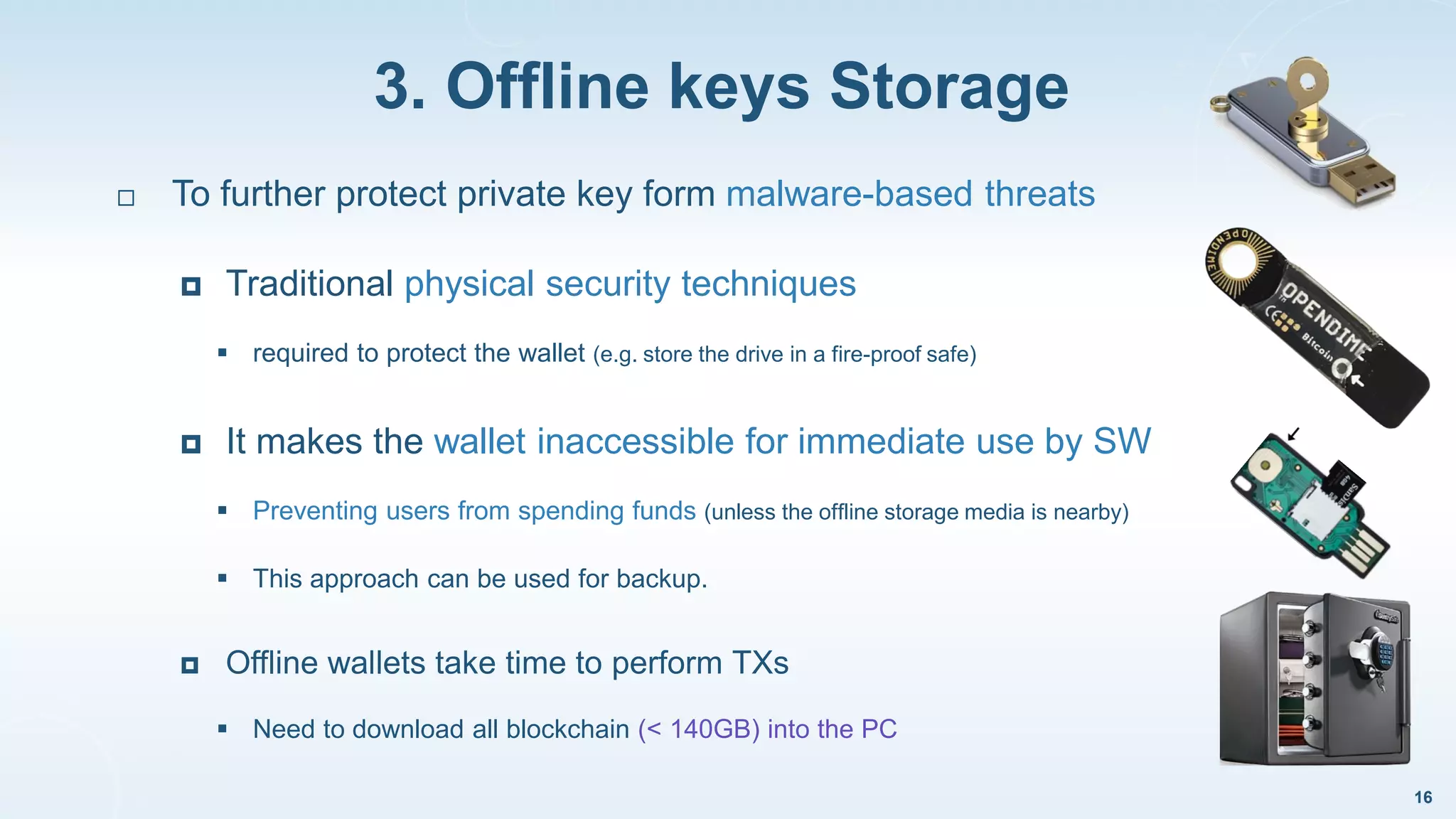
3. Offline keys Storage
16
 To further protect private key form malware-based threats
 Traditional physical security techniques
 required to protect the wallet (e.g. store the drive in a fire-proof safe)
 It makes the wallet inaccessible for immediate use by SW
 Preventing users from spending funds (unless the offline storage media is nearby)
 This approach can be used for backup.
 Offline wallets take time to perform TXs
 Need to download all blockchain (< 140GB) into the PC
3. Offline keys Storage
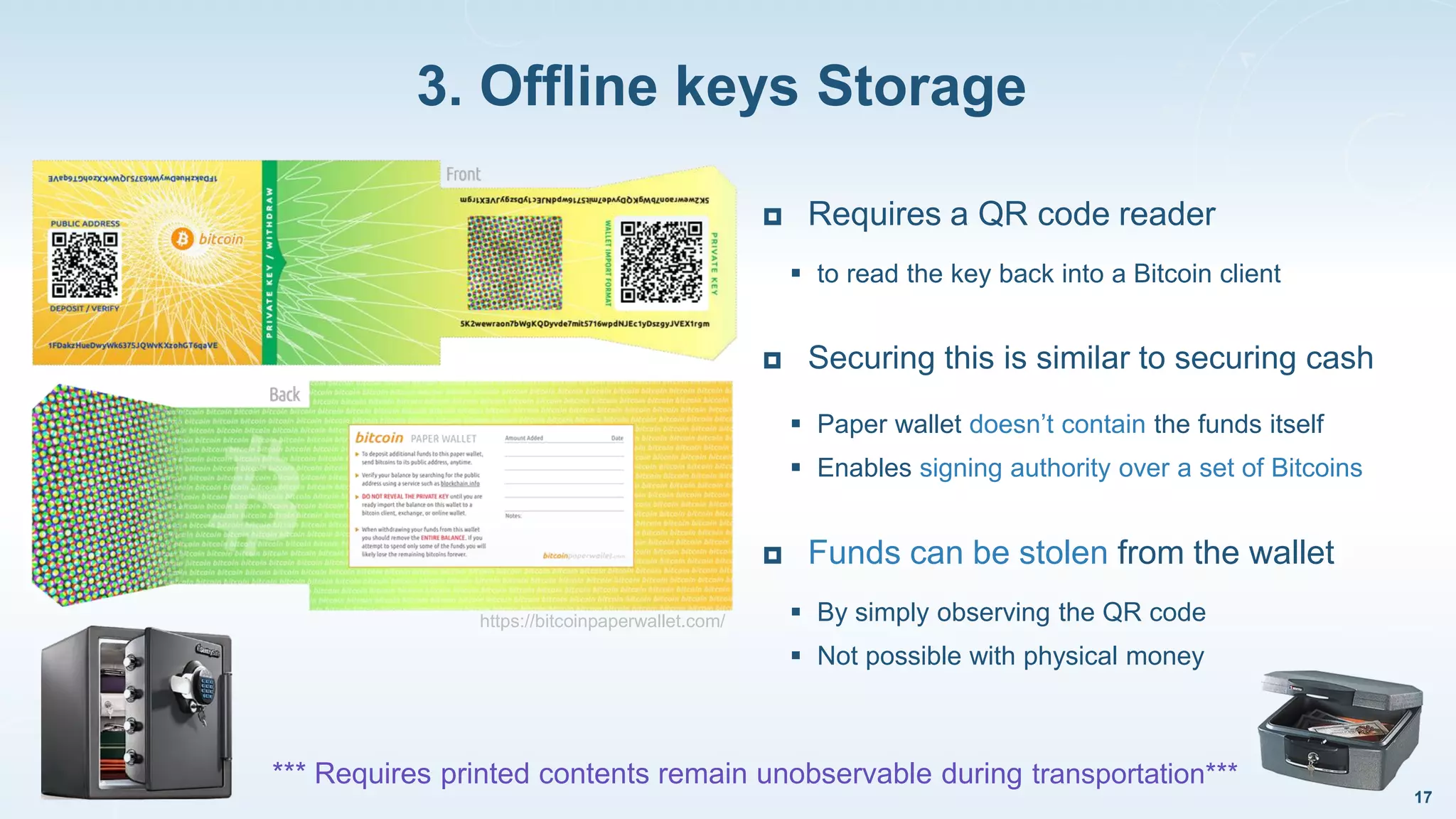
17
https://bitcoinpaperwallet.com/
 Requires a QR code reader
 to read the key back into a Bitcoin client
 Securing this is similar to securing cash
 Paper wallet doesn’t contain the funds itself
 Enables signing authority over a set of Bitcoins
 Funds can be stolen from the wallet
 By simply observing the QR code
 Not possible with physical money
*** Requires printed contents remain unobservable during transportation***
4. Air-gapped & hardware Storage
18
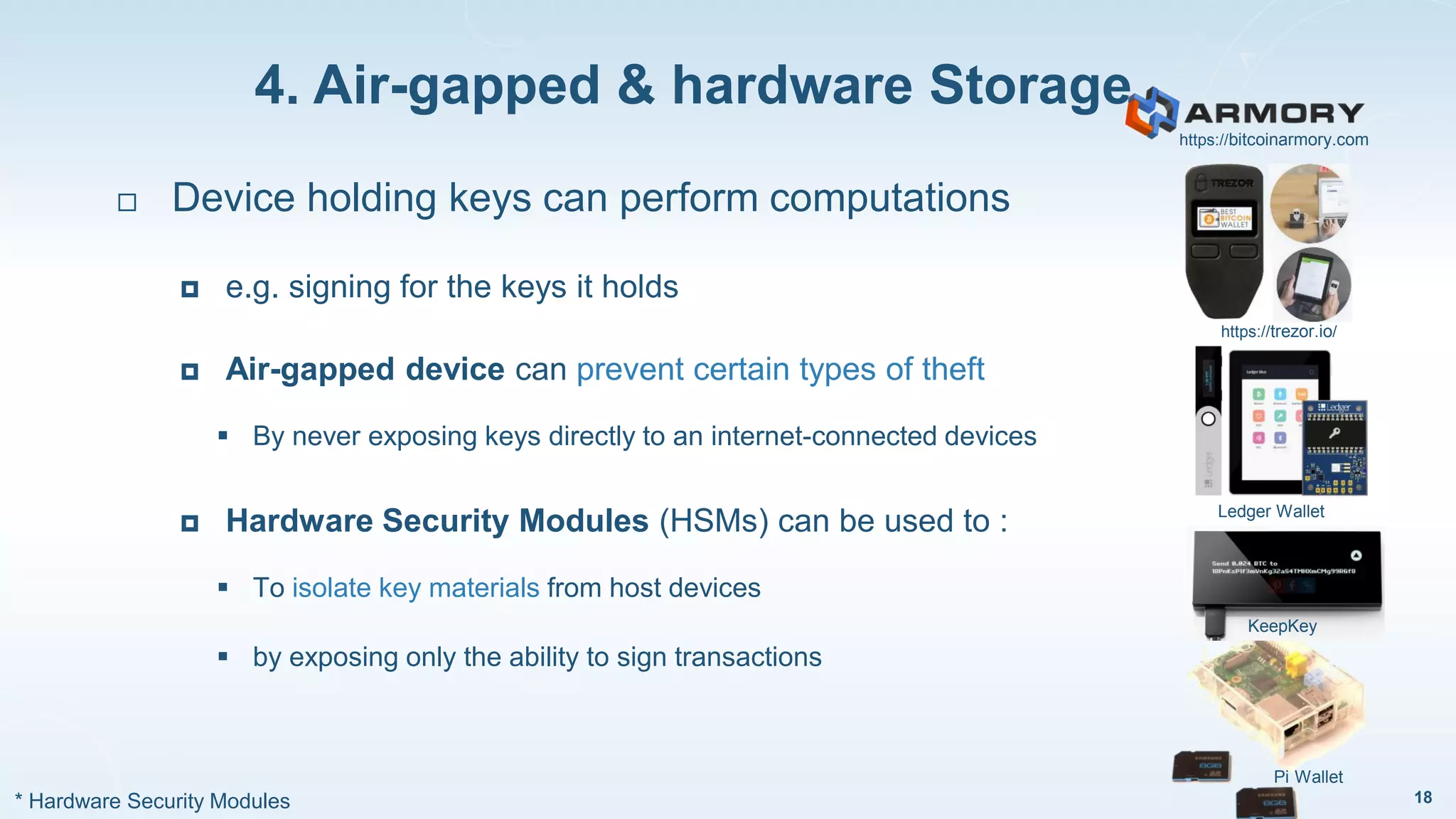
 Device holding keys can perform computations
 e.g. signing for the keys it holds
 Air-gapped device can prevent certain types of theft
 By never exposing keys directly to an internet-connected devices
 Hardware Security Modules (HSMs) can be used to :
 To isolate key materials from host devices
 by exposing only the ability to sign transactions
https://trezor.io/
Ledger Wallet
KeepKey
Pi Wallet
* Hardware Security Modules
https://bitcoinarmory.com
5. Password-derived Keys
19
 HD wallets [2] deterministically derive a set of private keys
 form a master secret key (a user randomly chosen passphrase)
 pw holder can view the balance and funds of any sub-account derived from the pw
 If one sub-key k is compromised, only the funds of that sub-key
(or sub-keys derived from it) may be stolen
 Weak passwords can be found easily through brute-force search
 Fingerprint of associated public keys will be in the public ledger
 if the account holds any amount of bitcoin
Hierarchical Deterministic
(HD) wallet
https://brainwallet.io/
https://brainwalletx.github.io/
6. Hosted Wallets
20
 User wallet is hosted by a trusted third-party WSP*
 Key management and storage services are offloaded
 No need to perform resource intensive cryptographic operations on devices
 WSPs maintain possession of the private keys
 Enable user access via standard web authentication mechanisms
 May also offer password recovery/reset mechanisms
 Users should assume the loss risk
 the service could be breached and funds lost
*WSP – Web Service Provider
https://blockchain.info/
Super-Wallet [9] : Multi Tiered Storage Scheme
21
https://bitcoinsecurityproject.org/SecureStorage/MultiTieredColdStorageScheme/
As a counter measure to theft, hosted
wallet providers often keep :
 Small float of holdings online in hot storage
 Majority of holdings offline in cold storage
 Causes delays in TXs for users if the
hot storage amount is exhausted.
 Implementation complexity
Comparison of Key Management Approaches for Bitcoin
Vs Traditional Online Banking Service [3]
22
Client partially awards the benefit
Client is awarded the benefit
WRAP UP
23
 Most of recent practical security attacks on bitcoin
 Leverage weaknesses in the network and consensus layers of BTC BC
 to considerably increase the advantage of an adversary
BTC shares many of the fundamental challenges of keys management
known from other domains.
 Bitcoin present opportunity to rethink key management for end users
[1] Mayer, Hartwig. "ECDSA Security in Bitcoin and Ethereum: a Research Survey." (2016).
[2] Antonopoulos, Andreas M. "Mastering Bitcoin: unlocking digital cryptocurrencies. " O'Reilly Media, Inc., 2014.
[3] Eskandari, Shayan, et al. "A first look at the usability of bitcoin key management." Workshop on Usable Security
(USEC), 2015.
[4] Goldfeder, Steven, et al. "Securing Bitcoin wallets via a new DSA/ECDSA threshold signature scheme." (2015).
[5] Bonneau, Joseph, et al. "Sok: Research perspectives and challenges for bitcoin and cryptocurrencies." Security
and Privacy (SP), 2015 IEEE Symposium on. IEEE, 2015
[6] Li, Xiaoqi, et al. "A survey on the security of blockchain systems." Future Generation Computer Systems (2017).
[7] RSA Laboratories, “PBKDF2 (Password-Based Key Derivation Function 2),” http://tools.ietf.org/html/rfc2898.
[9] Barber, Simon, et al. "Bitter to better—how to make bitcoin a better currency." International Conference on
Financial Cryptography and Data Security. Springer, Berlin, Heidelberg, 2012.
[10] Top 10 Security Concerns for Bitcoin Wallets and Exchanges - https://bitcoinsecurityproject.org/topten/
REFERENCES
24
25

Blockchain Security Issues and Challenges

  • 1.
    1 MPYANA MWAMBA MERLEC Departmentof Computer and Engineering Korea University Dec. 12, 2017 Blockchain Security Issues and Challenges Bitcoin Key Management Security Issues and Challenges
  • 2.
    Project Goal 2  Weaim to figure out the following questions :  What are the BTC key management security threats ?  How these security risks/issues can be addressed ?  What are the existing approaches and their limitations ?  What are the related challenges ?  The main purpose of this study is to investigate on :  Private key management related security issues and challenges  Bitcoin (BTC) as a BlockChain (BC) application use case
  • 3.
    Problem Statement 3  PrivateKey Security[6]  With BC, a private key is regarded as user identity and security credential  Generated and maintained by the user instead of 3rd party agencies  Hartwig et al.[1] discover a vulnerability in ECDSA* scheme  Side-channel attack and invalid-curve attack might be possible  Does not generate enough randomness during the signature process  Attacker can be able to recover the user’s private key * Elliptic Curve Digital Signature Algorithm
  • 4.
    Problem Statement 4  Side-channelattacks  Aim to retrieve secret data from a cryptographic system By observing factors outside the normal computation  invalid-curve attack  Aim to retrieve secret data from a cryptographic system By observing factors outside the normal computation
  • 5.
    Problem Statement 5  PrivateKey Security[6]  Once a user’s private key is lost, it will not be able to recovered  User’s BCT account will face the risks of being tampered by others  If a private key is stolen by criminals  BCT doesn’t dependent on any centralized 3rd party trusted infrastructure  Difficult to track the criminal’s behaviors and recover modified BC information  Decentralized aspect of BC makes the key management task very challenging
  • 6.
    Bitcoin Keys andAddresses 6 With bitcoin, keys come in pairs:  Private (secret) key = secret PIN or signature on a check  Provides a control over the account and sign TXs  Public key = bank account number  Unique and derived from private key  Bitcoin address = K recipient, represented by its digital fingerprint  Similar to a beneficiary name on a check (i.e. “Pay to the order of”)  Bitcoin address is generated form and corresponds to a public key Conversion of a public key into a bitcoin address [2] A = RIPEMD160(SHA256(K ))K = k * G G : is the generator point
  • 7.
    Bitcoin Wallet (BW) 7 Type-2deterministic (seeded) wallet [2]: a tree of keys generated from a single seed Type-0 nondeterministic (random) wallet [2]: a collection of randomly generated keys  Contains and manages a collection of key pairs  Mostly, k and K are stored together as a Key pair for convenience Randomly generated number combined with other data (i.e. index or chain code)
  • 8.
    Master Keys Creation& PK extension 8http://chimera.labs.oreilly.com/books/1234000001802/ch04.html#hd_wallets Creating master keys and chain code from a root seed [2] Extending a parent private key to create a child private key [2] HMAC : Hash Message Authentication Code Chain code is used to introduce entropy in the function that creates child keys from parent keys.
  • 9.
  • 10.
    Bitcoin Wallet StorageApproaches 10https://www.linkedin.com/pulse/part-2blockchain-technology-situation-malware-join-picco/
  • 11.
    BTC Key ManagementApproaches 11  Works in [3-5] surveyed on the BTC Key management approaches  Found that BTC has several fundamental issues and challenges  It offers opportunities to rethink the key management for end users  First investigation [3] on the usability issues of BTC’s key management  Survey and categorize most known BTC key management proposals  Propose a set of evaluation criteria for BTC key management
  • 12.
    1. Keys storedon local device 12  Bitcoin manages several private keys in a bitcoin wallet  Stored on users’ local storage device  Typically in a file or database in a pre-configured file system path.  Bitcoin client can read keys and immediately broadcast TXs over the network https://news.bitcoin.com/idiot-proof-vault-cold-storage-guide/ https://bitcoinnewsmagazine.com/what-is-the-best-bitcoin-wallet-for-2015/
  • 13.
    1. Keys storedon local device 13  Several threats to store keys in local devices [3]:  Files storing private keys can be read by any app.  with access to the user’s application folder  Malware may exploit this key management approach  Access to local files results in the adversary gaining access to the victim’s funds  Users must be aware to not mistakenly share their app. folders  P2P file sharing networks, off-site backups or a shared network drive https://www.secureworks.com/research/cryptocurrency-stealing-malware-landscapehttps://www.secureworks.com/research/cryptocurrency-stealing-malware-landscape
  • 14.
    1. Keys storedon local device 14  Several threats to store keys in a locally[3] :  Physical storage device theft  Especially in case of mobile devices (i.e. laptops or smart phones)  Equipment failure  Due to natural disasters and electrical failures  Undetected storage failure, etc.  Private key files format long-term readability  A trust fund/long-term saving requires PKs to be stored for a long period of time  Users must ensure that keys’ file format can continue to be read
  • 15.
    2. Password-protected (encrypted)wallet 15  BCT clients allow a locally stored wallet file to be encrypted  With a key derived from a user-chosen pw or passphrase  This address only physical theft of underlying devices  Brute-force of the pw if the file containing private key is stolen  Share the pros and cons of non-encrypted wallets  If the pw is forgotten, users lose access to their pw-protected wallet
  • 16.
    3. Offline keysStorage 16  To further protect private key form malware-based threats  Traditional physical security techniques  required to protect the wallet (e.g. store the drive in a fire-proof safe)  It makes the wallet inaccessible for immediate use by SW  Preventing users from spending funds (unless the offline storage media is nearby)  This approach can be used for backup.  Offline wallets take time to perform TXs  Need to download all blockchain (< 140GB) into the PC
  • 17.
    3. Offline keysStorage 17 https://bitcoinpaperwallet.com/  Requires a QR code reader  to read the key back into a Bitcoin client  Securing this is similar to securing cash  Paper wallet doesn’t contain the funds itself  Enables signing authority over a set of Bitcoins  Funds can be stolen from the wallet  By simply observing the QR code  Not possible with physical money *** Requires printed contents remain unobservable during transportation***
  • 18.
    4. Air-gapped &hardware Storage 18  Device holding keys can perform computations  e.g. signing for the keys it holds  Air-gapped device can prevent certain types of theft  By never exposing keys directly to an internet-connected devices  Hardware Security Modules (HSMs) can be used to :  To isolate key materials from host devices  by exposing only the ability to sign transactions https://trezor.io/ Ledger Wallet KeepKey Pi Wallet * Hardware Security Modules https://bitcoinarmory.com
  • 19.
    5. Password-derived Keys 19 HD wallets [2] deterministically derive a set of private keys  form a master secret key (a user randomly chosen passphrase)  pw holder can view the balance and funds of any sub-account derived from the pw  If one sub-key k is compromised, only the funds of that sub-key (or sub-keys derived from it) may be stolen  Weak passwords can be found easily through brute-force search  Fingerprint of associated public keys will be in the public ledger  if the account holds any amount of bitcoin Hierarchical Deterministic (HD) wallet https://brainwallet.io/ https://brainwalletx.github.io/
  • 20.
    6. Hosted Wallets 20 User wallet is hosted by a trusted third-party WSP*  Key management and storage services are offloaded  No need to perform resource intensive cryptographic operations on devices  WSPs maintain possession of the private keys  Enable user access via standard web authentication mechanisms  May also offer password recovery/reset mechanisms  Users should assume the loss risk  the service could be breached and funds lost *WSP – Web Service Provider https://blockchain.info/
  • 21.
    Super-Wallet [9] :Multi Tiered Storage Scheme 21 https://bitcoinsecurityproject.org/SecureStorage/MultiTieredColdStorageScheme/ As a counter measure to theft, hosted wallet providers often keep :  Small float of holdings online in hot storage  Majority of holdings offline in cold storage  Causes delays in TXs for users if the hot storage amount is exhausted.  Implementation complexity
  • 22.
    Comparison of KeyManagement Approaches for Bitcoin Vs Traditional Online Banking Service [3] 22 Client partially awards the benefit Client is awarded the benefit
  • 23.
    WRAP UP 23  Mostof recent practical security attacks on bitcoin  Leverage weaknesses in the network and consensus layers of BTC BC  to considerably increase the advantage of an adversary BTC shares many of the fundamental challenges of keys management known from other domains.  Bitcoin present opportunity to rethink key management for end users
  • 24.
    [1] Mayer, Hartwig."ECDSA Security in Bitcoin and Ethereum: a Research Survey." (2016). [2] Antonopoulos, Andreas M. "Mastering Bitcoin: unlocking digital cryptocurrencies. " O'Reilly Media, Inc., 2014. [3] Eskandari, Shayan, et al. "A first look at the usability of bitcoin key management." Workshop on Usable Security (USEC), 2015. [4] Goldfeder, Steven, et al. "Securing Bitcoin wallets via a new DSA/ECDSA threshold signature scheme." (2015). [5] Bonneau, Joseph, et al. "Sok: Research perspectives and challenges for bitcoin and cryptocurrencies." Security and Privacy (SP), 2015 IEEE Symposium on. IEEE, 2015 [6] Li, Xiaoqi, et al. "A survey on the security of blockchain systems." Future Generation Computer Systems (2017). [7] RSA Laboratories, “PBKDF2 (Password-Based Key Derivation Function 2),” http://tools.ietf.org/html/rfc2898. [9] Barber, Simon, et al. "Bitter to better—how to make bitcoin a better currency." International Conference on Financial Cryptography and Data Security. Springer, Berlin, Heidelberg, 2012. [10] Top 10 Security Concerns for Bitcoin Wallets and Exchanges - https://bitcoinsecurityproject.org/topten/ REFERENCES 24
  • 25.