The Mirror
Equation
@ ATDC
Review
2
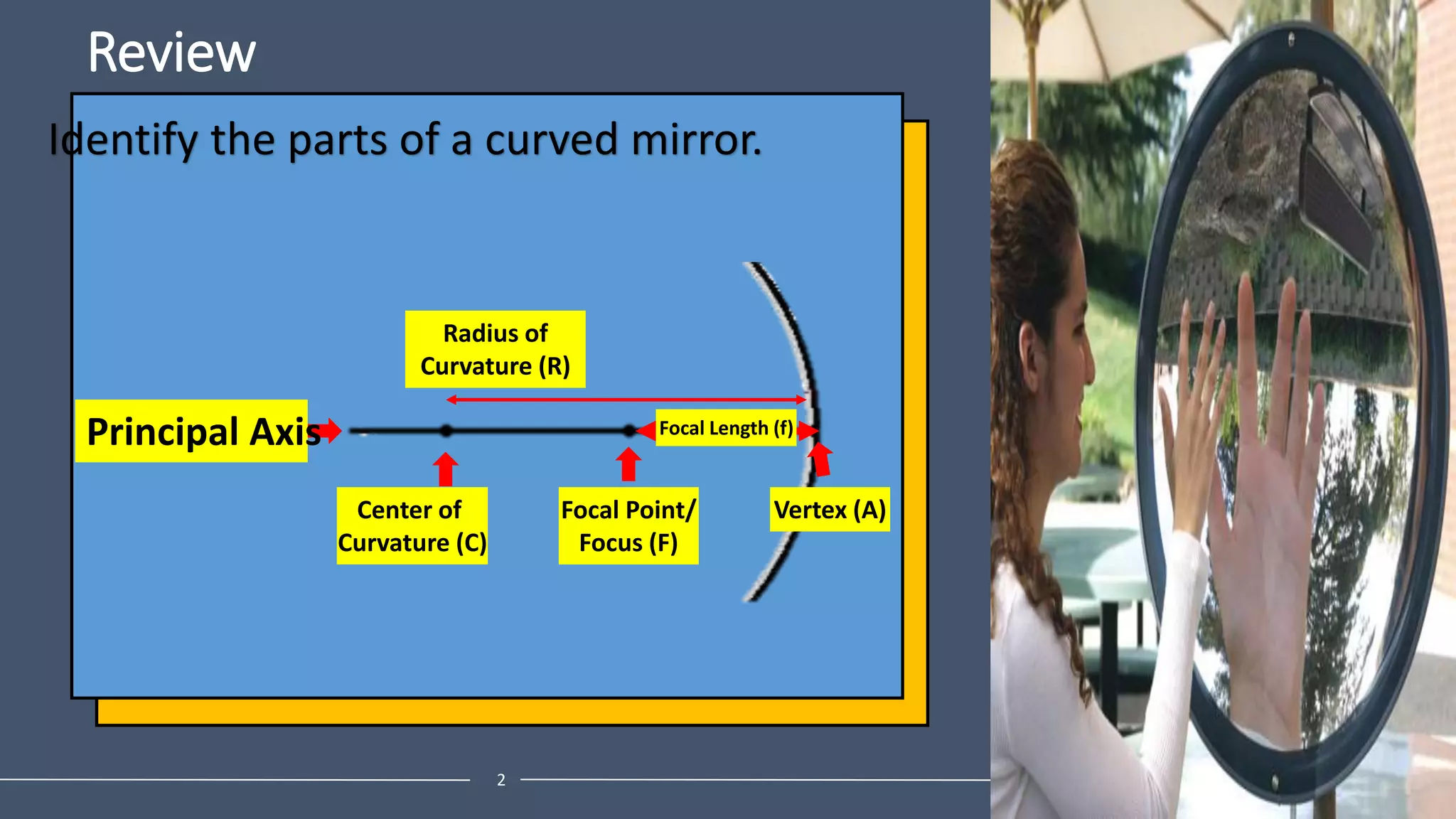
Identify the parts of a curved mirror.
Principal Axis
Center of
Curvature (C)
Focal Point/
Focus (F)
Vertex (A)
Radius of
Curvature (R)
Focal Length (f)
Review
3
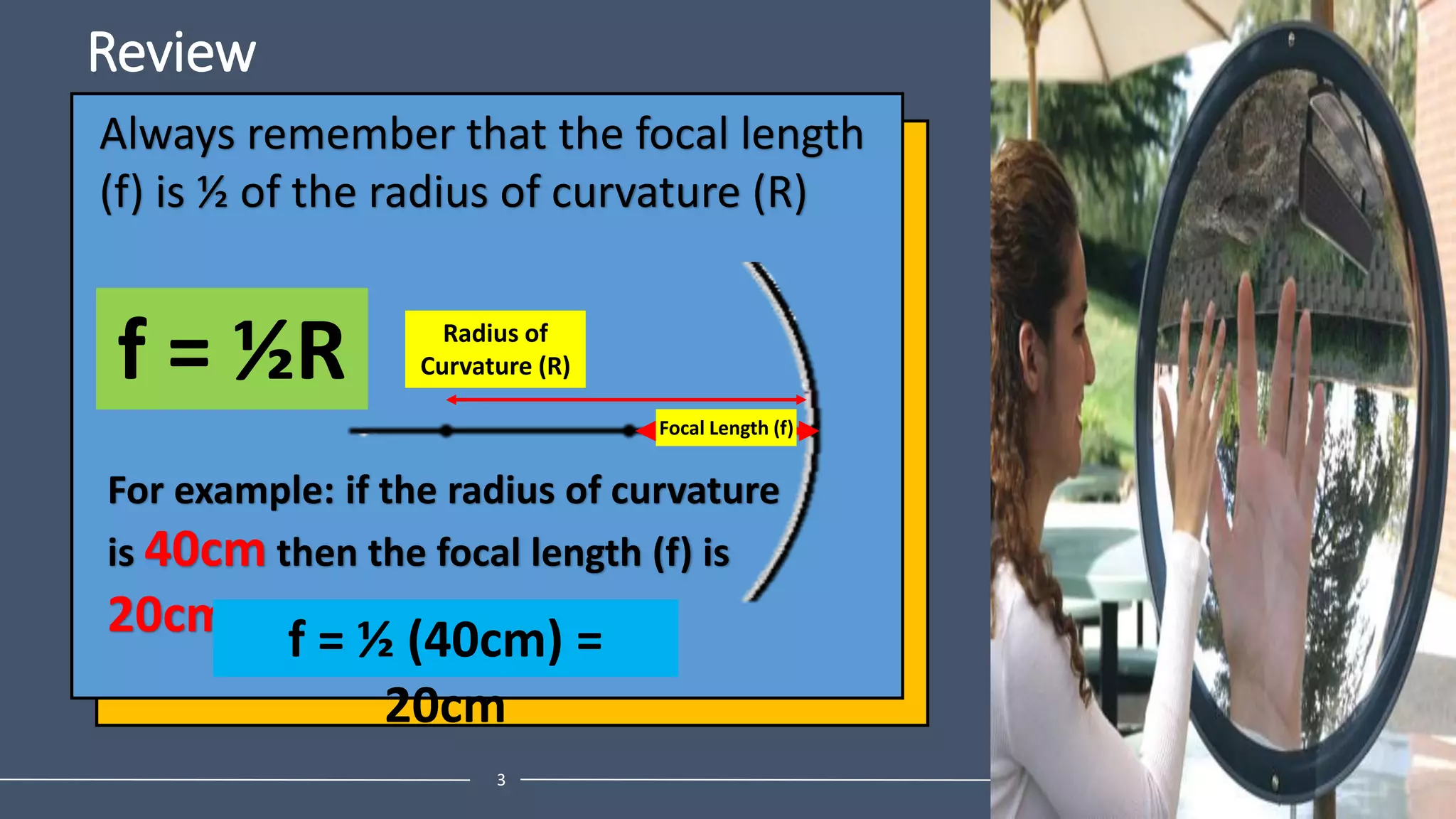
Always remember that the focal length
(f) is ½ of the radius of curvature (R)
Radius of
Curvature (R)
Focal Length (f)
f = ½R
For example: if the radius of curvature
is 40cm then the focal length (f) is
20cm.
f = ½ (40cm) =
20cm
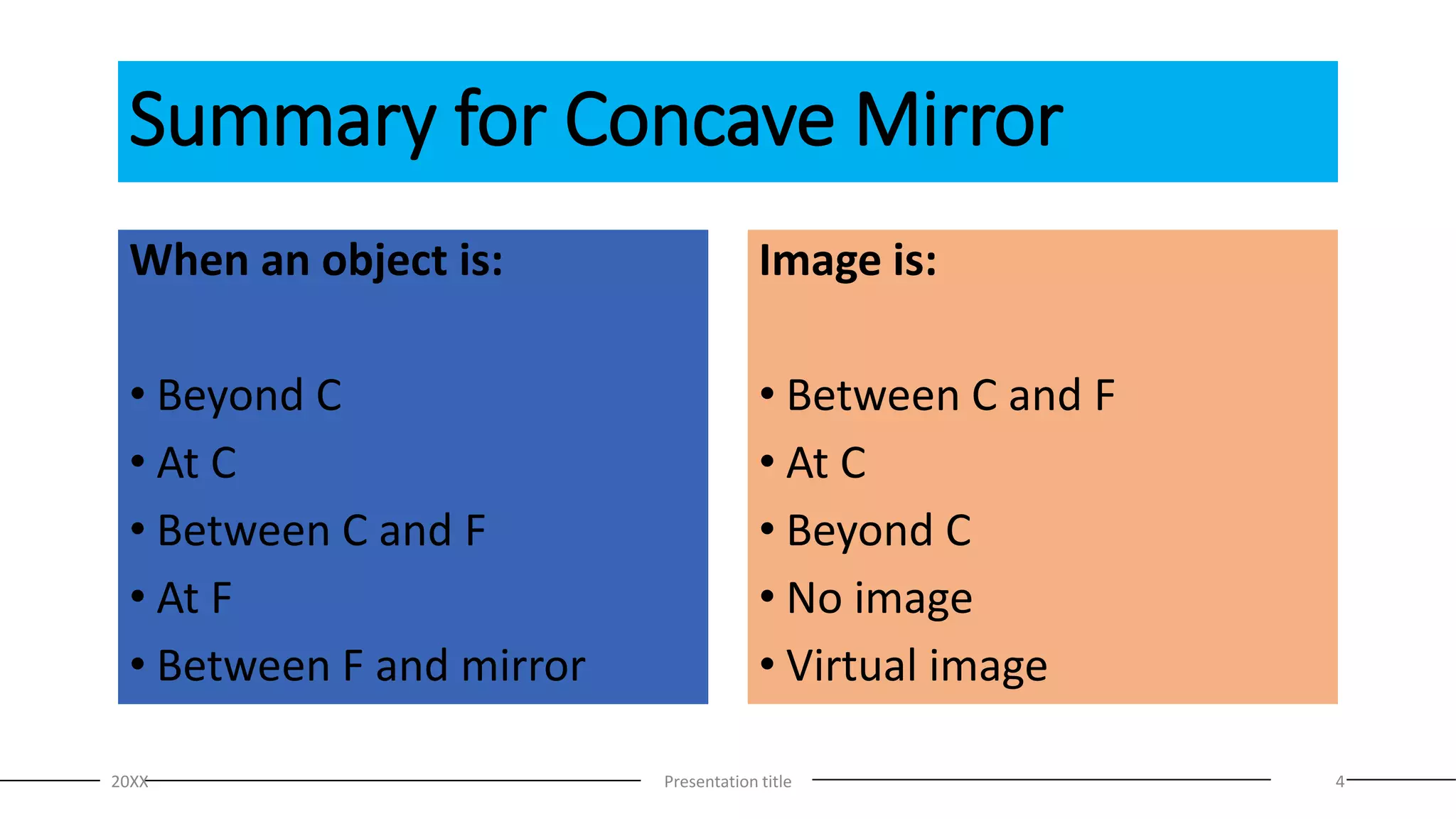
Summary for Concave Mirror
20XX Presentation title 4
When an object is:
• Beyond C
• At C
• Between C and F
• At F
• Between F and mirror
Image is:
• Between C and F
• At C
• Beyond C
• No image
• Virtual image
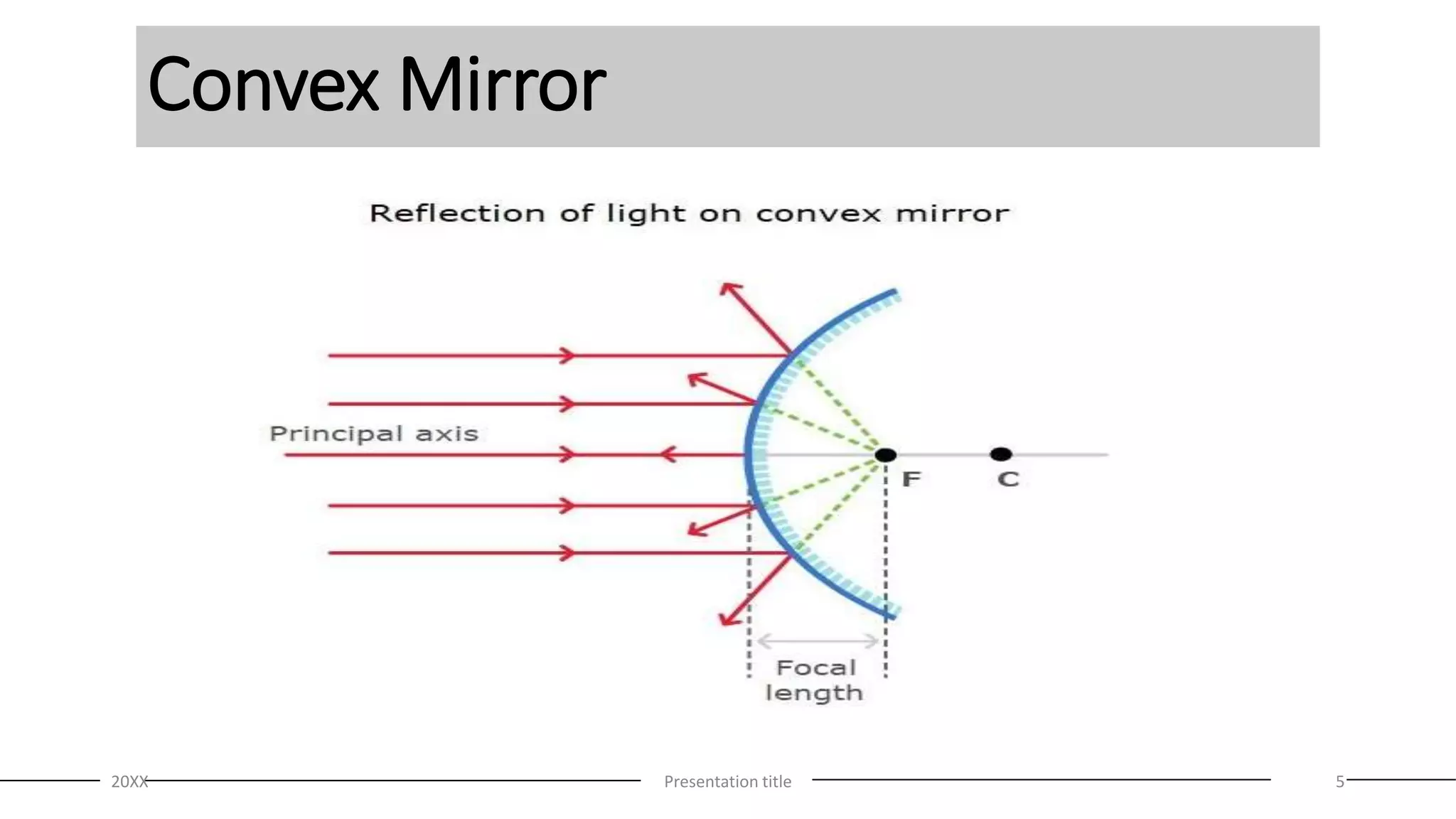
Convex Mirror
20XX Presentation title 5
Ray Diagram for Convex Mirror
20XX Presentation title 6
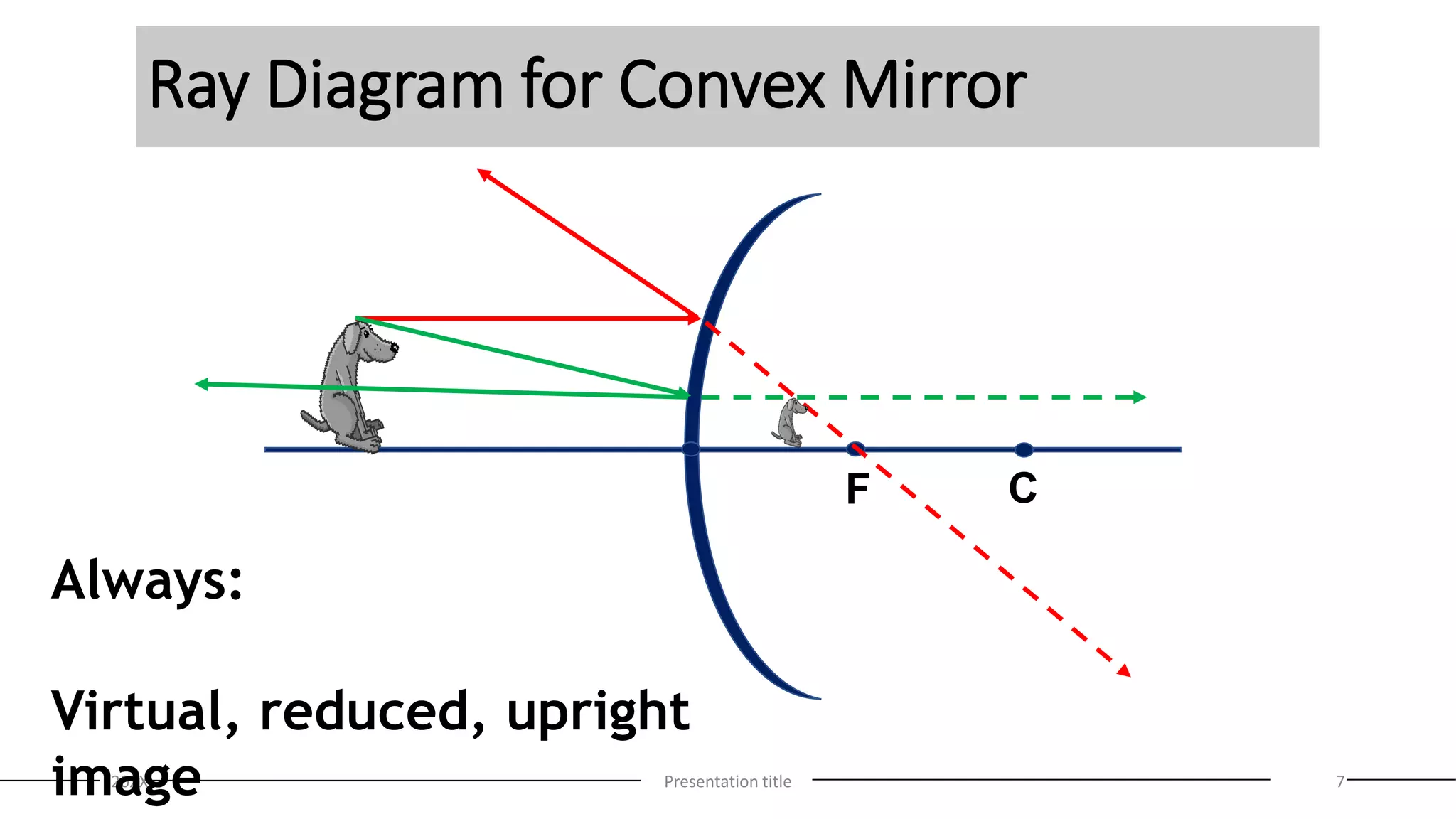
Ray Diagram for Convex Mirror
20XX Presentation title 7
C
F
Always:
Virtual, reduced, upright
image
There is an important relationship between the
distance of the object (do), the distance of the
image (di), and the focal length (f). This relationship
is known as the mirror equation.
The mirror equation is an accurate way to find and
describe the image formed by a spherical mirror
through computation or via a mathematical method.
20XX Presentation title 8
The Mirror
Equation
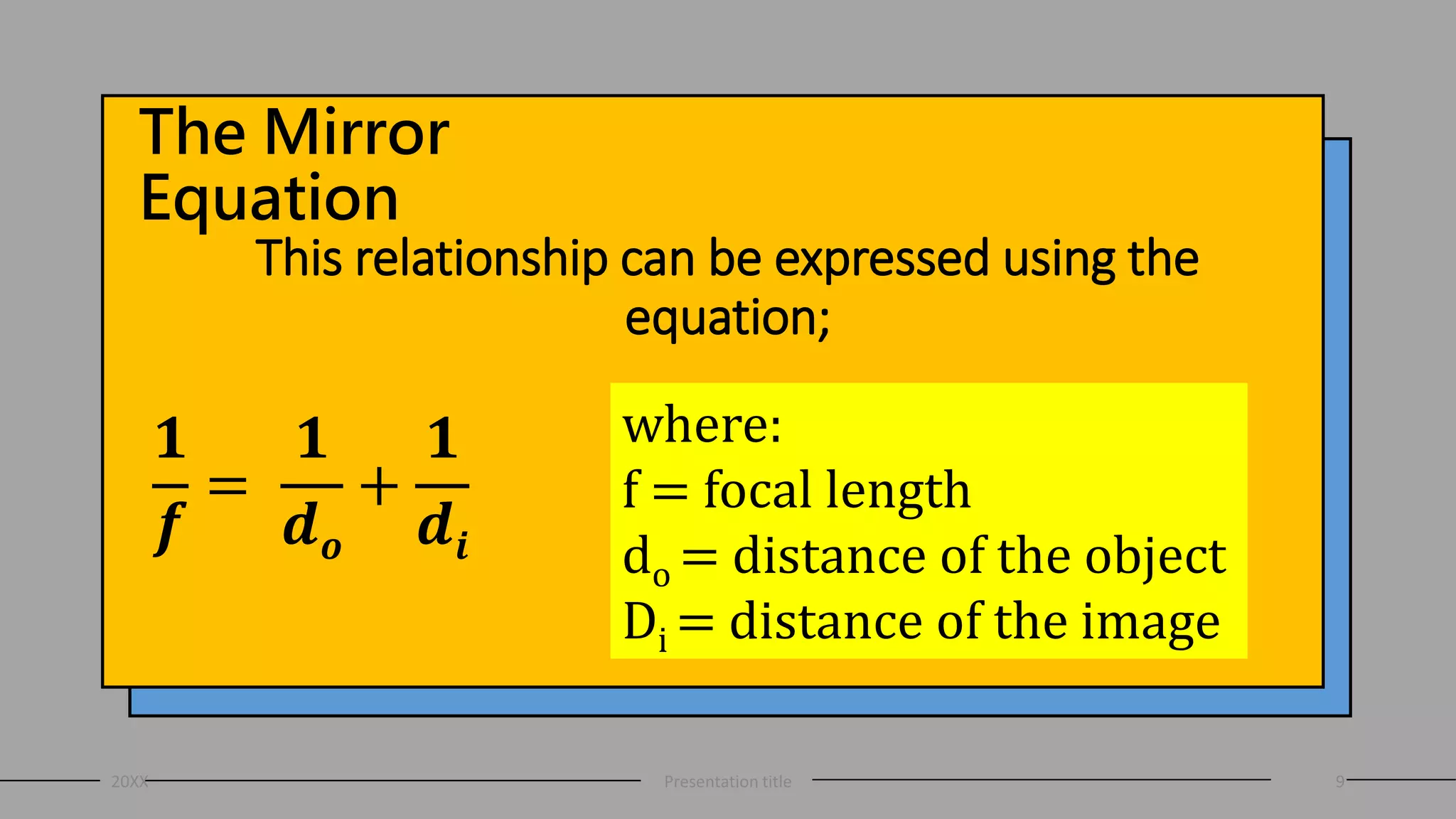
This relationship can be expressed using the
equation;
20XX Presentation title 9
The Mirror
Equation
𝟏
𝒇
=
𝟏
𝒅𝒐
+
𝟏
𝒅𝒊
where:
f = focal length
do = distance of the object
Di = distance of the image
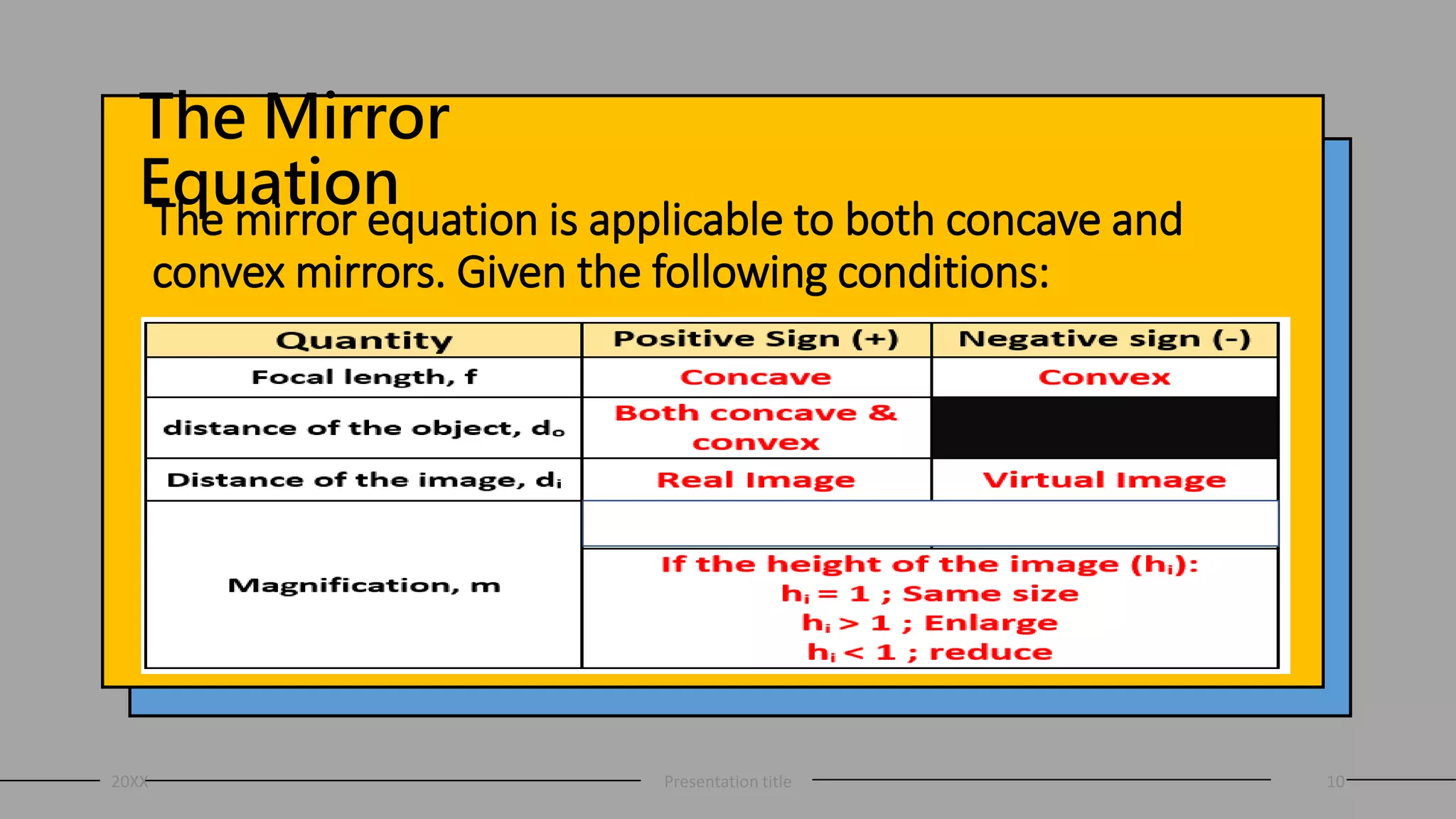
The mirror equation is applicable to both concave and
convex mirrors. Given the following conditions:
20XX Presentation title 10
The Mirror
Equation
m =
𝑺𝒊
𝑺𝒐
=
𝒅𝒊
𝒅𝒐
20XX Presentation title 11
The Mirror
Equation
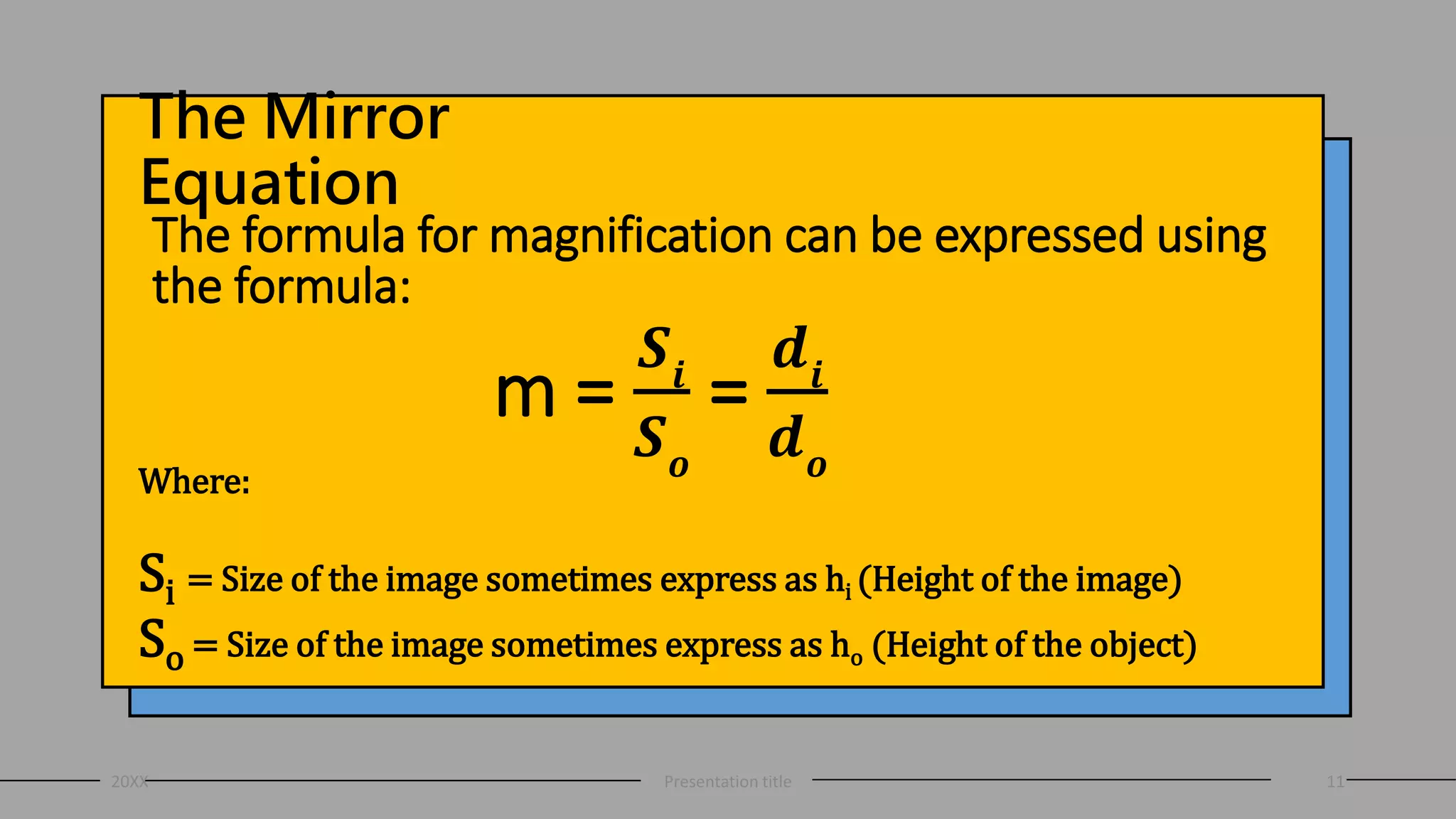
The formula for magnification can be expressed using
the formula:
Where:
Si = Size of the image sometimes express as hi (Height of the image)
So = Size of the image sometimes express as ho (Height of the object)
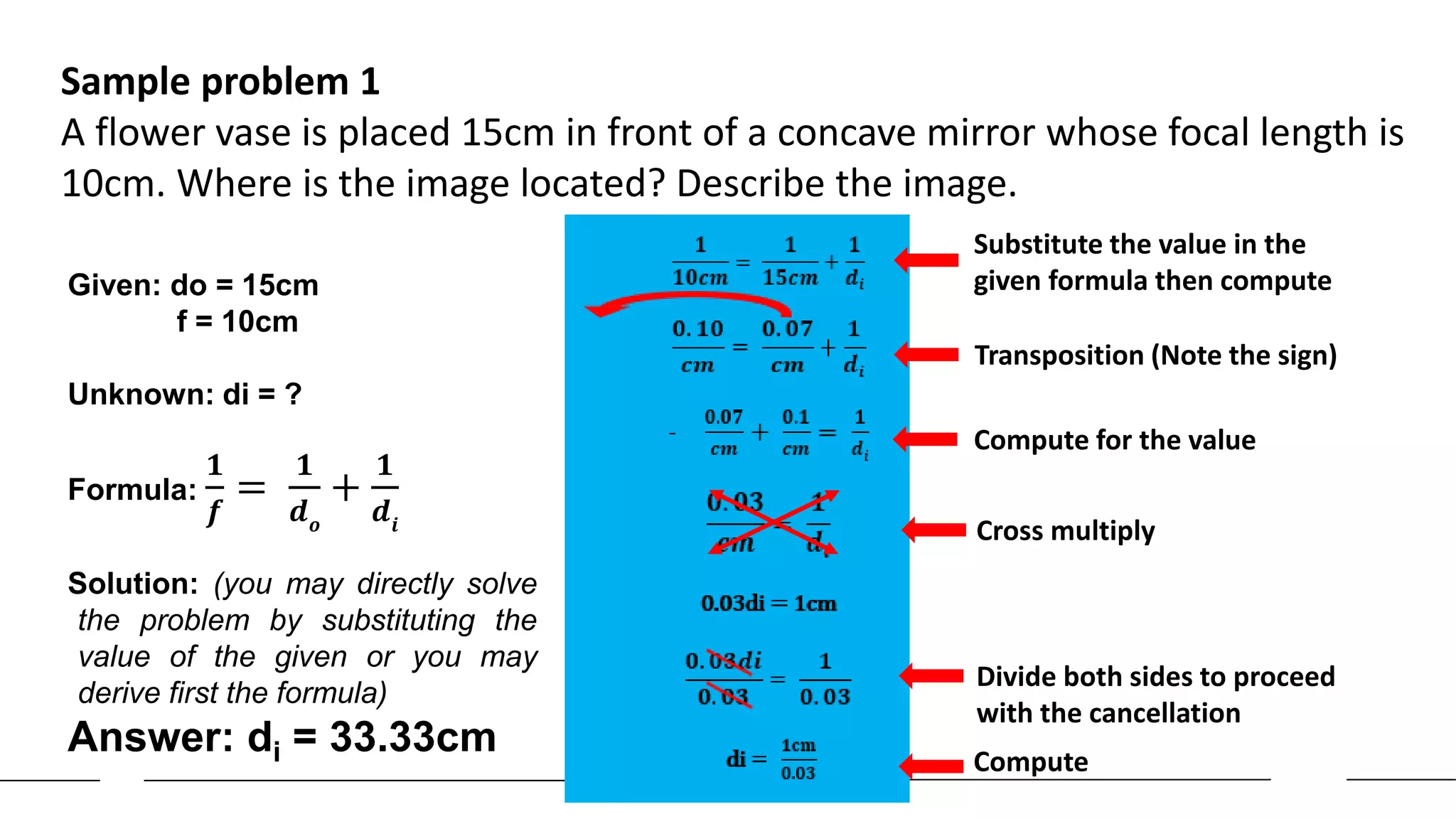
Sample problem 1
A flower vase is placed 15cm in front of a concave mirror whose focal length is
10cm. Where is the image located? Describe the image.
Given: do = 15cm
f = 10cm
Unknown: di = ?
Formula:
𝟏
𝒇
=
𝟏
𝒅𝒐
+
𝟏
𝒅𝒊
Solution: (you may directly solve
the problem by substituting the
value of the given or you may
derive first the formula)
Answer: di = 33.33cm
Substitute the value in the
given formula then compute
Transposition (Note the sign)
Compute for the value
Cross multiply
Divide both sides to proceed
with the cancellation
Compute
20XX Presentation title 13
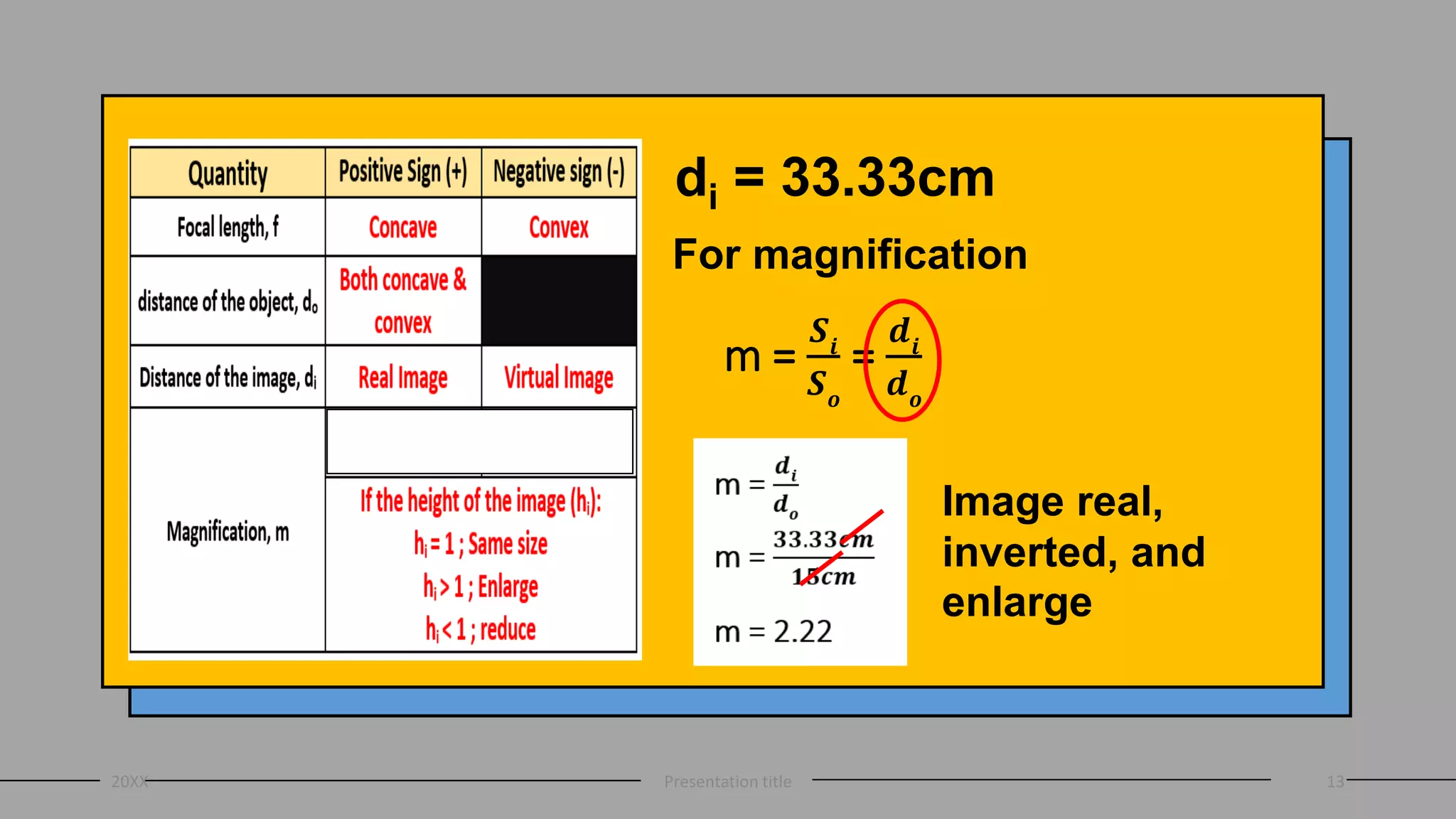
di = 33.33cm
m =
𝑺𝒊
𝑺𝒐
=
𝒅𝒊
𝒅𝒐
For magnification
Image real,
inverted, and
enlarge
20XX Presentation title 14
Sample problem 2
A bottle is held 5.0cm from a concave mirror whose
radius is 28.0cm. At what distance will the image be
formed?
Sample problem 3
A cup is placed in front of a curved mirror whose focal
point is at 8cm, and formed an image 24cm beyond C.
At what point thus the cup is located?

The Mirror Equation.pptx

  • 1.
  • 2.
    Review 2 Identify the partsof a curved mirror. Principal Axis Center of Curvature (C) Focal Point/ Focus (F) Vertex (A) Radius of Curvature (R) Focal Length (f)
  • 3.
    Review 3 Always remember thatthe focal length (f) is ½ of the radius of curvature (R) Radius of Curvature (R) Focal Length (f) f = ½R For example: if the radius of curvature is 40cm then the focal length (f) is 20cm. f = ½ (40cm) = 20cm
  • 4.
    Summary for ConcaveMirror 20XX Presentation title 4 When an object is: • Beyond C • At C • Between C and F • At F • Between F and mirror Image is: • Between C and F • At C • Beyond C • No image • Virtual image
  • 5.
  • 6.
    Ray Diagram forConvex Mirror 20XX Presentation title 6
  • 7.
    Ray Diagram forConvex Mirror 20XX Presentation title 7 C F Always: Virtual, reduced, upright image
  • 8.
    There is animportant relationship between the distance of the object (do), the distance of the image (di), and the focal length (f). This relationship is known as the mirror equation. The mirror equation is an accurate way to find and describe the image formed by a spherical mirror through computation or via a mathematical method. 20XX Presentation title 8 The Mirror Equation
  • 9.
    This relationship canbe expressed using the equation; 20XX Presentation title 9 The Mirror Equation 𝟏 𝒇 = 𝟏 𝒅𝒐 + 𝟏 𝒅𝒊 where: f = focal length do = distance of the object Di = distance of the image
  • 10.
    The mirror equationis applicable to both concave and convex mirrors. Given the following conditions: 20XX Presentation title 10 The Mirror Equation
  • 11.
    m = 𝑺𝒊 𝑺𝒐 = 𝒅𝒊 𝒅𝒐 20XX Presentationtitle 11 The Mirror Equation The formula for magnification can be expressed using the formula: Where: Si = Size of the image sometimes express as hi (Height of the image) So = Size of the image sometimes express as ho (Height of the object)
  • 12.
    Sample problem 1 Aflower vase is placed 15cm in front of a concave mirror whose focal length is 10cm. Where is the image located? Describe the image. Given: do = 15cm f = 10cm Unknown: di = ? Formula: 𝟏 𝒇 = 𝟏 𝒅𝒐 + 𝟏 𝒅𝒊 Solution: (you may directly solve the problem by substituting the value of the given or you may derive first the formula) Answer: di = 33.33cm Substitute the value in the given formula then compute Transposition (Note the sign) Compute for the value Cross multiply Divide both sides to proceed with the cancellation Compute
  • 13.
    20XX Presentation title13 di = 33.33cm m = 𝑺𝒊 𝑺𝒐 = 𝒅𝒊 𝒅𝒐 For magnification Image real, inverted, and enlarge
  • 14.
    20XX Presentation title14 Sample problem 2 A bottle is held 5.0cm from a concave mirror whose radius is 28.0cm. At what distance will the image be formed? Sample problem 3 A cup is placed in front of a curved mirror whose focal point is at 8cm, and formed an image 24cm beyond C. At what point thus the cup is located?