Introduction

Nonprofit leaders today are faced with doing more with less. Too few have
long-term fundraising plans in place because of the urgency to meet
immediate and short-term financial obligations.

Charitable gifts that are planned by donors
can help ensure the sustainability of an
organization with guaranteed revenue
streams, and provide peace of mind for all
concerned. They are in addition to annual
gifts, memberships, grants, events and
other sources of support.
This Planned Giving Toolkit has been developed by the California
Community Foundation in Los Angeles in order to assist nonprofits expand
their fundraising horizons. Any nonprofit, regardless of size or age, can
follow these practical, easy steps and use the ready-to-use template
materials to effectively, efficiently and confidently start a planned giving
program. Read on and begin today.

                                                                               2
Planned Giving: Why and Why Not?

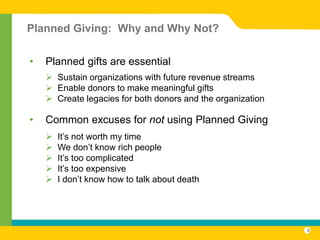
•   Planned gifts are essential
     Sustain organizations with future revenue streams
     Enable donors to make meaningful gifts
     Create legacies for both donors and the organization

•   Common excuses for not using Planned Giving
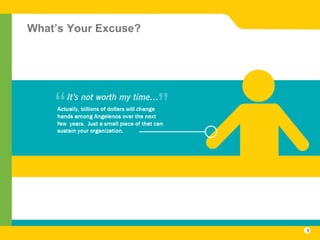
       It’s not worth my time
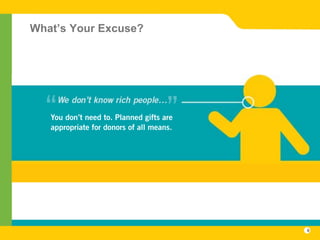
       We don’t know rich people
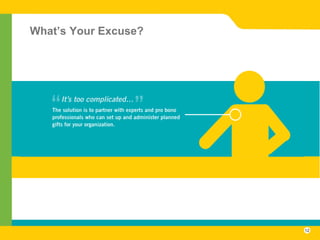
       It’s too complicated
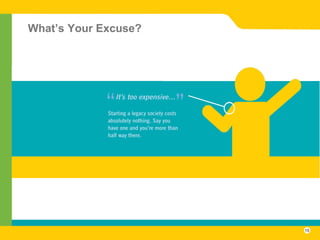
       It’s too expensive
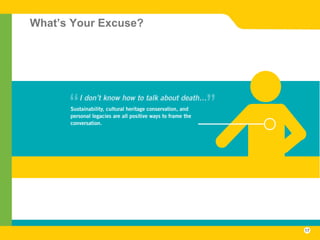
       I don’t know how to talk about death


                                                             3
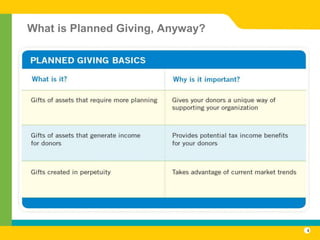
What is Planned Giving, Anyway?


                                  4
What’s Your Excuse?


                      5
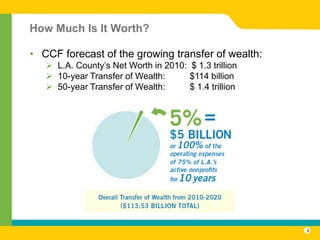
How Much Is It Worth?

• CCF forecast of the growing transfer of wealth:
    L.A. County’s Net Worth in 2010: $ 1.3 trillion
    10-year Transfer of Wealth:      $114 billion
    50-year Transfer of Wealth:      $ 1.4 trillion


                                                       6
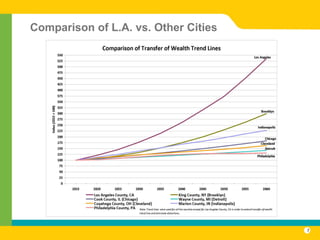
Comparison of L.A. vs. Other Cities


                                      7
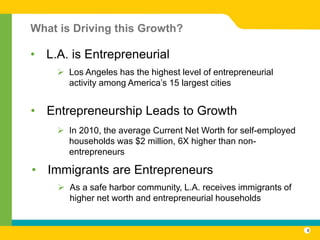
What is Driving this Growth?

• L.A. is Entrepreneurial
     Los Angeles has the highest level of entrepreneurial
      activity among America’s 15 largest cities


• Entrepreneurship Leads to Growth
     In 2010, the average Current Net Worth for self-employed
      households was $2 million, 6X higher than non-
      entrepreneurs

• Immigrants are Entrepreneurs
      As a safe harbor community, L.A. receives immigrants of
       higher net worth and entrepreneurial households


                                                                 8
What’s Your Excuse?


                      9
Who is Unprepared for Wealth Transfer?
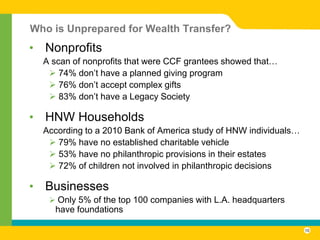
•   Nonprofits
    A scan of nonprofits that were CCF grantees showed that…
      74% don’t have a planned giving program
      76% don’t accept complex gifts
      83% don’t have a Legacy Society

•   HNW Households
    According to a 2010 Bank of America study of HNW individuals…
      79% have no established charitable vehicle
      53% have no philanthropic provisions in their estates
      72% of children not involved in philanthropic decisions

•   Businesses
      Only 5% of the top 100 companies with L.A. headquarters
      have foundations

                                                                    10
Read the Full Report


           https://calfund.org/transfer
                                          11
What’s Your Excuse?


                      12
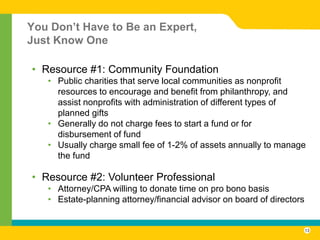
You Don’t Have to Be an Expert,
Just Know One

• Resource #1: Community Foundation
   • Public charities that serve local communities as nonprofit
     resources to encourage and benefit from philanthropy, and
     assist nonprofits with administration of different types of
     planned gifts
   • Generally do not charge fees to start a fund or for
     disbursement of fund
   • Usually charge small fee of 1-2% of assets annually to manage
     the fund

• Resource #2: Volunteer Professional
   • Attorney/CPA willing to donate time on pro bono basis
   • Estate-planning attorney/financial advisor on board of directors


                                                                        13
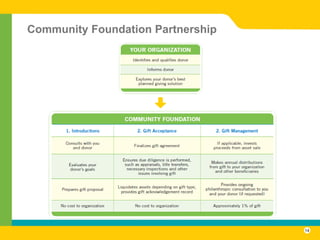
Community Foundation Partnership


                                   14
What’s Your Excuse?


                      15
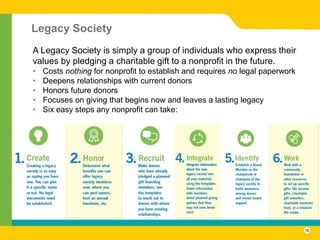
Legacy Society
A Legacy Society is simply a group of individuals who express their
values by pledging a charitable gift to a nonprofit in the future.
•   Costs nothing for nonprofit to establish and requires no legal paperwork
•   Deepens relationships with current donors
•   Honors future donors
•   Focuses on giving that begins now and leaves a lasting legacy
•   Six easy steps any nonprofit can take:


                                                                               16
What’s Your Excuse?


                      17
Don’t Want to Talk About Death? Don’t.
Focus on the present while talking about the future. For example:
1. Sustainability
“The needs of this community (hunger, homelessness, etc.) are ongoing.
A legacy gift ensures that our organization will be around years from now to
fulfill those needs.”

2. Next Generation
“Legacy gifts ensure the well-being of future generations and serve as an
inspiration to others to do the same.”

3. Heritage
“You understand the importance of preserving our rich heritage and cultural
identity. Legacy gifts provide donors a meaningful way to ensure this lasts
decades into the future.”

4. Personal Legacy
“Becoming a member of our Legacy Society ensures that the issues you care
about and the values you cherish will be long remembered.”

                                                                               18
What’s Your Objective?


    Building and Strengthening

            Individual
    FUNDRAISING

                                 19
What’s Your Message?


      Live a Legacy.
     Leave a Legacy.


                       20
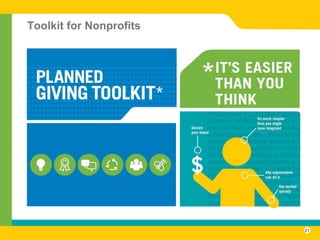
Toolkit for Nonprofits


                         21
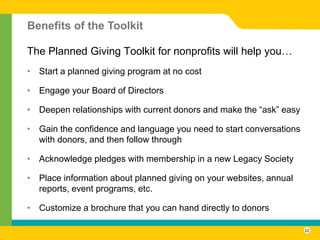
Benefits of the Toolkit

The Planned Giving Toolkit for nonprofits will help you…
• Start a planned giving program at no cost

• Engage your Board of Directors

• Deepen relationships with current donors and make the “ask” easy

• Gain the confidence and language you need to start conversations
  with donors, and then follow through

• Acknowledge pledges with membership in a new Legacy Society

• Place information about planned giving on your websites, annual
  reports, event programs, etc.

• Customize a brochure that you can hand directly to donors

                                                                     22
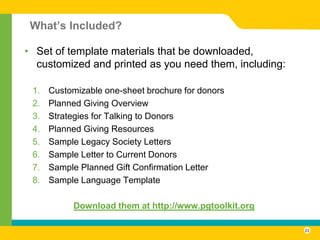
What’s Included?

• Set of template materials that be downloaded,
  customized and printed as you need them, including:

 1.   Customizable one-sheet brochure for donors
 2.   Planned Giving Overview
 3.   Strategies for Talking to Donors
 4.   Planned Giving Resources
 5.   Sample Legacy Society Letters
 6.   Sample Letter to Current Donors
 7.   Sample Planned Gift Confirmation Letter
 8.   Sample Language Template

           Download them at http://www.pgtoolkit.org

                                                        23
About

        California Community Foundation (CCF) is a public,
        charitable organization serving Los Angeles County
        since 1915, and playing several roles in the
        community today. It encourages philanthropy by
        individuals, families, companies and organizations,
        and serves as a steward of their funds and legacies.
        It supports nonprofits in the arts, civic engagement,
        education, health care, housing and neighborhoods,
        and human development with grants and other
        assistance, and collaborates in addressing the
        needs of poor and vulnerable populations. It actively
        engages in community problem solving with other
        organizations in the nonprofit, public and private
        sectors.

        For more information, visit calfund.org
        facebook.com/calfund and youtube.com/calfundtv


                                                                24

Planned Giving Presentation

  • 2.
    Introduction Nonprofit leaders todayare faced with doing more with less. Too few have long-term fundraising plans in place because of the urgency to meet immediate and short-term financial obligations. Charitable gifts that are planned by donors can help ensure the sustainability of an organization with guaranteed revenue streams, and provide peace of mind for all concerned. They are in addition to annual gifts, memberships, grants, events and other sources of support. This Planned Giving Toolkit has been developed by the California Community Foundation in Los Angeles in order to assist nonprofits expand their fundraising horizons. Any nonprofit, regardless of size or age, can follow these practical, easy steps and use the ready-to-use template materials to effectively, efficiently and confidently start a planned giving program. Read on and begin today. 2
  • 3.
    Planned Giving: Whyand Why Not? • Planned gifts are essential  Sustain organizations with future revenue streams  Enable donors to make meaningful gifts  Create legacies for both donors and the organization • Common excuses for not using Planned Giving  It’s not worth my time  We don’t know rich people  It’s too complicated  It’s too expensive  I don’t know how to talk about death 3
  • 4.
    What is PlannedGiving, Anyway? 4
  • 5.
  • 6.
    How Much IsIt Worth? • CCF forecast of the growing transfer of wealth:  L.A. County’s Net Worth in 2010: $ 1.3 trillion  10-year Transfer of Wealth: $114 billion  50-year Transfer of Wealth: $ 1.4 trillion 6
  • 7.
    Comparison of L.A.vs. Other Cities 7
  • 8.
    What is Drivingthis Growth? • L.A. is Entrepreneurial  Los Angeles has the highest level of entrepreneurial activity among America’s 15 largest cities • Entrepreneurship Leads to Growth  In 2010, the average Current Net Worth for self-employed households was $2 million, 6X higher than non- entrepreneurs • Immigrants are Entrepreneurs  As a safe harbor community, L.A. receives immigrants of higher net worth and entrepreneurial households 8
  • 9.
  • 10.
    Who is Unpreparedfor Wealth Transfer? • Nonprofits A scan of nonprofits that were CCF grantees showed that…  74% don’t have a planned giving program  76% don’t accept complex gifts  83% don’t have a Legacy Society • HNW Households According to a 2010 Bank of America study of HNW individuals…  79% have no established charitable vehicle  53% have no philanthropic provisions in their estates  72% of children not involved in philanthropic decisions • Businesses  Only 5% of the top 100 companies with L.A. headquarters have foundations 10
  • 11.
    Read the FullReport https://calfund.org/transfer 11
  • 12.
  • 13.
    You Don’t Haveto Be an Expert, Just Know One • Resource #1: Community Foundation • Public charities that serve local communities as nonprofit resources to encourage and benefit from philanthropy, and assist nonprofits with administration of different types of planned gifts • Generally do not charge fees to start a fund or for disbursement of fund • Usually charge small fee of 1-2% of assets annually to manage the fund • Resource #2: Volunteer Professional • Attorney/CPA willing to donate time on pro bono basis • Estate-planning attorney/financial advisor on board of directors 13
  • 14.
  • 15.
  • 16.
    Legacy Society A LegacySociety is simply a group of individuals who express their values by pledging a charitable gift to a nonprofit in the future. • Costs nothing for nonprofit to establish and requires no legal paperwork • Deepens relationships with current donors • Honors future donors • Focuses on giving that begins now and leaves a lasting legacy • Six easy steps any nonprofit can take: 16
  • 17.
  • 18.
    Don’t Want toTalk About Death? Don’t. Focus on the present while talking about the future. For example: 1. Sustainability “The needs of this community (hunger, homelessness, etc.) are ongoing. A legacy gift ensures that our organization will be around years from now to fulfill those needs.” 2. Next Generation “Legacy gifts ensure the well-being of future generations and serve as an inspiration to others to do the same.” 3. Heritage “You understand the importance of preserving our rich heritage and cultural identity. Legacy gifts provide donors a meaningful way to ensure this lasts decades into the future.” 4. Personal Legacy “Becoming a member of our Legacy Society ensures that the issues you care about and the values you cherish will be long remembered.” 18
  • 19.
    What’s Your Objective? Building and Strengthening Individual FUNDRAISING 19
  • 20.
    What’s Your Message? Live a Legacy. Leave a Legacy. 20
  • 21.
  • 22.
    Benefits of theToolkit The Planned Giving Toolkit for nonprofits will help you… • Start a planned giving program at no cost • Engage your Board of Directors • Deepen relationships with current donors and make the “ask” easy • Gain the confidence and language you need to start conversations with donors, and then follow through • Acknowledge pledges with membership in a new Legacy Society • Place information about planned giving on your websites, annual reports, event programs, etc. • Customize a brochure that you can hand directly to donors 22
  • 23.
    What’s Included? • Setof template materials that be downloaded, customized and printed as you need them, including: 1. Customizable one-sheet brochure for donors 2. Planned Giving Overview 3. Strategies for Talking to Donors 4. Planned Giving Resources 5. Sample Legacy Society Letters 6. Sample Letter to Current Donors 7. Sample Planned Gift Confirmation Letter 8. Sample Language Template Download them at http://www.pgtoolkit.org 23
  • 24.
    About California Community Foundation (CCF) is a public, charitable organization serving Los Angeles County since 1915, and playing several roles in the community today. It encourages philanthropy by individuals, families, companies and organizations, and serves as a steward of their funds and legacies. It supports nonprofits in the arts, civic engagement, education, health care, housing and neighborhoods, and human development with grants and other assistance, and collaborates in addressing the needs of poor and vulnerable populations. It actively engages in community problem solving with other organizations in the nonprofit, public and private sectors. For more information, visit calfund.org facebook.com/calfund and youtube.com/calfundtv 24