PLANNED GIVING LAYING THE GROUNDWORK FOR FUTURE GIFTS November 17, 2009
The Curtis Group OUR MISSION Committed to promoting philanthropy,  we help nonprofits plan their future, build awareness,  and raise substantial amounts of money.
The Curtis Group Raised hundreds of millions for more than 80 nonprofits Celebrating our 20 th  anniversary this year Only Virginia-based member of North America’s 35-member Giving Institute
Giving Institute: Leading  Consultants to Nonprofits Offers thought leadership on philanthropy Promotes high standards of ethical fundraising Publishes annual  Giving USA  and quarterly  Giving USA Spotlights
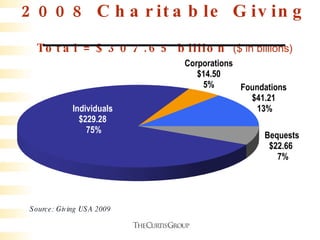
2008 Charitable Giving  Total = $307.65 billion  ($ in billions) Individuals $229.28  75% Foundations $41.21  13% Bequests $22.66   7% Corporations $14.50 5% Source: Giving USA 2009
Importance of Individual Giving January 2009 survey by Cygnus found that: 42% percent of donors would give to nonprofit they had not supported in the past if someone they knew asked for a gift September 2009 survey by IU Center on Philanthropy/Campbell & Company found that: Donors asked to give in person by someone they knew gave 19% more than if asked another way
What Is Planned Giving? The current gift of future assets through such vehicles as bequests, charitable trusts or annuities –  Board Source  Gift planning is the process of cultivating, designing, facilitating, and stewarding gifts to charitable organizations –  National Committee on Planned Giving
About Planned Giving Requires help, support, or counsel of a representative of organization receiving gift When successful, allows nonprofits to establish solid funding base for long term Bequests and charitable gift annuities are most common planned gifts If people can’t give in the current economy, they can plan to give later
Who Makes Planned Gifts People at all income levels leave charitable gifts, although those earning $100,000+ are more likely Those closest to you: Consistent donors Current and former board members Current and former volunteers Staff members
Who Makes Planned Gifts Education makes a difference 40% of those who finish high school include a charity in their will People with college degrees are 22% more likely to leave a planned gift to charity People with post-college education are 47% more likely to leave a planned gift to charity People with religious affiliations more likely to make charitable bequest
Who Makes Planned Gifts Single people, widows/widowers, couples without children  Married women least likely to leave charitable gift  Basic profile of bequest maker Single Highly educated Attends religious services Earns more than $100,000
Who Makes Planned Gifts? Among people who donate $500 a year or more to charity, only 9.5% have a charitable estate plan Among donors who had a will: 9.8% of those with grandchildren made a charitable bequest  50% of those without offspring made a charitable bequest Source: University of Georgia study tracking 20,000 Americans over age 50 from 1995 to 2006
Who Makes Planned Gifts Of all single donors 27.7% in cities or suburbs named charity in will 19.1% in rural regions named charity in will No real difference in # of men and women, but: Women tend to make more bequests; men tend to make more gifts from charitable trusts Women leave to religion, health, human services, and environment; men leave to public-society benefit and education
Planned Gifts: Bequests Are Key More than 80% of planned giving dollars come from bequests Remember, bequests are REVOCABLE – donors must receive appropriate stewardship Those who make bequests will probably change their plans several times –you need to be in the final will
Board’s Role in Planned Giving Making a planned gift Identifying prospects Cultivating and soliciting gifts Opening doors by introducing staff members Hosting events Offering testimonials in marketing materials
Board’s Role in Planned Giving Learning how to respond when donor/prospect brings up possibility of planned gift Staff has a big role in the process Scheduling meetings with professional advisors  Presenting a proposal (in some cases), but must be carefully managed and coordinated with the staff Once gift is made, remaining involved in donor recognition and stewardship
Reaching Potential Donors Marketing must present specialized message to the most likely planned-giving donors Mailings and marketing alone do not drive planned gifts You must meet with donors and professional advisors Make planned giving a part of your regular fundraising programs
Planned Giving Steps to Success Develop a Case Statement Clearly define needs and ways to give Prepare planned giving policies What types of gifts accepted What programs will gifts fund How will funds be invested Provide staff training
Planned Giving Steps to Success Create a professional advisory committee Identify prospects Donors who have given $25+ for three or more years Donors who are 65 and older Donors who have given $1,000+ at any time to your organization Remember FLAG: frequency, longevity, age, gender Others without children who can be cultivated
Planned Giving Steps to Success Establish legacy society for donor recognition Hold training sessions for your board Outline what planned giving is Provide profile of planned giving prospects Describe how planned giving fits into total development picture Make personal visits to donors and prospects
Planned Giving Steps to Success Market your planned giving program Create brochure about legacy society/ways to give Include testimonials in your newsletter Recognize donors in publications Provide sample wording for a bequest Create a direct-mail appeal for planned giving to targeted prospects Add info about it to your Web site Market to professional financial advisors
Planned Giving Summary People at all income levels make planned gifts Planned giving is huge opportunity for nonprofits; fewer than 10% of people now make a charitable bequest Current donors are best planned-giving prospects Bequests require proper stewardship; most people change their estate plans several times
757-496-2224 www.curtisgroupconsultants.com

Planned Giving

  • 1.
    PLANNED GIVING LAYINGTHE GROUNDWORK FOR FUTURE GIFTS November 17, 2009
  • 2.
    The Curtis GroupOUR MISSION Committed to promoting philanthropy, we help nonprofits plan their future, build awareness, and raise substantial amounts of money.
  • 3.
    The Curtis GroupRaised hundreds of millions for more than 80 nonprofits Celebrating our 20 th anniversary this year Only Virginia-based member of North America’s 35-member Giving Institute
  • 4.
    Giving Institute: Leading Consultants to Nonprofits Offers thought leadership on philanthropy Promotes high standards of ethical fundraising Publishes annual Giving USA and quarterly Giving USA Spotlights
  • 5.
    2008 Charitable Giving Total = $307.65 billion ($ in billions) Individuals $229.28 75% Foundations $41.21 13% Bequests $22.66 7% Corporations $14.50 5% Source: Giving USA 2009
  • 6.
    Importance of IndividualGiving January 2009 survey by Cygnus found that: 42% percent of donors would give to nonprofit they had not supported in the past if someone they knew asked for a gift September 2009 survey by IU Center on Philanthropy/Campbell & Company found that: Donors asked to give in person by someone they knew gave 19% more than if asked another way
  • 7.
    What Is PlannedGiving? The current gift of future assets through such vehicles as bequests, charitable trusts or annuities – Board Source Gift planning is the process of cultivating, designing, facilitating, and stewarding gifts to charitable organizations – National Committee on Planned Giving
  • 8.
    About Planned GivingRequires help, support, or counsel of a representative of organization receiving gift When successful, allows nonprofits to establish solid funding base for long term Bequests and charitable gift annuities are most common planned gifts If people can’t give in the current economy, they can plan to give later
  • 9.
    Who Makes PlannedGifts People at all income levels leave charitable gifts, although those earning $100,000+ are more likely Those closest to you: Consistent donors Current and former board members Current and former volunteers Staff members
  • 10.
    Who Makes PlannedGifts Education makes a difference 40% of those who finish high school include a charity in their will People with college degrees are 22% more likely to leave a planned gift to charity People with post-college education are 47% more likely to leave a planned gift to charity People with religious affiliations more likely to make charitable bequest
  • 11.
    Who Makes PlannedGifts Single people, widows/widowers, couples without children Married women least likely to leave charitable gift Basic profile of bequest maker Single Highly educated Attends religious services Earns more than $100,000
  • 12.
    Who Makes PlannedGifts? Among people who donate $500 a year or more to charity, only 9.5% have a charitable estate plan Among donors who had a will: 9.8% of those with grandchildren made a charitable bequest 50% of those without offspring made a charitable bequest Source: University of Georgia study tracking 20,000 Americans over age 50 from 1995 to 2006
  • 13.
    Who Makes PlannedGifts Of all single donors 27.7% in cities or suburbs named charity in will 19.1% in rural regions named charity in will No real difference in # of men and women, but: Women tend to make more bequests; men tend to make more gifts from charitable trusts Women leave to religion, health, human services, and environment; men leave to public-society benefit and education
  • 14.
    Planned Gifts: BequestsAre Key More than 80% of planned giving dollars come from bequests Remember, bequests are REVOCABLE – donors must receive appropriate stewardship Those who make bequests will probably change their plans several times –you need to be in the final will
  • 15.
    Board’s Role inPlanned Giving Making a planned gift Identifying prospects Cultivating and soliciting gifts Opening doors by introducing staff members Hosting events Offering testimonials in marketing materials
  • 16.
    Board’s Role inPlanned Giving Learning how to respond when donor/prospect brings up possibility of planned gift Staff has a big role in the process Scheduling meetings with professional advisors Presenting a proposal (in some cases), but must be carefully managed and coordinated with the staff Once gift is made, remaining involved in donor recognition and stewardship
  • 17.
    Reaching Potential DonorsMarketing must present specialized message to the most likely planned-giving donors Mailings and marketing alone do not drive planned gifts You must meet with donors and professional advisors Make planned giving a part of your regular fundraising programs
  • 18.
    Planned Giving Stepsto Success Develop a Case Statement Clearly define needs and ways to give Prepare planned giving policies What types of gifts accepted What programs will gifts fund How will funds be invested Provide staff training
  • 19.
    Planned Giving Stepsto Success Create a professional advisory committee Identify prospects Donors who have given $25+ for three or more years Donors who are 65 and older Donors who have given $1,000+ at any time to your organization Remember FLAG: frequency, longevity, age, gender Others without children who can be cultivated
  • 20.
    Planned Giving Stepsto Success Establish legacy society for donor recognition Hold training sessions for your board Outline what planned giving is Provide profile of planned giving prospects Describe how planned giving fits into total development picture Make personal visits to donors and prospects
  • 21.
    Planned Giving Stepsto Success Market your planned giving program Create brochure about legacy society/ways to give Include testimonials in your newsletter Recognize donors in publications Provide sample wording for a bequest Create a direct-mail appeal for planned giving to targeted prospects Add info about it to your Web site Market to professional financial advisors
  • 22.
    Planned Giving SummaryPeople at all income levels make planned gifts Planned giving is huge opportunity for nonprofits; fewer than 10% of people now make a charitable bequest Current donors are best planned-giving prospects Bequests require proper stewardship; most people change their estate plans several times
  • 23.