Definition by Global Economic Crime
Survey 2005:
• Economic crime or Fraud is a generic term used
to denote wrongful or criminal activities to or in
an organization, intended to result in the gain of
money or benefits for perpetrator.
• Corruption and Bribery means the unlawful use
of an official position to gain an advantage in
contravention of duty.
• Money Laundering actions are intending to
legitimize the proceeds of crime by distinguishing
their true origin.
Various Types of Economic Crimes
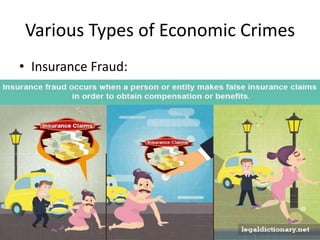
• Insurance Fraud:
• Smuggling: In the recent 2017, Mumbai Police
have seized good worth Rs 50 Crore.
• Invoice Manipulation: The term means
invoicing of goods at a price less or more than
the price for which they were actually sold or
purchased.
• Cyber Crime: Theft of communication
services, information piracy, forgery and
counterfeiting, stalking, extortion, terrorism,
sales and investment fraud, Hacking,
computer network breaches, copyright piracy,
software piracy are the examples
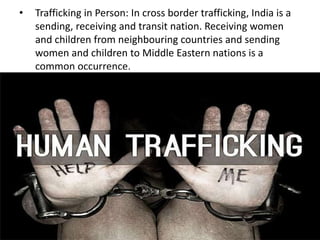
• Trafficking in Person: In cross border trafficking, India is a
sending, receiving and transit nation. Receiving women
and children from neighbouring countries and sending
women and children to Middle Eastern nations is a
common occurrence.
Types:
• Fraud Against Customers: Producers or sellers of
goods and services can cheat their customers in
many ways. They may provide defective or inferior
products or fail to deliver goods and services
altogether. They may advertise their products in a
deceptive manner.
• Bribery and Corruption: Business man provides extra
money to the public officials to get there work done
early or to get illegal work done in legal manner.
Corruption may discourage foreign investment.
Types:
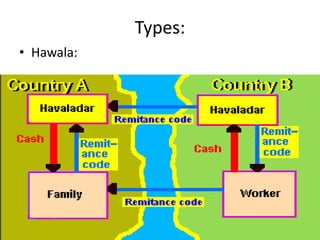
• Hawala:
Some of well known Scams in India
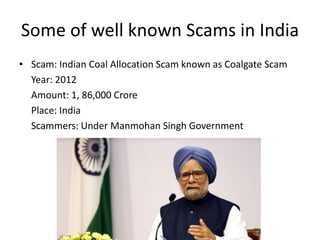
• Scam: Indian Coal Allocation Scam known as Coalgate Scam
Year: 2012
Amount: 1, 86,000 Crore
Place: India
Scammers: Under Manmohan Singh Government
Scams in India
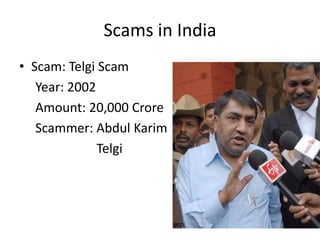
• Scam: Telgi Scam
Year: 2002
Amount: 20,000 Crore
Scammer: Abdul Karim
Telgi
Some of well known Scams in India
• Scam: Commonwealth Games Scam
Year: 2010
Amount: 70,000 Crore
• Scam: Satyam Scam
Year: 2009
Amount: 14,000 Crore
Scammer: Ramalinga Raju
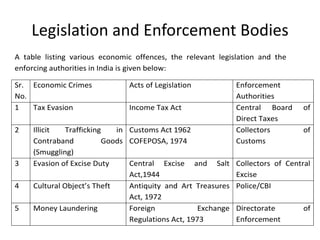
Legislation and Enforcement Bodies
A table listing various economic offences, the relevant legislation and the
enforcing authorities in India is given below:
Sr.
No.
Economic Crimes Acts of Legislation Enforcement
Authorities
1 Tax Evasion Income Tax Act Central Board of
Direct Taxes
2 Illicit Trafficking in
Contraband Goods
(Smuggling)
Customs Act 1962
COFEPOSA, 1974
Collectors of
Customs
3 Evasion of Excise Duty Central Excise and Salt
Act,1944
Collectors of Central
Excise
4 Cultural Object’s Theft Antiquity and Art Treasures
Act, 1972
Police/CBI
5 Money Laundering Foreign Exchange
Regulations Act, 1973
Directorate of
Enforcement
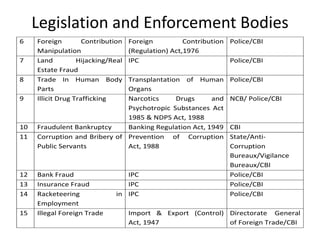
Legislation and Enforcement Bodies
6 Foreign Contribution
Manipulation
Foreign Contribution
(Regulation) Act,1976
Police/CBI
7 Land Hijacking/Real
Estate Fraud
IPC Police/CBI
8 Trade In Human Body
Parts
Transplantation of Human
Organs
Police/CBI
9 Illicit Drug Trafficking Narcotics Drugs and
Psychotropic Substances Act
1985 & NDPS Act, 1988
NCB/ Police/CBI
10 Fraudulent Bankruptcy Banking Regulation Act, 1949 CBI
11 Corruption and Bribery of
Public Servants
Prevention of Corruption
Act, 1988
State/Anti-
Corruption
Bureaux/Vigilance
Bureaux/CBI
12 Bank Fraud IPC Police/CBI
13 Insurance Fraud IPC Police/CBI
14 Racketeering in
Employment
IPC Police/CBI
15 Illegal Foreign Trade Import & Export (Control)
Act, 1947
Directorate General
of Foreign Trade/CBI
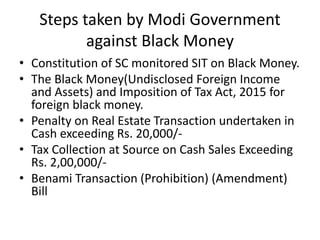
Steps taken by Modi Government
against Black Money
• Constitution of SC monitored SIT on Black Money.
• The Black Money(Undisclosed Foreign Income
and Assets) and Imposition of Tax Act, 2015 for
foreign black money.
• Penalty on Real Estate Transaction undertaken in
Cash exceeding Rs. 20,000/-
• Tax Collection at Source on Cash Sales Exceeding
Rs. 2,00,000/-
• Benami Transaction (Prohibition) (Amendment)
Bill
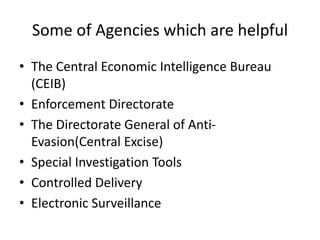
Some of Agencies which are helpful
• The Central Economic Intelligence Bureau
(CEIB)
• Enforcement Directorate
• The Directorate General of Anti-
Evasion(Central Excise)
• Special Investigation Tools
• Controlled Delivery
• Electronic Surveillance
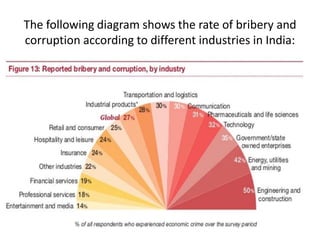
The following diagram shows the rate of bribery and
corruption according to different industries in India:
Conclusion:
• Most of the economic crimes in India are committed
through the cooperation and nexus between the
corrupt politicians, bureaucrats, industrialists,
businessman and middle-men. As far as criminality is
concerned these economic offences, while bearing
similarity to traditional offences, constitute a separate
class by virtue of their scale and dimension, and in
making individuals/state/society as collective victims of
financial loss. With general acceptance on this
fundamental, the call of tomorrow may be a
comprehensive “economic offences code”, distinct
from penal codes, to effectively counter economic
crimes.
Thank You
Presented by: Sarrah Kaviwala
Roll No: C-40
BA LLB 2nd Year

Economic Crimes

  • 2.
    Definition by GlobalEconomic Crime Survey 2005: • Economic crime or Fraud is a generic term used to denote wrongful or criminal activities to or in an organization, intended to result in the gain of money or benefits for perpetrator. • Corruption and Bribery means the unlawful use of an official position to gain an advantage in contravention of duty. • Money Laundering actions are intending to legitimize the proceeds of crime by distinguishing their true origin.
  • 3.
    Various Types ofEconomic Crimes • Insurance Fraud:
  • 4.
    • Smuggling: Inthe recent 2017, Mumbai Police have seized good worth Rs 50 Crore. • Invoice Manipulation: The term means invoicing of goods at a price less or more than the price for which they were actually sold or purchased. • Cyber Crime: Theft of communication services, information piracy, forgery and counterfeiting, stalking, extortion, terrorism, sales and investment fraud, Hacking, computer network breaches, copyright piracy, software piracy are the examples
  • 5.
    • Trafficking inPerson: In cross border trafficking, India is a sending, receiving and transit nation. Receiving women and children from neighbouring countries and sending women and children to Middle Eastern nations is a common occurrence.
  • 6.
    Types: • Fraud AgainstCustomers: Producers or sellers of goods and services can cheat their customers in many ways. They may provide defective or inferior products or fail to deliver goods and services altogether. They may advertise their products in a deceptive manner. • Bribery and Corruption: Business man provides extra money to the public officials to get there work done early or to get illegal work done in legal manner. Corruption may discourage foreign investment.
  • 7.
  • 8.
    Some of wellknown Scams in India • Scam: Indian Coal Allocation Scam known as Coalgate Scam Year: 2012 Amount: 1, 86,000 Crore Place: India Scammers: Under Manmohan Singh Government
  • 9.
    Scams in India •Scam: Telgi Scam Year: 2002 Amount: 20,000 Crore Scammer: Abdul Karim Telgi
  • 10.
    Some of wellknown Scams in India • Scam: Commonwealth Games Scam Year: 2010 Amount: 70,000 Crore • Scam: Satyam Scam Year: 2009 Amount: 14,000 Crore Scammer: Ramalinga Raju
  • 11.
    Legislation and EnforcementBodies A table listing various economic offences, the relevant legislation and the enforcing authorities in India is given below: Sr. No. Economic Crimes Acts of Legislation Enforcement Authorities 1 Tax Evasion Income Tax Act Central Board of Direct Taxes 2 Illicit Trafficking in Contraband Goods (Smuggling) Customs Act 1962 COFEPOSA, 1974 Collectors of Customs 3 Evasion of Excise Duty Central Excise and Salt Act,1944 Collectors of Central Excise 4 Cultural Object’s Theft Antiquity and Art Treasures Act, 1972 Police/CBI 5 Money Laundering Foreign Exchange Regulations Act, 1973 Directorate of Enforcement
  • 12.
    Legislation and EnforcementBodies 6 Foreign Contribution Manipulation Foreign Contribution (Regulation) Act,1976 Police/CBI 7 Land Hijacking/Real Estate Fraud IPC Police/CBI 8 Trade In Human Body Parts Transplantation of Human Organs Police/CBI 9 Illicit Drug Trafficking Narcotics Drugs and Psychotropic Substances Act 1985 & NDPS Act, 1988 NCB/ Police/CBI 10 Fraudulent Bankruptcy Banking Regulation Act, 1949 CBI 11 Corruption and Bribery of Public Servants Prevention of Corruption Act, 1988 State/Anti- Corruption Bureaux/Vigilance Bureaux/CBI 12 Bank Fraud IPC Police/CBI 13 Insurance Fraud IPC Police/CBI 14 Racketeering in Employment IPC Police/CBI 15 Illegal Foreign Trade Import & Export (Control) Act, 1947 Directorate General of Foreign Trade/CBI
  • 13.
    Steps taken byModi Government against Black Money • Constitution of SC monitored SIT on Black Money. • The Black Money(Undisclosed Foreign Income and Assets) and Imposition of Tax Act, 2015 for foreign black money. • Penalty on Real Estate Transaction undertaken in Cash exceeding Rs. 20,000/- • Tax Collection at Source on Cash Sales Exceeding Rs. 2,00,000/- • Benami Transaction (Prohibition) (Amendment) Bill
  • 14.
    Some of Agencieswhich are helpful • The Central Economic Intelligence Bureau (CEIB) • Enforcement Directorate • The Directorate General of Anti- Evasion(Central Excise) • Special Investigation Tools • Controlled Delivery • Electronic Surveillance
  • 15.
    The following diagramshows the rate of bribery and corruption according to different industries in India:
  • 16.
    Conclusion: • Most ofthe economic crimes in India are committed through the cooperation and nexus between the corrupt politicians, bureaucrats, industrialists, businessman and middle-men. As far as criminality is concerned these economic offences, while bearing similarity to traditional offences, constitute a separate class by virtue of their scale and dimension, and in making individuals/state/society as collective victims of financial loss. With general acceptance on this fundamental, the call of tomorrow may be a comprehensive “economic offences code”, distinct from penal codes, to effectively counter economic crimes.
  • 17.
    Thank You Presented by:Sarrah Kaviwala Roll No: C-40 BA LLB 2nd Year