

FORTUNE Magazine World's Most Admired Companies®
2014 | 2015 | 2016 | 2017
Breaking through the
transformation pain barrier
Fiserv
Julie Lindenberg
Director, BA and UX
David Morris
Manager, Enterprise Agile
&
FORTUNE Magazine World's Most Admired Companies®
2014 | 2015 | 2016 | 2017
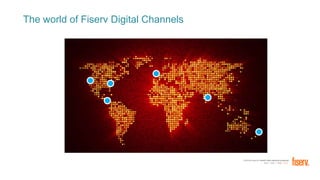
The world of Fiserv Digital Channels
FORTUNE Magazine World's Most Admired Companies®
2014 | 2015 | 2016 | 2017
How we sustained change beyond the initial transformation
• Making people the center of transformation
• Successful approaches to change
• Sustaining the momentum
• Governance and metrics
FORTUNE Magazine World's Most Admired Companies®
2014 | 2015 | 2016 | 2017
Making people the center of transformation
FORTUNE Magazine World's Most Admired Companies®
2014 | 2015 | 2016 | 2017
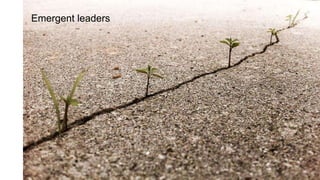
Emergent leaders
FORTUNE Magazine World's Most Admired Companies®
2014 | 2015 | 2016 | 2017
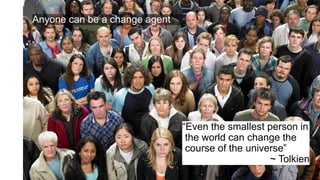
Anyone can be a change agent
“Even the smallest person in
the world can change the
course of the universe”
~ Tolkien
FORTUNE Magazine World's Most Admired Companies®
2014 | 2015 | 2016 | 2017
Successful approaches to change
FORTUNE Magazine World's Most Admired Companies®
2014 | 2015 | 2016 | 2017
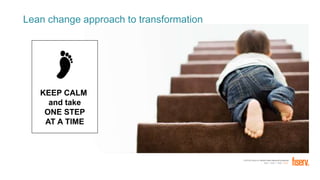
Lean change approach to transformation
KEEP CALM
and take
ONE STEP
AT A TIME
FORTUNE Magazine World's Most Admired Companies®
2014 | 2015 | 2016 | 2017
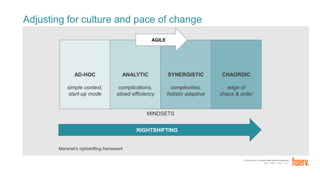
Adjusting for culture and pace of change
Marshall’s rightshifting framework
AD-HOC
simple context,
start-up mode
ANALYTIC
complications,
siloed efficiency
CHAORDIC
edge of
chaos & order
SYNERGISTIC
complexities,
holistic adaptive
MINDSETS
RIGHTSHIFTING
AGILE
FORTUNE Magazine World's Most Admired Companies®
2014 | 2015 | 2016 | 2017
Sustaining the momentum
FORTUNE Magazine World's Most Admired Companies®
2014 | 2015 | 2016 | 2017
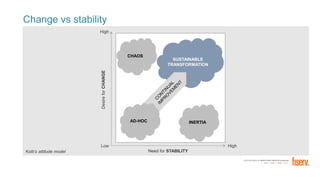
CHAOS
INERTIA
SUSTAINABLE
TRANSFORMATION
Change vs stability
Need for STABILITY
DesireforCHANGE
Low High
High
Kolb’s attitude model
AD-HOC
FORTUNE Magazine World's Most Admired Companies®
2014 | 2015 | 2016 | 2017
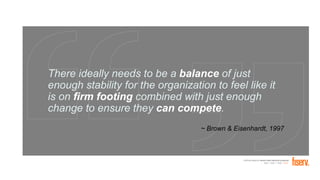
There ideally needs to be a balance of just
enough stability for the organization to feel like it
is on firm footing combined with just enough
change to ensure they can compete.
~ Brown & Eisenhardt, 1997
FORTUNE Magazine World's Most Admired Companies®
2014 | 2015 | 2016 | 2017Autonomy and trust
FORTUNE Magazine World's Most Admired Companies®
2014 | 2015 | 2016 | 2017
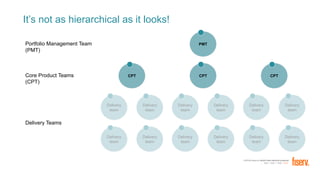
It’s not as hierarchical as it looks!
PMT
CPT
Delivery Teams
Core Product Teams
(CPT)
Portfolio Management Team
(PMT)
Delivery
team
Delivery
team
Delivery
team
Delivery
team
CPT
Delivery
team
Delivery
team
Delivery
team
Delivery
team
CPT
Delivery
team
Delivery
team
Delivery
team
Delivery
team
FORTUNE Magazine World's Most Admired Companies®
2014 | 2015 | 2016 | 2017
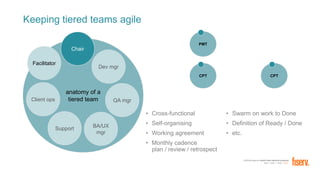
Keeping tiered teams agile
PMT
CPTCPT
anatomy of a
tiered team
Facilitator
• Cross-functional
• Self-organising
• Working agreement
• Monthly cadence
plan / review / retrospect
• Swarm on work to Done
• Definition of Ready / Done
• etc.
Dev mgr
Client ops
Support BA/UX
mgr
QA mgr
Chair
FORTUNE Magazine World's Most Admired Companies®
2014 | 2015 | 2016 | 2017
Everyone’s favourite topics (governance and metrics)
FORTUNE Magazine World's Most Admired Companies®
2014 | 2015 | 2016 | 2017
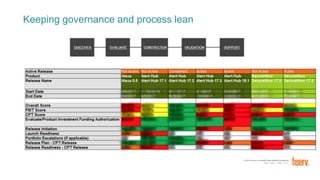
Keeping governance and process lean
FORTUNE Magazine World's Most Admired Companies®
2014 | 2015 | 2016 | 2017
Metrics
FORTUNE Magazine World's Most Admired Companies®
2014 | 2015 | 2016 | 2017
Conclusions
FORTUNE Magazine World's Most Admired Companies®
2014 | 2015 | 2016 | 2017
What was the impact?
3 fold increase in releases / year
from 7 to 17 features released in Mobiliti in the space of 1 year
Excellent customer feedback
Just a couple of years ago, I would hear
comments that the app was years behind what
our customers were wanting and what some of
our competition was providing;
that's not the case anymore.
~ HomeTrust Bank
FORTUNE Magazine World's Most Admired Companies®
2014 | 2015 | 2016 | 2017
“We’ve come a long, long
way, together; through the
hard times and the good.”
We have to celebrate!
@FatboySlim (1998)
FORTUNE Magazine World's Most Admired Companies®
2014 | 2015 | 2016 | 2017
Q&A
FORTUNE Magazine World's Most Admired Companies®
2014 | 2015 | 2016 | 2017
Thanks for listening

Breaking Through the Transformation Pain Barrier - Julie Lindenberg & David Morris - AgileNZ 2017

  • 1.
    FORTUNE Magazine World'sMost Admired Companies® 2014 | 2015 | 2016 | 2017 Breaking through the transformation pain barrier Fiserv Julie Lindenberg Director, BA and UX David Morris Manager, Enterprise Agile &
  • 2.
    FORTUNE Magazine World'sMost Admired Companies® 2014 | 2015 | 2016 | 2017 The world of Fiserv Digital Channels
  • 3.
    FORTUNE Magazine World'sMost Admired Companies® 2014 | 2015 | 2016 | 2017 How we sustained change beyond the initial transformation • Making people the center of transformation • Successful approaches to change • Sustaining the momentum • Governance and metrics
  • 4.
    FORTUNE Magazine World'sMost Admired Companies® 2014 | 2015 | 2016 | 2017 Making people the center of transformation
  • 5.
    FORTUNE Magazine World'sMost Admired Companies® 2014 | 2015 | 2016 | 2017 Emergent leaders
  • 6.
    FORTUNE Magazine World'sMost Admired Companies® 2014 | 2015 | 2016 | 2017 Anyone can be a change agent “Even the smallest person in the world can change the course of the universe” ~ Tolkien
  • 7.
    FORTUNE Magazine World'sMost Admired Companies® 2014 | 2015 | 2016 | 2017 Successful approaches to change
  • 8.
    FORTUNE Magazine World'sMost Admired Companies® 2014 | 2015 | 2016 | 2017 Lean change approach to transformation KEEP CALM and take ONE STEP AT A TIME
  • 9.
    FORTUNE Magazine World'sMost Admired Companies® 2014 | 2015 | 2016 | 2017 Adjusting for culture and pace of change Marshall’s rightshifting framework AD-HOC simple context, start-up mode ANALYTIC complications, siloed efficiency CHAORDIC edge of chaos & order SYNERGISTIC complexities, holistic adaptive MINDSETS RIGHTSHIFTING AGILE
  • 10.
    FORTUNE Magazine World'sMost Admired Companies® 2014 | 2015 | 2016 | 2017 Sustaining the momentum
  • 11.
    FORTUNE Magazine World'sMost Admired Companies® 2014 | 2015 | 2016 | 2017 CHAOS INERTIA SUSTAINABLE TRANSFORMATION Change vs stability Need for STABILITY DesireforCHANGE Low High High Kolb’s attitude model AD-HOC
  • 12.
    FORTUNE Magazine World'sMost Admired Companies® 2014 | 2015 | 2016 | 2017 There ideally needs to be a balance of just enough stability for the organization to feel like it is on firm footing combined with just enough change to ensure they can compete. ~ Brown & Eisenhardt, 1997
  • 13.
    FORTUNE Magazine World'sMost Admired Companies® 2014 | 2015 | 2016 | 2017Autonomy and trust
  • 14.
    FORTUNE Magazine World'sMost Admired Companies® 2014 | 2015 | 2016 | 2017 It’s not as hierarchical as it looks! PMT CPT Delivery Teams Core Product Teams (CPT) Portfolio Management Team (PMT) Delivery team Delivery team Delivery team Delivery team CPT Delivery team Delivery team Delivery team Delivery team CPT Delivery team Delivery team Delivery team Delivery team
  • 15.
    FORTUNE Magazine World'sMost Admired Companies® 2014 | 2015 | 2016 | 2017 Keeping tiered teams agile PMT CPTCPT anatomy of a tiered team Facilitator • Cross-functional • Self-organising • Working agreement • Monthly cadence plan / review / retrospect • Swarm on work to Done • Definition of Ready / Done • etc. Dev mgr Client ops Support BA/UX mgr QA mgr Chair
  • 16.
    FORTUNE Magazine World'sMost Admired Companies® 2014 | 2015 | 2016 | 2017 Everyone’s favourite topics (governance and metrics)
  • 17.
    FORTUNE Magazine World'sMost Admired Companies® 2014 | 2015 | 2016 | 2017 Keeping governance and process lean
  • 18.
    FORTUNE Magazine World'sMost Admired Companies® 2014 | 2015 | 2016 | 2017 Metrics
  • 19.
    FORTUNE Magazine World'sMost Admired Companies® 2014 | 2015 | 2016 | 2017 Conclusions
  • 20.
    FORTUNE Magazine World'sMost Admired Companies® 2014 | 2015 | 2016 | 2017 What was the impact? 3 fold increase in releases / year from 7 to 17 features released in Mobiliti in the space of 1 year Excellent customer feedback Just a couple of years ago, I would hear comments that the app was years behind what our customers were wanting and what some of our competition was providing; that's not the case anymore. ~ HomeTrust Bank
  • 21.
    FORTUNE Magazine World'sMost Admired Companies® 2014 | 2015 | 2016 | 2017 “We’ve come a long, long way, together; through the hard times and the good.” We have to celebrate! @FatboySlim (1998)
  • 22.
    FORTUNE Magazine World'sMost Admired Companies® 2014 | 2015 | 2016 | 2017 Q&A
  • 23.
    FORTUNE Magazine World'sMost Admired Companies® 2014 | 2015 | 2016 | 2017 Thanks for listening

Editor's Notes

  • #3 JULIE Fiserv is a US provider of financial services technology across the globe, with 23,000 employees. It is listed in the top 100 FORTUNE World's Most Admired Companies The division we work for is Digital Channels. We develop 7 product offerings which focus on the digital consumer. David and I are based in the Auckland office, in this location we develop and support Mobile banking products. The main sites we work with are: > Portland, Oregon > Atlanta, Georgia > Costa Rica > London, England > Bangalore and Pune, India My associates are in all those locations with the exception of one, we are a truly global company. And to give you an idea of scale we have 14 scrum teams in Auckland and another 34 teams across the other locations, totalling 50.
  • #4 People in transformation > Emergent leadership > Everyone can be a change agent Successful change approach > Incremental change > Cultural pacing Sustaining momentum > Change vs stability > How to scale autonomy and trust Governance and metrics > Lean governance / lean process > Enterprise transparency and metrics
  • #5 JULIE Emergent leadership Everyone can be a change agent
  • #6 JULIE I would like to start this talk off my telling you a personal story of what my journey has been at Fiserv and how I became an emergent leader. To set– at the time I had been working for 18months in the Auckland office with little exposure to the wider Fiserv environment. I was promoted into a Director role which entailed managing the BA’s across the division of Fiserv we worked for. There was this ‘thing’ being lead out of the US called Value Delivery Transformation all I really knew was our process needed less bottlenecks and we had a week long crash course oh how to achieve this. We were good at scrum within the teams but we needed to get better at getting work to the teams and getting working software to the market. And there was a governance group called Transformation Leadership Team (TLT) – 6 hours every week with representatives from different disciplines across Product and Development. Within a couple of weeks I had more questions than answers and I was building the confidence to ask them in front of all these stakeholders I didn’t know – why were we doing certain things, who is managing what, what timeline are we working to, how are we tracking these, wasn’t the commitment last week the BA was coming out in me and I was asking all the akward questions. I didn't understand how we were going to be successful if we weren’t holding ourselves to account. So instead of stepping back I was brave and I moved into the space where there was a gap and saw what happened, then when nothing exploded I did it again. I built my confidence and didn’t put my discipline blinkers on, this was about all of us succeeding or failing. Don’t get me wrong it was a hard and scary place, and it can still be sometimes. The key for me was finding partners, people I could bounce ideas off, who I could trust would listen and give me sound honest feedback, like ’yeah that makes sense’ or say ‘Julie that’s a bit crazy’. The outcome is I have built a reputation in our division for delivering and being able to lead change. But in a positive, inspiring manner. The TLT still meets but only for 1 hour every 2 weeks and the participants are a handful of people who represent a range of disciplines.
  • #7 DAVID Julie is a great example of an emergent leader, someone who stepped into a gap and fulfilled the potential of the opportunity. Sometimes leaders like Julie emerge and sometimes we need to find and nurture them. But how do we do that? We looked at people’s level of advocacy. How engaged and experienced they are. We had a handful of thought leaders and champions, with high engagement and experience. Mostly, though, we had to look for those with good engagement or experience and nurture them to acting as champions. However, while it was good to find and support leaders; we didn’t want this to be a solely top-down initiative. When we set up our teams, including the TRANSFORMATION leadership team, we didn’t discourage anyone who felt that they should be at the table. That was 18 months ago. After a year, we worked with each team review and revise their purpose and got everyone to agree who should be core to the team to meet that purpose. This saw some roles switch to consulted or even just informed. That was ok. It took us time, but ensured that people came on the journey. It allowed change agents to emerge. People (like Julie) who stepped up to take on responsibility in a way that naturally extended from their roles. We also want everyone involved to know that they have a VOICE and can INFLUENCE what we do and how we do it. Via requests to the TLT. In the last 12 months, we have had over 60 requests. Over three quarters of these have either been approved or are on hold or need more info. Only 14 have been declined. “Even the smallest person in the world can change the course of the universe” ~ Tolkien
  • #8 JULIE Incremental change Cultural pacing
  • #9 DAVID We are all at the AGILE NZ conference, so we know that it is inherently risky to change everything in our products at once. Big batches are more prone to failure, and if they do fail, the impact is much larger. Transforming how we operate, shifting mindset and behaviours, is a HUGE change. People are inherently complex. Unless we are in crisis, all the evidence points to rolling out something that impacts everyone / everywhere / at the same time will NOT WORK. There is still too much of the one-size fits all approach to change. The old LEWIN unfreeze / change / refreeze mentality is still rife. Especially in larger organizations and the big consultancies. You’d think it would be obvious. If we are trying to achieve agility in how we operate our businesses, we should take a similar approach in how we manage the change. This means breaking large change down into smaller increments. Minimum Viable Change that we can complete within THREE months. Break that down into smaller SAFE-TO-FAIL steps that can be completed in no more than a month. Inspect and adapt. Rinse and repeat. EXAMPLE Central 90-day coaching plan shifted to individual improvement backlogs per team.
  • #10 DAVID We also need to recognise that not everyone starts from the same place. Not everyone has the same distance to cover. Some may not even have the same end destination. Some will be able to move faster than others. Based on Schneider’s culture model and Marshall’s rightshifting framework, we need to understand people where they are at right now, as well as when, how far, and how fast they should move. Thinking about our multiple locations and products: while a small handful were in the AD-HOC space, most were in the ANALYTIC space with a culture of CONTROL (i.e., optimized for working in a regulated industry and ensuring we followed our processes). In order to continue delivering a quality product, while responding better to changing market needs, we needed to shift them more into the SYNERGISTIC space and encourage a greater degree of COLLABORATION. Agile values, principles, and practices are key to this shift. Some were more ready for this transformation than others, so we had to pace the change, and breaking it into smaller increments definitely helped with this. I call this CULTURAL PACING. One of the main findings from my masters research.
  • #11 JULIE Sustaining change and stability Autonomy and trust scale
  • #12 JULIE When the transformation kicked off it was overall going to be a big change for the organisation in terms of culture and process shift. . At that time we were sitting in the Inertia stage, we needed to be stable, we are a finance company after all, and while there was a desire for something to change, but there were blockers, which was resulting in a low desire to change. It required the organisation to change process but more importantly it required people to change their mindset. In many ways – the key to which was being Agile. Be transparent - don’t hide issues, work together – don’t throw items over walls and, small regular releases will be better. But we didn’t get it right the first time and know, that you won’t. Everything cant be planned in advance and that is part of the change. There needs to be continual improvement. At times I heard can we stop making changes, lets be stable, my team is change fatigued. This is a statement I struggled with, I get major change can cause change fatigue and sustaining the change is key but we should always be looking for small incremental changes; the environment changes; we learn and we need to keep evolving. We can’t sit idle. Change is not about reaching a destination it’s about moving forward. So where in the model are we now? Well we still need stability but not as much, it’s not rigid. And our desire to change is higher. We know there can be a better way.
  • #13 JULIE The quote sums it up nicely – we need enough stability to create a level of certainty, but enough change to adapt as circumstances do. And a word of warning: I mentioned the transformation required people to change their mind set from telling, hiding issues or ducking. You might think people have got it but when under pressure or under stress a handful of people will default back to their comfort zone of how they used to operate. Let me give you a personal example before joining Fiserv I worked in organisations where I was the leader I would tell people want to do and they would action those requests. That is far from my management style now, but when I am time precious I catch myself reverting back to the telling state of “can you do it like this”, and it’s been 3 years since that was my default style.
  • #14 JULIE When we started we were in a place where many decisions were made by executives in locations across the world with only selected members of staff present. It was unclear when the decision was being made and what the conversation or outcome of the meeting was. Different disciplines were represented but often not by those who knew the details and the implications of decisions being made. Our transformation turned all this on its head.
  • #15 JULIE We introduced a tiered decision making body – now I know that sounds very hierarchal and it is true there are some groups or ‘teams’ that make decisions and others don’t, but it works. To set some context the Portfolio Management team makes investment decisions for a product – what should we build, when, how long will it take, what resourcing do we need and how will quality be defined. The Directors and Lead Product Managers sit at this tier. The CPT then breaks this work down into features, talks about practical implications such as assumptions and escalations. They bring org impediments or competing priorities to the PMT. The Managers sit at this tier. So how can this new team construct work and how does something that appear hieratical work? Firstly they need to be autonomous. The team has a clear understanding of what they are responsible for and what they own. This means PMT members need to back off, they don’t need to know all the detail – sure they can ask questions to build their understanding and have confidence they can trust the CPT – don’t be blind there does need to be transparency and both groups need to understand what each other want – understand their stakeholder needs (we are still working through that), this leads to the second point they need to TRUST. In return the CPT members need to learn to step in, the PMT is not going to pick up the missing pieces the CPT needs to own it, its there responsibility. There also needs to be clear expectations with both groups – what does good look like. How each PMT and CPT has achieved this varies and depends on culture. For one product we ask the CPT to provide an update on the health of their product releases in another product they have a monthly sync where both the PMT and CPT share what they are working on and what support they need from each other.
  • #16 DAVID And in case you were concerned at all, to help keep this structure lean and agile, we built the teams on the same principles as scrum delivery teams. WHO: > Each teams has a Chair, who acts like the PO on a delivery team – key decision point around prioritising the work and accountable for value delivered according to investment made > Each team has a Facilitator, who acts like SM on delivery team – lean / agile expert who can orchestrate the work and provide situational coaching to their team > Team is cross-functional, with all the skills and influence required to make decisions and get work delivered WHAT/HOW: > Self-organizing / autonomous, within constraints > Joint purpose, working agreement > Definition of Ready and Done, for the PMT on Epics, and for the CPT on Features > Work on a monthly cadence > Plan their work a month ahead > Meet twice per week to synchronize and re-plan if required > Once per month review progress with stakeholders > Once per month hold a retrospective > In between, swarm on work to get it done – preparing the roadmap, making investment decisions, checking launch readiness, handling impediments escalated from the delivery teams, etc.
  • #17 JULIE – change context (to avoid David continuing to talk and blurring the shift) Lean process / lean governance Enterprise transparency and metrics
  • #18 DAVID We needed to replace tired / brittle / rigid / over-planned process. Done with good intent, this still risks becoming overgrown and slowing everything down. Alastair Cockburn said that every product delivery process runs at the speed of its decision-making. We need to stay focused and ensure that we keep it lean. Whenever we add anything, we always try to see if there is something else we can remove. EXAMPLES: -- data vs document – get it from VersionOne Over time, this has become more and more respected and better used. Initially, we had less than 1% compliance with the process. A couple of months back we achieved the highest compliance yet, 85%. It has dropped back a little now, as we have more products and more teams starting their journey.
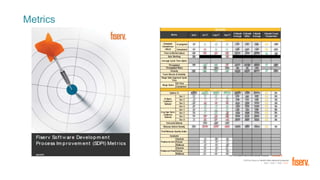
  • #19 JULIE In the Autonomy and Trust section I mentioned transparency and the PMT wanting an understanding of how the product delivery was performing, Metrics is one of the measures we use to achieve this. On a personal note I am not a fan of metrics mainly because I am a people person and not a number person. A VP at work recently said to me, “Julie as a leader in the org do you think you should care about metrics”? To which my answer was “yeah you are probably right”. So lets just say some of us love these metrics and others not as much. But regardless of whether we like them or not they tell a story. Now when the metrics were first published, there were many sad but mainly angry people, those metrics are wrong that is not what is going on. Sadly for all metrics don’t lie, well mostly, and actually it wasn’t that the products weren’t performing, a large portion was the data was wrong. It has actually taught us a very valuable lesson because we are pulling data straight from the tool where work is managed by the PMT, CPT and Delivery teams, we could start to unpick where the problems lied. In terms of what we report there are defined metrics which are a combination of a SDPI white paper which recommends Metrics to provide transparency into performance, standards, and expectations and what leaders in the the organisation would like to measure. There are measures are rolled by to a Division level and rolled down to a CPT level. So how do these metrics get reported and actioned on: there are several touch points. 1. They are published to the Extended leadership team, 2. They are reviewed between the PMT and CPT to look at the latest figures and the trends we are seeing, this often leads to questions and more follow-ups being required. 3. A monthly call is held where the extended leadership team is on the call and each leader owns a section of the scorecard and is expected to talk and represent the data (accountability). Still struggling with PMTs and CPTs taking ownership – why does it matter? – why should we care?
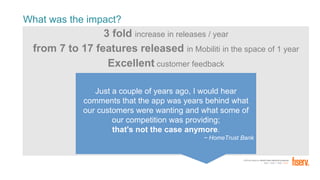
  • #21 JULIE 1 release a year per 7 products, now more than 20 releases a year, which is a 3 fold increase. We did this while increased the number of features to the market, while introducing technology complexity but yet the results have still been very positive. In May 2016 Mobiliti lagged all direct competitors in battleground functionality, in April 2017 Plugin a key part of MoRASP’s competitive “leapfrogging” from 7 to 17 features Our customers were happy with us, we were delivering when we said we would and more often, with great quality
  • #22 DAVID Made people the center of transformation Encouraged everyone to be a change agent Adopted a lean change approach Paced it according to readiness Sustained it, balancing stability with change Scaled autonomy and trust Kept the process as lean as possible Ensured transparency We’ve come a long way. Seen a lot of change. Always challenge ourselves to do better, which leads to continual tensions (at edge of chaos), which means we continue to adapt. With what we’ve learned now, would we have done it the way we did? No. But we had to go through those experiences. JULIE SUPER PROUD. Oh, and Fiserv is awesome!