Parallel and Distributed Computing
Chapter 5: Basic Communications
Operations
1
Muhammad Haroon
mr.harunahmad2014@gmail.com
Cell# +92300-7327761
Department of Computer Science
Hitec University
Taxila Cantt
Pakistan6/1/2020
5.1a: Communication in Parallel System
2
 Nearest neighbor communication:
Communication between two directly link
nodes
 Remote node communication: With more
than one links between the communicating
nodes
1.) Store-and-forward routing
2.) Cut-through routing
6/1/2020
5.1b: Basic Communication Operations
3
 One to one communication
 One to all communication (broadcasting)
 All to all communication
 All to one communication (reduction)
 These basic communication operations are commonly
used on various parallel architectures
 It is crucial that they be implemented efficiently on a
particular parallel system
6/1/2020
5.1c: Commonly Used Interconnections
4
 Linear array
 Two-dimensional mesh
 Hypercube
6/1/2020
5.1d: Mesh Topology
5
 A large number of processors can be connected
relatively inexpensively with mesh topology
 Many applications map naturally onto a mesh
network
 The disadvantage of high diameter of mesh
topology can be diminished for networks with cut-
through routing
 Several commercially available parallel computers
are based on mesh network
 T3D, SGI, IBM Blue Gene
6/1/2020
5.1e: Hypercube Topology
6
 The fastest hypercube algorithms are asymptotically
as fast as the fastest PRAM algorithms
 Hypercubes tap maximum concurrency and impose
data locality
 The best hypercube algorithm is also the best for
other networks such as fat trees, meshes, and
multistage networks
 Hypercube has an elegant recursive structure that
makes it attractive for developing a wide class of
algorithms
6/1/2020
5.2a: Basic Assumptions
7
 Network supports store-and-forward routing
and cut-through routing
 The communication links are bidirectional
 Single-port communication model
One node can only send one message at a
time
It can only receive one message at a time
Send and receive can be done
simultaneously
6/1/2020
5.2b: Dual Operations
8
 A dual of a communication is the opposite of
the original operation
 It can be performed by reversing the direction
and sequence of messages in the original
operation
E.g., All-to-one communication (reduction) is
the dual of one-to-all broadcast.
6/1/2020
5.3a: One-to-All Broadcast and All-to-one
Reduction (Single Node Accumulation)
9
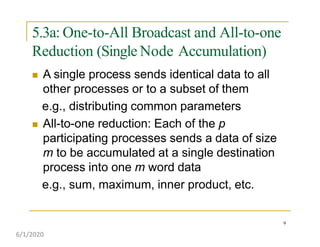
 A single process sends identical data to all
other processes or to a subset of them
e.g., distributing common parameters
 All-to-one reduction: Each of the p
participating processes sends a data of size
m to be accumulated at a single destination
process into one m word data
e.g., sum, maximum, inner product, etc.
6/1/2020
5.3b: Ring Network
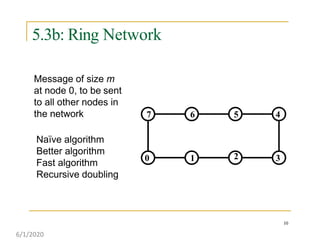
0
10
1 2 3
4567
Message of size m
at node 0, to be sent
to all other nodes in
the network
Naïve algorithm
Better algorithm
Fast algorithm
Recursive doubling
6/1/2020
5.3c: Mesh Network
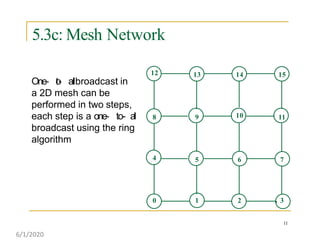
0
11
1 2 3
4 765
8 9 10 11
15141312
One- to- albroadcast in
a 2D mesh can be
performed in two steps,
each step is a one- to- all
broadcast using the ring
algorithm
6/1/2020
5.3d: Hypercube
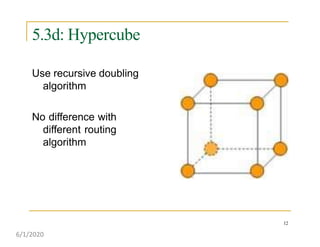
Use recursive doubling
algorithm
No difference with
different routing
algorithm
12
6/1/2020
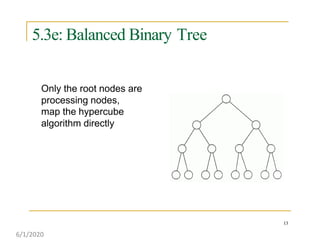
5.3e: Balanced Binary Tree
Only the root nodes are
processing nodes,
map the hypercube
algorithm directly
13
6/1/2020
5.3f: Communication Cost
14
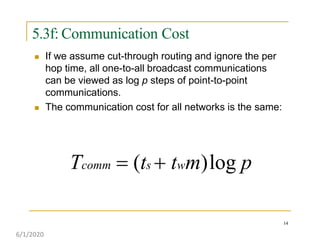
 If we assume cut-through routing and ignore the per
hop time, all one-to-all broadcast communications
can be viewed as log p steps of point-to-point
communications.
 The communication cost for all networks is the same:
Tcomm  (ts  twm)log p
6/1/2020
5.4a: All-to-All Broadcast and Reduction
15
 All-to-all broadcast can be viewed as a
generalization of one-to-all broadcast
 All p nodes simultaneouslytwinitiate a broadcast
 Each node sends the same m-word message to
every other nodes
 Different node may broadcast different messages
 Applications include matrix-multiplication and
matrix-vector multiplication
 The dual of all-to-all broadcast is all-to-all
reduction
 Every node is the destination of an all-to-one
reduction
6/1/2020
5.4b: Ring and Linear Array
16
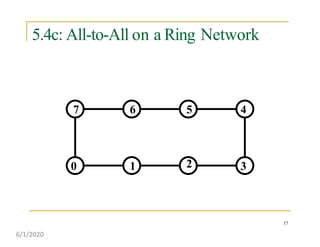
 All-to-all broadcast is achieved by a pipelined point-
to-point nearest neighbor communication
 For linear array, bi-directional link is necessary
 For all-to-all reduction, the procedure is reversed,
each node needs to perform the operation at each
step
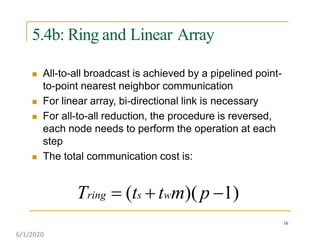
 The total communication cost is:
Tring  (ts  twm)( p 1)
6/1/2020
5.4c: All-to-All on a Ring Network
0
17
1 2 3
4567
6/1/2020
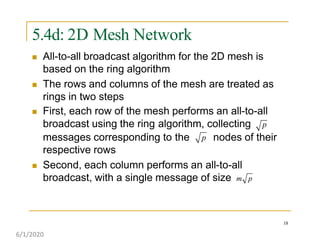
5.4d: 2D Mesh Network
messages corresponding to the nodes of their
respective rows
p
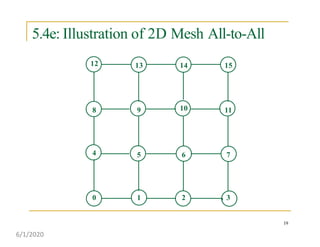
 All-to-all broadcast algorithm for the 2D mesh is
based on the ring algorithm
 The rows and columns of the mesh are treated as
rings in two steps
 First, each row of the mesh performs an all-to-all
broadcast using the ring algorithm, collecting p
 Second, each column performs an all-to-all
broadcast, with a single message of size m p
18
6/1/2020
5.4e: Illustration of 2D Mesh All-to-All
0
19
1 2 3
4 765
8 9 10 11
15141312
6/1/2020
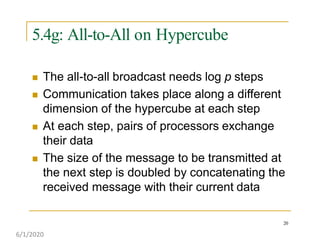
5.4g: All-to-All on Hypercube
20
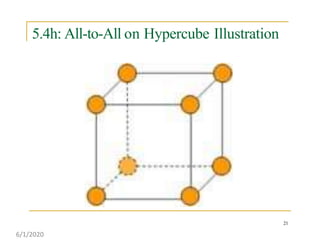
 The all-to-all broadcast needs log p steps
 Communication takes place along a different
dimension of the hypercube at each step
 At each step, pairs of processors exchange
their data
 The size of the message to be transmitted at
the next step is doubled by concatenating the
received message with their current data
6/1/2020
5.4h: All-to-All on Hypercube Illustration
21
6/1/2020
5.5a: AllReduce Operation
22
 Each node starts with a buffer of size m
 Final results of the operation are identical
buffers of size m on each node that are
formed by combining the original p buffers
using an associative operator
 It can be done by an all-to-one reduction,
followed by a one-to-all broadcast
 All-reduce operation can be used to
implement barrier synchronization on a
message-passing computer
6/1/2020
5.6: Prefix Sum Operation
23
 Initially, each processor has a data
 Finally, each processor collect the sum of its
data and the data from all processors with
lower labels
 This operation can be performed by an all-to-
all broadcast, with data being summed locally
in each processor
 Each processor needs two copies of data,
one for its own sum, the other to send out
6/1/2020
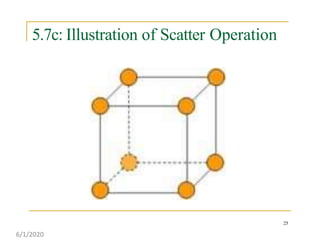
5.7a: One-to-All Personalized
Communication
24
 The source node starts with p unique
messages, one is intended for each node
 One-to-all personalization does not involve
any duplication of data
 This operation is commonly called scatter
operation
 The dual of the scatter operation is the
gather operation, or concatenation
 No reduction operation is performed
6/1/2020
5.7c: Illustration of Scatter Operation
25
6/1/2020
5.7d: Scatter Operations for Ring and
Mesh
26
 The hypercube algorithm for one-to-all personalized
communication can be mapped to ring and mesh
networks with the same cost
 The gather operation can be performed analogously
6/1/2020
5.8a: All-to-All Personalized
Communication
27
 Each node sends a distinct message of size
m to every other node
 This is not an all-to-all broadcast operation
 All-to-all personalized communication is also
called total exchange
 It can be used in fast Fourier transform,
matrix transpose, sample sort, etc.,
applications
6/1/2020
5.8b: All-to-All Personalized
Communication on Ring Network
28
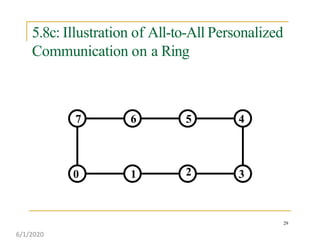
 The procedure is the same as the al-l to- albroadcast,
only the size of the data communicated is changed
 It uses pipelined communication, each node sends
data to its neighboring node in (p-1) steps
 Each node receives data from its neighboring node,
extracts the piece belongs to it, and forwards the
remaining part to its neighboring node
 At the end of the procedure, every node has the same
data of ensemble
6/1/2020
5.8c: Illustration of All-to-All Personalized
Communication on a Ring
0
29
1 2 3
4567
6/1/2020
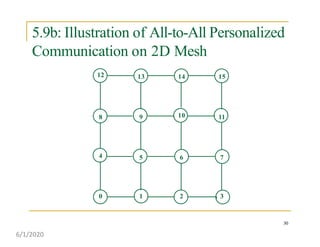
5.9b: Illustration of All-to-All Personalized
Communication on 2D Mesh
0
30
1 2 3
4 765
8 9 10 11
13 14 1512
6/1/2020
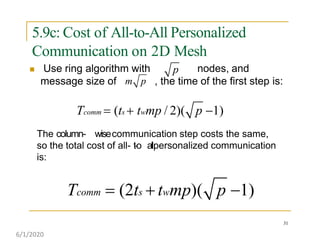
5.9c: Cost of All-to-All Personalized
Communication on 2D Mesh
 Use ring algorithm with nodes, andp
message size of m p , the time of the first step is:
Tcomm  (ts  twmp / 2)( p 1)
The column- wisecommunication step costs the same,
so the total cost of all- t-o alpersonalized communication
is:
Tcomm  (2ts  twmp)( p 1)
31
6/1/2020
5.10a: All-to-All Personalized
Communication on Hypercube
32
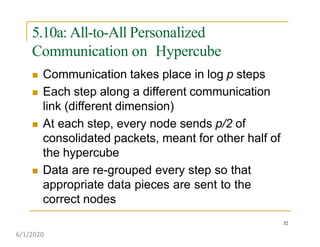
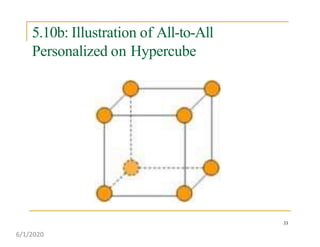
 Communication takes place in log p steps
 Each step along a different communication
link (different dimension)
 At each step, every node sends p/2 of
consolidated packets, meant for other half of
the hypercube
 Data are re-grouped every step so that
appropriate data pieces are sent to the
correct nodes
6/1/2020
5.10b: Illustration of All-to-All
Personalized on Hypercube
33
6/1/2020
5.10e: Optimal Algorithm for All-to-All
Personalized Hypercube Communication
34
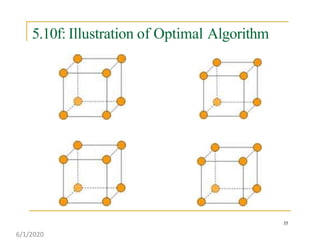
 Allows all pairs of nodes exchange some
data
 Every pair of nodes directly communicate
with each other, with a total of (p-1) steps
 A congestion-free schedule can be used
1.) At the j-th step communication, node i
exchanges data with node (I XOR j)
2.) Use E-cube routing scheme to establish
communication paths
6/1/2020
5.10f: Illustration of Optimal Algorithm
35
6/1/2020

Lecturre 07 - Chapter 05 - Basic Communications Operations

  • 1.
    Parallel and DistributedComputing Chapter 5: Basic Communications Operations 1 Muhammad Haroon mr.harunahmad2014@gmail.com Cell# +92300-7327761 Department of Computer Science Hitec University Taxila Cantt Pakistan6/1/2020
  • 2.
    5.1a: Communication inParallel System 2  Nearest neighbor communication: Communication between two directly link nodes  Remote node communication: With more than one links between the communicating nodes 1.) Store-and-forward routing 2.) Cut-through routing 6/1/2020
  • 3.
    5.1b: Basic CommunicationOperations 3  One to one communication  One to all communication (broadcasting)  All to all communication  All to one communication (reduction)  These basic communication operations are commonly used on various parallel architectures  It is crucial that they be implemented efficiently on a particular parallel system 6/1/2020
  • 4.
    5.1c: Commonly UsedInterconnections 4  Linear array  Two-dimensional mesh  Hypercube 6/1/2020
  • 5.
    5.1d: Mesh Topology 5 A large number of processors can be connected relatively inexpensively with mesh topology  Many applications map naturally onto a mesh network  The disadvantage of high diameter of mesh topology can be diminished for networks with cut- through routing  Several commercially available parallel computers are based on mesh network  T3D, SGI, IBM Blue Gene 6/1/2020
  • 6.
    5.1e: Hypercube Topology 6 The fastest hypercube algorithms are asymptotically as fast as the fastest PRAM algorithms  Hypercubes tap maximum concurrency and impose data locality  The best hypercube algorithm is also the best for other networks such as fat trees, meshes, and multistage networks  Hypercube has an elegant recursive structure that makes it attractive for developing a wide class of algorithms 6/1/2020
  • 7.
    5.2a: Basic Assumptions 7 Network supports store-and-forward routing and cut-through routing  The communication links are bidirectional  Single-port communication model One node can only send one message at a time It can only receive one message at a time Send and receive can be done simultaneously 6/1/2020
  • 8.
    5.2b: Dual Operations 8 A dual of a communication is the opposite of the original operation  It can be performed by reversing the direction and sequence of messages in the original operation E.g., All-to-one communication (reduction) is the dual of one-to-all broadcast. 6/1/2020
  • 9.
    5.3a: One-to-All Broadcastand All-to-one Reduction (Single Node Accumulation) 9  A single process sends identical data to all other processes or to a subset of them e.g., distributing common parameters  All-to-one reduction: Each of the p participating processes sends a data of size m to be accumulated at a single destination process into one m word data e.g., sum, maximum, inner product, etc. 6/1/2020
  • 10.
    5.3b: Ring Network 0 10 12 3 4567 Message of size m at node 0, to be sent to all other nodes in the network Naïve algorithm Better algorithm Fast algorithm Recursive doubling 6/1/2020
  • 11.
    5.3c: Mesh Network 0 11 12 3 4 765 8 9 10 11 15141312 One- to- albroadcast in a 2D mesh can be performed in two steps, each step is a one- to- all broadcast using the ring algorithm 6/1/2020
  • 12.
    5.3d: Hypercube Use recursivedoubling algorithm No difference with different routing algorithm 12 6/1/2020
  • 13.
    5.3e: Balanced BinaryTree Only the root nodes are processing nodes, map the hypercube algorithm directly 13 6/1/2020
  • 14.
    5.3f: Communication Cost 14 If we assume cut-through routing and ignore the per hop time, all one-to-all broadcast communications can be viewed as log p steps of point-to-point communications.  The communication cost for all networks is the same: Tcomm  (ts  twm)log p 6/1/2020
  • 15.
    5.4a: All-to-All Broadcastand Reduction 15  All-to-all broadcast can be viewed as a generalization of one-to-all broadcast  All p nodes simultaneouslytwinitiate a broadcast  Each node sends the same m-word message to every other nodes  Different node may broadcast different messages  Applications include matrix-multiplication and matrix-vector multiplication  The dual of all-to-all broadcast is all-to-all reduction  Every node is the destination of an all-to-one reduction 6/1/2020
  • 16.
    5.4b: Ring andLinear Array 16  All-to-all broadcast is achieved by a pipelined point- to-point nearest neighbor communication  For linear array, bi-directional link is necessary  For all-to-all reduction, the procedure is reversed, each node needs to perform the operation at each step  The total communication cost is: Tring  (ts  twm)( p 1) 6/1/2020
  • 17.
    5.4c: All-to-All ona Ring Network 0 17 1 2 3 4567 6/1/2020
  • 18.
    5.4d: 2D MeshNetwork messages corresponding to the nodes of their respective rows p  All-to-all broadcast algorithm for the 2D mesh is based on the ring algorithm  The rows and columns of the mesh are treated as rings in two steps  First, each row of the mesh performs an all-to-all broadcast using the ring algorithm, collecting p  Second, each column performs an all-to-all broadcast, with a single message of size m p 18 6/1/2020
  • 19.
    5.4e: Illustration of2D Mesh All-to-All 0 19 1 2 3 4 765 8 9 10 11 15141312 6/1/2020
  • 20.
    5.4g: All-to-All onHypercube 20  The all-to-all broadcast needs log p steps  Communication takes place along a different dimension of the hypercube at each step  At each step, pairs of processors exchange their data  The size of the message to be transmitted at the next step is doubled by concatenating the received message with their current data 6/1/2020
  • 21.
    5.4h: All-to-All onHypercube Illustration 21 6/1/2020
  • 22.
    5.5a: AllReduce Operation 22 Each node starts with a buffer of size m  Final results of the operation are identical buffers of size m on each node that are formed by combining the original p buffers using an associative operator  It can be done by an all-to-one reduction, followed by a one-to-all broadcast  All-reduce operation can be used to implement barrier synchronization on a message-passing computer 6/1/2020
  • 23.
    5.6: Prefix SumOperation 23  Initially, each processor has a data  Finally, each processor collect the sum of its data and the data from all processors with lower labels  This operation can be performed by an all-to- all broadcast, with data being summed locally in each processor  Each processor needs two copies of data, one for its own sum, the other to send out 6/1/2020
  • 24.
    5.7a: One-to-All Personalized Communication 24 The source node starts with p unique messages, one is intended for each node  One-to-all personalization does not involve any duplication of data  This operation is commonly called scatter operation  The dual of the scatter operation is the gather operation, or concatenation  No reduction operation is performed 6/1/2020
  • 25.
    5.7c: Illustration ofScatter Operation 25 6/1/2020
  • 26.
    5.7d: Scatter Operationsfor Ring and Mesh 26  The hypercube algorithm for one-to-all personalized communication can be mapped to ring and mesh networks with the same cost  The gather operation can be performed analogously 6/1/2020
  • 27.
    5.8a: All-to-All Personalized Communication 27 Each node sends a distinct message of size m to every other node  This is not an all-to-all broadcast operation  All-to-all personalized communication is also called total exchange  It can be used in fast Fourier transform, matrix transpose, sample sort, etc., applications 6/1/2020
  • 28.
    5.8b: All-to-All Personalized Communicationon Ring Network 28  The procedure is the same as the al-l to- albroadcast, only the size of the data communicated is changed  It uses pipelined communication, each node sends data to its neighboring node in (p-1) steps  Each node receives data from its neighboring node, extracts the piece belongs to it, and forwards the remaining part to its neighboring node  At the end of the procedure, every node has the same data of ensemble 6/1/2020
  • 29.
    5.8c: Illustration ofAll-to-All Personalized Communication on a Ring 0 29 1 2 3 4567 6/1/2020
  • 30.
    5.9b: Illustration ofAll-to-All Personalized Communication on 2D Mesh 0 30 1 2 3 4 765 8 9 10 11 13 14 1512 6/1/2020
  • 31.
    5.9c: Cost ofAll-to-All Personalized Communication on 2D Mesh  Use ring algorithm with nodes, andp message size of m p , the time of the first step is: Tcomm  (ts  twmp / 2)( p 1) The column- wisecommunication step costs the same, so the total cost of all- t-o alpersonalized communication is: Tcomm  (2ts  twmp)( p 1) 31 6/1/2020
  • 32.
    5.10a: All-to-All Personalized Communicationon Hypercube 32  Communication takes place in log p steps  Each step along a different communication link (different dimension)  At each step, every node sends p/2 of consolidated packets, meant for other half of the hypercube  Data are re-grouped every step so that appropriate data pieces are sent to the correct nodes 6/1/2020
  • 33.
    5.10b: Illustration ofAll-to-All Personalized on Hypercube 33 6/1/2020
  • 34.
    5.10e: Optimal Algorithmfor All-to-All Personalized Hypercube Communication 34  Allows all pairs of nodes exchange some data  Every pair of nodes directly communicate with each other, with a total of (p-1) steps  A congestion-free schedule can be used 1.) At the j-th step communication, node i exchanges data with node (I XOR j) 2.) Use E-cube routing scheme to establish communication paths 6/1/2020
  • 35.
    5.10f: Illustration ofOptimal Algorithm 35 6/1/2020