RMI
Concurrent & Distributed software

BY
Ravi Theja Y
Remote Procedure Calls (RPC)
•Goal: To provide a procedural interface for distributed (i.e., remote)

services

•To make distributed nature of service transparent to the programmer

Remote Method Invocation (RMI)
•Goal: RPC + Object Orientation
•Allows objects living in one process to invoke methods of an object living

in another process
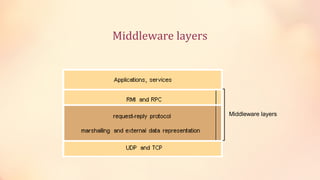
Middleware layers

Middleware layers
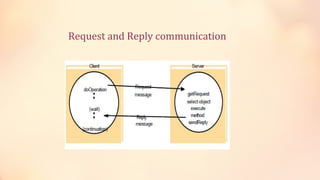
Request and Reply communication
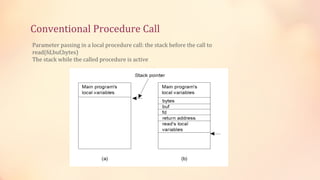
Conventional Procedure Call
Parameter passing in a local procedure call: the stack before the call to
read(fd,buf,bytes)
The stack while the called procedure is active
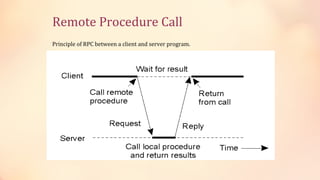
Remote Procedure Call
Principle of RPC between a client and server program.
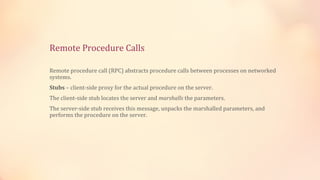
Remote Procedure Calls
Remote procedure call (RPC) abstracts procedure calls between processes on networked
systems.
Stubs – client-side proxy for the actual procedure on the server.
The client-side stub locates the server and marshalls the parameters.
The server-side stub receives this message, unpacks the marshalled parameters, and
performs the procedure on the server.
Steps of a Remote Procedure Call
1.

Client procedure calls client stub in normal way

2.

Client stub builds message, calls local OS

3.

Client's OS sends message to remote OS

4.

Remote OS gives message to server stub

5.

Server stub unpacks parameters, calls server

6.

Server does work, returns result to the stub

7.

Server stub packs it in message, calls local OS

8.

Server's OS sends message to client's OS

9.

Client's OS gives message to client stub

10. Stub unpacks result, returns to client
RMI
RMI = RPC + Object-orientation
Java RMI
CORBA
• Middleware that is language-independent

Microsoft DCOM/COM+
SOAP
• RMI on top of HTTP
Interfaces in distributed systems
Programs organized as a set of modules that communicate with one another via
procedure calls/method invocations
Explicit interfaces defined for each module in order to control interactions between
modules
In distributed systems, modules can be in different processes
A remote interface specifies the methods of an object that are available for invocation
by objects in other processes defining the types of the input and output arguments of
each of them.
Object model
Object references
Objects accessed via object references
Object references can be assigned to variables, passed as arguments and returned as
results
Interfaces provides a signature of a set of methods (types of arguments, return values
and exceptions) without specifying their implementations
Actions (invocations)
Exceptions
Garbage Collection
Distributed Objects
Remote object references
An identifier that can be used throughout a distributed
system to refer to a particular remote object
Remote interfaces
CORBA provides an interface definition language (IDL) for specifying a remote interface
JAVA RMI: Java interface that extends Remote interface
Actions: remote invocations
Remote Exceptions may arise for reasons such as partial failure or message loss
Distributed Garbage Collection: cooperation between local garbage collectors needed
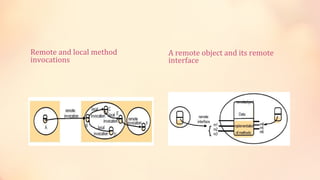
Remote and local method
invocations

A remote object and its remote
interface
RMI Programming
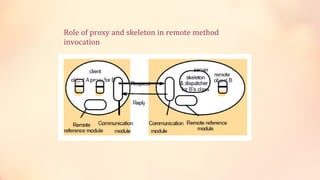
RMI software
Generated by IDL compiler
Proxy
• Behaves like remote object to clients (invoker)
• Marshals arguments, forwards message to remote object, unmarshals
results, returns results to client

Skeleton
• Server side stub;
• Unmarshals arguments, invokes method, marshals results and sends
to sending proxy’s method

Dispatcher
• Receives the request message from communication module, passes
on the message to the appropriate method in the skeleton
Role of proxy and skeleton in remote method
invocation
Calculator.java
import java.rmi.Remote;
import java.rmi.RemoteException;
public interface Calculator extends Remote
{
public long add(long a,long b) throws RemoteException;
}

Calculatorserver.java

Calculatorimpl.java

import java.rmi.RemoteException;
import java.rmi.server.UnicastRemoteObject;
public class CalculatorImpl extends UnicastRemoteObject implements Calculator
{
protected CalculatorImpl() throws RemoteException
{
super();
}
public long add(long a, long b) throws RemoteException
{
return a+b;
}
}
-------------------------------------------------------------------------------------------

import java.rmi.Naming;
public class CalculatorServer
{
CalculatorServer()
{try
{
Calculator c = new CalculatorImpl();
Naming.rebind("rmi://127.0.0.1:1099/CalculatorService", c);
}
catch (Exception e)
{ e.printStackTrace(); }
}
public static void main(String[] args)
{
new CalculatorServer();
}}

import java.rmi.Naming;
public class CalculatorClient
{
public static void main(String[] args)
Calculatorclient.java
{
try
{
Calculator c = (Calculator)
Naming.lookup("//127.0.0.1:1099/CalculatorService");
System.out.println("addition : "+c.add(10, 15));
}
catch (Exception e)
{
System.out.println(e);
}}}
RMI systems
CORBA – language independent
DCOM - Microsoft
Java RMI
SOAP (Simple Object Access Protocol)
HTTP is request-reply protocol
XML for data representation
Thank you

remote method invocation

  • 1.
    RMI Concurrent & Distributedsoftware BY Ravi Theja Y
  • 2.
    Remote Procedure Calls(RPC) •Goal: To provide a procedural interface for distributed (i.e., remote) services •To make distributed nature of service transparent to the programmer Remote Method Invocation (RMI) •Goal: RPC + Object Orientation •Allows objects living in one process to invoke methods of an object living in another process
  • 3.
  • 4.
    Request and Replycommunication
  • 5.
    Conventional Procedure Call Parameterpassing in a local procedure call: the stack before the call to read(fd,buf,bytes) The stack while the called procedure is active
  • 6.
    Remote Procedure Call Principleof RPC between a client and server program.
  • 7.
    Remote Procedure Calls Remoteprocedure call (RPC) abstracts procedure calls between processes on networked systems. Stubs – client-side proxy for the actual procedure on the server. The client-side stub locates the server and marshalls the parameters. The server-side stub receives this message, unpacks the marshalled parameters, and performs the procedure on the server.
  • 8.
    Steps of aRemote Procedure Call 1. Client procedure calls client stub in normal way 2. Client stub builds message, calls local OS 3. Client's OS sends message to remote OS 4. Remote OS gives message to server stub 5. Server stub unpacks parameters, calls server 6. Server does work, returns result to the stub 7. Server stub packs it in message, calls local OS 8. Server's OS sends message to client's OS 9. Client's OS gives message to client stub 10. Stub unpacks result, returns to client
  • 9.
    RMI RMI = RPC+ Object-orientation Java RMI CORBA • Middleware that is language-independent Microsoft DCOM/COM+ SOAP • RMI on top of HTTP
  • 10.
    Interfaces in distributedsystems Programs organized as a set of modules that communicate with one another via procedure calls/method invocations Explicit interfaces defined for each module in order to control interactions between modules In distributed systems, modules can be in different processes A remote interface specifies the methods of an object that are available for invocation by objects in other processes defining the types of the input and output arguments of each of them.
  • 11.
    Object model Object references Objectsaccessed via object references Object references can be assigned to variables, passed as arguments and returned as results Interfaces provides a signature of a set of methods (types of arguments, return values and exceptions) without specifying their implementations Actions (invocations) Exceptions Garbage Collection Distributed Objects Remote object references An identifier that can be used throughout a distributed system to refer to a particular remote object Remote interfaces CORBA provides an interface definition language (IDL) for specifying a remote interface JAVA RMI: Java interface that extends Remote interface Actions: remote invocations Remote Exceptions may arise for reasons such as partial failure or message loss Distributed Garbage Collection: cooperation between local garbage collectors needed
  • 12.
    Remote and localmethod invocations A remote object and its remote interface
  • 13.
    RMI Programming RMI software Generatedby IDL compiler Proxy • Behaves like remote object to clients (invoker) • Marshals arguments, forwards message to remote object, unmarshals results, returns results to client Skeleton • Server side stub; • Unmarshals arguments, invokes method, marshals results and sends to sending proxy’s method Dispatcher • Receives the request message from communication module, passes on the message to the appropriate method in the skeleton
  • 14.
    Role of proxyand skeleton in remote method invocation
  • 15.
    Calculator.java import java.rmi.Remote; import java.rmi.RemoteException; publicinterface Calculator extends Remote { public long add(long a,long b) throws RemoteException; } Calculatorserver.java Calculatorimpl.java import java.rmi.RemoteException; import java.rmi.server.UnicastRemoteObject; public class CalculatorImpl extends UnicastRemoteObject implements Calculator { protected CalculatorImpl() throws RemoteException { super(); } public long add(long a, long b) throws RemoteException { return a+b; } } ------------------------------------------------------------------------------------------- import java.rmi.Naming; public class CalculatorServer { CalculatorServer() {try { Calculator c = new CalculatorImpl(); Naming.rebind("rmi://127.0.0.1:1099/CalculatorService", c); } catch (Exception e) { e.printStackTrace(); } } public static void main(String[] args) { new CalculatorServer(); }} import java.rmi.Naming; public class CalculatorClient { public static void main(String[] args) Calculatorclient.java { try { Calculator c = (Calculator) Naming.lookup("//127.0.0.1:1099/CalculatorService"); System.out.println("addition : "+c.add(10, 15)); } catch (Exception e) { System.out.println(e); }}}
  • 16.
    RMI systems CORBA –language independent DCOM - Microsoft Java RMI SOAP (Simple Object Access Protocol) HTTP is request-reply protocol XML for data representation
  • 17.