Parallel and Distributed Computing
(Lecture # 01) (Part 02)
1
Cell: +92300-7327761 Email: mr.harunahmad2014@gmail.com
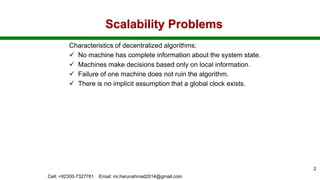
Scalability Problems
Characteristics of decentralized algorithms:
 No machine has complete information about the system state.
 Machines make decisions based only on local information.
 Failure of one machine does not ruin the algorithm.
 There is no implicit assumption that a global clock exists.
2
Cell: +92300-7327761 Email: mr.harunahmad2014@gmail.com
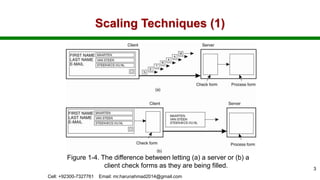
Scaling Techniques (1)
Figure 1-4. The difference between letting (a) a server or (b) a
client check forms as they are being filled.
Cell: +92300-7327761 Email: mr.harunahmad2014@gmail.com
3
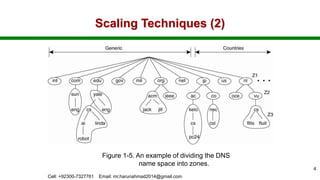
Scaling Techniques (2)
Figure 1-5. An example of dividing the DNS
name space into zones.
Cell: +92300-7327761 Email: mr.harunahmad2014@gmail.com
4
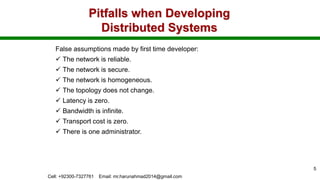
Pitfalls when Developing
Distributed Systems
False assumptions made by first time developer:
 The network is reliable.
 The network is secure.
 The network is homogeneous.
 The topology does not change.
 Latency is zero.
 Bandwidth is infinite.
 Transport cost is zero.
 There is one administrator.
Cell: +92300-7327761 Email: mr.harunahmad2014@gmail.com
5
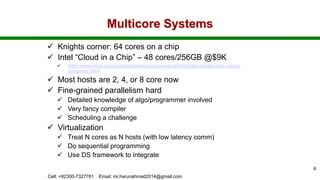
Multicore Systems
 Knights corner: 64 cores on a chip
 Intel “Cloud in a Chip” – 48 cores/256GB @$9K
 http://www.intel.com/content/www/us/en/research/intel-labs-single-chip-cloud-
computer.html
 Most hosts are 2, 4, or 8 core now
 Fine-grained parallelism hard
 Detailed knowledge of algo/programmer involved
 Very fancy compiler
 Scheduling a challenge
 Virtualization
 Treat N cores as N hosts (with low latency comm)
 Do sequential programming
 Use DS framework to integrate
Cell: +92300-7327761 Email: mr.harunahmad2014@gmail.com
6
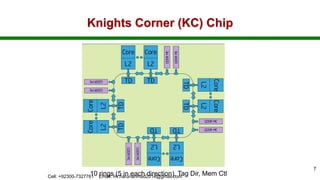
Knights Corner (KC) Chip
10 rings (5 in each direction), Tag Dir, Mem CtlCell: +92300-7327761 Email: mr.harunahmad2014@gmail.com
7
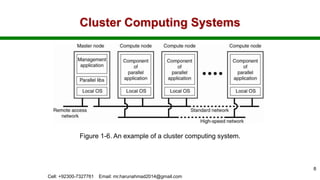
Cluster Computing Systems
Figure 1-6. An example of a cluster computing system.
Cell: +92300-7327761 Email: mr.harunahmad2014@gmail.com
8
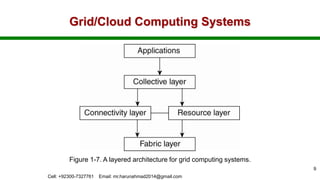
Grid/Cloud Computing Systems
Figure 1-7. A layered architecture for grid computing systems.
Cell: +92300-7327761 Email: mr.harunahmad2014@gmail.com
9
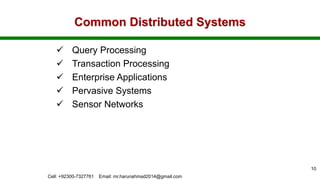
Common Distributed Systems
 Query Processing
 Transaction Processing
 Enterprise Applications
 Pervasive Systems
 Sensor Networks
Cell: +92300-7327761 Email: mr.harunahmad2014@gmail.com
10
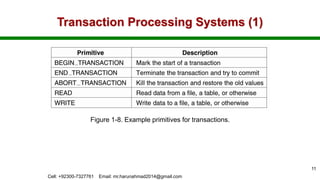
Transaction Processing Systems (1)
Figure 1-8. Example primitives for transactions.
Cell: +92300-7327761 Email: mr.harunahmad2014@gmail.com
11
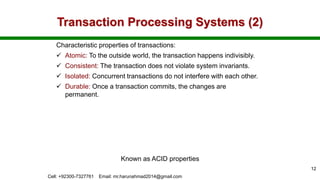
Transaction Processing Systems (2)
Characteristic properties of transactions:
 Atomic: To the outside world, the transaction happens indivisibly.
 Consistent: The transaction does not violate system invariants.
 Isolated: Concurrent transactions do not interfere with each other.
 Durable: Once a transaction commits, the changes are
permanent.
Known as ACID properties
Cell: +92300-7327761 Email: mr.harunahmad2014@gmail.com
12
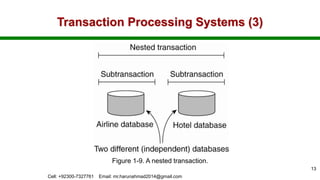
Transaction Processing Systems (3)
Figure 1-9. A nested transaction.
Cell: +92300-7327761 Email: mr.harunahmad2014@gmail.com
13
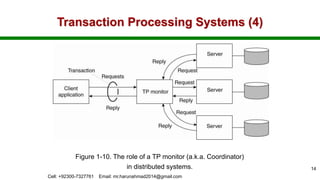
Transaction Processing Systems (4)
Figure 1-10. The role of a TP monitor (a.k.a. Coordinator)
in distributed systems.
Cell: +92300-7327761 Email: mr.harunahmad2014@gmail.com
14
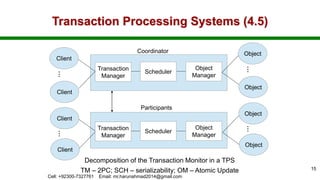
Transaction Processing Systems (4.5)
Decomposition of the Transaction Monitor in a TPS
TM – 2PC; SCH – serializability; OM – Atomic Update
Client
Client
Client
Client
......
Coordinator
Participants
Object
Manager
Scheduler
Transaction
Manager
Object
Object
Object
Object
......
Object
Manager
Scheduler
Transaction
Manager
Cell: +92300-7327761 Email: mr.harunahmad2014@gmail.com
15
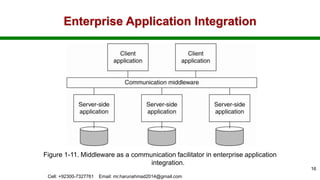
Enterprise Application Integration
Figure 1-11. Middleware as a communication facilitator in enterprise application
integration.
Cell: +92300-7327761 Email: mr.harunahmad2014@gmail.com
16
Distributed Pervasive Systems
Requirements for pervasive systems
 Embrace contextual changes.
 Encourage ad hoc composition.
 Recognize sharing as the default.
Cell: +92300-7327761 Email: mr.harunahmad2014@gmail.com
17
Electronic Health Care Systems (1)
Questions to be addressed for health care systems:
 Where and how should monitored data be stored?
 How can we prevent loss of crucial data?
 What infrastructure is needed to generate and propagate alerts?
 How can physicians provide online feedback?
 How can extreme robustness of the monitoring system be realized?
 What are the security issues and how can the proper policies be
enforced?
Cell: +92300-7327761 Email: mr.harunahmad2014@gmail.com
18
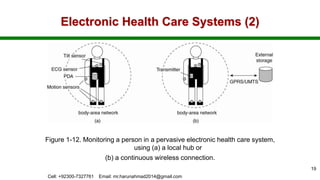
Electronic Health Care Systems (2)
Figure 1-12. Monitoring a person in a pervasive electronic health care system,
using (a) a local hub or
(b) a continuous wireless connection.
Cell: +92300-7327761 Email: mr.harunahmad2014@gmail.com
19
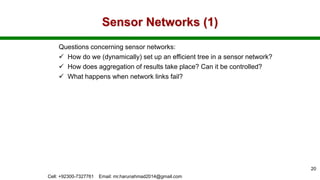
Sensor Networks (1)
Questions concerning sensor networks:
 How do we (dynamically) set up an efficient tree in a sensor network?
 How does aggregation of results take place? Can it be controlled?
 What happens when network links fail?
Cell: +92300-7327761 Email: mr.harunahmad2014@gmail.com
20
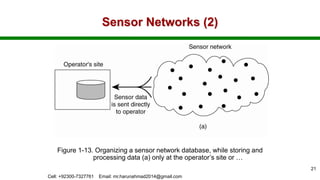
Sensor Networks (2)
Figure 1-13. Organizing a sensor network database, while storing and
processing data (a) only at the operator’s site or …
Cell: +92300-7327761 Email: mr.harunahmad2014@gmail.com
21
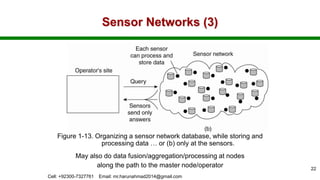
Sensor Networks (3)
Figure 1-13. Organizing a sensor network database, while storing and
processing data … or (b) only at the sensors.
May also do data fusion/aggregation/processing at nodes
along the path to the master node/operator
Cell: +92300-7327761 Email: mr.harunahmad2014@gmail.com
22
Some Fundamental Issues
 How do we decompose a complex problem/task into logical/manageable
chunks?
 What is the physical architecture?
 How do we assign roles/responsibilities to physical components?
 How do we find components (logical and physical)?
 How do we define and maintain consistency?
Cell: +92300-7327761 Email: mr.harunahmad2014@gmail.com
23
End
24
Cell: +92300-7327761 Email: mr.harunahmad2014@gmail.com

Lecture 02 - Chapter 1 (Part 02): Grid/Cloud Computing Systems, Cluster Computing Systems, Common Distributed Systems

  • 1.
    Parallel and DistributedComputing (Lecture # 01) (Part 02) 1 Cell: +92300-7327761 Email: mr.harunahmad2014@gmail.com
  • 2.
    Scalability Problems Characteristics ofdecentralized algorithms:  No machine has complete information about the system state.  Machines make decisions based only on local information.  Failure of one machine does not ruin the algorithm.  There is no implicit assumption that a global clock exists. 2 Cell: +92300-7327761 Email: mr.harunahmad2014@gmail.com
  • 3.
    Scaling Techniques (1) Figure1-4. The difference between letting (a) a server or (b) a client check forms as they are being filled. Cell: +92300-7327761 Email: mr.harunahmad2014@gmail.com 3
  • 4.
    Scaling Techniques (2) Figure1-5. An example of dividing the DNS name space into zones. Cell: +92300-7327761 Email: mr.harunahmad2014@gmail.com 4
  • 5.
    Pitfalls when Developing DistributedSystems False assumptions made by first time developer:  The network is reliable.  The network is secure.  The network is homogeneous.  The topology does not change.  Latency is zero.  Bandwidth is infinite.  Transport cost is zero.  There is one administrator. Cell: +92300-7327761 Email: mr.harunahmad2014@gmail.com 5
  • 6.
    Multicore Systems  Knightscorner: 64 cores on a chip  Intel “Cloud in a Chip” – 48 cores/256GB @$9K  http://www.intel.com/content/www/us/en/research/intel-labs-single-chip-cloud- computer.html  Most hosts are 2, 4, or 8 core now  Fine-grained parallelism hard  Detailed knowledge of algo/programmer involved  Very fancy compiler  Scheduling a challenge  Virtualization  Treat N cores as N hosts (with low latency comm)  Do sequential programming  Use DS framework to integrate Cell: +92300-7327761 Email: mr.harunahmad2014@gmail.com 6
  • 7.
    Knights Corner (KC)Chip 10 rings (5 in each direction), Tag Dir, Mem CtlCell: +92300-7327761 Email: mr.harunahmad2014@gmail.com 7
  • 8.
    Cluster Computing Systems Figure1-6. An example of a cluster computing system. Cell: +92300-7327761 Email: mr.harunahmad2014@gmail.com 8
  • 9.
    Grid/Cloud Computing Systems Figure1-7. A layered architecture for grid computing systems. Cell: +92300-7327761 Email: mr.harunahmad2014@gmail.com 9
  • 10.
    Common Distributed Systems Query Processing  Transaction Processing  Enterprise Applications  Pervasive Systems  Sensor Networks Cell: +92300-7327761 Email: mr.harunahmad2014@gmail.com 10
  • 11.
    Transaction Processing Systems(1) Figure 1-8. Example primitives for transactions. Cell: +92300-7327761 Email: mr.harunahmad2014@gmail.com 11
  • 12.
    Transaction Processing Systems(2) Characteristic properties of transactions:  Atomic: To the outside world, the transaction happens indivisibly.  Consistent: The transaction does not violate system invariants.  Isolated: Concurrent transactions do not interfere with each other.  Durable: Once a transaction commits, the changes are permanent. Known as ACID properties Cell: +92300-7327761 Email: mr.harunahmad2014@gmail.com 12
  • 13.
    Transaction Processing Systems(3) Figure 1-9. A nested transaction. Cell: +92300-7327761 Email: mr.harunahmad2014@gmail.com 13
  • 14.
    Transaction Processing Systems(4) Figure 1-10. The role of a TP monitor (a.k.a. Coordinator) in distributed systems. Cell: +92300-7327761 Email: mr.harunahmad2014@gmail.com 14
  • 15.
    Transaction Processing Systems(4.5) Decomposition of the Transaction Monitor in a TPS TM – 2PC; SCH – serializability; OM – Atomic Update Client Client Client Client ...... Coordinator Participants Object Manager Scheduler Transaction Manager Object Object Object Object ...... Object Manager Scheduler Transaction Manager Cell: +92300-7327761 Email: mr.harunahmad2014@gmail.com 15
  • 16.
    Enterprise Application Integration Figure1-11. Middleware as a communication facilitator in enterprise application integration. Cell: +92300-7327761 Email: mr.harunahmad2014@gmail.com 16
  • 17.
    Distributed Pervasive Systems Requirementsfor pervasive systems  Embrace contextual changes.  Encourage ad hoc composition.  Recognize sharing as the default. Cell: +92300-7327761 Email: mr.harunahmad2014@gmail.com 17
  • 18.
    Electronic Health CareSystems (1) Questions to be addressed for health care systems:  Where and how should monitored data be stored?  How can we prevent loss of crucial data?  What infrastructure is needed to generate and propagate alerts?  How can physicians provide online feedback?  How can extreme robustness of the monitoring system be realized?  What are the security issues and how can the proper policies be enforced? Cell: +92300-7327761 Email: mr.harunahmad2014@gmail.com 18
  • 19.
    Electronic Health CareSystems (2) Figure 1-12. Monitoring a person in a pervasive electronic health care system, using (a) a local hub or (b) a continuous wireless connection. Cell: +92300-7327761 Email: mr.harunahmad2014@gmail.com 19
  • 20.
    Sensor Networks (1) Questionsconcerning sensor networks:  How do we (dynamically) set up an efficient tree in a sensor network?  How does aggregation of results take place? Can it be controlled?  What happens when network links fail? Cell: +92300-7327761 Email: mr.harunahmad2014@gmail.com 20
  • 21.
    Sensor Networks (2) Figure1-13. Organizing a sensor network database, while storing and processing data (a) only at the operator’s site or … Cell: +92300-7327761 Email: mr.harunahmad2014@gmail.com 21
  • 22.
    Sensor Networks (3) Figure1-13. Organizing a sensor network database, while storing and processing data … or (b) only at the sensors. May also do data fusion/aggregation/processing at nodes along the path to the master node/operator Cell: +92300-7327761 Email: mr.harunahmad2014@gmail.com 22
  • 23.
    Some Fundamental Issues How do we decompose a complex problem/task into logical/manageable chunks?  What is the physical architecture?  How do we assign roles/responsibilities to physical components?  How do we find components (logical and physical)?  How do we define and maintain consistency? Cell: +92300-7327761 Email: mr.harunahmad2014@gmail.com 23
  • 24.
    End 24 Cell: +92300-7327761 Email:mr.harunahmad2014@gmail.com