
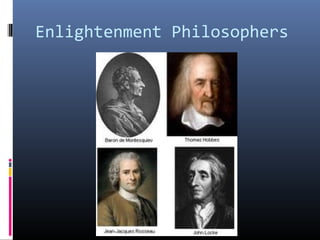
Enlightenment Philosophers
Francis Bacon (1561-1626)
 Whatever the “mind seizes and dwells upon
with particular satisfaction is to be held in
suspicion”
 Bacon’s inductive method of reasoning to
interpret nature evident in his work the
“Novum Organum”
 Move from observations to theory – a
bottom-up approach
Cesare Beccaria (1738-1794)
 “On Crimes and Punishments” (1764)
 Influenced leaders in Europe as well as
revolutionary leaders in the American
colonies
 The social contract – people choose to live in
a society and have to thus give up some
personal liberties in exchange for the safety
of society.
 Laws as the framework of society designed to
encourage/prohibit acts
 Laws to be determined rationally and be
based upon the idea of the “greatest
happiness shared by the greatest number”
 Rational punishment – punishment that
would fit the crime and not be unnecessarily
cruel or arbitrary.
Georges-Louis Leclerc
Buffon (1707-1788)
 Humankind’s understanding of the world
dominated by Separate Creation (all
creatures were created separately by God)
and the age of the earth as 6 000 years.
 Buffon challenged this 100 years before
Darwin.
 Suggested the common ancestry of man and
apes and challenged the age of the earth in
“Les Epoques de la Nature” (1788)
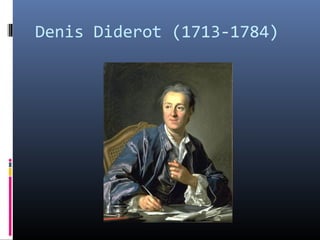
Denis Diderot (1713-1784)
 Chief editor of the “L’Encyclopedie” – an
attempt to collect all human knowledge,
consisting of 17 volumes of text and 11
volumes of illustrations.
 Diderot’s own writings “Supplement au
voyage de Bougainville” challenged
colonization and slavery.
Benjamin Franklin (1706-
1790)
 Influenced by Sir Isaac Newton and John
Locke
 Worked as a printer and published a
newspaper
 Inventor and worked on electricity
 Increasing involvement in politics and
opposed British policies in American colonies
 Helped draft the Declaration of
Independence and approved the US
Constitution
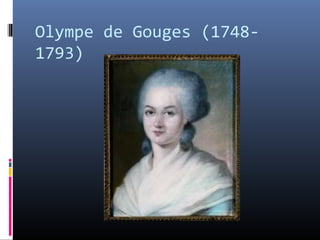
Olympe de Gouges (1748-
1793)
 Advocate of human rights and equality for
women
 “The Declaration of the Rights of Women and
of the Citizen” (1791)
 Belief that women had the right to free
speech and the same rights given to men.
 Guillotined in 1793
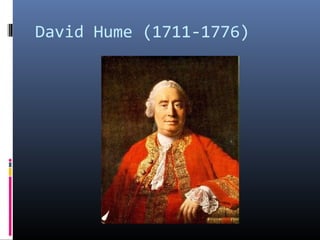
David Hume (1711-1776)
 Scottish Enlightenment emphasis on human
reason and rejection of authority that could not
be justified by reason
 Changes guided by reason could improve
society.
 Hume’s “radical skepticism” – the importance of
experience from which we then derive ideas.
 “A Treatise of Human Nature” (1739-1740), “An
Enquiry Concerning Human Understanding”
(1748)
John Locke (1632-1704)
 “An Essay Concerning Human
Understanding” (1690) – all our ideas are
derived from experience thus we cannot
know anything beyond our experience
 “ Two Treatises of Civil Government: (1690) –
government depends on the consent of those
who are governed; majority rule with the
right to revolution if dissatisfied with
government.
 “Letter Concerning Toleration” (1689)
Thomas Paine (1737-1809)
 Born in England but moved to America.
 “Common Sense” (1776) – promoted the cause of
American independence
 “The Rights of Man” – political rights for ALL
men in a democracy; rejection of hereditary
govt; social legislation for the poor.
 Govt should preserve the natural rights of all
men and rest on the sovereignty of the people
 Elected to the National Convention in France but
arrested during the Terror.
Adam Smith (1723-1790)
 “The Wealth of Nations” (1776) – “rational
self-interest in a free market economy leads
to economic well-being”
 Sought to reveal the nature and cause of a
nation’s prosperity.
 Advocated the increasing division of labour.
 Advocated free trade – an economy based on
“natural laws” with little govt interference i.e.
capitalism
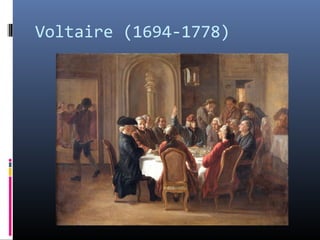
Voltaire (1694-1778)
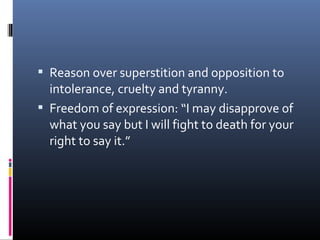
 Reason over superstition and opposition to
intolerance, cruelty and tyranny.
 Freedom of expression: “I may disapprove of
what you say but I will fight to death for your
right to say it.”

Lectures9 10

  • 2.
  • 3.
    Francis Bacon (1561-1626) Whatever the “mind seizes and dwells upon with particular satisfaction is to be held in suspicion”  Bacon’s inductive method of reasoning to interpret nature evident in his work the “Novum Organum”  Move from observations to theory – a bottom-up approach
  • 4.
    Cesare Beccaria (1738-1794) “On Crimes and Punishments” (1764)  Influenced leaders in Europe as well as revolutionary leaders in the American colonies  The social contract – people choose to live in a society and have to thus give up some personal liberties in exchange for the safety of society.  Laws as the framework of society designed to encourage/prohibit acts
  • 5.
     Laws tobe determined rationally and be based upon the idea of the “greatest happiness shared by the greatest number”  Rational punishment – punishment that would fit the crime and not be unnecessarily cruel or arbitrary.
  • 6.
    Georges-Louis Leclerc Buffon (1707-1788) Humankind’s understanding of the world dominated by Separate Creation (all creatures were created separately by God) and the age of the earth as 6 000 years.  Buffon challenged this 100 years before Darwin.  Suggested the common ancestry of man and apes and challenged the age of the earth in “Les Epoques de la Nature” (1788)
  • 7.
  • 8.
     Chief editorof the “L’Encyclopedie” – an attempt to collect all human knowledge, consisting of 17 volumes of text and 11 volumes of illustrations.  Diderot’s own writings “Supplement au voyage de Bougainville” challenged colonization and slavery.
  • 9.
    Benjamin Franklin (1706- 1790) Influenced by Sir Isaac Newton and John Locke  Worked as a printer and published a newspaper  Inventor and worked on electricity  Increasing involvement in politics and opposed British policies in American colonies  Helped draft the Declaration of Independence and approved the US Constitution
  • 10.
    Olympe de Gouges(1748- 1793)
  • 11.
     Advocate ofhuman rights and equality for women  “The Declaration of the Rights of Women and of the Citizen” (1791)  Belief that women had the right to free speech and the same rights given to men.  Guillotined in 1793
  • 12.
  • 13.
     Scottish Enlightenmentemphasis on human reason and rejection of authority that could not be justified by reason  Changes guided by reason could improve society.  Hume’s “radical skepticism” – the importance of experience from which we then derive ideas.  “A Treatise of Human Nature” (1739-1740), “An Enquiry Concerning Human Understanding” (1748)
  • 14.
    John Locke (1632-1704) “An Essay Concerning Human Understanding” (1690) – all our ideas are derived from experience thus we cannot know anything beyond our experience  “ Two Treatises of Civil Government: (1690) – government depends on the consent of those who are governed; majority rule with the right to revolution if dissatisfied with government.  “Letter Concerning Toleration” (1689)
  • 15.
    Thomas Paine (1737-1809) Born in England but moved to America.  “Common Sense” (1776) – promoted the cause of American independence  “The Rights of Man” – political rights for ALL men in a democracy; rejection of hereditary govt; social legislation for the poor.  Govt should preserve the natural rights of all men and rest on the sovereignty of the people  Elected to the National Convention in France but arrested during the Terror.
  • 16.
    Adam Smith (1723-1790) “The Wealth of Nations” (1776) – “rational self-interest in a free market economy leads to economic well-being”  Sought to reveal the nature and cause of a nation’s prosperity.  Advocated the increasing division of labour.  Advocated free trade – an economy based on “natural laws” with little govt interference i.e. capitalism
  • 17.
  • 18.
     Reason oversuperstition and opposition to intolerance, cruelty and tyranny.  Freedom of expression: “I may disapprove of what you say but I will fight to death for your right to say it.”