DEPT & SEM :
SUBJECT NAME :
COURSE CODE :
UNIT :
PREPARED BY :
COURSE: HT UNIT: 1 Pg. 1
MECH III & II SEM
Heat and Mass Transfer
ME20APC602
I
Dr. VENKATA KONDAIAH & Mr. D.Anjan Kumar
Reddy
COURSE: HT UNIT: 1 Pg. (#)
OUTLINE
 Introduction
Modes and Mechanisms of Heat Transfer
Basic Laws of Heat Transfer
General Applications of Heat Transfer.
 Conduction Heat Transfer:
Fourier Rate Equation
General Heat Conduction Equation In Cartesian, Cylindrical and
Spherical Coordinates.
Simplification and Forms of the Field Equation – Steady, Unsteady and
Periodic Heat Transfer – Boundary and Initial Conditions.
COURSE: HT UNIT: 1 Pg. (#)
One Dimensional Steady State Heat Conduction:
In Homogeneous Slabs, Hollow Cylinders and Spheres
Overall Heat Transfer Coefficient – Electrical Analogy
Critical Radius/Thickness of Insulation – With Variable Thermal
Conductivity – With Internal Heat Sources or Heat Generation
Cont..
COURSE: HT UNIT: 1 Pg. (#)
To grasp the concept of steady state conduction.
Student can learn representing conduction equation in various
forms.
Student can imply concept successfully to problems encounter
in day-to-day life
UNIT I OUTCOMES
COURSE: HT UNIT: 1 Pg. (#)
W h a t i s h e a t t r a n s f e r ?
D e f i n i t i o n :
 H e a t Tra n s fe r : is the form of energy that can be transferred from one system to
another as a result of temperature difference.
 It is the science that deals with the determination of the rates of energy transfer in
the form heat.
 It is thermal energy in transit due to a spacial temprature difference
 The transfer of heat is always from the higher-temperature medium to the lower-
temperature one, and heat transfer stops when the two mediums reach the same
temperature.
INTRODUCTION
COURSE: HT UNIT: 1 Pg. (#)
 Heat can be transferred in three different modes/mechanisms:
1. Conduction,
2. Convection, and
3. Radiation.
 All modes of heat transfer require the existence of a temperature difference, and
 In all modes/mechanisms heat is transfer from the high-temperature medium to a
lower-temperature one.
INTRODUCTION
COURSE: HT UNIT: 1 Pg. (#)
C o n d u c t i o n : is the transfer of energy/heat from the more energetic particles of a
substance to the adjacent less energetic ones as a result of interactions between the
particles.
 Conduction can take place in s o l i d s , l i q u i d s , o r g a s e s .
 In gases and liquids, conduction heat transfer is due to the collisions and diffusion of
the molecules during their random motion.
 In solids, it is due to the combination of vibrations of the molecules in a lattice and the
energy transport by free electrons.
CONDUCTION HEAT TRANSFER
COURSE: HT UNIT: 1 Pg. (#)
Example: A cold canned drink in a warm room, eventually warms up to the room temperature as
a result of heat transfer from the room to the drink through the aluminum can by conduction.
 The rate of heat conduction through a medium depends on the:
geometry of the medium,
thickness of the medium, and
the material type of the medium,
temperature difference across the medium.
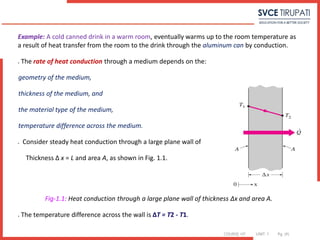
 Consider steady heat conduction through a large plane wall of
Thickness Δ x = L and area A, as shown in Fig. 1.1.
Fig-1.1: Heat conduction through a large plane wall of thickness Δx and area A.
 The temperature difference across the wall is ΔT = T2 - T1.
COURSE: HT UNIT: 1 Pg. (#)
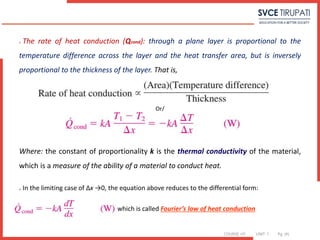
 The rate of heat conduction (Qcond): through a plane layer is proportional to the
temperature difference across the layer and the heat transfer area, but is inversely
proportional to the thickness of the layer. That is,
Or/
Where: the constant of proportionality k is the thermal conductivity of the material,
which is a measure of the ability of a material to conduct heat.
 In the limiting case of Δx →0, the equation above reduces to the differential form:
which is called Fourier’s law of heat conduction
COURSE: HT UNIT: 1 Pg. (#)
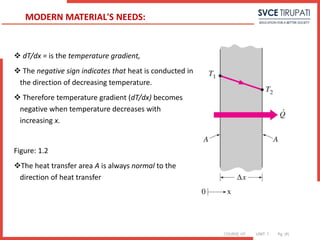
 dT/dx = is the temperature gradient,
 The negative sign indicates that heat is conducted in
the direction of decreasing temperature.
 Therefore temperature gradient (dT/dx) becomes
negative when temperature decreases with
increasing x.
Figure: 1.2
The heat transfer area A is always normal to the
direction of heat transfer
MODERN MATERIAL'S NEEDS:
COURSE: HT UNIT: 1 Pg. (#)
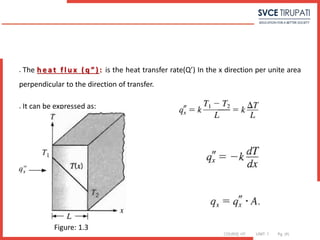
 The h e a t f l u x ( q ” ) : is the heat transfer rate(Q’) In the x direction per unite area
perpendicular to the direction of transfer.
 It can be expressed as:
Figure: 1.3
COURSE: HT UNIT: 1 Pg. (#)
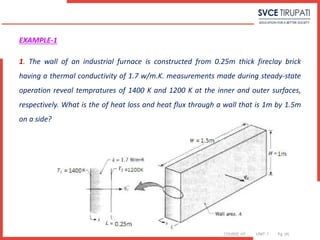
EXAMPLE-1
1. The wall of an industrial furnace is constructed from 0.25m thick fireclay brick
having a thermal conductivity of 1.7 w/m.K. measurements made during steady-state
operation reveal tempratures of 1400 K and 1200 K at the inner and outer surfaces,
respectively. What is the of heat loss and heat flux through a wall that is 1m by 1.5m
on a side?
COURSE: HT UNIT: 1 Pg. (#)
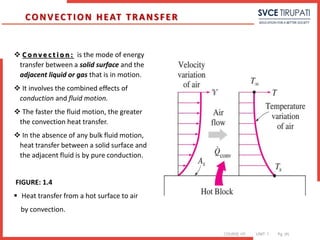
 C o n v e c t i o n : is the mode of energy
transfer between a solid surface and the
adjacent liquid or gas that is in motion.
 It involves the combined effects of
conduction and fluid motion.
 The faster the fluid motion, the greater
the convection heat transfer.
 In the absence of any bulk fluid motion,
heat transfer between a solid surface and
the adjacent fluid is by pure conduction.
FIGURE: 1.4
 Heat transfer from a hot surface to air
by convection.
CONVECTION HEAT TRANSFER
COURSE: HT UNIT: 1 Pg. (#)
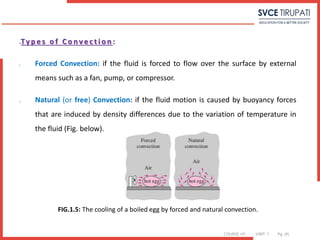
Ty p e s o f C o n v e c t i o n :
1. Forced Convection: if the fluid is forced to flow over the surface by external
means such as a fan, pump, or compressor.
2. Natural (or free) Convection: if the fluid motion is caused by buoyancy forces
that are induced by density differences due to the variation of temperature in
the fluid (Fig. below).
FIG.1.5: The cooling of a boiled egg by forced and natural convection.
COURSE: HT UNIT: 1 Pg. (#)
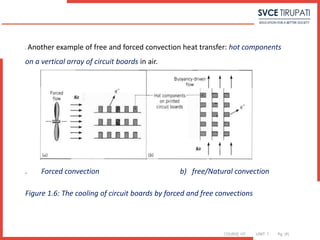
 Another example of free and forced convection heat transfer: hot components
on a vertical array of circuit boards in air.
a) Forced convection b) free/Natural convection
Figure 1.6: The cooling of circuit boards by forced and free convections
COURSE: HT UNIT: 1 Pg. (#)
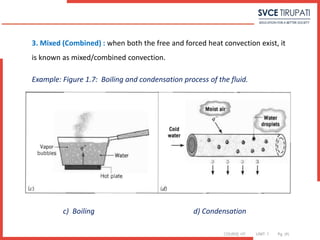
3. Mixed (Combined) : when both the free and forced heat convection exist, it
is known as mixed/combined convection.
Example: Figure 1.7: Boiling and condensation process of the fluid.
c) Boiling d) Condensation
COURSE: HT UNIT: 1 Pg. (#)
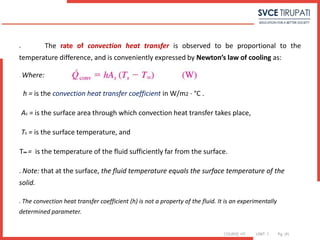
 The rate of convection heat transfer is observed to be proportional to the
temperature difference, and is conveniently expressed by Newton’s law of cooling as:
o Where:
h = is the convection heat transfer coefficient in W/m2 · °C .
As = is the surface area through which convection heat transfer takes place,
Ts = is the surface temperature, and
T∞ = is the temperature of the fluid sufficiently far from the surface.
 Note: that at the surface, the fluid temperature equals the surface temperature of the
solid.
 The convection heat transfer coefficient (h) is not a property of the fluid. It is an experimentally
determined parameter.
COURSE: HT UNIT: 1 Pg. (#)
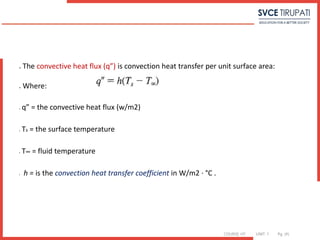
 The convective heat flux (q”) is convection heat transfer per unit surface area:
 Where:
 q” = the convective heat flux (w/m2)
 Ts = the surface temperature
 T∞ = fluid temperature
 h = is the convection heat transfer coefficient in W/m2 · °C .
COURSE: HT UNIT: 1 Pg. (#)
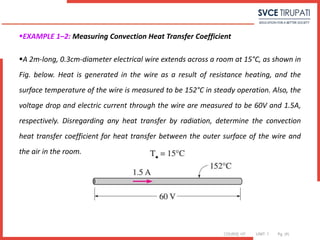
EXAMPLE 1–2: Measuring Convection Heat Transfer Coefficient
A 2m-long, 0.3cm-diameter electrical wire extends across a room at 15°C, as shown in
Fig. below. Heat is generated in the wire as a result of resistance heating, and the
surface temperature of the wire is measured to be 152°C in steady operation. Also, the
voltage drop and electric current through the wire are measured to be 60V and 1.5A,
respectively. Disregarding any heat transfer by radiation, determine the convection
heat transfer coefficient for heat transfer between the outer surface of the wire and
the air in the room.
COURSE: HT UNIT: 1 Pg. (#)
R a d i a t i o n : is the energy emitted by matter in the form of electromagnetic waves
(or photons) as a result of the changes in the electronic configurations of the atoms or
molecules.
 Unlike conduction and convection, the transfer of energy by radiation does not
require the presence of an intervening medium.
 Energy transfer by radiation is fastest (at the speed of light) and it suffers no
attenuation in a vacuum.
o Example: Energy of the sun reaches the earth.
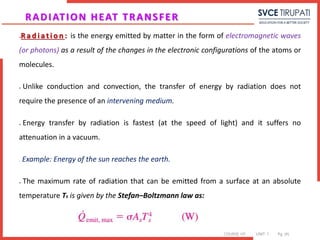
 The maximum rate of radiation that can be emitted from a surface at an absolute
temperature Ts is given by the Stefan–Boltzmann law as:
RADIATION HEAT TRANSFER
COURSE: HT UNIT: 1 Pg. (#)
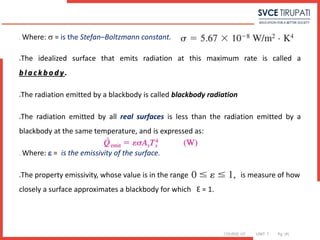
o Where:  = is the Stefan–Boltzmann constant.
The idealized surface that emits radiation at this maximum rate is called a
b l a c k b o d y.
The radiation emitted by a blackbody is called blackbody radiation
The radiation emitted by all real surfaces is less than the radiation emitted by a
blackbody at the same temperature, and is expressed as:
o Where:  = is the emissivity of the surface.
The property emissivity, whose value is in the range is measure of how
closely a surface approximates a blackbody for which Ɛ = 1.
COURSE: HT UNIT: 1 Pg. (#)
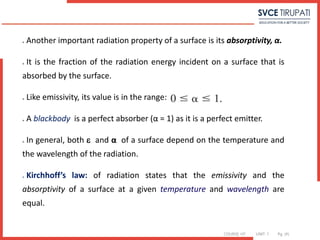
 Another important radiation property of a surface is its absorptivity, α.
 It is the fraction of the radiation energy incident on a surface that is
absorbed by the surface.
 Like emissivity, its value is in the range:
 A blackbody is a perfect absorber (α = 1) as it is a perfect emitter.
 In general, both  and α of a surface depend on the temperature and
the wavelength of the radiation.
 Kirchhoff’s law: of radiation states that the emissivity and the
absorptivity of a surface at a given temperature and wavelength are
equal.
COURSE: HT UNIT: 1 Pg. (#)
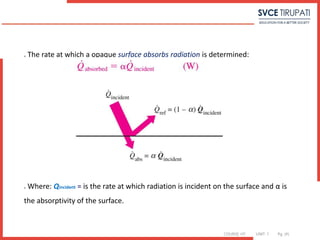
 The rate at which a opaque surface absorbs radiation is determined:
 Where: Qincident = is the rate at which radiation is incident on the surface and α is
the absorptivity of the surface.
COURSE: HT UNIT: 1 Pg. (#)
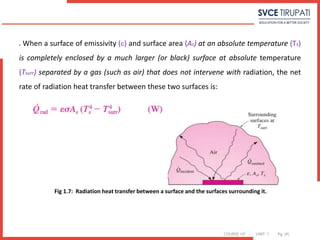
 When a surface of emissivity () and surface area (As) at an absolute temperature (Ts)
is completely enclosed by a much larger (or black) surface at absolute temperature
(Tsurr) separated by a gas (such as air) that does not intervene with radiation, the net
rate of radiation heat transfer between these two surfaces is:
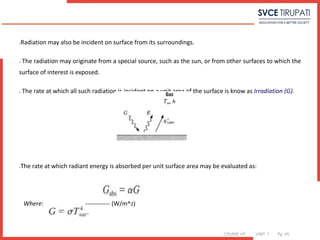
Fig 1.7: Radiation heat transfer between a surface and the surfaces surrounding it.
COURSE: HT UNIT: 1 Pg. (#)
Radiation may also be incident on surface from its surroundings.
 The radiation may originate from a special source, such as the sun, or from other surfaces to which the
surface of interest is exposed.
 The rate at which all such radiation is incident on a unit area of the surface is know as Irradiation (G).
The rate at which radiant energy is absorbed per unit surface area may be evaluated as:
Where: ------------ (W/m^2)
COURSE: HT UNIT: 1 Pg. (#)
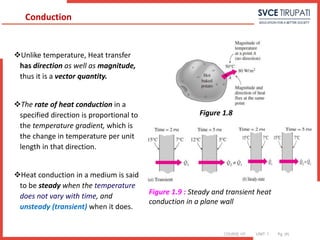
Unlike temperature, Heat transfer
has direction as well as magnitude,
thus it is a vector quantity.
The rate of heat conduction in a
specified direction is proportional to
the temperature gradient, which is
the change in temperature per unit
length in that direction.
Heat conduction in a medium is said
to be steady when the temperature
does not vary with time, and
unsteady (transient) when it does.
Conduction
Figure 1.8
Figure 1.9 : Steady and transient heat
conduction in a plane wall
COURSE: HT UNIT: 1 Pg. (#)
Heat conduction in a medium, in general, is three-dimensional and time
dependent.
That is, T = T(x, y, z, t) and the temperature in a medium varies with
position as well as time.
a) Heat conduction in a medium is said to be one-dimensional when
conduction is significant in one dimension only and negligible in the other
two dimensions.
b) Two - dimensional :- when conduction in the third dimension is
negligible.
C) Three – dimensional:- when conduction in all dimensions is significant.
COURSE: HT UNIT: 1 Pg. (#)
A major objective in a conduction analysis is to determine the temperature field
(temperature distribution) in a medium, which is varies with a position.
Once this distribution is known, the conduction heat flux at any point in the
medium or on its surface may be computed from Fourier’s law.
For a solid, knowing temp. distribution could be used to ascertain structural
integrity through determination of thermal stress, expansions, and deflections of
the material.
One of the manner in which the temperature distribution can be determined, is
applying the energy conservation.
In this case, we define a differential control volume , identify the relevant
energy transfer process and introduce the appropriate rate eqn.
THE HEAT DIFFUSION EQUATION
COURSE: HT UNIT: 1 Pg. (#)
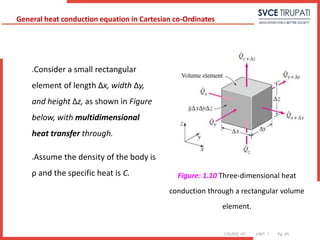
Consider a small rectangular
element of length Δx, width Δy,
and height Δz, as shown in Figure
below, with multidimensional
heat transfer through.
Assume the density of the body is
ρ and the specific heat is C.
General heat conduction equation in Cartesian co-Ordinates
Figure: 1.10 Three-dimensional heat
conduction through a rectangular volume
element.
COURSE: HT UNIT: 1 Pg. (#)
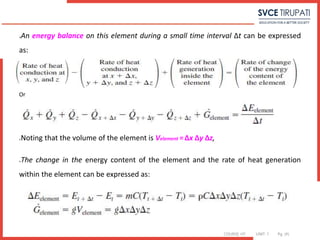
An energy balance on this element during a small time interval Δt can be expressed
as:
Or
Noting that the volume of the element is Velement = Δx Δy Δz,
The change in the energy content of the element and the rate of heat generation
within the element can be expressed as:
COURSE: HT UNIT: 1 Pg. (#)
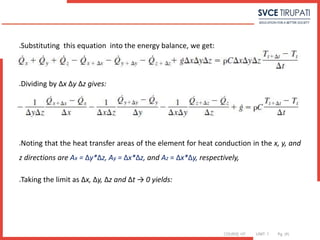
Substituting this equation into the energy balance, we get:
Dividing by Δx Δy Δz gives:
Noting that the heat transfer areas of the element for heat conduction in the x, y, and
z directions are Ax = Δy*Δz, Ay = Δx*Δz, and Az = Δx*Δy, respectively,
Taking the limit as Δx, Δy, Δz and Δt → 0 yields:
COURSE: HT UNIT: 1 Pg. (#)
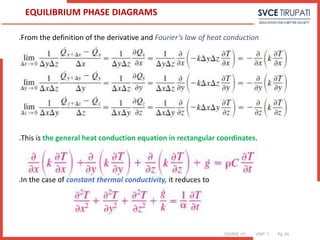
From the definition of the derivative and Fourier’s law of heat conduction
,
This is the general heat conduction equation in rectangular coordinates.
In the case of constant thermal conductivity, it reduces to
EQUILIBRIUM PHASE DIAGRAMS
COURSE: HT UNIT: 1 Pg. (#)
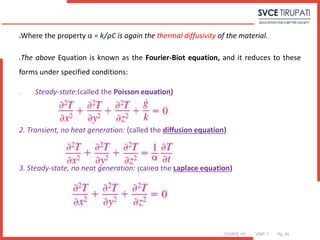
Where the property α = k/ρC is again the thermal diffusivity of the material.
The above Equation is known as the Fourier-Biot equation, and it reduces to these
forms under specified conditions:
1. Steady-state:(called the Poisson equation)
2. Transient, no heat generation: (called the diffusion equation)
3. Steady-state, no heat generation: (called the Laplace equation)
COURSE: HT UNIT: 1 Pg. (#)
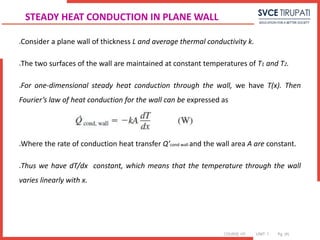
Consider a plane wall of thickness L and average thermal conductivity k.
The two surfaces of the wall are maintained at constant temperatures of T1 and T2.
For one-dimensional steady heat conduction through the wall, we have T(x). Then
Fourier’s law of heat conduction for the wall can be expressed as
Where the rate of conduction heat transfer Q’cond wall and the wall area A are constant.
Thus we have dT/dx constant, which means that the temperature through the wall
varies linearly with x.
STEADY HEAT CONDUCTION IN PLANE WALL
COURSE: HT UNIT: 1 Pg. (#)
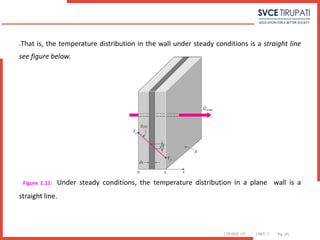
That is, the temperature distribution in the wall under steady conditions is a straight line
see figure below.
Figure 1.11: Under steady conditions, the temperature distribution in a plane wall is a
straight line.
COURSE: HT UNIT: 1 Pg. (#)
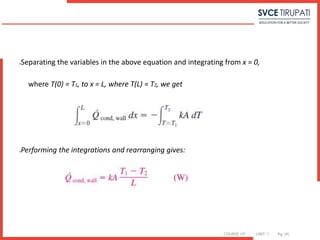
Separating the variables in the above equation and integrating from x = 0,
where T(0) = T1, to x = L, where T(L) = T2, we get
Performing the integrations and rearranging gives:
COURSE: HT UNIT: 1 Pg. (#)
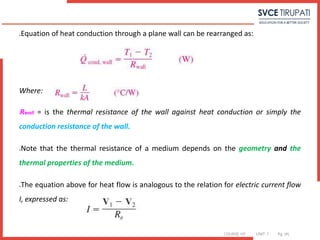
Equation of heat conduction through a plane wall can be rearranged as:
Where:
Rwall = is the thermal resistance of the wall against heat conduction or simply the
conduction resistance of the wall.
Note that the thermal resistance of a medium depends on the geometry and the
thermal properties of the medium.
The equation above for heat flow is analogous to the relation for electric current flow
I, expressed as:
COURSE: HT UNIT: 1 Pg. (#)
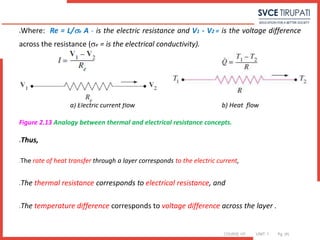
Where: Re = L/e A - is the electric resistance and V1 - V2 = is the voltage difference
across the resistance (e = is the electrical conductivity).
a) Electric current flow b) Heat flow
Figure 2.13 Analogy between thermal and electrical resistance concepts.
Thus,
The rate of heat transfer through a layer corresponds to the electric current,
The thermal resistance corresponds to electrical resistance, and
The temperature difference corresponds to voltage difference across the layer .
COURSE: HT UNIT: 1 Pg. (#)
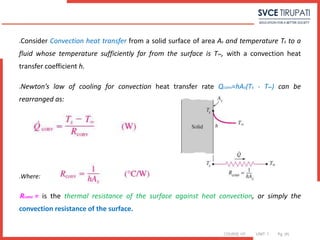
Consider Convection heat transfer from a solid surface of area As and temperature Ts to a
fluid whose temperature sufficiently far from the surface is T∞, with a convection heat
transfer coefficient h.
Newton’s law of cooling for convection heat transfer rate Qconv=hAs(Ts - T∞) can be
rearranged as:
Where:
Rconv = is the thermal resistance of the surface against heat convection, or simply the
convection resistance of the surface.
COURSE: HT UNIT: 1 Pg. (#)
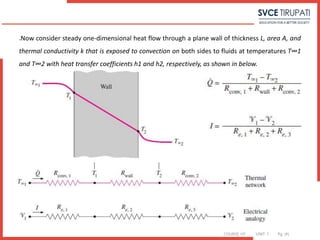
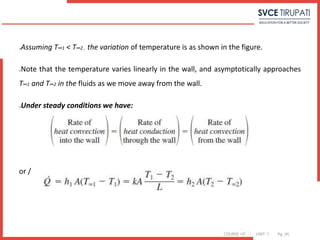
Now consider steady one-dimensional heat flow through a plane wall of thickness L, area A, and
thermal conductivity k that is exposed to convection on both sides to fluids at temperatures T∞1
and T∞2 with heat transfer coefficients h1 and h2, respectively, as shown in below.
COURSE: HT UNIT: 1 Pg. (#)
Assuming T∞1 < T∞2 , the variation of temperature is as shown in the figure.
Note that the temperature varies linearly in the wall, and asymptotically approaches
T∞1 and T∞2 in the fluids as we move away from the wall.
Under steady conditions we have:
or /
COURSE: HT UNIT: 1 Pg. (#)
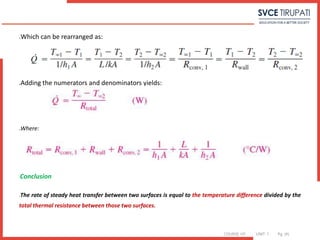
Which can be rearranged as:
Adding the numerators and denominators yields:
Where:
Conclusion
The rate of steady heat transfer between two surfaces is equal to the temperature difference divided by the
total thermal resistance between those two surfaces.
COURSE: HT UNIT: 1 Pg. (#)
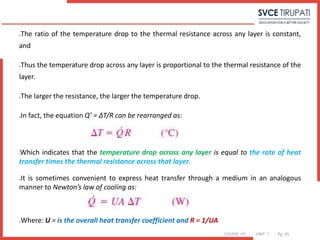
The ratio of the temperature drop to the thermal resistance across any layer is constant,
and
Thus the temperature drop across any layer is proportional to the thermal resistance of the
layer.
The larger the resistance, the larger the temperature drop.
In fact, the equation Q’ = ΔT/R can be rearranged as:
Which indicates that the temperature drop across any layer is equal to the rate of heat
transfer times the thermal resistance across that layer.
It is sometimes convenient to express heat transfer through a medium in an analogous
manner to Newton’s law of cooling as:
Where: U = is the overall heat transfer coefficient and R = 1/UA
COURSE: HT UNIT: 1 Pg. (#)
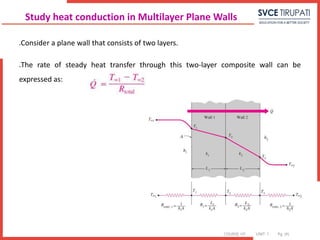
Consider a plane wall that consists of two layers.
The rate of steady heat transfer through this two-layer composite wall can be
expressed as:
Study heat conduction in Multilayer Plane Walls
COURSE: HT UNIT: 1 Pg. (#)
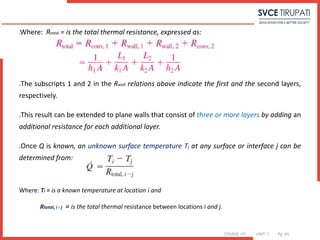
Where: Rtotal = is the total thermal resistance, expressed as:
The subscripts 1 and 2 in the Rwall relations above indicate the first and the second layers,
respectively.
This result can be extended to plane walls that consist of three or more layers by adding an
additional resistance for each additional layer.
Once Q is known, an unknown surface temperature Tj at any surface or interface j can be
determined from:
Where: Ti = is a known temperature at location i and
Rtotal, i - j = is the total thermal resistance between locations i and j.
COURSE: HT UNIT: 1 Pg. (#)
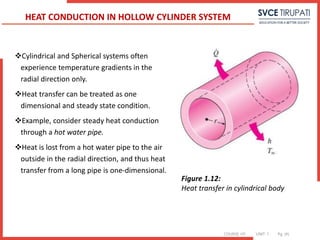
Cylindrical and Spherical systems often
experience temperature gradients in the
radial direction only.
Heat transfer can be treated as one
dimensional and steady state condition.
Example, consider steady heat conduction
through a hot water pipe.
Heat is lost from a hot water pipe to the air
outside in the radial direction, and thus heat
transfer from a long pipe is one-dimensional.
HEAT CONDUCTION IN HOLLOW CYLINDER SYSTEM
Figure 1.12:
Heat transfer in cylindrical body
COURSE: HT UNIT: 1 Pg. (#)
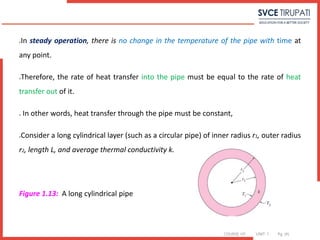
In steady operation, there is no change in the temperature of the pipe with time at
any point.
Therefore, the rate of heat transfer into the pipe must be equal to the rate of heat
transfer out of it.
 In other words, heat transfer through the pipe must be constant,
Consider a long cylindrical layer (such as a circular pipe) of inner radius r1, outer radius
r2, length L, and average thermal conductivity k.
Figure 1.13: A long cylindrical pipe
COURSE: HT UNIT: 1 Pg. (#)
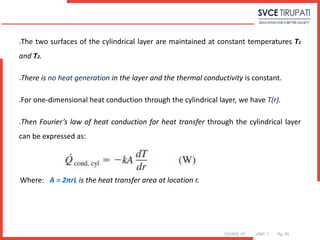
The two surfaces of the cylindrical layer are maintained at constant temperatures T1
and T2.
There is no heat generation in the layer and the thermal conductivity is constant.
For one-dimensional heat conduction through the cylindrical layer, we have T(r).
Then Fourier’s law of heat conduction for heat transfer through the cylindrical layer
can be expressed as:
Where: A = 2πrL is the heat transfer area at location r.
COURSE: HT UNIT: 1 Pg. (#)
Note that A depends on r, and thus it varies in the direction of heat transfer.
Separating the variables in the above equation and integrating from
r = r1, where: T(r1) = T1, to r = r2, where T(r2) = T2, gives:
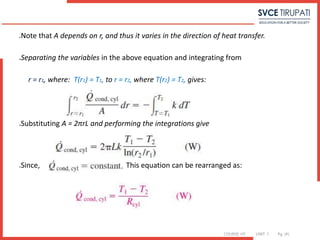
Substituting A = 2πrL and performing the integrations give
Since, This equation can be rearranged as:
COURSE: HT UNIT: 1 Pg. (#)
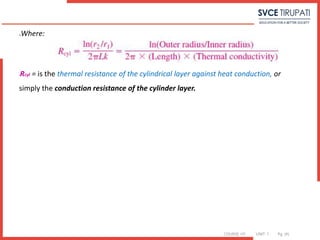
Where:
Rcyl = is the thermal resistance of the cylindrical layer against heat conduction, or
simply the conduction resistance of the cylinder layer.
COURSE: HT UNIT: 1 Pg. (#)
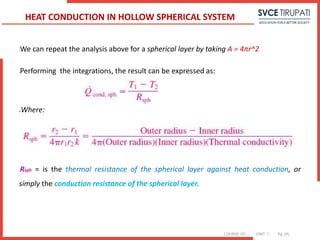
We can repeat the analysis above for a spherical layer by taking A = 4πr^2
Performing the integrations, the result can be expressed as:
Where:
Rsph = is the thermal resistance of the spherical layer against heat conduction, or
simply the conduction resistance of the spherical layer.
HEAT CONDUCTION IN HOLLOW SPHERICAL SYSTEM
COURSE: HT UNIT: 1 Pg. (#)
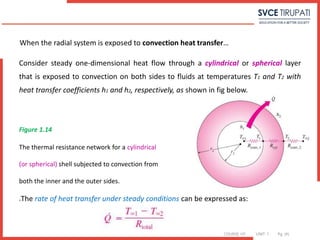
When the radial system is exposed to convection heat transfer…
Consider steady one-dimensional heat flow through a cylindrical or spherical layer
that is exposed to convection on both sides to fluids at temperatures T1 and T2 with
heat transfer coefficients h1 and h2, respectively, as shown in fig below.
Figure 1.14
The thermal resistance network for a cylindrical
(or spherical) shell subjected to convection from
both the inner and the outer sides.
The rate of heat transfer under steady conditions can be expressed as:
COURSE: HT UNIT: 1 Pg. (#)
Where:
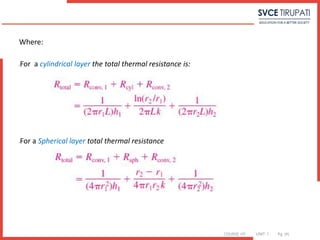
For a cylindrical layer the total thermal resistance is:
For a Spherical layer total thermal resistance
COURSE: HT UNIT: 1 Pg. (#)
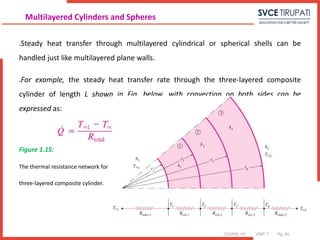
Steady heat transfer through multilayered cylindrical or spherical shells can be
handled just like multilayered plane walls.
For example, the steady heat transfer rate through the three-layered composite
cylinder of length L shown in Fig. below. with convection on both sides can be
expressed as:
Figure 1.15:
The thermal resistance network for
three-layered composite cylinder.
Multilayered Cylinders and Spheres
COURSE: HT UNIT: 1 Pg. (#)
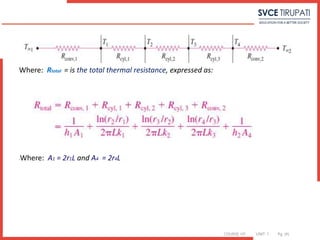
Where: Rtotal = is the total thermal resistance, expressed as:
Where: A1 = 2r1L and A4 = 2r4L
COURSE: HT UNIT: 1 Pg. (#)
There is some mis understanding about that addition of insulating material on a
surface always brings about a decrease in the heat transfer rate.
But addition of insulating material to the outside surfaces of cylindrical or spherical
walls (geometries which have non-constant cross-sectional areas) may increase the
heat transfer rate rather than decrease under the certain circumstances
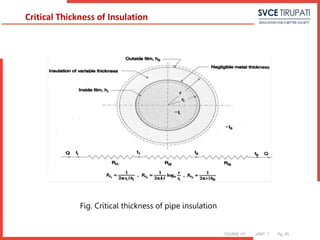
To establish this fact, consider a thin walled metallic cylinder of length l, radius and
transporting a fluid at temperature which is higher than the ambient temperature.
Insulation of thickness(r-ri) and conductivity k is provided on the surface of the
cylinder
Critical Thickness of Insulation
COURSE: HT UNIT: 1 Pg. (#)
Critical Thickness of Insulation
Fig. Critical thickness of pipe insulation
COURSE: HT UNIT: 1 Pg. (#)
assumptions
a. Steady state heat conduction
b. One-dimensional heat flow only in radial direction
c. Negligible thermal resistance due to cylinder wall
d. Negligible radiation exchange between outer surface of insulation and surrounding
Critical Thickness of Insulation
COURSE: HT UNIT: 1 Pg. (#)
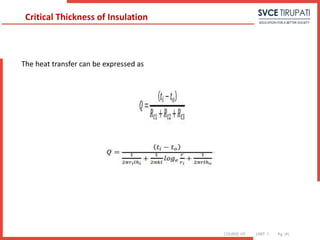
The heat transfer can be expressed as
Critical Thickness of Insulation
COURSE: HT UNIT: 1 Pg. (#)
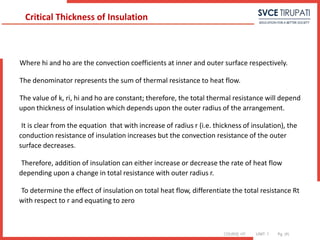
Where hi and ho are the convection coefficients at inner and outer surface respectively.
The denominator represents the sum of thermal resistance to heat flow.
The value of k, ri, hi and ho are constant; therefore, the total thermal resistance will depend
upon thickness of insulation which depends upon the outer radius of the arrangement.
It is clear from the equation that with increase of radius r (i.e. thickness of insulation), the
conduction resistance of insulation increases but the convection resistance of the outer
surface decreases.
Therefore, addition of insulation can either increase or decrease the rate of heat flow
depending upon a change in total resistance with outer radius r.
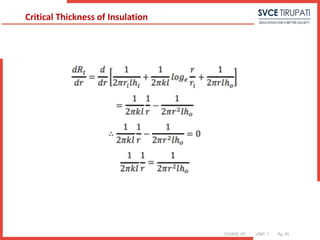
To determine the effect of insulation on total heat flow, differentiate the total resistance Rt
with respect to r and equating to zero
Critical Thickness of Insulation
COURSE: HT UNIT: 1 Pg. (#)
Critical Thickness of Insulation
COURSE: HT UNIT: 1 Pg. (#)
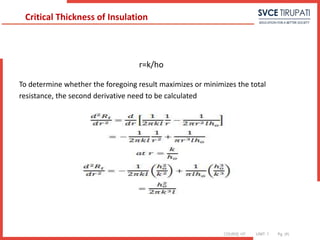
r=k/ho
To determine whether the foregoing result maximizes or minimizes the total
resistance, the second derivative need to be calculated
Critical Thickness of Insulation
COURSE: HT UNIT: 1 Pg. (#)
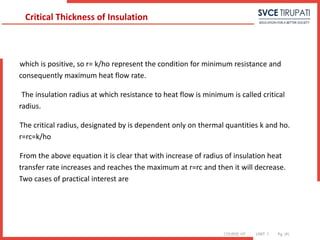
which is positive, so r= k/ho represent the condition for minimum resistance and
consequently maximum heat flow rate.
The insulation radius at which resistance to heat flow is minimum is called critical
radius.
The critical radius, designated by is dependent only on thermal quantities k and ho.
r=rc=k/ho
From the above equation it is clear that with increase of radius of insulation heat
transfer rate increases and reaches the maximum at r=rc and then it will decrease.
Two cases of practical interest are
Critical Thickness of Insulation
COURSE: HT UNIT: 1 Pg. (#)
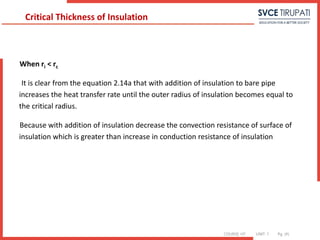
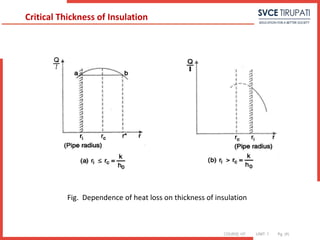
When ri < rc
It is clear from the equation 2.14a that with addition of insulation to bare pipe
increases the heat transfer rate until the outer radius of insulation becomes equal to
the critical radius.
Because with addition of insulation decrease the convection resistance of surface of
insulation which is greater than increase in conduction resistance of insulation
Critical Thickness of Insulation
COURSE: HT UNIT: 1 Pg. (#)
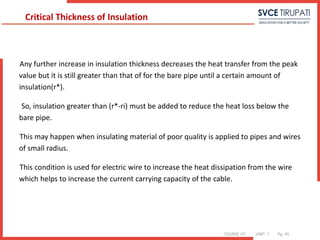
Fig. Dependence of heat loss on thickness of insulation
Critical Thickness of Insulation
COURSE: HT UNIT: 1 Pg. (#)
Any further increase in insulation thickness decreases the heat transfer from the peak
value but it is still greater than that of for the bare pipe until a certain amount of
insulation(r*).
So, insulation greater than (r*-ri) must be added to reduce the heat loss below the
bare pipe.
This may happen when insulating material of poor quality is applied to pipes and wires
of small radius.
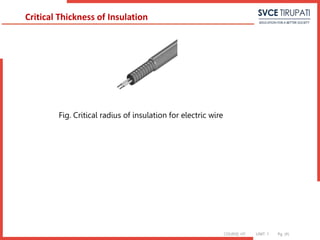
This condition is used for electric wire to increase the heat dissipation from the wire
which helps to increase the current carrying capacity of the cable.
Critical Thickness of Insulation
COURSE: HT UNIT: 1 Pg. (#)
Critical Thickness of Insulation
Fig. Critical radius of insulation for electric wire
COURSE: HT UNIT: 1 Pg. (#)
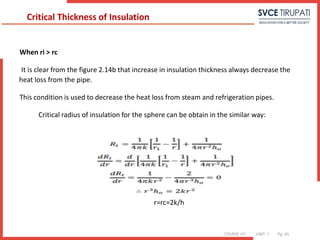
When ri > rc
It is clear from the figure 2.14b that increase in insulation thickness always decrease the
heat loss from the pipe.
This condition is used to decrease the heat loss from steam and refrigeration pipes.
Critical radius of insulation for the sphere can be obtain in the similar way:
r=rc=2k/h
Critical Thickness of Insulation
COURSE: HT UNIT: 1 Pg. (#)
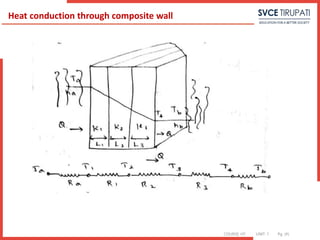
Heat conduction through composite wall
COURSE: HT UNIT: 1 Pg. (#)
Q=Aha(Ta-T1) =-k1A(T2-T1 / L1)= -k2A(T3-T2 / L2)=-k3A(T4-T3 / L3) =Ahb(T4-Tb)
Q= (Ta-T1)/Ra = T1-T2 / R1 = T2-T3 / R2 = T3-T4 / R3 = T4-Tb / Rb
Where
Ra = 1/Aha, R1 = L1/Ak1, R2 = L2/Ak2, R3 = L3/Ak3, Rb = 1/Ahb
ΔT = Ta-Tb = (Ta-T1 )+(T1-T2)+(T2-T3)+(T3-T4)+(T4-Tb)
Q= ΔT/ΣR
Q= Ta-Tb / [1/haA+L1/Ak1+L2/Ak2+L3/Ak3+1/hbA ]
= Ta-Tb /ΣR
Heat conduction through composite wall
COURSE: HT UNIT: 1 Pg. (#)
ΣR = 1/haA+L1/Ak1+L2/Ak2+L3/Ak3+1/hbA
ΣR =1/A[1/ha+L1/k1+L2/k2+L3/k3+1/hb]
Ta=T1, Tb=T4
R=1/UA, Q= Ta-Tb / 1/UA = Q=UAC(Ta- Tb)
U is the overall heat transfer coefficient
Heat conduction through composite wall
COURSE: HT UNIT: 1 Pg. (#)
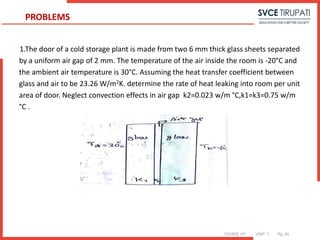
1.The door of a cold storage plant is made from two 6 mm thick glass sheets separated
by a uniform air gap of 2 mm. The temperature of the air inside the room is -20°C and
the ambient air temperature is 30°C. Assuming the heat transfer coefficient between
glass and air to be 23.26 W/m2K. determine the rate of heat leaking into room per unit
area of door. Neglect convection effects in air gap k2=0.023 w/m °C,k1=k3=0.75 w/m
°C .
PROBLEMS
COURSE: HT UNIT: 1 Pg. (#)
Given data
L1 = 6mm
L2 = 2 mm
L3 = 6 mm
Ta = 30°C
Tb = -20°C
ha =hb = 23.36 W/m2 K
Q/A = Ta-Tb/ [1/ha+L1/k1+L2/k2+L3/k3+1/hb ]
Q/A = 30 – (- 20) / [1/23.26+ 0.006/0.75 + 0.002/0.02 + 0.006/0.75+1/23.26]
Q/A = 247.5 W/m2
PROBLEMS
COURSE: HT UNIT: 1 Pg. (#)
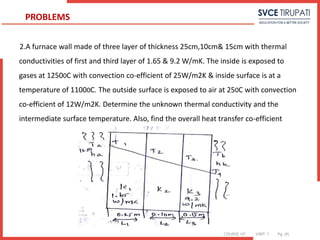
2.A furnace wall made of three layer of thickness 25cm,10cm& 15cm with thermal
conductivities of first and third layer of 1.65 & 9.2 W/mK. The inside is exposed to
gases at 12500C with convection co-efficient of 25W/m2K & inside surface is at a
temperature of 11000C. The outside surface is exposed to air at 250C with convection
co-efficient of 12W/m2K. Determine the unknown thermal conductivity and the
intermediate surface temperature. Also, find the overall heat transfer co-efficient
PROBLEMS
COURSE: HT UNIT: 1 Pg. (#)
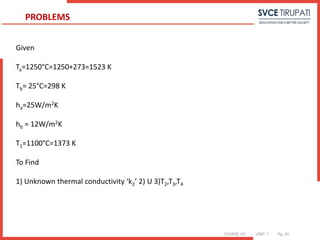
Given
Ta=1250°C=1250+273=1523 K
Tb= 25°C=298 K
ha=25W/m2K
hb = 12W/m2K
T1=1100°C=1373 K
To Find
1) Unknown thermal conductivity ‘k2’ 2) U 3)T2,T3,T4
PROBLEMS
COURSE: HT UNIT: 1 Pg. (#)
Heat Transfer
Q=haA(Ta-T1)
Q/A = 3750 W/m2
Q= ΔT/ΣR
Q/A= Ta-Tb/ [1/ha+L1/k1+L2/k2+L3/k3+1/hb ]
3750 = 1523 – 298 / [1/25 + 0.25/1.65 + 0.10/k2+ 0.15/9.2+1/12]
k2 = 2.816 W/mK
PROBLEMS
COURSE: HT UNIT: 1 Pg. (#)
U= 1/R
R = [1/ha+L1/k1+L2/k2+L3/k3+1/hb ]
=[1/25 + 0.25/1.65 + 0.10/ 2.816 + 0.15/9.2+1/12]
= [0.04+1.9+2.916+0.016+0.08]
= 0.3258 K/W
U= 1/R = 3.069 W/K
PROBLEMS
COURSE: HT UNIT: 1 Pg. (#)
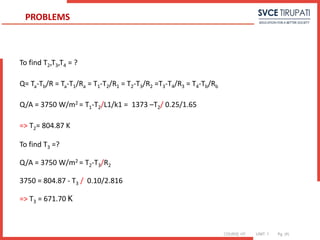
To find T2,T3,T4 = ?
Q= Ta-Tb/R = Ta-T1/Ra = T1-T2/R1 = T2-T3/R2 =T3-T4/R3 = T4-Tb/Rb
Q/A = 3750 W/m2 = T1-T2/L1/k1 = 1373 –T2/ 0.25/1.65
=> T2= 804.87 K
To find T3 =?
Q/A = 3750 W/m2 = T2-T3/R2
3750 = 804.87 - T3 / 0.10/2.816
=> T3 = 671.70 K
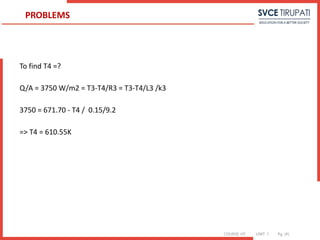
PROBLEMS
COURSE: HT UNIT: 1 Pg. (#)
To find T4 =?
Q/A = 3750 W/m2 = T3-T4/R3 = T3-T4/L3 /k3
3750 = 671.70 - T4 / 0.15/9.2
=> T4 = 610.55K
PROBLEMS
COURSE: HT UNIT: 1 Pg. (#)
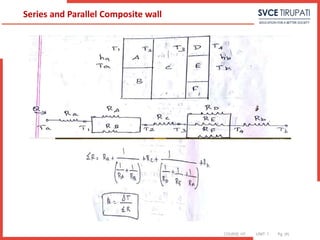
Series and Parallel Composite wall
COURSE: HT UNIT: 1 Pg. (#)
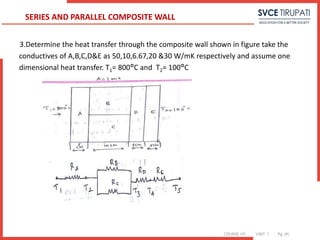
3.Determine the heat transfer through the composite wall shown in figure take the
conductives of A,B,C,D&E as 50,10,6.67,20 &30 W/mK respectively and assume one
dimensional heat transfer. T1= 800°C and T2= 100°C
SERIES AND PARALLEL COMPOSITE WALL
COURSE: HT UNIT: 1 Pg. (#)
R1= L1/k1A1 = 0.05/50*1 = 1*10-3W/K
=> R2 = 1/[ 1/Rb+ 1/Rc ]
Rb= Lb/kbAb = 0.1/10*0.5 = 2*10-2W/K
Rc= Lc/kcAc = 0.1/6.67*0.5 = 3*10-2W/K
=> R2 = 1/[ 1/2*10-2 + 1/3*10-2] = 1.2*10-2W/K
=> R3 = L3/k3A3 = 0.05/20*1 = 2.5*10-3W/K
=> R4 = L4/k4A4 = 0.05/30*1 = 1.66*10-3W/K
SERIES AND PARALLEL COMPOSITE WALL
COURSE: HT UNIT: 1 Pg. (#)
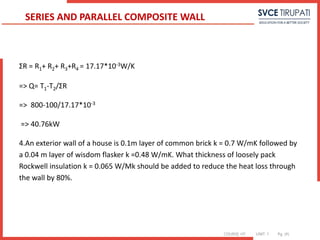
ΣR = R1+ R2+ R3+R4 = 17.17*10-3W/K
=> Q= T1-T2/ΣR
=> 800-100/17.17*10-3
=> 40.76kW
4.An exterior wall of a house is 0.1m layer of common brick k = 0.7 W/mK followed by
a 0.04 m layer of wisdom flasker k =0.48 W/mK. What thickness of loosely pack
Rockwell insulation k = 0.065 W/Mk should be added to reduce the heat loss through
the wall by 80%.
SERIES AND PARALLEL COMPOSITE WALL
COURSE: HT UNIT: 1 Pg. (#)
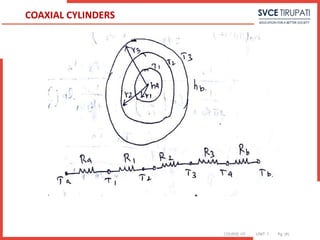
COAXIAL CYLINDERS
COURSE: HT UNIT: 1 Pg. (#)
Q = ha 2¶r1L (Ta-T1)
R =1/ 2¶ L [1/ har1 +1/k1 ln(r2/r1)+ 1/k2 ln(r3/r2)+1/k3 ln(r4/r3) + 1/ har4 ]
Q= ΔT/R
ΔT = Ta-Tb /R
Q = T1-T2 / 1/2 ¶ k1L1(lnr2/r1) = T2-T3 / 1/2 ¶ k2L2(lnr3/r2) = T3-T4 / 1/2 ¶ k3L3(lnr4/r3) =
T4-T3 / 1/2 ¶ k3L3(lnr4/r3) = T4-Tb / 1/hb (2¶r3L)
COAXIAL CYLINDERS
COURSE: HT UNIT: 1 Pg. (#)
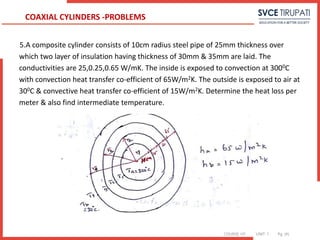
5.A composite cylinder consists of 10cm radius steel pipe of 25mm thickness over
which two layer of insulation having thickness of 30mm & 35mm are laid. The
conductivities are 25,0.25,0.65 W/mK. The inside is exposed to convection at 3000C
with convection heat transfer co-efficient of 65W/m2K. The outside is exposed to air at
300C & convective heat transfer co-efficient of 15W/m2K. Determine the heat loss per
meter & also find intermediate temperature.
COAXIAL CYLINDERS -PROBLEMS
COURSE: HT UNIT: 1 Pg. (#)
Given
ri = 10cm = 0.1m =r1
r2 = r1 + 0.025 = 0.125 m
r3 = r2 + 0.03 = 0.155 m
r4 = r3 + 0.035 = 0.19 m
k1 = 25 W/mK , ha = 65 W/m2K
K2 = 0.25 W/mK , hb = 15 W/m2K
K 3= 0.65 W/mK, L= 1m (if not given)
ΣR =1/ 2¶ L [1/ har1 +1/k1 ln(r2/r1)+ 1/k2 ln(r3/r2)+1/k3 ln(r4/r3) + 1/ har4 ]
ΣR = 0.268 W
Q= ΔT/ ΣR = 300-30/ 0.268 = 1007.46 W/m
COAXIAL CYLINDERS -PROBLEMS
COURSE: HT UNIT: 1 Pg. (#)
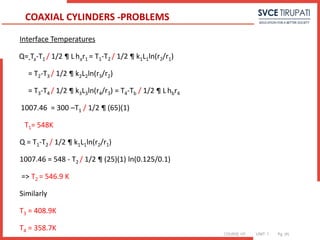
Interface Temperatures
Q= Ta-T1 / 1/2 ¶ L har1 = T1-T2 / 1/2 ¶ k1L1ln(r2/r1)
= T2-T3 / 1/2 ¶ k2L2ln(r3/r2)
= T3-T4 / 1/2 ¶ k3L3ln(r4/r3) = T4-Tb / 1/2 ¶ L hbr4
1007.46 = 300 –T1 / 1/2 ¶ (65)(1)
T1= 548K
Q = T1-T2 / 1/2 ¶ k1L1ln(r2/r1)
1007.46 = 548 - T2 / 1/2 ¶ (25)(1) ln(0.125/0.1)
=> T2 = 546.9 K
Similarly
T3 = 408.9K
T4 = 358.7K
COAXIAL CYLINDERS -PROBLEMS
COURSE: HT UNIT: 1 Pg. (#)
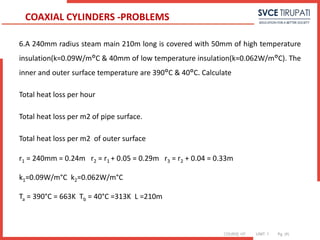
6.A 240mm radius steam main 210m long is covered with 50mm of high temperature
insulation(k=0.09W/m°C & 40mm of low temperature insulation(k=0.062W/m°C). The
inner and outer surface temperature are 390°C & 40°C. Calculate
Total heat loss per hour
Total heat loss per m2 of pipe surface.
Total heat loss per m2 of outer surface
r1 = 240mm = 0.24m r2 = r1 + 0.05 = 0.29m r3 = r2 + 0.04 = 0.33m
k1=0.09W/m°C k2=0.062W/m°C
Ta = 390°C = 663K Tb = 40°C =313K L =210m
COAXIAL CYLINDERS -PROBLEMS
COURSE: HT UNIT: 1 Pg. (#)
Q= ΔT/ ΣR
ΣR = 1/ 2¶ L [1/ har1 +1/k1 ln(r2/r1)+ 1/k2 ln(r3/r2)+1/k3 ln(r4/r3) + 1/ hbr4 ]
ΣR = 1/ 2¶ 210 [0 +1/0.09 ln(0.29/0.24)+ 1/0.062 ln (0.33/0.29)+0+0]
ΣR = 3.13*10-3°C/W
Q= ΔT/ ΣR = (663- 313)/ 3.13*10-3 =111.5kW
(i) Total heat loss per hour
Q= 111.5*103 / 1/ 3600 = 401.4 MJ/hr
(ii) Total heat loss per m2 of pipe surface
Q= 111.5*103 / 1/2 ¶*0.24*210 = 35.29 MJ/hr
(iii) Total heat loss per m2 of outer surface
Q= 111.5*103 / 1/2 ¶*0.33*210 = 48.52 MJ/hr
COAXIAL CYLINDERS -PROBLEMS
COURSE: HT UNIT: 1 Pg. (#)
COMPOSITE SPHERES
R= ¼ ¶{ 1/hiri
2 +1/k1[1/r1 - 1/r2] +1/k2[1/r2 - 1/r3] +1/hor3
2}
Q= Ti-T0/4¶hiri
2 = T1-T2/ 1/4¶ [1/r1-1/r2] = T2-T3/ 1/4¶ [1/r2-1/r3]
= T3-T4/ 1/4¶ [1/r4-1/r3]
= T4-Tb /4¶hor3
2
COURSE: HT UNIT: 1 Pg. (#)
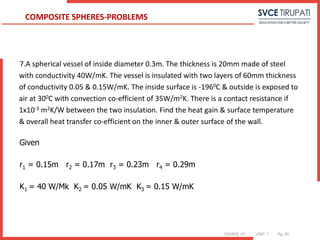
7.A spherical vessel of inside diameter 0.3m. The thickness is 20mm made of steel
with conductivity 40W/mK. The vessel is insulated with two layers of 60mm thickness
of conductivity 0.05 & 0.15W/mK. The inside surface is -1960C & outside is exposed to
air at 300C with convection co-efficient of 35W/m2K. There is a contact resistance if
1x10⁻³ m2K/W between the two insulation. Find the heat gain & surface temperature
& overall heat transfer co-efficient on the inner & outer surface of the wall.
Given
r1 = 0.15m r2 = 0.17m r3 = 0.23m r4 = 0.29m
K1 = 40 W/Mk K2 = 0.05 W/mK K3 = 0.15 W/mK
COMPOSITE SPHERES-PROBLEMS
COURSE: HT UNIT: 1 Pg. (#)
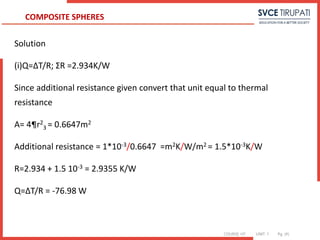
Solution
(i)Q=ΔT/R; ΣR =2.934K/W
Since additional resistance given convert that unit equal to thermal
resistance
A= 4¶r2
3 = 0.6647m2
Additional resistance = 1*10-3/0.6647 =m2K/W/m2 = 1.5*10-3K/W
R=2.934 + 1.5 10-3 = 2.9355 K/W
Q=ΔT/R = -76.98 W
COMPOSITE SPHERES
COURSE: HT UNIT: 1 Pg. (#)
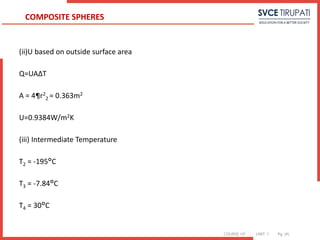
(ii)U based on outside surface area
Q=UAΔT
A = 4¶r2
2 = 0.363m2
U=0.9384W/m2K
(iii) Intermediate Temperature
T2 = -195°C
T3 = -7.84°C
T4 = 30°C
COMPOSITE SPHERES
COURSE: HT UNIT: 1 Pg. (#)
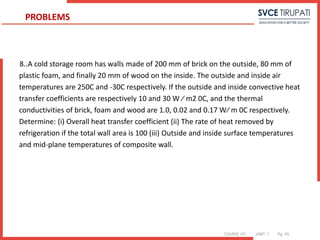
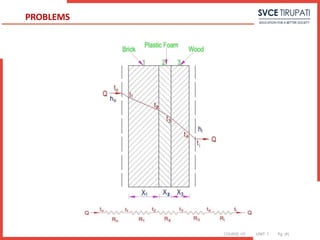
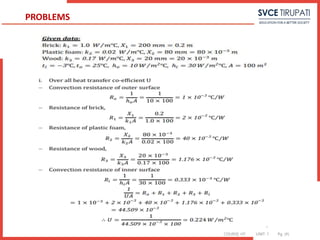
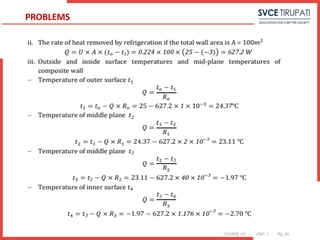
8..A cold storage room has walls made of 200 mm of brick on the outside, 80 mm of
plastic foam, and finally 20 mm of wood on the inside. The outside and inside air
temperatures are 250C and -30C respectively. If the outside and inside convective heat
transfer coefficients are respectively 10 and 30 W ⁄ m2 0C, and the thermal
conductivities of brick, foam and wood are 1.0, 0.02 and 0.17 W⁄ m 0C respectively.
Determine: (i) Overall heat transfer coefficient (ii) The rate of heat removed by
refrigeration if the total wall area is 100 (iii) Outside and inside surface temperatures
and mid-plane temperatures of composite wall.
PROBLEMS
COURSE: HT UNIT: 1 Pg. (#)
PROBLEMS
COURSE: HT UNIT: 1 Pg. (#)
PROBLEMS
COURSE: HT UNIT: 1 Pg. (#)
PROBLEMS
COURSE: HT UNIT: 1 Pg. (#)
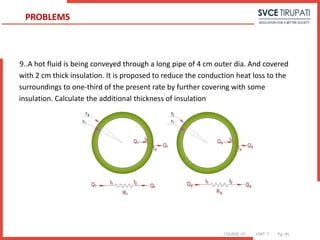
9..A hot fluid is being conveyed through a long pipe of 4 cm outer dia. And covered
with 2 cm thick insulation. It is proposed to reduce the conduction heat loss to the
surroundings to one-third of the present rate by further covering with some
insulation. Calculate the additional thickness of insulation
PROBLEMS
COURSE: HT UNIT: 1 Pg. (#)
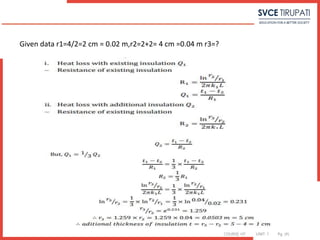
Given data r1=4/2=2 cm = 0.02 m,r2=2+2= 4 cm =0.04 m r3=?
COURSE: HT UNIT: 1 Pg. (#)
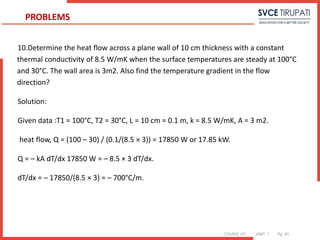
10.Determine the heat flow across a plane wall of 10 cm thickness with a constant
thermal conductivity of 8.5 W/mK when the surface temperatures are steady at 100°C
and 30°C. The wall area is 3m2. Also find the temperature gradient in the flow
direction?
Solution:
Given data :T1 = 100°C, T2 = 30°C, L = 10 cm = 0.1 m, k = 8.5 W/mK, A = 3 m2.
heat flow, Q = (100 – 30) / (0.1/(8.5 × 3)) = 17850 W or 17.85 kW.
Q = – kA dT/dx 17850 W = – 8.5 × 3 dT/dx.
dT/dx = – 17850/(8.5 × 3) = – 700°C/m.
PROBLEMS
COURSE: HT UNIT: 1 Pg. (#)
11. A surface is at 200°C and has an area of 2m2. It exchanges heat with another
surface B at 30°C by radiation. The value of factor due to the geometric location and
emissivity is 0.46. Determine the heat exchange. Also find the value of thermal
resistance and equivalent convection coefficient.
Solution:
Given data T1 = 200°C = 200 + 273 = 473K, T2 = 30°C = 30 + 273 = 303K
σ = 5.67 × 10⁻⁸, A = 2m2, F = 0.46.
Q = 0.46 × 5.67 × 10–8 × 2[4734 – 3034] = 0.46 × 5.67 × 2 [(473/100)4 – (303/100)4]
Q = 2171.4 W
PROBLEMS
COURSE: HT UNIT: 1 Pg. (#)
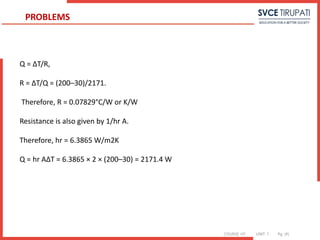
Q = ∆T/R,
R = ∆T/Q = (200–30)/2171.
Therefore, R = 0.07829°C/W or K/W
Resistance is also given by 1/hr A.
Therefore, hr = 6.3865 W/m2K
Q = hr A∆T = 6.3865 × 2 × (200–30) = 2171.4 W
PROBLEMS
COURSE: HT UNIT: 1 Pg. (#)
12. A electric room heater (radiator) element is 25 cm long and 4 cm in diameter. The
element dissipates heat to the surroundings at 1500 W mainly by radiation, the
surrounding temperature being 15°C. Determine the equilibrium temperature of the
element surface.
Solution
Given data L=25 cm, D= 4 cm, Q=1500W, T2=15+273=288 k
,Q = σ A(T1 4 – T2 4)
1500 = 5.67 × π × 0.04 × 0.25 [(T1/100)4 – (288/100)4]
T1 = 959.9 K or 686.9°C
PROBLEMS
COURSE: HT UNIT: 1 Pg. (#)
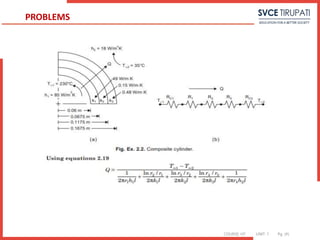
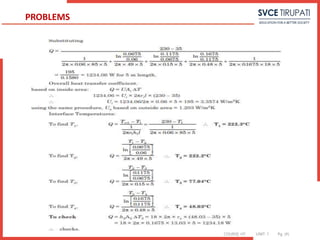
13.A pipe carrying steam at 230°C has an internal diameter of 12 cm and the pipe
thickness is 7.5 mm. The conductivity of the pipe material is 49 W/mK the convective
heat transfer coefficient on the inside is 85 W/m2K. The pipe is insulated by two layers
of insulation one of 5 cm thickness of conductivity 0.15 W/mK and over it another 5
cm thickness of conductivity 0.48 W/mK. The outside is exposed to air at 35°C with a
convection coefficient of 18 W/m2K. Determine the heat loss for 5 m length. Also
determine the interface temperatures and the overall heat transfer coefficient based
on inside and outside areas.
Solution:
Given data: Ti=230C ,hi=85 W/m2K,To=35C,ho=18 W/m2K,k1=49 W/mK,k2=0.15
W/mK,k3= 0.48 W/mK,r1=6 cm,t1=7.5mm,t2=5cm,t3=5cm.
PROBLEMS
COURSE: HT UNIT: 1 Pg. (#)
PROBLEMS
COURSE: HT UNIT: 1 Pg. (#)
PROBLEMS
COURSE: HT UNIT: 1 Pg. (#)
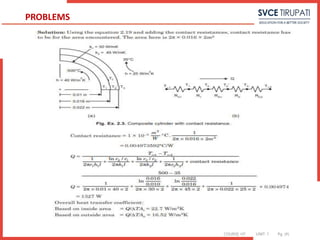
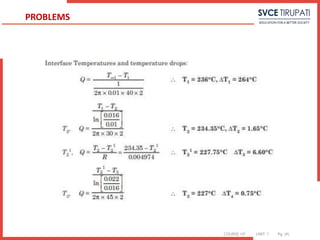
14.A composite cylinder is made of 6 mm thick layers each of two materials of thermal
conductivities of 30 W/m°C and 45 W/m°C. The inside is exposed to a fluid at 500°C
with a convection coefficient of 40 W/m2 °C and the outside is exposed to air at 35°C
with a convection coefficient of 25 W/m2K. There is a contact resistance of 1 × 10⁻³
m2 °C/W between the layers. Determine the heat loss for a length of 2 m and the
surface temperatures. Inside dia = 20 mm.
PROBLEMS
COURSE: HT UNIT: 1 Pg. (#)
PROBLEMS
COURSE: HT UNIT: 1 Pg. (#)
PROBLEMS
COURSE: HT UNIT: 1 Pg. (#)
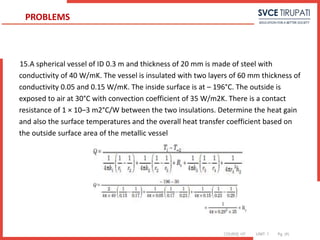
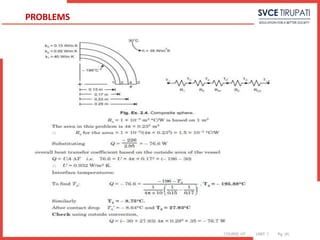
15.A spherical vessel of ID 0.3 m and thickness of 20 mm is made of steel with
conductivity of 40 W/mK. The vessel is insulated with two layers of 60 mm thickness of
conductivity 0.05 and 0.15 W/mK. The inside surface is at – 196°C. The outside is
exposed to air at 30°C with convection coefficient of 35 W/m2K. There is a contact
resistance of 1 × 10⁻³ m2°C/W between the two insulations. Determine the heat gain
and also the surface temperatures and the overall heat transfer coefficient based on
the outside surface area of the metallic vessel
PROBLEMS
COURSE: HT UNIT: 1 Pg. (#)
PROBLEMS
COURSE: HT UNIT: 1 Pg. (#)
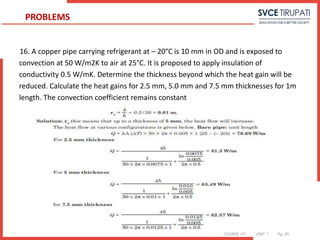
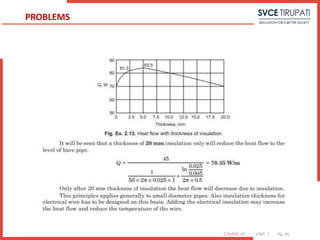
16. A copper pipe carrying refrigerant at – 20°C is 10 mm in OD and is exposed to
convection at 50 W/m2K to air at 25°C. It is proposed to apply insulation of
conductivity 0.5 W/mK. Determine the thickness beyond which the heat gain will be
reduced. Calculate the heat gains for 2.5 mm, 5.0 mm and 7.5 mm thicknesses for 1m
length. The convection coefficient remains constant
PROBLEMS
COURSE: HT UNIT: 1 Pg. (#)
PROBLEMS
COURSE: HT UNIT: 1 Pg. (#)
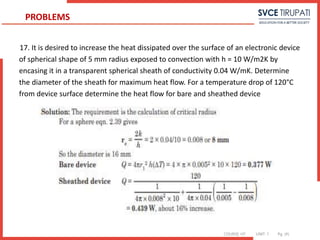
17. It is desired to increase the heat dissipated over the surface of an electronic device
of spherical shape of 5 mm radius exposed to convection with h = 10 W/m2K by
encasing it in a transparent spherical sheath of conductivity 0.04 W/mK. Determine
the diameter of the sheath for maximum heat flow. For a temperature drop of 120°C
from device surface determine the heat flow for bare and sheathed device
PROBLEMS
COURSE: HT UNIT: 1 Pg. (#)
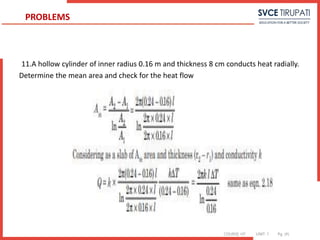
11.A hollow cylinder of inner radius 0.16 m and thickness 8 cm conducts heat radially.
Determine the mean area and check for the heat flow
PROBLEMS
COURSE: HT UNIT: 1 Pg. (#)
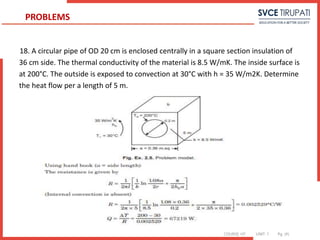
18. A circular pipe of OD 20 cm is enclosed centrally in a square section insulation of
36 cm side. The thermal conductivity of the material is 8.5 W/mK. The inside surface is
at 200°C. The outside is exposed to convection at 30°C with h = 35 W/m2K. Determine
the heat flow per a length of 5 m.
PROBLEMS
COURSE: HT UNIT: 1 Pg. (#)
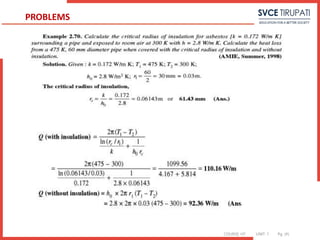
19. Calculate the critical radius of insulation for asbestos [k =0.17 W/m ◦C]
surrounding a pipe and exposed to room air at 20◦C with h=3.0 W/m2 ◦C. Calculate
the heat loss from a 200◦C,5.0-cm-diameter pipe when covered with the critical radius
of insulation and without insulation.
Solution:
ro = k /h =0.17 /3.0 =0.0567 m=5.67 cm
The inside radius of the insulation is 5.0/2=2.5 cm,
so the heat transfer is calculated from Equation as q/L= 2π (200−20) / ln
(5.67/2.5)0.17+ 1
(0.0567)(3.0) =105.7 W/m
Without insulation the convection from the outer surface of the pipe is
q/L=h(2πr)(Ti −To)=(3.0)(2π)(0.025)(200−20)=84.8 W/m
PROBLEMS
COURSE: HT UNIT: 1 Pg. (#)
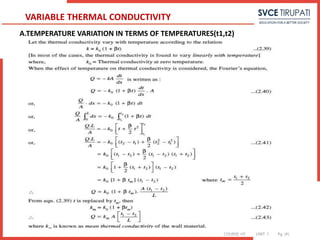
A.TEMPERATURE VARIATION IN TERMS OF TEMPERATURES(t1,t2)
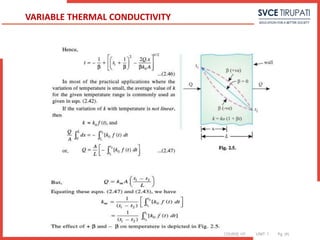
VARIABLE THERMAL CONDUCTIVITY
COURSE: HT UNIT: 1 Pg. (#)
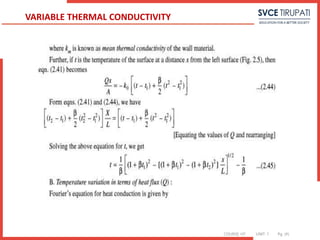
VARIABLE THERMAL CONDUCTIVITY
COURSE: HT UNIT: 1 Pg. (#)
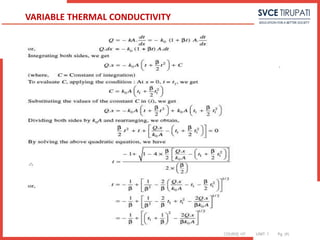
VARIABLE THERMAL CONDUCTIVITY
COURSE: HT UNIT: 1 Pg. (#)
VARIABLE THERMAL CONDUCTIVITY
COURSE: HT UNIT: 1 Pg. (#)
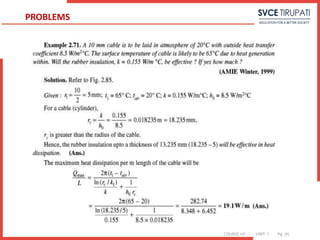
PROBLEMS
COURSE: HT UNIT: 1 Pg. (#)
PROBLEMS
COURSE: HT UNIT: 1 Pg. (#)
DIGITAL RESOURCES
 Lecture Notes - Lecture Notes
 Video Lectures -
 E-Book -
 Model Papers-

UNIT I Digital Content.pptx engineering shshhsghsjsjsggh

  • 1.
    DEPT & SEM: SUBJECT NAME : COURSE CODE : UNIT : PREPARED BY : COURSE: HT UNIT: 1 Pg. 1 MECH III & II SEM Heat and Mass Transfer ME20APC602 I Dr. VENKATA KONDAIAH & Mr. D.Anjan Kumar Reddy
  • 2.
    COURSE: HT UNIT:1 Pg. (#) OUTLINE  Introduction Modes and Mechanisms of Heat Transfer Basic Laws of Heat Transfer General Applications of Heat Transfer.  Conduction Heat Transfer: Fourier Rate Equation General Heat Conduction Equation In Cartesian, Cylindrical and Spherical Coordinates. Simplification and Forms of the Field Equation – Steady, Unsteady and Periodic Heat Transfer – Boundary and Initial Conditions.
  • 3.
    COURSE: HT UNIT:1 Pg. (#) One Dimensional Steady State Heat Conduction: In Homogeneous Slabs, Hollow Cylinders and Spheres Overall Heat Transfer Coefficient – Electrical Analogy Critical Radius/Thickness of Insulation – With Variable Thermal Conductivity – With Internal Heat Sources or Heat Generation Cont..
  • 4.
    COURSE: HT UNIT:1 Pg. (#) To grasp the concept of steady state conduction. Student can learn representing conduction equation in various forms. Student can imply concept successfully to problems encounter in day-to-day life UNIT I OUTCOMES
  • 5.
    COURSE: HT UNIT:1 Pg. (#) W h a t i s h e a t t r a n s f e r ? D e f i n i t i o n :  H e a t Tra n s fe r : is the form of energy that can be transferred from one system to another as a result of temperature difference.  It is the science that deals with the determination of the rates of energy transfer in the form heat.  It is thermal energy in transit due to a spacial temprature difference  The transfer of heat is always from the higher-temperature medium to the lower- temperature one, and heat transfer stops when the two mediums reach the same temperature. INTRODUCTION
  • 6.
    COURSE: HT UNIT:1 Pg. (#)  Heat can be transferred in three different modes/mechanisms: 1. Conduction, 2. Convection, and 3. Radiation.  All modes of heat transfer require the existence of a temperature difference, and  In all modes/mechanisms heat is transfer from the high-temperature medium to a lower-temperature one. INTRODUCTION
  • 7.
    COURSE: HT UNIT:1 Pg. (#) C o n d u c t i o n : is the transfer of energy/heat from the more energetic particles of a substance to the adjacent less energetic ones as a result of interactions between the particles.  Conduction can take place in s o l i d s , l i q u i d s , o r g a s e s .  In gases and liquids, conduction heat transfer is due to the collisions and diffusion of the molecules during their random motion.  In solids, it is due to the combination of vibrations of the molecules in a lattice and the energy transport by free electrons. CONDUCTION HEAT TRANSFER
  • 8.
    COURSE: HT UNIT:1 Pg. (#) Example: A cold canned drink in a warm room, eventually warms up to the room temperature as a result of heat transfer from the room to the drink through the aluminum can by conduction.  The rate of heat conduction through a medium depends on the: geometry of the medium, thickness of the medium, and the material type of the medium, temperature difference across the medium.  Consider steady heat conduction through a large plane wall of Thickness Δ x = L and area A, as shown in Fig. 1.1. Fig-1.1: Heat conduction through a large plane wall of thickness Δx and area A.  The temperature difference across the wall is ΔT = T2 - T1.
  • 9.
    COURSE: HT UNIT:1 Pg. (#)  The rate of heat conduction (Qcond): through a plane layer is proportional to the temperature difference across the layer and the heat transfer area, but is inversely proportional to the thickness of the layer. That is, Or/ Where: the constant of proportionality k is the thermal conductivity of the material, which is a measure of the ability of a material to conduct heat.  In the limiting case of Δx →0, the equation above reduces to the differential form: which is called Fourier’s law of heat conduction
  • 10.
    COURSE: HT UNIT:1 Pg. (#)  dT/dx = is the temperature gradient,  The negative sign indicates that heat is conducted in the direction of decreasing temperature.  Therefore temperature gradient (dT/dx) becomes negative when temperature decreases with increasing x. Figure: 1.2 The heat transfer area A is always normal to the direction of heat transfer MODERN MATERIAL'S NEEDS:
  • 11.
    COURSE: HT UNIT:1 Pg. (#)  The h e a t f l u x ( q ” ) : is the heat transfer rate(Q’) In the x direction per unite area perpendicular to the direction of transfer.  It can be expressed as: Figure: 1.3
  • 12.
    COURSE: HT UNIT:1 Pg. (#) EXAMPLE-1 1. The wall of an industrial furnace is constructed from 0.25m thick fireclay brick having a thermal conductivity of 1.7 w/m.K. measurements made during steady-state operation reveal tempratures of 1400 K and 1200 K at the inner and outer surfaces, respectively. What is the of heat loss and heat flux through a wall that is 1m by 1.5m on a side?
  • 13.
    COURSE: HT UNIT:1 Pg. (#)  C o n v e c t i o n : is the mode of energy transfer between a solid surface and the adjacent liquid or gas that is in motion.  It involves the combined effects of conduction and fluid motion.  The faster the fluid motion, the greater the convection heat transfer.  In the absence of any bulk fluid motion, heat transfer between a solid surface and the adjacent fluid is by pure conduction. FIGURE: 1.4  Heat transfer from a hot surface to air by convection. CONVECTION HEAT TRANSFER
  • 14.
    COURSE: HT UNIT:1 Pg. (#) Ty p e s o f C o n v e c t i o n : 1. Forced Convection: if the fluid is forced to flow over the surface by external means such as a fan, pump, or compressor. 2. Natural (or free) Convection: if the fluid motion is caused by buoyancy forces that are induced by density differences due to the variation of temperature in the fluid (Fig. below). FIG.1.5: The cooling of a boiled egg by forced and natural convection.
  • 15.
    COURSE: HT UNIT:1 Pg. (#)  Another example of free and forced convection heat transfer: hot components on a vertical array of circuit boards in air. a) Forced convection b) free/Natural convection Figure 1.6: The cooling of circuit boards by forced and free convections
  • 16.
    COURSE: HT UNIT:1 Pg. (#) 3. Mixed (Combined) : when both the free and forced heat convection exist, it is known as mixed/combined convection. Example: Figure 1.7: Boiling and condensation process of the fluid. c) Boiling d) Condensation
  • 17.
    COURSE: HT UNIT:1 Pg. (#)  The rate of convection heat transfer is observed to be proportional to the temperature difference, and is conveniently expressed by Newton’s law of cooling as: o Where: h = is the convection heat transfer coefficient in W/m2 · °C . As = is the surface area through which convection heat transfer takes place, Ts = is the surface temperature, and T∞ = is the temperature of the fluid sufficiently far from the surface.  Note: that at the surface, the fluid temperature equals the surface temperature of the solid.  The convection heat transfer coefficient (h) is not a property of the fluid. It is an experimentally determined parameter.
  • 18.
    COURSE: HT UNIT:1 Pg. (#)  The convective heat flux (q”) is convection heat transfer per unit surface area:  Where:  q” = the convective heat flux (w/m2)  Ts = the surface temperature  T∞ = fluid temperature  h = is the convection heat transfer coefficient in W/m2 · °C .
  • 19.
    COURSE: HT UNIT:1 Pg. (#) EXAMPLE 1–2: Measuring Convection Heat Transfer Coefficient A 2m-long, 0.3cm-diameter electrical wire extends across a room at 15°C, as shown in Fig. below. Heat is generated in the wire as a result of resistance heating, and the surface temperature of the wire is measured to be 152°C in steady operation. Also, the voltage drop and electric current through the wire are measured to be 60V and 1.5A, respectively. Disregarding any heat transfer by radiation, determine the convection heat transfer coefficient for heat transfer between the outer surface of the wire and the air in the room.
  • 20.
    COURSE: HT UNIT:1 Pg. (#) R a d i a t i o n : is the energy emitted by matter in the form of electromagnetic waves (or photons) as a result of the changes in the electronic configurations of the atoms or molecules.  Unlike conduction and convection, the transfer of energy by radiation does not require the presence of an intervening medium.  Energy transfer by radiation is fastest (at the speed of light) and it suffers no attenuation in a vacuum. o Example: Energy of the sun reaches the earth.  The maximum rate of radiation that can be emitted from a surface at an absolute temperature Ts is given by the Stefan–Boltzmann law as: RADIATION HEAT TRANSFER
  • 21.
    COURSE: HT UNIT:1 Pg. (#) o Where:  = is the Stefan–Boltzmann constant. The idealized surface that emits radiation at this maximum rate is called a b l a c k b o d y. The radiation emitted by a blackbody is called blackbody radiation The radiation emitted by all real surfaces is less than the radiation emitted by a blackbody at the same temperature, and is expressed as: o Where:  = is the emissivity of the surface. The property emissivity, whose value is in the range is measure of how closely a surface approximates a blackbody for which Ɛ = 1.
  • 22.
    COURSE: HT UNIT:1 Pg. (#)  Another important radiation property of a surface is its absorptivity, α.  It is the fraction of the radiation energy incident on a surface that is absorbed by the surface.  Like emissivity, its value is in the range:  A blackbody is a perfect absorber (α = 1) as it is a perfect emitter.  In general, both  and α of a surface depend on the temperature and the wavelength of the radiation.  Kirchhoff’s law: of radiation states that the emissivity and the absorptivity of a surface at a given temperature and wavelength are equal.
  • 23.
    COURSE: HT UNIT:1 Pg. (#)  The rate at which a opaque surface absorbs radiation is determined:  Where: Qincident = is the rate at which radiation is incident on the surface and α is the absorptivity of the surface.
  • 24.
    COURSE: HT UNIT:1 Pg. (#)  When a surface of emissivity () and surface area (As) at an absolute temperature (Ts) is completely enclosed by a much larger (or black) surface at absolute temperature (Tsurr) separated by a gas (such as air) that does not intervene with radiation, the net rate of radiation heat transfer between these two surfaces is: Fig 1.7: Radiation heat transfer between a surface and the surfaces surrounding it.
  • 25.
    COURSE: HT UNIT:1 Pg. (#) Radiation may also be incident on surface from its surroundings.  The radiation may originate from a special source, such as the sun, or from other surfaces to which the surface of interest is exposed.  The rate at which all such radiation is incident on a unit area of the surface is know as Irradiation (G). The rate at which radiant energy is absorbed per unit surface area may be evaluated as: Where: ------------ (W/m^2)
  • 26.
    COURSE: HT UNIT:1 Pg. (#) Unlike temperature, Heat transfer has direction as well as magnitude, thus it is a vector quantity. The rate of heat conduction in a specified direction is proportional to the temperature gradient, which is the change in temperature per unit length in that direction. Heat conduction in a medium is said to be steady when the temperature does not vary with time, and unsteady (transient) when it does. Conduction Figure 1.8 Figure 1.9 : Steady and transient heat conduction in a plane wall
  • 27.
    COURSE: HT UNIT:1 Pg. (#) Heat conduction in a medium, in general, is three-dimensional and time dependent. That is, T = T(x, y, z, t) and the temperature in a medium varies with position as well as time. a) Heat conduction in a medium is said to be one-dimensional when conduction is significant in one dimension only and negligible in the other two dimensions. b) Two - dimensional :- when conduction in the third dimension is negligible. C) Three – dimensional:- when conduction in all dimensions is significant.
  • 28.
    COURSE: HT UNIT:1 Pg. (#) A major objective in a conduction analysis is to determine the temperature field (temperature distribution) in a medium, which is varies with a position. Once this distribution is known, the conduction heat flux at any point in the medium or on its surface may be computed from Fourier’s law. For a solid, knowing temp. distribution could be used to ascertain structural integrity through determination of thermal stress, expansions, and deflections of the material. One of the manner in which the temperature distribution can be determined, is applying the energy conservation. In this case, we define a differential control volume , identify the relevant energy transfer process and introduce the appropriate rate eqn. THE HEAT DIFFUSION EQUATION
  • 29.
    COURSE: HT UNIT:1 Pg. (#) Consider a small rectangular element of length Δx, width Δy, and height Δz, as shown in Figure below, with multidimensional heat transfer through. Assume the density of the body is ρ and the specific heat is C. General heat conduction equation in Cartesian co-Ordinates Figure: 1.10 Three-dimensional heat conduction through a rectangular volume element.
  • 30.
    COURSE: HT UNIT:1 Pg. (#) An energy balance on this element during a small time interval Δt can be expressed as: Or Noting that the volume of the element is Velement = Δx Δy Δz, The change in the energy content of the element and the rate of heat generation within the element can be expressed as:
  • 31.
    COURSE: HT UNIT:1 Pg. (#) Substituting this equation into the energy balance, we get: Dividing by Δx Δy Δz gives: Noting that the heat transfer areas of the element for heat conduction in the x, y, and z directions are Ax = Δy*Δz, Ay = Δx*Δz, and Az = Δx*Δy, respectively, Taking the limit as Δx, Δy, Δz and Δt → 0 yields:
  • 32.
    COURSE: HT UNIT:1 Pg. (#) From the definition of the derivative and Fourier’s law of heat conduction , This is the general heat conduction equation in rectangular coordinates. In the case of constant thermal conductivity, it reduces to EQUILIBRIUM PHASE DIAGRAMS
  • 33.
    COURSE: HT UNIT:1 Pg. (#) Where the property α = k/ρC is again the thermal diffusivity of the material. The above Equation is known as the Fourier-Biot equation, and it reduces to these forms under specified conditions: 1. Steady-state:(called the Poisson equation) 2. Transient, no heat generation: (called the diffusion equation) 3. Steady-state, no heat generation: (called the Laplace equation)
  • 34.
    COURSE: HT UNIT:1 Pg. (#) Consider a plane wall of thickness L and average thermal conductivity k. The two surfaces of the wall are maintained at constant temperatures of T1 and T2. For one-dimensional steady heat conduction through the wall, we have T(x). Then Fourier’s law of heat conduction for the wall can be expressed as Where the rate of conduction heat transfer Q’cond wall and the wall area A are constant. Thus we have dT/dx constant, which means that the temperature through the wall varies linearly with x. STEADY HEAT CONDUCTION IN PLANE WALL
  • 35.
    COURSE: HT UNIT:1 Pg. (#) That is, the temperature distribution in the wall under steady conditions is a straight line see figure below. Figure 1.11: Under steady conditions, the temperature distribution in a plane wall is a straight line.
  • 36.
    COURSE: HT UNIT:1 Pg. (#) Separating the variables in the above equation and integrating from x = 0, where T(0) = T1, to x = L, where T(L) = T2, we get Performing the integrations and rearranging gives:
  • 37.
    COURSE: HT UNIT:1 Pg. (#) Equation of heat conduction through a plane wall can be rearranged as: Where: Rwall = is the thermal resistance of the wall against heat conduction or simply the conduction resistance of the wall. Note that the thermal resistance of a medium depends on the geometry and the thermal properties of the medium. The equation above for heat flow is analogous to the relation for electric current flow I, expressed as:
  • 38.
    COURSE: HT UNIT:1 Pg. (#) Where: Re = L/e A - is the electric resistance and V1 - V2 = is the voltage difference across the resistance (e = is the electrical conductivity). a) Electric current flow b) Heat flow Figure 2.13 Analogy between thermal and electrical resistance concepts. Thus, The rate of heat transfer through a layer corresponds to the electric current, The thermal resistance corresponds to electrical resistance, and The temperature difference corresponds to voltage difference across the layer .
  • 39.
    COURSE: HT UNIT:1 Pg. (#) Consider Convection heat transfer from a solid surface of area As and temperature Ts to a fluid whose temperature sufficiently far from the surface is T∞, with a convection heat transfer coefficient h. Newton’s law of cooling for convection heat transfer rate Qconv=hAs(Ts - T∞) can be rearranged as: Where: Rconv = is the thermal resistance of the surface against heat convection, or simply the convection resistance of the surface.
  • 40.
    COURSE: HT UNIT:1 Pg. (#) Now consider steady one-dimensional heat flow through a plane wall of thickness L, area A, and thermal conductivity k that is exposed to convection on both sides to fluids at temperatures T∞1 and T∞2 with heat transfer coefficients h1 and h2, respectively, as shown in below.
  • 41.
    COURSE: HT UNIT:1 Pg. (#) Assuming T∞1 < T∞2 , the variation of temperature is as shown in the figure. Note that the temperature varies linearly in the wall, and asymptotically approaches T∞1 and T∞2 in the fluids as we move away from the wall. Under steady conditions we have: or /
  • 42.
    COURSE: HT UNIT:1 Pg. (#) Which can be rearranged as: Adding the numerators and denominators yields: Where: Conclusion The rate of steady heat transfer between two surfaces is equal to the temperature difference divided by the total thermal resistance between those two surfaces.
  • 43.
    COURSE: HT UNIT:1 Pg. (#) The ratio of the temperature drop to the thermal resistance across any layer is constant, and Thus the temperature drop across any layer is proportional to the thermal resistance of the layer. The larger the resistance, the larger the temperature drop. In fact, the equation Q’ = ΔT/R can be rearranged as: Which indicates that the temperature drop across any layer is equal to the rate of heat transfer times the thermal resistance across that layer. It is sometimes convenient to express heat transfer through a medium in an analogous manner to Newton’s law of cooling as: Where: U = is the overall heat transfer coefficient and R = 1/UA
  • 44.
    COURSE: HT UNIT:1 Pg. (#) Consider a plane wall that consists of two layers. The rate of steady heat transfer through this two-layer composite wall can be expressed as: Study heat conduction in Multilayer Plane Walls
  • 45.
    COURSE: HT UNIT:1 Pg. (#) Where: Rtotal = is the total thermal resistance, expressed as: The subscripts 1 and 2 in the Rwall relations above indicate the first and the second layers, respectively. This result can be extended to plane walls that consist of three or more layers by adding an additional resistance for each additional layer. Once Q is known, an unknown surface temperature Tj at any surface or interface j can be determined from: Where: Ti = is a known temperature at location i and Rtotal, i - j = is the total thermal resistance between locations i and j.
  • 46.
    COURSE: HT UNIT:1 Pg. (#) Cylindrical and Spherical systems often experience temperature gradients in the radial direction only. Heat transfer can be treated as one dimensional and steady state condition. Example, consider steady heat conduction through a hot water pipe. Heat is lost from a hot water pipe to the air outside in the radial direction, and thus heat transfer from a long pipe is one-dimensional. HEAT CONDUCTION IN HOLLOW CYLINDER SYSTEM Figure 1.12: Heat transfer in cylindrical body
  • 47.
    COURSE: HT UNIT:1 Pg. (#) In steady operation, there is no change in the temperature of the pipe with time at any point. Therefore, the rate of heat transfer into the pipe must be equal to the rate of heat transfer out of it.  In other words, heat transfer through the pipe must be constant, Consider a long cylindrical layer (such as a circular pipe) of inner radius r1, outer radius r2, length L, and average thermal conductivity k. Figure 1.13: A long cylindrical pipe
  • 48.
    COURSE: HT UNIT:1 Pg. (#) The two surfaces of the cylindrical layer are maintained at constant temperatures T1 and T2. There is no heat generation in the layer and the thermal conductivity is constant. For one-dimensional heat conduction through the cylindrical layer, we have T(r). Then Fourier’s law of heat conduction for heat transfer through the cylindrical layer can be expressed as: Where: A = 2πrL is the heat transfer area at location r.
  • 49.
    COURSE: HT UNIT:1 Pg. (#) Note that A depends on r, and thus it varies in the direction of heat transfer. Separating the variables in the above equation and integrating from r = r1, where: T(r1) = T1, to r = r2, where T(r2) = T2, gives: Substituting A = 2πrL and performing the integrations give Since, This equation can be rearranged as:
  • 50.
    COURSE: HT UNIT:1 Pg. (#) Where: Rcyl = is the thermal resistance of the cylindrical layer against heat conduction, or simply the conduction resistance of the cylinder layer.
  • 51.
    COURSE: HT UNIT:1 Pg. (#) We can repeat the analysis above for a spherical layer by taking A = 4πr^2 Performing the integrations, the result can be expressed as: Where: Rsph = is the thermal resistance of the spherical layer against heat conduction, or simply the conduction resistance of the spherical layer. HEAT CONDUCTION IN HOLLOW SPHERICAL SYSTEM
  • 52.
    COURSE: HT UNIT:1 Pg. (#) When the radial system is exposed to convection heat transfer… Consider steady one-dimensional heat flow through a cylindrical or spherical layer that is exposed to convection on both sides to fluids at temperatures T1 and T2 with heat transfer coefficients h1 and h2, respectively, as shown in fig below. Figure 1.14 The thermal resistance network for a cylindrical (or spherical) shell subjected to convection from both the inner and the outer sides. The rate of heat transfer under steady conditions can be expressed as:
  • 53.
    COURSE: HT UNIT:1 Pg. (#) Where: For a cylindrical layer the total thermal resistance is: For a Spherical layer total thermal resistance
  • 54.
    COURSE: HT UNIT:1 Pg. (#) Steady heat transfer through multilayered cylindrical or spherical shells can be handled just like multilayered plane walls. For example, the steady heat transfer rate through the three-layered composite cylinder of length L shown in Fig. below. with convection on both sides can be expressed as: Figure 1.15: The thermal resistance network for three-layered composite cylinder. Multilayered Cylinders and Spheres
  • 55.
    COURSE: HT UNIT:1 Pg. (#) Where: Rtotal = is the total thermal resistance, expressed as: Where: A1 = 2r1L and A4 = 2r4L
  • 56.
    COURSE: HT UNIT:1 Pg. (#) There is some mis understanding about that addition of insulating material on a surface always brings about a decrease in the heat transfer rate. But addition of insulating material to the outside surfaces of cylindrical or spherical walls (geometries which have non-constant cross-sectional areas) may increase the heat transfer rate rather than decrease under the certain circumstances To establish this fact, consider a thin walled metallic cylinder of length l, radius and transporting a fluid at temperature which is higher than the ambient temperature. Insulation of thickness(r-ri) and conductivity k is provided on the surface of the cylinder Critical Thickness of Insulation
  • 57.
    COURSE: HT UNIT:1 Pg. (#) Critical Thickness of Insulation Fig. Critical thickness of pipe insulation
  • 58.
    COURSE: HT UNIT:1 Pg. (#) assumptions a. Steady state heat conduction b. One-dimensional heat flow only in radial direction c. Negligible thermal resistance due to cylinder wall d. Negligible radiation exchange between outer surface of insulation and surrounding Critical Thickness of Insulation
  • 59.
    COURSE: HT UNIT:1 Pg. (#) The heat transfer can be expressed as Critical Thickness of Insulation
  • 60.
    COURSE: HT UNIT:1 Pg. (#) Where hi and ho are the convection coefficients at inner and outer surface respectively. The denominator represents the sum of thermal resistance to heat flow. The value of k, ri, hi and ho are constant; therefore, the total thermal resistance will depend upon thickness of insulation which depends upon the outer radius of the arrangement. It is clear from the equation that with increase of radius r (i.e. thickness of insulation), the conduction resistance of insulation increases but the convection resistance of the outer surface decreases. Therefore, addition of insulation can either increase or decrease the rate of heat flow depending upon a change in total resistance with outer radius r. To determine the effect of insulation on total heat flow, differentiate the total resistance Rt with respect to r and equating to zero Critical Thickness of Insulation
  • 61.
    COURSE: HT UNIT:1 Pg. (#) Critical Thickness of Insulation
  • 62.
    COURSE: HT UNIT:1 Pg. (#) r=k/ho To determine whether the foregoing result maximizes or minimizes the total resistance, the second derivative need to be calculated Critical Thickness of Insulation
  • 63.
    COURSE: HT UNIT:1 Pg. (#) which is positive, so r= k/ho represent the condition for minimum resistance and consequently maximum heat flow rate. The insulation radius at which resistance to heat flow is minimum is called critical radius. The critical radius, designated by is dependent only on thermal quantities k and ho. r=rc=k/ho From the above equation it is clear that with increase of radius of insulation heat transfer rate increases and reaches the maximum at r=rc and then it will decrease. Two cases of practical interest are Critical Thickness of Insulation
  • 64.
    COURSE: HT UNIT:1 Pg. (#) When ri < rc It is clear from the equation 2.14a that with addition of insulation to bare pipe increases the heat transfer rate until the outer radius of insulation becomes equal to the critical radius. Because with addition of insulation decrease the convection resistance of surface of insulation which is greater than increase in conduction resistance of insulation Critical Thickness of Insulation
  • 65.
    COURSE: HT UNIT:1 Pg. (#) Fig. Dependence of heat loss on thickness of insulation Critical Thickness of Insulation
  • 66.
    COURSE: HT UNIT:1 Pg. (#) Any further increase in insulation thickness decreases the heat transfer from the peak value but it is still greater than that of for the bare pipe until a certain amount of insulation(r*). So, insulation greater than (r*-ri) must be added to reduce the heat loss below the bare pipe. This may happen when insulating material of poor quality is applied to pipes and wires of small radius. This condition is used for electric wire to increase the heat dissipation from the wire which helps to increase the current carrying capacity of the cable. Critical Thickness of Insulation
  • 67.
    COURSE: HT UNIT:1 Pg. (#) Critical Thickness of Insulation Fig. Critical radius of insulation for electric wire
  • 68.
    COURSE: HT UNIT:1 Pg. (#) When ri > rc It is clear from the figure 2.14b that increase in insulation thickness always decrease the heat loss from the pipe. This condition is used to decrease the heat loss from steam and refrigeration pipes. Critical radius of insulation for the sphere can be obtain in the similar way: r=rc=2k/h Critical Thickness of Insulation
  • 69.
    COURSE: HT UNIT:1 Pg. (#) Heat conduction through composite wall
  • 70.
    COURSE: HT UNIT:1 Pg. (#) Q=Aha(Ta-T1) =-k1A(T2-T1 / L1)= -k2A(T3-T2 / L2)=-k3A(T4-T3 / L3) =Ahb(T4-Tb) Q= (Ta-T1)/Ra = T1-T2 / R1 = T2-T3 / R2 = T3-T4 / R3 = T4-Tb / Rb Where Ra = 1/Aha, R1 = L1/Ak1, R2 = L2/Ak2, R3 = L3/Ak3, Rb = 1/Ahb ΔT = Ta-Tb = (Ta-T1 )+(T1-T2)+(T2-T3)+(T3-T4)+(T4-Tb) Q= ΔT/ΣR Q= Ta-Tb / [1/haA+L1/Ak1+L2/Ak2+L3/Ak3+1/hbA ] = Ta-Tb /ΣR Heat conduction through composite wall
  • 71.
    COURSE: HT UNIT:1 Pg. (#) ΣR = 1/haA+L1/Ak1+L2/Ak2+L3/Ak3+1/hbA ΣR =1/A[1/ha+L1/k1+L2/k2+L3/k3+1/hb] Ta=T1, Tb=T4 R=1/UA, Q= Ta-Tb / 1/UA = Q=UAC(Ta- Tb) U is the overall heat transfer coefficient Heat conduction through composite wall
  • 72.
    COURSE: HT UNIT:1 Pg. (#) 1.The door of a cold storage plant is made from two 6 mm thick glass sheets separated by a uniform air gap of 2 mm. The temperature of the air inside the room is -20°C and the ambient air temperature is 30°C. Assuming the heat transfer coefficient between glass and air to be 23.26 W/m2K. determine the rate of heat leaking into room per unit area of door. Neglect convection effects in air gap k2=0.023 w/m °C,k1=k3=0.75 w/m °C . PROBLEMS
  • 73.
    COURSE: HT UNIT:1 Pg. (#) Given data L1 = 6mm L2 = 2 mm L3 = 6 mm Ta = 30°C Tb = -20°C ha =hb = 23.36 W/m2 K Q/A = Ta-Tb/ [1/ha+L1/k1+L2/k2+L3/k3+1/hb ] Q/A = 30 – (- 20) / [1/23.26+ 0.006/0.75 + 0.002/0.02 + 0.006/0.75+1/23.26] Q/A = 247.5 W/m2 PROBLEMS
  • 74.
    COURSE: HT UNIT:1 Pg. (#) 2.A furnace wall made of three layer of thickness 25cm,10cm& 15cm with thermal conductivities of first and third layer of 1.65 & 9.2 W/mK. The inside is exposed to gases at 12500C with convection co-efficient of 25W/m2K & inside surface is at a temperature of 11000C. The outside surface is exposed to air at 250C with convection co-efficient of 12W/m2K. Determine the unknown thermal conductivity and the intermediate surface temperature. Also, find the overall heat transfer co-efficient PROBLEMS
  • 75.
    COURSE: HT UNIT:1 Pg. (#) Given Ta=1250°C=1250+273=1523 K Tb= 25°C=298 K ha=25W/m2K hb = 12W/m2K T1=1100°C=1373 K To Find 1) Unknown thermal conductivity ‘k2’ 2) U 3)T2,T3,T4 PROBLEMS
  • 76.
    COURSE: HT UNIT:1 Pg. (#) Heat Transfer Q=haA(Ta-T1) Q/A = 3750 W/m2 Q= ΔT/ΣR Q/A= Ta-Tb/ [1/ha+L1/k1+L2/k2+L3/k3+1/hb ] 3750 = 1523 – 298 / [1/25 + 0.25/1.65 + 0.10/k2+ 0.15/9.2+1/12] k2 = 2.816 W/mK PROBLEMS
  • 77.
    COURSE: HT UNIT:1 Pg. (#) U= 1/R R = [1/ha+L1/k1+L2/k2+L3/k3+1/hb ] =[1/25 + 0.25/1.65 + 0.10/ 2.816 + 0.15/9.2+1/12] = [0.04+1.9+2.916+0.016+0.08] = 0.3258 K/W U= 1/R = 3.069 W/K PROBLEMS
  • 78.
    COURSE: HT UNIT:1 Pg. (#) To find T2,T3,T4 = ? Q= Ta-Tb/R = Ta-T1/Ra = T1-T2/R1 = T2-T3/R2 =T3-T4/R3 = T4-Tb/Rb Q/A = 3750 W/m2 = T1-T2/L1/k1 = 1373 –T2/ 0.25/1.65 => T2= 804.87 K To find T3 =? Q/A = 3750 W/m2 = T2-T3/R2 3750 = 804.87 - T3 / 0.10/2.816 => T3 = 671.70 K PROBLEMS
  • 79.
    COURSE: HT UNIT:1 Pg. (#) To find T4 =? Q/A = 3750 W/m2 = T3-T4/R3 = T3-T4/L3 /k3 3750 = 671.70 - T4 / 0.15/9.2 => T4 = 610.55K PROBLEMS
  • 80.
    COURSE: HT UNIT:1 Pg. (#) Series and Parallel Composite wall
  • 81.
    COURSE: HT UNIT:1 Pg. (#) 3.Determine the heat transfer through the composite wall shown in figure take the conductives of A,B,C,D&E as 50,10,6.67,20 &30 W/mK respectively and assume one dimensional heat transfer. T1= 800°C and T2= 100°C SERIES AND PARALLEL COMPOSITE WALL
  • 82.
    COURSE: HT UNIT:1 Pg. (#) R1= L1/k1A1 = 0.05/50*1 = 1*10-3W/K => R2 = 1/[ 1/Rb+ 1/Rc ] Rb= Lb/kbAb = 0.1/10*0.5 = 2*10-2W/K Rc= Lc/kcAc = 0.1/6.67*0.5 = 3*10-2W/K => R2 = 1/[ 1/2*10-2 + 1/3*10-2] = 1.2*10-2W/K => R3 = L3/k3A3 = 0.05/20*1 = 2.5*10-3W/K => R4 = L4/k4A4 = 0.05/30*1 = 1.66*10-3W/K SERIES AND PARALLEL COMPOSITE WALL
  • 83.
    COURSE: HT UNIT:1 Pg. (#) ΣR = R1+ R2+ R3+R4 = 17.17*10-3W/K => Q= T1-T2/ΣR => 800-100/17.17*10-3 => 40.76kW 4.An exterior wall of a house is 0.1m layer of common brick k = 0.7 W/mK followed by a 0.04 m layer of wisdom flasker k =0.48 W/mK. What thickness of loosely pack Rockwell insulation k = 0.065 W/Mk should be added to reduce the heat loss through the wall by 80%. SERIES AND PARALLEL COMPOSITE WALL
  • 84.
    COURSE: HT UNIT:1 Pg. (#) COAXIAL CYLINDERS
  • 85.
    COURSE: HT UNIT:1 Pg. (#) Q = ha 2¶r1L (Ta-T1) R =1/ 2¶ L [1/ har1 +1/k1 ln(r2/r1)+ 1/k2 ln(r3/r2)+1/k3 ln(r4/r3) + 1/ har4 ] Q= ΔT/R ΔT = Ta-Tb /R Q = T1-T2 / 1/2 ¶ k1L1(lnr2/r1) = T2-T3 / 1/2 ¶ k2L2(lnr3/r2) = T3-T4 / 1/2 ¶ k3L3(lnr4/r3) = T4-T3 / 1/2 ¶ k3L3(lnr4/r3) = T4-Tb / 1/hb (2¶r3L) COAXIAL CYLINDERS
  • 86.
    COURSE: HT UNIT:1 Pg. (#) 5.A composite cylinder consists of 10cm radius steel pipe of 25mm thickness over which two layer of insulation having thickness of 30mm & 35mm are laid. The conductivities are 25,0.25,0.65 W/mK. The inside is exposed to convection at 3000C with convection heat transfer co-efficient of 65W/m2K. The outside is exposed to air at 300C & convective heat transfer co-efficient of 15W/m2K. Determine the heat loss per meter & also find intermediate temperature. COAXIAL CYLINDERS -PROBLEMS
  • 87.
    COURSE: HT UNIT:1 Pg. (#) Given ri = 10cm = 0.1m =r1 r2 = r1 + 0.025 = 0.125 m r3 = r2 + 0.03 = 0.155 m r4 = r3 + 0.035 = 0.19 m k1 = 25 W/mK , ha = 65 W/m2K K2 = 0.25 W/mK , hb = 15 W/m2K K 3= 0.65 W/mK, L= 1m (if not given) ΣR =1/ 2¶ L [1/ har1 +1/k1 ln(r2/r1)+ 1/k2 ln(r3/r2)+1/k3 ln(r4/r3) + 1/ har4 ] ΣR = 0.268 W Q= ΔT/ ΣR = 300-30/ 0.268 = 1007.46 W/m COAXIAL CYLINDERS -PROBLEMS
  • 88.
    COURSE: HT UNIT:1 Pg. (#) Interface Temperatures Q= Ta-T1 / 1/2 ¶ L har1 = T1-T2 / 1/2 ¶ k1L1ln(r2/r1) = T2-T3 / 1/2 ¶ k2L2ln(r3/r2) = T3-T4 / 1/2 ¶ k3L3ln(r4/r3) = T4-Tb / 1/2 ¶ L hbr4 1007.46 = 300 –T1 / 1/2 ¶ (65)(1) T1= 548K Q = T1-T2 / 1/2 ¶ k1L1ln(r2/r1) 1007.46 = 548 - T2 / 1/2 ¶ (25)(1) ln(0.125/0.1) => T2 = 546.9 K Similarly T3 = 408.9K T4 = 358.7K COAXIAL CYLINDERS -PROBLEMS
  • 89.
    COURSE: HT UNIT:1 Pg. (#) 6.A 240mm radius steam main 210m long is covered with 50mm of high temperature insulation(k=0.09W/m°C & 40mm of low temperature insulation(k=0.062W/m°C). The inner and outer surface temperature are 390°C & 40°C. Calculate Total heat loss per hour Total heat loss per m2 of pipe surface. Total heat loss per m2 of outer surface r1 = 240mm = 0.24m r2 = r1 + 0.05 = 0.29m r3 = r2 + 0.04 = 0.33m k1=0.09W/m°C k2=0.062W/m°C Ta = 390°C = 663K Tb = 40°C =313K L =210m COAXIAL CYLINDERS -PROBLEMS
  • 90.
    COURSE: HT UNIT:1 Pg. (#) Q= ΔT/ ΣR ΣR = 1/ 2¶ L [1/ har1 +1/k1 ln(r2/r1)+ 1/k2 ln(r3/r2)+1/k3 ln(r4/r3) + 1/ hbr4 ] ΣR = 1/ 2¶ 210 [0 +1/0.09 ln(0.29/0.24)+ 1/0.062 ln (0.33/0.29)+0+0] ΣR = 3.13*10-3°C/W Q= ΔT/ ΣR = (663- 313)/ 3.13*10-3 =111.5kW (i) Total heat loss per hour Q= 111.5*103 / 1/ 3600 = 401.4 MJ/hr (ii) Total heat loss per m2 of pipe surface Q= 111.5*103 / 1/2 ¶*0.24*210 = 35.29 MJ/hr (iii) Total heat loss per m2 of outer surface Q= 111.5*103 / 1/2 ¶*0.33*210 = 48.52 MJ/hr COAXIAL CYLINDERS -PROBLEMS
  • 91.
    COURSE: HT UNIT:1 Pg. (#) COMPOSITE SPHERES R= ¼ ¶{ 1/hiri 2 +1/k1[1/r1 - 1/r2] +1/k2[1/r2 - 1/r3] +1/hor3 2} Q= Ti-T0/4¶hiri 2 = T1-T2/ 1/4¶ [1/r1-1/r2] = T2-T3/ 1/4¶ [1/r2-1/r3] = T3-T4/ 1/4¶ [1/r4-1/r3] = T4-Tb /4¶hor3 2
  • 92.
    COURSE: HT UNIT:1 Pg. (#) 7.A spherical vessel of inside diameter 0.3m. The thickness is 20mm made of steel with conductivity 40W/mK. The vessel is insulated with two layers of 60mm thickness of conductivity 0.05 & 0.15W/mK. The inside surface is -1960C & outside is exposed to air at 300C with convection co-efficient of 35W/m2K. There is a contact resistance if 1x10⁻³ m2K/W between the two insulation. Find the heat gain & surface temperature & overall heat transfer co-efficient on the inner & outer surface of the wall. Given r1 = 0.15m r2 = 0.17m r3 = 0.23m r4 = 0.29m K1 = 40 W/Mk K2 = 0.05 W/mK K3 = 0.15 W/mK COMPOSITE SPHERES-PROBLEMS
  • 93.
    COURSE: HT UNIT:1 Pg. (#) Solution (i)Q=ΔT/R; ΣR =2.934K/W Since additional resistance given convert that unit equal to thermal resistance A= 4¶r2 3 = 0.6647m2 Additional resistance = 1*10-3/0.6647 =m2K/W/m2 = 1.5*10-3K/W R=2.934 + 1.5 10-3 = 2.9355 K/W Q=ΔT/R = -76.98 W COMPOSITE SPHERES
  • 94.
    COURSE: HT UNIT:1 Pg. (#) (ii)U based on outside surface area Q=UAΔT A = 4¶r2 2 = 0.363m2 U=0.9384W/m2K (iii) Intermediate Temperature T2 = -195°C T3 = -7.84°C T4 = 30°C COMPOSITE SPHERES
  • 95.
    COURSE: HT UNIT:1 Pg. (#) 8..A cold storage room has walls made of 200 mm of brick on the outside, 80 mm of plastic foam, and finally 20 mm of wood on the inside. The outside and inside air temperatures are 250C and -30C respectively. If the outside and inside convective heat transfer coefficients are respectively 10 and 30 W ⁄ m2 0C, and the thermal conductivities of brick, foam and wood are 1.0, 0.02 and 0.17 W⁄ m 0C respectively. Determine: (i) Overall heat transfer coefficient (ii) The rate of heat removed by refrigeration if the total wall area is 100 (iii) Outside and inside surface temperatures and mid-plane temperatures of composite wall. PROBLEMS
  • 96.
    COURSE: HT UNIT:1 Pg. (#) PROBLEMS
  • 97.
    COURSE: HT UNIT:1 Pg. (#) PROBLEMS
  • 98.
    COURSE: HT UNIT:1 Pg. (#) PROBLEMS
  • 99.
    COURSE: HT UNIT:1 Pg. (#) 9..A hot fluid is being conveyed through a long pipe of 4 cm outer dia. And covered with 2 cm thick insulation. It is proposed to reduce the conduction heat loss to the surroundings to one-third of the present rate by further covering with some insulation. Calculate the additional thickness of insulation PROBLEMS
  • 100.
    COURSE: HT UNIT:1 Pg. (#) Given data r1=4/2=2 cm = 0.02 m,r2=2+2= 4 cm =0.04 m r3=?
  • 101.
    COURSE: HT UNIT:1 Pg. (#) 10.Determine the heat flow across a plane wall of 10 cm thickness with a constant thermal conductivity of 8.5 W/mK when the surface temperatures are steady at 100°C and 30°C. The wall area is 3m2. Also find the temperature gradient in the flow direction? Solution: Given data :T1 = 100°C, T2 = 30°C, L = 10 cm = 0.1 m, k = 8.5 W/mK, A = 3 m2. heat flow, Q = (100 – 30) / (0.1/(8.5 × 3)) = 17850 W or 17.85 kW. Q = – kA dT/dx 17850 W = – 8.5 × 3 dT/dx. dT/dx = – 17850/(8.5 × 3) = – 700°C/m. PROBLEMS
  • 102.
    COURSE: HT UNIT:1 Pg. (#) 11. A surface is at 200°C and has an area of 2m2. It exchanges heat with another surface B at 30°C by radiation. The value of factor due to the geometric location and emissivity is 0.46. Determine the heat exchange. Also find the value of thermal resistance and equivalent convection coefficient. Solution: Given data T1 = 200°C = 200 + 273 = 473K, T2 = 30°C = 30 + 273 = 303K σ = 5.67 × 10⁻⁸, A = 2m2, F = 0.46. Q = 0.46 × 5.67 × 10–8 × 2[4734 – 3034] = 0.46 × 5.67 × 2 [(473/100)4 – (303/100)4] Q = 2171.4 W PROBLEMS
  • 103.
    COURSE: HT UNIT:1 Pg. (#) Q = ∆T/R, R = ∆T/Q = (200–30)/2171. Therefore, R = 0.07829°C/W or K/W Resistance is also given by 1/hr A. Therefore, hr = 6.3865 W/m2K Q = hr A∆T = 6.3865 × 2 × (200–30) = 2171.4 W PROBLEMS
  • 104.
    COURSE: HT UNIT:1 Pg. (#) 12. A electric room heater (radiator) element is 25 cm long and 4 cm in diameter. The element dissipates heat to the surroundings at 1500 W mainly by radiation, the surrounding temperature being 15°C. Determine the equilibrium temperature of the element surface. Solution Given data L=25 cm, D= 4 cm, Q=1500W, T2=15+273=288 k ,Q = σ A(T1 4 – T2 4) 1500 = 5.67 × π × 0.04 × 0.25 [(T1/100)4 – (288/100)4] T1 = 959.9 K or 686.9°C PROBLEMS
  • 105.
    COURSE: HT UNIT:1 Pg. (#) 13.A pipe carrying steam at 230°C has an internal diameter of 12 cm and the pipe thickness is 7.5 mm. The conductivity of the pipe material is 49 W/mK the convective heat transfer coefficient on the inside is 85 W/m2K. The pipe is insulated by two layers of insulation one of 5 cm thickness of conductivity 0.15 W/mK and over it another 5 cm thickness of conductivity 0.48 W/mK. The outside is exposed to air at 35°C with a convection coefficient of 18 W/m2K. Determine the heat loss for 5 m length. Also determine the interface temperatures and the overall heat transfer coefficient based on inside and outside areas. Solution: Given data: Ti=230C ,hi=85 W/m2K,To=35C,ho=18 W/m2K,k1=49 W/mK,k2=0.15 W/mK,k3= 0.48 W/mK,r1=6 cm,t1=7.5mm,t2=5cm,t3=5cm. PROBLEMS
  • 106.
    COURSE: HT UNIT:1 Pg. (#) PROBLEMS
  • 107.
    COURSE: HT UNIT:1 Pg. (#) PROBLEMS
  • 108.
    COURSE: HT UNIT:1 Pg. (#) 14.A composite cylinder is made of 6 mm thick layers each of two materials of thermal conductivities of 30 W/m°C and 45 W/m°C. The inside is exposed to a fluid at 500°C with a convection coefficient of 40 W/m2 °C and the outside is exposed to air at 35°C with a convection coefficient of 25 W/m2K. There is a contact resistance of 1 × 10⁻³ m2 °C/W between the layers. Determine the heat loss for a length of 2 m and the surface temperatures. Inside dia = 20 mm. PROBLEMS
  • 109.
    COURSE: HT UNIT:1 Pg. (#) PROBLEMS
  • 110.
    COURSE: HT UNIT:1 Pg. (#) PROBLEMS
  • 111.
    COURSE: HT UNIT:1 Pg. (#) 15.A spherical vessel of ID 0.3 m and thickness of 20 mm is made of steel with conductivity of 40 W/mK. The vessel is insulated with two layers of 60 mm thickness of conductivity 0.05 and 0.15 W/mK. The inside surface is at – 196°C. The outside is exposed to air at 30°C with convection coefficient of 35 W/m2K. There is a contact resistance of 1 × 10⁻³ m2°C/W between the two insulations. Determine the heat gain and also the surface temperatures and the overall heat transfer coefficient based on the outside surface area of the metallic vessel PROBLEMS
  • 112.
    COURSE: HT UNIT:1 Pg. (#) PROBLEMS
  • 113.
    COURSE: HT UNIT:1 Pg. (#) 16. A copper pipe carrying refrigerant at – 20°C is 10 mm in OD and is exposed to convection at 50 W/m2K to air at 25°C. It is proposed to apply insulation of conductivity 0.5 W/mK. Determine the thickness beyond which the heat gain will be reduced. Calculate the heat gains for 2.5 mm, 5.0 mm and 7.5 mm thicknesses for 1m length. The convection coefficient remains constant PROBLEMS
  • 114.
    COURSE: HT UNIT:1 Pg. (#) PROBLEMS
  • 115.
    COURSE: HT UNIT:1 Pg. (#) 17. It is desired to increase the heat dissipated over the surface of an electronic device of spherical shape of 5 mm radius exposed to convection with h = 10 W/m2K by encasing it in a transparent spherical sheath of conductivity 0.04 W/mK. Determine the diameter of the sheath for maximum heat flow. For a temperature drop of 120°C from device surface determine the heat flow for bare and sheathed device PROBLEMS
  • 116.
    COURSE: HT UNIT:1 Pg. (#) 11.A hollow cylinder of inner radius 0.16 m and thickness 8 cm conducts heat radially. Determine the mean area and check for the heat flow PROBLEMS
  • 117.
    COURSE: HT UNIT:1 Pg. (#) 18. A circular pipe of OD 20 cm is enclosed centrally in a square section insulation of 36 cm side. The thermal conductivity of the material is 8.5 W/mK. The inside surface is at 200°C. The outside is exposed to convection at 30°C with h = 35 W/m2K. Determine the heat flow per a length of 5 m. PROBLEMS
  • 118.
    COURSE: HT UNIT:1 Pg. (#) 19. Calculate the critical radius of insulation for asbestos [k =0.17 W/m ◦C] surrounding a pipe and exposed to room air at 20◦C with h=3.0 W/m2 ◦C. Calculate the heat loss from a 200◦C,5.0-cm-diameter pipe when covered with the critical radius of insulation and without insulation. Solution: ro = k /h =0.17 /3.0 =0.0567 m=5.67 cm The inside radius of the insulation is 5.0/2=2.5 cm, so the heat transfer is calculated from Equation as q/L= 2π (200−20) / ln (5.67/2.5)0.17+ 1 (0.0567)(3.0) =105.7 W/m Without insulation the convection from the outer surface of the pipe is q/L=h(2πr)(Ti −To)=(3.0)(2π)(0.025)(200−20)=84.8 W/m PROBLEMS
  • 119.
    COURSE: HT UNIT:1 Pg. (#) A.TEMPERATURE VARIATION IN TERMS OF TEMPERATURES(t1,t2) VARIABLE THERMAL CONDUCTIVITY
  • 120.
    COURSE: HT UNIT:1 Pg. (#) VARIABLE THERMAL CONDUCTIVITY
  • 121.
    COURSE: HT UNIT:1 Pg. (#) VARIABLE THERMAL CONDUCTIVITY
  • 122.
    COURSE: HT UNIT:1 Pg. (#) VARIABLE THERMAL CONDUCTIVITY
  • 123.
    COURSE: HT UNIT:1 Pg. (#) PROBLEMS
  • 124.
    COURSE: HT UNIT:1 Pg. (#) PROBLEMS
  • 125.
    COURSE: HT UNIT:1 Pg. (#) DIGITAL RESOURCES  Lecture Notes - Lecture Notes  Video Lectures -  E-Book -  Model Papers-