BASICS OF HEAT
TRANSFER
Mr. F. Adritowin,
Assistant Professor,
Department of Mechanical Engineering,
St. Xavier’s Catholic College of Engineering,
Chunkankadai, Nagercoil.
Introduction to Heat Transfer
• Heat transfer is the exchange of thermal energy between
physical systems due to a temperature gradient.
• This fundamental phenomenon is everywhere in nature
and engineering, playing a crucial role in maintaining
environmental balance, designing industrial systems, and
developing energy-efficient technologies.
Why Heat Transfer Matters
• Heat transfer is critical in applications like power
generation, heating and cooling systems, and electronic
devices.
• Understanding the mechanisms allows engineers to
design better thermal management solutions, impacting
energy consumption and operational efficiency.
Mechanisms of Heat Transfer
• Heat transfer occurs through three primary modes:
conduction, convection, and radiation.
• Each mechanism operates under distinct principles and is
governed by different physical laws.
Conduction
• Conduction is the transfer of heat through direct molecular
interaction within a material. Governed by Fourier's Law, it is
predominant in solids, where tightly packed molecules transfer
energy effectively.
• The rate of conduction depends on the material's thermal
conductivity, temperature gradient, and cross-sectional area.
• Example:
• Heat conduction in metal cookware.
Convection
• Convection involves the movement of heat through fluids
(liquids or gases) due to the motion of the fluid itself.
• This can be natural convection, driven by buoyancy
forces, or forced convection, induced by external means
like fans or pumps.
• Example:
• Heat transfer in a boiling pot of water.
Radiation
• Radiation is the transfer of heat through electromagnetic waves.
• Unlike conduction and convection, radiation does not require a
medium and can occur in a vacuum.
• Stefan-Boltzmann Law describes the radiant heat transfer rate
based on the temperature and emissivity of the surfaces.
• Example:
• Heat from the Sun reaching Earth.
Thermal Properties of Materials
• The effectiveness of heat transfer depends on the thermal
properties of materials. Key properties include:
• Thermal Conductivity: Measures a material's ability to
conduct heat.
• Specific Heat Capacity: Indicates the amount of heat
required to change a material's temperature.
• Thermal Diffusivity: Relates thermal conductivity to
density and specific heat.
• Emissivity: Describes a material's efficiency in emitting
thermal radiation.
• Materials with high thermal conductivity, like metals, are
used in heat sinks, while insulators like foam are used for
thermal barriers.
Mathematical Modeling of Heat Transfer
• Quantitative analysis of heat transfer is achieved through
mathematical models. Key equations include:
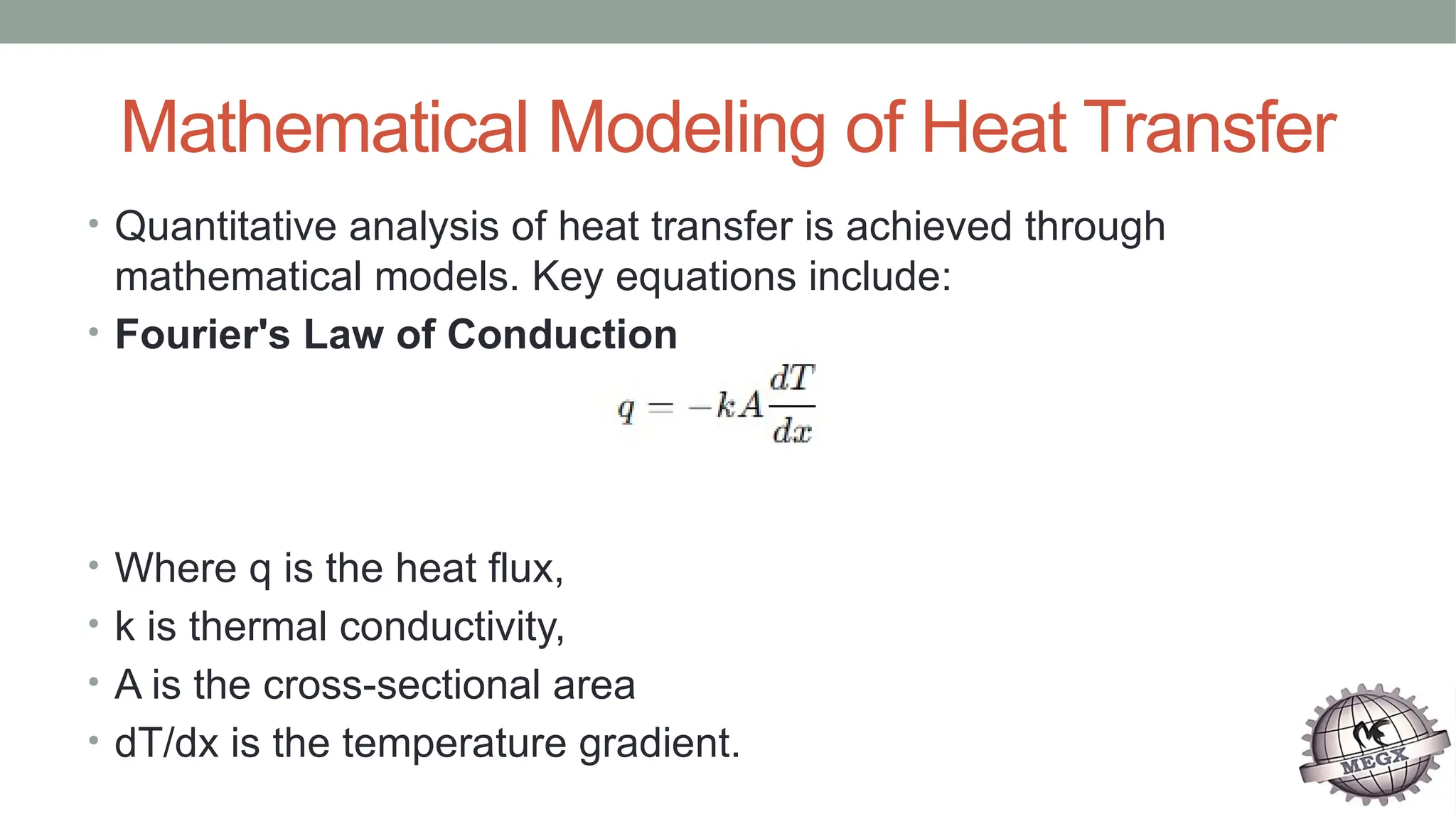
• Fourier's Law of Conduction
• Where q is the heat flux,
• k is thermal conductivity,
• A is the cross-sectional area
• dT/dx​is the temperature gradient.
Mechanisms of Conduction
• Conduction occurs at the microscopic level through:
• Lattice Vibrations: Dominant in non-metallic solids, where heat is
transferred by atomic vibrations.
• Electron Transport: In metals, free electrons facilitate heat
conduction.
• Phonons: Quantum mechanical vibrations play a key role in
crystalline solids.
Thermal Properties Affecting Conduction
• Material properties influencing conduction include:
• Density: Denser materials generally conduct heat better.
• Specific Heat Capacity: Determines the material’s ability to
store thermal energy.
• Thermal Diffusivity: Combines conductivity, density, and
specific heat for transient conduction scenarios.
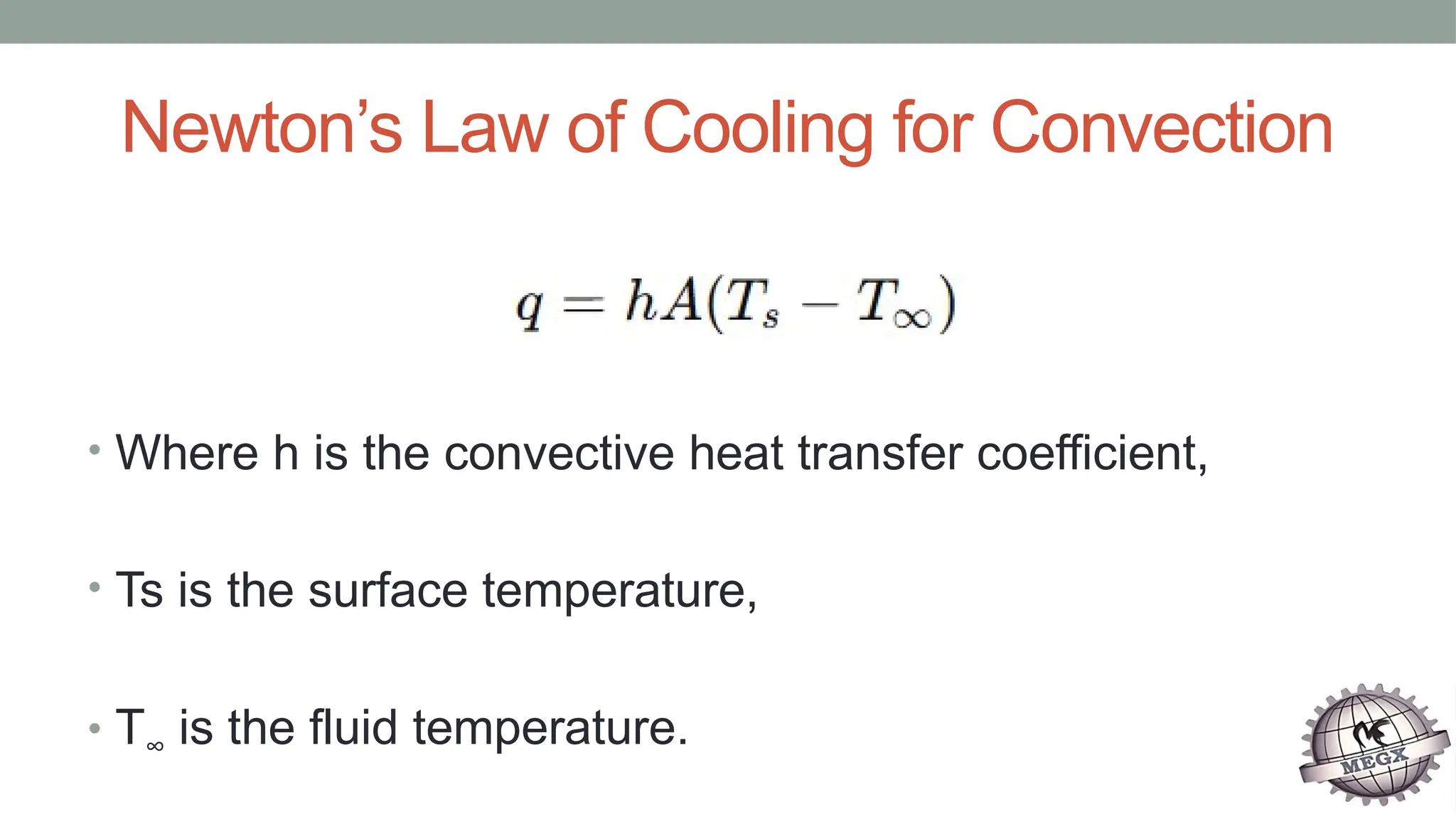
Newton’s Law of Cooling for Convection
• Where h is the convective heat transfer coefficient,
• Ts​is the surface temperature,
• T∞​ is the fluid temperature.
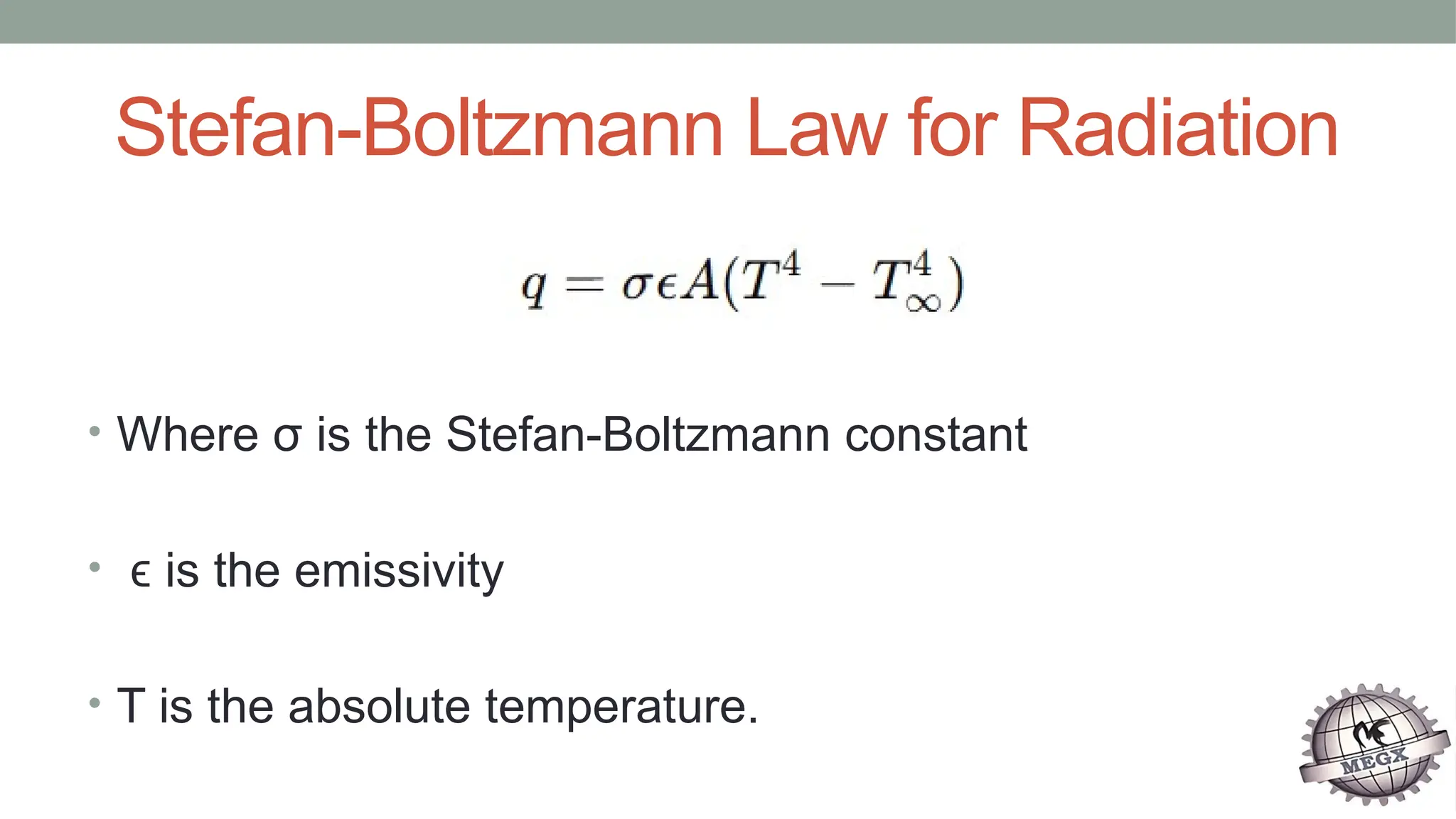
Stefan-Boltzmann Law for Radiation
• Where σ is the Stefan-Boltzmann constant
• is the emissivity
ϵ
• T is the absolute temperature.
Applications of Heat Transfer
• Heat transfer is integral to various fields, including:
• Industrial Processes
• Heat exchangers in chemical plants.
• Cryogenics for storage of liquefied gases.
• Renewable Energy
• Solar panels leveraging radiation.
• Geothermal systems using conduction.
• HVAC Systems
• Efficient heating and cooling technologies improve indoor comfort
and reduce energy consumption.
• Electronics
• Thermal management is essential for preventing overheating in
devices.
Heat Transfer in Engineering Design
• Engineers apply heat transfer principles to optimize
system performance. Design considerations include
material selection, thermal resistance, and geometric
configurations.
• Case Study: Heat Exchanger Design
• Heat exchangers are designed to maximize heat transfer
efficiency while minimizing size and cost. Plate heat
exchangers and shell-and-tube designs are common.
Advances in Heat Transfer Technology
• Emerging technologies are reshaping the field of heat transfer:
• Nanofluids: Enhance thermal conductivity in cooling systems.
• Phase Change Materials (PCMs): Store and release energy
efficiently.
• Microchannel Heat Sinks: Improve heat dissipation in compact
devices.
Challenges and Future Directions
• Despite advancements, challenges remain, such as
optimizing heat transfer in extreme environments or scaling
up renewable energy systems. Future research focuses on:
• Integration of artificial intelligence for predictive modeling.
• Development of eco-friendly cooling systems.
• Enhancing heat transfer efficiency in Nano scale systems.
Conclusion
• Heat transfer is a cornerstone of thermal sciences,
influencing a broad spectrum of industries and
technologies.
• By mastering its principles and applications, engineers
and scientists can innovate solutions for global
challenges, from energy sustainability to advanced
manufacturing.
Thank You

Introduction to Heat Transfer and Basics of HEAT TRANSFER

  • 1.
    BASICS OF HEAT TRANSFER Mr.F. Adritowin, Assistant Professor, Department of Mechanical Engineering, St. Xavier’s Catholic College of Engineering, Chunkankadai, Nagercoil.
  • 2.
    Introduction to HeatTransfer • Heat transfer is the exchange of thermal energy between physical systems due to a temperature gradient. • This fundamental phenomenon is everywhere in nature and engineering, playing a crucial role in maintaining environmental balance, designing industrial systems, and developing energy-efficient technologies.
  • 3.
    Why Heat TransferMatters • Heat transfer is critical in applications like power generation, heating and cooling systems, and electronic devices. • Understanding the mechanisms allows engineers to design better thermal management solutions, impacting energy consumption and operational efficiency.
  • 4.
    Mechanisms of HeatTransfer • Heat transfer occurs through three primary modes: conduction, convection, and radiation. • Each mechanism operates under distinct principles and is governed by different physical laws.
  • 5.
    Conduction • Conduction isthe transfer of heat through direct molecular interaction within a material. Governed by Fourier's Law, it is predominant in solids, where tightly packed molecules transfer energy effectively. • The rate of conduction depends on the material's thermal conductivity, temperature gradient, and cross-sectional area. • Example: • Heat conduction in metal cookware.
  • 6.
    Convection • Convection involvesthe movement of heat through fluids (liquids or gases) due to the motion of the fluid itself. • This can be natural convection, driven by buoyancy forces, or forced convection, induced by external means like fans or pumps. • Example: • Heat transfer in a boiling pot of water.
  • 7.
    Radiation • Radiation isthe transfer of heat through electromagnetic waves. • Unlike conduction and convection, radiation does not require a medium and can occur in a vacuum. • Stefan-Boltzmann Law describes the radiant heat transfer rate based on the temperature and emissivity of the surfaces. • Example: • Heat from the Sun reaching Earth.
  • 8.
    Thermal Properties ofMaterials • The effectiveness of heat transfer depends on the thermal properties of materials. Key properties include: • Thermal Conductivity: Measures a material's ability to conduct heat. • Specific Heat Capacity: Indicates the amount of heat required to change a material's temperature.
  • 9.
    • Thermal Diffusivity:Relates thermal conductivity to density and specific heat. • Emissivity: Describes a material's efficiency in emitting thermal radiation. • Materials with high thermal conductivity, like metals, are used in heat sinks, while insulators like foam are used for thermal barriers.
  • 10.
    Mathematical Modeling ofHeat Transfer • Quantitative analysis of heat transfer is achieved through mathematical models. Key equations include: • Fourier's Law of Conduction • Where q is the heat flux, • k is thermal conductivity, • A is the cross-sectional area • dT/dx​is the temperature gradient.
  • 11.
    Mechanisms of Conduction •Conduction occurs at the microscopic level through: • Lattice Vibrations: Dominant in non-metallic solids, where heat is transferred by atomic vibrations. • Electron Transport: In metals, free electrons facilitate heat conduction. • Phonons: Quantum mechanical vibrations play a key role in crystalline solids.
  • 12.
    Thermal Properties AffectingConduction • Material properties influencing conduction include: • Density: Denser materials generally conduct heat better. • Specific Heat Capacity: Determines the material’s ability to store thermal energy. • Thermal Diffusivity: Combines conductivity, density, and specific heat for transient conduction scenarios.
  • 13.
    Newton’s Law ofCooling for Convection • Where h is the convective heat transfer coefficient, • Ts​is the surface temperature, • T∞​ is the fluid temperature.
  • 14.
    Stefan-Boltzmann Law forRadiation • Where σ is the Stefan-Boltzmann constant • is the emissivity ϵ • T is the absolute temperature.
  • 15.
    Applications of HeatTransfer • Heat transfer is integral to various fields, including: • Industrial Processes • Heat exchangers in chemical plants. • Cryogenics for storage of liquefied gases.
  • 16.
    • Renewable Energy •Solar panels leveraging radiation. • Geothermal systems using conduction. • HVAC Systems • Efficient heating and cooling technologies improve indoor comfort and reduce energy consumption. • Electronics • Thermal management is essential for preventing overheating in devices.
  • 17.
    Heat Transfer inEngineering Design • Engineers apply heat transfer principles to optimize system performance. Design considerations include material selection, thermal resistance, and geometric configurations. • Case Study: Heat Exchanger Design • Heat exchangers are designed to maximize heat transfer efficiency while minimizing size and cost. Plate heat exchangers and shell-and-tube designs are common.
  • 18.
    Advances in HeatTransfer Technology • Emerging technologies are reshaping the field of heat transfer: • Nanofluids: Enhance thermal conductivity in cooling systems. • Phase Change Materials (PCMs): Store and release energy efficiently. • Microchannel Heat Sinks: Improve heat dissipation in compact devices.
  • 19.
    Challenges and FutureDirections • Despite advancements, challenges remain, such as optimizing heat transfer in extreme environments or scaling up renewable energy systems. Future research focuses on: • Integration of artificial intelligence for predictive modeling. • Development of eco-friendly cooling systems. • Enhancing heat transfer efficiency in Nano scale systems.
  • 20.
    Conclusion • Heat transferis a cornerstone of thermal sciences, influencing a broad spectrum of industries and technologies. • By mastering its principles and applications, engineers and scientists can innovate solutions for global challenges, from energy sustainability to advanced manufacturing.
  • 21.