ComplexCognitive ProcessesComplexCognitive Processes
Understanding Diversity in the Classroom
1
Renée Delgado
9.12.11
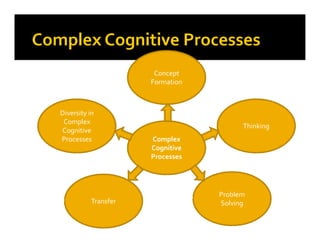
Diversity in
Complex
Thinking
Concept
Formation
Complex
Cognitive
Processes
Transfer
Complex
Cognitive
Processes
Thinking
Problem
Solving
Invalid concepts
Naïve theories
Undergeneralization
OvergeneralizationOvergeneralization
Incorrect analogies
Misconceptions are difficult to change
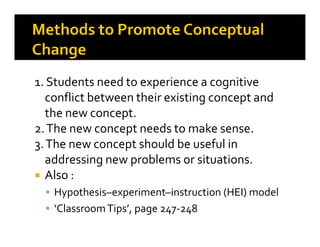
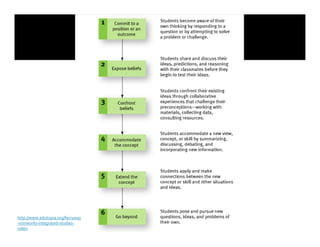
1. Students need to experience a cognitive
conflict between their existing concept and
the new concept.
2.The new concept needs to make sense.2.The new concept needs to make sense.
3.The new concept should be useful in
addressing new problems or situations.
Also :
Hypothesis–experiment–instruction (HEI) model
‘ClassroomTips’, page 247-248
http://www.edutopia.org/ferryway
-ironworks-integrated-studies-
video
▪ Are these feasible?
▪ How would you implement these in your own
classroom?
▪ How could you as a student use these tips in a class that▪ How could you as a student use these tips in a class that
you may be struggling with?
Manipulating and transforming information in
our working memory
Multiple cognitive processes:
RehearsalRehearsal
Elaboration
Organization
Visualization
Storing
Encoding
Retrieval
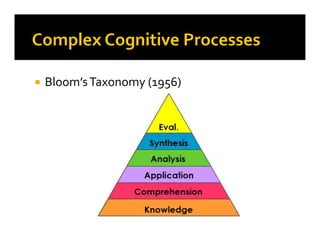
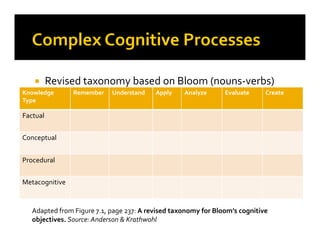
Bloom’sTaxonomy (1956)
Revised taxonomy based on Bloom (nouns-verbs)
Knowledge
Type
Remember Understand Apply Analyze Evaluate Create
Factual
Adapted from Figure 7.1, page 237: A revised taxonomy for Bloom’s cognitive
objectives. Source: Anderson & Krathwohl
Conceptual
Procedural
Metacognitive
Deductive
Inductive
Evaluating alternative options and making choices
Thinking flaws:
Confirmation bias: the tendency to look for information that
confirms rather than refutes our thoughts
Hindsight bias:The tendency to falsely report that weHindsight bias:The tendency to falsely report that we
accurately predicted an event once the event occurs
Overconfidence bias, the tendency to be more optimistic
about alternatives that we would be if we had considered
probabilities or past experience
Belief perseverance: the tendency to hold on to a belief
despite the presence of contradictory evidence
SeeTable 7.2, page 252.
Novel, unique ideas and thinking
Highly creative people often have high IQ
High IQ people are not necessarily creative
Divergent thinkingDivergent thinking
Create a sense of mastery in a domain
Create a safe learning environment
Create an autonomy supporting learning
environmentenvironment
Encourage brainstorming
Model creativity
Demonstrate the value of creativity
Allow time for creativity
Systematically examining available information
and coming up with conclusions that are based
on evidence
Students are not likely to engage in critical
thinking spontaneously.thinking spontaneously.
Four elements:
Motivation
Some knowledge about the issue being considered
Metacognition
A set of component skills.
SeeTable 7.3, page 259 andTable 7.4, page 260.
Note taking
Summarizing
SQ4R
Strategies need to be explicitly taughtStrategies need to be explicitly taught
Pg. 268-272
▪ Cognitive rigidity
▪ Functional fixednessFunctional fixedness
▪ Response set
▪ Positive transfer
▪ Negative transfer
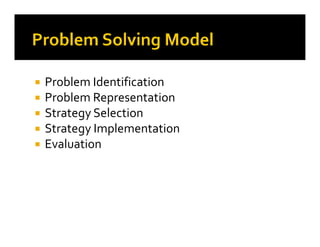
Problem Identification
Problem Representation
Strategy Selection
Strategy ImplementationStrategy Implementation
Evaluation
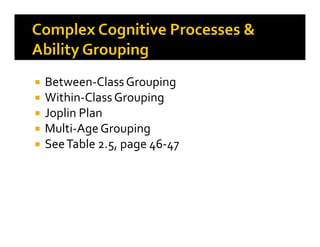
Between-ClassGrouping
Within-ClassGrouping
Joplin Plan
Multi-AgeGroupingMulti-AgeGrouping
SeeTable 2.5, page 46-47
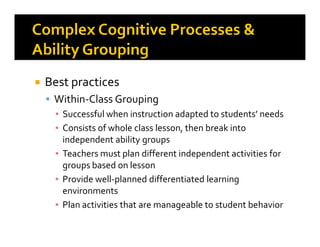
Best practices
Within-Class Grouping
▪ Successful when instruction adapted to students’ needs
▪ Consists of whole class lesson, then break into▪ Consists of whole class lesson, then break into
independent ability groups
▪ Teachers must plan different independent activities for
groups based on lesson
▪ Provide well-planned differentiated learning
environments
▪ Plan activities that are manageable to student behavior
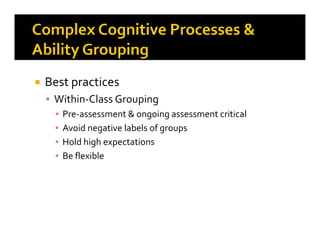
Best practices
Within-Class Grouping
▪ Pre-assessment & ongoing assessment critical
▪ Avoid negative labels of groups▪ Avoid negative labels of groups
▪ Hold high expectations
▪ Be flexible
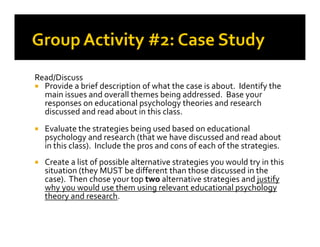
Read/Discuss
Provide a brief description of what the case is about. Identify the
main issues and overall themes being addressed. Base your
responses on educational psychology theories and research
discussed and read about in this class.
Evaluate the strategies being used based on educationalEvaluate the strategies being used based on educational
psychology and research (that we have discussed and read about
in this class). Include the pros and cons of each of the strategies.
Create a list of possible alternative strategies you would try in this
situation (they MUST be different than those discussed in the
case). Then chose your top two alternative strategies and justify
why you would use them using relevant educational psychology
theory and research.
What to know?

lecture_notes.9.12

  • 1.
    ComplexCognitive ProcessesComplexCognitive Processes UnderstandingDiversity in the Classroom 1 Renée Delgado 9.12.11
  • 2.
  • 3.
  • 4.
    1. Students needto experience a cognitive conflict between their existing concept and the new concept. 2.The new concept needs to make sense.2.The new concept needs to make sense. 3.The new concept should be useful in addressing new problems or situations. Also : Hypothesis–experiment–instruction (HEI) model ‘ClassroomTips’, page 247-248
  • 5.
  • 6.
    ▪ Are thesefeasible? ▪ How would you implement these in your own classroom? ▪ How could you as a student use these tips in a class that▪ How could you as a student use these tips in a class that you may be struggling with?
  • 7.
    Manipulating and transforminginformation in our working memory Multiple cognitive processes: RehearsalRehearsal Elaboration Organization Visualization Storing Encoding Retrieval
  • 8.
  • 9.
    Revised taxonomy basedon Bloom (nouns-verbs) Knowledge Type Remember Understand Apply Analyze Evaluate Create Factual Adapted from Figure 7.1, page 237: A revised taxonomy for Bloom’s cognitive objectives. Source: Anderson & Krathwohl Conceptual Procedural Metacognitive
  • 10.
  • 11.
    Evaluating alternative optionsand making choices Thinking flaws: Confirmation bias: the tendency to look for information that confirms rather than refutes our thoughts Hindsight bias:The tendency to falsely report that weHindsight bias:The tendency to falsely report that we accurately predicted an event once the event occurs Overconfidence bias, the tendency to be more optimistic about alternatives that we would be if we had considered probabilities or past experience Belief perseverance: the tendency to hold on to a belief despite the presence of contradictory evidence SeeTable 7.2, page 252.
  • 12.
    Novel, unique ideasand thinking Highly creative people often have high IQ High IQ people are not necessarily creative Divergent thinkingDivergent thinking
  • 13.
    Create a senseof mastery in a domain Create a safe learning environment Create an autonomy supporting learning environmentenvironment Encourage brainstorming Model creativity Demonstrate the value of creativity Allow time for creativity
  • 14.
    Systematically examining availableinformation and coming up with conclusions that are based on evidence Students are not likely to engage in critical thinking spontaneously.thinking spontaneously. Four elements: Motivation Some knowledge about the issue being considered Metacognition A set of component skills. SeeTable 7.3, page 259 andTable 7.4, page 260.
  • 15.
    Note taking Summarizing SQ4R Strategies needto be explicitly taughtStrategies need to be explicitly taught
  • 16.
    Pg. 268-272 ▪ Cognitiverigidity ▪ Functional fixednessFunctional fixedness ▪ Response set ▪ Positive transfer ▪ Negative transfer
  • 17.
    Problem Identification Problem Representation StrategySelection Strategy ImplementationStrategy Implementation Evaluation
  • 18.
  • 19.
    Best practices Within-Class Grouping ▪Successful when instruction adapted to students’ needs ▪ Consists of whole class lesson, then break into▪ Consists of whole class lesson, then break into independent ability groups ▪ Teachers must plan different independent activities for groups based on lesson ▪ Provide well-planned differentiated learning environments ▪ Plan activities that are manageable to student behavior
  • 20.
    Best practices Within-Class Grouping ▪Pre-assessment & ongoing assessment critical ▪ Avoid negative labels of groups▪ Avoid negative labels of groups ▪ Hold high expectations ▪ Be flexible
  • 21.
    Read/Discuss Provide a briefdescription of what the case is about. Identify the main issues and overall themes being addressed. Base your responses on educational psychology theories and research discussed and read about in this class. Evaluate the strategies being used based on educationalEvaluate the strategies being used based on educational psychology and research (that we have discussed and read about in this class). Include the pros and cons of each of the strategies. Create a list of possible alternative strategies you would try in this situation (they MUST be different than those discussed in the case). Then chose your top two alternative strategies and justify why you would use them using relevant educational psychology theory and research.
  • 22.