Designing for learning
& Learning theories
in practice
“I have to say attendance has been quite
poor recently, but the level of the students
is quite good.”

Chrissi Nerantzi @chrissinerantzi & Haleh Moravej @halehmoravej

PGCAP > DAPP
http://www.celt.mmu.ac.uk/

@mmu_celt
Intended learning outcomes
By the end of this week, you will have had the
opportunity to:
• discuss and evaluate your own design process
for learning including constructive alignment
• explore active learning approaches and a
selection of learning theories to maximise
learning in your own practice
2
3

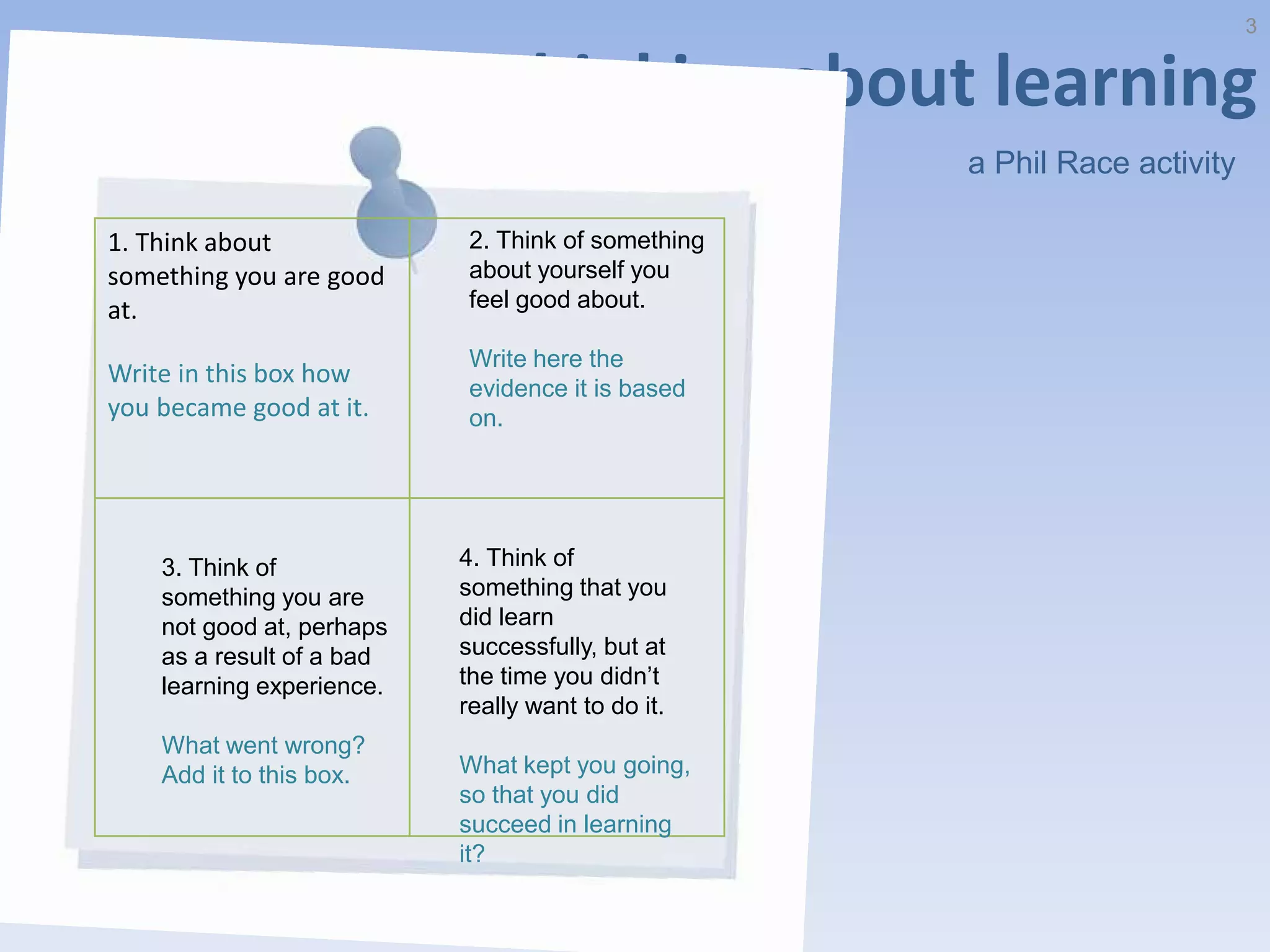
Thinking about learning
a Phil Race activity
1. Think about
something you are good
at.

2. Think of something
about yourself you
feel good about.

Write in this box how
you became good at it.

Write here the
evidence it is based
on.

3. Think of
something you are
not good at, perhaps
as a result of a bad
learning experience.
What went wrong?
Add it to this box.

4. Think of
something that you
did learn
successfully, but at
the time you didn’t
really want to do it.
What kept you going,
so that you did
succeed in learning
it?
Session planning
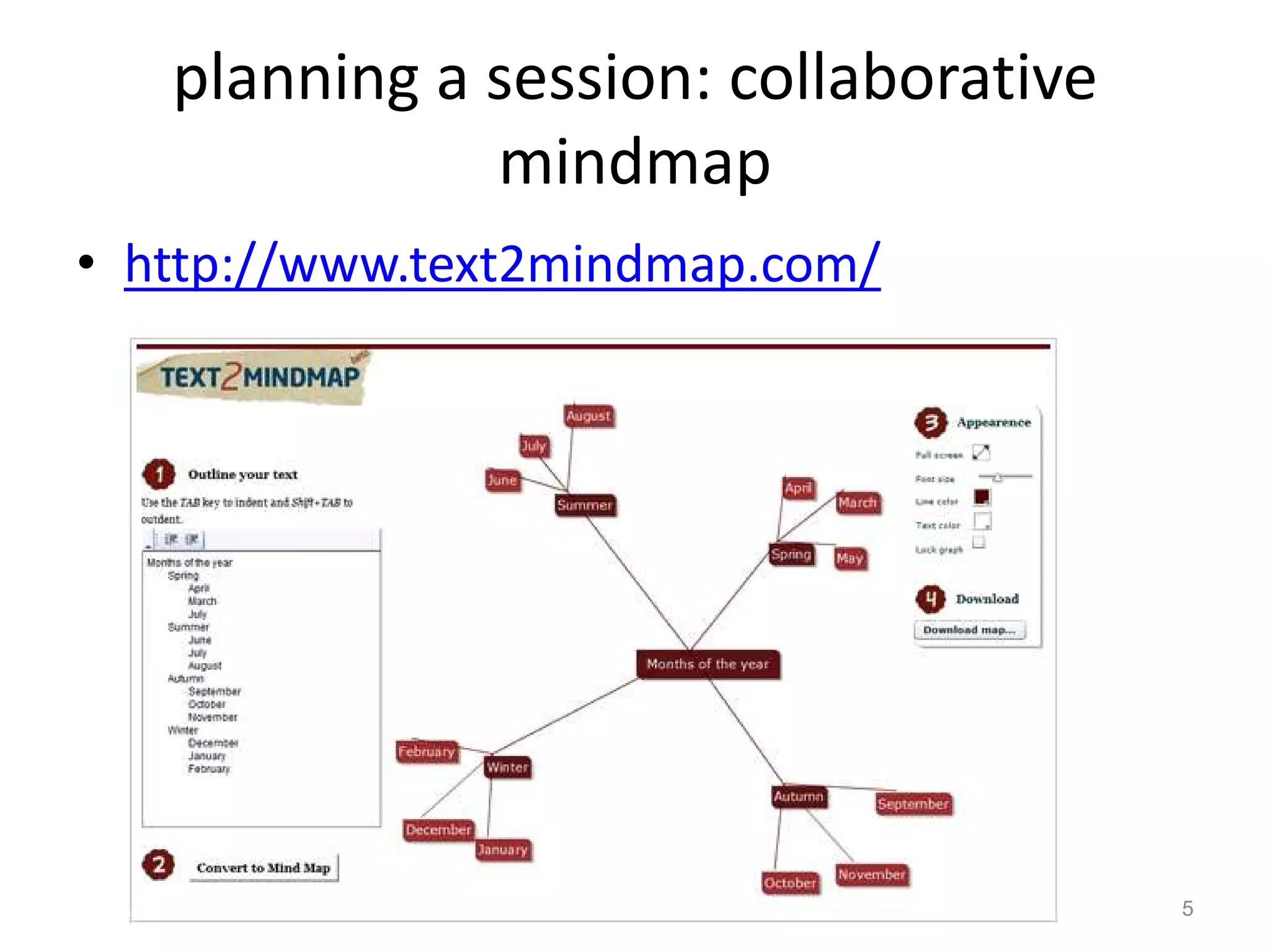
planning a session: collaborative
mindmap
• http://www.text2mindmap.com/

5
Planning a session
•
•

Your learners
Group size

•
•
•
•
•
•
•
•
•
•

Title
Time/duration
Day/date, location
Aims and Learning Outcomes
Structure and Content
Methods/Activities
Aids and Resources
Assessment
Differentiation
Reflection/Evaluation

•

“If you fail to plan, you plan to fail!”

6
Intended Learning Outcomes
• “Descriptors of the ways that students will be
expected to demonstrate the results of their
learning.” Race (2000:10)

7
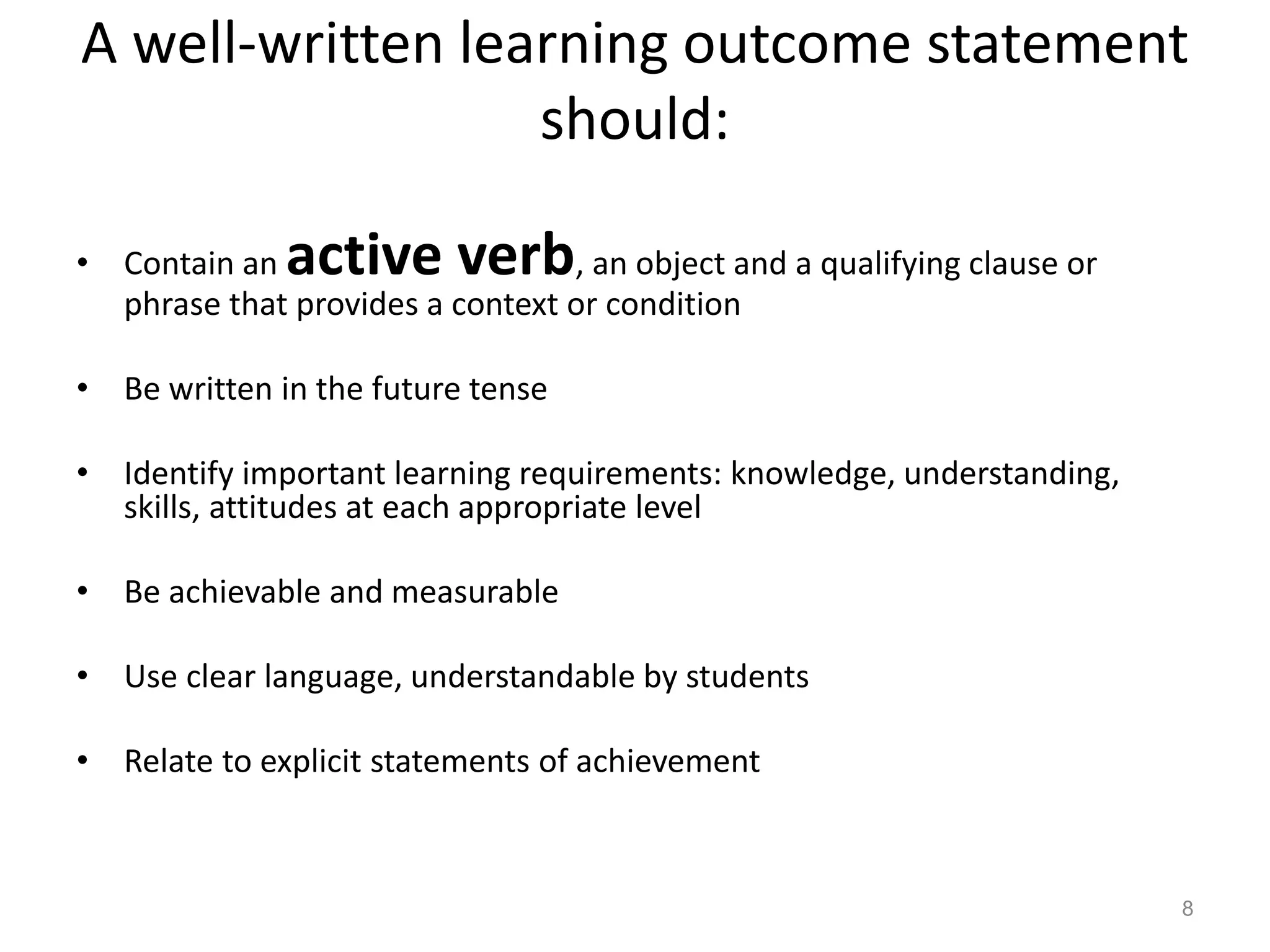
A well-written learning outcome statement
should:
active verb

• Contain an
, an object and a qualifying clause or
phrase that provides a context or condition
• Be written in the future tense
• Identify important learning requirements: knowledge, understanding,
skills, attitudes at each appropriate level
• Be achievable and measurable
• Use clear language, understandable by students
• Relate to explicit statements of achievement

8
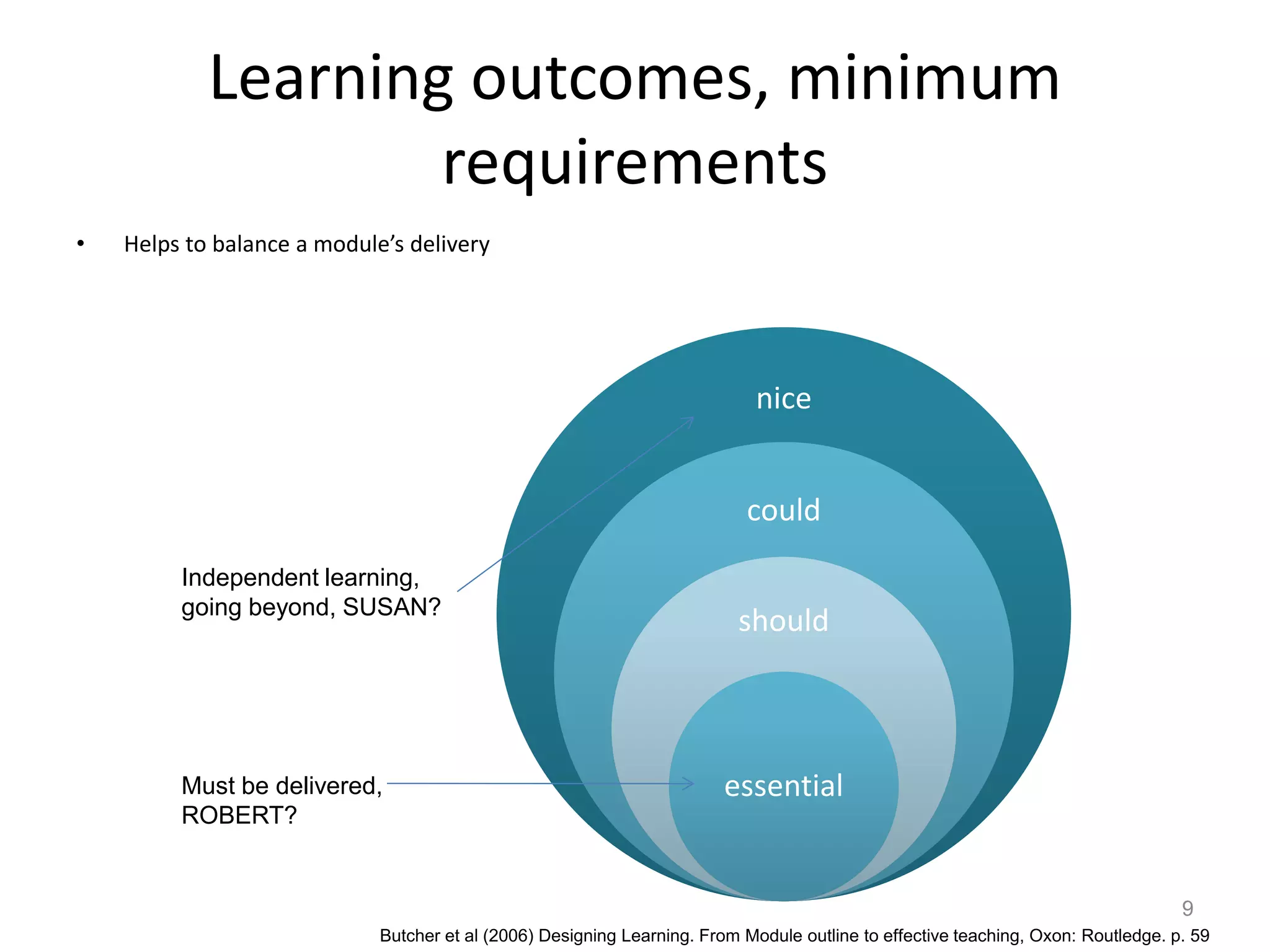
Learning outcomes, minimum
requirements
•

Helps to balance a module’s delivery

nice
could
Independent learning,
going beyond, SUSAN?

Must be delivered,
ROBERT?

should

essential

9
Butcher et al (2006) Designing Learning. From Module outline to effective teaching, Oxon: Routledge. p. 59
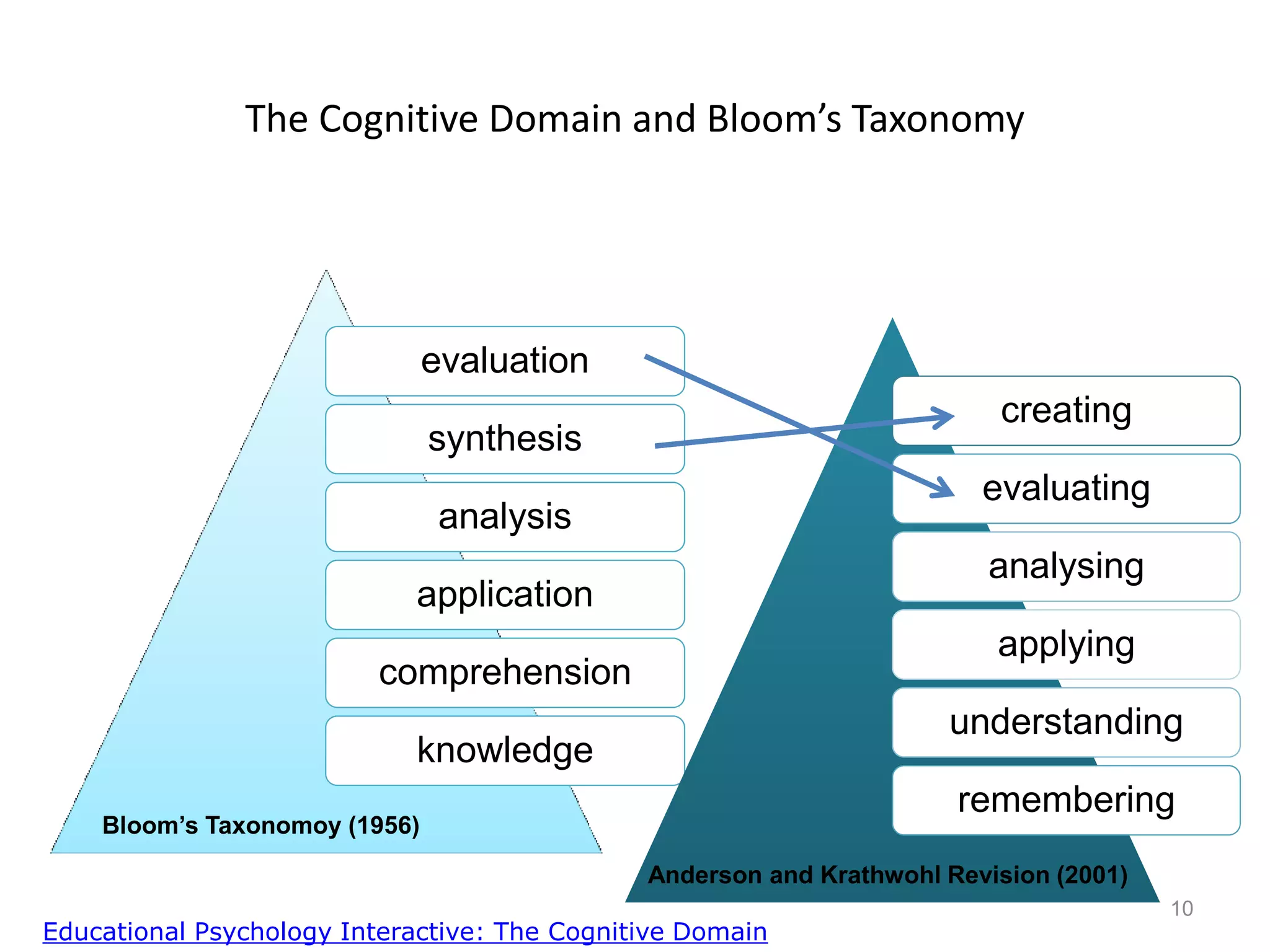
The Cognitive Domain and Bloom’s Taxonomy

evaluation
creating

synthesis

evaluating

analysis

analysing

application

applying

comprehension

understanding

knowledge

remembering

Bloom’s Taxonomoy (1956)

Anderson and Krathwohl Revision (2001)
Educational Psychology Interactive: The Cognitive Domain

10
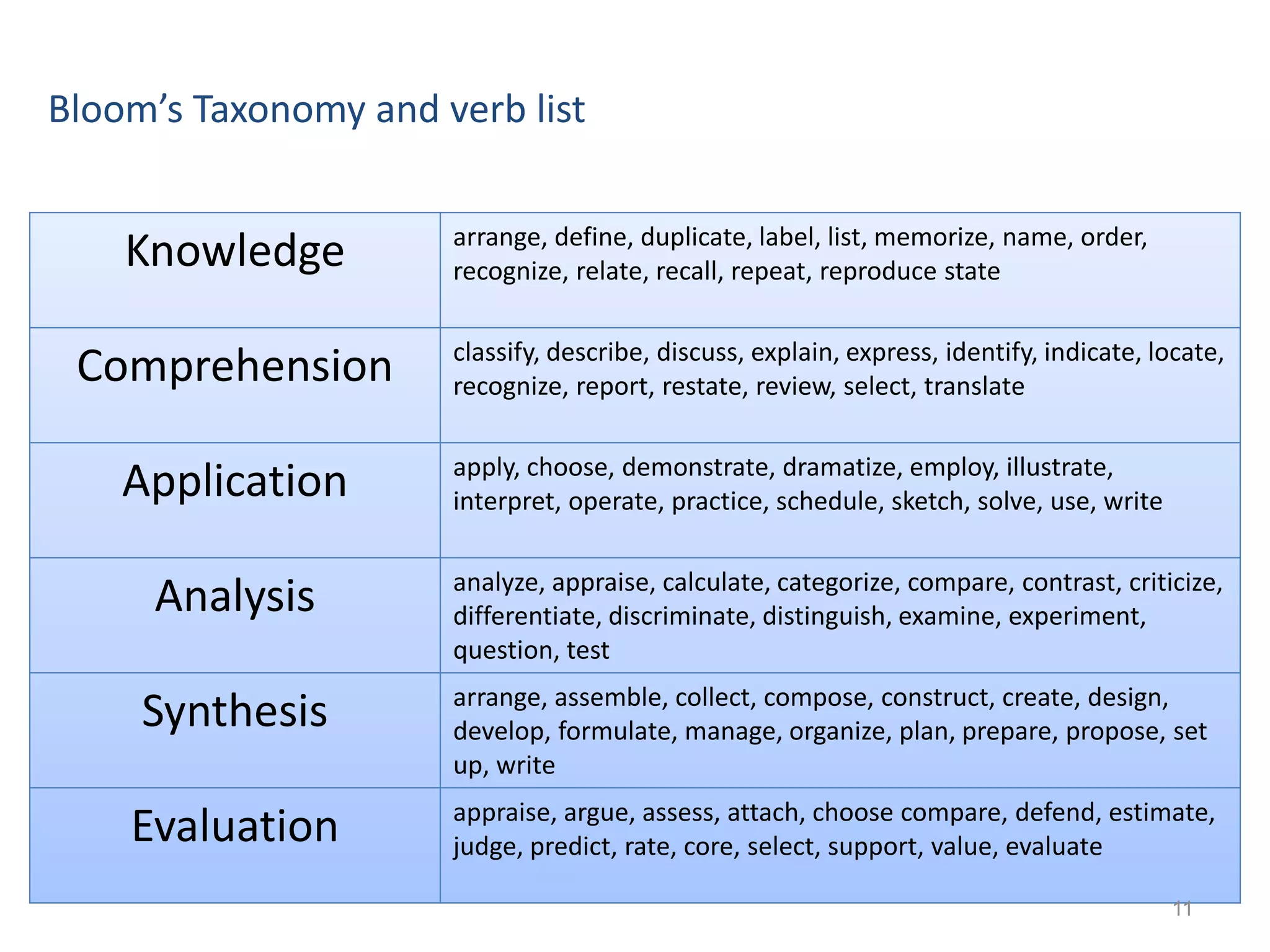
Bloom’s Taxonomy and verb list

Knowledge

Comprehension
Application

arrange, define, duplicate, label, list, memorize, name, order,
recognize, relate, recall, repeat, reproduce state

classify, describe, discuss, explain, express, identify, indicate, locate,
recognize, report, restate, review, select, translate
apply, choose, demonstrate, dramatize, employ, illustrate,
interpret, operate, practice, schedule, sketch, solve, use, write

Analysis

analyze, appraise, calculate, categorize, compare, contrast, criticize,
differentiate, discriminate, distinguish, examine, experiment,
question, test

Synthesis

arrange, assemble, collect, compose, construct, create, design,
develop, formulate, manage, organize, plan, prepare, propose, set
up, write

Evaluation

appraise, argue, assess, attach, choose compare, defend, estimate,
judge, predict, rate, core, select, support, value, evaluate
11
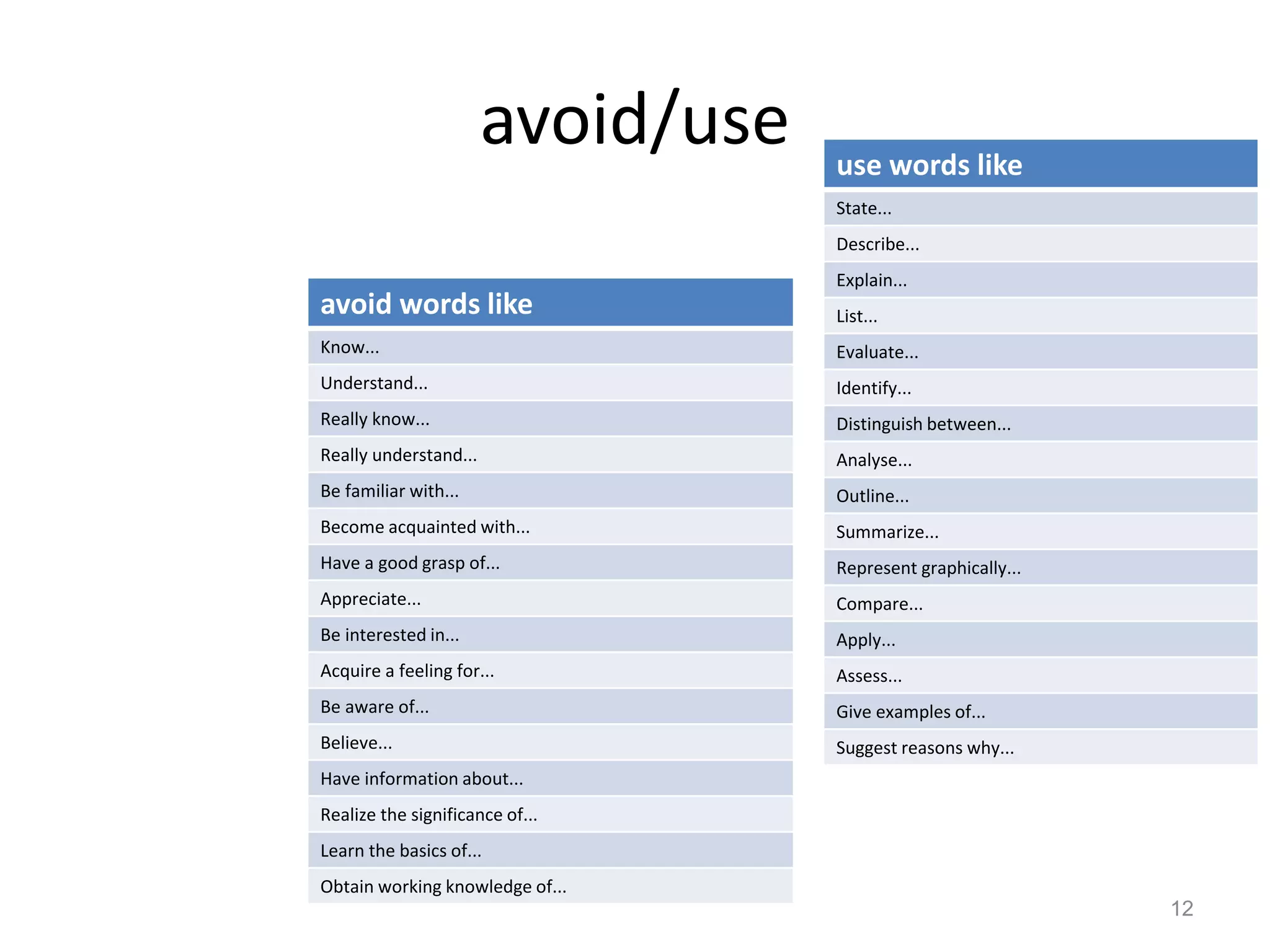
avoid/use

use words like
State...
Describe...

avoid words like

Explain...
List...

Know...

Evaluate...

Understand...

Identify...

Really know...

Distinguish between...

Really understand...

Analyse...

Be familiar with...

Outline...

Become acquainted with...

Summarize...

Have a good grasp of...

Represent graphically...

Appreciate...

Compare...

Be interested in...

Apply...

Acquire a feeling for...

Assess...

Be aware of...

Give examples of...

Believe...

Suggest reasons why...

Have information about...
Realize the significance of...
Learn the basics of...
Obtain working knowledge of...

12
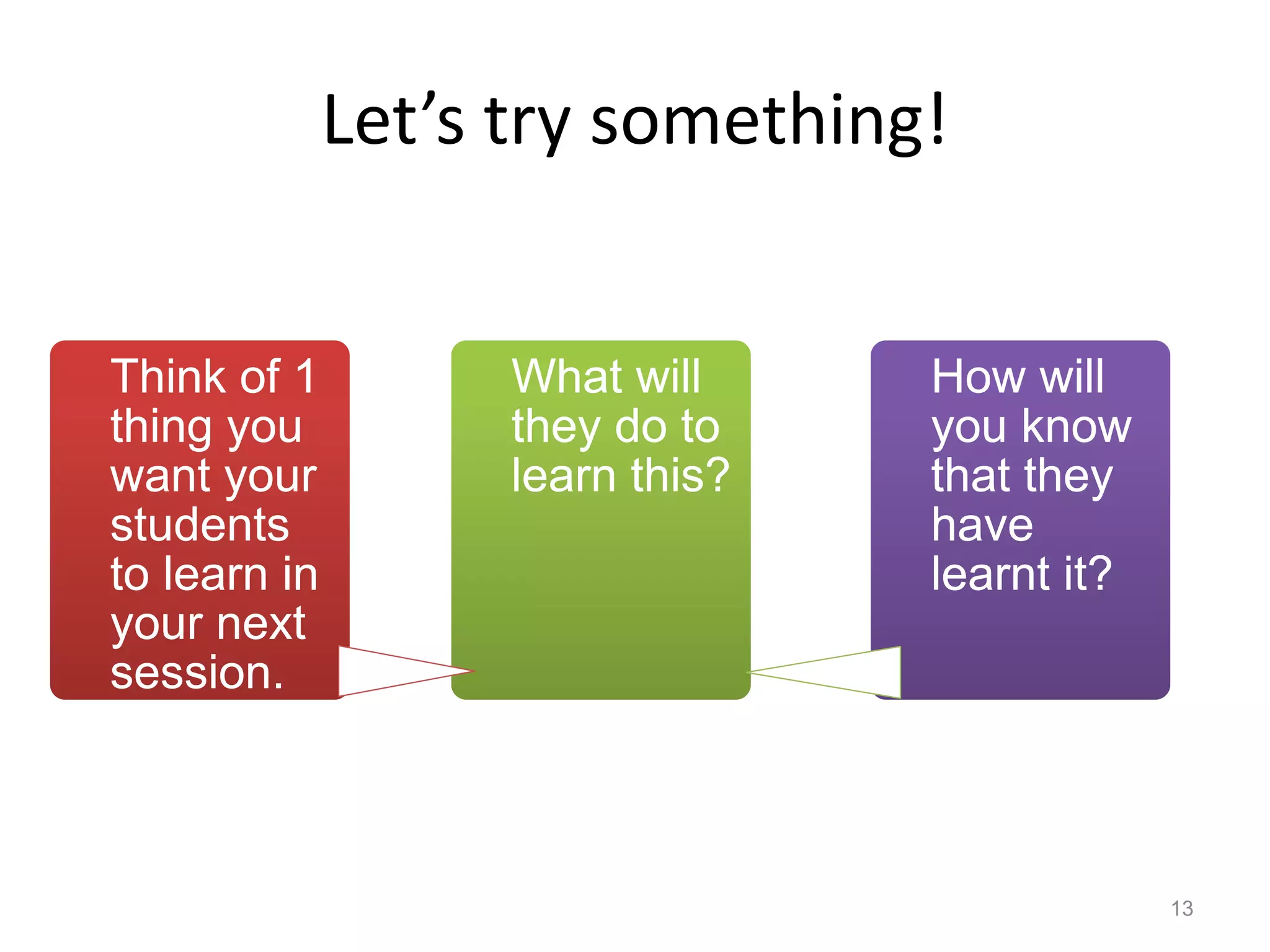
Let’s try something!
Think of 1
thing you
want your
students
to learn in
your next
session.

What will
they do to
learn this?

How will
you know
that they
have
learnt it?

13
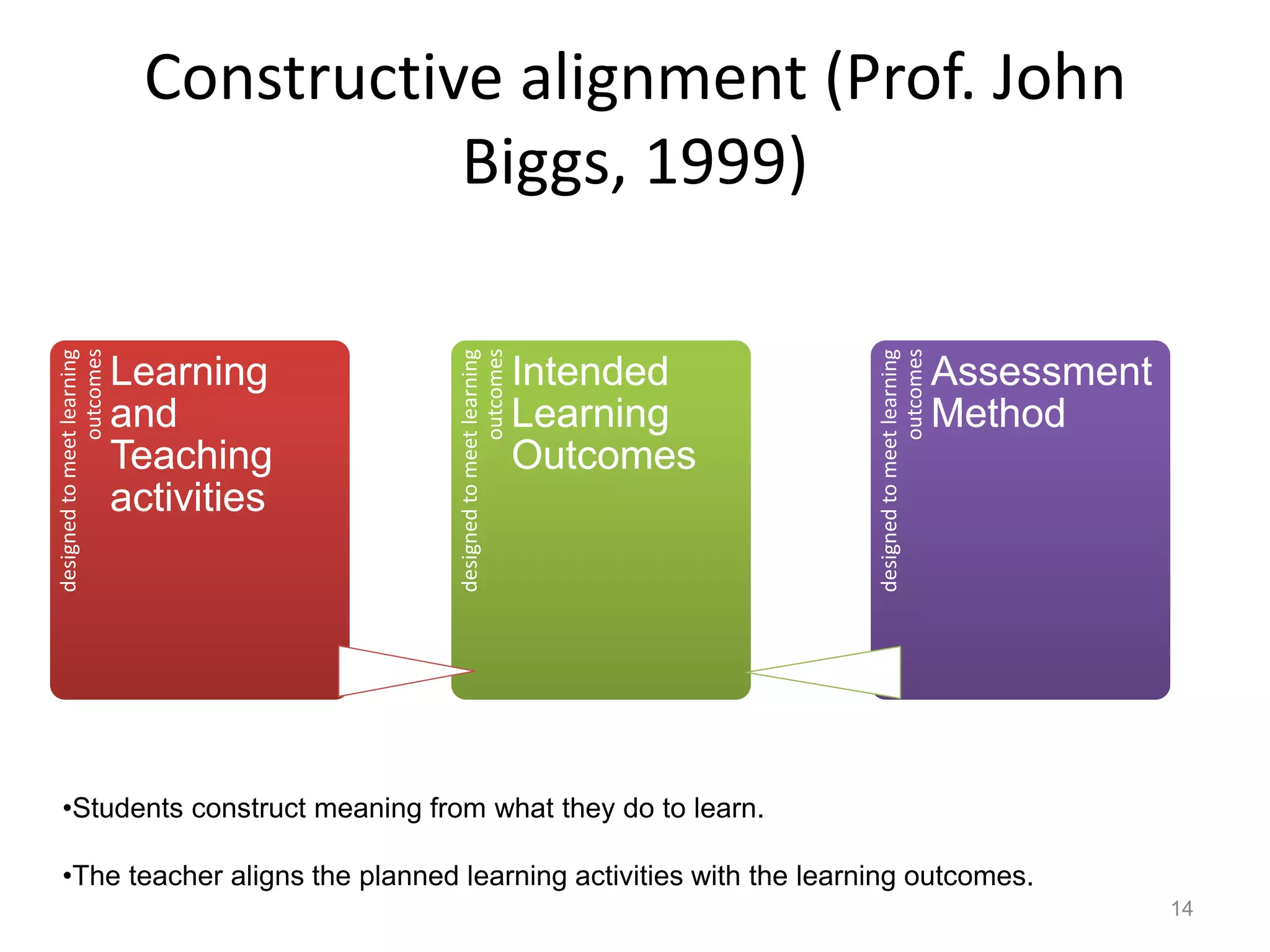
Intended
Learning
Outcomes

designed to meet learning
outcomes

Learning
and
Teaching
activities

designed to meet learning
outcomes

designed to meet learning
outcomes

Constructive alignment (Prof. John
Biggs, 1999)
Assessment
Method

•Students construct meaning from what they do to learn.
•The teacher aligns the planned learning activities with the learning outcomes.
14
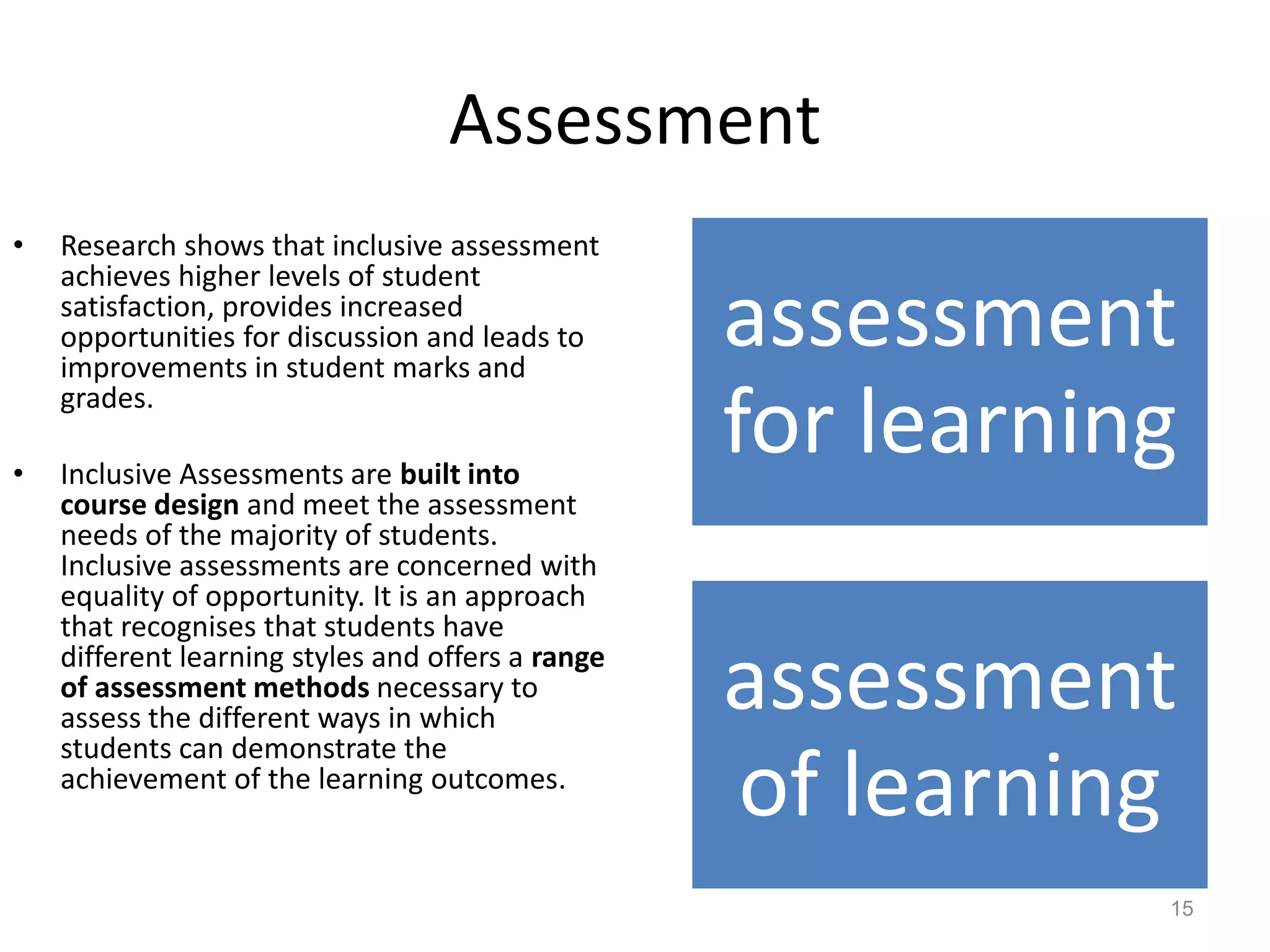
Assessment
•

•

Research shows that inclusive assessment
achieves higher levels of student
satisfaction, provides increased
opportunities for discussion and leads to
improvements in student marks and
grades.
Inclusive Assessments are built into
course design and meet the assessment
needs of the majority of students.
Inclusive assessments are concerned with
equality of opportunity. It is an approach
that recognises that students have
different learning styles and offers a range
of assessment methods necessary to
assess the different ways in which
students can demonstrate the
achievement of the learning outcomes.

assessment
for learning

assessment
of learning
15
Learning theories
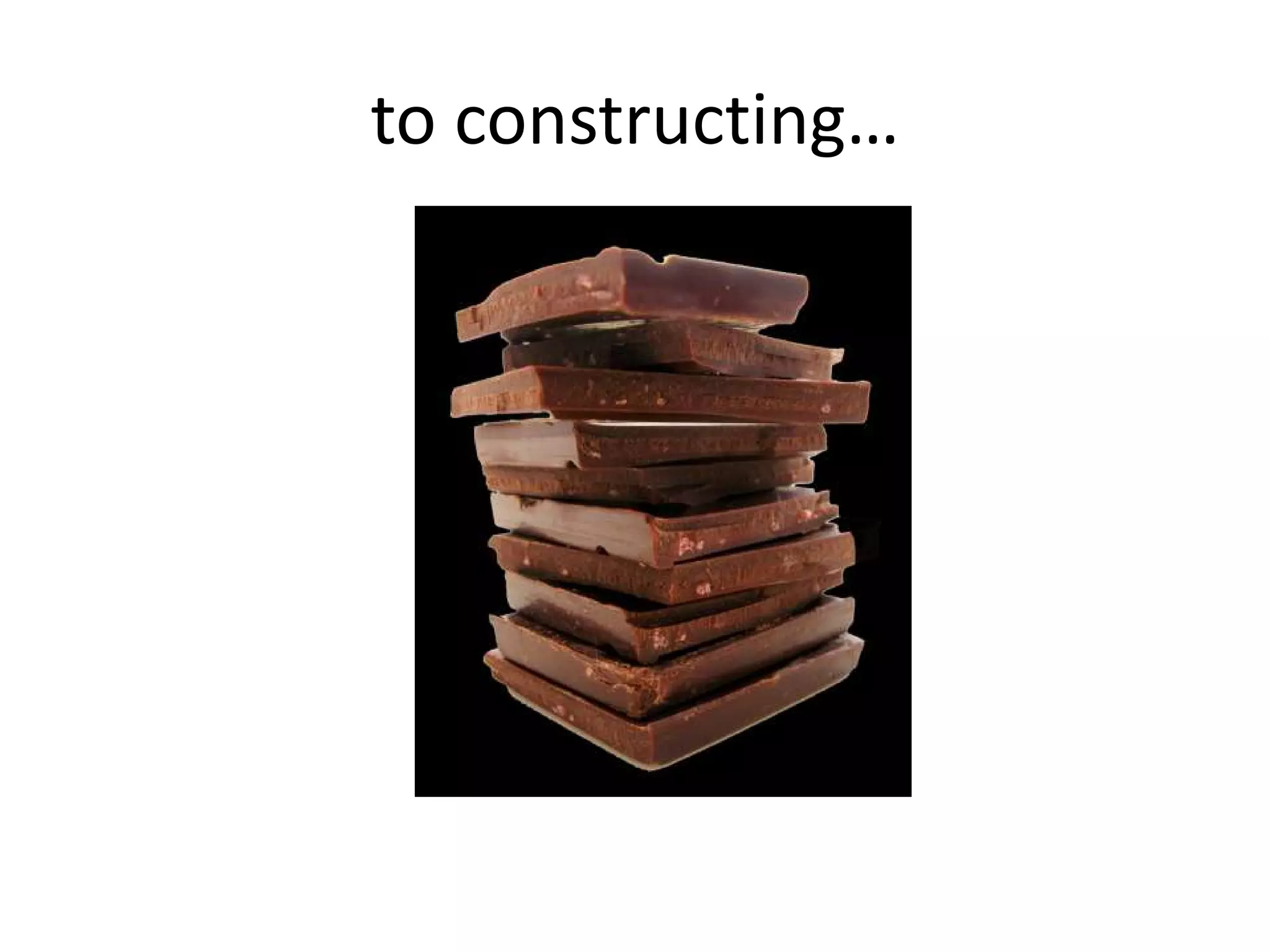
from transmission…
to constructing…
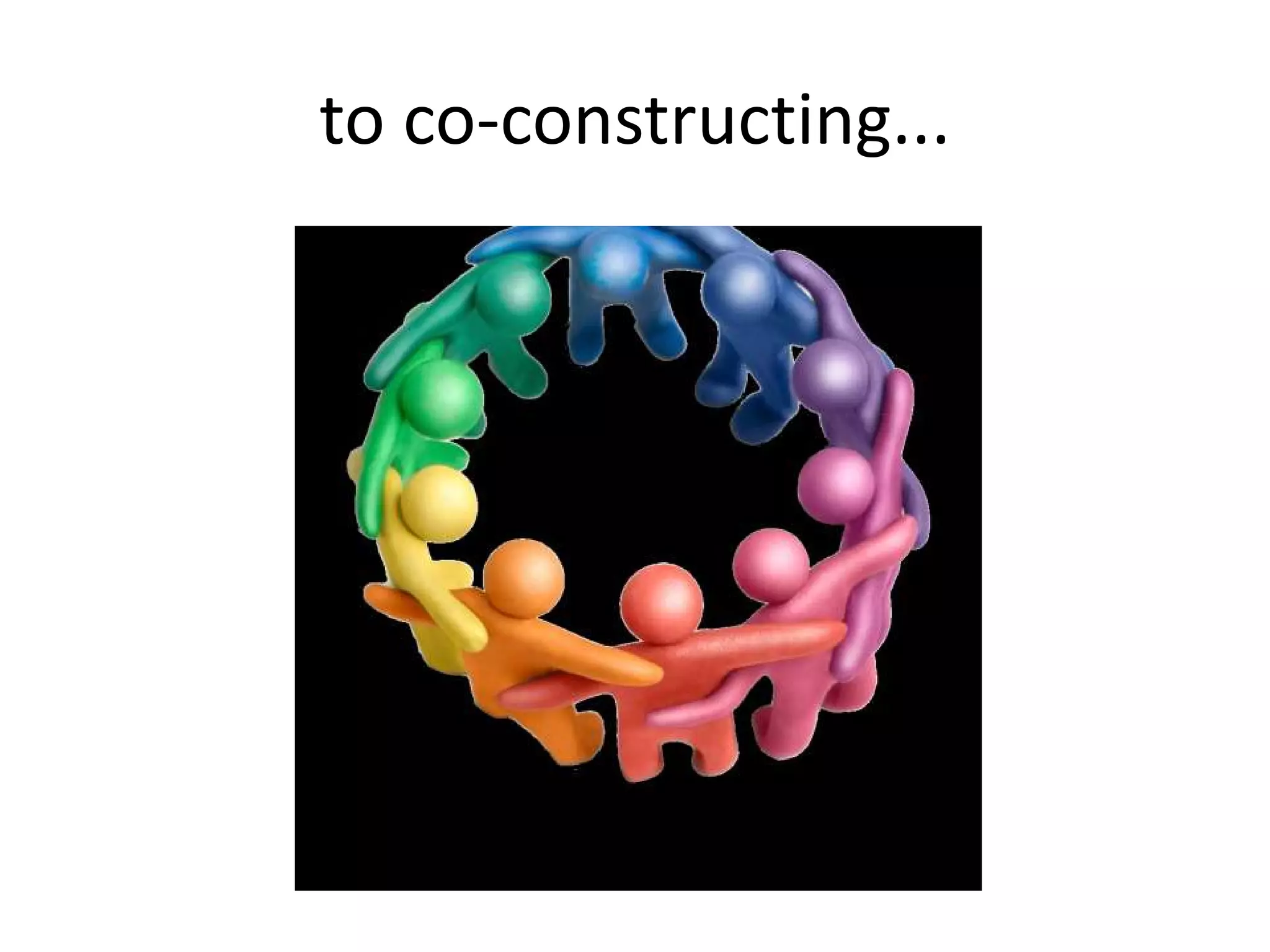
to co-constructing...
activity in small groups
Task 1: Each groups studies one of the following theories (15 mins)
•
•
•
•
•

Behaviourism
Cognitivism
Socio-constructivism
Connectionism
Connectivism

Task 2: Create a poster to capture the key characteristics of each theory. (15 mins)

Discuss the following:
•
•
•
•

Pros = The advantages of this theory in HE practice
Cons = The disadvantages of this theory in HE Practice
Application = The applicability of this theory to your area of practice
Unsuitable for = Areas within your practice that this theory would be difficult/unsuitable to
apply

Task 3: Share your findings with the other groups. (10 mins)
Threshold Concepts? (Meyer & Land, 2003)
•

Certain concepts are held to be central to the mastery of a subject

•

They have the following features:

– Transformative: Once understood, a threshold concept changes the way in which the
student views the discipline.
– Troublesome: Threshold concepts are likely to be troublesome for the student. e.g
when it is counter−intuitive.
– Irreversible: They are difficult to unlearn.
– Integrative: Threshold concepts, once learned, are likely to bring together different
aspects of the subject that previously did not appear, to the student, to be related.
– Bounded: A threshold concept will probably delineate a particular conceptual space,
serving a specific and limited purpose.
– Discursive: Crossing of a threshold will incorporate an enhanced and extended use of
language.
21
Applying theory to Practice
Using the information from the pre session study and create a chart to capture the
key characteristics of each theory and relate to your practice.
•
Behaviourism
•
Cognitivism
•
Humanism
•
Socio-constructivism ( Connectivism)

1: Discuss the following:
•

Pros = The advantages of this theory in HE practice

•

Cons = The disadvantages of this theory in HE Practice

•

Application = The applicability of this theory to your area of practice

•

Unsuitable for = Areas within your practice that this theory would be
difficult/unsuitable to apply

2. Share your findings with the other groups.

30 Mins
20 Mins
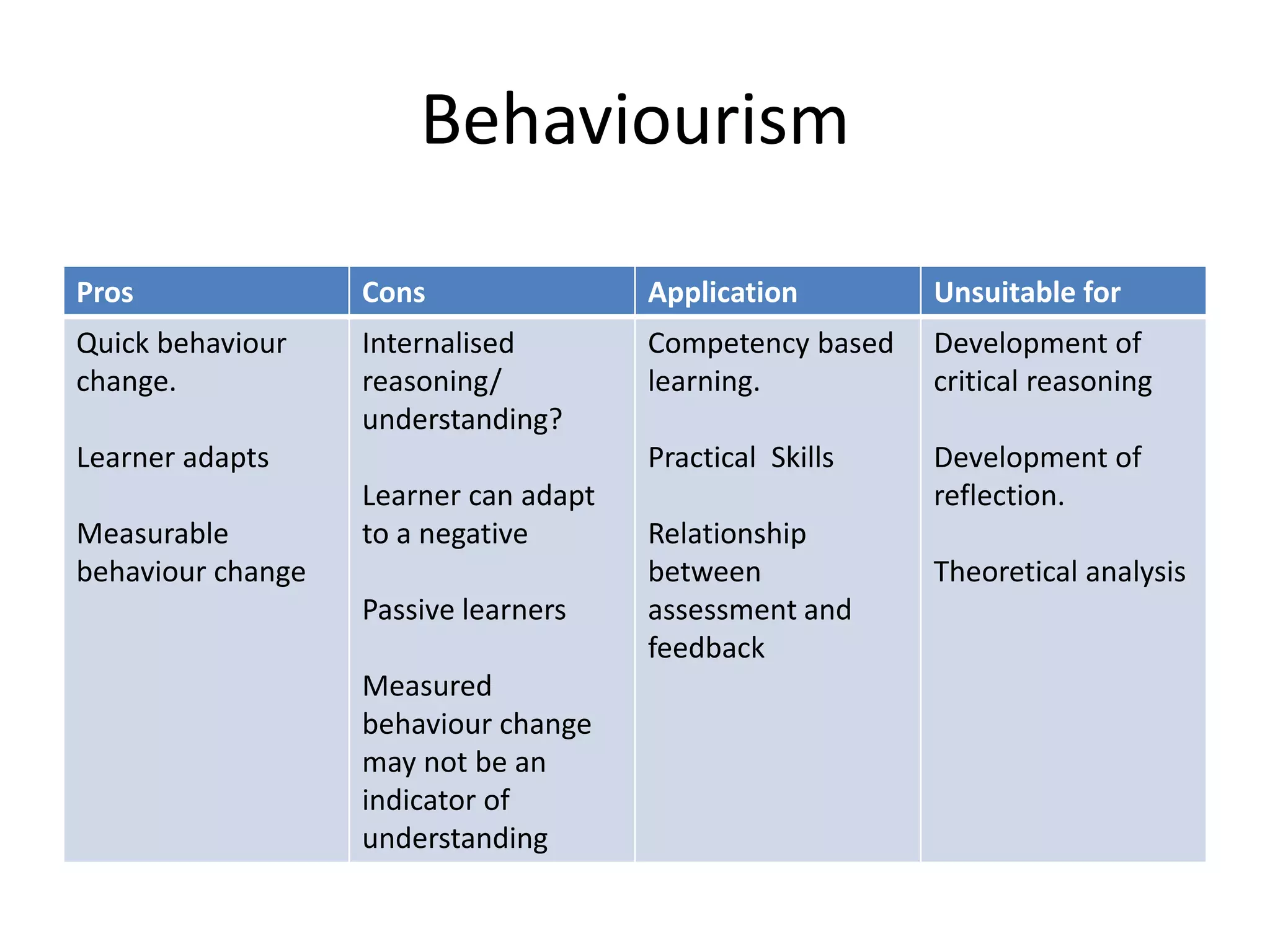
Behaviourism
Pros

Cons

Application

Unsuitable for

Quick behaviour
change.

Internalised
reasoning/
understanding?

Competency based
learning.

Development of
critical reasoning

Practical Skills

Development of
reflection.

Learner adapts
Measurable
behaviour change

Learner can adapt
to a negative
Passive learners
Measured
behaviour change
may not be an
indicator of
understanding

Relationship
between
assessment and
feedback

Theoretical analysis
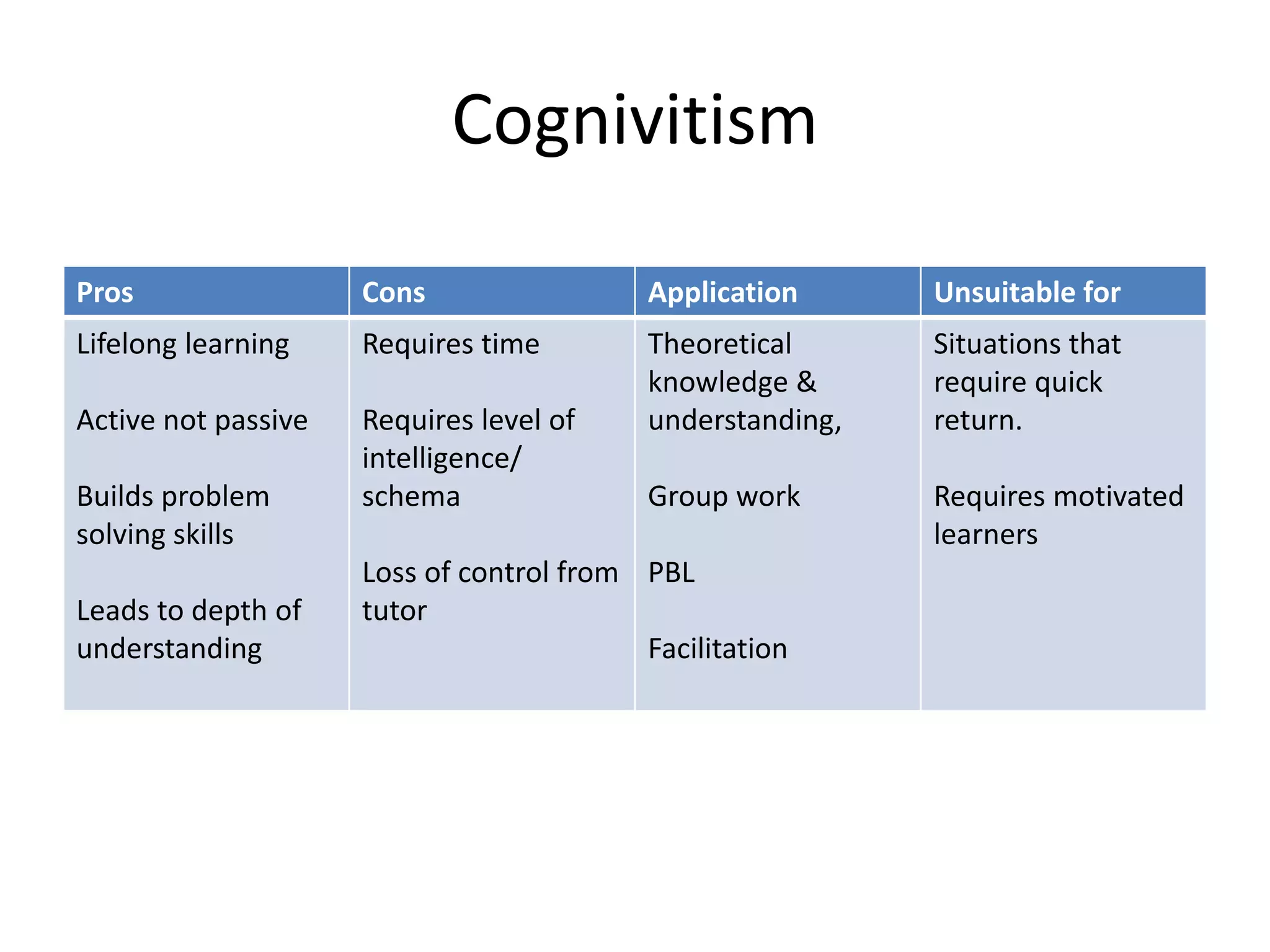
Cognivitism
Pros

Cons

Application

Unsuitable for

Lifelong learning

Requires time

Active not passive

Requires level of
intelligence/
schema

Theoretical
knowledge &
understanding,

Situations that
require quick
return.

Group work

Requires motivated
learners

Builds problem
solving skills
Leads to depth of
understanding

Loss of control from PBL
tutor
Facilitation
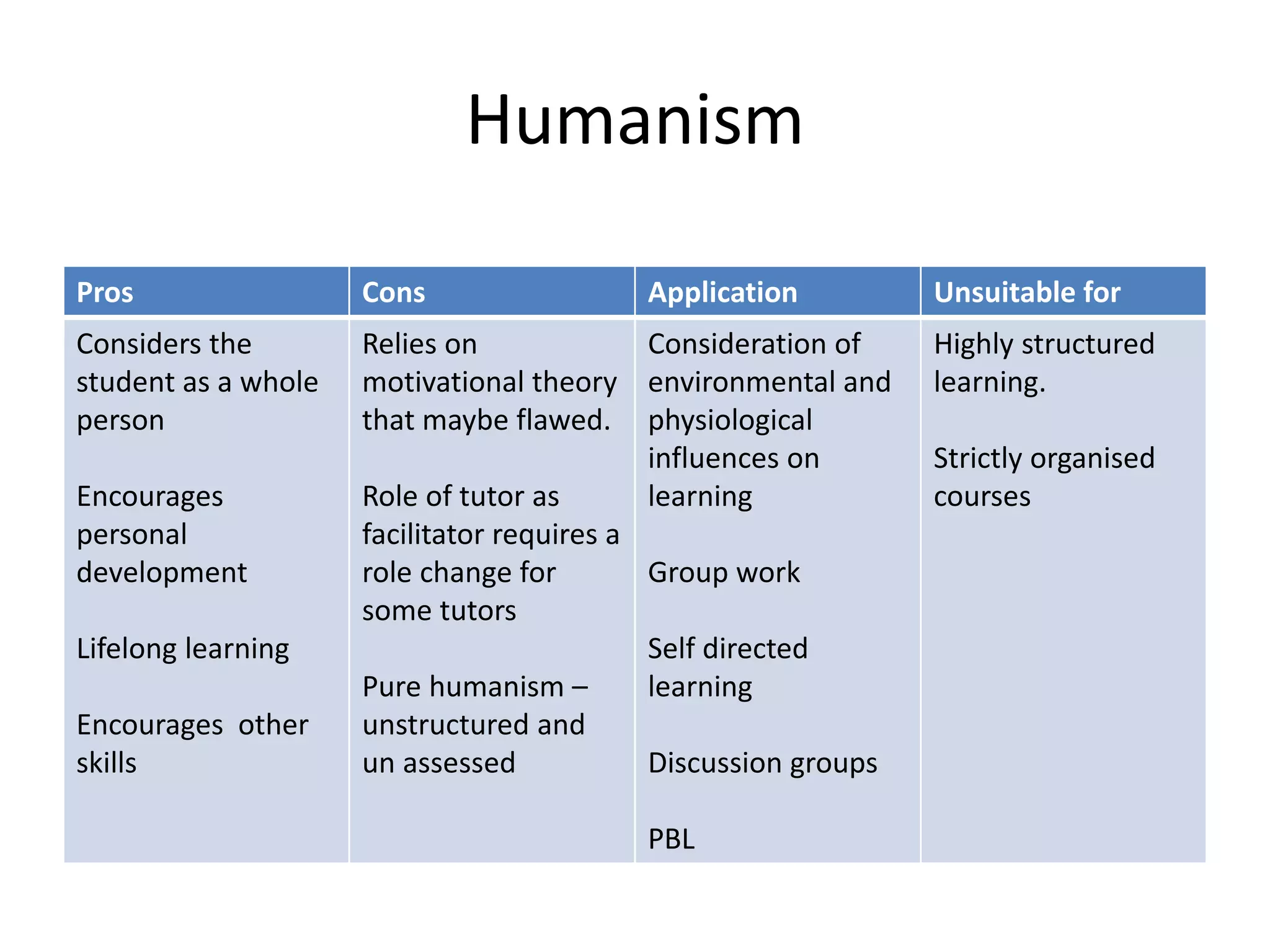
Humanism
Pros

Cons

Considers the
student as a whole
person

Relies on
Consideration of
motivational theory environmental and
that maybe flawed. physiological
influences on
Role of tutor as
learning
facilitator requires a
role change for
Group work
some tutors
Self directed
Pure humanism –
learning
unstructured and
un assessed
Discussion groups

Encourages
personal
development
Lifelong learning
Encourages other
skills

Application

PBL

Unsuitable for
Highly structured
learning.
Strictly organised
courses
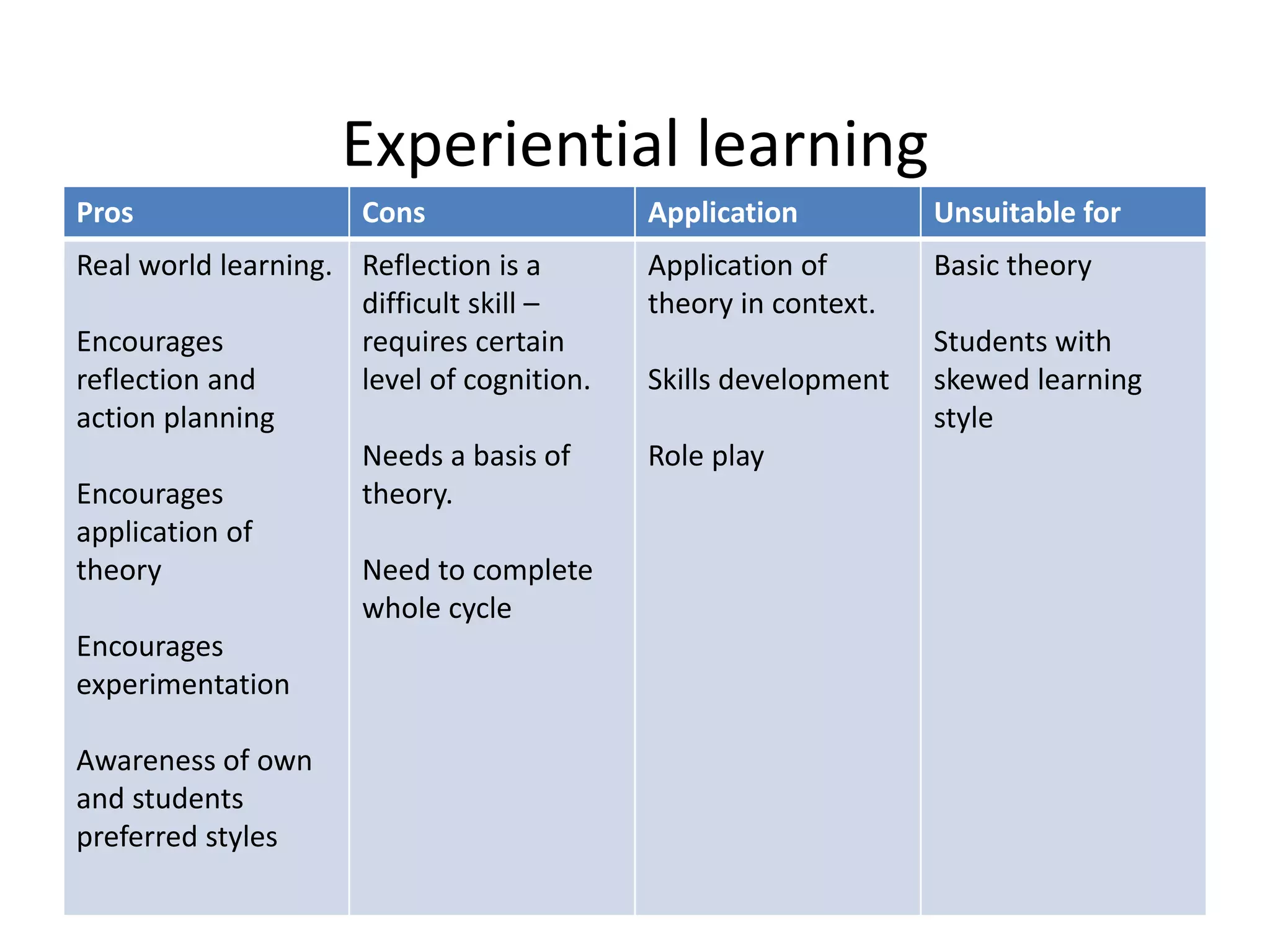
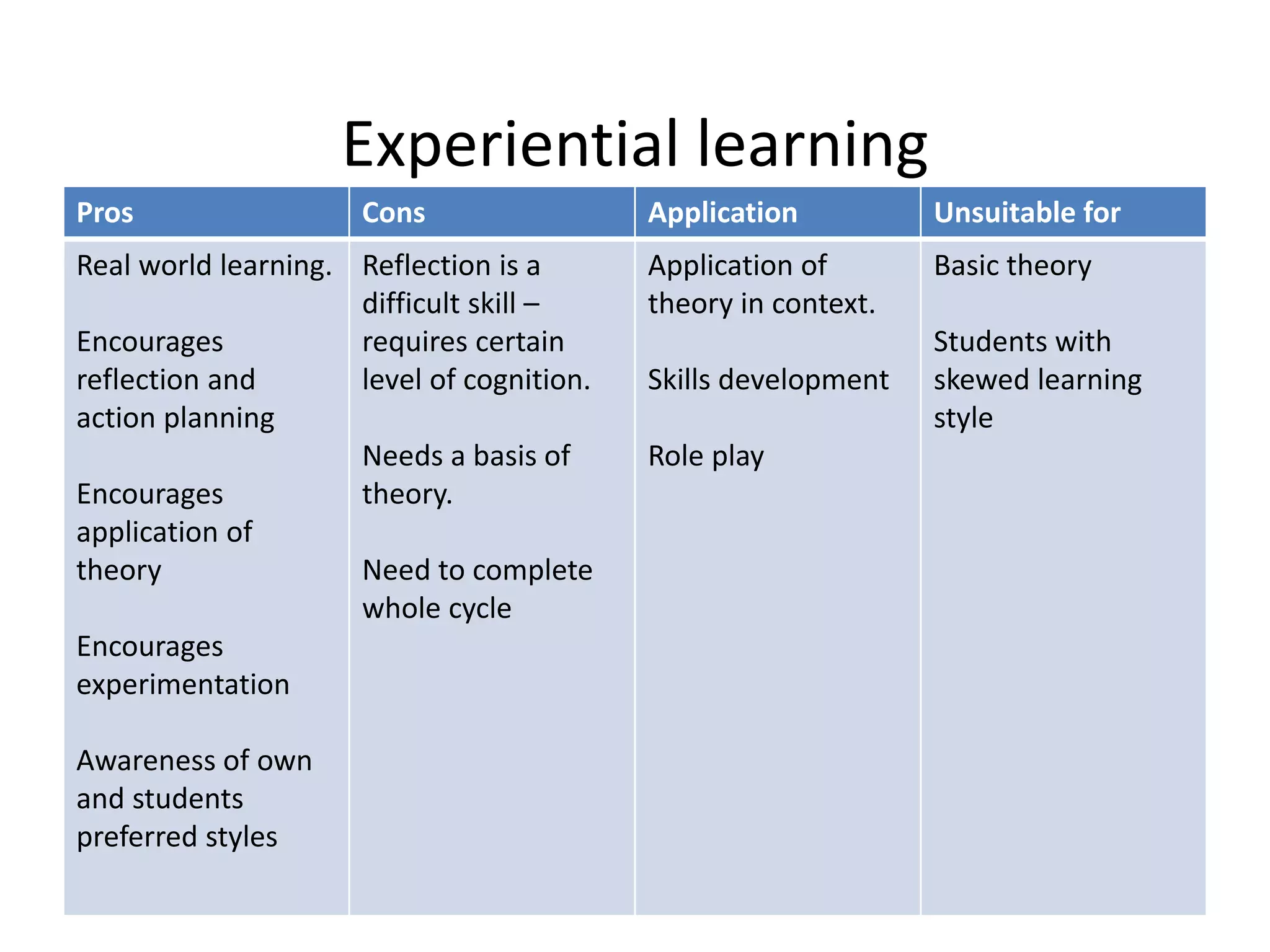
Experiential learning
Pros

Cons

Real world learning. Reflection is a
difficult skill –
Encourages
requires certain
reflection and
level of cognition.
action planning
Needs a basis of
Encourages
theory.
application of
theory
Need to complete
whole cycle
Encourages
experimentation
Awareness of own
and students
preferred styles

Application

Unsuitable for

Application of
theory in context.

Basic theory

Skills development
Role play

Students with
skewed learning
style
Experiential learning
Pros

Cons

Real world learning. Reflection is a
difficult skill –
Encourages
requires certain
reflection and
level of cognition.
action planning
Needs a basis of
Encourages
theory.
application of
theory
Need to complete
whole cycle
Encourages
experimentation
Awareness of own
and students
preferred styles

Application

Unsuitable for

Application of
theory in context.

Basic theory

Skills development
Role play

Students with
skewed learning
style
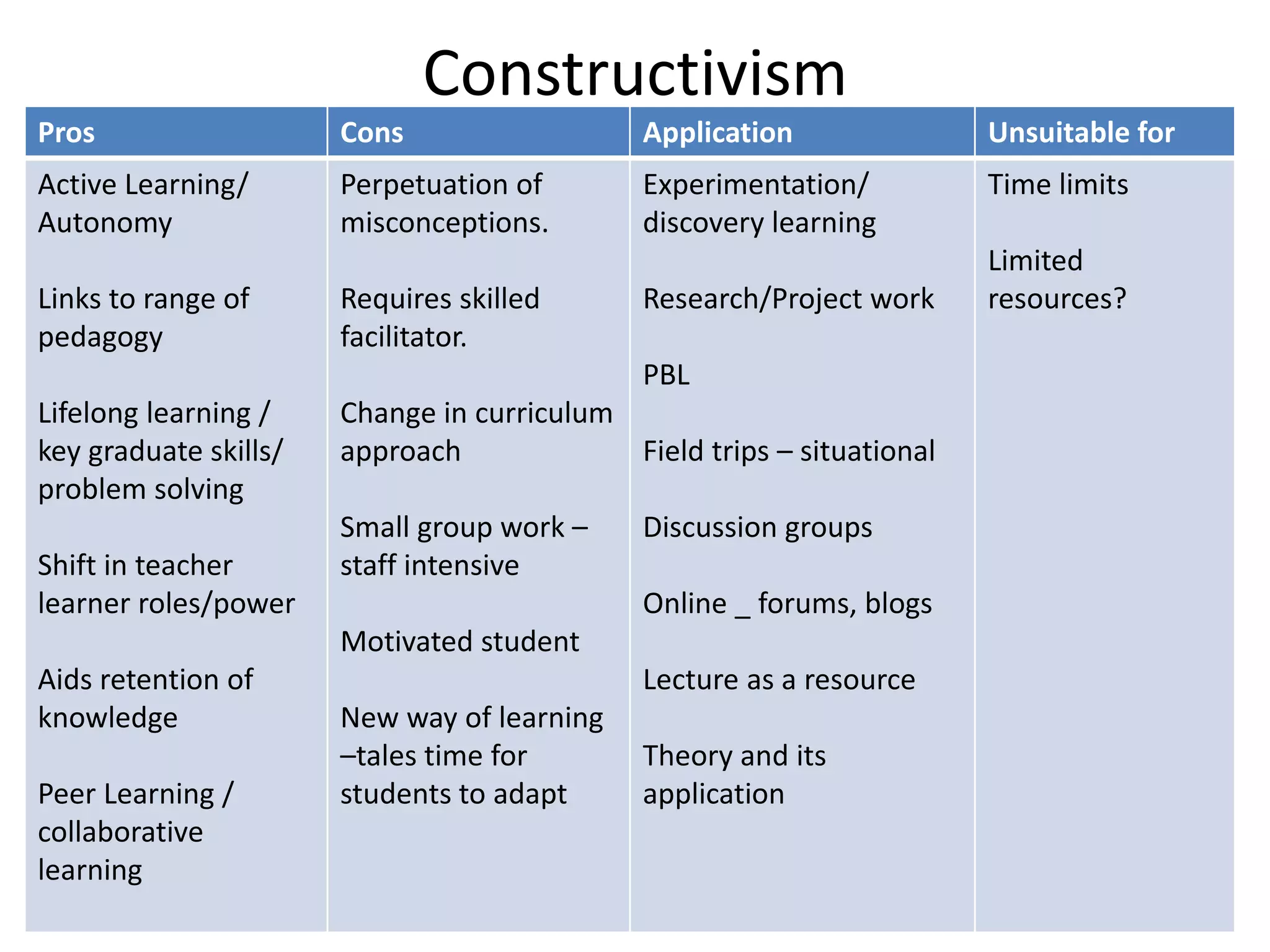
Constructivism
Pros

Cons

Application

Unsuitable for

Active Learning/
Autonomy

Perpetuation of
misconceptions.

Experimentation/
discovery learning

Time limits

Links to range of
pedagogy

Requires skilled
facilitator.

Research/Project work
PBL

Lifelong learning /
key graduate skills/
problem solving
Shift in teacher
learner roles/power

Change in curriculum
approach
Field trips – situational
Small group work –
staff intensive

Discussion groups

Online _ forums, blogs
Motivated student

Aids retention of
knowledge

Peer Learning /
collaborative
learning

Lecture as a resource
New way of learning
–tales time for
students to adapt

Theory and its
application

Limited
resources?
Designing sessions for learning
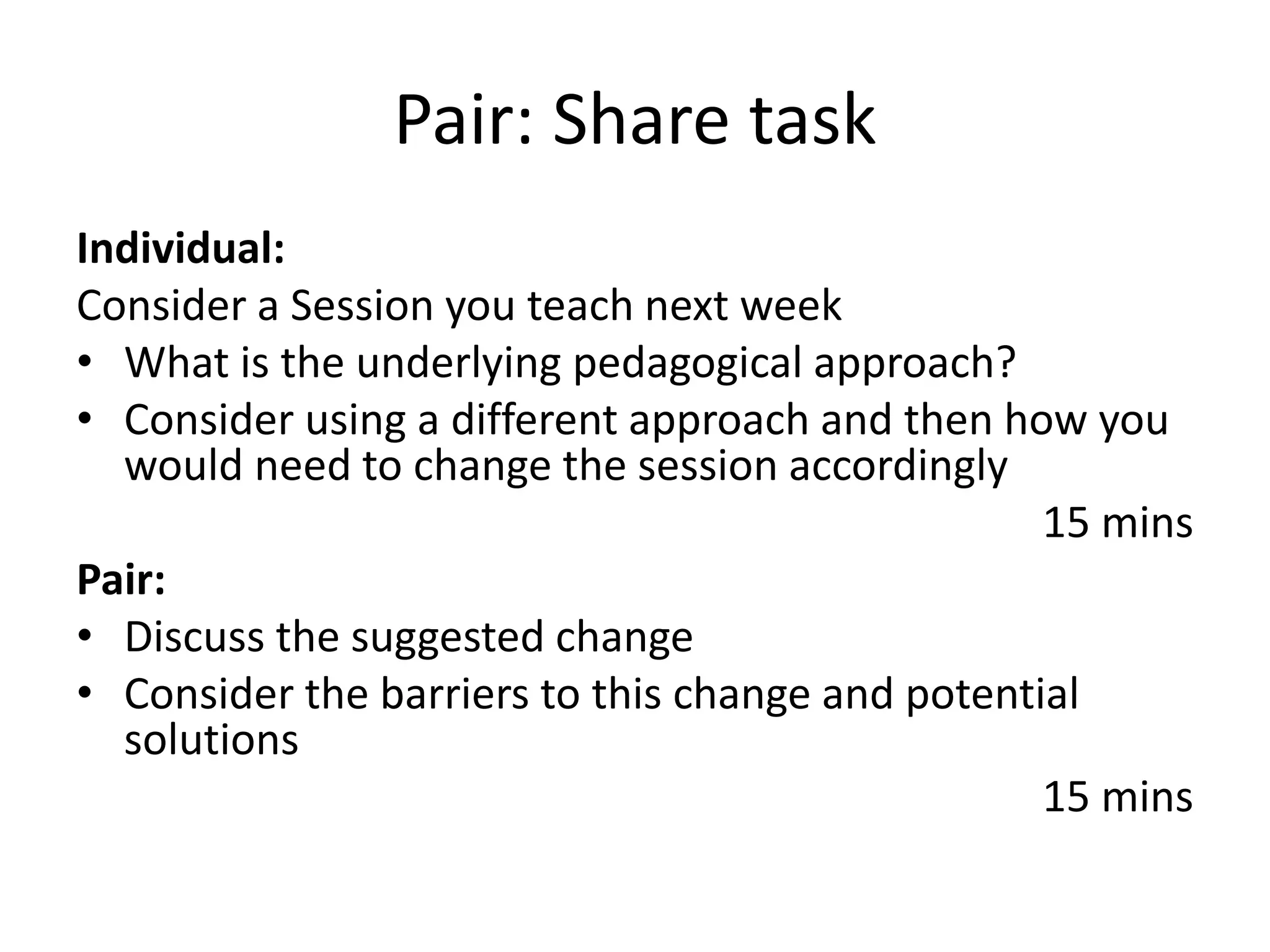
Pair: Share task
Individual:
Consider a Session you teach next week
• What is the underlying pedagogical approach?
• Consider using a different approach and then how you
would need to change the session accordingly
15 mins
Pair:
• Discuss the suggested change
• Consider the barriers to this change and potential
solutions
15 mins
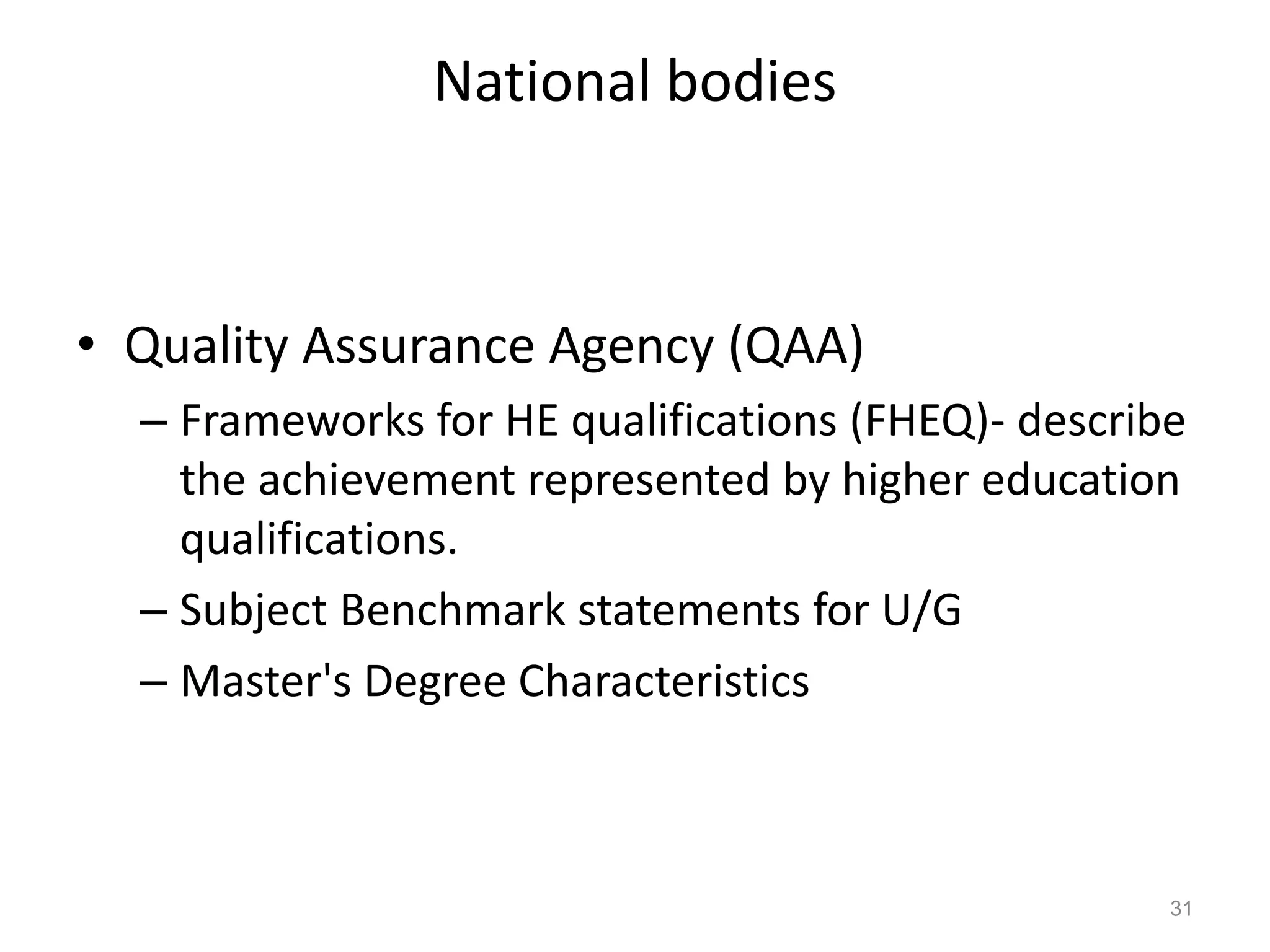
National bodies

• Quality Assurance Agency (QAA)
– Frameworks for HE qualifications (FHEQ)- describe
the achievement represented by higher education
qualifications.
– Subject Benchmark statements for U/G
– Master's Degree Characteristics

31
Resources:
• Guide for Busy Academics: Using Learning
Outcomes to Design a Course and Assess
Learning
http://www.itslifejimbutnotasweknowit.org.uk/f
iles/CPLHE/Learnng%20outcomes%20for%20b
usy%20academics.rtf

32
References
•
•
•
•
•
•
•
•
•
•
•
•
•
•
•
•
•
•
•
•
•
•

Biggs, J. (1999) Teaching for Quality Learning at University SRHE/OUP
Bloom, B.S. et al, Taxonomy of Educational Objectives: Cognitive Domain New York: McKay
Bourner, T & Flowers, S (1998) Teaching and Learning Methods in Higher Education: A Glimpse of the Future. Reflections on HE, pp. 77-102.
Butcher, Davies & Highton (2006) Designing Learning: From Module Outline to Effective Teaching, Abingdon: Routledge
Hussey, T. and Smith, P. (2002) The Trouble with Learning Outcomes, Active Learning 3 (3) 220-233
Hussey, T. and Smith, P. (2003) The Uses of Learning Outcomes, Teaching in Higher Education 8 (3) 357-368
Hussey, T. and Smith, P. (2008) Learning Outcomes: a conceptual analysis, Teaching in Higher Education 13 (1) 107-115
Knight, P. (2002) Being a Teacher in Higher Education Buckingham: SRHE/OUP
Knight, P. (2001) ‘Complexity and curriculum: a process approach to curriculum making’ in Teaching in HE Vol 6 No 3 pp369-381.
Laurillard, D. (2002) Rethinking University Teaching: A Framework for the Effective Use of Educational Technology London: Routledge
Light, G. and Cox, R. (2001) Learning and Teaching in Higher Education London: PCP publishing
Nixon, J. (2001) Not without dust and heat: the moral bases of the new academic professionalism, British Journal of Educational Studies, 49, 2. 173186.
Meyer, J.H.F. and Land, R. (2003) Threshold concepts and troublesome knowledge: linkages to ways of thinking and practising, In: Rust, C. (ed.),
Improving Student Learning - Theory and Practice Ten Years On. Oxford: Oxford Centre for Staff and Learning Development (OCSLD), pp 412-424.
Ramsden, P. (1992) Learning to Teach in Higher Education London: Routledge.
Schon D. A. (1983) The Reflective Practitioner: How Professionals Think in Action New York: Basic Books.
Shulman, L.S. (1987) ‘Knowledge and teaching: foundations of the new reform’ in Harvard Educational Review February 57 (1) pp.1-22.
Steeples, C, Jones, CR & Goodyear, P (2002) Beyond e-learning: a future for networked learning. In C Steeples and CR Jones (Eds) Networked learning
: principles and perspectives. London: Springer
Trigwell, K. (2001) Professionalism in the practice of teaching: the role of research ILT Conference - Keynote address University of York
Trigwell, K., Prosser, M., and Taylor, P. (1994) Qualitative differences in approaches to teaching first year university science, Higher Education 27,
pp75-84.
Universities UK (2004) Towards a Framework of Professional Teaching Standards: Consultation Document.
http://www.universitiesuk.ac.uk/consultations/UniversitiesUK/

33
next week:

Good Teaching

PGCAP > DAPP
http://www.celt.mmu.ac.uk/ @mmu_celt

DAPP141 session 3: Designing for Learning & Learning theories in practice

  • 1.
    Designing for learning &Learning theories in practice “I have to say attendance has been quite poor recently, but the level of the students is quite good.” Chrissi Nerantzi @chrissinerantzi & Haleh Moravej @halehmoravej PGCAP > DAPP http://www.celt.mmu.ac.uk/ @mmu_celt
  • 2.
    Intended learning outcomes Bythe end of this week, you will have had the opportunity to: • discuss and evaluate your own design process for learning including constructive alignment • explore active learning approaches and a selection of learning theories to maximise learning in your own practice 2
  • 3.
    3 Thinking about learning aPhil Race activity 1. Think about something you are good at. 2. Think of something about yourself you feel good about. Write in this box how you became good at it. Write here the evidence it is based on. 3. Think of something you are not good at, perhaps as a result of a bad learning experience. What went wrong? Add it to this box. 4. Think of something that you did learn successfully, but at the time you didn’t really want to do it. What kept you going, so that you did succeed in learning it?
  • 4.
  • 5.
    planning a session:collaborative mindmap • http://www.text2mindmap.com/ 5
  • 6.
    Planning a session • • Yourlearners Group size • • • • • • • • • • Title Time/duration Day/date, location Aims and Learning Outcomes Structure and Content Methods/Activities Aids and Resources Assessment Differentiation Reflection/Evaluation • “If you fail to plan, you plan to fail!” 6
  • 7.
    Intended Learning Outcomes •“Descriptors of the ways that students will be expected to demonstrate the results of their learning.” Race (2000:10) 7
  • 8.
    A well-written learningoutcome statement should: active verb • Contain an , an object and a qualifying clause or phrase that provides a context or condition • Be written in the future tense • Identify important learning requirements: knowledge, understanding, skills, attitudes at each appropriate level • Be achievable and measurable • Use clear language, understandable by students • Relate to explicit statements of achievement 8
  • 9.
    Learning outcomes, minimum requirements • Helpsto balance a module’s delivery nice could Independent learning, going beyond, SUSAN? Must be delivered, ROBERT? should essential 9 Butcher et al (2006) Designing Learning. From Module outline to effective teaching, Oxon: Routledge. p. 59
  • 10.
    The Cognitive Domainand Bloom’s Taxonomy evaluation creating synthesis evaluating analysis analysing application applying comprehension understanding knowledge remembering Bloom’s Taxonomoy (1956) Anderson and Krathwohl Revision (2001) Educational Psychology Interactive: The Cognitive Domain 10
  • 11.
    Bloom’s Taxonomy andverb list Knowledge Comprehension Application arrange, define, duplicate, label, list, memorize, name, order, recognize, relate, recall, repeat, reproduce state classify, describe, discuss, explain, express, identify, indicate, locate, recognize, report, restate, review, select, translate apply, choose, demonstrate, dramatize, employ, illustrate, interpret, operate, practice, schedule, sketch, solve, use, write Analysis analyze, appraise, calculate, categorize, compare, contrast, criticize, differentiate, discriminate, distinguish, examine, experiment, question, test Synthesis arrange, assemble, collect, compose, construct, create, design, develop, formulate, manage, organize, plan, prepare, propose, set up, write Evaluation appraise, argue, assess, attach, choose compare, defend, estimate, judge, predict, rate, core, select, support, value, evaluate 11
  • 12.
    avoid/use use words like State... Describe... avoidwords like Explain... List... Know... Evaluate... Understand... Identify... Really know... Distinguish between... Really understand... Analyse... Be familiar with... Outline... Become acquainted with... Summarize... Have a good grasp of... Represent graphically... Appreciate... Compare... Be interested in... Apply... Acquire a feeling for... Assess... Be aware of... Give examples of... Believe... Suggest reasons why... Have information about... Realize the significance of... Learn the basics of... Obtain working knowledge of... 12
  • 13.
    Let’s try something! Thinkof 1 thing you want your students to learn in your next session. What will they do to learn this? How will you know that they have learnt it? 13
  • 14.
    Intended Learning Outcomes designed to meetlearning outcomes Learning and Teaching activities designed to meet learning outcomes designed to meet learning outcomes Constructive alignment (Prof. John Biggs, 1999) Assessment Method •Students construct meaning from what they do to learn. •The teacher aligns the planned learning activities with the learning outcomes. 14
  • 15.
    Assessment • • Research shows thatinclusive assessment achieves higher levels of student satisfaction, provides increased opportunities for discussion and leads to improvements in student marks and grades. Inclusive Assessments are built into course design and meet the assessment needs of the majority of students. Inclusive assessments are concerned with equality of opportunity. It is an approach that recognises that students have different learning styles and offers a range of assessment methods necessary to assess the different ways in which students can demonstrate the achievement of the learning outcomes. assessment for learning assessment of learning 15
  • 16.
  • 17.
  • 18.
  • 19.
  • 20.
    activity in smallgroups Task 1: Each groups studies one of the following theories (15 mins) • • • • • Behaviourism Cognitivism Socio-constructivism Connectionism Connectivism Task 2: Create a poster to capture the key characteristics of each theory. (15 mins) Discuss the following: • • • • Pros = The advantages of this theory in HE practice Cons = The disadvantages of this theory in HE Practice Application = The applicability of this theory to your area of practice Unsuitable for = Areas within your practice that this theory would be difficult/unsuitable to apply Task 3: Share your findings with the other groups. (10 mins)
  • 21.
    Threshold Concepts? (Meyer& Land, 2003) • Certain concepts are held to be central to the mastery of a subject • They have the following features: – Transformative: Once understood, a threshold concept changes the way in which the student views the discipline. – Troublesome: Threshold concepts are likely to be troublesome for the student. e.g when it is counter−intuitive. – Irreversible: They are difficult to unlearn. – Integrative: Threshold concepts, once learned, are likely to bring together different aspects of the subject that previously did not appear, to the student, to be related. – Bounded: A threshold concept will probably delineate a particular conceptual space, serving a specific and limited purpose. – Discursive: Crossing of a threshold will incorporate an enhanced and extended use of language. 21
  • 22.
    Applying theory toPractice Using the information from the pre session study and create a chart to capture the key characteristics of each theory and relate to your practice. • Behaviourism • Cognitivism • Humanism • Socio-constructivism ( Connectivism) 1: Discuss the following: • Pros = The advantages of this theory in HE practice • Cons = The disadvantages of this theory in HE Practice • Application = The applicability of this theory to your area of practice • Unsuitable for = Areas within your practice that this theory would be difficult/unsuitable to apply 2. Share your findings with the other groups. 30 Mins 20 Mins
  • 23.
    Behaviourism Pros Cons Application Unsuitable for Quick behaviour change. Internalised reasoning/ understanding? Competencybased learning. Development of critical reasoning Practical Skills Development of reflection. Learner adapts Measurable behaviour change Learner can adapt to a negative Passive learners Measured behaviour change may not be an indicator of understanding Relationship between assessment and feedback Theoretical analysis
  • 24.
    Cognivitism Pros Cons Application Unsuitable for Lifelong learning Requirestime Active not passive Requires level of intelligence/ schema Theoretical knowledge & understanding, Situations that require quick return. Group work Requires motivated learners Builds problem solving skills Leads to depth of understanding Loss of control from PBL tutor Facilitation
  • 25.
    Humanism Pros Cons Considers the student asa whole person Relies on Consideration of motivational theory environmental and that maybe flawed. physiological influences on Role of tutor as learning facilitator requires a role change for Group work some tutors Self directed Pure humanism – learning unstructured and un assessed Discussion groups Encourages personal development Lifelong learning Encourages other skills Application PBL Unsuitable for Highly structured learning. Strictly organised courses
  • 26.
    Experiential learning Pros Cons Real worldlearning. Reflection is a difficult skill – Encourages requires certain reflection and level of cognition. action planning Needs a basis of Encourages theory. application of theory Need to complete whole cycle Encourages experimentation Awareness of own and students preferred styles Application Unsuitable for Application of theory in context. Basic theory Skills development Role play Students with skewed learning style
  • 27.
    Experiential learning Pros Cons Real worldlearning. Reflection is a difficult skill – Encourages requires certain reflection and level of cognition. action planning Needs a basis of Encourages theory. application of theory Need to complete whole cycle Encourages experimentation Awareness of own and students preferred styles Application Unsuitable for Application of theory in context. Basic theory Skills development Role play Students with skewed learning style
  • 28.
    Constructivism Pros Cons Application Unsuitable for Active Learning/ Autonomy Perpetuationof misconceptions. Experimentation/ discovery learning Time limits Links to range of pedagogy Requires skilled facilitator. Research/Project work PBL Lifelong learning / key graduate skills/ problem solving Shift in teacher learner roles/power Change in curriculum approach Field trips – situational Small group work – staff intensive Discussion groups Online _ forums, blogs Motivated student Aids retention of knowledge Peer Learning / collaborative learning Lecture as a resource New way of learning –tales time for students to adapt Theory and its application Limited resources?
  • 29.
  • 30.
    Pair: Share task Individual: Considera Session you teach next week • What is the underlying pedagogical approach? • Consider using a different approach and then how you would need to change the session accordingly 15 mins Pair: • Discuss the suggested change • Consider the barriers to this change and potential solutions 15 mins
  • 31.
    National bodies • QualityAssurance Agency (QAA) – Frameworks for HE qualifications (FHEQ)- describe the achievement represented by higher education qualifications. – Subject Benchmark statements for U/G – Master's Degree Characteristics 31
  • 32.
    Resources: • Guide forBusy Academics: Using Learning Outcomes to Design a Course and Assess Learning http://www.itslifejimbutnotasweknowit.org.uk/f iles/CPLHE/Learnng%20outcomes%20for%20b usy%20academics.rtf 32
  • 33.
    References • • • • • • • • • • • • • • • • • • • • • • Biggs, J. (1999)Teaching for Quality Learning at University SRHE/OUP Bloom, B.S. et al, Taxonomy of Educational Objectives: Cognitive Domain New York: McKay Bourner, T & Flowers, S (1998) Teaching and Learning Methods in Higher Education: A Glimpse of the Future. Reflections on HE, pp. 77-102. Butcher, Davies & Highton (2006) Designing Learning: From Module Outline to Effective Teaching, Abingdon: Routledge Hussey, T. and Smith, P. (2002) The Trouble with Learning Outcomes, Active Learning 3 (3) 220-233 Hussey, T. and Smith, P. (2003) The Uses of Learning Outcomes, Teaching in Higher Education 8 (3) 357-368 Hussey, T. and Smith, P. (2008) Learning Outcomes: a conceptual analysis, Teaching in Higher Education 13 (1) 107-115 Knight, P. (2002) Being a Teacher in Higher Education Buckingham: SRHE/OUP Knight, P. (2001) ‘Complexity and curriculum: a process approach to curriculum making’ in Teaching in HE Vol 6 No 3 pp369-381. Laurillard, D. (2002) Rethinking University Teaching: A Framework for the Effective Use of Educational Technology London: Routledge Light, G. and Cox, R. (2001) Learning and Teaching in Higher Education London: PCP publishing Nixon, J. (2001) Not without dust and heat: the moral bases of the new academic professionalism, British Journal of Educational Studies, 49, 2. 173186. Meyer, J.H.F. and Land, R. (2003) Threshold concepts and troublesome knowledge: linkages to ways of thinking and practising, In: Rust, C. (ed.), Improving Student Learning - Theory and Practice Ten Years On. Oxford: Oxford Centre for Staff and Learning Development (OCSLD), pp 412-424. Ramsden, P. (1992) Learning to Teach in Higher Education London: Routledge. Schon D. A. (1983) The Reflective Practitioner: How Professionals Think in Action New York: Basic Books. Shulman, L.S. (1987) ‘Knowledge and teaching: foundations of the new reform’ in Harvard Educational Review February 57 (1) pp.1-22. Steeples, C, Jones, CR & Goodyear, P (2002) Beyond e-learning: a future for networked learning. In C Steeples and CR Jones (Eds) Networked learning : principles and perspectives. London: Springer Trigwell, K. (2001) Professionalism in the practice of teaching: the role of research ILT Conference - Keynote address University of York Trigwell, K., Prosser, M., and Taylor, P. (1994) Qualitative differences in approaches to teaching first year university science, Higher Education 27, pp75-84. Universities UK (2004) Towards a Framework of Professional Teaching Standards: Consultation Document. http://www.universitiesuk.ac.uk/consultations/UniversitiesUK/ 33
  • 34.
    next week: Good Teaching PGCAP> DAPP http://www.celt.mmu.ac.uk/ @mmu_celt