• ASSIMILATION
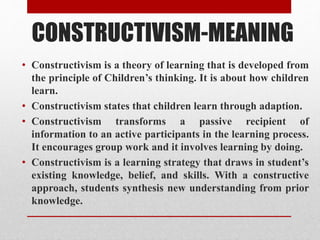
Assimilation of knowledge
occurs when a learner
encounters a new idea, and
must fit that idea into
what they already know.
• DISSEMINATION
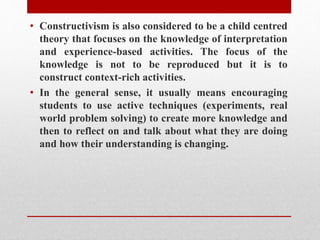
Dissemination is to spread
information, knowledge,
opinions etc widely.
CONSTRUCTIVISM-MEANING
• Constructivism is a theory of learning that is developed from
the principle of Children’s thinking. It is about how children
learn.
• Constructivism states that children learn through adaption.
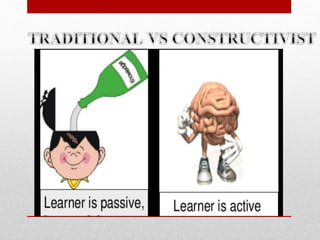
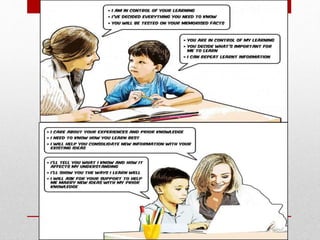
• Constructivism transforms a passive recipient of
information to an active participants in the learning process.
It encourages group work and it involves learning by doing.
• Constructivism is a learning strategy that draws in student’s
existing knowledge, belief, and skills. With a constructive
approach, students synthesis new understanding from prior
knowledge.
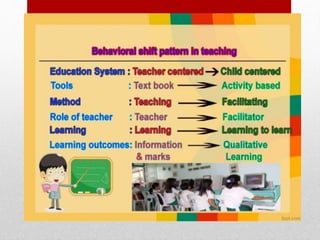
• Constructivism is also considered to be a child centred
theory that focuses on the knowledge of interpretation
and experience-based activities. The focus of the
knowledge is not to be reproduced but it is to
construct context-rich activities.
• In the general sense, it usually means encouraging
students to use active techniques (experiments, real
world problem solving) to create more knowledge and
then to reflect on and talk about what they are doing
and how their understanding is changing.
Role of Teachers in
Constructive Learning Design
• The primary responsibility of the teacher is to create a collaborative
problem-solving environment where students become active
participants in their own learning.
• A teacher acts as a facilitator of learning rather than an instructor.
• The teacher makes sure he/she understands the students' preexisting
conceptions, and guides the activity to address them and then build on
them.
• Constructivist teachers encourage students to constantly assess how the
activity is helping them gain understanding. By questioning themselves
and their strategies, students in the constructivist classroom ideally
become "expert learners." This gives them ever-broadening tools to
keep learning. With a well-planned classroom environment, the
students learn HOW TO LEARN.
• Constructivism does not dismiss the active role of the teacher or the
value of expert knowledge. Constructivism modifies that role, so that
teachers help students to construct knowledge rather than to reproduce
a series of facts.
Role of teachers
1. Modelling: 2 types of modelling:
• Behavioural modelling:
 In behavior modeling, an individual can learn new behaviors by
observing. The correct behavior is demonstrated for the learner, the
learner observes the model, and then imitates the behavior of the
model.
 For modeling to be most effective the learner must demonstrate
attending and imitative skills in their repertoire, that is, the learner
must be able to pay attention and perform the behavior that the model
just demonstrated. Modeling is an easy, practical, and successful way
of teaching.
• Cognitive modelling: The term "cognitive " in its simplest form is the
use of the mind (cognition) to solve a problem or complete a task. A
cognitive strategy serves to support the learner as he or she develops
internal procedures that enable him/her to perform tasks that are
complex .
2. Coaching: Coaching is a method in which an individual is
supervised by a superior person to improve his competencies
and capabilities. It is unlocking a person’s potential to
maximize their own performance. It is helping them to learn
rather than teaching them.
3. Scaffolding: A structure built alongside a building when a
brand new building is being built or when a building is being
repaired is scaffolding. After completion, scaffolding is
removed.
When a pupil learns a new task or a difficult skill, the skilled
person may use direct instruction. When they begin to
understand, less guidance is given.
Children apply new knowledge & be independent.
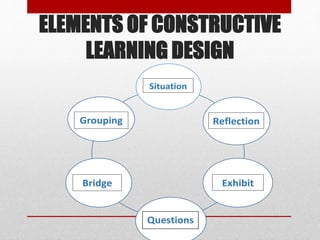
ELEMENTS OF CONSTRUCTIVE
LEARNING DESIGN
Situation
Gro
Questions
Situation
Grouping
s
Bridge
Reflection
s
Exhibit
Situation
• Teachers develop the situation for
students to explain, select process
for grouping of materials and
students.
• What situation are you going to
arrange for students to explain?
• Give this situation a title and describe a process of solving
problems, answering questions, creating metaphors,
making decisions, drawing conclusions or setting goals. The
situation should include what you expect the student to do
and how students will make their own meaning.
Groupings :-
 How you are going to make groupings; as a whole class, individuals, in
collaborative thinking teams of two, three, four, five, six, or more and what
process will you use to group them; counting off, choose a colour or
similar clothing. This depends upon the situation you design and the
materials you have available to you.
 How are you going to arrange groupings of materials that students will use
to explain the situation by physical modelling, graphically representation,
numerically, describing, or individually writing about their collective
experience. How many sets of materials you have will often determine the
number of student groups you will form.
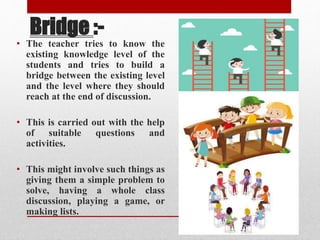
The students are then divided into
groups to explore the problem
presented in their own perspective.
There are two categories of groupings
:-
Bridge :-
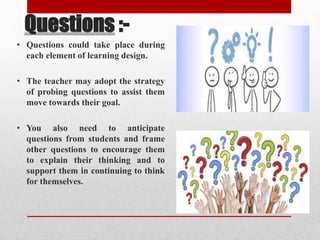
• The teacher tries to know the
existing knowledge level of the
students and tries to build a
bridge between the existing level
and the level where they should
reach at the end of discussion.
• This is carried out with the help
of suitable questions and
activities.
• This might involve such things as
giving them a simple problem to
solve, having a whole class
discussion, playing a game, or
making lists.
Questions :-
• Questions could take place during
each element of learning design.
• The teacher may adopt the strategy
of probing questions to assist them
move towards their goal.
• You also need to anticipate
questions from students and frame
other questions to encourage them
to explain their thinking and to
support them in continuing to think
for themselves.
Exhibit :-
• The students are expected to
exhibit or explain their
understandings regarding the
topic to other students.
• This involves having students
make an exhibit for others.
This could include writing a
description on cards and giving
a verbal presentation, making a
graph, chart or other visual
representation with models,
and making a video tape,
photographs, or audio tape for
display.
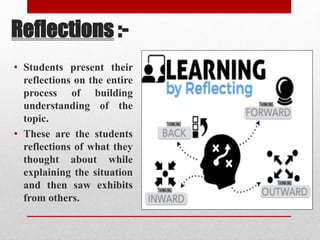
Reflections :-
• Students present their
reflections on the entire
process of building
understanding of the
topic.
• These are the students
reflections of what they
thought about while
explaining the situation
and then saw exhibits
from others.
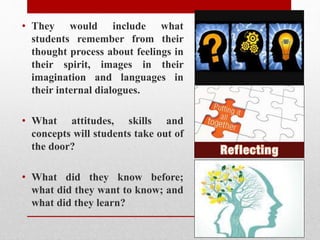
• They would include what
students remember from their
thought process about feelings in
their spirit, images in their
imagination and languages in
their internal dialogues.
• What attitudes, skills and
concepts will students take out of
the door?
• What did they know before;
what did they want to know; and
what did they learn?
Knowledge and curriculum

Knowledge and curriculum

  • 4.
    • ASSIMILATION Assimilation ofknowledge occurs when a learner encounters a new idea, and must fit that idea into what they already know. • DISSEMINATION Dissemination is to spread information, knowledge, opinions etc widely.
  • 5.
    CONSTRUCTIVISM-MEANING • Constructivism isa theory of learning that is developed from the principle of Children’s thinking. It is about how children learn. • Constructivism states that children learn through adaption. • Constructivism transforms a passive recipient of information to an active participants in the learning process. It encourages group work and it involves learning by doing. • Constructivism is a learning strategy that draws in student’s existing knowledge, belief, and skills. With a constructive approach, students synthesis new understanding from prior knowledge.
  • 6.
    • Constructivism isalso considered to be a child centred theory that focuses on the knowledge of interpretation and experience-based activities. The focus of the knowledge is not to be reproduced but it is to construct context-rich activities. • In the general sense, it usually means encouraging students to use active techniques (experiments, real world problem solving) to create more knowledge and then to reflect on and talk about what they are doing and how their understanding is changing.
  • 10.
    Role of Teachersin Constructive Learning Design • The primary responsibility of the teacher is to create a collaborative problem-solving environment where students become active participants in their own learning. • A teacher acts as a facilitator of learning rather than an instructor. • The teacher makes sure he/she understands the students' preexisting conceptions, and guides the activity to address them and then build on them. • Constructivist teachers encourage students to constantly assess how the activity is helping them gain understanding. By questioning themselves and their strategies, students in the constructivist classroom ideally become "expert learners." This gives them ever-broadening tools to keep learning. With a well-planned classroom environment, the students learn HOW TO LEARN. • Constructivism does not dismiss the active role of the teacher or the value of expert knowledge. Constructivism modifies that role, so that teachers help students to construct knowledge rather than to reproduce a series of facts.
  • 13.
    Role of teachers 1.Modelling: 2 types of modelling: • Behavioural modelling:  In behavior modeling, an individual can learn new behaviors by observing. The correct behavior is demonstrated for the learner, the learner observes the model, and then imitates the behavior of the model.  For modeling to be most effective the learner must demonstrate attending and imitative skills in their repertoire, that is, the learner must be able to pay attention and perform the behavior that the model just demonstrated. Modeling is an easy, practical, and successful way of teaching. • Cognitive modelling: The term "cognitive " in its simplest form is the use of the mind (cognition) to solve a problem or complete a task. A cognitive strategy serves to support the learner as he or she develops internal procedures that enable him/her to perform tasks that are complex .
  • 14.
    2. Coaching: Coachingis a method in which an individual is supervised by a superior person to improve his competencies and capabilities. It is unlocking a person’s potential to maximize their own performance. It is helping them to learn rather than teaching them. 3. Scaffolding: A structure built alongside a building when a brand new building is being built or when a building is being repaired is scaffolding. After completion, scaffolding is removed. When a pupil learns a new task or a difficult skill, the skilled person may use direct instruction. When they begin to understand, less guidance is given. Children apply new knowledge & be independent.
  • 15.
    ELEMENTS OF CONSTRUCTIVE LEARNINGDESIGN Situation Gro Questions Situation Grouping s Bridge Reflection s Exhibit
  • 16.
    Situation • Teachers developthe situation for students to explain, select process for grouping of materials and students. • What situation are you going to arrange for students to explain? • Give this situation a title and describe a process of solving problems, answering questions, creating metaphors, making decisions, drawing conclusions or setting goals. The situation should include what you expect the student to do and how students will make their own meaning.
  • 17.
    Groupings :-  Howyou are going to make groupings; as a whole class, individuals, in collaborative thinking teams of two, three, four, five, six, or more and what process will you use to group them; counting off, choose a colour or similar clothing. This depends upon the situation you design and the materials you have available to you.  How are you going to arrange groupings of materials that students will use to explain the situation by physical modelling, graphically representation, numerically, describing, or individually writing about their collective experience. How many sets of materials you have will often determine the number of student groups you will form. The students are then divided into groups to explore the problem presented in their own perspective. There are two categories of groupings :-
  • 18.
    Bridge :- • Theteacher tries to know the existing knowledge level of the students and tries to build a bridge between the existing level and the level where they should reach at the end of discussion. • This is carried out with the help of suitable questions and activities. • This might involve such things as giving them a simple problem to solve, having a whole class discussion, playing a game, or making lists.
  • 19.
    Questions :- • Questionscould take place during each element of learning design. • The teacher may adopt the strategy of probing questions to assist them move towards their goal. • You also need to anticipate questions from students and frame other questions to encourage them to explain their thinking and to support them in continuing to think for themselves.
  • 20.
    Exhibit :- • Thestudents are expected to exhibit or explain their understandings regarding the topic to other students. • This involves having students make an exhibit for others. This could include writing a description on cards and giving a verbal presentation, making a graph, chart or other visual representation with models, and making a video tape, photographs, or audio tape for display.
  • 21.
    Reflections :- • Studentspresent their reflections on the entire process of building understanding of the topic. • These are the students reflections of what they thought about while explaining the situation and then saw exhibits from others.
  • 22.
    • They wouldinclude what students remember from their thought process about feelings in their spirit, images in their imagination and languages in their internal dialogues. • What attitudes, skills and concepts will students take out of the door? • What did they know before; what did they want to know; and what did they learn?