BehavioralViews of Learning
1
Renée Delgado
9.26.11
2
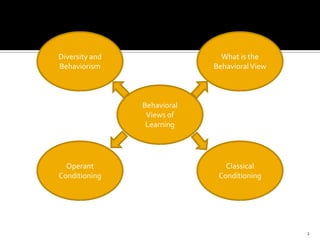
Behavioral
Views of
Learning
Operant
Conditioning
Diversity and
Behaviorism
What is the
BehavioralView
Classical
Conditioning
 Learning : any relatively permanent change in
our thoughts, feelings, or behavior that
results from experience.
 The behavioral view : learning is a relatively
enduring change in observable behavior that
results from experience.
 Mental processes not observable, and
therefore not considered.
 Based on animal learning research.
 Classroom management
 Can help teachers address students’
misbehavior and social skill deficits
 Promoting appropriate behaviors
 Social or motor skills
 Self-regulation
 Discouraging inappropriate behaviors
 Learning through association
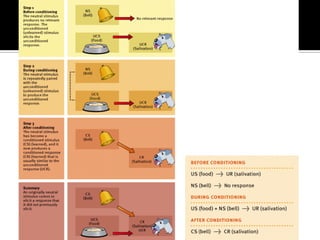
 Classical conditioning : pairing of automatic
responses to new stimuli
 Unconditioned stimulus
 Unconditioned response
 Neutral stimulus
 Unconditioned stimulus
 Unconditioned response
 Pairing neutral stimulus with unconditioned
stimulus
 Neutral stimulus becomes conditioned
stimulus
 Unconditioned Response becomes
Conditioned Response
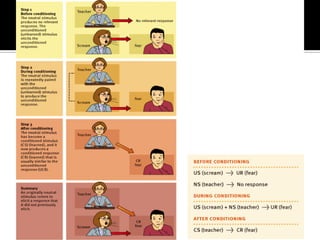
 See Figure 5.1, page 158.
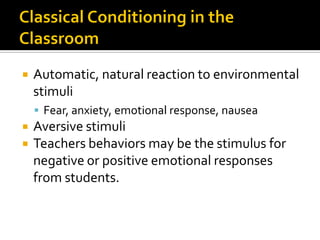
 Automatic, natural reaction to environmental
stimuli
 Fear, anxiety, emotional response, nausea
 Aversive stimuli
 Teachers behaviors may be the stimulus for
negative or positive emotional responses
from students.
 Acquisition
 Extinction
 Spontaneous recovery
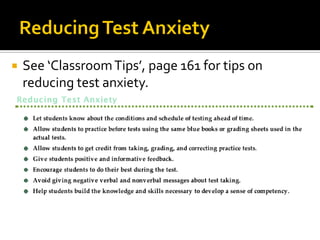
 See ‘ClassroomTips’, page 161 for tips on
reducing test anxiety.
 Generalization - tendency for a new stimulus
that is similar to the original stimulus to
produce a similar response.
 Discrimination – individuals respond to
certain stimuli but not to others.
 Operants - deliberate actions to “operate” on
the environment to change it in a certain way
 Law of effect – behaviors that are followed by
positive outcomes are strengthened and
behaviors that are followed by negative
outcomes are weakened.
 Classical  Operant
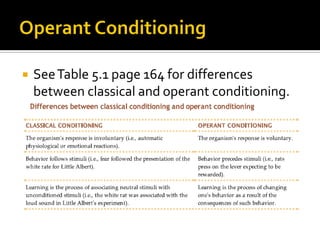
 SeeTable 5.1 page 164 for differences
between classical and operant conditioning.
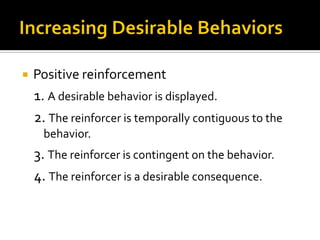
 Positive reinforcement
1. A desirable behavior is displayed.
2. The reinforcer is temporally contiguous to the
behavior.
3. The reinforcer is contingent on the behavior.
4. The reinforcer is a desirable consequence.
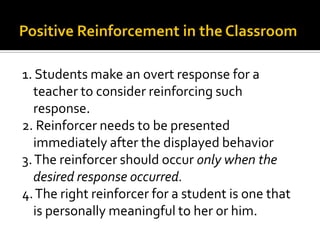
1. Students make an overt response for a
teacher to consider reinforcing such
response.
2. Reinforcer needs to be presented
immediately after the displayed behavior
3.The reinforcer should occur only when the
desired response occurred.
4.The right reinforcer for a student is one that
is personally meaningful to her or him.
 Token economies
 Contingency contracts
 Premack Principle
 Negative does not mean bad – it means removal
 Removing an aversive consequence when the
desirable behavior is displayed.
 Examples:
 Making a final exam optional for students who achieve an
average score of 80% or higher on all other tests
 Dropping students’ lowest grade when they submit all
classroom assignments on time
 Removing a stare at a student after he or she starts
working at an assignment.
 Negative reinforcement is NOT punishment.
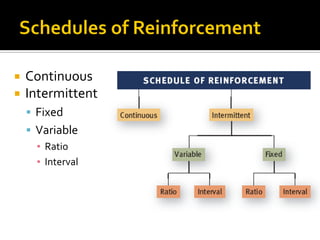
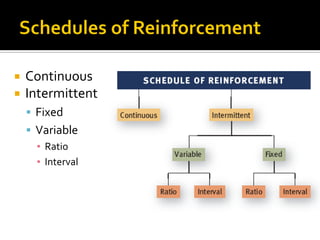
 Continuous
 Intermittent
 Fixed
 Variable
▪ Ratio
▪ Interval
 Continuous –
 most effective for helping students acquire new
behaviors
 Desirable behaviors increase rapidly during
reinforcement
 Once reinforcement stops, students will be likely
to stop displaying the desired behavior.
 Continuous
 Intermittent
 Fixed
 Variable
▪ Ratio
▪ Interval
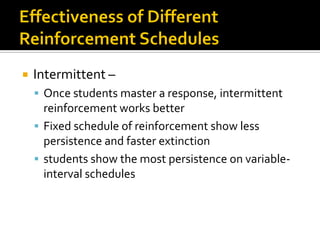
 Intermittent –
 Once students master a response, intermittent
reinforcement works better
 Fixed schedule of reinforcement show less
persistence and faster extinction
 students show the most persistence on variable-
interval schedules
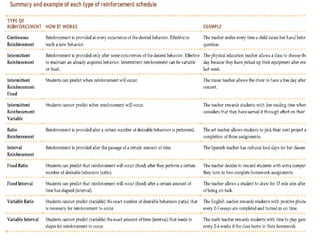
 SeeTable 5.3, page 170 for a summary of
reinforcement schedules.
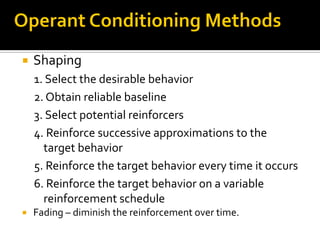
 Shaping
1. Select the desirable behavior
2. Obtain reliable baseline
3. Select potential reinforcers
4. Reinforce successive approximations to the
target behavior
5. Reinforce the target behavior every time it occurs
6. Reinforce the target behavior on a variable
reinforcement schedule
 Fading – diminish the reinforcement over time.
 Cueing
 Setting event
 Prompting
 Differential reinforcement
 Extinction
 Satiation
 Removal punishment
 Time out
 Detention
 In-school suspension
 Response cost
 Presentation punishment
 Desists, verbal reprimands, and logical consequences.
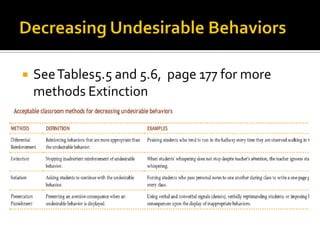
 SeeTables5.5 and 5.6, page 177 for more
methods Extinction
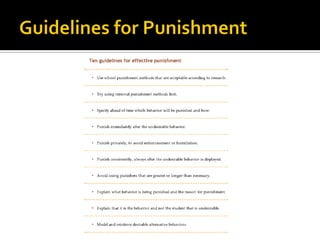
 Physical punishment
 Psychological punishment
 Extra class work
 Out-of-school suspension
 See ‘ClassroomTips’, page 179, for more
ideas on use of Behavioral Principles.
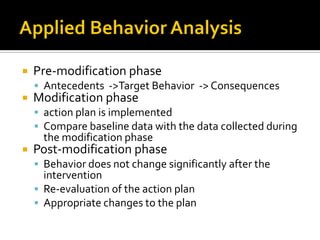
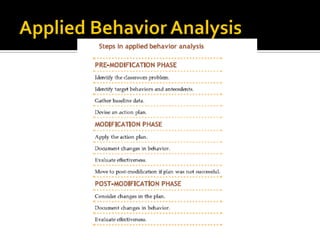
 Pre-modification phase
 Antecedents ->Target Behavior -> Consequences
 Modification phase
 action plan is implemented
 Compare baseline data with the data collected during
the modification phase
 Post-modification phase
 Behavior does not change significantly after the
intervention
 Re-evaluation of the action plan
 Appropriate changes to the plan
 All students respond to reinforcers
 Effectiveness of specific rewards and deterrents
of undesirable behavior can be influenced by
students’ individual differences:
 Interests
 Needs
 Values
 Goals
 Differences in perception of what is punishment
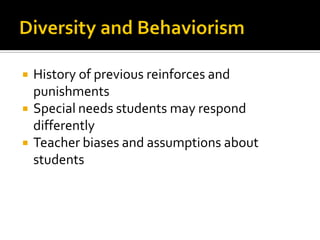
 History of previous reinforces and
punishments
 Special needs students may respond
differently
 Teacher biases and assumptions about
students
 Find a partner

lecture_notes.9.26.11

  • 1.
  • 2.
  • 4.
     Learning :any relatively permanent change in our thoughts, feelings, or behavior that results from experience.  The behavioral view : learning is a relatively enduring change in observable behavior that results from experience.  Mental processes not observable, and therefore not considered.  Based on animal learning research.
  • 5.
     Classroom management Can help teachers address students’ misbehavior and social skill deficits  Promoting appropriate behaviors  Social or motor skills  Self-regulation  Discouraging inappropriate behaviors
  • 7.
     Learning throughassociation  Classical conditioning : pairing of automatic responses to new stimuli  Unconditioned stimulus  Unconditioned response
  • 8.
     Neutral stimulus Unconditioned stimulus  Unconditioned response  Pairing neutral stimulus with unconditioned stimulus  Neutral stimulus becomes conditioned stimulus  Unconditioned Response becomes Conditioned Response  See Figure 5.1, page 158.
  • 11.
     Automatic, naturalreaction to environmental stimuli  Fear, anxiety, emotional response, nausea  Aversive stimuli  Teachers behaviors may be the stimulus for negative or positive emotional responses from students.
  • 12.
  • 13.
     See ‘ClassroomTips’,page 161 for tips on reducing test anxiety.
  • 14.
     Generalization -tendency for a new stimulus that is similar to the original stimulus to produce a similar response.  Discrimination – individuals respond to certain stimuli but not to others.
  • 16.
     Operants -deliberate actions to “operate” on the environment to change it in a certain way  Law of effect – behaviors that are followed by positive outcomes are strengthened and behaviors that are followed by negative outcomes are weakened.
  • 17.
  • 18.
     SeeTable 5.1page 164 for differences between classical and operant conditioning.
  • 19.
     Positive reinforcement 1.A desirable behavior is displayed. 2. The reinforcer is temporally contiguous to the behavior. 3. The reinforcer is contingent on the behavior. 4. The reinforcer is a desirable consequence.
  • 20.
    1. Students makean overt response for a teacher to consider reinforcing such response. 2. Reinforcer needs to be presented immediately after the displayed behavior 3.The reinforcer should occur only when the desired response occurred. 4.The right reinforcer for a student is one that is personally meaningful to her or him.
  • 21.
     Token economies Contingency contracts  Premack Principle
  • 22.
     Negative doesnot mean bad – it means removal  Removing an aversive consequence when the desirable behavior is displayed.  Examples:  Making a final exam optional for students who achieve an average score of 80% or higher on all other tests  Dropping students’ lowest grade when they submit all classroom assignments on time  Removing a stare at a student after he or she starts working at an assignment.  Negative reinforcement is NOT punishment.
  • 23.
     Continuous  Intermittent Fixed  Variable ▪ Ratio ▪ Interval
  • 24.
     Continuous – most effective for helping students acquire new behaviors  Desirable behaviors increase rapidly during reinforcement  Once reinforcement stops, students will be likely to stop displaying the desired behavior.
  • 25.
     Continuous  Intermittent Fixed  Variable ▪ Ratio ▪ Interval
  • 26.
     Intermittent – Once students master a response, intermittent reinforcement works better  Fixed schedule of reinforcement show less persistence and faster extinction  students show the most persistence on variable- interval schedules
  • 27.
     SeeTable 5.3,page 170 for a summary of reinforcement schedules.
  • 28.
     Shaping 1. Selectthe desirable behavior 2. Obtain reliable baseline 3. Select potential reinforcers 4. Reinforce successive approximations to the target behavior 5. Reinforce the target behavior every time it occurs 6. Reinforce the target behavior on a variable reinforcement schedule  Fading – diminish the reinforcement over time.
  • 29.
     Cueing  Settingevent  Prompting
  • 30.
     Differential reinforcement Extinction  Satiation  Removal punishment  Time out  Detention  In-school suspension  Response cost  Presentation punishment  Desists, verbal reprimands, and logical consequences.
  • 31.
     SeeTables5.5 and5.6, page 177 for more methods Extinction
  • 32.
     Physical punishment Psychological punishment  Extra class work  Out-of-school suspension  See ‘ClassroomTips’, page 179, for more ideas on use of Behavioral Principles.
  • 34.
     Pre-modification phase Antecedents ->Target Behavior -> Consequences  Modification phase  action plan is implemented  Compare baseline data with the data collected during the modification phase  Post-modification phase  Behavior does not change significantly after the intervention  Re-evaluation of the action plan  Appropriate changes to the plan
  • 37.
     All studentsrespond to reinforcers  Effectiveness of specific rewards and deterrents of undesirable behavior can be influenced by students’ individual differences:  Interests  Needs  Values  Goals  Differences in perception of what is punishment
  • 38.
     History ofprevious reinforces and punishments  Special needs students may respond differently  Teacher biases and assumptions about students
  • 39.
     Find apartner