Software Design Class
Diagram
Material based on
[Booch99, Rambaugh99, Jacobson99, Fowler97, Brown99]
Classes
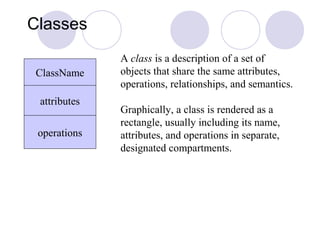
ClassName
attributes
operations
A class is a description of a set of
objects that share the same attributes,
operations, relationships, and semantics.
Graphically, a class is rendered as a
rectangle, usually including its name,
attributes, and operations in separate,
designated compartments.
Class Names
ClassName
attributes
operations
The name of the class is the only required
tag in the graphical representation of a
class. It always appears in the top-most
compartment.
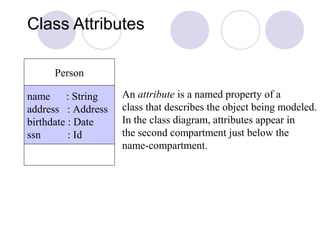
Class Attributes
Person
name : String
address : Address
birthdate : Date
ssn : Id
An attribute is a named property of a
class that describes the object being modeled.
In the class diagram, attributes appear in
the second compartment just below the
name-compartment.
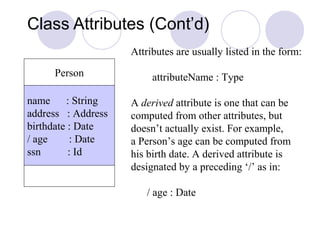
Class Attributes (Cont’d)
Person
name : String
address : Address
birthdate : Date
/ age : Date
ssn : Id
Attributes are usually listed in the form:
attributeName : Type
A derived attribute is one that can be
computed from other attributes, but
doesn’t actually exist. For example,
a Person’s age can be computed from
his birth date. A derived attribute is
designated by a preceding ‘/’ as in:
/ age : Date
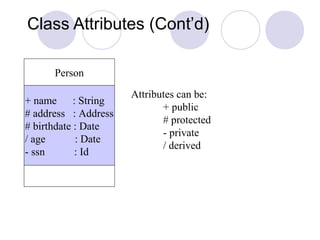
Class Attributes (Cont’d)
Person
+ name : String
# address : Address
# birthdate : Date
/ age : Date
- ssn : Id
Attributes can be:
+ public
# protected
- private
/ derived
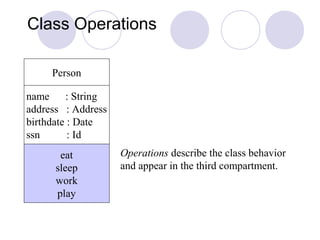
Class Operations
Person
name : String
address : Address
birthdate : Date
ssn : Id
eat
sleep
work
play
Operations describe the class behavior
and appear in the third compartment.
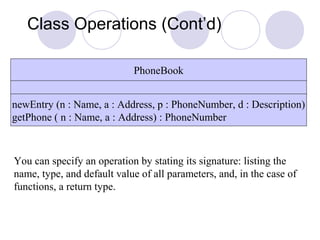
Class Operations (Cont’d)
PhoneBook
newEntry (n : Name, a : Address, p : PhoneNumber, d : Description)
getPhone ( n : Name, a : Address) : PhoneNumber
You can specify an operation by stating its signature: listing the
name, type, and default value of all parameters, and, in the case of
functions, a return type.
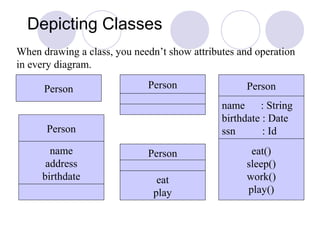
Depicting Classes
Person
name : String
birthdate : Date
ssn : Id
eat()
sleep()
work()
play()
When drawing a class, you needn’t show attributes and operation
in every diagram.
Person
Person
name
address
birthdate
Person
eat
play
Person
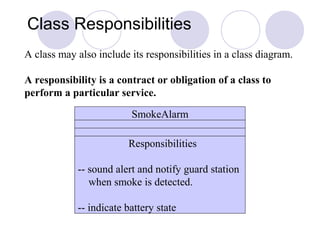
Class Responsibilities
A class may also include its responsibilities in a class diagram.
A responsibility is a contract or obligation of a class to
perform a particular service.
SmokeAlarm
Responsibilities
-- sound alert and notify guard station
when smoke is detected.
-- indicate battery state
Relationships
In UML, object interconnections (logical or physical), are
modeled as relationships.
There are three kinds of relationships in UML:
• dependencies
• generalizations
• associations
Dependency Relationships
CourseSchedule
add(c : Course)
remove(c : Course)
Course
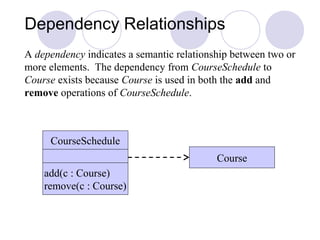
A dependency indicates a semantic relationship between two or
more elements. The dependency from CourseSchedule to
Course exists because Course is used in both the add and
remove operations of CourseSchedule.
Generalization Relationships
Person
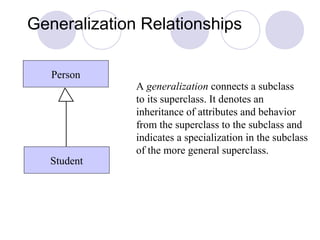
A generalization connects a subclass
to its superclass. It denotes an
inheritance of attributes and behavior
from the superclass to the subclass and
indicates a specialization in the subclass
of the more general superclass.
Student
Generalization Relationships (Cont’d)
Student
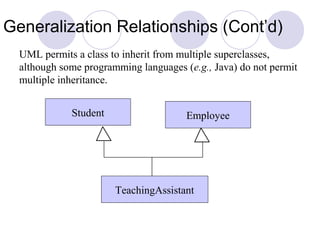
UML permits a class to inherit from multiple superclasses,
although some programming languages (e.g., Java) do not permit
multiple inheritance.
TeachingAssistant
Employee
Association Relationships
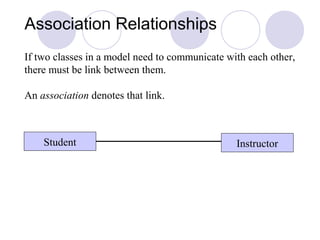
If two classes in a model need to communicate with each other,
there must be link between them.
An association denotes that link.
InstructorStudent
Association Relationships (Cont’d)
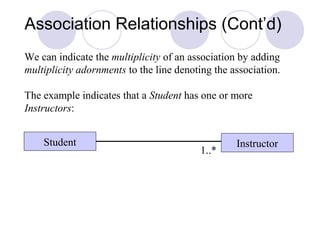
We can indicate the multiplicity of an association by adding
multiplicity adornments to the line denoting the association.
The example indicates that a Student has one or more
Instructors:
InstructorStudent
1..*
Association Relationships (Cont’d)
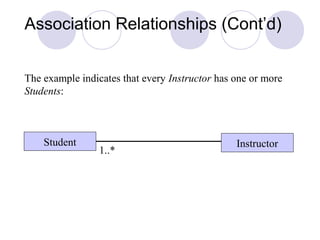
The example indicates that every Instructor has one or more
Students:
InstructorStudent
1..*
Association Relationships (Cont’d)
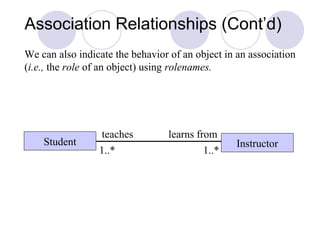
We can also indicate the behavior of an object in an association
(i.e., the role of an object) using rolenames.
InstructorStudent
1..*1..*
learns fromteaches
Association Relationships (Cont’d)
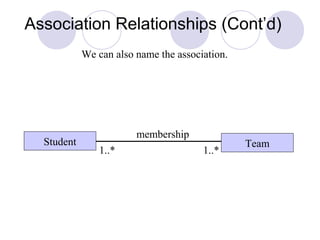
We can also name the association.
TeamStudent
membership
1..* 1..*
Association Relationships (Cont’d)
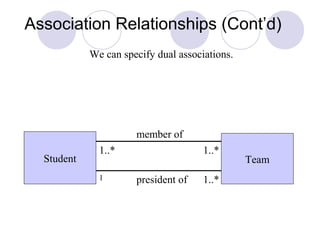
We can specify dual associations.
TeamStudent
member of
1..*
president of1 1..*
1..*
Association Relationships (Cont’d)
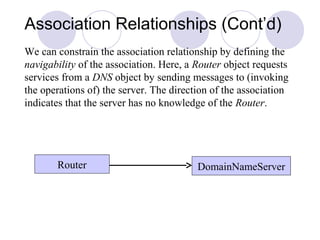
We can constrain the association relationship by defining the
navigability of the association. Here, a Router object requests
services from a DNS object by sending messages to (invoking
the operations of) the server. The direction of the association
indicates that the server has no knowledge of the Router.
Router DomainNameServer
Association Relationships (Cont’d)
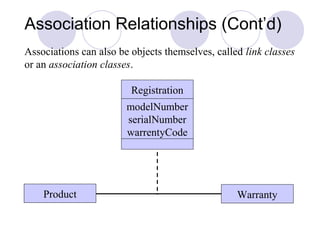
Associations can also be objects themselves, called link classes
or an association classes.
WarrantyProduct
Registration
modelNumber
serialNumber
warrentyCode
Association Relationships (Cont’d)
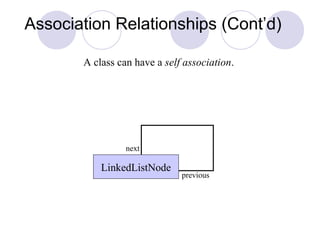
A class can have a self association.
LinkedListNode
next
previous
Association Relationships (Cont’d)
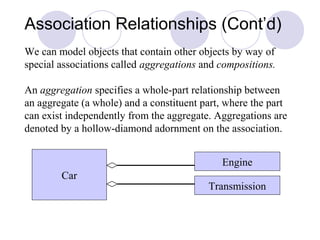
We can model objects that contain other objects by way of
special associations called aggregations and compositions.
An aggregation specifies a whole-part relationship between
an aggregate (a whole) and a constituent part, where the part
can exist independently from the aggregate. Aggregations are
denoted by a hollow-diamond adornment on the association.
Car
Engine
Transmission
Association Relationships (Cont’d)
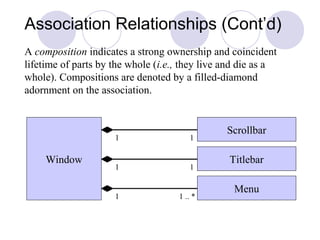
A composition indicates a strong ownership and coincident
lifetime of parts by the whole (i.e., they live and die as a
whole). Compositions are denoted by a filled-diamond
adornment on the association.
Window
Scrollbar
Titlebar
Menu
1
1
1
1
1
1 .. *
Interfaces
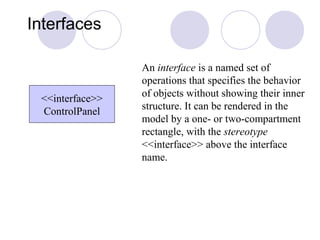
An interface is a named set of
operations that specifies the behavior
of objects without showing their inner
structure. It can be rendered in the
model by a one- or two-compartment
rectangle, with the stereotype
<<interface>> above the interface
name.
<<interface>>
ControlPanel
Interface Services
Interfaces do not get instantiated.
They have no attributes or state.
Rather, they specify the services
offered by a related class.
<<interface>>
ControlPanel
getChoices : Choice[]
makeChoice (c : Choice)
getSelection : Selection
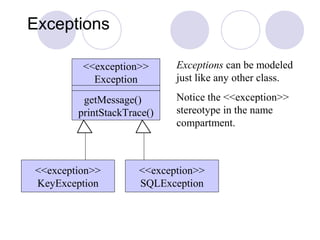
Exceptions
<<exception>>
KeyException
<<exception>>
SQLException
<<exception>>
Exception
getMessage()
printStackTrace()
Exceptions can be modeled
just like any other class.
Notice the <<exception>>
stereotype in the name
compartment.
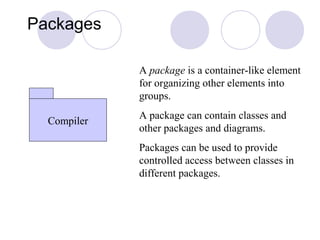
Packages
Compiler
A package is a container-like element
for organizing other elements into
groups.
A package can contain classes and
other packages and diagrams.
Packages can be used to provide
controlled access between classes in
different packages.
Example: Problem Report Tool
A CASE tool for storing and tracking
problem reports
Each report contains a problem description and
a status
Each problem can be assigned to someone
Problem reports are made on one of the
“artifacts” of a project
Employees are assigned to a project
A manager may add new artifacts and assign
problem reports to team members
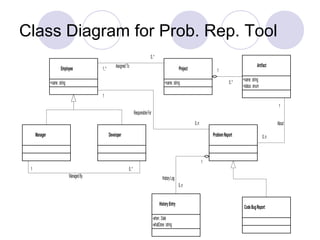
Class Diagram for Prob. Rep. Tool
Employee
+name:string
Manager Developer
Project
+name:string
Artifact
+name:string
+status:enum
ProblemReport
HistoryEntry
-when:Date
-whatDone:string
CodeBugReport
1
0..n
ResponsibleFor
0..*
1
1
0..n
About
0..n
1
HistoryLog
1..*
0..*
AssignedTo
1 0..*
ManagedBy

Lecture12 software design class diagram

  • 1.
    Software Design Class Diagram Materialbased on [Booch99, Rambaugh99, Jacobson99, Fowler97, Brown99]
  • 2.
    Classes ClassName attributes operations A class isa description of a set of objects that share the same attributes, operations, relationships, and semantics. Graphically, a class is rendered as a rectangle, usually including its name, attributes, and operations in separate, designated compartments.
  • 3.
    Class Names ClassName attributes operations The nameof the class is the only required tag in the graphical representation of a class. It always appears in the top-most compartment.
  • 4.
    Class Attributes Person name :String address : Address birthdate : Date ssn : Id An attribute is a named property of a class that describes the object being modeled. In the class diagram, attributes appear in the second compartment just below the name-compartment.
  • 5.
    Class Attributes (Cont’d) Person name: String address : Address birthdate : Date / age : Date ssn : Id Attributes are usually listed in the form: attributeName : Type A derived attribute is one that can be computed from other attributes, but doesn’t actually exist. For example, a Person’s age can be computed from his birth date. A derived attribute is designated by a preceding ‘/’ as in: / age : Date
  • 6.
    Class Attributes (Cont’d) Person +name : String # address : Address # birthdate : Date / age : Date - ssn : Id Attributes can be: + public # protected - private / derived
  • 7.
    Class Operations Person name :String address : Address birthdate : Date ssn : Id eat sleep work play Operations describe the class behavior and appear in the third compartment.
  • 8.
    Class Operations (Cont’d) PhoneBook newEntry(n : Name, a : Address, p : PhoneNumber, d : Description) getPhone ( n : Name, a : Address) : PhoneNumber You can specify an operation by stating its signature: listing the name, type, and default value of all parameters, and, in the case of functions, a return type.
  • 9.
    Depicting Classes Person name :String birthdate : Date ssn : Id eat() sleep() work() play() When drawing a class, you needn’t show attributes and operation in every diagram. Person Person name address birthdate Person eat play Person
  • 10.
    Class Responsibilities A classmay also include its responsibilities in a class diagram. A responsibility is a contract or obligation of a class to perform a particular service. SmokeAlarm Responsibilities -- sound alert and notify guard station when smoke is detected. -- indicate battery state
  • 11.
    Relationships In UML, objectinterconnections (logical or physical), are modeled as relationships. There are three kinds of relationships in UML: • dependencies • generalizations • associations
  • 12.
    Dependency Relationships CourseSchedule add(c :Course) remove(c : Course) Course A dependency indicates a semantic relationship between two or more elements. The dependency from CourseSchedule to Course exists because Course is used in both the add and remove operations of CourseSchedule.
  • 13.
    Generalization Relationships Person A generalizationconnects a subclass to its superclass. It denotes an inheritance of attributes and behavior from the superclass to the subclass and indicates a specialization in the subclass of the more general superclass. Student
  • 14.
    Generalization Relationships (Cont’d) Student UMLpermits a class to inherit from multiple superclasses, although some programming languages (e.g., Java) do not permit multiple inheritance. TeachingAssistant Employee
  • 15.
    Association Relationships If twoclasses in a model need to communicate with each other, there must be link between them. An association denotes that link. InstructorStudent
  • 16.
    Association Relationships (Cont’d) Wecan indicate the multiplicity of an association by adding multiplicity adornments to the line denoting the association. The example indicates that a Student has one or more Instructors: InstructorStudent 1..*
  • 17.
    Association Relationships (Cont’d) Theexample indicates that every Instructor has one or more Students: InstructorStudent 1..*
  • 18.
    Association Relationships (Cont’d) Wecan also indicate the behavior of an object in an association (i.e., the role of an object) using rolenames. InstructorStudent 1..*1..* learns fromteaches
  • 19.
    Association Relationships (Cont’d) Wecan also name the association. TeamStudent membership 1..* 1..*
  • 20.
    Association Relationships (Cont’d) Wecan specify dual associations. TeamStudent member of 1..* president of1 1..* 1..*
  • 21.
    Association Relationships (Cont’d) Wecan constrain the association relationship by defining the navigability of the association. Here, a Router object requests services from a DNS object by sending messages to (invoking the operations of) the server. The direction of the association indicates that the server has no knowledge of the Router. Router DomainNameServer
  • 22.
    Association Relationships (Cont’d) Associationscan also be objects themselves, called link classes or an association classes. WarrantyProduct Registration modelNumber serialNumber warrentyCode
  • 23.
    Association Relationships (Cont’d) Aclass can have a self association. LinkedListNode next previous
  • 24.
    Association Relationships (Cont’d) Wecan model objects that contain other objects by way of special associations called aggregations and compositions. An aggregation specifies a whole-part relationship between an aggregate (a whole) and a constituent part, where the part can exist independently from the aggregate. Aggregations are denoted by a hollow-diamond adornment on the association. Car Engine Transmission
  • 25.
    Association Relationships (Cont’d) Acomposition indicates a strong ownership and coincident lifetime of parts by the whole (i.e., they live and die as a whole). Compositions are denoted by a filled-diamond adornment on the association. Window Scrollbar Titlebar Menu 1 1 1 1 1 1 .. *
  • 26.
    Interfaces An interface isa named set of operations that specifies the behavior of objects without showing their inner structure. It can be rendered in the model by a one- or two-compartment rectangle, with the stereotype <<interface>> above the interface name. <<interface>> ControlPanel
  • 27.
    Interface Services Interfaces donot get instantiated. They have no attributes or state. Rather, they specify the services offered by a related class. <<interface>> ControlPanel getChoices : Choice[] makeChoice (c : Choice) getSelection : Selection
  • 28.
    Exceptions <<exception>> KeyException <<exception>> SQLException <<exception>> Exception getMessage() printStackTrace() Exceptions can bemodeled just like any other class. Notice the <<exception>> stereotype in the name compartment.
  • 29.
    Packages Compiler A package isa container-like element for organizing other elements into groups. A package can contain classes and other packages and diagrams. Packages can be used to provide controlled access between classes in different packages.
  • 30.
    Example: Problem ReportTool A CASE tool for storing and tracking problem reports Each report contains a problem description and a status Each problem can be assigned to someone Problem reports are made on one of the “artifacts” of a project Employees are assigned to a project A manager may add new artifacts and assign problem reports to team members
  • 31.
    Class Diagram forProb. Rep. Tool Employee +name:string Manager Developer Project +name:string Artifact +name:string +status:enum ProblemReport HistoryEntry -when:Date -whatDone:string CodeBugReport 1 0..n ResponsibleFor 0..* 1 1 0..n About 0..n 1 HistoryLog 1..* 0..* AssignedTo 1 0..* ManagedBy