Principles of Pharmacogenomics Readings: Pharmacogenomics (Rothstein,ed. Chapter 2, 8, 9, 11) ©2003-2008 Gus Rosania
Outline What is Pharmacogenomics? How does it work? What are the forces pushing pharmacogenomics into health care practice What are the four essential steps for translating pharmacogenomics info from research to practice. ©2003-2008 Gus Rosania
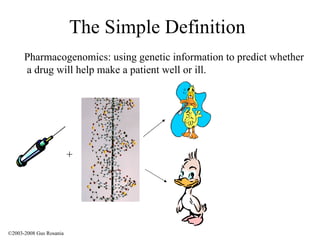
The Simple Definition ©2003-2008 Gus Rosania Pharmacogenomics: using genetic information to predict whether a drug will help make a patient well or ill. +
Pharmacogenomics as a field Pharmacogenomics studies how genes determine interindividual variability in drug response. Combines many different fields: Genetics, genomics, molecular biology, pharmacology, pharmaceutics, toxicology, population biology, statistics. For Pharmacists: It may be used to predict how a patient may respond to drug, with the help of a genetic test. ©2003-2008 Gus Rosania
What makes pharmacogenomics possible today but not 10yrs ago? Sequencing of the human genome reveals 2.9 billion base pairs that are constant, narrowing down variability to about 3 million base pairs, of which 100,000 capture the full human variation and <10,000 may be pharmaceutically relevant. Advances in genome sequencing technology make possible addressing those individual base pairs. Automatization and miniaturization significantly drive down cost of DNA sequencing reaction. Computer technology and computer networks facilitate handling of data. ©2003-2008 Gus Rosania
Current Impact Pharmacogenomics broadly adopted in drug discovery and development phases in the pharmaceutical industry. Pharmacogenomics research heavily invested upon by public and private companies 3.  Pharmacogenomics seen as the future of medicine – so called PERSONALIZED MEDICINE. ©2003-2008 Gus Rosania
Future Trends Point-of-care (Doctor’s office) genetic testing Personal Genomics Population sequencing ©2003-2008 Gus Rosania
2. Forces Driving Pharmacogenomics into Healthcare Practice ©2003-2008 Gus Rosania
QUESTION What are the driving forces behind pharmacogenomics?
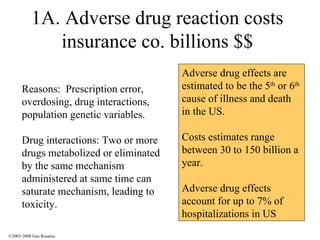
1A. Adverse drug reaction costs insurance co. billions $$ Reasons:  Prescription error, overdosing, drug interactions, population genetic variables. Drug interactions: Two or more drugs metabolized or eliminated by the same mechanism administered at same time can saturate mechanism, leading to toxicity. Adverse drug effects are estimated to be the 5 th  or 6 th  cause of illness and death in the US.  Costs estimates range between 30 to 150 billion a year. Adverse drug effects account for up to 7% of hospitalizations in US ©2003-2008 Gus Rosania
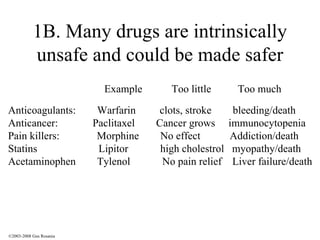
1B. Many drugs are intrinsically unsafe and could be made safer Anticoagulants:  Warfarin  clots, stroke  bleeding/death Anticancer:  Paclitaxel  Cancer grows  immunocytopenia Pain killers:  Morphine  No effect  Addiction/death Statins  Lipitor  high cholestrol  myopathy/death Acetaminophen  Tylenol  No pain relief  Liver failure/death Example  Too little  Too much  ©2003-2008 Gus Rosania
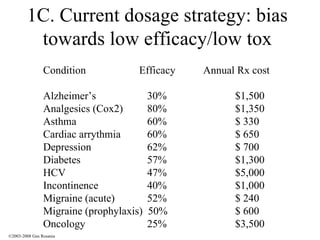
1C. Current dosage strategy: bias towards low efficacy/low tox Condition Efficacy  Annual Rx cost Alzheimer’s   30% $1,500 Analgesics (Cox2)   80% $1,350 Asthma   60% $ 330 Cardiac arrythmia   60% $ 650 Depression   62% $ 700 Diabetes   57% $1,300 HCV   47% $5,000 Incontinence   40% $1,000 Migraine (acute)   52% $ 240 Migraine (prophylaxis)  50%  $ 600 Oncology   25% $3,500 ©2003-2008 Gus Rosania
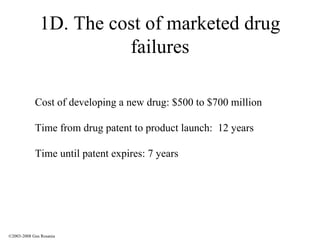
1D. The cost of marketed drug failures Cost of developing a new drug: $500 to $700 million Time from drug patent to product launch:  12 years Time until patent expires: 7 years ©2003-2008 Gus Rosania
1E.  Consumer advocacy/Litigation The sequencing of the human genome has led to identification of genetic markers for drug toxicity. The patients may hold pharmaceutical companies liable for not requiring pharmacogenomic testing in association with drug prescription. ©2003-2008 Gus Rosania
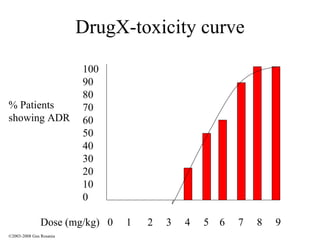
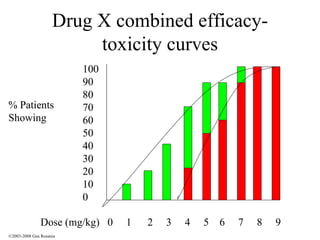
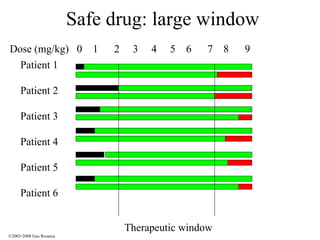
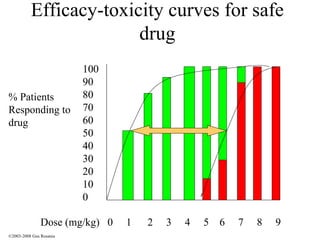
Goal: Use genetic info. to broaden drug’s therapeutic index Efficacy:  % patients cured at a given dose   Toxicity:% patients exhibiting side effects at a given dose Therapeutic index: Dose range at which drug shows highest efficacy and low toxicity ©2003-2008 Gus Rosania
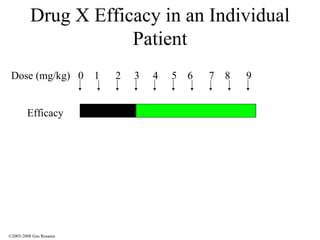
Drug X Efficacy in an Individual Patient Efficacy Dose (mg/kg)  0  1  2  3  4  5  6  7  8  9 ©2003-2008 Gus Rosania
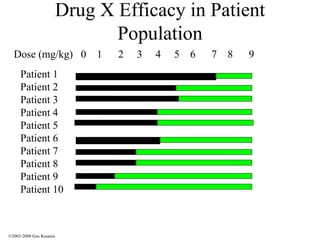
Drug X Efficacy in Patient Population Patient 1 Patient 2 Patient 3 Patient 4 Patient 5 Patient 6 Patient 7 Patient 8 Patient 9 Patient 10 Dose (mg/kg)  0  1  2  3  4  5  6  7  8  9 ©2003-2008 Gus Rosania
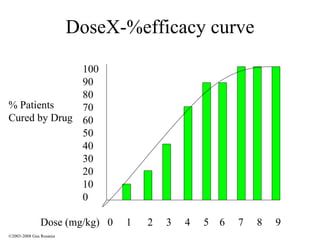
DoseX-%efficacy curve Dose (mg/kg)  0  1  2  3  4  5  6  7  8  9 % Patients Cured by Drug 100 90 80 70 60 50 40 30 20 10 0 ©2003-2008 Gus Rosania
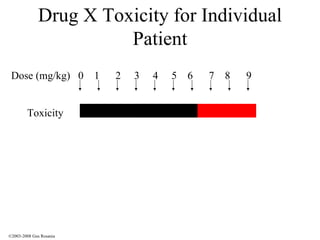
Drug X Toxicity for Individual Patient Toxicity Dose (mg/kg)  0  1  2  3  4  5  6  7  8  9 ©2003-2008 Gus Rosania
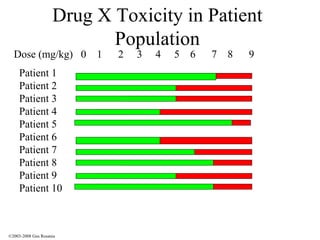
Drug X Toxicity in Patient Population Patient 1 Patient 2 Patient 3 Patient 4 Patient 5 Patient 6 Patient 7 Patient 8 Patient 9 Patient 10 Dose (mg/kg)  0  1  2  3  4  5  6  7  8  9 ©2003-2008 Gus Rosania
DrugX-toxicity curve Dose (mg/kg)  0  1  2  3  4  5  6  7  8  9 % Patients showing ADR 100 90 80 70 60 50 40 30 20 10 0 ©2003-2008 Gus Rosania
Drug X combined efficacy-toxicity curves % Patients Showing  100 90 80 70 60 50 40 30 20 10 0 Dose (mg/kg)  0  1  2  3  4  5  6  7  8  9 % Patients 100 90 80 70 60 50 40 30 20 10 0 ©2003-2008 Gus Rosania
Safe drug: large window Patient 1 Patient 2 Patient 3 Patient 4 Patient 5 Patient 6 Therapeutic window Dose (mg/kg)  0  1  2  3  4  5  6  7  8  9 ©2003-2008 Gus Rosania
Efficacy-toxicity curves for safe drug % Patients Showing  100 90 80 70 60 50 40 30 20 10 0 Dose (mg/kg)  0  1  2  3  4  5  6  7  8  9 % Patients Responding to drug 100 90 80 70 60 50 40 30 20 10 0 ©2003-2008 Gus Rosania
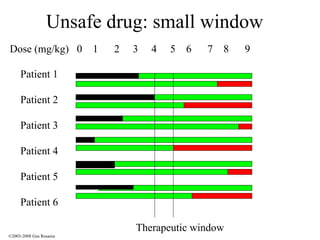
Unsafe drug: small window Patient 1 Patient 2 Patient 3 Patient 4 Patient 5 Patient 6 Dose (mg/kg)  0  1  2  3  4  5  6  7  8  9 Therapeutic window ©2003-2008 Gus Rosania
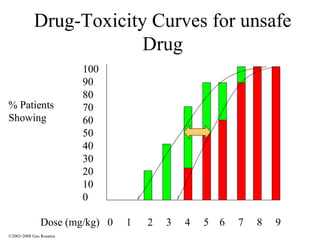
Drug-Toxicity Curves for unsafe Drug % Patients Showing  100 90 80 70 60 50 40 30 20 10 0 Dose (mg/kg)  0  1  2  3  4  5  6  7  8  9 % Patients 100 90 80 70 60 50 40 30 20 10 0 ©2003-2008 Gus Rosania
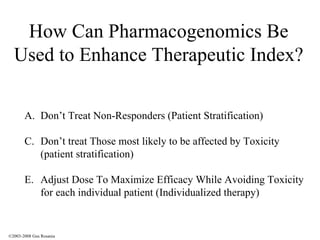
How Can Pharmacogenomics Be Used to Enhance Therapeutic Index? Don’t Treat Non-Responders (Patient Stratification) Don’t treat Those most likely to be affected by Toxicity (patient stratification) Adjust Dose To Maximize Efficacy While Avoiding Toxicity for each individual patient (Individualized therapy) ©2003-2008 Gus Rosania
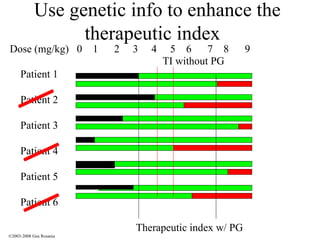
Use genetic info to enhance the therapeutic index  TI without PG ©2003-2008 Gus Rosania Patient 1 Patient 2 Patient 3 Patient 4 Patient 5 Patient 6 Dose (mg/kg)  0  1  2  3  4  5  6  7  8  9 Therapeutic index w/ PG
What are the steps for translating pharmacogenomic info. from research into practice? ©2003-2008 Gus Rosania
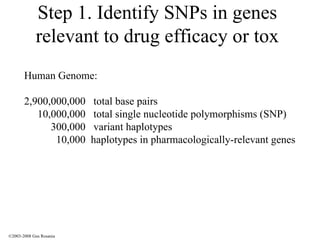
Step 1. Identify SNPs in genes relevant to drug efficacy or tox Human Genome: 2,900,000,000  total base pairs 10,000,000  total single nucleotide polymorphisms (SNP) 300,000  variant haplotypes 10,000  haplotypes in pharmacologically-relevant genes ©2003-2008 Gus Rosania
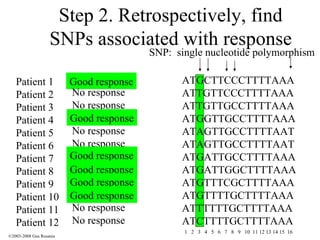
Step 2. Retrospectively, find SNPs associated with response Patient 1 Patient 2 Patient 3 Patient 4 Patient 5 Patient 6 Patient 7 Patient 8 Patient 9 Patient 10 Patient 11 Patient 12 Good response No response No response Good response No response No response Good response Good response Good response Good response No response No response ATGCTTCCCTTTTAAA ATTGTTCCCTTTTAAA ATTGTTGCCTTTTAAA ATGGTTGCCTTTTAAA ATAGTTGCCTTTTAAT ATAGTTGCCTTTTAAT ATGATTGCCTTTTAAA ATGATTGGCTTTTAAA ATGTTTCGCTTTTAAA ATGTTTTGCTTTTAAA ATTTTTTGCTTTTAAA ATCTTTTGCTTTTAAA SNP:  single nucleotide polymorphism Good response Good response Good response Good response Good response 1  2  3  4  5  6  7  8  9  10  11 12 13 14 15  16 ©2003-2008 Gus Rosania
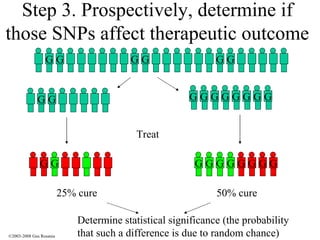
Step 3. Prospectively, determine if those SNPs affect therapeutic outcome G G G G G G G G G G G G G G G G G G G G G G G G G G Treat 25% cure  50% cure  Determine statistical significance (the probability that such a difference is due to random chance) ©2003-2008 Gus Rosania
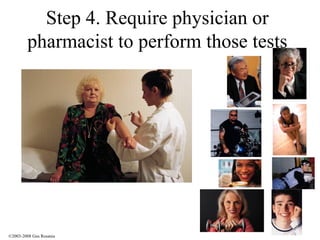
Step 4. Require physician or pharmacist to perform those tests ©2003-2008 Gus Rosania

lecture1_2008_p734

  • 1.
    Principles of PharmacogenomicsReadings: Pharmacogenomics (Rothstein,ed. Chapter 2, 8, 9, 11) ©2003-2008 Gus Rosania
  • 2.
    Outline What isPharmacogenomics? How does it work? What are the forces pushing pharmacogenomics into health care practice What are the four essential steps for translating pharmacogenomics info from research to practice. ©2003-2008 Gus Rosania
  • 3.
    The Simple Definition©2003-2008 Gus Rosania Pharmacogenomics: using genetic information to predict whether a drug will help make a patient well or ill. +
  • 4.
    Pharmacogenomics as afield Pharmacogenomics studies how genes determine interindividual variability in drug response. Combines many different fields: Genetics, genomics, molecular biology, pharmacology, pharmaceutics, toxicology, population biology, statistics. For Pharmacists: It may be used to predict how a patient may respond to drug, with the help of a genetic test. ©2003-2008 Gus Rosania
  • 5.
    What makes pharmacogenomicspossible today but not 10yrs ago? Sequencing of the human genome reveals 2.9 billion base pairs that are constant, narrowing down variability to about 3 million base pairs, of which 100,000 capture the full human variation and <10,000 may be pharmaceutically relevant. Advances in genome sequencing technology make possible addressing those individual base pairs. Automatization and miniaturization significantly drive down cost of DNA sequencing reaction. Computer technology and computer networks facilitate handling of data. ©2003-2008 Gus Rosania
  • 6.
    Current Impact Pharmacogenomicsbroadly adopted in drug discovery and development phases in the pharmaceutical industry. Pharmacogenomics research heavily invested upon by public and private companies 3. Pharmacogenomics seen as the future of medicine – so called PERSONALIZED MEDICINE. ©2003-2008 Gus Rosania
  • 7.
    Future Trends Point-of-care(Doctor’s office) genetic testing Personal Genomics Population sequencing ©2003-2008 Gus Rosania
  • 8.
    2. Forces DrivingPharmacogenomics into Healthcare Practice ©2003-2008 Gus Rosania
  • 9.
    QUESTION What arethe driving forces behind pharmacogenomics?
  • 10.
    1A. Adverse drugreaction costs insurance co. billions $$ Reasons: Prescription error, overdosing, drug interactions, population genetic variables. Drug interactions: Two or more drugs metabolized or eliminated by the same mechanism administered at same time can saturate mechanism, leading to toxicity. Adverse drug effects are estimated to be the 5 th or 6 th cause of illness and death in the US. Costs estimates range between 30 to 150 billion a year. Adverse drug effects account for up to 7% of hospitalizations in US ©2003-2008 Gus Rosania
  • 11.
    1B. Many drugsare intrinsically unsafe and could be made safer Anticoagulants: Warfarin clots, stroke bleeding/death Anticancer: Paclitaxel Cancer grows immunocytopenia Pain killers: Morphine No effect Addiction/death Statins Lipitor high cholestrol myopathy/death Acetaminophen Tylenol No pain relief Liver failure/death Example Too little Too much ©2003-2008 Gus Rosania
  • 12.
    1C. Current dosagestrategy: bias towards low efficacy/low tox Condition Efficacy Annual Rx cost Alzheimer’s 30% $1,500 Analgesics (Cox2) 80% $1,350 Asthma 60% $ 330 Cardiac arrythmia 60% $ 650 Depression 62% $ 700 Diabetes 57% $1,300 HCV 47% $5,000 Incontinence 40% $1,000 Migraine (acute) 52% $ 240 Migraine (prophylaxis) 50% $ 600 Oncology 25% $3,500 ©2003-2008 Gus Rosania
  • 13.
    1D. The costof marketed drug failures Cost of developing a new drug: $500 to $700 million Time from drug patent to product launch: 12 years Time until patent expires: 7 years ©2003-2008 Gus Rosania
  • 14.
    1E. Consumeradvocacy/Litigation The sequencing of the human genome has led to identification of genetic markers for drug toxicity. The patients may hold pharmaceutical companies liable for not requiring pharmacogenomic testing in association with drug prescription. ©2003-2008 Gus Rosania
  • 15.
    Goal: Use geneticinfo. to broaden drug’s therapeutic index Efficacy: % patients cured at a given dose Toxicity:% patients exhibiting side effects at a given dose Therapeutic index: Dose range at which drug shows highest efficacy and low toxicity ©2003-2008 Gus Rosania
  • 16.
    Drug X Efficacyin an Individual Patient Efficacy Dose (mg/kg) 0 1 2 3 4 5 6 7 8 9 ©2003-2008 Gus Rosania
  • 17.
    Drug X Efficacyin Patient Population Patient 1 Patient 2 Patient 3 Patient 4 Patient 5 Patient 6 Patient 7 Patient 8 Patient 9 Patient 10 Dose (mg/kg) 0 1 2 3 4 5 6 7 8 9 ©2003-2008 Gus Rosania
  • 18.
    DoseX-%efficacy curve Dose(mg/kg) 0 1 2 3 4 5 6 7 8 9 % Patients Cured by Drug 100 90 80 70 60 50 40 30 20 10 0 ©2003-2008 Gus Rosania
  • 19.
    Drug X Toxicityfor Individual Patient Toxicity Dose (mg/kg) 0 1 2 3 4 5 6 7 8 9 ©2003-2008 Gus Rosania
  • 20.
    Drug X Toxicityin Patient Population Patient 1 Patient 2 Patient 3 Patient 4 Patient 5 Patient 6 Patient 7 Patient 8 Patient 9 Patient 10 Dose (mg/kg) 0 1 2 3 4 5 6 7 8 9 ©2003-2008 Gus Rosania
  • 21.
    DrugX-toxicity curve Dose(mg/kg) 0 1 2 3 4 5 6 7 8 9 % Patients showing ADR 100 90 80 70 60 50 40 30 20 10 0 ©2003-2008 Gus Rosania
  • 22.
    Drug X combinedefficacy-toxicity curves % Patients Showing 100 90 80 70 60 50 40 30 20 10 0 Dose (mg/kg) 0 1 2 3 4 5 6 7 8 9 % Patients 100 90 80 70 60 50 40 30 20 10 0 ©2003-2008 Gus Rosania
  • 23.
    Safe drug: largewindow Patient 1 Patient 2 Patient 3 Patient 4 Patient 5 Patient 6 Therapeutic window Dose (mg/kg) 0 1 2 3 4 5 6 7 8 9 ©2003-2008 Gus Rosania
  • 24.
    Efficacy-toxicity curves forsafe drug % Patients Showing 100 90 80 70 60 50 40 30 20 10 0 Dose (mg/kg) 0 1 2 3 4 5 6 7 8 9 % Patients Responding to drug 100 90 80 70 60 50 40 30 20 10 0 ©2003-2008 Gus Rosania
  • 25.
    Unsafe drug: smallwindow Patient 1 Patient 2 Patient 3 Patient 4 Patient 5 Patient 6 Dose (mg/kg) 0 1 2 3 4 5 6 7 8 9 Therapeutic window ©2003-2008 Gus Rosania
  • 26.
    Drug-Toxicity Curves forunsafe Drug % Patients Showing 100 90 80 70 60 50 40 30 20 10 0 Dose (mg/kg) 0 1 2 3 4 5 6 7 8 9 % Patients 100 90 80 70 60 50 40 30 20 10 0 ©2003-2008 Gus Rosania
  • 27.
    How Can PharmacogenomicsBe Used to Enhance Therapeutic Index? Don’t Treat Non-Responders (Patient Stratification) Don’t treat Those most likely to be affected by Toxicity (patient stratification) Adjust Dose To Maximize Efficacy While Avoiding Toxicity for each individual patient (Individualized therapy) ©2003-2008 Gus Rosania
  • 28.
    Use genetic infoto enhance the therapeutic index TI without PG ©2003-2008 Gus Rosania Patient 1 Patient 2 Patient 3 Patient 4 Patient 5 Patient 6 Dose (mg/kg) 0 1 2 3 4 5 6 7 8 9 Therapeutic index w/ PG
  • 29.
    What are thesteps for translating pharmacogenomic info. from research into practice? ©2003-2008 Gus Rosania
  • 30.
    Step 1. IdentifySNPs in genes relevant to drug efficacy or tox Human Genome: 2,900,000,000 total base pairs 10,000,000 total single nucleotide polymorphisms (SNP) 300,000 variant haplotypes 10,000 haplotypes in pharmacologically-relevant genes ©2003-2008 Gus Rosania
  • 31.
    Step 2. Retrospectively,find SNPs associated with response Patient 1 Patient 2 Patient 3 Patient 4 Patient 5 Patient 6 Patient 7 Patient 8 Patient 9 Patient 10 Patient 11 Patient 12 Good response No response No response Good response No response No response Good response Good response Good response Good response No response No response ATGCTTCCCTTTTAAA ATTGTTCCCTTTTAAA ATTGTTGCCTTTTAAA ATGGTTGCCTTTTAAA ATAGTTGCCTTTTAAT ATAGTTGCCTTTTAAT ATGATTGCCTTTTAAA ATGATTGGCTTTTAAA ATGTTTCGCTTTTAAA ATGTTTTGCTTTTAAA ATTTTTTGCTTTTAAA ATCTTTTGCTTTTAAA SNP: single nucleotide polymorphism Good response Good response Good response Good response Good response 1 2 3 4 5 6 7 8 9 10 11 12 13 14 15 16 ©2003-2008 Gus Rosania
  • 32.
    Step 3. Prospectively,determine if those SNPs affect therapeutic outcome G G G G G G G G G G G G G G G G G G G G G G G G G G Treat 25% cure 50% cure Determine statistical significance (the probability that such a difference is due to random chance) ©2003-2008 Gus Rosania
  • 33.
    Step 4. Requirephysician or pharmacist to perform those tests ©2003-2008 Gus Rosania